Category Archives: Arms Sales

Farewell Russian Arms and Russian Army

Does it matter what old soldiers think?  It doesn’t seem to right now.  Maybe they’re just bitter old dudes whose time has passed. 

But they certainly provide interesting and frank commentary on the state of the OPK, the Armed Forces, and Serdyukov’s reforms at odds with official pronouncements from the Kremlin, White House, and Defense Ministry.

Former 58th Army Commander, retired General-Lieutenant Viktor Sobolev wrote recently for Pravda.  He reacted to a program on the army on NTV from October 9.  It apparently wasn’t posted on NTV’s site. 

Sobolev says this right up front:

“On the eve of elections, our president and Supreme Commander-in-Chief Dmitriy Medvedev and ‘national leader’ Vladimir Putin have been worried in turn by the condition of the country’s army and military-industrial complex and are assuring gullible Russian citizens that they will do everything so that our Armed Forces meet modern requirements and receive new types of armaments and military equipment in a timely manner.”

“The Russian mass media [SMI] under the government’s and president’s control have been actively used in making these assurances.”

The ex-general-lieutenant is critical of just about everyone:  Serdyukov and his “effective” managers, people who haven’t served in the army, former First Deputy Defense Minister Popovkin who wanted to buy more arms abroad, his successor Sukhorukov who dares insist that defense enterprises substantiate their prices, independent defense commentators like Litovkin and Pukhov, interest-hungry banks, corrupt middlemen.

He points only to Tactical Missile Armaments Corporation General Director Boris Obnosov in a positive light for recognizing that other countries won’t sell Russia their best weaponry. 

Still, Sobolev’s under a bit of a misimpression thinking that Moscow is really buying lots abroad.  In fact, a cynical observer might conclude the whole situation over the last year was designed to let Putin be the champion of the domestic defense sector vs. Medvedev the Westernizer.  But we digress . . . 

For Sobolev, this all sums to an OPK with a broken GOZ, that’s chronically underfinanced and losing its capability to produce modern arms and equipment. 

Again, the cynic might say this was already lost a number of years ago.

But, says Sobolev, when compared with the OPK:

“Even worse is the situation in the Armed Forces.  It’s believed we have a million-man army which Mr. Sukhorukov recalled on this program.  Let’s calculate it together.  According to TO&E, there are 150 thousand officers in the army, no warrants at all, they were liquidated.  According to civilian [but he still wears his uniform] GOMU Chief V. Smirnov, 184 thousand contractees are serving in the army and navy.  In all 334 thousand, the remaining 666 thousand are conscript servicemen.  But they simply couldn’t have called up so many.  Moreover, conscripts serve not only in the army and navy, of the number called up, up to 30% serve in the Internal Troops, Border Guards, MChS units, presidential regiment, and so forth.  This means in the army and navy huge undermanning exists, and it will only get bigger.  It’s planned to reduce the fall callup by 2 times.  More than 200 thousand citizens, according to Smirnov, are evading military service.  The spring callup stretches out to September, and the fall until March.  In the troops, they’re occupied with it constantly, in the course of the entire year, they take young soldiers into their ranks in small groups, organize individual training for them and try to man sub-units.  At the same time, the process of dismissal also goes on without interruption.  In these conditions, you can’t talk about any kind of quality manning of sub-units.  What kind of units of permanent combat readiness are these?”

“Therefore NATO’s military analysts note with satisfaction that, as a result of the reforms conducted, Russia’s Armed Forces aren’t capable of completing missions even in local conflicts, ‘The Russian Army does not have a sufficient quantity of transport resources for redeploying troops over great distances, does not have a sufficient quantity of aircraft and pilots who know how to fly in any weather, no unified information system.  There are not enough soldiers in the army . . .’”

“In NATO, they understand the Russian Army’s fallen apart, but how about our country’s leadership?”

Whoa. 

Sobolev’s no crank, and he’s not to be taken lightly.  Born and schooled in southern Russia, he probably has combat experience whereas the current General Staff Chief and Ground Troops CINC probably don’t.  Sobolev served as Deputy Commander of the OGV(s) in Chechnya in 2002, before taking over the NCMD’s 58th Army in 2003.  He ended his career as the chief military advisor in Russia’s Indian embassy in late 2010.
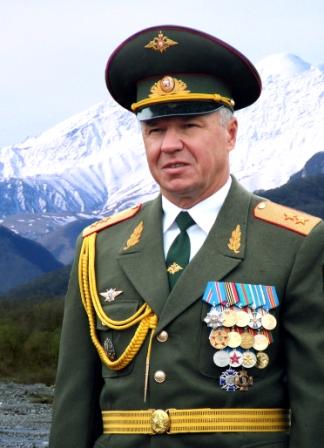
General-Lieutenant Sobolev

A more recent photo shows him looking just about as fit in retirement at age 61.

One wonders if a conservative like Sobolev realizes how much his thinking coincides with that of more liberal critics he seems to detest.
Death of Mikoyan

On October 21, the labor union of the Engineering Center of the Experimental-Design Bureau (OKB) named for A. I. Mikoyan went public with its claim that  well-known aircraft maker RSK MiG is in a catastrophic state.  Metronews.ru published part of the union’s open appeal as well as MiG’s official reaction.  The union’s letter is addressed to the president, prime minister, and heads of political parties, and dated October 11.

Union chairman Yuriy Malakhov says:

“The situation taking shape in our engineering center forced me to write this letter.  We’ve always been the brain of the company, it’s right here that new aircraft models were developed.  For a long time, we’ve had no new orders.  In the past five years, six general directors have been replaced, they all come from the Sukhoy company, and the impression’s created that they are strangling us, they want to close our company.  All the best orders go there [Sukhoy].  For example, we aren’t even allowed to participate in developing unmanned aerial vehicles.  Sukhoy is working on them, but this aircraft company doesn’t have our experience.  They focused on heavy fighters.  The pay of our colleagues is lower than in the trolleybus yard next door.  Lead engineers get 8-10 thousand rubles [per month].  Sometimes with occasional bonuses they get 30 thousand.  Talented young specialists leave for other firms, for example, Boeing, where they get two-three times more.  Now 10 percent of orders come from Russia, the rest from abroad.  In the course of several years we tried to get a response from our leadership, but no one wanted to start negotiations with us.  And the engineering center’s director decided to meet with employees only after this letter.  We are very much hoping for this meeting.  We expect new orders and increased wages.”

 MiG’s press-secretary offered this response:

“The absence of the Gosoboronzakaz in the 1990s was a serious blow to the country’s defense industry, including to RSK MiG.  Only those companies that had large export contracts could develop successfully, for example in that period the Sukhoy company managed to conclude contracts with India and China.  At that moment, MiG had only a contract with Malaysia.  In recent years, RSK MiG’s been headed by directors from Sukhoy corporation – Nikitin, Fedorov, Pogosyan, Korotkov.  From outside this could look like a raider’s seizure of MiG.  But who needs to seize debts and problems?  A positive dynamic began precisely with the arrival of these people – large foreign contracts were signed, the contract with the Defense Ministry to supply MiG-SMT.  Aircraft were supplied against this contract and they’re being successfully employed in the RF VVS.  Presently, a contract with the Defense Ministry to supply the MiG-29K is being discussed.”

“Today RSK MiG’s order portfolio is more than $4 billion, serial production of new aircraft is unfolding. There is a positive dynamic, maybe it’s not as quick and wages not as high as all of us would like.  Some young specialists come and stay, some leave.  But on the whole the company has good prospects.”

A couple points on these claims.  We know raiders take and sell what’s good, and leave “debts and problems” behind.  The Defense Ministry’s acceptance of the Algerian MiG-SMTs was more a financial bailout for the company and face-saving maneuver for Russia writ large than a real contract.  Not mentioned is Aleksandr Sukhorukov’s October 11 statement that MiG-29K procurement won’t come until 2013-2015.

The text of the union’s letter says MiG is simply dying.  It cites many problems and complaints, including a 48-billion-ruble debt, losses and delays in contracts, moving engineers to Zhukovskiy, closing MAPO, etc.  It says crucial pay bonuses can’t always be paid, and MiG is just supplying skilled people to Sukhoy and Irkut.  The letter calls OAK an incomprehensible middle layer blocking competition, but allowing personal lobbying.  Finally, it blames Mikhail Pogosyan for closing MiG’s promising future projects.

Scanning other recent MiG headlines – the Indian tender wasn’t the only blow to the MiG-35, its chances with the Russian Air Forces didn’t look too rosy anyway, and the early September MiG-31 crash indicated again what dire straits that old airframe is in.

Izvestiya’s Ilya Kramnik published recently on the MiG-29’s fate.  He wrote that (unlike the Su-27 or Su-24) the Defense Ministry doesn’t plan to modernize the MiG-29.  His military source says replacement of these worn-out aircraft in the future is deemed more cost-effective.

Kramnik’s source describes production of the generation “4+++” (?!) MiG-35 as an unavoidable but not yet decided step.  He sees the MiG-29 variant line ending since it’s outclassed by updated Su-27s.

Kramnik’s OPK source sees 20 or 24 MiG-35s being produced each year, for about 25 billion, to replace 150 or 160 MiG-29s in Russia’s inventory.

He cites Konstantin Makiyenko who sees the MiG-35 as important not just as a MiG-29 replacement, but also to keep Russia in the light- to medium-, $60-million-range fighter export market and not leave this industry segment to China and its J-10.

But Konstantin Bogdanov tells Kramnik he thinks the MiG-35’s loss in the Indian tender hurt its chances at home because it raises questions about MiG’s ability to support a production program for the Russian Air Forces.

One also wonders how much MiG-35 and MiG-29 will be needed with T-50 / PAK FA, with Su-35, and with Su-27 upgrades out there.

It’s hard to see the MiG story as anything but another chapter in the painful and necessary process of post-Cold War industrial downsizing and restructuring.  After all, the U.S. is down basically to Boeing and Lockheed Martin.  In MiG’s case, one can question whether the selection is really natural and the fittest are truly surviving.  The answer is probably yes.  However they managed it, Sukhoy and Irkut played their post-Soviet hand better, and it shows today.  The Russian aviation sector will be better off with further consolidation.  Still it doesn’t need Sukhoy to be a monopolist.  Managing that outcome will be tricky.

Makarov’s Press-Conference (Part I)

General Staff Chief Nikolay Makarov apparently held a lengthy press-conference today covering many topics.  He’s still advocating buying weapons abroad (when necessary), despite Prime Minister Putin’s strong support of the domestic OPK against the military’s demands.

ITAR-TASS quotes Makarov on the pending Navy headquarters move to Piter:

“Concerning a decision by the Supreme CINC [President Medvedev] to revoke the transfer of the Navy Main Staff to St. Petersburg, there has been no such decision.  We are now working on this issue.”

The General Staff Chief seemed to say there won’t be any diminution of the role or place occupied by service Glavkomaty, according to the news service.  He said the Main Commands of the services of the Armed Forces are part of the military branch of command and control which he heads.

ITAR-TASS quotes Makarov on buying arms and equipment abroad:

“We will need to buy something that isn’t produced with the quality we require.”

He compared domestic Msta-S and longer-range French Caesar howitzers:

“In France, we were shown the work of an artillery battalion which was ready to fire 30 seconds after a march.  Our analogous norm is 15 minutes.  The difference between one minute and 15 minutes is huge.”

“Therefore, we have to acquire something in order not to lag behind, but on the condition of arranging joint production in Russia.”

Interfaks quoted him on buying armor abroad:

“Some technologies certainly have to be bought in the West.”

The Defense Ministry, he says, has no desire to buy arms and equipment abroad if Russia has analogs or more modern models.  But Russia will find it hard to compete with Western firms that are cooperating with each other.  Makarov cited Renault’s APC which uses a Volvo engine.  “Our producers need to make a revolutionary leap,” Makarov concluded.

The General Staff Chief was ambivalent about the T-90 tank, according to ITAR-TASS:

“I visited the Nizhniy Tagil exhibition and got familiar with our T-90 tank.  The tank they showed us, particularly its turret, calls for serious respect.  But we have questions remaining about many drawbacks.”

“. . . the experimental-design work the factory is conducting will allow them to realize those requirements the Russian military is placing on this new product.”

ITAR-TASS also picked up Makarov’s remarks on the Tsentr-2011 exercises:

“We want to work out common approaches to employing armed forces within the ODKB [CSTO] framework.”

“Besides militaries, all other power structures, which are understood as part of the state’s military organization, in the ODKB countries will participate in these exercises.  As far as Russia goes, we want to check the country’s military organization fully by conducting a series of mobilization measures, including also industry.”

“Starting today, we’ve started into mobilization deployment of a number of formations and units according to independent plans.”

Their Man in Pyongyang

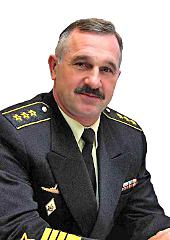
Admiral Sidenko

Eastern MD Commander, Admiral Konstantin Sidenko suddenly became the Kremlin’s man in Pyongyang yesterday.  His visit to North Korea was kept tightly wrapped until his departure.

Sidenko will visit the DPRK from August 22-26, while North Korean leader Kim Jong Il is in Russia’s Far East to meet President Medvedev.

Moscow’s once close military relationship with the DPRK declined to practically zero over the past 20 years, hence the surprise of yesterday’s news.  Meanwhile, Russia cultivated military-to-military ties with the rest of northeast Asia — China, Japan, and the Republic of Korea — leaving its old ally in the cold.  Until yesterday.

The Defense Ministry’s press release says Admiral Sidenko will meet command representatives from the Korean People’s Army, and consult on questions of renewing and further developing military and naval cooperation, possibly conducting Russian-Korean humanitarian exercises, and mutual ship visits between the RF and DPRK navies.

Additionally, according to the press release, the sides will discuss the future of cooperation between their Ground Troops, the possibility of conducting joint exercises and training for naval SAR, and also the issue of providing assistance to civilians during natural disasters.

The Russian media has written little thus far on what it means to have a military delegation visit the North Korean capital.  However, AP asked Aleksandr Golts for comments, and this is how the wire service summarized them:

“Military expert Alexander Golts said North Korea’s goal in inviting the Russian military could be to assuage fears of instability as Russia is considering building a natural gas pipeline through North Korea.  The pipeline is expected to be one of the main topics of Kim and Medvedev’s talks.”

“Golts said it was highly unlikely Russia would renew arms sales to North Korea, which would not be in its interests as a participant in the six-party talks.  He also noted the low level of the Russian delegation, which is led by the commander of Russia’s eastern military district.”

One might suppose it’s equally possible the North Koreans wanted the Russian military to visit Pyongyang as part of its quid pro quo for considering a gas pipeline over its territory to South Korea.

Arms sales seem unlikely, but probably because Moscow’s no longer in the game of providing free military aid. 

Admiral Sidenko is a lower level visitor, but it’s traditional for Moscow to send proximate regional commanders on such visits.  MD commanders can be precursors to General Staff Chiefs and Defense Ministers, and higher-profile military relations generally.

It’s almost impossible to know when the DPRK is involved, but this first interaction in nearly ten years automatically means something’s afoot.  The participants themselves probably don’t know where a bit of diplomatic, economic, and military activity will lead.

Done Deal

Mistral Contract Signing

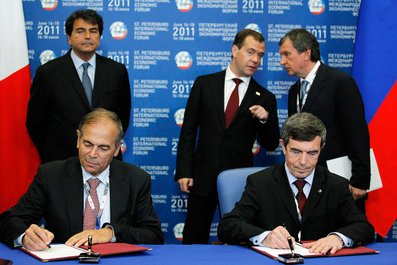
The deal for the first two Mistrals, that is.  With President Medvedev looking on, Rosoboroneksport’s Anatoliy Isaykin and DCNS’ Patrick Bouasie signed the contract at the Petersburg International Economic Forum.  RIA Novosti quoted Isaykin on the €1.2 billion price.  Work can begin after the Russians pay an advance (Versii.com repeated a rumor that the French wanted 80 percent prepayment). 

RIA Novosti also noted Isaykin saying the Russian Mistrals will be identical to French units except they’ll have reinforced hulls and flight decks to handle Russia’s northern waters, and its heavier helicopters.  Isaykin said Russia has an option for two more Mistrals to be built in Russia.  But it’s up to the Defense Ministry to get money for them in the Gosoboronzakaz.

ITAR-TASS made the point that the Senit 9 tactical command and control system, and its documentation, are part of the just-inked deal.  OSK General Director Roman Trotsenko told Rossiya-24, “The French side has gone to an unprecedented level of technology transfer and is transferring technologies, including the programming source codes for battle information-management systems, communications systems.”

Kommersant reported the first Russian unit is expected in 36 months, the second in 48, or 2014 and 2015 respectively.   It cited Trotsenko on Russia contributing up to 40 percent of the work on the two ships to be built at STX in Saint-Nazaire.

While the Mistrals will come with French electronics, the Russians will have the task of outfitting the ships with their own weapons, helicopters, amphibious assault craft, and other systems.

Radio Svoboda asked for some thoughts about the occasion.  NVO’s Viktor Litovkin opined that these expeditionary warfare ships don’t make much sense under Russia’s current military doctrine or in the context of defending the Kurils.  Pavel Felgengauer said the Mistrals may be appropriate for fighting enemies with weak air and naval forces, but Russia’s leadership hasn’t specified who they might be.  Viktor Alksnis complained that they are another stake in the heart of Russia’s dying OPK.  He calls for Russia to modernize its own arms production base instead of buying abroad.  He also fears the French could put an “off switch” in the ships’ C2 systems, effectively turning them into “target barges.”

Aleksandr Golts supports the deal because Russian shipbuilders will participate and get new technologies, but he also because he favors the emphasis on force projection rather than the Navy’s pro-SSBN mission.

Navy CINC, Admiral Vladimir Vysotskiy made some appropriately effusive comments about the capabilities and prospects for employing the Mistrals.

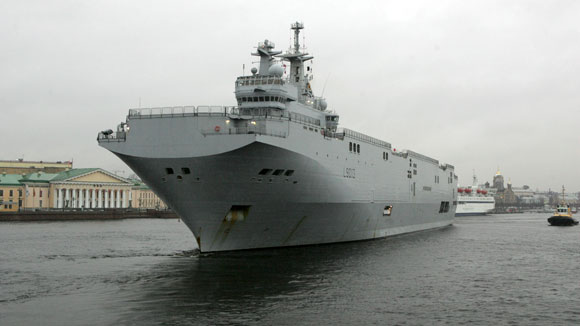
Mistral in Piter (photo: Izvestiya)

Defense Minister Serdyukov was less willing to elaborate saying:

“Let’s build them first, and then we’ll think about where to deploy them.  We have plans to employ them, when they’re closer to ready we’ll disclose them.”

In Moskovskiy komsomolets, Olga Bozhyeva writes that the Mistral deal does several things for Moscow.  An arms sale like this implies a level of acceptance by Europe, it divides old and new Europeans, and it serves as a wedge between the U.S. and its European allies.  She notes that Russian military leaders have kept pretty quiet about Mistral.  And Bozhyeva concludes, overall, it’s a bad deal for Russia.  It’s a high price tag for something that’s not a priority for the fleet.  Its missions are not well thought out.  A relatively old system like Senit 9 won’t help Russia catch up very much.  And Russia didn’t seriously consider Dutch, Spanish, or South Korean shipyards to drive the French price down, but:

“. . . we would have to exclude a certain corruption component, which, in the opinion of many experts, is included in the Russo-French contract (but it’s better to leave this subject to the procuracy).”

As is often the case, Nezavisimaya gazeta sums it all up best:

“The Glavkom [CINC] ought to specify the countries on which our Navy intend to ‘project the power’ of the LHD.  Judging by the fact that it’s intended to deploy the first two ships in the Pacific Fleet, for the defense of the Kuril Islands (can it really be that someone intends to attack them?), then Japan—ally of the U.S., China—our strategic partner or North and South Korea could be the object of this projection.  Again with Seoul it’s somehow uncomfortable.  It’s also an ally of Washington.  And don’t mention projecting power on Pyongyang, apparently, even the Americans aren’t risking doing this.”

“And not everything’s clear with our deck-based aviation for ‘Mistral.’  Our attack helicopters, Mi-24, Mi-28N, Ka-52, and naval Ka-27, Ka-28, Ka-31 are bigger (higher) in their dimensions than French ones, so it’s necessary to redesign the LHD’s hangar deck for them.  This means extra expenditures of financial resources, as well as a change of extremely weak armament for this ship.  Including even air defense.  There are also other problems.  Like the construction of a shore base for the deployment of ‘Mistrals’ on the country’s eastern shore, on the Pacific Ocean.  It still isn’t there.  But to keep such a huge hull tied up at anchor in Petr Velikiy Gulf or in other Far Eastern bays, like it was with domestic Proyekt 1123 class helicopter carriers ‘Moskva’ and ‘Leningrad,’ means to expend their service life in vain and kill it without reason.”

“In a word, the French LHDs, which should enter our Navy’s inventory in 2014 and 2015, could be not a reinforcement of our groupings of ships, which, by the way, also still need to be built up, but a headache for Russian admirals.”

Smiling, But Not About Mistral

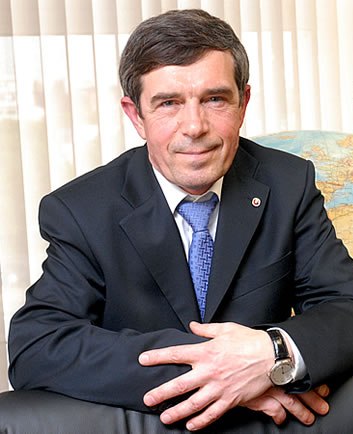
Anatoliy Isaykin

FGUP Rosoboroneksport General Director Anatoliy Isaykin is smiling, but not about Mistral.

In fact, Isaykin’s poured cold water on thoughts of quickly resolving the Russo-French impasse over these helicopter carriers.

As if to answer anyone looking for a date when negotiations will be completed,  Voyenno-promyshlennyy kuryer quotes Isaykin:

“Dates are guesses.  Such contracts, when we’re talking hundreds of millions of euros, — this is years and years of negotiations.  It’s simply funny to expect we’ll conclude such a contract over several months.”

Of the complex and lengthy contracting process, VPK says don’t expect a detailed contract to be signed earlier than next year.  The political agreement on the acquisition was one thing, but now there’s routine pre-contract work which takes months, if not years, agreeing step-by-step on hundreds of points and compromises.

Recall early this year Isaykin was very reserved about the political agreement on Mistral, reminding the press it contained nothing about costs or timeframes.

More Mistral Negotiations

Mistral in Piter (photo: RIA Novosti / Aleksey Danichev)

Might as well start the week with Mistral news.  An informed RIA Novosti source in the OPK suggests this week could be decisive for negotiations on the sale of Mistral to Russia.  But can anything really be decisive in a drawn-out process like this?

The news agency’s interlocutor, much like Anatoliy Antonov, says:

“The situation is not very simple, the negotiating process is going with difficulty.”

“The stumbling block remains the ship’s outfitting, disagreement concerns two NATO standard command and control systems — combat information-command system Senit 9 and battle group (fleet) command and control system SIC-21.”

“The French agreed to transfer Senit 9 to Russia without a production license, they don’t want to transfer SIC-21 with the ship at all.”

RIA Novosti reminds that Russia has insisted on Mistral’s transfer with all  its systems and equipment.

Ruslan Pukhov bravely tells RIA Novosti, when it comes to amphibious command ships, it’s a buyer’s market, so Russia will find another country to sell it if France declines.  That’s at least half true, but it’s also true that France is something of a special case.  The Dutch, Spanish, or South Koreans might not be willing to give everything Moscow wants either.

Does That Box Come With Electronics?

The latest Mistral story is more complex than what you’ve probably read so far.

Russian press services report a highly-placed military source claims Paris has “registered” Moscow’s demand for systems and equipment on Mistral that fully satisfy the Russian Navy’s requirements.

Media sources also say the negotiations foresee a state contract for the provision of two Mistrals, spare parts, instrumentation, and essential operator documentation, as well as equipment, services, and construction documentation needed to build two more Mistrals in Russia.

A source also told the wire services preparation for the acquisition of Mistral “is going logically and systematically” within the bounds of the negotiating process with the French side.

Newsru.com, by contrast, claims this is the Defense Ministry’s way of countering reports that Moscow has decided not to buy Mistral since France is trying sell Russia “empty boxes” for a billion euros. 

Newsru is referring to Vedomosti’s story from earlier this week saying the entire Mistral deal is under threat because the ships’ outfitting is unacceptable to Russia since it doesn’t include modern command, control, and communications systems, and is only a “basic variant” of the ship, a “box without electronics” essentially.

Newsru recaps Tuesday’s Vedomosti:

“. . . the preliminary agreement actually didn’t include the construction of two more ships in Russia, or crew training and the transfer of shipbuilding technologies.  As “Vedomosti” stated with reference to sources in the Presidential Administration and the RF Defense Ministry, the negotiations with the French have reached a dead end, and now resolution of the problem is being sought at the political level.”

On the issue of providing C3 systems (specifically, Senit 9 and SIC-21) on-board Mistral, Vedomosti implies it’s more about money than technology transfer.  Russia can either pay an extra 200 million euros for a full electronics fit, or try to argue at the political level for the ships at the price of 890 million euros which was supposedly on the protocol signed late last year by now-retired Vice-Admiral Nikolay Borisov and Deputy PM Igor Sechin.  Other sources have said Borisov and Sechin exceeded their mandate in agreeing to a price well over 1 billion euros.  We don’t really know what was on that protocol.

The point – overlooked by many including yours truly – is that there’s no real contract for Mistral yet, and it’s a long way off.  All there are so far are protocols, agreements, and understandings.  What was signed in January at Saint-Nazaire was an “intergovernmental agreement” for the possible construction of two Mistrals, not a specific contract covering that and the construction of two more in Russia.

Wednesday Interfaks.ru ran its review of the Mistral story concluding that the negotiating process is difficult, but the French have decided to meet Russia’s requirements.

Interfaks also published something else that might be useful when thinking about Mistral:

“Meanwhile in mid-March, Deputy Defense Minister Anatoliy Antonov, who’s overseeing international cooperation issues, told journalists in Paris that Russia doesn’t intend to force the signing of the contract for the purchase of the French ‘Mistral’ helicopter carriers until it’s determined that all technical parameters won’t impinge on the Defense Ministry’s interests.  ‘It’s early to talk about dates, too many technical details have to be decided.  The contract has to be adapted to our conditions.  Complex expert professional work in the verification of all parameters of a future agreement is going on,’ said the Deputy Minister.  And he noted talk about how all technical nuances are reflected and have been laid down in the contract.  ‘The negotiating process is complex, I would say difficult,’ said Antonov.  He added that, essentially, the negotiations have just begun.  ‘We have to discuss the entire complex of issues.  The task of acquiring ships and their technologies has been given to us.  That’s the most important thing,’ said the Deputy Minister.  In his opinion, an important part of the negotiating process is ‘the contract’s price.’  ‘It’s important to understand that on the issue of buying Mistral type ships agreements were reached at the level of the presidents of the two countries, and negotiators have all necessary authorities and instructions.  We have to work calmly and implement all agreements,’ said Antonov.  He noted that now it’s essential that all agreements ‘be put on paper and to reflect the political agreements of the two presidents in figures so that they meet the interests of the two countries.’”

A professional diplomat and negotiator is never going to say a process is easy, and this one isn’t.  But it does sound like there’s a draft contract, while price and exactly what the presidents agreed remains at issue.

GPV, Exports, and OPK Capacity

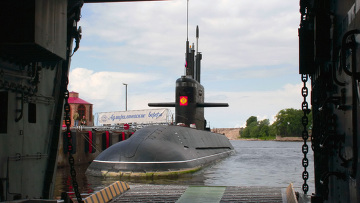
New Sub at Admiralty (photo: RIA Novosti)

This morning RIA Novosti reported on a familiar topic — the conflict between planned acquisition embodied in the State Program of Armaments, 2011-2020, and the Russian OPK’s capacity and capability to deliver it.  In this case, new diesel-electric submarines from St. Petersburg’s Admiralty Wharves.  Also familiar is one reason for the bind — a lingering priority on production for sale abroad.

A highly-placed OPK source tells the news agency that the GPV’s plan for conventional submarine deliveries might not be fulfilled due to Admiralty’s heavy load of orders.  The Russian Navy is reportedly supposed to get 20 new diesel-electric boats by 2020, and Russia also has ten foreign deliveries scheduled.  The OPK source notes that Admiralty has become a sole source for conventional subs, and he calls for shifting some sub production to Nizhniy Novgorod and Komsomolsk:

“In view of the large volume of new submarine construction for the Navy, and also for export, it’s essential to diversify production, utilizing, for example, the capacity of ‘Krasnoye Sormovo’ Shipbuilding Plant in Nizhniy Novgorod and the Amur Shipbuilding Plant in Komsomolsk-na-Amure.  Otherwise the state program in the diesel submarine construction area could be disrupted.”

RIA Novosti notes “Krasnoye Sormovo” built plenty of Soviet submarines, 280 in all, including 25 nuclear-powered ones.  Its last boat was a diesel-electric for China in 2005.  The plant also outfits Russian Navy and export subs with torpedo- and mast-related equipment.

The article also speculates that construction of French-designed Mistral helicopter carriers could be problematic if Admiralty is selected.  The shipyard is reportedly planning on new construction space on Kronshtadt for this reason.  The OPK source says Mistral would be Admiralty’s main concern, and occupy its main capacity and personnel.  So, he continues, it’s logical to send some orders (i.e. submarines) to other factories that have the capabilities.

Igor Korotchenko tells RIA Novosti “Krasnoye Sormovo” could provide extra buildingways if Admiralty can’t meet all its export contracts.  He says Admiralty is now building five subs under the GOZ, six for Vietnam, and:

“In the event new contracts are signed for sub construction with Venezuela and Indonesia there will be an obvious problem with inadequate buildingway space, and then a backup could be required.”

RIA Novosti notes rather dryly along the way that no Russian GPV has been fulfilled completely because of the country’s insufficient modern industrial capacity.

One wonders what, if any, work and investment would be required to bring “Krasnoye Sormovo” and Amur back into the sub-building business.

New Deputy Defense Minister

Antonov with Medvedev and Serdyukov (photo: Kremlin.ru)

Today President Medvedev made Anatoliy Ivanovich Antonov Deputy Defense Minister for International Military Cooperation.  He’ll bear responsibility for organizing and conducting the Ministry’s contacts with foreign military departments.  Kremlin.ru notes Antonov was one of the negotiators for the new Treaty on Strategic Offensive Arms.  Medvedev said Antonov’s experience in this successful negotiating process will enable him to fulfill his new duties effectively.

Anatoliy Antonov

PIR-Tsentr’s short biography of Ambassador Antonov says he’s been serving as Director of the Foreign Ministry’s Security and Disarmament Issues Department.  He was born in 1955.  In 1978, he graduated the USSR Foreign Ministry’s Moscow State Institute of International Relations (MGIMO or МГИМО).  In 1983, he completed graduate study at the same institution.  Antonov’s worked in the Foreign Ministry since 1978.  He’s headed government delegations in G8, NPT, Inhumane Weapons Convention, and multilateral export control negotiations.  He’s a member of the U.N. Secretary General’s Consultative Council on Disarmament.

In mid-2007, Antonov helped then-President Putin unveil his offer to use Russia’s Gabala and Armavir radars in NATO missile defense, according to Novosti KM.RU.

Antonov makes nine deputies to Serdyukov; a tenth deputy slot for finance-economic work has been vacant since Vera Chistova’s departure in the fall.

Antonov’s quite different from his predecessors in this job.

International military cooperation seemed to fall off the Defense Ministry’s radar for a while after Anatoliy Serdyukov took over.  You may recall, former Main Directorate for International Military Cooperation (GU MVS) Chief, General-Colonel Anatoliy Mazurkevich fled the Defense Ministry when Serdyukov arrived.  GU MVS essentially disappeared from the military department’s organizational chart.

GU MVS’ roots stretch back to the General Staff’s old 10th Main Directorate, which had a long history of involvement in arranging arms sales and providing military advisors and training to Soviet client states in the bad old days.