Category Archives: Command and Control

Flip-Flopping on Navy Move to Piter

Late Friday, First Deputy Chief of the Navy Main Staff, Vice-Admiral Burtsev claimed the entire Russian media misinterpreted his remarks about the cancellation of the Navy headquarters move to St. Petersburg. 

That’s quite a feat . . . making everyone misunderstand what you’ve said . . . and this from a guy who’s pretty much an official Navy spokesman.  It sounds more like the flip-flopping on this issue continues . . . ‘bulldogs still fighting under the rug,’ so to speak.  And someone made Burtsev retract his comments by way of claiming no one managed to understand what he was saying.

According to ITAR-TASS, Burtsev now says:

“I believe it’s necessary to make several substantial adjustments in information linked to me disseminated yesterday about the terms of the transfer of the Navy Main Staff to St. Petersburg.  There has not been any suspension of the decision on such a transfer.”

“The mass media incorrectly interpreted my words about work toward the full transfer of the Navy Main Staff not being completed in 2010.”

He says the transfer:

“. . . is happening on schedule, a number of structural sub-units and units of the Main Command are already fully working in St. Petersburg.”

“First of all, these are the auxiliary command and control post, supporting peacetime command and control of forces, and also sub-units of military acceptance [voyenpredy], shipbuilding and radioelectronic warfare, and a number of organs of the naval scientific committee.”

“The full-scale transfer of the Main Command to St. Petersburg requires establishment of a qualitatively new infrastructural foundation, which is being laid down at the present time.  This concerns primarily sub-units responsible for command and control of naval strategic nuclear forces, groupings at sea, but also some other operational sub-units which, incidentally, are located not just in Moscow, but in other territorial components of the RF.”

“I want to note again:  the transfer of the Navy Main Command to St. Petersburg is occurring on schedule, in accordance with decisions taken earlier, in the bounds of the plan for reform of Russia’s Armed Forces.”
Western MD Opens for Business

According to ITAR-TASS, General-Colonel Valeriy Gerasimov told journalists yesterday that the new Western Military District (MD) was fully formed and functional on 1 September.  Gerasimov said:

“The Western Military District started functioning on 1 September.  Command and control organs of the former Leningrad and Moscow Military Districts, Northern and Baltic Fleets, and also the 1st Air Forces and Air Defense Command went into the composition of the staff located in St. Petersburg.”

Gerasimov said the majority of Moscow MD staff officers:

“. . . were appointed to positions in the staff of the Western Military District and other organs of military command and control.  Part of the officers, having served out their prescribed terms, were dismissed, but those who have a half-year to a year remaining to serve are at the disposition [of their commanding officers].”

Gerasimov himself went from Commander, Moscow MD to become a deputy chief of the General Staff.

The Defense Ministry now wants the other three new MDs / OSKs to be functional by 1 October.

No Navy Headquarters Move to Piter

First Deputy Chief of the Navy Main Staff, Vice-Admiral Oleg Burtsev told journalists today the Navy headquarters will not move from Moscow to St. Petersburg.  He says the decision not to move was taken a year ago.  He declined to say whether the Main Staff will remain in its current location in Moscow.  But he added:

“Two variants for the location of the staff are being reviewed, but the decision about which of them to choose has not been made.”

The Main Staff won’t remain on Bolshoy Kozlovskiy Lane, near the Krasnyye Borota Metro, and media sources are saying it will either move into the Genshtab’s building on Znamenka, or into the Frunze Military Academy (Combined Arms Academy) building.

The idea for the move came from Putin ally and Duma Speaker Boris Gryzlov in 2007, and received support, not surprisingly, from St. Petersburg politicos.  Affected naval officers actively opposed the move, and their seniors were ambivalent at best.  It looks like Serdyukov’s Defense Ministry slow-rolled until the decision was reversed.  Not that it opposed the idea of freeing up expensive property for sale, but the cost and disruption of moving the Navy headquarters was prohibitive.

The Navy Main Staff and the Petersburg Move

Yesterday’s Gazeta.ru recapped a brief Interfaks item saying the much-discussed Navy Main Staff move from Moscow to St. Petersburg will be delayed for an undetermined period of time.  A Main Staff source told Interfaks:

“The transfer of the Navy Main Staff to Petersburg is put off to an undetermined time.  Now the main efforts are concentrated on a radical optimization of its structure, which must be finished before year’s end.”

“At present the process of forming a compact command and control structure, which, being located in Petersburg, will be as close to the fleet as possible, is ongoing.”

The source says the group of staff officers who moved to Petersburg at the beginning of 2010 will stay in Admiralty and act as a Glavkomat representative.  Navy CINC Admiral Vysotskiy has an office there, and he routinely visits St. Petersburg.

So maybe the ‘radical optimization’ [i.e. cut] in the Navy Main Staff is not going as smoothly as hoped back in the winter.  Recall there were unofficial hopes and reports that the staff would be cut by mid-summer allowing the move to start at that time.

Winners and Losers in Organizing New MDs and Armies

Today a Ground Troops spokesman told ITAR-TASS three current Leningrad Military District (MD) brigades will form a 6th Combined Arms Army (CAA) in the new Western MD.  The 200th, 138th, and 25th Motorized Rifle Brigades will comprise the new army, and its headquarters will probably be Agalatovo, just north of St. Petersburg.  The spokesman also said a surface-to-air missile brigade and independent engineering brigade will be added to the Western MD.

These comments came in conjunction with a visit by Ground Troops CINC, General-Colonel Aleksandr Postnikov to the region to check on the formation of the new MD.  The spokesman said Postnikov may be working on peacetime coordination between the district’s Ground Troops, the Northern and Baltic Fleets, and Air Forces units.  He said, in wartime, “everything’s clear – [the district’s] commander directly commands everything deployed within the district’s boundaries.  But there’s still no experience of coordination in peacetime and we need to get it.”

Nezavisimaya gazeta’s Vladimir Mukhin also wrote today that the third new CAA will be based in Maykop, Southern MD.  Mukhin says that staffs, commands, formations, and military units in the Far East, Siberian, and Moscow MDs are being liquidated in the shift to four new MDs / OSKs, and, as a result, several thousand officers will be placed outside the TO&E beginning 1 September.  He thinks many of them won’t find vacant posts, and will be discharged from the army.

Serdyukov’s Defense Ministry will also be putting some soon-to-be-vacant properties up for sale, e.g. Moscow MD headquarters (Polina Osipenko Street, Moscow), Far East MD headquarters (Seryshev Street, Khabarovsk).  The initial asking prices for these buildings and land will be several billion U.S. dollars.  As long planned, proceeds from these sales, along with the sale of the Navy Main Staff, military educational institutions, and other military establishments in Moscow, are supposed to fund construction of housing for servicemen as well as military garrison infrastructure in new army deployment locations.

Mukhin talked to General-Lieutenant Yuriy Netkachev about Maykop.  Netkachev says Moscow is resurrecting the army headquarters located there until 1993.  He believes Maykop was chosen to reinforce against threats from Georgia as well as threats to the 2014 Winter Olympics in Sochi.

In the Central MD, Mukhin says the 67th Spetsnaz Brigade will move yet again, from IVVAIU in Irkutsk to Chita or Transbaykal Kray.  The IVVAIU building will be sold.

Mukhin sees Moscow’s demilitarization and moving forces closer to their likely operational theaters as the right policy, but asks if it’s underpinned with resources.  It has serious impact on servicemen and their families, and they’ve been forgotten in this process.

Mukhin quotes servicemen’s union chief Oleg Shvedkov:

“Continuing steps to transition the troops into a new profile supposes not only a significant cut in professional servicemen, but also their relocation to a new place of service.  And this means new everyday life problems are possible:  transfers, absence of housing, work for spouses, education for children, and the like.  The Defense Ministry is trying to resolve these issues on its own, but it would be more correct for the government to work on them through a special federal program.”

Vice-Admiral Chirkov and the Pacific Fleet

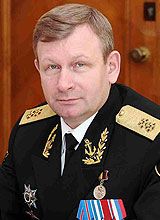
Vice-Admiral Chirkov

Baltic Fleet Commander, Vice-Admiral Viktor Chirkov is apparently being tapped to replace Vice-Admiral Konstantin Sidenko in the Pacific Fleet, according to Russian press agencies and a Kommersant source in the Navy Main Staff.  

Sidenko will command the new Eastern Military District and Combined Strategic Command (OSK) East.  Chirkov will be replaced in the Baltic Fleet by his chief of staff, Rear-Admiral Sergey Farkov.  Kommersant’s source calls these changes a ‘normal rotation.’ 

Gzt.ru’s source says the Pacific Fleet is expecting the Chirkov announcement ‘any minute,’ but drawing up the papers, including the President’s decree on the appointment, is ongoing. 

Viktor Viktorovich Chirkov is a surface warfare officer with Pacific Fleet roots.  He was born on 8 September 1959 in Alma-Ata, capital of the former Kazakh SSR.  In 1982, he graduated from the Vladivostok Higher Naval School and became head of the mine-torpedo department on old Riga-class corvette Lun in the Pacific Fleet.  He served as assistant commander of a corvette, then executive officer of Kotlin-class destroyer Vozbuzhdennyy.  

In 1986-1987, Chirkov completed Higher Special Officers’ Classes in Leningrad, and became commander of the infamous Krivak-class frigate Storozhevoy.  Under a mutinous crew, this Soviet Baltic Fleet unit tried, unsuccessfully, to defect in 1975.  Later it transferred to the Pacific Fleet. 

From 1990 to 1993, Chirkov commanded Udaloy-class destroyer Admiral Spirodonov.  He was deputy chief of staff for an ASW ship division, deputy division commander, and commander of an ASW ship division during 1993-1998.  In 1997, he completed the Kuznetsov Naval Academy as a correspondence student.  

After graduating from the Military Academy of the General Staff in 2000, Chirkov served for five years as chief of staff, first deputy commander of Troops and Forces in the North-East on Kamchatka.  In the first years of this assignment, he served under Vice-Admiral Sidenko.  

In 2005-2007, he commanded the Primorskiy Mixed Forces Flotilla.  For the next two years, he was chief of staff, first deputy commander of the Baltic Fleet, and became its commander in September 2009. 

Chirkov is married with two sons. 

A Pacific Fleet staff source told Gzt.ru Chirkov is happily anticipated since he’s an old friend and ‘not an outsider.’  Another calls him a wise and honorable officer who knows his business. 

Vitaliy Shlykov talked to Gzt.ru about the Pacific Fleet’s growing importance: 

“In the Baltic there’s nothing to do, everyone’s friends, allies.  But the Pacific Ocean is the future, it’s necessary to turn all attention there.  And we don’t have enemies there, so there’s time to strengthen this fleet before there’s a confrontation between the U.S. and China.” 

“Of course, given this state of affairs, the significance of the fleet is growing sharply in comparison with Russia’s other fleets.” 

NVO’s Viktor Litovkin notes that Chirkin will be first to command the Pacific Fleet in its new condition of subordination to OSK East.  He thinks the new commander has multiple problems to solve, including obtaining new ships, dismantling old nuclear submarines, and building housing for servicemen.  Chirkin will also have to grapple with getting contract sailors, rather than conscripts, to man his afloat forces for long deployments.

Is the Helicopter Carrier Tender for Real?

Speaking in Yerevan today, Defense Minister Serdyukov told journalists:

“We have announced an international tender for construction of a helicopter-carrying ship.”

He indicated Russia is talking about two ships.  He also welcomed the French builders of the Mistral to join in the tender.

The tender will take place next month, and the winning bid will be selected before year’s end.

After months of negotiations with France on building Mistral-class amphibious assault ships, the Russians couldn’t reach agreement on the terms of a deal.

The two sides may have agreed on building two ships in France’s STX shipyard.  French President Sarkozy told its workers last month they’d be building two ships with the Russians.

Maybe the Russians wanted to buy one and build three, but Serdyukov says the international tender is for two ships, so it seems likely Paris and Moscow had agreed on a ‘2+2’ formula.  So something else is probably the sticking point.

RIA Novosti suggests talks with Paris stalled over its unwillingness to sell Moscow the NATO standard tactical communications system aboard Mistral, according to an unnamed expert who spoke to Ouest-France.

The expert said the comms system is tied to the SENIT 9 tactical combat information system.  It’s described as an important node NATO isn’t prepared to share with Russia.  The French expert says the Russians “don’t have a very good command of military computers and are trying to fill the gap.” 

Officially, the Elysee says negotiations with Russia continue, it’s confident of a successful outcome, and it isn’t worried about the Russian tender.  It hasn’t commented on participating in it either.  Meanwhile, the French media claims Moscow has stopped its exclusive talks with Paris.

Two New Armies for the Central Military District

This week General-Lieutenant Vladimir Chirkin spoke to Krasnaya zvezda about several things.  Recall that Chirkin is acting commander of the troops of the ‘Combined Strategic Command of the Red Banner Central Military District.’  He has been commander of the SibVO until now of course.

His interview brought two things immediately into focus.  First, it appears that OSKs will actually be unified or combined strategic commands rather than ‘operational-strategic commands.’  Either way the acronym is OSK.  But combined strategic command connotes a couple significant things.  They may really unify all armed services and branches on their territory for warfighting.  Second, they are beyond the ‘operational-strategic’ level of warfare; they are intended to be strategic.

In this interview, Chirkin was asked and talked at length about the scale and scope of Vostok-2010 in Siberia, as well as the performance of his troops in the exercise.

Asked about the formation of the four new OSKs, Chirkin provided a short dissertation on why the Armed Forces command and control system is being overhauled:

“Recently the Russian Federation adopted a new National Security Strategy and Military Doctrine.  The Defense Ministry and General Staff put amendments in these documents.  Possible threats of wars and conflicts, basic forms and capabilities for fulfilling strategic missions were determined.  The National Security Concept of the Russian Federation proposes that the state could encounter real and potential threats.  I won’t reveal all the subtleties, but I will say one thing — the new system of command and control is being created accounting for the realities of the current time and changing international situation, so the state can independently confront possible threats to its security and the security of its allies, and achieve strategic goals.”

“Such a decision was predicated on the realities of our times and repeatedly  thought over by both the General Staff of the Armed Forces and the country’s leadership.  Reforming the system at all levels is the basis of military reform.  In a word, this decision strengthens the preceding results and gives the process a new turn.”

Chirkin says the formation of his new OSK is not interfering with planned combat training at the brigade level and below.

He says there shouldn’t be any concern about excess officers in his command:

“Officers who meet all requirements and wish to continue serving will be appointed to positions.  Firstly, the Combined Strategic Commands in Yekaterinburg and Khabarovsk [i.e. Eastern Military District] will require supplements of several hundred officers ready to serve in their directorates, departments, and services.  You understand the territories and quantity of troops are increasing.  And this means professional-administrators will be needed, and there are not just a few of these among SibVO officers.”

“Secondly, in Chita a combined arms army will be formed.  Officers and civilian personnel will also be required there.  Besides, in Transbaykal, several more formations and units will be formed, which must make up a large formation [i.e. объединение, an army].  And this, you understand, is hundreds more officer positions.  The main thing is an officer should be a qualified specialist, a master of his trade and have the desire to continue serving.”

Recall in early June, General Staff Chief Makarov told the Federation Council three new armies comprising six brigades would be formed, and so it looks like Makarov’s old home, the erstwhile SibVO, and its massive territory in its new Combined Strategic Command of the Central Military District incarnation, will receive two of the new armies.  Look for generals with a strong SibVO pedigree to command them.  No indication of where Makarov’s third new army will appear.  The Eastern Military District might be a good bet.

As a postscript, Chirkin noted that the SibVO has gotten 4,500 apartments to distribute to dismissed or retired officers.

Frontal, Army Aviation to OSK Commanders

Air Forces CINC, General-Colonel Aleksandr Zelin had many announcements yesterday on the eve of his service’s holiday, but none more interesting than the not-completely-surprising news that frontal and army aviation will transfer from the Air Forces to be directly subordinate to Russia’s four new ‘operational-strategic commands.’

Zelin said:

“The Air Forces will remain a service of the Armed Forces, its Main Command [Glavkomat or Главкомат] will continue functioning, the transfer of four Air Forces and Air Defense commands [i.e. armies] to the commanders of the new military districts — Western, Southern, Central and Eastern is planned.”

“Frontal and army aviation is transferring to the commanders of these districts and, accordingly, to the unified strategic commands.  As regards the aviation component of the RF strategic nuclear triad — Long-Range Aviation, it, like Military-Transport Aviation and the Operational-Strategic Command of Aerospace Defense [ОСК ВКО] will remain immediately subordinate to the Air Forces CINC.”

So what’s happened?

After years of lobbying, army aviation is leaving the Air Forces, but not exactly returning to the Ground Troops.  It is, however, returning to a Ground Troops-dominated environment in the OSKs.

The OSKs look more and more like U.S.-style unified, combatant commands, and the RF armed services like force providers.  

One supposes that the Air Forces, like the Navy, will have to continue playing a very large role in developing doctrine, tactics, acquisition, training, and operations and maintenance of frontal aviation at least, and probably army aviation as well. 

Zelin had more fragmentary comments on this subject.  The Air Forces CINC will retain:

“. . . immediate authority to direct combat training of all aviation and air defense forces, development of all directive documents, and also material-technical support.”

“This entire system is arranged just to optimize command and control and concentrate the main forces and means in the troops [i.e. OSKs].”

He added that these measures must:

“. . . prevent theft and waste of material and financial means and guarantee their strict centralization.”

One wonders how aspects of this ‘material-technical support’ (MTO) role for the Air Forces CINC will track with General-Colonel Bulgakov’s new MTO empire in the increasingly civilian Defense Ministry.

Lieutenant Colonel Biront’s Defense

Sounding somewhat dazed, Lieutenant Colonel Viktor Biront told Life News his story about how and why the naval aviation depot near Kolomna burned.  According to Biront, higher authorities were completely informed about his situation days before the facility burned, but ignored repeated requests for assistance.

Biront says firefighters worked to save expensive dachas near his base, but weren’t as willing to help him.

According to Biront, the base he commanded for only three months before the fire had just lost 19 officers and 36 warrants as a result of Defense Minister Serdyukov’s cuts in both personnel categories.  He also lost his firefighting unit in February.

Biront describes how he managed to trade his car to get use of a fire engine.

Reports of the value of property lost have varied widely, but Biront indicates they saved most of what was worth saving.

Here’s the interview verbatim: 

“The lieutenant colonel dismissed because of the fire relates how he and his sailors saved the air base from fire for 10 days.”

“Relieved of duty as military base commander after the big fire, 43-year-old Lieutenant Colonel Viktor Biront tells in an exclusive interview with Life News how he and his subordinates saved the military unit from the fire.”

“The morning of 29 July the lieutenant colonel went to the perimeter and posted people on the edge of the burning forest.”

“’Everyone worked in the forest – both civilians and military,’ said Viktor Ivanovich.  ‘I was there also, only leaving periodically to call and request help.  The chiefs of Civil Defense and Emergency Situations came to evaluate the situation.  Then a strong wind started – the gusts were nearly 20 meters per second – and drove everything from the depth of the forest.  It was terrible to be in the fiery pockets.  Here, look – hands, feet all burned.  We stood on the perimeter, still 1.5 kilometers from the facility.  What a terrible picture – the fire was a wall in the forest.  I gave the order to evacuate.  I was last to leave there, because I was shouting to the last so the boys wouldn’t die there.’”

“According to Viktor Biront, the firemen arrived only two hours after the call.”

“’It’s as if we don’t exist for the city:  neither MChS, nor police . . . no one was with us,’ said the lieutenant colonel.  ‘They saved 1.5 million dollar dachas here.  There were both cordons and police there.  The first help came after several hours – no matter how much I called, how much I asked.  Only after a couple hours a firefighting helicopter flew in.  We can’t get through there – everything’s burning, everything’s blazing . . .  I quickly recounted the people.  Then equipment came from Moscow, and by night a deputy defense minister arrived.  It was impossible to go in.  Sailors were simply suffocating in gas masks – they were saturated with smoke.  I gave the command to take them off . . .’”

“The massive fire that destroyed property worth billions of rubles was preceded by 10 days of struggle with the fire.  And over these 10 days, the big bosses, despite all requests, didn’t take any clear decision about how to save the air base.  In fact, saving it depended only on 40 sailors and their commander.  115 hectares – almost three per man.”

“’I’ve been in the position for three months, they gave me this unit in May in a new composition, after reductions,’ Biront says.  ‘They cut 19 officers, 36 warrants.  In all 40 sailors remained, eleven sergeants and four officers – and this is all the people for such a large unit.  Plus civilian personnel whom I treated with great understanding.  I couldn’t send female clerks into the battle with the fire because the average age of my workers is 58-60.  The pay is low, 5-7 thousand, only female pensioners who’ve worked here a long time do this work.  They also helped as they could.  Men came into the forest with axes and shovels – tried to stop the flames.’”

“’The forest near the unit burned for 10 days,’ Viktor Ivanovich continues.  ‘I turned to them repeatedly, high officials came, had meetings here, made plans, a certain Mr. Shumeyev – deputy for security, an ecologist came here.  The sailors stood two days on the perimeter, not allowing the fire to spread.  I called Civil Defense and Emergency Situations.  Sometimes they gave help, but sometimes they refused.  I didn’t have my own firefighting team – they eliminated it in February of this year.  There was simply an ad hoc firefighting team, they dug themselves in and fought by all means.  When I saw this was all very difficult – I put my non-TO&E car to use, I had to give it to the firemen.  Generally, it’s use is forbidden, we used it because I had to pay money.  They brought a fire engine and handed it over there.  I secured a driver, whom we used to the fullest extent.  We hosed, knocked down flames, in general, battling though I didn’t have specialists.  We had to teach our officers who were extinguishing the fire.’”

“’In principle, we coped with the fire the first ten days,’ says the dismissed commander.  ‘I reported to Moscow by phone, by morning reports, by faxes.  I asked for help.  One time they gave equipment.  A KamAZ came from Shcherbinka from the airport, poured out two cisterns and went back.  Local civilians were all in action – villages burning, the government likewise, then they left 14 castoff portable fire extinguishers, literally the day before the conflagration.  They took them from the unit two kilometers into the forest.’”

“They didn’t manage to save the base.  Viktor Biront learned about his dismissal on the television news. At this moment he’s again writing a statement in the prosecutor’s office.  In this document he indicated that they managed to save property worth 40 million rubles.”

“’My people saved the new equipment.  The burned up property there had expired service lives and required repairs.  But then everything was finished, all closed, but they told us we were all morons generally.  Here it’s burning, and they are crawling through hell and saving equipment.  I’m not defending myself, I’ve told it like it is.  In theory in three months I should have cleared out everything that grew up in this forest over 60 years.  Because in 60 years no one ever did anything there.’”