Category Archives: Command and Control

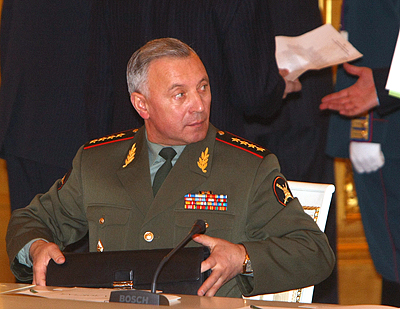
President’s Tough Talk to Defense Minister Serdyukov

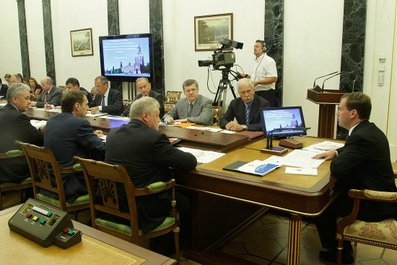
Medvedev at Security Council Meeting

Let’s look at President Dmitriy Medvedev’s criticism of the Navy and the Defense Ministry, his warnings and dismissals of some Navy officers.  It looks somewhat like a script torn from Vladimir Putin’s ‘tough guy’ handbook. 

Kommersant recounted the details of what sparked the President’s ire.  On 29 July, a fire burned the 2512th Central Aviation-Equipment Base of Naval Aviation and Air Defense near Kolomna, several dozen kilometers southeast of Moscow.  The Prosecutor’s Investigative Committee (SK) said the blaze destroyed the staff headquarters, finance unit, club, two bays of vehicle parking, 13 warehouses with various items of aviation equipment, and 17 open equipment storage stands with vehicles on them. 

Medvedev addressed yesterday’s Security Council meeting: 

“I instructed the Defense Ministry to take part in the firefighting effort and help to protect the civilian population, but sadly, in a number of cases, the ministry has proved unable to protect itself.  A fire took place in Moscow Oblast that has caused very serious damage.  The ministry has already carried out a preliminary internal investigation, and the investigation will continue of course.  The evidence so far indicates that this is quite simply a case of neglect of duty and criminal negligence, when personnel failed to bring under control a fire that was not spreading particularly fast, and no one even knew where the base’s commanders had gone.  I have therefore taken the following decision.”      

“Regarding the Navy’s senior command:  Navy CINC Admiral Vysotskiy has been warned about not fulfilling his duties; Chief of the Navy Main Staff and First Deputy CINC  Tatarinov has been warned about not fulfilling his duties; Deputy Chief of Navy Rear Services Sergeyev is dismissed; Chief of Naval Aviation Kuklev is dismissed; Deputy Chief of Naval Aviation Colonel Rasskazov is dismissed; Acting Deputy Chief of Naval Aviation Rear Services Monakov is dismissed; the chief of base 2512 is dismissed.”  

“I am also instructing the Defense Ministry to dismiss a number of other officers and personnel for disciplinary violations.  If anything similar happens in other places and other departments I will do exactly the same again, and without the slightest regret.” 

After discussing the fire situation with other ministers, Medvedev turned back to Defense Minister Serdyukov later in the meeting: 

“Now the Defense Ministry.  I already announced certain decisions.  The Minister needs to take everything under direct control.  Conduct a meeting today with the Ministry’s leadership and say that, if anything else like this burns, everyone will answer for it.” 

“Are there any concerns about the current situation?” 

Serdyukov responded saying plans have been made, operational groups established at all command levels.  Personnel and equipment have been put at the disposal of MChS and regional authorities.  And he noted that Deputy Defense Minister, General-Colonel Dmitriy Bulgakov is his point man for the fire emergency. 

Medvedev chided Serdyukov because the Vladimir Oblast governor had to go to the Defense Ministry for help instead of suitably empowered local commanders. 

Serdyukov said ‘corresponding’ orders have gone to all commanders and garrisons.  He continued with the Defense Ministry’s support of MChS — 11,000 servicemen, thousands of pieces of equipment, 33 kilometers of water pipelines laid in four rayons.  After Bulgakov’s visit to the Federal Nuclear Research Center in Sarov yesterday, another two battalions and special equipment were allocated to efforts there.  Serdyukov said another 28,000 troops can be brought into firefighting in the Central Federal District within 3-12 days. 

Serdyukov concluded: 

“We are taking all steps in full measure, we reinforced all facilities (there are 164 of them, but in immediate areas where there are fires there are 22) behind every responsible commander.  We are conducting all measures there:  increased volumes of water reserves for extinguishing fires, equipment has been brought in, extra personnel, everything literally transferred into a barracks condition, therefore all necessary steps for this, in fact, have been accomplished.  Therefore I submit that this sad incident that happened at base 2512 will not be repeated.” 

Kommersant helped out with a full run-down on the ranks and names of the lesser known Navy officers:  Rear-Admiral Sergey Sergeyev, General-Major Nikolay Kuklev, Colonel Sergey Rasskazov, Colonel Sergey Monakov, and Base Chief Colonel Viktor Biront. 

RIA Novosti covered Serdyukov’s firing of other officers at the base.  They included:  Deputy Base Chief Major R. Gidayatov; Deputy Chief Main Engineer Lieutenant Colonel V. Marchenko; Support and Security Company Commander Major A. Yermolov; Chief of the Material-Technical Support Department V. Karandak; and Chief of the 7th Storage Department V. Melsisidenkov. 

Today the SK said a criminal negligence case has been initiated.  Gazeta ru said, per usual Russian practice, top officials have blamed lower-ranking ones, in this case Navy officers, allowing the ‘untouchables’ to demonstrate their toughness and avoid responsibility.  Kommersant noted that the warnings for Vysotskiy and Tatarinov are just a step from dismissal.  But history shows other general and flag officers have gotten such warnings and still moved forward in their careers. 

Gzt.ru broached the subject of whether this could provide Medvedev an occasion to purge the Defense Ministry and fill it with his ‘own people.’ Konstantin Sivkov and Aleksandr Konovalov agree that he could use this opportunity.  But one has to ask, does this make sense in the scheme of tandem politics?  Medvedev has changed few in the cast inherited from Putin, and he’s very unlikely to start with a stolid Team Putin guy like Serdyukov.  Especially when he appears to be the first man to make some real headway in fixing the post-Soviet military.
Disappearing Deputy Defense Minister Portfolios

Or who will answer for what?

On Tuesday, Kommersant and Rossiyskaya gazeta described, even if they can’t explain, Deputy Defense Minister portfolio changes.  The shuffling began in early July, when Grigoriy Naginskiy was ‘freed’ from his responsibilities as Chief of Housing and Construction but remained a Deputy Defense Minister.

According to a decree known, but not published, Medvedev removed General-Colonel Dmitriy Bulgakov from his post as Chief of Rear Services, while retaining him as a Deputy Defense Minister without specific duties.  It’s widely believed, of course, Bulgakov has taken charge of a new Material-Technical Support (MTO) empire that will encompass not only logistics but also arms and equipment supplies.

For his part, Defense Ministry Apparatus Chief Mikhail Mokretsov formally became a Deputy Defense Minister (no longer holding just informal ‘Deputy Minister status’).

Kommersant points out there are still eight Deputy Ministers (six are civilians).  A Defense Ministry source told the paper, however, that Bulgakov might be civilianized.  And his MTO organization will be part of the Defense Ministry’s ‘civilian component’ as opposed to its ‘military component.’  Kommersant says the ‘military component’ (planning and operational troop command and control) will just be the General Staff when the current Defense Ministry reorganization is complete.

Bulgakov has apparently indicated that MTO will have a planning and coordination department, a resource and transportation support department, Main Automotive-Armor Directorate (GABTU), and also repair-refurbishment and metrological directorates.  As announced elsewhere, ten new MTO brigades are to be established in the four new OSKs.  Recall that, in the same presidential decree on Naginskiy, Bulgakov’s rear services chief of staff Sergey Zhirov became Chief of the Planning and Coordination Department (read staff).

One should really look at Mil.ru’s ‘Leadership Structure’ page here.  In it, you’ll see Vera Chistova retains her clear responsibility for finance-economic work.  Bulgakov’s biography notes he became simply Deputy Defense Minister in July.  Naginskiy’s contains no similar notation though it could.  Then comes the oft-forgotten Dmitriy Chushkin who followed Defense Minister Serdyukov from the Federal Tax Service in late 2008.  He has no portfolio spelled out in his title, but his bio reads:

“Responsible for forming and conducting the Defense Ministry’s united military-technical policy in the information and telecommunications technology area which aims to increase the effectiveness of the command and control system, as well as supporting and developing its foundations.”

Mokretsov’s bio has a note that he added Deputy Defense Minister to his title in July.

The ultimate plan behind these moves isn’t clear yet.  But it does seem to go back to late June’s replacement of Kolmakov with Popovkin in one of the Defense Ministry’s two First Deputy slots.  More support functions were and are being consolidated under civilians, while purely military training, planning, and operations may now be more solidly under General Staff Chief, First Deputy Defense Minister Nikolay Makarov.

Will the Genshtab and OSKs Replace the Glavkomaty?

Writing in Vremya novostey yesterday, Nikolay Khorunzhiy claims the recently-concluded, largest post-Soviet exercise – Vostok-2010 – was intended to test the establishment of four operational-strategic commands (OSK or ОСК) in place of Russia’s six military districts, as well as the establishment of structural sub-units of the General Staff in place of the Main Commands (Glavkomaty or Главкоматы) of the Ground Troops, Air Forces, and Navy.

Khorunzhiy continues:

“It’s proposed that the army’s new structure will allow a sharp cut in the steps in passing commands from 16 levels to three, and increase their precision and reliability.  On 6 July, President Dmitriy Medvedev signed a decree establishing OSKs.  Part of the authority of central command and control organs, but also that earlier entrusted to the Glavkomaty, are going to the OSKs.”

The 6 July decree still hasn’t appeared publicly. 

Khorunzhiy notes that then-General Staff Chief Yuriy Baluyevskiy tested the transition to regional commands during Baykal-2006:

“Then he didn’t manage to break the resistance of district commanders who didn’t want to share their authority with OSK commanders.”

Khorunzhiy digresses to the precursors of OSKs, without calling them High Commands of Forces.  Former General Staff Chief Nikolay Ogarkov set out to reform the army’s command and control:

“The instrument of such a reform he considered main commands on strategic directions (theaters of military operations, in modern terminology) which would improve coordination between services and troop branches and would strengthen the unity of command in combat units (permanent readiness units).”

Ogarkov viewed the Soviet North-Western, Western, and South-Western main commands of troops from World War II as prototypes, but these Glavkomaty were only intermediate links between the Headquarters,  Supreme High Command [Stavka VGK] and the fronts, but received no authority, troops, or communications.  Khorunzhiy contrasts this to Vasilevskiy being sent to fight the Japanese in 1945; he had authority and troops.

Then, in 1978, Army General Vasiliy Petrov was sent out to establish the Main Command of Troops of the Far East, and he had authority up to appoint regiment commanders and arrange cooperation with neighboring states.  The situation of troops in the Far East sharply improved.

Ogarkov set off then to establish main commands on strategic directions, and improve command and control and readiness in yearly exercises (West, East, Autumn).  But in 1984, Ogarkov himself was sent off to be CINC of the Western direction in Legnica.  He failed to get enough authority for these commanders from the CPSU or Defense Ministry, and these main commands were eliminated in 1991.

But Khorunzhiy goes on to describe today’s OSK as an ultimate victory for Ogarkov over the ‘parochial interests of the army elite.’  He doesn’t seem to wonder whether it might be too soon to declare victory.

He finishes by looking at the KPRF’s call for a parliamentary investigation and special Duma session on how Serdyukov’s reforms are ‘disarming Russia.’  In particular, Khorunzhiy quotes the KPRF press-service:

“The system of military districts which has existed for centuries has just been eliminated.  In place of them incomprehensible strategic commands have been established according to an American template.  It’s obvious that this endless modernization of military structures is leading unavoidably to the loss of troop controllability.”

What’s it all mean . . . ?

The possible elimination of the Main Commands — the service headquarters — would be a big deal (no one mentioned what might happen to VDV, Space Troops, or RVSN branch commands).   

This would obviously greatly strengthen General Staff Chief Makarov, and really make him lord and master of the uniformed military.  It would strengthen the General Staff (except Serdyukov’s been cutting its personnel, like the rest of the Central Apparatus).

Would it give Makarov too much power?  Maybe, or maybe not if Serdyukov thinks he can fire him and get another general whenever necessary.

The possibility of eliminating service headquarters makes Navy CINC Vysotskiy’s reticence to talk about moving to St. Petersburg in the midst of a command and control reorganization make more sense.  Maybe he was telling us there’s a much bigger issue at work than just OSKs.

Perhaps in the most objective sense, getting rid of the Glavkomaty would reduce personnel and some resistance to new ideas.  But wouldn’t it also throw away yet another place where the regime should seek good alternative ideas, counterarguments, and feedback on its plans?

Vysotskiy’s Navy Day Interview

Press coverage of Navy Day (25 July) was replete with interesting stories of plans to revivify Russia’s Kirov-class CGNs and even the Orlan-class wing-in-ground effect vehicle.  There was more talk about moving the Neustrashimyy and Yaroslav Mudryy to the BSF.  Navy CINC Admiral Vladimir Vysotskiy’s interview with Ekho Moskvy, however, didn’t get a lot of attention beyond a couple RIA Novosti and ITAR-TASS sound bytes.

Discussing development of Russia’s fleet of the future, Vysotskiy emphasized the long lead time required to get it:

“Today it takes 10-12 years to get some kind of definite design.  We understand that we have to go according to some operational-tactical requirements, perhaps even operational-strategic ones in this design, of course.  So, it means the development or construction of a series is approximately another 5-7 years, up to 10 years.  Perhaps more, the service life of the design is 20 to 25 years.  In other words, if today we make a decision on constructing some full-scale fleet, then we have to understand we’ll receive this fleet in about 50 years.  Well, at a minimum, beginning from the main component in 35 years.”

Vysotskiy’s comments on Bulava were also captured by the wire services:

“Well, the question which we, military men bearing certain responsibility for this, of course, well, honestly speaking, we are already tired of answering because there is one cause — a deep, I underscore, failure of primary production technology for such expensive missile systems.”  

“We all very simply understand well:  when we began to arrange the process of our work incorrectly from the beginning, and here everything was not done as it needed to be.  Here, of course, we’ll get big problems in the process of the work itself.  This means, in my view, in the last 2 years, a serious move in the direction of us receiving this system has been made nonetheless.  But we need to understand that getting this system in its current form is not the final step of the work.  But we have a fair chance all the same to complete this work successfully, well, so we’ll say, in the course of the coming year.”

“When a systemic mistake is found, it’s simpler,  In this instance, an entire systemic mistake was found precisely in the lack of a system.  That is, to put it properly, forgive such a tautology or, on the other hand, a paradox.  But, what we’ve got is what we’ve got.”

And Vysotskiy said lots of other interesting things that went unnoticed.

He naturally supported Vice-Admiral Sidenko as Far East OSK Commander, saying it made sense and reflected the country’s maritime interests in the Pacific and Indian Oceans. 

He connected the acquisition of the Mistral to drawing down mobilization resources in favor of permanent readiness.  He said PR units could be put on Mistral and the ship could be a mobile command point for an OSK’s inter-service grouping.  He defended turning abroad by saying it would take Russian yards 1.5 to 3 years to even prepare to make such a ship if they started today.

Vysotskiy wants the BSF to pick up the antipiracy load so the distant fleets don’t have to send their ships.

He discussed Russia’s long-term search and rescue support program, and he emphasized rapid information transfer and international cooperation and combined training, like NATO’s Bold Monarch exercise, as essential ingredients for success.

On the loss of the Kursk ten years ago, Vysotskiy said the accident started with a technical cause — errors in handling a peroxide-fueled torpedo — but there was an accumulation of mistakes, including organizational and command ones, that led to the tragedy.

Russia is working on its organizational and technical problems in SAR, both buying equipment and learning to use it abroad.  Vysotskiy cited an ‘absolute understanding’ on cooperation with foreign partners.

He was evasive on moving the Navy’s headquarters to St. Petersburg, saying a remote command and control point is there, and other steps in this direction are being taken.  But the overall military C2 reform has to be completed this year before he can really answer questions.

Lastly, on foreign bases for the Navy.  He’d like to have them, and there’s movement in this direction, at least compared with the recent past.  The Navy is working with a number of states to arrange for simplified port access for its ships in some strategic places, and it’s almost like having a base.

Interim OSK Commanders Named

Late Thursday Interfaks learned that Defense Minister Anatoliy Serdyukov signed an order naming acting commanders of Russia’s four new military districts, or operational-strategic commands (OSKs).

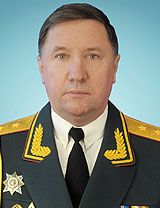
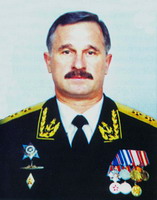
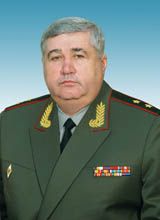
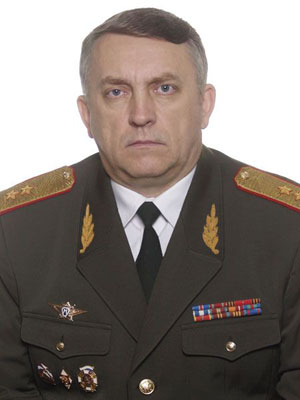
Volga-Ural MD Commander, General-Colonel Arkadiy Bakhin will be the interim commander of the new Western MD.  Siberian MD Commander, General-Lieutenant Vladimir Chirkin will temporarily head the new Central MD.  Pacific Fleet Commander, Admiral Konstantin Sidenko will command the new Far East MD for now.  And North Caucasus MD Commander, General-Lieutenant Aleksandr Galkin will head the the new Southern MD. 

General-Colonel Bakhin

General-Lieutenant Chirkin

Admiral Sidenko

General-Lieutenant Galkin

Serdyukov wants the new command and control scheme operating from the start of the new training year on 1 December.

Kommersant noted general surprise that a naval officer was picked to head the Far East MD.  Ground Troops generals have always commanded the army-dominated MDs.  But a Navy Main Staff source said Sidenko is not new to commanding army units; he once commanded the combined Navy-Ground Troops force on Kamchatka.

Kommersant also said extramural Defense Ministry collegiums will evaluate the effectiveness of these reorganizations before the end of the year.

Makarov’s Guys Take Key Posts

Bakhin, Chirkin, and Galkin prospered under General Staff Chief Nikolay Makarov when he was Siberian MD Commander from 2002-2007.  Each of them served as an army commander, deputy MD commander, and chief of staff, first deputy MD commander under Makarov in Siberia (or immediately after his departure for Moscow).  Chirkin served as Bakhin’s chief of staff, first deputy commander of the Volga-Ural MD, before becoming Siberian MD Commander this year.

Sidenko is a submariner, and most of his career has been in the Pacific Fleet.  His experience as ‘Commander of Troops and Forces in the North-East’ is, interestingly enough, a little similar to Makarov’s late 1990s time as ‘Commander of Ground and Coastal Troops, Deputy Commander of the Baltic Fleet for Ground and Coastal Troops.’

TsOPI Critiques Serdyukov’s Reforms

In last week’s Nezavisimoye voyennoye obozreniye, IMEMO’s Vladimir Yevseyev presented the results of a recent round table on reform in the RF Armed Forces. The Center for Social-Political Initiatives (TsOPI or ЦОПИ), with support from Germany’s Rosa Luxemburg Foundation, sponsored the event.

Yevseyev described early reform as cutting personnel without changing the army’s structures during a time of political paralysis in the 1990s.  In the Putin era, he says there were still failures and the army’s equipment levels dropped, but the army began to believe it could still fight.

At this time, former Defense Minister Ivanov more than once declared the end of army reform, the troops started to get limited quantities of new weapons, and there was an unsuccessful attempt to move to professional enlisted force.  Yevseyev tries unconvincingly to point out successes in the Putin-Ivanov period.  His leading examples are especially dubious:

“— the elimination of cadre units and formations and forming of permanent readiness units numbering nearly 200 thousand servicemen on a contract basis.”

“— partial fulfillment of the federal targeted program of transition to manning with servicemen conducting military service on contract in a number of formations and military units in 2004-2007 that as a whole with a corresponding change in legislation in 2008 allowed a reduction in the conscripted service term to one year.”

The hollow unit problem wasn’t tackled until late in 2008, and Yevseyev has already labeled contract service a failure.  Moreover, the contract service program probably didn’t attract more than 80,000 soldiers.

And contract service didn’t have anything to do with one-year conscript service.  That change was made to try to encourage more young Russian men to serve rather than avoid serving.  Professional enlisted service, had it worked, would have allowed Moscow to continue drafting only 260,000 men per year for two years, rather than 540,000 per year to serve for a year as it is now.

But Yevseyev comes to the right conclusion:

“. . . radical change in the reform of the Armed Forces did not happen.  The main reason for this was that the Russian leadership could not take the fundamentally important decision on bringing the size of the Armed Forces into correspondence with the economic possibilities we have and with observable (future) external threats.”

Yevseyev writes that the most acute phase of military reform came with Defense Minister Serdyukov, and the war with Georgia, which revealed the army’s shortcomings.
 
But, says Yevseyev, Serdyukov’s initiatives like reducing officers and cutting warrants ran into difficulties.  Forty thousand officers placed outside the TO&E couldn’t be retired because they still lack permanent housing.  And many would-be officer graduates in 2009 and 2010 were forced into sergeant’s duties.

Yevseyev says Serdyukov’s reform is bringing an increased flow of negative consequences as shown in the results of TsOPI’s polling. It surveyed more than 2,500 people, including nearly 1,700 servicemen, in nine major cities.  According to 61 percent of respondents, reform has degraded the entire military command and control system.  Sixty-four percent said the army’s ‘new profile’ has seriously reduced their social status.  Thirty-two percent are not sure their housing, pension, and pay rights will be observed during Serdyukov’s reform.  Twenty-three percent are worried about their outplacement rights, and 8 percent about their medical benefits.

Yevseyev and his colleagues discussed three major problems for the Armed Forces:  rearmament, infrastructure, and manning.

They say 40 percent of Soviet arms and equipment were modern at the end of the 1980s, with the percentage declining to only 10-12 percent by 2005, and 5 percent at present.  They give a useful rundown of what’s been produced over recent years.

In 2004-2008:

  • 36 ‘Topol-M’ ICBMs;
  • 2 battalions of Iskander SSMs;
  • 2 battalions of S-400 SAMs;
  • 150 T-90 tanks;
  • 700 armored combat vehicles;
  • 20 self-propelled artillery systems;
  • 1 Tu-160 strategic bomber;
  • 3 Su-34 bombers;
  • 30 helicopters;
  • 1 diesel submarine;
  • 2 corvettes; and
  • 13 smaller ships and auxiliaries.

In 2009:

  • 49 new or modernized aircraft;
  • 31 helicopters;
  • 304 armored combat vehicles; and
  • 20 artillery systems.

Yevseyev and company conclude:

“It would seem that the situation with equipping the country’s Armed Forces is beginning to be corrected.  But in reality such rates of military equipment supply allow full rearmament across 30-50 years, which significantly exceeds the length of its service life.”

So this will make it difficult to increase the share of new weapons and equipment to 30 percent by 2015, even for permanent readiness units and formations.

They point next to the massive lingering Russian military structure.  Four years ago there were 26,000 military organizations of one type or another, and now only 6,000.  And that will be reduced to 2,500.  But they say, instead of consolidating and realizing cost savings, some of this process was fake, and some organizations were just named as subsidiaries [filialy] of larger ones.  As an example, they cite the shift from regiments to brigades and 1,000 reported TO&E changes, of which only 30 actually involved a physical unit relocation.

Finally, Yevseyev and the round table participants point to a potential unit leadership void when officers and professional enlisted are being cut (or not recruited) at the same time.  They say, given the training time they need, conscripts shouldn’t comprise more than 30 percent of a permanent readiness unit.

Yevseyev sums up:

“. . . the process of implementing military reform in the Russian Armed Forces now prompts the most serious misgivings.  In essence, the military personnel training system is being destroyed, the decline in the Armed Forces’ equipping continues, their system of manning and command and control is being broken.  All this leads to the weakening of the country’s defense capability and requires taking immediate measures to eliminate the negative consequences we are already experiencing.”

General Staff Chief Makarov’s Press Conference

Sound bites from General Staff Chief Nikolay Makarov’s press conference today dribbled out one at a time, as usual.

Makarov told reporters President Medvedev signed a decree establishing four operational-strategic commands (OSK) to replace the existing military districts on 6 July, but the text hasn’t been published.  Makarov also said arrangements putting the OSKs in place would be complete on 1 December.

Makarov talked more about the new “unified system of material-technical support (MTO)” also apparently covered in Medvedev’s decree.

Rear Services Chief, Deputy Defense Minister, General-Colonel Dmitriy Bulgakov, as expected, will head the unified MTO system, and new First Deputy Defense Minister Vladimir Popovkin will supervise the new state armaments program, 2011-2020, as well as coordination with military industries. 

Makarov stressed uniting transportation and supply functions under Bulgakov:

“We had a disconnect when all transport for supplies of material means to the troops was at the disposal of the Deputy Defense Minister for Rear Services, but he didn’t have anything he needed to move with this transport.  The other Deputy Defense Minister, on the other hand, had armaments, but no means for transporting them to the troops.”

“This is very important because now the management of transportation and armaments is concentrated in the hands of one man.  The correctness of the decision was confirmed by the recently completed ‘Vostok-2010’ operational-strategic exercise in the Far East.”

 “Now one official serving as a Deputy Defense Minister heads a unified system of material-technical support which has united rear services and armaments.  He alone personally answer for both the transport of supplies of material-technical means, and for these means themselves.  Now one man answers for the state of affairs with armaments and for their supply to the troops, who will also now be responsible for that.”

The way Makarov puts it, Popovkin be on the hook for product quality:

“He will work with defense-industrial complex enterprises to control their production of armaments and military equipment for the Armed Forces.”

Popovkin’s old job of Chief of Armaments, Deputy Defense Minister will disappear most likely.

Makarov told reporters Russia plans to move to netcentric command and control by 2015, once it equips its troops with new C3 systems united in one information space.  Such systems are now scarce, but he says, they are working hard so to install digital equipment everywhere.  Makarov calls this the main renovation that he’s giving all structures and troops starting in the fall of this year.  He says Russia’s new command posts unite reconnaissance, target designation, and troops and weapons to execute combat missions in real time.

It’s interesting that RIA Novosti took time to explain that the netcentric concept is an American creation more than 10 years old, and one not loved by those used to strictly centralized command and control.

Makarov told the press the army will begin forming light brigades, which it currently doesn’t have, this year.  They’ll have light combat vehicles of some type.  While not providing details, Makarov emphasized that light brigades will be built around a standard vehicle, so that, as in Vostok-2010, a brigade can fly in and its personnel can marry up with their normal vehicles in their place of deployment. 

Answering a question, Makarov said Russia will buy more Il-78 tankers in GPV 2011-2020, but he didn’t specify a number.

Makarov announced an intention to equip all Russian combat aircraft with new targeting-navigation systems over the next three years.  He said the new equipment will increase the accuracy of air strikes and allow the Air Forces to “abandon the previous practice of area bombing.”  He said the new system was tried on a Su-24M2 during Vostok-2010.  Installation of the targeting equipment on the Su-24M2 began in 2007.  Makarov said the VVS has nearly 300 Su-24 of all variants, and naval aviation about 60.

Stoletiye.ru had an interesting observation on Makarov and efforts to streamline command and control in the Russian Army.  It said the move to 4 OSKs and other steps are intended to reduce duplication of officer responsibilities and make 2-3 officers responsible for the fulfillment of combat missions.  It quoted Makarov, “We’ve eliminated the system of spreading responsibility throughout the Defense Ministry.”

Testing Army Reforms in Vostok-2010

Readers seem eager for anything they can get on Vostok-2010.  Here’s something. 

Russia’s largest maneuvers of the year, Vostok-2010, began June 29, and continue until July 8.  This broad-scale operational-strategic exercise (OSU or ОСУ) encompasses the Siberian and Far East MDs, as well as the Pacific Fleet—in other words, what will reportedly become the new Far East MD or operational-strategic command (OSK or ОСК) before the end of 2010.  

General Staff Chief, Army General Nikolay Makarov talked to RIA Novosti and ITAR-TASS at length about Vostok-2010 recently.  He said the Far East was chosen for its broad expanses, limited infrastructure, and difficult weather and climate.  Eleven combined arms, 3 air forces, and 4 naval training ranges will be used.  Makarov noted up to 20,000 soldiers, 2,500 weapons systems and pieces of equipment, 70 aircraft, and 30 ships will take part in the exercise. 

Makarov said Vostok-2010 will be a logical continuation of last year’s large training events.  Beyond Defense Ministry forces, operational groups and sub-units from the MVD, FSB, FSO, MChS, and FSIN will participate.

As is customary, Makarov said the maneuvers:

“. . . are not directed against any real country or military-political bloc.  They have an exclusively defensive orientation for ensuring the security and defense of the state’s interests on the Far East border against a notional enemy.”

And the exercise’s theme is:

“. . . preparation and employment of formations [military units] in a new TO&E structure to fulfill missions in isolated sectors to ensure the Russian Federation’s military security.”

Makarov said the maneuvers will:

  • Check the effectiveness of the newly-created three-level system of troop command and control;
  • Evaluate the readiness of new TO&E formations and military units to  conduct combat actions in isolated sectors in a constantly changing situation, as well as their mobility and combat possibilities;
  • Resolve training and command and control issues at the operational-strategic and operational level while conducting combat actions;       
  • Organize coordination of military command and control organs with the troops and military formations of other federal ministries and departments, and also local organs of executive authority in resolving joint missions; and
  • Investigate the capabilities of a unified system of material-technical support (MTO) which was created during the structural reformation of the army and fleet.

The exercise will include special operations, air defense and ship combat firings, and air and amphibious assaults.  Makarov said the RVSN will join the exercise play, but no ICBM training launches will occur.  Military transports will bring independent sub-units from the Moscow and Volga-Ural MDs to join the exercise, but they will draw their weapons and equipment from Siberian and Far East storage bases.

Makarov noted the participation of an unidentified number of Su-24M and Su-34 aircraft arriving from Central Russia during a direct flight with aerial refueling.   Black Sea Fleet flagship Slava-class CG Moskva and Northern Fleet Kirov-class CGN Petr Velikiy also completed long-range cruises to participate.

Makarov said new operational and operational-strategic level command and control posts will be used in the exercise, as will ‘fifth generation’ radio communications gear and future soldier systems under development at Sozvezdiye.  Iskander operational-tactical missiles and Russian-made UAVs will also be employed.

Siberian MD Commander, General-Lieutenant Vladimir Chirkin told Krasnaya zvezda the exercise will focus on defensive operations, but also special operations to localize and destroy irregular armed formations in several RF regions.  He said there will be more than a little new given that new combat regulations will be used.  He added:

“We’re moving away from linear tactics, from large-scale front operations.  As the experience of local wars and armed conflicts in recent years shows, there’s no need to utilize a massive quantity of forces and means to conduct front and army operations.”

In Nezavisimaya gazeta, Vladimir Mukhin focused on the logistics of Vostok-2010.  He noted Rear Services Chief, General-Colonel Dmitriy Bulgakov’s expectation that President Medvedev will soon issue a decree combining the jobs of Chief of Armaments and Chief of Rear Services.  And leaving First Deputy Defense Minister Popovkin’s old job vacant could be a hint of this.  After Vostok-2010, Mukhin expects a new deputy defense minister for material-technical support (MTO), presumably Bulgakov, to be appointed.

A lot of the activity before Vostok-2010 has apparently involved trying out new combat service and support arrangements.  A special logistics exercise tested the new MTO system.  And this year, according to Mukhin’s information, ten MTO brigades will be formed, one for each combined arms army.  The Railroad Troops will reportedly be downgraded to a directorate and each MD (OSK) will absorb the Railroad Troops units on their territory.

Krasnaya zvezda described these exercises.  Rear Services troops used 4,000 men, 30 units of different sizes, and 1,000 pieces of equipment in a pipeline-building exercise, training to repair damaged bridges over the Aga River, and refueling a brigade before its Onon River crossing.

General-Colonel Bulgakov talked about the new MTO regiments and the exercises.  He said they are permanent combat readiness units which have all necessary troops support structures and sub-units.  This was the first test of the new TO&E structure for logistics.  Based on the results, Bulgakov thinks this year the army can move from material support regiments (PMO) to material support brigades.  In every district (OSK), there will be a minimum of two, according to him.  Unlike regiments, material support brigades (BMOs?) will have repair and maintenance battalions.  Brigades were chosen to conform as much as possible to the prevailing three link ‘district-army-brigade’ command scheme.

Trud’s Mikhail Lukanin put Vostok-2010’s most difficult missions this way:

  • Moving troops great distances, including Siberian river crossings;
  • Supplying fuel, ammunition, and food to the area of combat actions;
  • Conducting an amphibious assault under enemy fire.

Prominent commentators view Vostok-2010 as a test of the success of Defense Minister Serdyukov’s army reforms.  Trud talked to independent defense analyst Aleksandr Khramchikhin who said:

“Military reform has gone on already for more than a year and a half, but there’s still no answer to the main question:  what have we gotten from it?  That is, after radical cuts in the officer ranks, the reorganization of military command and control organs, turning former divisions into combined arms brigades, are the Armed Forces capable of conducting modern combat actions.”

Anatoliy Tsyganok believes the army made a hash of Zapad-2009, with only 30 percent  of Russia’s maneuver brigades receiving good evaluations, most only satisfactory, and a handful unsatisfactory.  Presumably, he doesn’t expect to be more impressed by Vostok-2010.

Karakayev Replaces Shvaychenko as RVSN Commander

Lots of action near the top of the Russian military pyramid today . . . 

General-Lieutenant Andrey Shvaychenko’s exceptionally brief tenure as RVSN Commander came to an abrupt and unexpected end.  He just turned 57 on June 18, and only commanded Russia’s land-based strategic forces for a little over 10 months.  His predecessor—Nikolay Solovtsov—served for 8 years. 

Already past retirement age for his two-star rank, President Medvedev and Defense Minister Serdyukov apparently decided to replace rather than promote him. 

The timing of Shvaychenko’s replacement is interesting and most likely not accidental, to say the least.  The Russians have swapped out a key figure just as they enter the process of ratifying a new strategic arms treaty with the United States. 

General-Lieutenant Sergey Viktorovich Karakayev replaces Shvaychenko.  Like his predecessor, he’s a two-star general, but 8 years younger.  He served as Chief of Staff, First Deputy Commander of the RVSN just since last October.  He occupied RVSN command positions up to and including missile division commander and Vladimir Missile Army commander in 2006-2008.  

General-Lieutenant Karakayev

Somewhat atypically, he served some time as a department chief in the Defense Ministry’s Main Personnel Directorate.  He completed studies in the civilian North-Western State Service Academy before finishing the General Staff Academy.  He holds a doctorate in military science.  His full biography is here

Kremlin.ru provided the following excerpt from today’s Gorki meeting between Medvedev, Serdyukov, and Karakayev: 

“This is a serious position.  The functioning of our nuclear shield depends on work in these duties.  And of course, I hope that you will do everything necessary, everything dependent on you to apply your knowledge, your experience for the good of the country, to create the right RVSN command and control system.” 

“Despite the fact that we are reducing our nuclear arsenal, this must not affect the combat core within the limits of that agreement which is currently operative for us, and within the limits of that agreement which is in ratification.” 

“Generally, it’s necessary to do everything so that our Rocket Troops of Strategic Designation will be fully combat ready and can fulfill their established missions.” 

Karakayev gave a customarily brief response: 

“Comrade Supreme Commander-in-Chief, I will not fail.” 

Pervyy kanal covered also covered the Gorki meeting, if you’d like some video.  

The change in the RVSN may be a result of the bumps and bruises of reaching internal agreement to go forward with the new strategic offensive arms treaty.  Or maybe not.  But something’s clearly wrong; a ten-month tenure is clearly far off the norm.  Medvedev’s short comments aren’t much to go on, but they seem to say (a) Shvaychenko wasn’t doing the job the way his masters wanted; (b) the masters want an improved strategic nuclear command and control system; (c) the new arms treaty doesn’t threaten Russia’s nuclear deterrence capability and, therefore, is a good deal for Moscow; and (d) the RVSN Commander needs to focus his attention on the optimal operation of whatever weapons systems provided him by the country’s leadership.  And Karakayev indicated in front of the cameras that he’s on-board with all this. 

Armaments Chief Vladimir Popovkin also replaced First Deputy Defense Minister, General-Colonel  Aleksandr Kolmakov.  Popovkin seems to have accommodated Serdyukov, and fit well into the Defense Minister’s ‘new profile.’  The ex-Space Troops general seems to be the type of official the civilian leadership wants in its more civilian Defense Ministry.  He will keep charge of the weapons portfolio, and training and readiness accounts overseen by Kolmakov will probably go back to the Genshtab.  But more on this one tomorrow.

OSK Commanders Will Directly Control Navy and Air Forces

Army General Makarov

Russian General Staff Chief, Army General Nikolay Makarov briefed the Federation Council’s Defense and Security Committee today, and, according to Interfaks, he has made the decision to replace Russia’s six military districts with four that will function as operational-strategic commands (OSK).  He said:

“We will propose on the base of six military districts to establish four military districts, to the commander of which all forces and means deployed on their territory, including Navy, Air Forces and Air Defense, will be subordinate.  And subordinate not operationally, but directly.”

“Ground-, sea- and air-based nuclear deterrence forces will remain under the General Staff.”

“Our proposal on establishing four operational-strategic commands is now with the country’s president and I think that this issue will be favorably resolved soon.”

Infox.ru cited Makarov on the creation of three additional combined arms armies for several strategic axes: 

“We conducted a careful analysis of current threats and challenges and came to the conclusion that it’s necessary to create additional combined arms armies on several strategic axes.  There will be three in all.”

Makarov added that one army would be based in Chita, and six additional motorized rifle brigades will be formed to flesh out the newly created armies.

And Makarov wasn’t done . . .

According again to Interfaks, Makarov told these members of Russia’s upper house of parliament that ten combined air (8) and naval air (2) bases will be established in Russia.  Until recently, the military had been talking about new “first- and second-rank air bases” that were basically Air Forces’ equivalents of Ground Troops’ brigades.  This approach may have been abandoned in favor of a smaller number of larger air bases.  The choice of the word ‘combined’ [объединённые] makes these things sound like they’re now equivalent to armies.

Makarov explained that Russia has 245 airfields:

“The approximate cost of using one airfield is 1 billion rubles per year.  This amount is prohibitive, therefore we took a decision on enlarging air bases.”

After this change, Russia will only have 27 airfields, according to the General Staff Chief, and the combined air and naval air bases will be spread out over Russia in cities like Voronezh, Chelyabinsk, Domna (near Chita), and Komsomolsk-na-Amure.

Makarov said the goal was not only excellent conditions for fulfilling flight missions, but also for the everyday lives of servicemen and their families:

“We’re doing everything so that our pilots and their families can live in human conditions.”

Makarov told the assembled lawmakers that Russia will complete contract to buy Mistral from the French:

“Concerning Mistral, the contractual obligations are practically ready.  I think we’ll buy this ship.”

“We need such a ship.  In the Far East, it’s simply essential.”

He went to say, it’s needed around the Kurils which “generally have nothing to defend them.”  And he elaborated:

“Earlier there was an army there.  There’s no one there to cover them, we need mobile means so at the necessary time we can deliver a landing force quickly.”

He repeated his past comments to the effect that Mistral is 4-5 times bigger than Russia’s largest amphibious ship, the Ivan Rogov class.

Tomorrow it’s Serdyukov’s turn to speak to the Federation Council, so prepare for some more news.