Category Archives: Conscription

No One to Call (Part I)

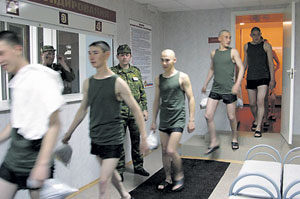
Shaved and Ready to Serve (photo: Yelena Fazliullina / Nezavisimaya gazeta)

“We could call-up 11.7% of all young men.  Of them, 60% got out on health grounds.  Therefore, the RF Defense Ministry confronts the fact that there is almost no one to call-up into the RF Armed Forces.”

Army General Nikolay Makarov

So the General Staff Chief declared on November 11, 2011, and he’s been quoted to this effect many times since. 

Just nine months earlier, the Defense Ministry declared professional contract service would be the primary method of manning the Armed Forces.  And a year before that, the Defense Minister and General Staff Chief said the exact opposite:  conscription would be primary and contract service would be curtailed.  

But the impossibility of manning a million-man Russian Army by means of the draft was clearly understood by many observers at that time.

The Defense Ministry recently issued its customary press-release indicating 100-percent fulfillment of the fall draft campaign.  

Only 135,850 young men were conscripted for one year of obligatory military service.  This was about 80,000 fewer than the number inducted during the spring draft (218,720), and less than half the fall 2010 call-up (280,000). 

This fall’s 135,850 twelve-month soldiers are just about the same number of men typically drafted for a two-year service term in the mid-2000s.

Viktor Baranets published his archive of annual conscription numbers back to 1999, which is handy.  He makes the point that, in contrast to today’s 12 percent or less, 20 percent of available men were being drafted as late as the late 1990s.

Let’s suppose if Makarov’s 12 percent go to serve and 60 percent are excused for health reasons, then 28 percent are escaping through deferments (mostly educational) or evasion. 

Makarov’s precise 11.7 percent or 135,850 conscripts would mean his total draft pool was under 1.2 million men.  This seems odd because census numbers say Russia should have at least two million 18- and 19-year-old men right now.  And that’s not even mentioning some 21- or 22-year-olds who get caught in the commissar’s dragnet. 

There might be some math your author can’t fathom, but it could also be that the widely-reported number of 200,000 long-term draft (or draft summons) evaders is actually much, much higher.

Let’s look at a fairly detailed report on conscription in one oblast — Sverdlovsk.  Nakanune.ru reports the oblast’s military commissar sent out 25,000 draft notices to the region’s youth. 

Almost half were unfit for health reasons, leaving, let’s suppose, 13,000 young men to sort through.  But this, of course, means Sverdlovsk’s a lot healthier place than many places.

Of those 13,000, some 6,000 had deferments.  So we’re down to 7,000 candidate-soldiers.  Of them, 4,056 were inducted this fall. 

That’s a deferment rate of 24 percent for all men summoned to the draft board.  And 4,056 is 16 percent of those summoned.  The MVD got 700 men (3 percent), and the Armed Forces presumably got 3,356 (13 percent).

Now unmentioned are the 2,944 not deferred and not drafted.  Who knows how they might be counted.  But they might be guys evading the draft by simply going missing.  For those keeping score, that could be an 11.7 percent evasion rate.  Just as many dudes avoiding service as going to serve this fall.
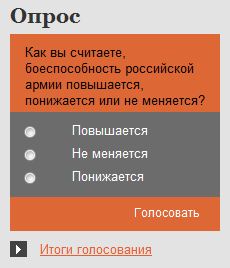
The Sociological Center

Is the Russian Army's Combat Capability Increasing?

A nice find on Mil.ru . . . the Defense Ministry website has the Internet poll above on its front page.  If you click on Voting Results, you go to the results of all surveys conducted by the Defense Ministry’s Sociological Center.

To this particular question, 78 percent of respondents said its combat capability is decreasing.

Stepping back a bit, clicking on Sociological Center goes to a narrative explaining a little about it.  Its purpose is monitoring social processes in the military to work out scientifically-founded proposals on the morale-psychological support of military organizational development, training, and employment of the Armed Forces.  It also provides information support to commanders, staffs, and personnel officers.  The Center is charged with collecting data about the socio-economic circumstances of servicemen and their families.

The military opinion surveying effort has been around for a while.  During the first big push for contract service beginning in 2003, Defense Ministry pollsters actively asked contractees, or prospective ones, what attracted or discouraged them from signing up.

We’re not told how or when these survey questions were asked.  They’re likely Internet polls rather than more scientific random sampling. 

But one still admires the brutal honesty of publishing these results.  They don’t accord with what Defense Minister Anatoliy Serdyukov wants to see or hear three years after launching military reform.  They indicate how far the Russians have to go to turn around the perception, if not the reality, of life in the Armed Forces.  At the same time, getting feedback is a critical step in correcting their problems.

Your author has regrouped the survey results on various questions thematically.  In the interests of brevity, only the answer with the highest percentage is shown.

Let’s start with other combat capability-related questions:

  • How do you evaluate the Russian Army’s current combat capability?  72 percent said low.
  • Is three months sufficient to train a military specialist?  82 percent said no.
  • What effect is the humanization of service having on combat readiness?  71 percent said it is causing it to decline.
  • Are you satisfied by the media’s presentation of Armed Forces exercises?  75 percent said no.
  • How do you evaluate the present level of combat training?  74 percent said poor.
  • Can the Armed Forces reliably guarantee Russia’s security?  81 percent said no.
  • Is there now a military threat to Russia from other countries?  79 percent said yes.

Some very general questions:

  • Do you approve of the Russian Army’s activity?  62 percent said no.
  • How do you feel when you talk about the Armed Forces?  52 percent said negative.
  • Is it necessary for the media to discuss negative events in the Armed Forces?  75 percent said yes.
  • How does the media portray the activities of the Armed Forces?  64 percent said not objectively.
  • Do you agree that “A powerful army is a powerful Russia?”  80 percent said yes.

On conscription:

  • Should draft evaders be punished?  68 percent said yes.
  • How do you feel about draft evasion?  59 percent said negative.
  • Does military service promote striving for a healthy way of life?  56 percent said yes.
  • Would you want a close relative to serve in the army?  68 percent said no.

On law and order in the ranks:

  • Who should control the military police?  52 percent said the Defense Ministry.
  • Do officers have enough powers to keep order?  84 percent said no.
  • How do you assess measures to counter corruption in the army?  66 percent said they have little effect.
  • Is “dedovshchina” an acute problem?  62 percent said yes.

On personnel, pay, and benefits:

  • Should Order No. 400 premium pay continue or be discontinued?  80 percent said discontinue it.
  • How do you feel about rotating officers’ duty stations?  51 percent are negative.
  • How has Order No. 400 affected corruption in the army?  88 percent said it’s caused it to grow.
  • Is there a “cadre famine” in the Armed Forces?  83 percent said yes.
  • How do you evaluate the consequences of Order No. 400?  89 percent are negative.
  • Where should priests be located?  42 percent said in battalions.
  • Will priests help in forming healthy moral relations in the military collective?  55 percent said no.
  • How do you evaluate the effect of the military mortgage system?  74 percent said low.
  • Will higher pay in 2012 raise the social status of servicemen?  58 percent said no.
  • Will requalifying military arsenal workers increase safety?  65 percent said no.
  • Do military families live better or worse than people in your region?  77 percent said worse.
  • Are social guarantees for servicemen sufficient?  86 percent said no.
  • Has the prestige of the Armed Forces increased in the course of military reform?  59 percent said it remains at the previous level.

The responses on the army’s capabilities weren’t new.  One is surprised, however, at how negative respondents were on premium pay, how little they expect from higher officer pay, and the lack of any improved perception of the prestige of military service.

Year Two

This blog completed its second year yesterday.  There were 288 posts in year two (a few less than last year).  Just a couple to go to reach 600 posts since December 10, 2009. 

One hopes the reading was half as worthwhile as the writing.  But frustration lingers.  It’s impossible to follow everything.  Adding Twitter provided a “release valve” for overflowing news.  Still there’s tension between posting short items and writing more detailed pieces drawing together many different sources. 

In 2011, Defense Minister Anatoliy Serdyukov and General Staff Chief Nikolay Makarov had plenty of interviews, official appearances, and other public utterances to cover.  There were a large number of high-level personnel changes, retirements, and dismissals to report.

Serdyukov eased a little on cutting the officer corps.  The Defense Ministry readied its new higher pay system while scandal plagued the stopgap premium pay scheme.  Military housing remained a major headache as always.

Moscow hit a wall on manpower and had to accept undermanning.  After acknowledging there aren’t enough potential draftees, the military is starting over (yet again) with an effort to create professional enlisted and NCOs through contract service.

This year began with questions about the GPV’s feasibility, but devolved into immediate problems with GOZ-2011.  The Russians threw money at the OPK without looking at the defense sector’s (and the procurement bureaucracy’s) capability to turn financing into the kind of weapons and equipment the military requires.  Difficulties ramping up production of naval and missile systems occupied media attention.  The public debate over the relative merits of buying Russian or foreign weapons made several headlines.     

So where is Russia’s military?

To this observer, the Russian Armed Forces are improving and beginning serious rearmament.  But the hour is late.  Significant future problems could derail recent positive changes.  These include new and old, unsolved economic, budgetary, social, demographic, and possibly even political challenges.  Not to mention purely military obstacles to modernizing the army and navy.

Your visits and page views grew significantly in year two.  Page views are about 400 a day, 2,000+ a week, and 9,000-10,000 a month.  We’ll see if this is the ceiling for this rather specialized topic.

Your views, opinions, and arguments are always appreciated.  Those sharing or highlighting data and evidence on issues are particularly valuable.

Makarov Reports to Public Chamber

Makarov Briefs the Public Chamber

According to Mil.ru, General Staff Chief, Army General Nikolay Makarov reported to the Public Chamber today as part of its hearings on “The New Profile of the Russian Army:  Results, Problems, Prospects.”  Here’s a sampling of what he discussed.

According to ITAR-TASS, Makarov said there are 186,400 contract servicemen today, and there will be 425,000 in 2016.  Recruiters will work throughout Russia starting next year.  Prospective contractees will train for three months before signing contracts.  Minimum pay will be 23,000 rubles.  Makarov said 2012 will be a test year, and from 2013, 50,000 contractees will be signed up each year.

RIA Novosti printed Makarov’s stark assessment of Russia’s conscript manpower.  The General Staff Chief said, of all men liable to conscription, only 11.7 percent can be called up, and 60 percent of them are excluded for health reasons.  So, he concludes:

“Therefore we are practically faced with the fact that there is almost no one to callup into the Armed Forces.”

He said Russia’s current mobilization reserve consists of 700,000 ex-conscripts. 

Makarov suggested increasing the prestige of military service through a veteran’s preference system.  Former soldiers and officers would enjoy a priority in hiring for government service, according to RIA Novosti.

ITAR-TASS quoted Makarov on cuts in military command and control organs.  He indicated they’ve been cut by a factor of four — from 51,000 to 13,435 personnel, and this process continues.  One-third of C2 organs were disbanded, and the rest reduced in size several times. 

He indicated that, when the Defense Ministry’s central apparatus numbered 51,000, it occupied more than 20 buildings in Moscow.  The apparat is now in a single building.  Other buildings were sold off.  But Makarov assured his audience the effectiveness of C2 hasn’t declined because of the reductions.

Regarding the new pay system for officers, RIA Novosti wrote that Makarov said higher pay basically implements the old Order No. 400 on premium pay, but officers will still have the chance to receive extra “stimulus” pay under the new system.

ITAR-TASS printed Makarov’s figures on efforts to get rid of old ammunition.  According to the General Staff Chief, at the start of the year, Russia had 119.5 million tons of old munitions to destroy, but now only 7 million.  Less than one percent could be dismantled; the vast majority had to be blown up.  Makarov indicated the number of ammunition storage sites will drop from 161 at present to about 30.

Makarov defended his past criticism of domestic weapons and equipment by giving more examples where foreign systems are superior to Russian ones (i.e. tanks, MLRS, satellites), according to ITAR-TASS.  The general argued for increasing the range and service life of systems as well as providing better protection for soldiers operating them.

RIA Novosti reported Makarov intends to continue pushing for lower prices on arms and equipment the military’s buying.  He intimated there will be a “specialized department” for negotiating with producers.  He claimed shipbuilding contracts with OSK were concluded on the Defense Ministry’s terms.  He added that the military has given Almaz-Antey two years to build two new factories to produce the S-500, according to RIA Novosti.

ITAR-TASS relayed Makarov’s remarks on Russia’s airfields.  Makarov indicated Russia has cut from 357 military airfields down to 26 that he describes as meeting world standards.  Russia has eight air bases. 

He said pilot flight hours are at 90 per year.  He said it’s planned to increase them to 130 next year, and then to 220 at some point.

ITAR-TASS and RIA Novosti carried the General Staff Chief’s comments about threats on Russia’s borders: 

“Under certain conditions, local and regional conflicts can grow into mass ones with the employment of nuclear weapons.”

“The conflict which could occur in connection with the withdrawal of American troops [from Afghanistan] could lead to a local, regional and even large-scale one.  And we have to be ready for it.”

New Poll on Conscription

FOM's Poll on Conscription

The Public Opinion Foundation (FOM) just published a major poll looking at Russian attitudes toward the callup and obligatory military service.  It’s 48 pages, but here are some highlights.

The poll was conducted in July, with 3,000 respondents in 204 populated places in 64 of Russia’s regions.

Fifty-two percent of respondents favor a mixed manning system combining conscription with contract service, and 23 percent favor the callup only.

Sixty-four percent support the announced plan to cut conscripts and increase contract soldiers, although only 22 percent would support taking money from education and health care to pay for them.  Survey participants on average thought 34,500 rubles was worthy pay for contractees.

Fifty-five percent liked reducing conscript service from two years to one while 37 percent did not.  In the 18-30 age group, 65% supported the shorter service term.

In the population as a whole, 29% believe one-year service has reduced dedovshchina and “nonregulation relations” against 46 percent who feel nothing’s changed by it.  There were fewer of the former and more of the latter among respondents claiming intimate knowledge of army life.

The FOM poll showed strong support for a number of Defense Ministry initiatives to “humanize” conscript service.

Fifty-four percent were critical of draft evaders, but 34% were sympathetic toward them.

Finally, buried deep in the results, participants were asked for their views on the state of affairs in the Russian Army in coming years:

  • 19% said it will improve.
  • 19% said it will worsen.
  • 35% said it will stay the same.
  • 26% said hard to answer.

However, when asked to compare military service conditions today against those 10-15 years ago, more respondents said they are easier (39%), and many fewer said they are harder (14%), by comparison with Russians asked the same question in 2002 (just 6% and a whopping 64% respectively).

A Rock and a Hard Place

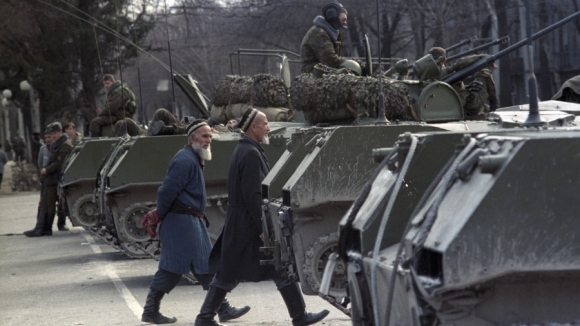
Russians in Tajikistan (photo: RIA Novosti / Vladimir Fedorenko)

Conscripts or contractees?  It’s difficult for the Russian Army to get the right kind of conscripts, where it needs them.  But, over time, it hasn’t been any easier to obtain long-term contract enlisted either. 

Last week, Izvestiya wrote about army plans to replace conscripts currently serving in its 201st Military Base in Tajikistan with contractees. 

An officer in the formation told the paper it’s too costly to keep 3,000 conscripts in Tajikistan, and, by the end of 2012, the Russian Army will replace half with contractees.  A GOMU source tells the paper replacing all 3,000 at once is “unrealistic.”  Contractees will reportedly serve on three-year deals getting 30,000 rubles per month.

The situation for Russians in Tajikistan, the officer says, is strained, and Tajik authorities regularly detain conscripts for one reason or another.  As an example, he cites the case of a conscript driver who killed three Tajiks last January.  Thus, he concludes, it would be easier with “professionals” – contractees —  who “know what they’re doing, and can be responsible for their actions.”

But there’s no reason to think contractees will avoid trouble any better than conscripts.  The first contract experiment proved that.  Contractees are more costly and just as difficult to control, if not more than their conscripted brother-soldiers.

According to Izvestiya, the 201st now has 5,500 personnel, including the 3,000 conscripts.

An old Krasnaya zvezda report says, in early 2007 – at the height of the first, failed attempt at introducing contract service – the military base had 7,000 servicemen in all, about 60 or 65 percent contractees.  Its two maneuver units had 50 percent or fewer in their ranks.

Back then, the Defense Ministry daily said the military was all set to send conscripts in place of hired soldiers.  It was hard to convince older, experienced men to go to Tajikistan because of the difficult living conditions and prospects for serving on contract in Russia.

As Izvestiya’s interlocutor intimated, relations between Moscow and Dushanbe are a bit strained right now, prompting some to wonder out loud if manning the 201st won’t become a moot issue.

Farewell Russian Arms and Russian Army

Does it matter what old soldiers think?  It doesn’t seem to right now.  Maybe they’re just bitter old dudes whose time has passed. 

But they certainly provide interesting and frank commentary on the state of the OPK, the Armed Forces, and Serdyukov’s reforms at odds with official pronouncements from the Kremlin, White House, and Defense Ministry.

Former 58th Army Commander, retired General-Lieutenant Viktor Sobolev wrote recently for Pravda.  He reacted to a program on the army on NTV from October 9.  It apparently wasn’t posted on NTV’s site. 

Sobolev says this right up front:

“On the eve of elections, our president and Supreme Commander-in-Chief Dmitriy Medvedev and ‘national leader’ Vladimir Putin have been worried in turn by the condition of the country’s army and military-industrial complex and are assuring gullible Russian citizens that they will do everything so that our Armed Forces meet modern requirements and receive new types of armaments and military equipment in a timely manner.”

“The Russian mass media [SMI] under the government’s and president’s control have been actively used in making these assurances.”

The ex-general-lieutenant is critical of just about everyone:  Serdyukov and his “effective” managers, people who haven’t served in the army, former First Deputy Defense Minister Popovkin who wanted to buy more arms abroad, his successor Sukhorukov who dares insist that defense enterprises substantiate their prices, independent defense commentators like Litovkin and Pukhov, interest-hungry banks, corrupt middlemen.

He points only to Tactical Missile Armaments Corporation General Director Boris Obnosov in a positive light for recognizing that other countries won’t sell Russia their best weaponry. 

Still, Sobolev’s under a bit of a misimpression thinking that Moscow is really buying lots abroad.  In fact, a cynical observer might conclude the whole situation over the last year was designed to let Putin be the champion of the domestic defense sector vs. Medvedev the Westernizer.  But we digress . . . 

For Sobolev, this all sums to an OPK with a broken GOZ, that’s chronically underfinanced and losing its capability to produce modern arms and equipment. 

Again, the cynic might say this was already lost a number of years ago.

But, says Sobolev, when compared with the OPK:

“Even worse is the situation in the Armed Forces.  It’s believed we have a million-man army which Mr. Sukhorukov recalled on this program.  Let’s calculate it together.  According to TO&E, there are 150 thousand officers in the army, no warrants at all, they were liquidated.  According to civilian [but he still wears his uniform] GOMU Chief V. Smirnov, 184 thousand contractees are serving in the army and navy.  In all 334 thousand, the remaining 666 thousand are conscript servicemen.  But they simply couldn’t have called up so many.  Moreover, conscripts serve not only in the army and navy, of the number called up, up to 30% serve in the Internal Troops, Border Guards, MChS units, presidential regiment, and so forth.  This means in the army and navy huge undermanning exists, and it will only get bigger.  It’s planned to reduce the fall callup by 2 times.  More than 200 thousand citizens, according to Smirnov, are evading military service.  The spring callup stretches out to September, and the fall until March.  In the troops, they’re occupied with it constantly, in the course of the entire year, they take young soldiers into their ranks in small groups, organize individual training for them and try to man sub-units.  At the same time, the process of dismissal also goes on without interruption.  In these conditions, you can’t talk about any kind of quality manning of sub-units.  What kind of units of permanent combat readiness are these?”

“Therefore NATO’s military analysts note with satisfaction that, as a result of the reforms conducted, Russia’s Armed Forces aren’t capable of completing missions even in local conflicts, ‘The Russian Army does not have a sufficient quantity of transport resources for redeploying troops over great distances, does not have a sufficient quantity of aircraft and pilots who know how to fly in any weather, no unified information system.  There are not enough soldiers in the army . . .’”

“In NATO, they understand the Russian Army’s fallen apart, but how about our country’s leadership?”

Whoa. 

Sobolev’s no crank, and he’s not to be taken lightly.  Born and schooled in southern Russia, he probably has combat experience whereas the current General Staff Chief and Ground Troops CINC probably don’t.  Sobolev served as Deputy Commander of the OGV(s) in Chechnya in 2002, before taking over the NCMD’s 58th Army in 2003.  He ended his career as the chief military advisor in Russia’s Indian embassy in late 2010.

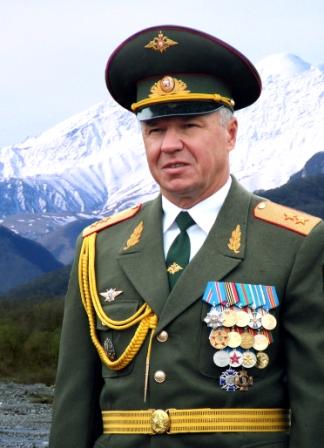
General-Lieutenant Sobolev

A more recent photo shows him looking just about as fit in retirement at age 61.

One wonders if a conservative like Sobolev realizes how much his thinking coincides with that of more liberal critics he seems to detest.

The Ayderkhanov Case (Part II)

According to Newsru.com, Aleksandr Vlasov concluded the traumas on Ayderkhanov’s body were inflicted while he was still alive, and the GVP’s statements about hitting the tree are a fiction without objective confirmation. 

Meanwhile, Ayderkhanov’s relatives organized a round-the-clock vigil at his grave to prevent anyone from stealing his body [i.e. the evidence].  Apparently, some people came looking for his grave on October 18, according to IA Rosbalt.

Ayderkhanov’s aunt told Radio Svoboda that he was full of life and not the type to commit suicide.  Nor was he likely to have conflicts with other soldiers.  She described what happened to her nephew as not just a beating,  but torture.  She said she knew the Yelan garrison had a bad record of conscript abuse.

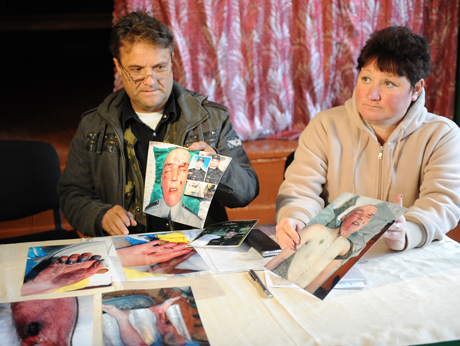
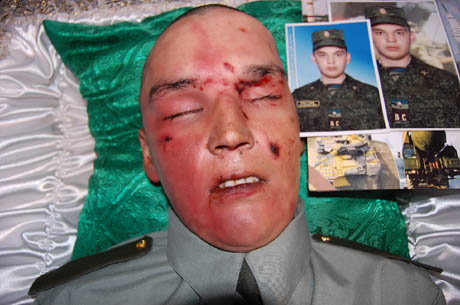
Post-Mortem Photos

Ura.ru writes that this is the third army tragedy in the last six years for Ayderkhanov’s home village Araslanovo and its 800 inhabitants.  The grandson of a local reportedly hung himself while serving in 2005, and another boy ran away from his unit and was found frozen to death in 2008.

In late September, 500 people from Araslanovo (as well as nearby Shemakha, Mezhevaya, Tashkinovo and Skaz) signed an appeal asking President Medvedev to get to bottom of Ayderkhanov’s murder, and accusing his officers of concealing it.  The appeal asks if someone can really commit suicide after such savage punishment?  It notes Ayderkhanov wanted to serve, and even considered staying in the army as a contractee. 

The appeal asks when disorder in the Armed Forces will end, and claims everyone knows such a state of affairs exists not just in Ayderkhanov’s unit but in many others as well.  Finally, the appeal says the people of these villages are stopping the fall draft until order’s established in Ayderkhanov’s unit, and those guilty of beating and killing him are punished.

Despite some sympathy with the cause, the local military commissar has warned that draft evaders will be punished.

According to Ura, some locals believe Ayderkhanov was killed because he was Tatar.  Others who previously served in V / Ch 55062 say the unit was rife with nationalism, dedovshchina, and extortion.

It’s interesting and sad (perhaps not surprising though) that no wider social or political outrage — similar to what occurred in 2006 after the Andrey Sychev case — has developed over Ayderkhanov.

The Ayderkhanov Case (Part I)

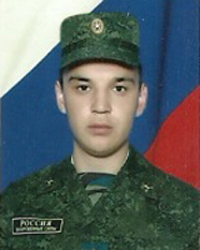
Ruslan Ayderkhanov

Here’s what looks like a case where the beating death of a conscript is being passed off as another suicide in the ranks.  We addressed this here, and the tragic Ayderkhanov case broke into the news just 11 days later.  This sad story deserved attention sooner than your author was able to give it.

Thursday Newsru.com reported Ayderkhanov’s body has been exhumed for additional medical examination to determine the cause and circumstances of his death.  Official examiners as well as one independent expert, Aleksandr Vlasov, will take part in the process which, according to RIA Novosti, should take two weeks.

Newsru recapped the basic facts.  On August 31, the 20-year-old Ayderkhanov went missing from V / Ch 55062, part of the Yelan garrison, located in Poroshino, Chelyabinsk Oblast.  His body was found hanging from a tree in nearby woods on September 3.

The military authorities were quick to label this an obvious suicide, but his relatives were suspicious about injuries all over Ayderkhanov’s body.  He had teeth knocked out, a broken leg, a missing eye, a knife wound in his chest, and burns, bruises, and abrasions.

The Yelan garrison’s military prosecutor opened an Article 110 “Incitement to Suicide” investigation, but just as quickly announced there were no facts indicating violence or the “violation of the regulations on mutual relations” [i.e. abuse] against Ayderkhanov.  The prosecutor concluded the soldier was simply depressed about the death of his mother last winter. 

The Main Military Prosecutor stated categorically there was no evidence of a beating, and any injuries on Ayderkhanov’s body were from banging against the tree on which he hung himself.  The GVP categorically rejected the idea of exhuming and examining the body again.

Radio Svoboda quoted GVP directorate chief Aleksandr Nikitin:

“There is evidence that his death was not a result of violent actions.”

RIA Novosti continued from Nikitin:

“A close examination of the place of death and Ayderkhanov’s body was conducted.  The investigation established that there are not any traces of violence which could have caused the serviceman’s death on the body.”

Ruslan Ayderkhanov

Nakanune.ru quoted a Central MD spokesman:

“According to preliminary data, no facts of nonregulation relations have appeared.  But if the guilt of officials is proven, they will be punished in the most strict way.”

According to Radio Svoboda, after the GVP proved no help, Chelyabinsk’s human rights ombudsman approached Aleksandr Vlasov.  Vlasov has stated his professional opinion that Ayderkhanov was struck at least 18 times while he was still alive.

Part II tomorrow.

Exercise Casualties

Russia’s fall exercises took a toll on some conscripts participating in them.  Three were killed in Union Shield-2011 at Ashuluk, and two more may have died during Tsentr-2011.

Life.ru reports a conscript died on September 26 from injuries sustained in a fall from a railroad platform while loading equipment during Union Shield-2011.

According to IA Regnum, at Ashuluk on September 24, an automated command and control system operator, a draftee, was found dead in a KamAZ.  An officer and two conscripts had to wait for help overnight when their vehicle broke down.  One of the conscripts apparently died during the night. 

On September 20, a Russian attack aircraft fired an errant air-to-surface rocket that flew several kilometers from its intended target before exploding, killing one soldier and injuring a second.  IA Rosbalt also noted Ashuluk was the scene of an August 23 ordnance accident that killed eight soldiers.

News outlets and military spokesmen are publicly disputing whether two tank crewmen died of carbon monoxide poisoning while President Medvedev and Defense Minister Serdyukov reviewed the concluding phase of Tsentr-2011 at Chebarkul on September 27. 

According to Novyy region, a Chelyabinsk rights activist says two conscripts died and the military is trying to cover up the accident.  Another source says the two men are hospitalized in critical and serious condition respectively.  The army says the men were poisoned by powder gases during training before Tsentr, and will soon be discharged from the hospital.  The Central MD’s press-service says the exercise was conducted without incidents, accidents, or equipment failures.

Military prosecutors are investigating at least some of these incidents.