Category Archives: Conscription

Supreme CINC Meets Troops at Alabino

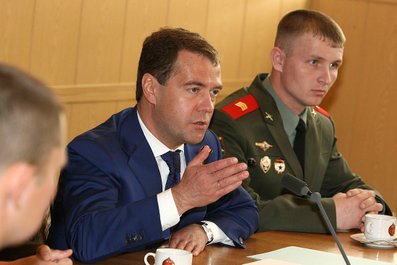
President Medvedev at Alabino

On 5 May, President Medvedev visited Alabino’s 5th Guards Taman Independent Motorized Rifle Brigade (formerly division), a traditional showcase and test bed formation for new equipment and concepts.  

Medvedev and Defense Minister Serdyukov followed up the latter’s late April meeting with the Committee of Soldiers’ Mothers and other public representatives about ‘humanizing’ the armed forces.  At that time, Serdyukov presented ideas for driving the ‘spirit of the prison camp from the army.’  They included freeing soldiers from additional duties to focus completely on training, allowing them more free time, pushing reveille and lights-out back an hour, mandating a rest hour after lunch, instituting a 5-day conscript working week, allowing the possibility of draftees serving close to home, and obtaining weekend passes to leave the garrison. 

Alabino is a place where things like these are typically tried out. 

As Rossiyskaya gazeta put it, Medvedev went to Alabino to see how conscripts live in ‘new profile’ conditions.  He inspected the training grounds, classrooms, and barracks, and answered questions from the new soldiers themselves.  

Medvedev and Serdyukov addressed physical training, one-year conscription, contract service, weekend passes, mobile phones, and hiring civilians to perform nonmilitary support services. 

Taman Brigade Commander Andrey Ivanayev told the Supreme CINC about the experiment with intensive physical training (PT) in his formation.  Ivanayev indicated the troops formerly had 53 hours of PT  per year, but now get 4-5 hours per day, or about 25 per week.  He and Medvedev discussed how soldiers are separated into groups by the physical load they can handle. 

In the Kremlin.ru transcript, Ivanayev said in April testing there were only 88 negative PT evaluations.  According to RIA Novosti’s reporting, Ivanayev thinks the formation’s fitness level has already increased 50 percent.   

Medvedev remarked on the Taman brigade’s outfitting with special PT gear.  He asked Defense Minister Serdyukov about introducing new athletic uniforms in other units.  Serdyukov said:  

“Yes, we are literally this spring buying 50,000 sets and toward fall, apparently, on the order of 100,000 more, the fact is in the course of two years we’re trying to outfit the entire army fully with sports gear for training in summer as well as winter.” 

Most important to the vast majority of Russians, Medvedev told Taman brigade soldiers he doesn’t intend to raise the current 1-year conscription term:  

“That decision on the transition to one-year service which was made, it was painful for us, it isn’t easy, but we won’t change it.  Service in other countries comparable to our country in combat potential is organized in exactly such as way.  And this year still allows us to train a quality specialist, soldier, sergeant.  And despite the fact that there are now certain problems with manning—it’s true, we don’t intend to change the service term.” 

When one soldier asked about enlisted contract service, Medvedev turned to Serdyukov to explain what’s new on this front.  Serdyukov answered: 

“We are now preparing a concept precisely on contract service for soldier and sergeant personnel.  There will be an entire complex of proposals, including on pay, service conduct.  We will equate the entire social package (sergeant like officer) on support, pay and all parameters . . . .” 

“I think in the course of this summer we will prepare and then send you concrete proposals about how this will look, what quantity of contractees we intend to accept, in which specialties particularly and with what kind of pay.” 

Medvedev responded that current pay is not very high, but those who are serving well on it should be retained: 

“However, at the same time, it’s completely obvious according to the well-known principle, better less, but better.  Let there be higher pay and those remaining will really want to serve, instead of us spreading this [pay] among a large quantity of contractees, who won’t have the stimulus, particular desire, or any kind of motive to continue serving and to serve well.” 

When Medvedev pressed him for what he thinks about contractee pay, Moscow MD Commander Valeriy Gerasimov finally said he thinks contractees should get 50-60 percent of lieutenant pay.  Serdyukov said it would be more on the order of 80-85 percent, depending on the duty position.  The more technically complex, the closer to officer pay.  He continues: 

“We are proceeding from the fact that, on the whole, in all the armed forces—a lieutenant from 55, and a sergeant from 35 [thousand rubles per month] . . . .” 

But a little math says that is closer to Gerasimov’s figure, or 64 percent of officer pay . . . 

Medvedev asked his Defense Minister about devising a policy to give conscripts weekend passes to visit home if they live nearby.  Serdyukov said: 

“We are planning over two-three months to proceed on this regime.  Well, naturally, after taking the oath, after he becomes a soldier, after this we’ll introduce it.  We have this really experimental brigade, we are just beginning to work all these approaches out.” 

Medvedev added: 

“Here again we have to proceed from modern approaches.  If a guy serves close by and manning goes according to the territorial principle, then why not let him go home?  Another thing, of course, everyone has to understand what responsibility the soldier carries for any type of infraction in this case, but this is just a question of self-discipline.  You want to go home for the weekend, this means, simply do everything as it’s supposed to be done.” 

Serdyukov chimed in: 

“In the course of five days [of the working week] you need to show the highest indicators, then this will be a particular stimulus for one who wants to pay a visit home on Saturday and Sunday.” 

This policy is especially interesting . . . the possibility of the weekend pass is predicated on several things not really discussed during the Alabino visit.  Working backward, the pass depends on successfully implementing a five-day working week for conscripts.  Then on having conscripts serving relatively close to home in the first place.  At least one voyenkom has already said conscripts from his republic don’t have this chance because they all serve outside their home borders.  A prized weekend pass could also become one more thing to be bought and sold to the highest bidder, or briber.  If implemented, this policy will be difficult to maintain in the face of soldiers who don’t return to the garrison or get into serious trouble while away from it. 

A new conscript asked Medvedev if mobile phones are permitted in the army.  The President asked him if he had one in his pocket, and the soldier replied yes.  Medvedev responded, “Then why did you ask?”  He continued: 

“In fact these rules, as I understand, essentially are established at the unit level, at the level of the corresponding troop formation, but there are no bans on this issue.” 

Gerasimov added that in the Moscow MD anyone may have a cell phone, but they may not be used during training or duty time. 

Discussing training and physical conditioning, Serdyukov turned to one of his earliest initiatives at the Defense Ministry—relieving soldiers from essential nonmilitary duties like kitchen patrol, cleaning, groundskeeping, and utilities maintenance. 

He mentioned the goal of moving to civilian service and support within 12-18 months in all Defense Ministry units, but “everything will depend on our financial condition.  According to preliminary calculations, we have to make do in the bounds of our existing budget.” 

Medvedev said: 

“I think here it’s obvious to everyone that soldiers and officers need to serve the Motherland, be occupied with troop training, improve their physical conditioning, but questions of maintaining the sub-unit, generally, this is an issue which civilian organizations could do successfully for money, as this is done, incidentally, around the world.  Then there won’t be problems with tiresome details and it’ll be possible to concentrate on fundamental service.” 

Civilians already take care of the Taman brigade’s food service, and soon they will maintain its engineering networks, and provide cleaning services.  Serdyukov indicated the FSB is working on licensing firms to work in closed facilities, and Oboronservis will work in remote garrisons where contractors can’t be found.
Victim of the ‘New Profile’

Obvious individual suffering from Serdyukov’s ‘New Profile’ military reforms hasn’t been readily apparent until now.

Russian media today carried sad news about a 34-year-old lieutenant colonel, one Aleksey Kudryavtsev, serving in Udmurtiya, who hung himself in the forest upon learning his unit would be disbanded.

Press said he served in v/ch 93233, which Yandex shows is the military commissariat [draft and mobilization office] for Igra Rayon of the Udmurt Republic.  Kudryavtsev must have been one of the few remaining uniforms in the commissariat since most military men were early victims of Serdyukov’s cut in the officer corps.  Some officers have been able to serve on as civilians.

Despondent on finding out about his imminent dismissal, the lieutenant colonel stood to lose not only his post, but also his service apartment.  He wrote his wife a note saying not to look for him and to start a new family, and then disappeared last September.  His body was finally located in a remote wooded area.  He left sons of 4 and 8 behind.

Newsru.com and Argumenty nedeli covered the story.

Major Beating at Shilovskiy

According to Kommersant, prosecutors have charged an artillery battalion commander from a motorized rifle brigade based below Novosibirsk with exceeding his authority by beating four conscripts from Dagestan.  A senior investigator from the Military-Investigative Department of the Prosecutor’s Investigative Committee for the Novosibirsk Garrison reports that the incident occurred last November at the Shilovskiy range when Major Nikolay Levyy beat two draftees from Dagestan in his office, then smashed their cell phones.  Levyy had been critical of the pair on more than one occasion. 

Two more natives of Dagestan got it from the major in front of the formation.  The investigator determined that Renat Magomedov got the worst of it when the major asked whether Magomedov would fight for the battalion or his own people if he had to choose, and Magomedov responded for his compatriots.

After this, the investigator reported, Slavic servicemen proceeded to beat all four soldiers from Dagestan.  Major Levyy looked on without intervening.  That evening, the events spiraled into a larger fight.  Russian servicemen herded dozens of Caucasian servicemen into one barracks and locked them  down.  Overnight, the unit’s officers managed to quiet the disturbance, and all soldiers from Dagestan were later sent to other units.

Major Levyy was relieved of duty pending the outcome of his case.  He did not admit his guilt, but also refused to incriminate himself by giving evidence.  The events involving the other fighting are still under investigation.

The media accounts note that this is not the first mass fight between Caucasians and Slavs at Shilovskiy.  The last one occurred on 8 January 2007 when officers had to fire warning shots to break it up, according to Kommersant.  Law enforcement only found out when one soldier turned up in the hospital with a ruptured spleen several days later.

Some press reminded readers of the early July 2009 incident in which 200 Russian and other soldiers reportedly fought with 44 conscripts from Dagestan at Aleysk, also in the SibVO.

Some thoughts on this news item . . .

The major smashing the soldiers’ cell phones is interesting.  Commanders say they don’t like soldiers having them because new conscripts have them taken away by older soldiers, contractees, and officers.  Commanders say cell phones jeopardize their units’ secrecy and security.  But they probably don’t like them because cell phones are a lifeline to call for help in cases where conscripts are being abused or mistreated.  This tends to get the commander in trouble, one way or the other.

Would the major ask a soldier from Dagestan if he would fight for his battalion or for his compatriots if there weren’t already some pretty serious interethnic violence, conflicts, and tensions in his unit?

Shilovskiy is basically a SibVO arms and equipment storage base left  unchanged despite the army’s ‘new profile.’  Levyy, like other Russian officers, probably faced the reality that there are now fewer officers, warrants, and contract sergeants to supervise increased numbers of conscripts.  The commander also faces more demands from his superiors, the SibVO, Genshtab, and Defense Ministry today with the push for the ‘new profile.’  It likely breeds frustration that drives higher levels of officer crime from year to year.  It’s interesting that it’s the battalion commander himself using his fists against soldiers, and not their own battery commanders, captains, or lieutenants.

A major in Levyy’s position is damned if he doesn’t and damned if he doesn’t.  If he acts, he has few levers at his disposal—where are the new military police, the guardhouses, the old military commandant?  So he resorts to his fists and something akin to prison camp order.  And if he doesn’t act, he can’t keep order at all and the situation just gets worse.

There are lots of other incidents involving conscripts from Dagestan either giving, or taking, beatings in the armed forces.  And we’ll look at some in days to come.  But interethnic tensions in the Russian Army don’t always involve just soldiers from Dagestan.

Second Half of General Staff Chief’s Interview

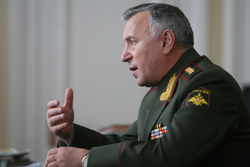
General Staff Chief Makarov (photo: Viktor Vasenin)

Rossiyskaya gazeta published the second, less substantial, half of Nikolay Makarov’s interview yesterday.

On speculation that the one-year conscription term will be raised, Makarov said:

“No one intends to increase the conscript service term.  But in the Defense Ministry they are thinking of measures to tighten accountability for evading military service.  Today no serious sanctions are applied against evaders.”

Regarding the supply of young men for the army:

“. . . after the transition to 12-month conscript service the callup increased about two times.  But from 2012 the complex demographic situation in the country will add to the problem of manning the armed forces.”

So this is why the military is thinking about clamping down on evasion, which Makarov puts at about 200,000 for all draft-age men.

Asked about measures to make the life of military school and institute cadets more like that of other students, Makarov said changes in the order of the day will have cadets go to classes and exercises in the mornings, and they will be free in the afternoons.  He continues:

“Why do we have to lock cadets in the barracks?  We understand if a person consciously picked the military profession, this means he will study.  If he’s not sure of his choice, he’ll simply get filtered out.”

Makarov indicated the Defense Ministry is looking at having its new state-owned rear services corporation Oboronservis supply militarized security guards for garrisons.  Privatized security companies would relieve servicemen of all guard duty functions and allow them to stop taking personnel away from combat training.  He cites U.S. and Israeli experience in using hired security for these purposes.

Makarov reaffirmed that only professional contract soldiers will serve in Abkhazia and South Ossetia.  He added:

“Even brigades in immediate proximity to the borders will be manned by professional soldiers to the greatest degree.”

That’s a lot of confidence to express in a professional contract service program that he’s deemed a failure.

Makarov indicated the ranks of generals have been trimmed from 1,200 to about 700, but he insisted all combined arms brigades with 3,000 personnel would be led by general-majors, not colonels.  He said generals had been cut in the Defense Ministry’s central apparatus, its main and central directorates, including the Genshtab, and the main commands of the services.  He concluded, “Now to become general, you need to serve with the troops.”

Makarov discussed the evolving training and promotion system for officers:

“Now a system has been built out where an officer after [commissioning] school can occupy at most a company commander position without supplementary training.  They can only be appointed higher through specialized courses.  Candidates for promotion need to complete them, take corresponding examinations.  And then they will pick the best on a competitive basis.  They will appoint them to higher positions.”

Under the old Soviet and Russian system, mid-career education and training didn’t usually come into play until an officer had commanded a battalion and was preparing to move into regimental command or staff positions.

Makarov said the new specialized courses might run 3 weeks for battalion chief of staff positions, or maybe several months for other positions.  He said the army would not be looking at keeping officers in certain posts for obligatory periods.  Some might master their duties in one year, others might not in five, he said.

Asked about whether Russia would accept French helicopter carrier Mistral as a ‘shell’ without weapons and electronics, Makarov said:

“The country’s leadership and the Defense Ministry have an absolutely clear position on this subject.  If a final decision on Mistral is made, then we’ll accept this ship only in a fully equipped form–with all command and control systems, navigation, and armaments.  The only exception is helicopters.  They will be ours.  Everything else must be done to their standards in full form.”

Asked whether the army would conduct reservist assemblies and even callup reservists for short periods, Makarov said no, conscripts are covering Russia’s manpower requirements, and reservist training assemblies would be kept at the level of about 10-15,000 men for the whole country.

State of the ‘New Profile’ in One District

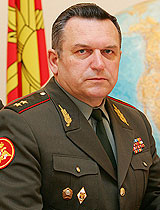
General-Lieutenant Bogdanovskiy

Leningrad Military District (LenVO) Commander, General-Lieutenant Nikolay Bogdanovskiy held a news conference today and, along with talking about the upcoming Victory Day parade on St. Petersburg’s Palace Square, he talked about his district’s ‘new profile.’

Firstly, following General Staff Chief Makarov, Bogdanovskiy said contractees will be reduced and conscripts increased.

Specifically, he stated:

“. . . the number of contractees will be signficantly reduced, many of those who showed themselves incapable of serving will need to be dismissed.”

The LenVO needs 25,000 draftees from this spring’s consription campaign beginning on 1 April. But he said this won’t create problems because, last fall, 100,000 young men came through the LenVO’s voyenkomaty and 25,000 were deemed fit to serve.

The LenVO Commander said, in the process of ongoing personnel cuts, 1,600 officers and 1,200 warrants have been ‘placed at the disposition’ of their commanding officers, but only 346 and 284 respectively have been discharged from the service.

These are surprisingly small numbers.

So, in the LenVO at least, only 22 percent of the officers destined for dismissal could actually be dismissed with the benefits and apartments owed them.  The other 78 percent remain in limbo, without duty posts and living on their rank pay [perhaps one-fourth of their former total monthly pay].  And 24 percent of warrants could be sent home with benefits and housing while the other 76 percent wait for these things.

Bogdanovskiy has also asked St. Petersburg’s governor to resolve a situation with owners of garages located on land the Defense Ministry claims near the village of Yukki, where the LenVO now wants to build apartments for servicemen.  But that one will be hard; the Defense Ministry’s old nemesis Rosimushchestvo says the property doesn’t belong to the military.  The builder and construction equipment have already been out to the site with the intention of knocking down the garages.  Boganovskiy says the plan is to put 50 apartment houses on this territory.

The LenVO Commander also acknowledged problems with military housing built in the district:

“I’ve more than once tried to sort out the quality problem in the housing in Pushkin.”

He indicated the problems started small, but failure to fix them in a timely manner means ten times the amount of money must be spent to repair them now.  But he promised to do so by the end of spring.

On the force structure front, he says the LenVO’s reforms were largely completed in 2009.  Ten brigades and other units were formed or reformed in the process [the district has 3 combined arms brigades–the 25th, 138th, and 200th].

Regarding problems with the command and violence in the 138th Independent Motorized Rifle Brigade at Kamenka, Bogdanovskiy said:

“. . . we haven’t managed to complete fully tasks connected with discipline–in particular, in the 138th Kamenka Brigade the commander, chief of staff, and assistants for armaments and socialization work were dismissed because of events there.  Now the situation is normalizing, we are trying not to repeat past mistakes.”

Interesting insights into what the Serdyukov’s reforms have meant for one, albeit small and not particularly significant, district.  But, if such a large percentage of officers are being left ‘at the disposal’ of their commanders, can one believe Serdyukov’s assertion that 65,000 officers were put out of the armed forces last year?  Does this include a small number of dismissed and a much larger number of those left ‘at the disposal’ of commanders?  On an issue closely tied to officer cuts, can one believe that the Defense Ministry really obtained 45,000 apartments last year if so many soon-to-be-ex-officers are ‘at the disposal’ awaiting them?

It would seem that, if Serdyukov has failed, or been unable, to move as speedily on officer reductions as he wanted, the door might be left open for someone to reverse this policy, especially if a large number of potentially angry officers remains for a long time in the limbo of being neither in, nor out of, the army.

Collapsing Contract Service, the Draft, and Professional NCOs

General Staff Chief Makarov’s recent death pronouncement for contract service means, as he said, more conscripts in the near future (or an attempt to conscript more soldiers).

In the longer run, however, the collapse of contract service means the Russian Army faces several manpower policy choices, each unpalatable for its own reasons.  The army will likely be less combat ready, and less combat capable, than desired.

Think back about where the army’s been, and how it reached the current predicament.

The armed forces were reportedly 1.13 million men, but probably more, in recent years.  At any moment, they had four distinct draft contingents of about 130,000 conscripts, totaling 520,000 draftees.  Next, they had a layer of perhaps 300,000 contractees and warrant officers.  The contractees included probably 90,000 long-term enlisted, NCOs, and females as well as no more than 80,000 contract soldiers from 2002 and later.  There were probably about 130,000 warrants.

So, let’s count 520,000 conscripts and the middle layer of 300,000, for a total of 820,000.  Lastly, on top, let’s add nearly 400,000 officers. 

What did this manpower structure mean for the Russian Army’s force structure?

With practically the same number of conscripts and officers, the force structure was hollow–few units or formations were fully manned and many low-strength (cadre) units had officers and equipment, but only small numbers of soldiers–conscript or contract–and they existed only to be fleshed out with mobilized reservists in the unlikely event of a big war.

This structure didn’t work well in little wars like Chechnya or more recently Georgia in which the army had to piece together regiments by finding combat ready battalions and capable commanders wherever they could be found.

In 2006, Putin said of the military dilemma at the outset of the second Chechen war:

“. . . we needed to gather a force of at least 65,000 men.  And yet the in all of the Ground Troops there were only 55,000 in combat ready units, and even they were scattered all around the country.  The army was 1.4 million strong, but there was no one to do the fighting.  And so unseasoned lads were sent to face the bullets.”

And in late 2008, Medvedev emphasized the need for 100 percent combat ready units as the number one lesson of the August conflict over South Ossetia:

“Overall, these changes aim to make the Armed Forces more combat ready.  We talked about the war in the Caucasus, where our armed forces demonstrated their best qualities, but this does not mean that there were not also problems that became apparent.  We need to continue improving our Armed Forces. What steps does this require?  First, we need to move over to a system of service only in permanent combat ready units.”

So, after the August war with Georgia, Serdyukov moved to eliminate the huge, big-war mobilization base, hollow units, and unneeded officers, and to use the savings to man and outfit 85 Ground Troops brigades in a permanently combat ready condition.

Given a nominal strength of 3,000 men in them, the army needs roughly 260,000 troops to man these new combat brigades.  And this doesn’t count conscripts needed elsewhere in the Ground Troops, Rear Services, VVS, VMF, RVSN, VDV, or KV.

With the commencement of the one-year draft in 2008, Moscow doubled its induction of conscripts from 130,000 to 270,000 every six months.  And the Ground Troops need fully half the 540,000 conscripts present in the armed forces at any given moment.

Like any country, Russia has a real and an ideal army, the army it has and the army it wants (a la Rumsfeld).  Moscow’s ideal army by 2012 has one million men, including 150,000 officers, a layer of 64,000 professional NCOs, and conscripts as the balance, perhaps 800,000.

But the Arbat military district hasn’t articulated it this clearly for several reasons.  First, shedding officers and (warrants) year after year isn’t an easy task.  Second, the number of professional NCOs desired or available in the future is in doubt given General Staff Chief Makarov’s and Defense Minister Serdyukov’s statements on the failure of contract service and the apparent withdrawal of funding for the current contract sergeants program.  And third, it’s unclear if Moscow can draft 400,000 young men semiannually to put 800,000 soldiers in the ranks.

The army Russia has is messier than the vision stated above.  Serdyukov says they are at 1 million already.  There were a reported 355,000 officers at the outset of the current reform in late 2008.  About 40,000 officer billets were vacant and 65,000 officers were released in 2009, putting them at 250,000 officers today.  Serdyukov has set about the elimination of almost all warrant officers, but he hasn’t said what they’ve done in this regard yet. Let’s guess 30,000 have been dismissed, leaving 100,000 warrants.  Let’s also make reasonable guesses that 60,000 recent contractees and 70,000 longer term ones remain in the troops.

So what is there?  Armed forces with 540,000 conscript soldiers and about 480,000 officers, warrants, and contract enlisted.  Moscow will have to revitalize its military education system to get the smaller number of quality officers needed in the future.  Getting the requisite numbers of conscripts will be a challenge given the country’s well-known demographic problems which are biting hard right now.  But obtaining the noncommissioned officer layer of military unit leadership is also proving difficult.  The layer is presently a jumble of perhaps 230,000 warrant officers, contract sergeants, and even officers and warrants who’ve accepted downgraded positions rather than dismissal.  It is not the army’s ideal, but this middle layer fulfills some functions.

With all this said, what are the Russian Army’s manpower options for the future?

If Moscow actually reduces the officer corps to 150,000 by 2012 and the contract sergeant program is not put on track, the balance of its 1 million man army could be 800,000 or 850,000 conscripts (including conscript-sergeants trained for only 3 or 6 months).  Drafting 400,000-425,000 men every six months would be practically impossible.  Of the current cohort of maybe 900,000 18-year-olds, maybe 300,000 can be inducted, leaving the army to find 500,000-550,000 conscripts among men who are 19-27 and have not already served, but can be difficult to induct for various reasons.

Even if manned fully, a 12-month force has to make Moscow wonder whether this mass of conscripts with this amount of training really meets its definition of a modern, combat-ready, and combat-capable army.

Reducing the manpower requirement by cutting the army’s overall size would reduce the draft burden, but it would contravene the decreed million-man army policy.  There would be howls of protest that the army is too small to cover Russia’s borders (as if one million is even enough to do it).

Extending conscription back even to 18 months would ease this task considerably.  Moscow could take just slightly more than the 270,000 it is conscripting now for 12 months, and by keeping them an extra six months, it could work its way up to a conscripted force of nearly 850,000 in the space of a year and a half.  An increased draft term would be unpopular but Russians would swallow it.  It’s not like it would lead to a Medvedev (or Putin) defeat at the polls in 2012.  The real problem might be the draft’s similarity to taxes–the longer (or higher) they get, the more incentive for people to avoid them.

So that brings us back to the central point.

The way to reduce the number of conscripts needed for a million-man army, keep the draft term at 12 months, and have a reasonably well-trained and capable force is the one path that has been abandoned–developing a large and professional NCO corps that has the right material incentives to serve for a career.

The slow-to-start, small-scale, and apparently recently eviscerated Federal Goal Program to train only 64,000 professional sergeants is not enough.  The current ranks 230,000 of former officers turned sergeants, warrant officers, warrants turned sergeants, contract sergeants, and enlisted contractees is a stew that could theoretically be converted to a professional NCO corps, but it would be far from easy.  In terms of size, however, it’s more like what’s required to do the job, lighten the conscription load a little, and impart some professionalism to a mass, short-term draftee army, if these NCOs become professionals themselves.

What professional NCOs demand in return is pretty basic (higher than median income wages, family housing, and guaranteed off-duty time outside the garrison), but they haven’t gotten it since the most recent contract experiments began in the early 2000s.  In many cases, even officers haven’t got these things.  But the pay promised in the contract sergeant program (up to 35,000 rubles per month after graduation) is more like what’s needed to attract men.

The sergeant program seems to be the army they want, but the Defense Ministry appears to have pulled the financial plug on it.  The flotsam and jetsam is the army they have and might be turned into something, but there’s no move in this direction as yet.  Meanwhile, recall that Serdyukov’s plan for mass officer reductions was partly justified by the thinking that many officer tasks would go into the hands of capable NCOs.  And as recently as the 5 March Defense Ministry collegium, Medvedev said:

“Particular attention also should go to sergeant personnel. Sergeants need to be capable, if the situation demands it, of replacing their tactical level officers.”

Plug Pulled on Contract Service

On Friday, Interfaks said a source in the Federation Council’s Defense and Security Committee indicated the latest contract service program (the Federal Targeted Program (FTsP) for Manning Sergeant (Petty Officer) and Soldier (Sailor) Ranks with Contract Servicemen) has been scrapped.  The program was supposed to produce 64,000 contract NCOs by 2015. 

The financial resources for this 2009-2015 program have been slashed by 86 percent according to an Audit Chamber report given to the upper house of the Russian legislature.  A Defense and Security Committee representative says 22.4 billion rubles of the 26.6 billion ruble program were slashed.

This certainly sounds like losses have been cut to what’s already been spent on selecting and beginning to train a little more than 200 future sergeants at Ryazan.  The program was slow in starting, and of 2,700 candidates who came to Ryazan, only 239 were ultimately accepted.

General Staff Chief Makarov and Ground Troops CINC Postnikov recently admitted contract service had failed, but said the contract sergeant program would continue.  They didn’t say it would basically be limited to its current very small scale.

Infox.ru on Friday quoted Prime Minister Putin who, in 2008, called the contract sergeant program “the logical development of plans for the organizational development of a modern and highly professional Russian Army.”

On cutting conscription to 12 months, Putin said, “For this decision we went logically over the course of the last six years, developing a system to attract citizens to military service in a voluntary manner, on contract.”

He continued, “. . . the main load of servicing new weapons systems will be on contract-sergeants in coming years” and “forming the professional sergeant corps is an important step toward a more modern organization of combat training.”

Apparently, none of this will happen now, and the army will rely more on its conscripts and traditional conscript-sergeants with six, or more likely three, months of training.

Russians Don’t Want to Serve in the Army

Three polls are better than one.  Three different opinion polls find Russians prefer their sons and brothers not serve in the army by a margin ranging from fully one-half to nearly two-thirds of those queried.  Press reporting on these polls didn’t do them justice, so here’s another take on them.

Look first at Levada-Tsentr, the most independent and well-respected Russian polling firm.  Levada’s published numbers on yes-or-no to army service date back to 1998, when 84 percent said they’d prefer their relatives not serve in the armed forces.  This no-to-service number declined to 77 percent in 2004, and to 53 percent in 2008, before increasing again to 57 percent of respondents indicating a preference against service this year.  The corresponding yes-to-service numbers start from a low of 13 percent in 1998, rising to 35 in 2007, 36 in 2008, and 34 percent this year.

So, in late January-early February 2010, 57 percent said don’t serve, 34 percent said serve.  Presumably, 9 percent just didn’t answer either way even though that wasn’t a choice in Levada’s survey.

Levada also asked, ‘if not, why not?’  Respondents could choose from multiple ‘why not’ reasons.  ‘Dedovshchina, nonregulation relations, violence in the army’ was the top ‘why not’ answer with 40 percent in 1998 and still 37 percent in 2010.  It’s interesting that the 2006 number spiked to 49 percent, probably because the poll came right after the notorious Sychev abuse case broke.

Levada’s next top 5 ‘why not’ answers:

  • ‘Death/injury in Chechen type conflicts’
  • ‘Denial of rights and humiliation of servicemen by officers, commanders’
  • ‘Difficult living conditions, poor food, health dangers’
  • ‘Moral decay, drunkenness, drug abuse’
  • ‘Collapse of the army, irresponsible policy of the authorities in relation to the army’

The number of those picking these declined by nearly, or more than, half over the 12-year period, 1998-2010.  But dedovshchina, hazing, abuse, violence, whatever you call it, persisted.

Since 1998, Levada has also asked whether Russians prefer conscript or contract service, and they’ve consistently answered contract, but the gap has narrowed since the mid-2000s to 54 percent for contract and 39 for conscript in 2010.

Similarly, for three years, Levada asked Russians whether a family member should serve, or seek a way to avoid serving, if drafted.  This one’s pretty much a toss-up this year, with 46 percent saying serve, and 42 percent saying find a way to avoid serving.

Levada also published two years of responses on whether Russia should preserve a million-man army or cut it and use the savings to equip the army with the newest weapons.  The gap on this question went wider this year with 36 percent favoring the million-man army and 50 percent the smaller, better equipped one.

Levada always asks about threats to Russia and the army’s ability to defend the country.

On threats to Russia from other countries, the poll tends to go up or down by 10 percent from year to year, but has still been pretty consistent over the last decade.  In 2010, 47 percent said there are definitely or likely threats to Russia (48 percent said this in 2000).  This year 42 percent said there are most likely or definitely not threats to Russia (vs. 45 percent in 2000).

On the army’s ability to defend Russia, the number also goes up or down by 10 percent from year to year.  In 2010, 63 percent said definitely or most likely yes it can defend Russia.  This figure was 60 percent in 2000, and 73 percent in 2008 and 2009 (perhaps still high from victory in the war with Georgia).  So it seems the number returned more to the norm this year.  Those who said it definitely or most likely can’t defend Russia was just 22 percent this year.  It had been 38 percent in 2005, and 31 percent in 2000.

But back to the mainline question on serving or not serving in the army . . . .

The All-Russian Center for the Study of Public Opinion (VTsIOM or ВЦИОМ) asks the same basic question as Levada—effectively, would you want your son or brother to serve in the army?  It’s the same question because Levada and his close associates went on their own when the Russian government moved to assert control over this inconvenient organization in 2003.

In VTsIOM’s mid-February poll, 50 percent said no-to-service and 36 percent yes-to-service.  Unlike the yes-no on Levada’s survey, VTsIOM allows for ‘I find it difficult to answer’ and 14 percent indicated that (but in Levada’s poll 9 percent didn’t answer, so there’s not a great difference here).  VTsIOM also breaks its responses out by sex.  Women were not surprisingly less likely to say yes-to-service than men and somewhat more likely to say no-to-service. 

VTsIOM also cross-referenced responses to its yes-or-no-to-service question by the respondent’s evaluation of the Russian Army’s condition.  So, of those who said the Russian Army’s condition is ‘very poor,’ 67 percent also said no-to-service.  But 54 percent of those who said its condition is ‘very good’ still favored no-to-service.

VTsIOM’s ‘if not, why not’ data is a little different from Levada’s.  It only gives data for 2000, 2002, and 2010.  Like Levada, in 2010, the number one reason was ‘Dedovshchina, nonregulation relations, violence in the army,’ but with 75 percent of respondents picking it in this closed, multiple choice question.  Otherwise, its list of top ‘why not’ answers tracked closely with Levada’s.

VTsIOM also collected data on responses by geographic region and educational attainment, though it didn’t fully publish it.  For instance, Russians in Siberia and the Volga basin are more likely to say yes-to-service than the average Russian, according to VTsIOM.  Poorly educated [undefined] respondents said yes-to-service slightly more than half the time.

Educated [undefined] Russians said no-to-service at a 57 percent clip.  And southerners and northwesterners said no at 56 and 55 percent respectively.

Early last October, SuperJob.ru conducted a poll on the issue of service.  But it limited its respondents to Russians with sons, and its question to whether they would want their sons to serve in the army.  SuperJob.ru also broke out respondents whose sons have already served (6 percent) and it also allowed for a ‘I find it hard to answer’ option (11 percent).  That said, this poll’s responses were 63 percent no-to-service and 20 percent yes-to-service.

SuperJob.ru also broke out its data by sex, age groups, and educational attainment.  The age group data was interesting for the 45-55 and the above 55 groups.  Respondents in those groups reported that their  sons had already served at the rates of 22 and 23 percent respectively.  This is a good indication of the general rates at which young Russian men serve (about one-fifth) or manage to avoid serving (about four-fifths) one way or the other.

Russians with higher education were more likely to say yes-to-service (25 percent) and those with only secondary or technical degrees were more likely to say no-to-service (66 percent).

Some of what SuperJob.ru’s respondents said:

‘Yes, I would’ – 20 percent.

  • ‘All men in our family served, and he is no exception.’
  • ‘I myself am an officer.’
  • ‘Why not?’
  • ‘A good school for life.’
  • ‘Let the lad grow.’
  • ‘Yes, I would.  But in my region, so there’s a chance to see him more often.  And on the condition that there’s access to the Internet and mobile phones.  Even more desirable would be if there they taught some kind of profession:  telephone operator, driver, draftsman, etc.’
  • ‘Of course, this is the obligation of every man.’
  • ‘Avoiding army service is shame for a man.’
  • ‘My first son didn’t serve, and should have.’
  • ‘Who can’t survive the army won’t survive in life.’

‘No, I wouldn’t’ – 63 percent.

  • ‘My husband and I gave 30 years to the service, and now don’t have anything.  And we raised two sons without the state’s help.  And now when they are grown, it turns out, they have a debt to the state!  When will the state pay its debts to us?  Enough, we’ve already served ten years for each child.’
  • ‘My brother served, after which he said he would never send his son to the army.’
  • ‘I’m afraid for my child.’
  • ‘I served 25 years myself.  Today year-long service in the army is wasted time for a man with higher education, even during [financial] crisis conditions.’
  • ‘I prefer to get a higher education in a VUZ with a military faculty.’
  • ‘Service needs to be on contract.’
  • ‘What we have is not an army.’
  • ‘There’s still no order in the ranks of our army even among officer personnel, so I wouldn’t want my sons to serve.’
  • ‘I’m afraid for his life and health.’
  • ‘To lose a year of your life is too expensive a present for Russia.’
  • ‘Why put a moral invalid in my family?’

‘I find it hard to answer’ – 11 percent.

  • ‘I want my son to go through training for life, but I don’t want this experience to consist only of beatings.’
  • ‘My son is still young.  And I don’t know what will be in 12 years when he will have to go into the army.  It could be they won’t be conscripting any longer and everything will be volunteer, but it could be, to the contrary, they could ‘shave’ everybody no matter what.’
  • ‘Every young man needs to go through this school to feel like a man and, if necessary, stand up for his country.  However, when kids come back from the army with ruined health, even in peacetime, you begin to think, is this necessary?’

18-Month Conscription or More Money for Contract Service

Vladimir Mukhin’s report on General Staff Chief Makarov denouncing  contract service has not received much attention.  See Monday’s Nezavisimaya gazeta

Mukhin concludes the military leadership has decided the longstanding effort to transfer some troops to a professional basis and reduce the length of conscript service has been a total fiasco.  And contractees will be reduced, and conscripts increased. 

Mukhin says, with this, Makarov touched the very painful issue of increasing conscript service back to 1.5 years.  He says such a plan is allegedly with the country’s leadership right now [this will really add to Medvedev’s popularity, won’t it?]. 

Duma Deputy Vladimir Komoyedov

Mukhin cites former Black Sea Fleet Commander, Admiral Komoyedov, now a KPRF Duma deputy and member of the Duma’s Defense Committee, who says the issue of raising the draft term is under discussion among generals as well as among legislators. 

Mukhin says all this is perfectly logical to military leaders.  A longer draft term will allow conscripts to be better trained and more knowledgeable and to compensate for the absence of professionals.  But this approach in no way  connects with the political statements of the country’s leadership which assures society there won’t be any increase in conscript service time. 

Komoyedov says: 

“The situation here is complicated.  The idea of increasing the military service term to 1.5 years is written into our, the KPRF, program.  We understand well that in current conditions it’s almost impossible to train a skilled and knowledgeable specialist in the troops in a year.  They’ve begun, apparently, to understand this in the Genshtab also.  It seems to me that military leaders know how to convince the president and prime minister to take unpopular steps on questions of changing to the side of increasing the military service term.  Otherwise the army expects significant undermanning–because of the demographic hole, losses on health grounds, and the like.”  

Mukhin turns next to the Chairman of the All-Russian Professional Servicemen’s Union (OPSV or ОПСВ) Oleg Shvedkov who says:   

“It seems to me that the idea of increasing the conscript military service term to a year and a half, even if it today it’s actively lobbied for by someone in military circles, neither the Kremlin nor Okhotnyy Ryad (the Duma) will support it.  Our leaders have already made so many mistakes including in questions of military reform.  Changes in the conscription and troop manning system will cause significant agitation in society.  The authorities of course won’t allow this.  More likely a decision on increasing military budget parameters for use in selecting and training contractees will be taken.” 

Valentina Melnikova, Secretary of the Union of Committees of Soldiers’ Mothers (СКСМ) of Russia, told Mukhin she still thinks a complete transition to contract service could be made. 

She and Shvedkov are right of course.  Theoretically, Russia could shift to all professional enlisted, but it would take political will lacking heretofore.  After what Makarov and Postnikov said (and knowing the generalitet’s predilections anyway), an effort to reinforce a badly, badly sagging contract service effort seems very unlikely.  And it would seem Makarov and his protege would have to resign too.

Golts on Makarov, Postnikov, and Contract Service

In Yezhednevnyy zhural on 1 March, Aleksandr Golts says Makarov’s and Postnikov’s pronouncements on the failure of contract service were, of course, an open secret.  Analysts and journalists had been writing about its failure for two years [much longer actually].  He recalled being at a December roundtable including GOMU generals, who had implemented contract service, who railed against slanderers who dared describe things as they are, including the failure of the contract program.  And now Defense Ministry chiefs have also acknowledged the obvious.

Golts concludes that Makarov and company also finally recognized something known to ‘liberal experts’ seven years ago–it was senseless to try to go to volunteer service without first creating a professional NCO corps.

Then Golts describes a Defense Ministry propensity for lying–GOMU Chief Smirnov gives one figure on the number of draft evaders, his deputy gives a different figure; Deputy Defense Minister Pankov says the 85 permanent readiness brigades are ready for battle in one hour, Ground Troops CINC Postnikov says actually they are ready only to depart their garrisons in one hour; Armaments Chief Popovkin says 5-6,000 tanks are needed, Postnikov says 10,000, or maybe only 2,000 are needed.

This irresponsible and unpunished lying pervades the army, it’s an everyday automatic reflex, and it’s not harmless.  The country’s leadership takes decisions on it.  God forbid they should trust GOMU when it says it’s possible to provide for conscription just by stopping draft evasion.  This would indicate that the complete collapse of the military manning system is near.  And the generals would use this as an argument to overturn the current reforms.