Category Archives: Crime and Corruption

Deputy Signals Chief Goes Down for Corruption

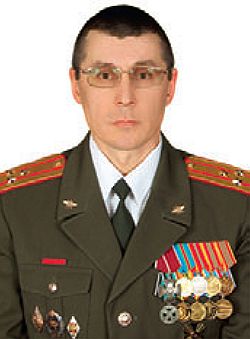
Colonel Andrey Kolupov (photo: Kommersant)

While President Medvedev may despair of the continuing corruption plague in Russian government and society, the Defense Ministry went after a fairly high-ranking figure this week. 

There’s been nothing general on the military corruption situation since earlier this year, so the Kolupov case is just an interesting, isolated one. 

A decorated combat veteran of Chechnya and Dagestan, Colonel Kolupov is the General Staff’s Deputy Chief of Communications, and he was in line to succeed his retiring boss until a check uncovered his failure to return a Defense Ministry apartment in Voronezh when he received another one in Moscow. 

In 1996, he had a 54-square-meter apartment in Voronezh with his wife and daughter.  In 2002, Kolupov became a senior officer of the MVO’s communications directorate.  Two years later he had a second daughter and received a three-room, 81.7-square-meter Moscow apartment, which he privatized in 2008, according to Kommersant

Meanwhile, Kolupov let his mother-in-law to privatize the service apartment in Voronezh rather than returning it to the Defense Ministry.  The loss to the state was put at 6.3 million rubles.  The colonel has been charged with large-scale fraud.  He apparently hasn’t acknowledged wrongdoing, and refused to speak with Kommersant

Kolupov’s housing machinations are less egregious than ones occurring in the Railroad Troops Command in recent years.  But there seems to be a campaign against apartment manipulations by senior military officers.  Generally, it might be possible to conclude that the Defense Ministry’s anticorruption efforts are relatively more vigorous and effective than those of other ministries, but it would also be impossible to prove this with any certainty.  And the key word is relatively.  The scale of Defense Ministry efforts may not be significant in an absolute sense against the scope of its overall corruption problem.  One can easily think of other apartment- and housing-related corruption, involving military men and civilians, that isn’t scrutinized similarly.

More Drugs, Extremism in the Army

According to ITAR-TASS, Main Military Prosecutor Sergey Fridinskiy today warned colleagues at an inter-governmental meeting on military-patriotic indoctrination that anti-drug measures among minors are not having the intended effect, and: 

“Based on last year’s results, the growth of crime connected with illegal trade in narcotic and dangerous substances in the troops (of all power structures) exceeded 70 percent.” 

For his part, Deputy Defense Minister, State Secretary Nikolay Pankov agreed that drug-addicted youth pose a threat not just to the army, but the whole country.  He added: 

“The ‘drug addiction’ diagnosis is becoming customary for draft commissions.” 

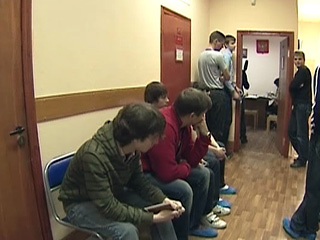
At the Draft Board (photo: Newsru.com)

And as if on cue, today from a Ural region draftee assembly point in Yegorshino came the story of 100 young men who arrived recently high on marijuana in hopes of being deferred from conscript service for dependence on narcotics. 

The voyenkomat reported nothing like 100 guys showing up before the draft board in a state of ‘narcotic intoxication’ has previously happened. 

A voyenkomat representative said: 

“There’s never been such a thing, we are sure this is a particular feature of the current draft.  The young guys intentionally used narcotics in order not to end up in the army.” 

According to Newsru.com, a State Narcotics Control officer for Sverdlovsk Oblast is investigating the ‘stoners’ who came from Nizhniy Tagil, Yekaterinburg, and Pervouralsk.  The voyenkomat said these men would be returned to their towns for additional medical observation and rehabilitation. 

ITAR-TASS reported more of Pankov’s comments on a different subject.  He said: 

“In Russia, nearly 150 extremist youth groups are active, the participants in them live mainly in big cities.” 

Pankov didn’t rule out that young extremists could spread from large cities to small towns and lightly populated areas, saying: 

“This is highly probable.  All this comes into military collectives and leads to the growth of nonregulation relations, so-called ‘dedovshchina.'”  

This is just one reason the army’s always preferred country boys from the ‘sticks’ rather than city guys.

The topics of drugs and nationalism in the army, if not taboo outright, have been little discussed.  Some honest talk about these problems might be the first step in solving them.

Yesterday’s Military Crime Report

The number and details of military crimes reported in yesterday’s press were above average and more interesting than usual.  They illustrate the kinds of pathologies the Defense Ministry confronts on a daily basis.

From Toglyatti, a noncombat loss.  An army conscript hung himself.  The military has reported nothing suspicious about this, except that the young man had transferred to this unit from another.  Conscripts sometimes obtain transfers to escape hazing, dedovshchina, etc.

From the MVO, the district’s chief of staff, first deputy commander of Rocket Troops and Artillery, one Colonel Aleksandr Zemlyanskiy, stands accused of using a conscript to guard and do household chores at his dacha in Moscow Oblast for five months last year.  The RF Prosecutor’s Investigative Committee’s Military Investigative Directorate investigated Zemlyanskiy’s case.  That’s a lot of investigating.  The colonel faces up to 4 years in prison.

From Reutov near Moscow, the personnel chief for an MVO unit, one Lieutenant Colonel Dmitriy Vasin, stands accused of demanding bribes in exchange for performing normal duties.  Obtaining the next military rank cost 15,000 rubles, an expedited dismissal from the armed forces cost 70,000 rubles.  For an extra 20,000, officers could get dismissed from the service and keep a place in the unit’s line for permanent housing.  Vasin could get 5 years.

From Chechnya, the SKVO, the finance chief of a unit got 4 years for exceeding his authority by paying out 3 million rubles to ten individuals with a court order for back combat pay owed to them.  The finance chief did not seek his commander’s permission to issue the pay although he knew their court documents were forgeries.

From the DVO, near Khabarovsk, a former unit commander got a year for extorting 3,000 rubles a month from an officer put outside the TO&E on health grounds, but kept on the unit’s books since he lacked permanent housing.  The 3,000 was the price for keeping him on the books, without him having to report to the unit every day.   

In the DVO, a lieutenant forced 9 contractees to work unpaid for four years in a private security company called “Deon.”  And he also stole their military pay amounting to 3 million rubles over time.  He beat one of the men.  The lieutenant got a 4 year sentence.

Lastly, again from the DVO, Novaya gazeta reports today on a case from 2008.  The VSU has started a criminal case against a former deputy regiment commander for socialization work, one Lieutenant Colonel Novokhatniy. 

He abused a handcuffed conscript on the parade ground in front of 500 men.  No one tried to stop it, and one of Novokhatniy’s subordinates videotaped the incident (you can view it on the Novgaz link). 

Local authorities complained about lawlessness, fights, and even murders at the regiment in letters to the Defense Minister, General Prosecutor, and DVO Commander:

“The condition of discipline in the unit can’t stand any criticism, it’s time to defend the civilian population from the contingent sent to serve here.”

One officer finally complained to the regiment commander and military prosecutor, and Novokhatniy punched him.  But all the incidents were hushed up, and Novokhatniy actually ran and won election to the rayon assembly for the South Kurils as a member of the ruling United Russia party. 

At some point, the officer who was punched turned the videotape of the incident over to the DVO’s VSU.  And the VSU came after Novokhatniy, who readily admitted his actions, as well as a couple of his cronies.

All in all, a remarkable day of military crime reports; not a typical day exactly, but remarkable, and lamentable.

Policy To-and-Fro on Military Police

State Secretary and Deputy Defense Minister Nikolay Pankov probably didn’t surprise a lot of people when he announced the latest Defense Ministry flip (or flop this time?) on the military police issue last week.

 Pankov announced that:

 “The Defense Ministry has found the establishment of military police inexpedient at this stage of Army and Navy reform.  Directive documents on the establishment of military police in the Russian Army have been suspended, and orders on the formation of these structures in the military districts and the fleets have lost force.”

 Later, the press quoted Pankov differently:

 “I wouldn’t say it so categorically – this work is suspended for now.”

But he didn’t elaborate on the Defense Ministry’s reasons for stopping or suspending the effort at this moment.

Military police units are, or were, supposed to stand up in 2010.  Their mission was to maintain order and discipline, and prevent hazing and other barracks violence and crime, primarily thefts of military property.  A military police department started working in the Defense Ministry’s Main Combat Training and Troop Service Directorate last December, drawing up plans and training programs for the new MP units.

In early February, a Defense Ministry representative denied press reports that Defense Minister Serdyukov had suspended work on the military police force.  But a source in the Defense Ministry’s press service told the media that “the documents establishing it have been sent to the appropriate legal directorates for reworking.”  He said that forming the military police would require amendments in federal legislation beyond the Defense Minister’s purview.

The back-and-forth, on-and-off nature of Russia’s yet-to-be created military police calls into question the Defense Ministry’s capacity to formulate and implement policies, or at least to do it so its doesn’t  look foolish.  Why would any military district commander or brigade chief of staff hurry to introduce any new policy or regulation that might just be overturned 6 months from now, or never implemented at all? 

As with the rumored halt in February, the latest stop may in fact be related to legal issues, but they usually only become an obstacle when they’re really protecting someone’s bureaucratic empire.  In this case, the military prosecutor and MVD are obviously very interested parties when it comes to devising a military police policy.  And they are pretty big hitters vis-à-vis the Defense Ministry.

The Defense Ministry already has plenty of people and organizations involved in military law enforcement, but they seem unable or unwilling to organize and cooperate to do the job.  Existing military law enforcement mechanisms could be made to work properly. 

Another sticking point may continue to be who will be in charge of a new military police force.  The prosecutor and MVD probably don’t want military police to answer to the Defense Ministry.  Military commanders could misuse or corrupt military police who would be enforcing laws on those commanders as well as ordinary servicemen.

Svpressa.ru talked to Anatoliy Tsyganok in this vein.  He said:

 “It once again attests to poorly thought-out reforms, zigzagging from side to side, senseless expenditure of resources needed for reequipping the army, and social programs.”

From the get-go, Tsyganok was against spending a ‘not small’ amount of money on a new structure seen as a panacea for all the army’s ills, at a time when the existing military command structure should be able to handle military police functions.

Tsyganok continues:

“. . . I came out not against military police per se, but against the dissipation of resources allocated for army reform:  the fact that they change conscripts for contractees, but then reverse this, the fact that they bring Yudashkin to design uniforms, but then chuck it, now here’s the confusion with military police.  It’d be better to use these resources on weapons for the army.  Russia’s military-industrial complex exports 90 percent of its production.  Aircraft to China and India, helicopters to Latin America and Middle Eastern countries.  Automatic weapons to Venezuela.  But the Russian Army scrapes by with old weapons.  At the same time money is invested in not well thought-out projects.”

“At present our servicemen who have violated order or broken the law are sent to do their time in basements, in special trenches, in storage areas.  Serdyukov doesn’t have financial resources even to build apartments for officers, there can’t even be talk about guardhouses.”

 “Now order among the troops is controlled by commandant (komendatura) forces, commandant patrols, commandant platoons and regiments, internal details; military traffic police structures are active.  This is a huge force.  For example, in Moscow there are 10 districts.  An integral commandant regiment patrols every district.  And is this little?  But military prosecutors, special departments [OO – FSB men—особисты or osobisty, embedded in large military groupings, units, and garrisons] also exist to maintain legal order in the army.  We need to force all this organizational and personnel mass to work effectively.  But for this the Defense Ministry itself needs to work effectively, and not spend money on schemes.”

 “The Defense Ministry leadership in answer to criticism about rampant crime in the army created nothing but the appearance of vigorous activity.  It’s hard to keep order, but forming something else at the expense of budget resources is easy.”

 “The failure of the project was sealed in its very organizational basis.  They proposed to subordinate the military police to the Defense Ministry in the person of the first deputy minister.  The fact is the very same operational structure of military control and repression would wind up in the hands of military leaders themselves.  This is a criminally corrupt thing.  Any Defense Minister, major troop commander, or independent unit commander could arrest on any pretext and end the contract of any inconvenient serviceman.”

Tsyganok kind of skirts around the issue without saying so, but it may be there’s not enough money to pay for building a military police force.

 Interfaks cited Duma Defense Committee Deputy Chairman Mikhail Babich, who called on the Defense Ministry to be more cautious about making changes in the armed forces and to avoid revoking its own decisions, as may be happening in the case of military police.  Babich is a somewhat critical and independent-minded member of Putin’s United Russia party.  He also said armed forces reforms require serious budget expenditures, so every time this or that program is dropped, the reasons should be closely studied and analyzed.  He concludes:

“I think the Defense Minister should hold to account those who were responsible for drawing up and implementing programs deemed unsuccessful.  First of all, this means the federal targeted program for recruiting professional sergeants in 2009-2015, which has not really started and the allocated money was spent on different purposes.”

Babich goes on to note that it’s still unclear what’s happening with Russia’s 85 permanent readiness combined arms brigades that replaced divisions in the Ground Troops.

“The Defense Ministry is keeping silent about this but it’s already clear that plans to establish permanent readiness combined arms brigades have fallen through.  As a result, it’s been decided to divide them into three types:  heavy, medium, and light.  Yet again everything is being done by rule of thumb.”

New Chief of Defense Minister’s Apparat

Mikhail Mokretsov (photo: RIA Novosti)

Yesterday’s press announced that Mikhail Mokretsov, ex-Director of the Federal Tax Service (FNS) and long-time colleague of Anatoliy Serdyukov, will be the Defense Minister’s Apparat Chief.  

Kommersant says Serdyukov had largely kept his old team in place, and still influenced personnel decisions in the Finance Ministry’s FNS.  And the FNS has been a stable supplier of high-level cadres for Serdyukov’s Defense Ministry.  Along with ex-deputy directors of the FNS Dmitriy Chushkin and Yevgeniy Vechko, not less than 10 other highly placed former tax service officials have come over to Serdyukov’s Defense Ministry. 

Kommersant indicates this may represent the end of Serdyukov’s ‘agreement’ with Finance Minister Kudrin to leave his old cronies in place in the FNS for three years.

Mokretsov’s work in the tax service has drawn some praise.  Deputy Chairman of the Duma’s Budget Committee Andrey Makarov says the Defense Ministry can use another strong manager like Mokretsov, and he adds:

“The main thing in reforming the army is to stop the stealing.  Control and auditing are essential there.”

Perhaps playing the provocateur, Gzt.ru suggests that some in the Genshtab see Mokretsov’s arrival as a precursor to Serdyukov’s departure from the Defense Ministry.  Under this scenario, Serdyukov would be preparing Mokretsov to take his place as Defense Minister when he moves to a higher post.  But a PA source denied any prospect for a change of Defense Minister and specifically ruled out Mokretsov’s chances.

Mokretsov will occupy a long-vacant post.  Its last occupant, Andrey Chobotov left with former Defense Minister Sergey Ivanov when he became Deputy Prime Minister.  Chobotov apparently works in Ivanov’s office and in the government’s Military-Industrial Commission (VPK).  Since Chobotov had the job, the apparat has been considered a Defense Ministry ‘service’ [not to be confused with an armed service] and this brings its chief the title of Deputy Defense Minister.

According to Gzt.ru, retired General-Lieutenant Andrey Kazakov has been the acting apparat chief since Chobotov’s departure.  Kazakov has served in the Defense Minister’s apparat, primarily as Chief of the Defense Ministry’s Affairs Directorate, since at least 2001.

The apparat chief wields serious power–at least within the administrative system.  According to Gzt.ru, he is not simply the Defense Minister’s right hand.  He’s a chief of staff and critical gatekeeper whose agreement is necessary to get documents signed and decisions made.  This power is largely unofficial, deriving from personal proximity to the Defense Minister.

The apparat chief’s official, statutory powers are more modest.  Mil.ru lists six official elements under him.  The Expert Center of the RF Defense Minister’s Apparat is something of a ‘think tank’ preparing analytical information and reports on military-technical policy, force structure, and force development, under the Defense Minister’s direction.  The Main Legal Directorate of the RF Defense Ministry has been reinvigorated of late, and its role is self-evident.  The above-mentioned Affairs Directorate serves as property manager and business agent for the Defense Ministry in Moscow.   The Directorate of State Assessment of the RF Defense Ministry is responsible for ensuring that military infrastructure complies with an array of government regulations.  The apparat also includes, without explanation, Inspection of State Architectural-Construction Oversight and the Management Directorate of the RF Defense Ministry.

Gzt.ru got our old friend Leonid Ivashov to comment on yesterday’s news.  Ivashov hates to contemplate the idea of career growth for Serdyukov, and he thinks the idea of Serdyukov putting Mokretsov in place behind him is ‘patently untenable.’  He holds even less back than usual when he says:

“If the task is to destroy the country the way Serdyukov has destroyed the army, then such an appointment is possible.  Serdyukov is a destroyer.  And the fact that they are dragging their nonprofessionals into the [Defense] Ministry supports this.  It’s very sad that the Defense Minister of our country is first when it comes to being an example of corruption and disrespect for the army.  Mokretsov can’t help Serdyukov straighten out financial flows which go through the military department.  But he will absolutely help him steal from them.”

Ivashov goes on to complain about Serdyukov’s commercialization of Defense Ministry functions, e.g. turning rear services into Oboronservis.

Vitaliy Shlykov, who views Serdyukov favorably, sees the Mokretsov move as promoting creation of a civilian Defense Ministry that still doesn’t exist.  And Shlykov doesn’t see Serdyukov leaving the Defense Ministry since it is, in many ways, a higher post than a deputy prime minister with a portfolio, who doesn’t really run anything.

Today’s Vedomosti intimates that Mokretsov will focus on auditing the State Defense Order on the heels of Prime Minister Putin’s remarks this week about corruption, waste, and poor results in the OPK .

More about Mokretsov specifically . . .

He joined the tax service in 2000, moving quickly from department chief to deputy director of the Tax Ministry’s Directorate for St. Petersburg, deputy director of the Directorate for Moscow, and Chief of the Directorate for International Tax Relations.  In 2004, he became deputy director of the renamed Federal Tax Service under Serdyukov, and Director of the FNS in February 2007 when Serdyukov left for the Defense Ministry.  

The 49-year-old Mokretsov was born in Udmurtiya, and graduated in 1984 from the Leningrad Financial-Economic Institute.  He was called up after graduation and served two years as a finance officer in the Soviet Army.  Between 1986 and 2000, he worked in unnamed government and commercial enterprises in St. Petersburg.

Update on Military Corruption, State Losses, and Crime

Main Military Prosecutor (GVP) Sergey Fridinskiy observed last week that it will only be possible to deal with corruption when not just the law enforcement organs, but also responsible officials in the military command hierarchy become involved in fighting it.

At last week’s coordinating conference on fighting corruption in the armed forces and other armed formations, Fridinskiy reported that, in January and February, military corruption cases increased by 10 percent over year ago figures, and material losses to the state in those first months of 2010 were 5 times greater than in 2009.  Inflation and an increased volume of arms purchases were cited as contributing to the spike. 

In 2009, corruption cases increased 5 percent in military units.  Fraud and forgery cases increased 50 percent, but misappropriation, embezzlement, bribery, misuse, and abuse of authority also grew. 

Fridinskiy said:

“For such crimes, 543 officers, including some higher officials, were convicted last year.  Last year military prosecutors uncovered nearly 7,500 violations of the law in this area, more than 2,000 responsible individuals were held to varying degrees of accountability in connection with 540 warnings delivered about unacceptable legal violations.”

Fridinskiy maintains that corruption doesn’t just have a negative economic impact, it also has an extremely demoralizing effect on military units.  He noted that the State Defense Order (GOZ) and the provision of social benefits to servicemen are trouble areas for military corruption.  He said:

“Placing a barrier against incidents of illegal and mismanaged expenditure of budget resources allocated for reequipping troops with new arms and military equipment, but also providing housing to servicemen, people discharged from military service, and family members is one of the complex, but principle tasks.”

Fridinskiy said a systemic fight against corruption was particularly important at a time of rising expenditures on the defense budget and rearmament.  He cited improved legislation, departmental regulations, reduced opportunities for misappropriation, guaranteed transparency and competition in tenders and state contracting as possible measures.  He continued:

“It’s also important to strengthen the role of control-auditing organs at all levels, to raise the level of inter-departmental  coordination, to conduct active propaganda work necessary to create an atmosphere where corruption is unacceptable.”

Fridinskiy reportedly proposed changing the existing GOZ system:

“We’re now working in the first place on putting systematic changes into the purchasing system so that prices will be down to earth, and not astronomical, so that it will be possible to organize this work in the bounds of current demand for purchases, and in order that not only the purchaser, but also those performing the work will bear responsibility for what they are doing.”

Representing the Defense Ministry, State Secretary and Deputy Defense Minister Nikolay Pankov reported that his department has created a special financial inspectorate sub-unit to exercise control on the use of its resources:

“Finance specialists, economists, mostly not from the armed forces, have been asked to join the financial inspectorate, and my presentation today concerned the effectiveness of the work of the financial inspectorate.  All the results that the financial inspectorate turn up are given to the organs of the military prosecutor.”

Recall, of course, that the Defense Ministry claimed it had a major anticorruption drive in progress this winter.  Maybe these are some of the results.

Attendees at GVP conference included representatives of the Federation Council, Duma, Military Collegium of the RF Supreme Court, Military-Investigative Directorate of the RF Prosecutor’s Investigative Committee, Ministry of Defense, MVD’s Main Command of Internal Troops, Ministry of Emergency Situations, and the FSB’s Border Service and Department [once Directorate?] of Military Counterintelligence.

Chief of the GVP’s Oversight Directorate Aleksandr Nikitin  repeated an earlier publicized statistic on a 16 percent reduction in military crime last year.  Nikitin credited widespread GVP preventative measures for the decline in crime.  He also noted the induction of more conscripts with higher education and supplementary performance pay for commanders as positive factors.  According to him, with the extra money, young commanders have started to pay more attention to ensuring order in their units.  Nikitin also says the overwhelming majority of the country’s military units generally function without crime or other incidents.

Major Beating at Shilovskiy

According to Kommersant, prosecutors have charged an artillery battalion commander from a motorized rifle brigade based below Novosibirsk with exceeding his authority by beating four conscripts from Dagestan.  A senior investigator from the Military-Investigative Department of the Prosecutor’s Investigative Committee for the Novosibirsk Garrison reports that the incident occurred last November at the Shilovskiy range when Major Nikolay Levyy beat two draftees from Dagestan in his office, then smashed their cell phones.  Levyy had been critical of the pair on more than one occasion. 

Two more natives of Dagestan got it from the major in front of the formation.  The investigator determined that Renat Magomedov got the worst of it when the major asked whether Magomedov would fight for the battalion or his own people if he had to choose, and Magomedov responded for his compatriots.

After this, the investigator reported, Slavic servicemen proceeded to beat all four soldiers from Dagestan.  Major Levyy looked on without intervening.  That evening, the events spiraled into a larger fight.  Russian servicemen herded dozens of Caucasian servicemen into one barracks and locked them  down.  Overnight, the unit’s officers managed to quiet the disturbance, and all soldiers from Dagestan were later sent to other units.

Major Levyy was relieved of duty pending the outcome of his case.  He did not admit his guilt, but also refused to incriminate himself by giving evidence.  The events involving the other fighting are still under investigation.

The media accounts note that this is not the first mass fight between Caucasians and Slavs at Shilovskiy.  The last one occurred on 8 January 2007 when officers had to fire warning shots to break it up, according to Kommersant.  Law enforcement only found out when one soldier turned up in the hospital with a ruptured spleen several days later.

Some press reminded readers of the early July 2009 incident in which 200 Russian and other soldiers reportedly fought with 44 conscripts from Dagestan at Aleysk, also in the SibVO.

Some thoughts on this news item . . .

The major smashing the soldiers’ cell phones is interesting.  Commanders say they don’t like soldiers having them because new conscripts have them taken away by older soldiers, contractees, and officers.  Commanders say cell phones jeopardize their units’ secrecy and security.  But they probably don’t like them because cell phones are a lifeline to call for help in cases where conscripts are being abused or mistreated.  This tends to get the commander in trouble, one way or the other.

Would the major ask a soldier from Dagestan if he would fight for his battalion or for his compatriots if there weren’t already some pretty serious interethnic violence, conflicts, and tensions in his unit?

Shilovskiy is basically a SibVO arms and equipment storage base left  unchanged despite the army’s ‘new profile.’  Levyy, like other Russian officers, probably faced the reality that there are now fewer officers, warrants, and contract sergeants to supervise increased numbers of conscripts.  The commander also faces more demands from his superiors, the SibVO, Genshtab, and Defense Ministry today with the push for the ‘new profile.’  It likely breeds frustration that drives higher levels of officer crime from year to year.  It’s interesting that it’s the battalion commander himself using his fists against soldiers, and not their own battery commanders, captains, or lieutenants.

A major in Levyy’s position is damned if he doesn’t and damned if he doesn’t.  If he acts, he has few levers at his disposal—where are the new military police, the guardhouses, the old military commandant?  So he resorts to his fists and something akin to prison camp order.  And if he doesn’t act, he can’t keep order at all and the situation just gets worse.

There are lots of other incidents involving conscripts from Dagestan either giving, or taking, beatings in the armed forces.  And we’ll look at some in days to come.  But interethnic tensions in the Russian Army don’t always involve just soldiers from Dagestan.

Military Police, Open Up!

On 12 March, Krasnaya zvezda profiled what might be the armed forces’ first military police department (OVP) in the Astrakhan military garrison, under the Navy’s Caspian Flotilla.

A Statute and Instruction cover the authority and operations of Russia’s military police (MPs).  The KZ article says their formal functions reinforcing discipline, providing security, conducting antiterrorism measures, and controlling traffic.

Russian military police are a long time coming and far from all are happy about the idea.  Instituting an MP force was first debated in the mid-1990s, but it didn’t happen.  The major sticking point was whether the military police would answer to, or be independent of, the Defense Ministry.

As recently as very late 2005, Deputy Defense Minister Nikolay Pankov didn’t support the idea, but hardly a month later, after the notorious Sychev abuse case, then-President Putin and then-Defense Minister Ivanov came out for establishing a military police force, primarily to halt violent crime and abuse in the barracks.  But the concept fell by the wayside after several months of debate.

Just as suddenly as the thought of military police disappeared, it resurfaced last fall.  The force was to be established on 1 December with a strength of 5,000 personnel, and military police units were to work jointly with local military komendaturas [commandant’s offices] for the first year before subsuming them.

As in the 1990s, the idea encountered considerable opposition primarily from the RF Human Rights Ombudsman Vladimir Lukin and Main Military Prosecutor Sergey Fridinskiy.  Lukin supports military police but only if they are independent of the Defense Ministry.  He has said military officials don’t need one more bureaucratic apparatus.  For his part, Fridinskiy said:

“We need to think clearly about all aspects of this issue, including those connected with legal and financial support. Moreover, where will we find such a number of qualified people?  In our country’s conditions, it’s not a certainty that military police will bring positive changes.  Where is the guarantee that we won’t get the very same excesses that they always talk about in connection with the [civilian] police–we aren’t selecting different people, it’s all the same contingent.”

Fridinskiy seems to be worried about military prosecutors tripping over MPs, or MPs fouling the work of his prosecutors.  He definitely doesn’t entertain the idea that they could work well together. 

There were press rumors over the winter that Defense Minister Serdyukov had decided to scrap the plan to institute MPs, but defense spokesmen denied the reports.  And at least the very first OVP has appeared and gotten some publicity.

The Astrakhan garrison’s OVP chief is an O-4 who once served as head of the security department for an armaments storage base, and chief of the garrison’s guardhouse.  His KZ interviewer says the OVP Chief knows all the ins and outs of garrison service firsthand.

The OVP Chief says the composition of an OVP is determined by the size, locations, and characteristics of the garrison it serves.  His OVP has a security and convoy section, investigation section, and an MP platoon, and he describes its initial capabilities as modest.

The security and convoy section guards and transports prisoners to the prosecutor’s and military-investigative organs, to disciplinary battalions, or investigative detention.  The investigative section prepares cases against soldiers accused of disciplinary offenses.  The MP platoon is responsible for patrol service, preventing crime, and maintaining discipline within the garrison.

The article indicates the OVP will spend a lot of its efforts on searching for AWOL soldiers.  The OVP Chief indicated that komendaturas and military commissariats haven’t been able to concentrate on this job in the past for lack of resources.  Russian AWOLs are known as ‘sochintsy’ from the abbreviation SOCh, or those ‘willfully leaving the unit.’

The Astrakhan OVP Chief recognizes that liaison and relations with unit commanders, local civilian law enforcement, and municipal authorities will be key for him to do his job.  More likely and problematic, however, is the possibility of crossed wires with military prosecutors or the local branch of the military-investigative directorate.  There are already lots of investigators out there investigating military incidents.  The investigative authority of the MPs was a contentious issue in the debate over them.

Russia’s 5,000-strong MP force is a modest start for a million-man army, and the success of the effort can’t be judged until it’s possible to see how many, or how few, OVPs are established.  Past initiatives in military law enforcement aren’t particularly encouraging.

For example, the 2005 effort to reestablish the guardhouse–administrative confinement–in order to do away with the army’s five disciplinary battalions (disbats)–the idea was abandoned when Serdyukov arrived because it required sending men guilty of more serious offenses into the civilian penal system where, unlike the disbat, they would get a permanent criminal record.  The guardhouse effort also went unrealized because it was costly; 98 old guardhouses needed to be rebuilt and 44 new ones were proposed.  And so the disbat lives.  Similarly, the Defense Ministry may discover it doesn’t want to pay to create a lot of OVPs.

Only time will tell how far or wide MPs will be implemented.

One-Year Conscription Hasn’t Stopped Dedovshchina

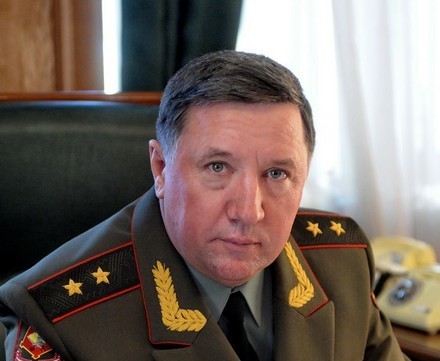
General-Lieutenant Chirkin (photo: IA Regnum)

On Thursday, SibVO Commander, General-Lieutenant Vladimir Chirkin told reporters:

“The military expected a dramatic decrease in this type of offenses, but, regrettably, hazing remains an acute problem. The conscripts, who now have to serve 12 months, regard themselves as ‘old timers’ after serving 6 months, and the same thing continues.  Apparently, this virus is transmissible.”

“We now know that we should search for the causes of bullying not in the duration of service but, it seems, deeper.  We now have to work harder with detachment commanders.  This year issues of discipline will be even more important for us than those of combat readiness.”

Chirkin said several high-profile abuse cases are currently under investigation in the SibVO.

Introduced in 2008, the one-year draft was intended to reduce conflict between conscripts from different draft campaigns.  The ‘dedy’ or ‘grandfathers’ about to demobilize would often abuse, haze, or otherwise mistreat brand-new inductees.  But as Veronika Marchenko from Mother’s Right says, it hasn’t been enough to stop dedovshchina:

“In the army then and now they beat people on the third day of service, in two weeks, and in the first months.”

Marchenko believes ending conscription completely is the only way to curb dedovshchina, but that’s not likely now with the virtually complete failure of professionalization through contract service.

What 3 Billion Stolen Rubles Could Buy

Viktor Baranets

On Wednesday, Komsomolskaya pravda commentator Viktor Baranets recapped Sergey Fridinskiy’s latest military corruption report, but Baranets also gave examples of what the Defense Ministry might have bought with the 3 billion rubles [$100 million] lost to corruption.

  • 50-55 T-90 tanks
  • 75-80 BMPs
  • 3 or 4 Su-27 or MiG-29 fighters
  • 8-10 Mi-28N attack helicopters
  • 1 light frigate or corvette
  • 1 or 2 Topol [SS-25] ICBMs
  • 3 or 4 reconnaissance satellites
  • 300-400 apartments
  • food for an MD (130,000 personnel) for a year
  • uniforms for 300,000 or 350,000 conscripts, or 1/3 of the army

So corruption brings a significant opportunity cost in the form of foregone or lost procurement, and ultimately reduces combat capability.  Bear in mind this is, of course, only uncovered corruption.  The real amount is undoubtedly larger, but who knows how much.  And this kind of army corruption didn’t start this year.  It’s been delivering this kind of blow to efforts to operate, maintain, and reequip the armed forces year in and year out for a long time.