Category Archives: Defense Industry

Dizzy with Bulava’s Success?

Iosif Vissarionovich might have accused Bulava’s proponents of dizziness after the SLBM’s test firing on October 7.  There’s no mistaking it was a clear boost to a troubled program.  Success always trumps failure.  It may even turn out that all of Bulava’s design, production, and assembly problems are resolved.  But one would think the history and current state of the Bulava would call for more cautious, guarded optimism.  This successful test was necessary, but far from even close to sufficient to complete the program.

The biggest news story after this successful test was the report that, as a result, the Bulava SLBM and Borey-class SSBN weapons system might be accepted into the arms inventory as early as mid-2011.

A highly-placed Navy Main Staff source told Interfaks:

“Before the end of the year, another two test launches of the missile are planned, if they are as successful as today’s launch, then it’s legitimate to consider the issue of the quickest completion of tests of this strategic system.  I’m proposing that the acceptance of Bulava into the arms inventory could happen in the middle of next year.”

He follows adding that serial production of the SLBM and its deployment in proyekt 955 Borey-class SSBNs will ensue.

The Navy Main Staff source doesn’t go into exactly what ‘quickest completion’ entails, but others do.  Presumably, this means another test from Dmitriy Donskoy before the end of October and, if that’s a success, the first launch from Borey-class Yuriy Dolgorukiy before year’s end.

Vesti.ru conjectures that ‘quickest completion’ might mean a second, ‘insurance’ shot from Yuriy Dolgorukiy in early 2011, then a volley firing of two missiles in spring or early summer.  After this, if every test is a success, the weapons system would be accepted, serial production would begin, and Bulava would be deployed on Yuriy Dolgorukiy.  That’s if everything goes right.

An irrationally exuberant Defense Ministry source even told RIA Novosti:

“The successful launch of the missile gives a basis to suppose that the entire system ‘submarine plus missile’ will be accepted into the Russian Navy’s arms inventory by the end of the year or at the beginning of next.”

Former Armaments Chief Anatoliy Sitnov was pretty confident, telling Interfaks and ARMS-TASS that no specialists are expressing doubts about Bulava, and ‘broken links’ in its production process have been overcome.

Old RVSN general Viktor Yesin told Interfaks he agrees it’s possible to plan for completing Bulava testing by mid-2011.  But he retains some caution:

“The tests conducted instill hope that the two flight tests of the Bulava ballistic missile coming before the end of this year will be successful.  If this happens, it’ll be possible to confirm that the designers and producers overcame a period of failures in the creation of the new submarine-launched missile system.”

Yesin also notes that only the telemetry can say if all the Bulava’s systems were working normally.

Forum.msk’s Anatoliy Baranov is skeptical about making Bulava part of Russia’s strategic nuclear forces even if the next two tests are successful, and make the tally 8 successes in 15 attempts.  He says having a missile you want to produce doesn’t mean you can produce it quickly in the necessary quantity:

“Incidentally, no one has answered for the strategic decision which left the country practically without a naval component of strategic nuclear forces [SYaS].  Don’t believe that the resignation of MIT director Solomonov is a sufficient measure of responsibility considering the possible consequences of such a mistake, and the fact that today our naval strategic nuclear forces [MSYaS] already lag the strategic enemy by a factor of 5.  But even given the most successful confluence of circumstances, we will have a gap between old missiles and submarines going out of service and new ones coming into service because the possibilities of domestic industry in serial production of solid-fuel missiles are very limited.  The Votkinsk factory produces 5-6 solid-fuel ‘Topol-M1’ missiles, there aren’t other producers.  This means the production of new missiles of the ‘Bulava’ type puts an extra load on production which already can’t cope with the creation of new land-based missiles — see, straining the RVSN rearmament program even worse.  In the best case, the necessary complement of armaments for the 3 new ‘Borey’ class SSBNs will be produced in nearly 15 years.  This is a catastrophe.”

Andrey Ionin doesn’t agree with Sitnov above.  He told Gazeta.ru that the Defense Ministry shouldn’t be impatient:

“A state commission report on successful testing and a formal decision on accepting the system for regular use doesn’t change the fact that the problem of low quality in joint production has not been eliminated.”

Carnegie Center Moscow associate Petr Topychkanov says:

“Three successful tests in a row is not a reason to put a type into serial production.”

But, unlike Baranov, he points out that the production run for Bulava doesn’t have to be too big since there are, and will be, relatively few tubes to fill.

Pavel Felgengauer in Novaya gazeta is skeptical about how close the Bulava RVs came to their intended targets, but, more important for this discussion, he calls saying that Bulava is almost ready for deployment after this successful test a “dangerous adventure.”  He adds:

“And here is a ‘raw’ missile, not completely ready and the not tested ‘Yuriy Dolgorukiy,’ a crew which clearly hasn’t mastered its submarine — and missile launches right away.  Very bold to put it mildly.”

Viktor Baranets sums it up:

“A successful launch instills some optimism.  But it’s still a long time before accepting the missile into the arms inventory.  And of 13 launches only 6 (including yesterday’s) [October 7]  were recognized as successful.  Or ‘partially successful.’  But this is not cause to launch the missile into a serial run.  Higher ‘positive indicators’ are needed.  Our specialists and foreign ones believe the quantity of successful launches should be steadily above 90%.”
Successful Bulava Test Reported

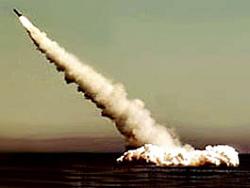
Bulava Launch (photo: ITAR-TASS)

ITAR-TASS reports today’s Bulava SLBM launch from Dmitriy Donskoy was successful.  It was the 13th test overall.  The missile’s warheads impacted on the Kura range on Kamchatka, according to the Defense Ministry press service. 

Dmitriy Donskoy fired the Bulava while submerged in the White Sea.  The missile’s flight trajectory was normal.  ITAR-TASS notes Russia’s military command and defense industry prepared for this launch more thoroughly than ever.

Mistral — For and Against

Last Friday, Nezavisimoye voyennoye obozreniye’s Viktor Litovkin covered a round table discussing Russia’s likely purchase of the Mistral helicopter carrier.  He was also one of the main speakers.  CAST sponsored the meeting, and Konstantin Makiyenko set the table with a general talk about amphibious assault ships and the world market for them.

Igor Korotchenko spoke in favor of purchasing the French ship, but not very convincingly.

According to Litovkin, Korotchenko made the following argument.  The Mistral purchase is part of a political-economic agreement between Moscow and Paris.  And so France will obviously win the Defense Ministry’s coming international tender.  This French ship will be extremely useful to the Russian Navy, and strengthen its combat capability.  Then Korotchenko seemed to imply that Mistral is less important as a naval platform than as a symbol of Franco-Russian military-technical cooperation, and France’s independence of the United States.

This view is a bit Cold War, and not particularly reflective of Moscow’s current effort to buy military capabilities abroad, and use them to improve the armed forces and defense industrial production at home.

Litovkin said the Mistral purchase raises a series of questions.  First, why does Russia need it?  The expeditionary missions for which it’s intended aren’t tasks for the Russian Navy under the new military doctrine, according to him.  If, as First Deputy Defense Minister Popovkin has said, Mistral is based in the Northern and Pacific Fleets, it’s senseless because Russia’s not very likely to land its troops on Norwegian, Japanese, or Chinese shores.  Second, Mistral needs to be part of a multipurpose naval grouping by virtue of its weak self-defense.  And Litovkin says Russia isn’t exactly laying down lots of other ships to escort and protect it.  Third, it’s not clear that a new base to support Mistral will be built.  Soviet-built proyekt 1123 and 1143 helicopter carriers (Moskva, Leningrad, Kiev, and Minsk) bobbed at anchor, lacked support, and were ultimately sold for scrap.

Aleksey Bezborodov starts from the state of the state of Russian shipbuilding.  Even if Russia tries to build the third and fourth Mistral units, shipyards won’t be able to manage it because they’ve lost many technical capabilities.  He maintains Russia doesn’t have an enterprise that can make engines for Mistral.

Makiyenko and Ilya Kramnik took issues with these ‘pessimists.’  The former noted that GPV 2011-2012 may include 15 frigates, 20 corvettes, etc.  The latter argued for acquiring Mistral because the Navy’s missions and requirements and Russia’s doctrine could change over the ships’ lives.  He sees it as a good platform for showing the flag and defending Russian interests abroad, and a hedge against future problems.

Litovkin says the discussion only went two hours, and it’s a shame General Staff and Navy representatives weren’t there to share their opinions.

Dolgorukiy Factory Testing Complete

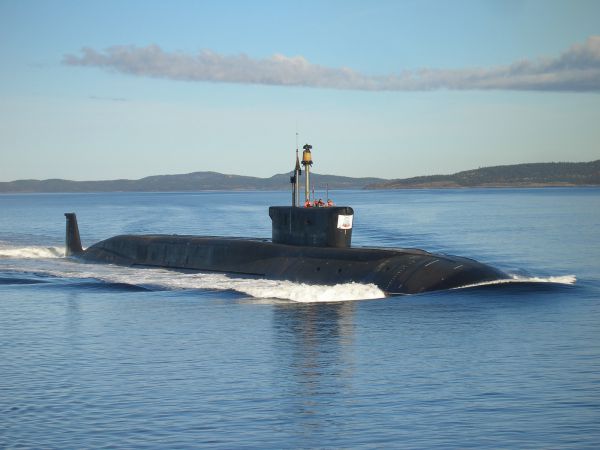
Borey-class SSBN Yuriy Dolgorukiy

Not a huge news story, but worth keeping continuity on . . . and there are interesting questions — has the fourth Borey really been laid down, and how many launch tubes will be on unit 2, 3, etc.? 

Borey-class SSBN Yuriy Dolgorukiy completed its factory underway testing by 24 September, according to the official Russian news services.  A spokeswoman for Sevmash said the current testing plan was fulfilled, and all established tasks were completed.  Captain First Rank Vladimir Shirin called the last at-sea period ‘excellent.’  All systems reportedly worked well, and minor issues noted during previous cruises were resolved.  The Sevmash delivery team and Dolgorukiy crew are preparing to present the submarine to the state acceptance commission.  But according to Grani.ru, a United Shipbuilding Corporation (OSK) source told Interfaks the obvious – acceptance of Dolgorukiy into the Navy inventory is not being considered since its main weapon – the Bulava SLBM – is not ready.  The Defense Ministry is still hoping that the new SSBN will be the launch platform for one of the next three Bulava tests.

The news services noted there are two additional Boreys, not three, on Sevmash’s buildingways.  So one supposes number four, Saint Nikolay, hasn’t been laid down yet.

The news services maintain the line that the Borey-class boats will have 12 launch tubes each, but Grani.ru, like other media outlets, claims Aleksandr Nevskiy and Vladimir Monomakh are proyekt 955A units and will have 16 tubes, while Saint Nikolay will be a proyekt 955U boat, possibly with 20 tubes.

46 Percent More or 47 Percent Short?

On Sunday, Defense Minister Anatoliy Serdyukov apparently told Bloomberg that Russia plans to spend 19 trillion rubles on its State Armaments Program 2011-2020.  Recall not long ago Finance Minister Kudrin said a final number had been worked out with the Defense Ministry, but he didn’t release it.

Bloomberg let Serdyukov advertise the plan [repeat, plan — the money has to be allocated in every annual budget] to spend 19 trillion rubles over the next 10 years as 46 percent more than Kudrin’s original offer of 13 trillion.

Serdyukov didn’t describe 19 trillion as 47 percent short of what the uniformed military says it needs to rearm.  Recall Deputy Armaments Chief, General-Lieutenant Frolov told the press 36 trillion was required to rearm all services and branches fully.

In fairness, Serdyukov admitted:

“This is the minimum we need to equip our armed forces with modern weaponry.  We could ask for a bigger number, but we need to understand that the budget cannot afford such spending, so 19 trillion is a serious amount of money that will provide considerable orders for our defense industry.”

OK, good.  There are limits on what the military can have, and this shows civilian control over the armed forces.  But what about saying this “will provide considerable orders for our defense industry.”  Isn’t the point for the armed forces to get some, or most, of what they need from industry, not simply ensuring the OPK has defense orders?

The 19 trillion rubles is not trivial.  If (a very big if) . . . if this gets approved and executed every year, it’s almost 4 times the amount in GPV 2007-2015.  But we know the GPV is always rewritten before it’s completed, so it’s very difficult to say what has or hasn’t been, or can be accomplished with any given amount of funding.

With Russia borrowing abroad to plug deficits, it’s not surprising the amount wasn’t what the military wanted.  And the state of its economy over the next couple years will determine if it actually gets this planned amount for procurement.

Serdyukov on Changing Bulava Production

According to RIA Novosti, Defense Secretary Serdyukov told Russian journalists in Washington Friday that, if the next Bulava launches fail for different reasons, Russia will have to change its system of production and quality control. 

Serdyukov said, if the missiles fail for the same reason, the cause of the failures will be found.   But if the causes turn out to be different, we “have to change the entire production and quality control system for these missiles.”

According to ITAR-TASS, Serdyukov said:

“In the assembly of these missiles we tried to make them fully identical so that they would be like twins [triplets?].” 

“We can’t hurry the testing.  The main thing is that in every assembly cycle there were strict guarantees that we made the missiles absolutely identically and all procedures were followed.”

“The possible defects will be the same, then we will eliminate them, but if they are different, then we have to break down the entire system and find out what is happening in production and quality control. Then it will be clear that the production monitoring is incorrect and it’s absolutely necessary to change it.”

State of Play on Mistral

Let’s review recent play in Russia’s possible purchase of French Mistral amphibious ships.

In yesterday’s Nezavisimaya gazeta, Viktor Litovkin said, despite reports Russian-French negotiations are going well, Russia’s announcement of an international tender for construction of large amphibious ships disrupted their exclusive talks.  But Litovkin thinks Russia will ultimately buy Mistral because (he believes) President Medvedev has promised French President Sarkozy.  So, the tender is really only about where to build two Russian-made ships (units 3 and 4), and the answer is Kaliningrad’s Yantar shipyard, according to Litovkin. 

To Litovkin, the remaining issues are the electronic fit on Mistral, and the final price of the deal.  He goes back to General Staff Chief Makarov’s comment that the Russian ships will be exactly like the French ones, down to their comms systems.  The only exception being Russian ones won’t have codes linking French ships into NATO’s command and control network.

On 9 September, Nezavisimaya gazeta picked up on a Le Figaro article concluding that Russia’s tender, coming after six months of negotiations with France, signified trouble.  It wrote that there is more than a little question whether they will remain exclusive talks, even if they continue. 

Technology transfer in the Mistral deal is Moscow’s sine qua non, but this issue may not be resolved on the French side.  Le Figaro believes the U.S. may be able to restrict the export of American-made electronic equipment on Mistral.

Also on 9 September, Rossiyskaya gazeta wrote that cost is the main unresolved issue in Moscow’s negotiations with Paris.  The paper also focused on the Defense Ministry’s insistence on receiving technologies, not just weapons systems and platforms from abroad.

ITAR-TASS reported Defense Minister Serdyukov’s 8 September statement that French cooperation on Mistral might open the way for more bilateral military-technical cooperation, possibly on UAVs.  At the conclusion of his visit to Paris, Serdyukov announced:

“The French side has expressed a desire to work in this area.  We proposed to do this in the form of joint ventures on the basis of our repair plants.  If we succeed on Mistral and we build on such experience, then in the future everything will go in other directions, including in unmanned aerial vehicles.  We have such a proposal from them.”

Also from 8 September, Newsru.com reported Serdyukov saying “we are now waiting on a price” from the French.  He apparently said the French offer would be evaluated with the help of both Russian and foreign experts.

After Serdyukov’s tender announcement, Sarkozy dispatched his military adviser, and former DRM chief, Benoit Puga to meet with Russian Deputy Prime Minister Igor Sechin on 26 August.  Of course, Sechin is Chairman of Russia’s United Shipbuilding Corporation and point man in dealing with the French on Mistral.  They met at Yantar in Kaliningrad.  Puga reportedly told Sechin that ‘2+2’ was acceptable; the first Mistral would be built in a French shipyard in 36 months, the second following 12 months after.  And the third and fourth would be built in a Russian yard.

The French have stayed fairly confident in public about winning the contract.  And most Russian defense commentators still see Mistral as the favorite even if there is competitive bidding for the work.

Bulava Test Postponed At Last Minute?

Dmitriy Donskoy Underway (photo: Sevmash)

According to Rossiyskaya gazeta’s sources, Bulava SLBM test platform Dmitriy Donskoy was on-station in the White Sea for a launch last week, and all test arrangements were laid on — command and control, international notifications, ground and space tracking, telemetry, support and rescue ships, but the launch was put off at the last minute. 

The paper’s space and OPK sources said the Bulava commission had concluded the missile and boat were ready for the launch, and “today there is no reason whatsoever to put it off to a later time.” 

But, Rossiyskaya concludes, it turns out there was a reason serious enough to return the submarine to base.  

So it comes to nothing, and Defense Minister Serdyukov’s 8 September comments added no clarity to the situation, according to the paper’s account. 

So, we don’t know the reason why a launch was prepared, drew close, and didn’t happen.  It suggests some continuing problem or doubt about Bulava’s performance, or continuing disagreement over the system’s readiness for its next test.

Bulava Test in Second Half of September

Defense Minister Anatoliy Serdyukov talked to the press today about the next Bulava SLBM test:

“The next test launch of the Bulava could happen, most likely, in September, but not in the first half of the month.  Definitely.”

“We’ve tried to control the entire process of assembling these missiles as precisely as possible to produce the same parameters. There will be three missiles at a minimum, we need to understand that if failures are repeated in the launches, we’ll learn the cause of unsuccessful launches.”

After reiterating how previous failures had different causes, Serdyukov continued:

“Now at every level and phase of assembly of the missile there was strict control and analysis.  Moreover the commission established to explore the results of the last unsuccessful launch also worked here.  It gave recommendations, we incorporated all of them in preparing for new tests.”

“I believe that launches will be conducted most likely in September according to their readiness.”

Russia is Priority for Mi-28N Deliveries

Mi-28N (photo: Denis Rossin)

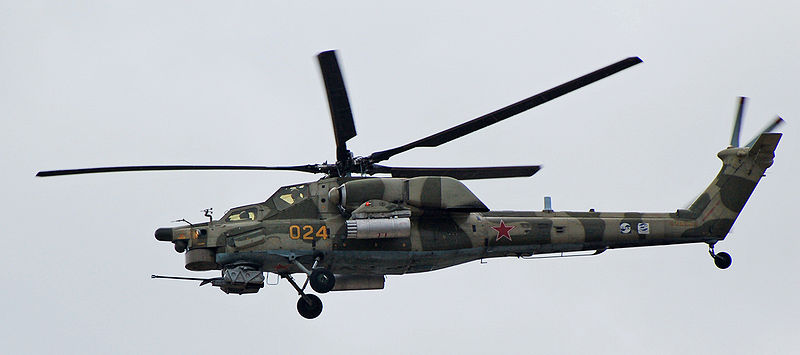
Yesterday Rostov Helicopter Plant (‘Rosvertol’) General Director Boris Slyusar said the Russian Armed Forces are the priority for Mi-28N ‘Night Hunter’ deliveries, despite what he claims are many profitable offers from abroad.  According to ITAR-TASS, he said:

“We have many requests for the Mi-28N, but the RF Defense Ministry still doesn’t have these systems in sufficient quantity, and we will take its interests into account first.”

Slyusar didn’t give the number of Mi-28N helicopters in Russian forces, but he said the North Caucasus Military District (NCMD) has about 20 ‘Night Hunters,’ and there will be more.  He added:

“Our task is to create in the district’s [NCMD’s] troops in 2011 two groupings of Mi-28N.”

Who knows what he means by groupings.  Squadrons?  A second squadron or two additional squadrons?  The information on the number of Mi-28N delivered is unclear and contradictory.  In late 2009, Deputy Prime Minister Sergey Ivanov rather dubiously claimed Russia had already procured 27.

In May, a ‘Rosvertol’ marketing official said Russia would receive two squadrons of Mi-28N helicopters before 2011.  She said two Mi-28N went to the pilot training center at Torzhok in early 2008, and ten more — apparently for the NCMD’s Budennovsk-based 487th Helicopter Regiment — were delivered in 2009.  In mid-2009, ‘Helicopters of Russia’ General Director Andrey Shibitov also told Interfaks-AVN the Russian military had 12 Mi-28N helicopters.

So the question still stands:  a second squadron of maybe 10 helicopters, or two additional squadrons?  One thing’s certain, this goal’s been pushed from 2010 to 2011.

‘Rosvertol’ General Director Slyusar indicated his company sold 10 billion rubles of products in 2009,  and this year sales are more than 15 billion rubles.  Receipts from domestic and export sales are about equal.  By 2015, the company has an ambitious goal of $1 billion in sales.  Slyusar says the company is moving on this plan with modernization, equipment purchases, and people.