Category Archives: Force Modernization

Ashurbeyli Interviewed (Part II)

The rest of former Almaz-Antey chief Igor Ashurbeyli’s interview with RIA Novosti . . .

Asked about the future of PVO, PRO, and VKO, Ashurbeyli says he sees the role of ground-based systems declining, and future “fire means” — after the S-500 — will be air-based.  Part of them, he claims, are already in RDT&E.

Returning more to the present, the former Almaz-Antey head says the Defense Ministry asks the impossible of weapons developers.  They have to sign contracts they know they can’t complete in the stipulated time frames, otherwise they’d have no work.

Ashurbeyli goes on to explain Almaz-Antey’s current production quandary.  The S-300 has been made only for export over the last 15 years.  One foreign order has just been filled, and only one remains.  So Ashurbeyli sees a gap between S-300 and S-400 production, and he predicts a decline in the factory’s operations in 2013 or even late 2012.

The lead-time for producing S-400 components is 24 months.  So, without budget advances today, there won’t be anything to produce in 2013.  In 2011, Ashurbeyli says, not a single supplementary S-400 production contract has been signed.

Ashurbeyli sounds a lot like former MIT head and solid-fuel ICBM maker Yuriy Solomonov who announced in early July that the 2011 state defense order is already broken.  Is it a coincidence both men were unseated from their general director and chief designer duties?

Ashurbeyli says:

“At the same time, the load on the plant today is far from full and the absence of contracts doesn’t allow for further renewing equipment and technology.  We have to understand that the S-400 is made on the very same equipment as the S-300.”

In response to another question, Ashurbeyli makes his case for consolidating the structure of aerospace defense industries.  He calls for a unified industrial corporation, a Concern VKO, to execute the Defense Ministry’s orders, and it’s needed, he continues, when a unified VKO is established [before 2012].  Organized like OAK or OSK, Concern VKO would bring in VKO-related weapons developers who aren’t part of Concern PVO Almaz-Antey. 

Ashurbeyli says this fall he’ll propose his view on how to integrate these enterprises and how to build the future VKO system to the country’s leadership.

So, where does this leave us?  If Ashurbeyli’s description is realistic, there’s no shortage of Almaz-Antey production capacity and no real need for new plants.  The problem is the lack of orders from the Defense Ministry.  For all the hype about increased defense spending and 20-trillion-ruble GPV 2011-2020, the absence of orders could be due to the military’s lack of cash or its difficulty arranging bank financing.  Or, despite Defense Minister Serdyukov’s talk about streamlining the GOZ, it could be that bureaucratic sclerosis (or corruption) is hindering the issuance of new contracts.
T-50 at MAKS-2011

A little Russia Today video of the T-50’s public debut on Wednesday at MAKS that someone was kind enough to upload . . .


The demonstration flight was made with Prime Minister Putin and other officials in attendance.  Novyye izvestiya said RIA Novosti reported the T-50 prototype wouldn’t perform the most complex maneuvers since it’s still in flight testing.

The press indicated one of the two prototypes will make a daily 15-minute flight at MAKS, but the aircraft isn’t on ground display.

RIA Novosti reported Sukhoy’s information that the two T-50, or PAK FA, prototypes have completed 84 flights.  Two more prototypes will join testing this year.

ITAR-TASS said air frame testing will finish in late 2012, and in 2013, ten T-50s will go to the Lipetsk Center for Combat Employment and Flight Crew Retraining.  VVS CINC Aleksandr Zelin noted only that his service will receive its first model for testing in 2013. 

Press reports say serial production is scheduled to begin in 2014-2015, with the Defense Ministry buying more than 50, 60, or even 150 of the fifth generation fighter in all.  ITAR-TASS noted that the plane’s state acceptance is planned for 2016.

General Director and Designer of Tactical Missile Weapons Corporation, Boris Obnosov told Interfaks his company is working on a new 200-km interceptor [air-to-air] missile for the PAK FA.  Test missiles reportedly will come this year, and series production next.  This Aviaport.ru article talks a little about weapons being designed for PAK FA.

Ashurbeyli Interviewed (Part I)

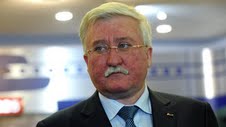
Igor Ashurbeyli (photo: RIA Novosti / Sergey Pyatakov)

Former Almaz-Antey General Director Igor Ashurbeyli gave RIA Novosti a long interview published on Monday.  Ashurbeyli was replaced at Almaz-Antey in early 2011, and he’s now a co-chair of the “Extradepartmental Expert Council on Aerospace Defense.”

He’s an accessible figure, having had extended sessions with the media in 2010 and 2009.  And his view of things has been pretty consistent.

This most recent Ashurbeyli interview spawned a number of sound bites saying that the former lead designer (among other things): 

  • called for establishing an overarching VKO industrial concern; 
  • offered the S-500 for European missile defense; and
  • said S-300 production has ended.

He actually had a lot more to say that might be worth a look.

Asked about Moscow’s anti-missile defense, Ashurbeyli replied that the service life of some Russian strategic interceptor missiles expired, while others [53T6 or Gazelle missiles] had their nuclear warheads removed per the decision of former President Yeltsin. 

Then Ashurbeyli gets to his point — the need for a new anti-missile defense (PRO) led to work on the mobile S-500 system.  Under the contract, it’s supposed to be accepted into the arsenal in 2015.  A schematic draft is complete, and technical design is being conducted.

On air defense, he says the S-300 and S-400 cover Moscow, but the service life of S-300PS systems will expire in the next year or two, and the new Vityaz system won’t be ready to take its place in the PVO network.

Ashurbeyli adds that Vityaz is expected in 2014-2015, but delays are possible due to problems with the new missile.

But, insists the former Almaz-Antey chief, there have never been any technical problem with the long-range missile for the S-400.  He says the problems have involved financing, preparing prototypes, and targets.  More targets and an updated target complex were needed.  And he foresees possibly the same problems with Vityaz testing.

Ashurbeyli tells his interviewer Vityaz, unlike the S-400, has just one base missile.  It will cover the same missions as the S-300PS and S-300PM.  The latter were last manufactured in 1994, and several dozen of the “freshest” will still have life for the next 7-10 years.  Most were updated to the Favorit (S-300PMU2) level but they aren’t new.  So, Ashurbeyli concludes, Russia needs to produce enough Vityaz to replace fully its S-300PS and S-300PM inventory.

The interviewer says relatively less has been written about Morfey.  Ashurbeyli obliges.  Morfey, he says, is a super short-range system and part of Russia’s echeloned defense.  While Vityaz is a medium-range system, and Pantsir and Tor are short-range weapons, Morfey is super short-range.  If developed as envisioned, Morfey will be unique.  It will have an omnidirectional cupola-type radar instead of a rotating one.

In sum, Ashurbeyli believes Morfey, Vityaz, S-400, and S-500 will be sufficient for the ground-based component of VKO for 20-25 years.  The tasks for Morfey and Vityaz were set in 2007 when the VPK decided to develop a single fifth generation surface-to-air PVO-PRO system.  The more complex S-500, he notes, will be longer in development.

More later.

Air Forces Prospects

With MAKS-2011 underway, this is something of a moving target.  Before getting to the main topic, a little news from Zhukovskiy . . . some of today’s headlines. 

OAK President Mikhail Pogosyan told the press two more T-50 prototypes will join the development and testing program this year.  He expects more than 100 military transport aircraft to be bought under GPV 2011-2020.  Il-112, Il-476, and Il-76MD will come first, then ten An-124 in 2014-2015, and later a larger number of An-70s.  Pogosyan said, starting from 2011, OAK will deliver more than 20 combat aircraft each year.

VVS CINC, General-Colonel Zelin told the media he foresees five squadrons of Su-34 (possibly as many as 120 aircraft).  The VVS will have six by the end of 2011 and will get 12 next year under the current contract for 32 aircraft.

For Air Forces Day, RIA Novosti had military commentator Konstantin Bogdanov describe how he sees things developing for this armed service.  How he puts the Air Forces’ future picture together is worth a look.

Bogdanov says he sees, for the first time since the Soviet collapse, movement, a turnaround in procurement financing, and real deliveries of aircraft in 2011. 

Interestingly, he begins with the Su-35S.  Forty-eight of these “transitional” 4++ generation fighters will be procured, but there could be more if there is any delay in the 5th generation T-50.  Bogdanov suggests, even without a  delay, the pragmatic Defense Ministry leadership could decide to blend 4th and 5th generation technology and equipment in one aircraft.

Bogdanov maintains one Su-34 flew missions in the 5-day war with Georgia [has anyone seen this elsewhere?], then got its serial production go-ahead, and contract for 32 aircraft in fall 2008.  Modernizing the aged Su-24 is a backup plan for the Su-34.  Bogdanov claims VVS CINC Zelin has hinted that ALCM-armed Su-34s could go to LRA.

Some old Su-27s have been updated to Su-27SM, and even a few new Su-27SM3 — unsold to China — have been obtained.

RSK MiG’s future, according to Bogdanov, looks less certain.  Russia had to buy the defective Algerian MiG-29SMTs.  It’s unclear if the Defense Ministry will have any requirement for the MiG-35.  And this leaves MiG with the possibility of providing MiG-29Ks to replace the Navy’s Su-33 fighters on the Kuznetsov’s deck.

Bogdanov then mentions how Irkut has parleyed its export success into more domestic sales.  He says the firm has redeveloped its Indian Su-30MKI into the Su-30SM, and it may sell as many as 40 to the Defense Ministry.  Twelve might go to replace Naval Aviation’s Su-24s at Gvardeyskoye in the Black Sea Fleet [apparently these aircraft weren’t swept up by the VVS earlier this year].  Similarly, says Bogdanov, KnAAPO last fall sold the VVS four Su-30M2s, domestic versions of its Su-30MK2 export.

Turning to rotary-wing aircraft, Bogdanov sees stable order books for Russian helicopter makers.  The order books are balanced in terms of military and civilian, and internal and external buyers, and all sales sectors are growing.

He says by 2010 the military’s contract for Mi-28N helicopters reached 100 units and serial production of its main competitor, the Ka-52, continued.  Mi-8s have been bought by the dozens.  And the hangars and flight decks of Mistral helicopter carriers will have to be filled in the future.

Bogdanov concludes more than 100 helicopters of all types may be procured before the end of 2011.  He repeats the familiar goal of 1,000 new helicopters by 2020, and says the near-term future for this sector looks good.

Bogdanov sees more clouds in military transport development and production.  Il-476 production at Ulyanovsk still needs to stand up, and Zelin’s already announced that a new A-100 AWACS will be based on it.  Restarting An-124 production and buying the An-70 from Ukraine are possibilities with details to be worked out.

Focused on platforms, Bogdanov gives short shrift to organizational and human aspects of VVS development.  He notes the Air Forces are completing the change from mission-oriented air armies and divisions to territorial composite or mixed formations (air bases), and he briefly mentions scandals over the handling of “order 400” premium pay.  But he concludes:

“In coming years we’ll see more than a few painful symptoms in the VVS, both strictly aviation-related and internal, and those connected to the general background of difficult transformations of the country’s armed forces.  Let there be pains, but let them be growing pains.”

Zelin’s Press Availability

Air Forces CINC, General-Colonel Aleksandr Zelin made a variety of remarks to the media this morning.  It’s not clear where yet, but it might have been a press-conference at ITAR-TASS.  It’s the season for such things with Air Forces Day and MAKS-2011 just ahead.

At any rate, Zelin had a lot of information on the status of different VVS programs and plans:

  • Army aviation will expand by more than 1,000 helicopters by 2020.  The number of army aviation bases will grow from 8 to 14 during that time.  He mentioned reestablishing production of Mi-26 transports in a POL supply variant.  Zelin doesn’t sound like he’s willing to surrender the VVS’ hold on army aviation.
  • Zelin mentioned getting 8 or 6 new Su-34 this year.  ITAR-TASS gave both numbers, but we’ve seen six elsewhere.
  • The VVS CINC criticized work on the Su-35, saying it has a number of problems.  PAK FA / T-50 is going on schedule, but he wouldn’t say when he expects it to enter the inventory.
  • On UAVs, some drones will go to the Ground Troops per a Genshtab decision, but Zelin says operational-tactical unmanned aircraft will stay at air bases under the control of military district commanders.
  • Without mentioning S-500 development, Zelin talked about new Morfey and Vityaz SAMs.  Morfey is a short-range system mentioned before as part of S-500.  Zelin described Vityaz in greater detail, calling it an improvement on the S-300 with greater capabilities and 16 missiles per launcher.  See ITAR-TASS for this.
  • Zelin said there will be four S-400 regiments by the end of 2011.  He said the second one, the 210th Air Defense Regiment, went on combat duty with it last week, so two more are expected.  The CINC said the manufacturer’s had problems with the system’s long-range missile, but there is an understanding on how to resolve them.  The Air Forces, he says, still want Almaz-Antey to build another production plant.  Interfaks posted on this.
  • The next 6 Pantsir-S gun-missile air defense systems will go to the OSK VKO around Moscow.  Zelin said the first 4 went to the 4th Air Forces and Air Defense Command at Novorossiysk.
  • Another flight demonstration group will be formed using Yak-130 trainers.
  • Zelin expects to get a new A-100 AWACS aircraft, based on the Il-476, by 2016.  He says it will have both air and ground surveillance missions.  The plan has Genshtab and financial support, according to Zelin.

Where’s the Logic?

A “highly-placed” Navy source has told RIA Novosti that S-400 / Triumf surface-to-air missile systems are arriving in the Baltic Fleet.  The source claims fleet air defense personnel are going to Ashuluk for training.

The news agency said a “highly-placed Baltic Fleet staff representative” confirmed announcements from several media outlets about the fleet receiving two S-400 battalions before the end of 2011.

Perhaps some healthy skepticism is in order.

The S-400 isn’t exactly bursting out the factory gates.  A second S-400 regiment hasn’t appeared at Dmitrov, and a third has already been promised for Moscow’s outskirts. 

There’s also a little matter of earlier spurious reports about where the S-400 would appear.  Recall General Staff Chief Makarov’s remark that it was deployed in the Far East in 2009.  Since then, there was talk of using it to defend the Kurils or Kamchatka, but Air Forces generals have spoken of the system strictly in terms of protecting Russia’s “central administrative and industrial zones,” i.e. Moscow and adjacent oblasts. 

Maybe it would make some sense to protect the country’s northwestern approaches from ever-dangerous Germans, Swedes, Finns, etc.  But it’s not really logical to do so until Moscow’s air defenses are modernized.

And it’s certainly not logical (from a bureaucratic viewpoint) for the VVS or VKO Troops (VVKO?) to let these precious new systems slip from their hands into the Navy’s control.  A second service operator at this point would complicate training and maintenance.

Maybe it’s another tactic for negotiating with the U.S. over missile defense in Eastern Europe (like deploying Iskander SSMs in Kaliningrad).

For its part, Interfaks (according to TsAMTO) reported the Navy S-400s would be placed in Russia’s Baltic exclave.

At any rate, there would seem to be few persuasive arguments and little sense behind a deployment of the S-400 in the Baltic Fleet any time soon.

Some World-Class Competitors

Despite problems with its state defense order and defense-industrial complex, Russia clearly has world-class defense producers.  This is apparent not just from their arms exports, but it’s also evident in their defense-related revenue.

Eight Russian companies just made the Defense News list of the Top 100 defense corporations worldwide.  They are Almaz-Antey, Helicopters of Russia, Sukhoy, Irkut, United Engine-building, Tactical Missiles, KB Instrument-building, and RTI Sistemy.

With 2010 defense revenue of nearly $4 billion, Almaz-Antey has appeared in the list since 2005 (Antey appeared alone prior to that).  Yet its revenue’s only about half that of Thales, a fourth of EADS, perhaps reflecting that those companies are more diversified in their defense and non-defense business. 

Helicopters of Russia vaulted into the middle of the Top 100 list with 2010 defense revenue of nearly $2 billion (a gain of 134.1% over 2009).  Consolidation of its helo design and manufacturing capabilities seems to have put Russia on the map (or at least on the Top 100).  Still, Helicopters of Russia has about half the defense revenue of Textron, and half as much diversification in its business.  The difference is more pronounced when comparing to United Technologies.

Sukhoy and Irkut need no introduction, but it’s a little surprising that their defense revenue was lower than Helicopters of Russia.

United Engine-building (ODK) is an interesting case.  Not huge defense revenue, but more diversified than other Russian corporations in the Top 100.

A number of Russian companies have fallen out of the Top 100 over the years.  They include submarine and shipbuilders Sevmash, Admiralty Wharves, and Northern Wharf (the United Shipbuilding Corporation — OSK — hasn’t appeared in their place), RSK MiG, Uralvagonzavod, and Aerospace Equipment.  It’s hard to say why they’ve fallen off; it could be their financial reporting — still sketchy at times — has made it hard to evaluate their revenue claims. 

Still, eight Russian companies in the Top 100 is a long way from 1999 when only Rosvooruzheniye (remember it?) made the list.

The Russian firms in the Top 100 are strong weapons and military equipment exporters, but the lesson for them from abroad seems to be that greater diversification and more civilian business makes a defense company more profitable.

VDV Day

Today was the 81st anniversary of VDV’s establishment . . .

VDV Commander, General-Lieutenant Vladimir Shamanov is looking for 20 new An-124 transport aircraft to support his troops by the end of GPV-2020, according to ITAR-TASS

Shamanov told Rossiyskaya gazeta he plans to return to jumping next year, despite injuries received when his vehicle was hit by a truck last fall.

He’s  disappointed the BMD-4M hasn’t completed its evaluation; armor testing remains.  And Shamanov admitted:

“There’s still no firm agreement on the schedules for testing and supplying this equipment to the troops.”

Shamanov’s first deputy and chief of staff, General-Lieutenant Nikolay Ignatov also told Ekho Moskvy a final decision on the BMD-4M’s readiness for combat employment will come after upcoming tests at Kubinka.

Ignatov talked to Ekho about the VDV’s plans for professional sergeants.  He said the VDV will start getting contractees from professional NCO training next fall, and will have only professional sergeants by 2016.  They will be “high class” specialists, and platoon and deputy platoon commanders to compensate for officer reductions.  The chief of staff said base [rank] contract pay will be 15-25,000 rubles per month, supplemented by a range of duty-related bonuses. Contractees will sign up initially for three years, and their units and divisions will decide if they’re offered a second contract.

Ignatov spoke disparagingly of the 2004-2007 contract service experiment, in which the 76th DShD served as test bed.  He said low pay and the lack of service housing for married soldiers bedeviled the program, and the government should have taken responsibility for pay and benefits rather than leaving them to the division.

About conscription, Ignatov said flatly:

“. . . today’s conscript servicemen simply won’t have a chance, he won’t be capable of mastering this equipment [new armaments] fully in all its characteristics.”

Ignatov also spoke at length about a new VDV automated C2 system called Andromeda-D, developed by the Scientific-Research Institute of Communications and Command and Control Systems (NIISSU or НИИССУ).

He describes Andromeda-D as a division-to-soldier system, with stationary points for commanders down to battalion, and vehicle-mounted systems for tactical units.  Andromeda-D has passed troop testing, has been deployed in the 76th DShD, and is in the GOZ to buy it for the 7th DShD, 98th VDD, and 31st DShBr, according to Ignatov. 

He told Krasnaya zvezda the existing Polet-K system will be integrated into the new Andromeda-D system.

He also says the VDV plans to deploy GLONASS receivers in its vehicles as part of its C2 system.

Valeriy Ivanov on VKO, S-500, S-400

General-Lieutenant Valeriy Ivanov

The Space Troops have seemed pretty confident about getting control of VKO up to this point, but now a senior Air Forces officer has taken his turn to suggest the VVS may have a leg up.

On Friday, Commander of the Operational-Strategic Command of Aerospace Defense (OSK VKO), General-Lieutenant Valeriy Ivanov described for journalists how his command provides air defense for 140 key facilities in Russia’s capital and central industrial regions. 

At a conference in Mozhaysk to commemorate the 70th anniversary of the defeat of the first Nazi air attack on Moscow, Ivanov said 800 OSK VKO personnel secure Moscow’s airspace on a daily basis, and he claimed his command covers two-thirds of Russian Federation territory, according to RIA Novosti

The OSK VKO Commander also said he expects to receive the S-500, new radars, and fighter aircraft by 2015.  Several news outlets repeated an early 2011 Interfaks report saying that ten S-500 battalions will be acquired under GPV-2020. 

Regarding President Medvedev’s late 2010 order to set up a unified VKO command by December 1, 2011, Ivanov told ITAR-TASS that VKO has already been established and is being improved:

“The VKO system is now being integrated, developed, and modernized.  We are now taking, uniting Space Troops and our OSK VKO.” 

But, according to ITAR-TASS, Ivanov had to admit there’s no clarity yet on the new form of VKO, and “our state’s political leadership will make the final decision on this.”

Krasnaya zvezda also provided a somewhat less categorical-sounding Ivanov quote:

“The Aerospace Defense system which we’re creating is now being integrated and developed.  Currently, the process of amalgamating Space Troops and the Operational-Strategic Command is going on.”

Komsomolskaya pravda relayed this Interfaks quote about the fate of aviation:

“Aviation carrying out air defense missions will be immediately subordinated to the VKO commander.  The one who directs the battle will also command [aviation].”

RIA Novosti also reported General-Lieutenant Ivanov saying the second S-400 regiment (at Dmitrov) will be on duty by July 31.  He said a third regiment will appear at Zvenigorod by the end of this year.

Su-35 Update

Su-35-2 No. 902

Militaryparitet was kind enough to highlight the June issue of Vzlet (Взлёт) and current information on the Su-35S.  The Defense Ministry contracted with Sukhoy for 48 Su-35S during MAKS-2009.

Vzlet says the first Su-35S arrived at the Akhtubinsk State Flight-Test Center on May 28 to begin state joint testing (GSI or ГСИ).

The Su-35S-1 was assembled this spring, and made its first flight from the factory airfield on May 3.  It made seven acceptance flight tests by mid-May.

GSI will determine its preliminary correspondence to basic requirements, and its potential for serial production for combat units.

Prototypes Su-35-1 (No. 901) and Su-35-2 (No. 902) first flew in 2008, and these export versions completed factory testing, fully meeting stability and maneuverability requirements, power plant parameters, and basic onboard system operations, according to Vzlet.

The Su-35S has a digital information-command system, Irbis long-range phased array radar (capable of tracking 30, and attacking 8 air targets, as well as tracking 4, and attacking 2 ground targets), and thrust-vectored 117S engines.

Interfaks reports KnAAPO has built two Su-35S, and a third flew in May.   KnAAPO will build three more for GSI in the second half of this year, a source told the news agency.

Back in April, Periscope2 cited a Kanwa military source in Moscow who claims some Su-35S will go to the 6968th Air Base in Komsomolsk-na-Amure.  Basing them close to the factory will simplify maintenance.  The source also says the first Su-35S will be received in 2012.

This winter the VVS was still saying 48 Su-35S will be put into two or three regiments, but a number of sources have said more will be purchased.