Category Archives: Force Modernization

Master and Commanders

Major media outlets covered President Dmitriy Medvedev’s dialogue with five commanders (three Ground Troops, two Navy) at Gorokhovets.  But one’s own look at what was said, and how it was said, is sometimes better.

The Supreme CINC took some surprisingly forthright views and questions from his commanders.  He didn’t make specific promises about providing the troops new assault helicopters, better protected combat vehicles, or tanks.  He just kept saying the GPV will be fulfilled.

Medvedev told one commander “we all know well what kind of army we had” before this most recent reform began in late 2008.  This is funny since it’s a slam on Vladimir Putin, who was responsible for the army’s condition for most of this decade.

Much of the dialogue depends on an artificial dichotomy between combat (combat training) and noncombat (housekeeping) officers, and on the need to shed the latter.  It is easy now, of course, to belittle officers in the 1990s, and much of the 2000s, who tried to keep their subordinates paid and housed, and conscripts from beating or killing each other, at a time when there was not enough money, fuel, equipment, or even troops for training.  A lot of officers neglected those housekeeping duties and turned to private schemes, crime, or corruption in those days. 

The two naval officers practically beg Medvedev for contractees because their conscripts can’t learn their jobs in one year.  The Supreme CINC is supportive, but he won’t do it until the concept is fiscally viable (not a bad idea since the most recent contract service effort was spoiled by failure to deliver pay and benefits that would attract professional enlisted).

And, finally, Medvedev revealed he is committed to finding Russia access to naval facilities abroad to support the Navy’s deployments.

But let’s look at exactly what was said . . .

VDV Colonel Igor Timofeyev, commander of the 56th Independent Air-Assault Brigade, told Medvedev his troops would like Army Aviation to have new helicopter types, for landing troops and providing effective fire support, i.e. all-purpose assault helicopters.  He also said his companies depend on UAZ vehicles for transport, which lack sufficient personnel protection, and can’t mount extra firepower.  Then he gets to his point . . . having seen new vehicles at Gorokhovets, he hopes he will have them in his own formation soon.

Medvedev avoids responding directly:

“Of course, the fact is what we have today is undoubtedly better than what we had at the beginning of this decade, but all this is still very, very far from what we are aiming for.  You mentioned ‘UAZy.’  I could also name other vehicles, I simply won’t do this in order not to put anyone in an awkward position.  But, unfortunately, the degree of their protection from very simple types of armaments, including infantry-type armaments, is practically nil.  We haven’t even been working on proper armor plating for a very long time, because we considered it expensive.  The mission now is to ensure that all transportation means, all our light and heavier types of transport means receive an effective defense against infantry weapons and, if possible, against heavier types of weapons.  This is definitely more expensive, but these are the lives of people, the lives of our servicemen, this is ultimately the effectiveness of the employment of the Armed Forces.  Therefore it’s essential for us to work on this, just as we will, of course, work on and fulfill the State Program of Armaments as a whole.”

The Supreme CINC doesn’t address the colonel’s call for better air support, and he admits the VDV’s vehicles are inadequate, but promises only that everyone’s transport means are going to receive more protection.  But nothing specific.

Next it’s the turn of Colonel Yakov Ryazantsev, commander of the 57th Independent Motorized Rifle Brigade.  Ryazantsev talks about the difficult process of dismissing officers who forgot about combat readiness and combat training or weren’t prepared to work under ‘modern conditions.’

Medvedev took this opportunity to say this is the reason for much criticism of the military reform process:

“Often in the media and in the statements of independent analysts we read very severe things about how the reforms are being conducted, about the condition of the Armed Forces’ combat capability.  This is normal, undoubtedly, because there should be critical stories, should be investigation of what is being done.  We have an open society, and the Armed Forces cannot appear like a closed corporation in this sense.  Nevertheless, sometimes these judgements bear an exceedingly severe character.  Some of them concern dismissals from the ranks of the Armed Forces.  In this context, I have a question for you:  what number of servicemen in your view in percentage terms were dismissed from your brigade?”

Ryazantsev goes one better and gives precise numbers:  415 officers of 611 in the former 81st Motorized Rifle Division were dismissed.  He says they were officers who focused on ‘everyday problems’ rather than the fulfillment of military service duties.

Meandering a bit, Medvedev returns to the issue of combat training vs. housekeeping, saying:

“And we all know well what kind of army we had.  We were just talking about ‘paper’ divisions and cadre sub-units.  That’s all there was.  And not just, by the way, in latest Russian history, but in the Soviet period it was, since every year the number of cadre units increased and increased.  How did this reflect on our combat capability?  It’s clear how.  And officers, unfortunately, who served in such places, were occupied mainly with housekeeping tasks.”

“But today those who aren’t prepared to serve are not allowed to serve.  So what you just said, once again strengthens my certainty in this.”

Next Colonel Valentin Rogalev, commander of the 74th Independent Motorized Rifle Brigade, tells Medvedev he can’t say his arms and equipment are fully adequate, especially when it comes to tanks and BMPs.  Referring to the GPV and plans to modernize 30 percent of equipment by 2015, Rogalev says:

“And we hope, Comrade Supreme CINC, that fundamentally new types of tanks and BMPs with greater firepower and also increased crew protection will enter the arms inventory soon, not as single units, but systematically.  This will significantly raise the brigade’s combat possibilities.”

In his response, Medvedev talks about galvanizing the OPK to produce what the army needs, about the GPV, and about spending money wisely, but he doesn’t promise Colonel Rogalev anything.

Then the Navy took over.  Captain First Rank Sergey Pinchuk described the condition of his Baltic Fleet surface ship brigade:

“In the ship formation I command, 10 years ago there were ships with an average service life of 10-15, but some even with 25 years.  They were mainly technically inoperable, technically unready, insufficiently manned, with minimal supplies, ships generally didn’t go to sea for years.  Today new ships have entered the formation.  They are multipurpose corvette class ships for missions in the near ocean zone.”

“The armaments and military equipment mounted on the new ships allows us to cut personnel on the ship substantially, practically by three times.  And the requirements on this personnel have increased significantly.  Besides officers, these are contract servicemen.  You talked about them today.  In the fleet, large effort on their training, education, creation of favorable service conditions is being conducted.  However, one would like to see that this category of servicemen has also found support at the state level.”

In his response to Pinchuk, Medvedev acknowledges that “we are still just preparing” to support contractees in terms of competitive pay and normal service and living conditions.

One wonders how long it will take to get ready . . . they spent most of the past decade preparing to implement contract service before pulling the plug earlier this year.

Nevertheless, Medvedev insists “I understand this and the Defense Ministry leadership understands,” and we “will return to the issue of supporting contractees in the near future.”

Again, no commitment.

Last up is Captain First Rank Ildar Akhmerov, commander of the 44th ASW Ship Brigade.  Akhmerov describes greatly increased underway time and Horn of Africa antipiracy operations by his four ships, and then concludes the sea time and servicing of complex shipboard equipment and systems are increasing the requirements on the training of all crew members.  The price of a mistake far from Russia is too high.  As formation commander, he says he has to increase the number of contractees on deployed ships by taking them from other ships, because conscripts can’t master complex equipment in their short time.  So in the fleet and the district, they’ve made great efforts in selecting contractees, and providing them housing.  But at present, this issue remains highly important not only at the level of a fleet formation, a district, but even on a state level.

Akhmerov continues saying his ships in the Gulf of Aden need higher quality rear and technical support than other ships.  But Russia has no bases in foreign countries in the Indian or Pacific Ocean where his ships could take on supplies, repair, and get some kind of rest for their crews.  This is presently done by support ships in the detachment of ships, but a shore base would increase the quality of rear and technical support and reduce costs.

Medvedev responds:

“On contractees, I just told your colleague.  We, of course, understand this problem.  And the fact that you have to pull contractees from other ships is not very healthy.  Now we simply have to understand what sum will be sufficient to motivate contractees.  We have discussed this more than once in Sovbez sessions, the Minister and Chief of the General Staff participated in this discussion.  I think here we will need to some degree to proceed from lieutenant’s pay, but for this we need to prepare so that this decision will be financially supported.  But, I repeat yet again, without modern, well-paid, socially motivated contractees in the army, nothing, of course, will occur in the Armed Forces.”

On the issue of foreign bases, he said:

“As you know, bases on the territory of foreign states aren’t created on the order of President of the Russian Federation.  For this, it’s necessary to conduct complex political-diplomatic work . . . .”

“I won’t hide from you that we have some ideas on this issue, but I won’t say them out loud for understandable reasons.  But it’s obvious that when, let’s say, support ships follow ships, this is very expensive and the expenditures are really huge.  And this is very often ineffective when this support train has to drag itself over the territory of the entire world ocean.  In this sense, our current partners have much better conditions, because they have staked out bases in the most varied parts of the world, visit and replenish themselves.  Generally, this is an issue which demands really attentive state interest.”
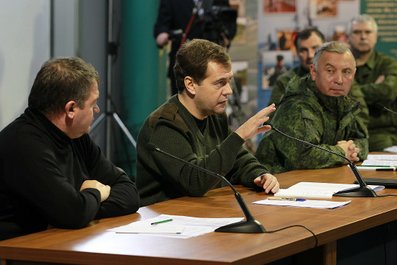
Medvedev Talks to Brigade Commanders

Medvedev Speaks at Brigade Commanders' Assembly

According to Kremlin.ru, President Dmitriy Medvedev traveled to the Gorokhovets training ground near Nizhniy Novgorod today to observe battalion-level ground and air maneuvers.  It’s a modern twist on an old tradition of presidential speeches before end-of-training-year assemblies in Moscow. 

Medvedev inspected a new field camp, different weapons and equipment, and watched a Tunguska demonstration.

Afterward he met brigade commanders observing the exercise, and addressed them about the process of reforming the armed forces.

Medvedev said for two years Russia has been actively modernizing its armed forces to make them more compact, effective, and better equipped, and completing ‘org-shtat’ measures [i.e. TO&E changes] to achieve a ‘new profile.’  Flanked by Defense Minister Serdyukov and General Staff Chief Makarov, he promised the assembled commanders a defense budget worth 2.8 percent of Russia’s GDP every year until 2020, but he said getting this level of spending will not be easy, and it requires adjustments and cuts elsewhere.

He particularly emphasized establishing the new system of higher pay to replace earlier ad hoc measures like premium pay.  He seemed to say extra money will be squeezed out for this, but people will be watching how it’s spent.  Kremlin.ru posted some of Medvedev’s opening remarks:

“This is creating the conditions to equip the troops with new equipment in accordance with the current edition of the State Program of Armaments and, what is a no less important task and really no less complex, to resolve all social issues which exist for servicemen.  This issues are also well-known.”

 “First and foremost is the indexation of pay which we are already now conducting, and implementation of the housing construction program.  From 2012, the planned reform of the military pay system not according to those fragmentary pieces which exist at present, not according to those selective approaches which exist, but a full reform of pay.”

“In the final accounting, we should get so that base salary, monetary salary of servicemen will be increased practically three times. And in the process to preserve and to extend to all the Armed Forces that which we talked about in the past, that which we did according to groundwork laid in bounds of order 400 and some other Defense Ministry documents.”

“All planned measures, reform measures should be calculated and materially supported in the most rigorous way.  An adjustment in the military budget is being conducted and oversight of the use of resources is being organized for this.  I promise the attention of all Defense Ministry leaders on this:  all these processes need to be completed in coordination with other government structures in order that we should have absolute precision here.”

“A high level of financial support for the Armed Forces allows, I hope, for freeing servicemen from noncore housekeeping functions – that, in fact, was done long ago in the armies of other countries.  The troops need first and foremost to put their attention on operational training, combat exercises, to concentrate exclusively on these issues.  Security duties (firstly, perhaps not even security, but cleaning), everyday support, food preparation should be transferred to civilian organizations.”

Medvedev told the commanders their brigades should be self-sufficient, modern, balanced, and capable of fulfilling missions given them, and he invited their feedback because, as he said, the success of the military’s transformation depends on it.

“It would also be useful for me to know your opinion on the quality of the reform, on the organizational changes, what, in your view, has proven itself useful, and where there are problems.”

Despite soliciting their honest opinions, one doubts the Supreme CINC will hear many complaints from this audience.  They are, after all, winners in the reform process since they managed to continue serving in command positions.

Grinyayev and Fomin’s Conclusion

This is a downpayment on Russia’s Armed Forces:  Year 2010.  You can read about the authors here.  The report’s not great, but it has interesting information not printed elsewhere.

This picks up on Fomin’s earlier interview.  Next look for their chapter on the OPK.

The gist of the conclusion is this.  There’s been no rebirth of the armed forces, in fact, many negative trends are now irreversible.  There’s been no real rearmament despite higher budgets.  The military doesn’t know how to set clear goals, and is planning to fight abstract threats like terrorism, instead of real ones like the U.S.  Russia has money, but has invested it in currency reserves instead of its armed forces.

Here’s a translation of their conclusion:

Conclusion

There’s a myth that in the last ten years an incredible militarization of the country and rebirth of military power not quite to the level of the Soviet Union has occurred.  As the analysis conducted showed, this does not correspond to reality – in reality a degradation of the Russian VS [Armed Forces] has taken place.

Negative processes which began in the 1990s have reached their apogee today and are close to completion, because many negative tendencies in army development have taken on an irreversible character.  Numerous reforms are confirmation of this:  when everything is normal, reforms are not required.  With growing expenditures, real rearmament is not happening and new equipment is not entering the forces as a practical matter.  The defense-industrial complex is still relying on developments from Soviet times and no substantially new developments in post-Soviet times have been made that could even go into experimental, much less into production use.

The analysis showed that the degradation of the Russian VS is conditioned on two main causes.

  1. The absence of a distinct system of goal establishment for the functioning and development of the VS.  The affair has gone to the point that many military experts and analysts (not speaking of officials) are completely ashamed to clearly designate possible military enemies, and are trying to implement military organizational development under abstract sources of danger and threats.  Any ordinary person understands that today and in the near future, there are only three such enemies:  the U.S., NATO, and China.  International terrorism is not an independent force, but only an instrument in the hands of the mentioned groups of countries.  It should be clearly understood that ambiguity in goal establishment is just as ruinous for the condition and development of a system as a lack of resources.
  2. Nor is everything right when it comes to resources.  More precisely, it is obvious they are insufficient even to hold a steady position.  Miracles do not happen in program planning:  if the amount of allocated resources drops to such a critical level, no improvement in the command and control system or reforms can make up for this.

One does not need to speak of the country’s difficult financial problems.  The country has money.  In 2006 and 2007, $125-175 billion was transferred to the country’s hard currency reserves, respectively.  $175 billion is, at the year average rate of 25 rubles/$, approximately 4.36 trillion rubles, that is 5 times more than all MO [Ministry of Defense] expenditures in 2007.  This money was transferred into long-term, low-interest, and ‘highly reliable’ U.S. securities.  So they assert.  It is simpler to say an unreimbursed investment in the American economy.  For this money, it would have been possible to maintain another five armies like the current Russian one.  Even in the crisis of 2009, when we experienced a federal budget deficit, from the middle of March until the end of the year, nearly $60  billion was transferred into hard currency reserves, i.e. nearly 2 trillion is the volume of financing for another 1.5 such armies like Russia’s. 

But the financing of the Russian VS is not happening on the necessary scale.  As a result, the real possibilities of Russia are being cut by leaps and bounds.  This affects both military power and political influence abroad.

PAK FA Update

PAK FA (photo: RIA Novosti / Aleksey Druzhinin)

RIA Novosti reports the second T-50 (PAK FA) testbed will begin flight tests before the end of the year, according to Sukhoy chief Mikhail Pogosyan.  He said the first testbed has performed 40 flights.  Sukhoy is satisfied with the course of testing which has gone faster than expected.

Pogosyan added that negotiations with India on its entry into the fifth generation fighter program should be completed this year.  Russia and India will roughly split the development expenses for one- and two-seat versions.  The PAK FA will start to enter the Russian inventory in 2015, and Indian forces around 2020.

A Thoroughly Modern CINC

You have to like Air Forces CINC, General-Colonel Aleksandr Zelin. 

He’s open and candid about what Defense Minister Anatoliy Serdyukov’s ‘new profile’ reforms mean for him and his service.  He’s talked earlier, more often, and longer about it than his Ground Troops or Navy counterparts.  He’s matter of fact and accepting of the entire process. 

Serdyukov’s changes turned General-Colonel into a trainer and force provider, and he nonchalantly admits as much. 

At 57, Zelin understands he can be replaced at any time, or allowed to serve three more years or even longer. 

If he were a tad younger, he would have been the right kind of general to command one of the new military districts / unified strategic commands (OSK / ОСК), say the Western or Central.  An air or air defense officer would have been just the right choice for a potential future war on those axes.  Instead, the Kremlin has three Ground Troops generals and one admiral (a step in the right direction).  It’s hard to argue against Ground Troops leadership in Russia’s restive south.  But Air Forces (VVS or ВВС) would have been a really good choice in the Western or Central Military Districts . . . a missed opportunity for now.

But back to Zelin.  On Tuesday, he addressed a foreign military attaché audience (and the Russian media) about the future of the VVS.

According to Gzt.ru, Zelin said the VVS will be reduced by a third and spread among the four new  OSKs.  And its Main Command (Glavkomat) will be responsible only for combat training.  The OSKs are in charge of employing the VVS in their theaters.

The VVS now consist of the Glavkomat, 7 operational commands, 7 first-rank air bases, 8 second-rank air bases, and 13 aerospace defense (VKO) brigades.  Before the ‘new profile,’ the Air Forces consisted of 72 regiments, 14 air bases, and 12 independent squadrons and detachments, with a third more aircraft than the VVS now have.

Four of today’s 7 operational commands are subordinate to the new OSKs.  Army Aviation also falls under them.

According to Zelin, in the future, the VVS Main Command (Glavkomat or Главкомат) could become a “branch department” of the General Staff responsible for the combat training of the Air Forces and Air Defense, while the OSKs employ the trained forces.

Zelin says VVS personnel will number 170,000 with 40,000 officers, nearly 30,000 sergeants, and the balance conscripts or civilian specialists.  He says today’s personnel training system doesn’t satisfy him, and so he’ll probably change the system of flight schools.  Only four remain today.  Voronezh will be the main training center.  Flight training will also be conducted in Krasnodar and Lipetsk.  Yaroslavl will remain home to air defense officer training.

According to the CINC, the VVS airfield network won’t change.  Base airfields will be first priority for reconstruction and modernization.  Zelin says civilian airfields could be used for operational purposes in the future.

He noted the VVS plans to go to a fully automated command and control system in the future, and, of course, develop its VKO forces.

Lenta.ua quoted Zelin’s remarks to Interfaks.  Zelin said the VVS will renew 30 percent of its inventory by 2015, and 100 percent new in some areas and 80 percent new overall by 2020.  He doesn’t say where the VVS are today in this regard, but recall Defense Minister Serdyukov has said only 10 percent of equipment in the Armed Forces is modern.

Zelin said the VVS will get new aircraft, air defense, reconnaissance, and electronic warfare systems, but modernization of some existing systems is still part of the plan.  Although the State Armaments Program 2011-2020 and its 19 or 20 trillion rubles have to be finalized, Zelin repeated that 10 T-50 (PAK FA) will be acquired in 2013-2015, and 60 more from 2016.  He mentioned Military-Transport Aviation (VTA or ВТА) is a priority – including the An-124 Ruslan, Il-112, Il-476, Il-76M, and An-70 – but he doesn’t venture any numbers or dates for new production.  Zelin does give a target of 400 new and modernized helicopters in the inventory by 2015.

Who knows what was or wasn’t covered in these media contacts, but it seems odd there’s still no mention of more S-400 deliveries.  Zelin was still talking about getting 5-6 more battalions in 2010 earlier this year.  But no sign of them.  It’ll be a big deal when or if they appear.  Also, no mention of S-500 development.

Short Stories

There aren’t enough hours in the day . . . quick takes on some stories of interest.

Rossiyskaya gazeta . . . Minregion again sternly warns of problems in heating military towns due to Defense Ministry debts . . . the Far East is the most serious case.

Nezavisimaya gazeta . . . Ukrainian Defense Ministry may not be able to cooperate on An-70 transport for financial reasons.

Argumenty nedeli . . . long expose on the death of Russian military medicine, and the consequences, as a result of Serdyukov’s cuts and reforms.

ITAR-TASS . . . the interdepartmental commission met at Sevmash today with Vladimir Popovkin leading a review of Yuriy Dolgorukiy’s readiness to test fire the Bulava.

ITAR-TASS . . . on Tuesday, Chelyabinsk’s governor called on Serdyukov to stop explosions at Chebarkul.  This mini-scandal’s been evolving since they started in early October.  Expired munitions are being destroyed, but locals are complaining of damage from tremors.  Serdyukov was supposed to go to Chelyabinsk, but sent logistics deputy Bulgakov in his place.  Bulgakov supervised an elaborate demonstration to show that the explosions aren’t powerful enough to shake Chelyabinsk.  Residents say they can feel them in the city’s high-rise buildings.  The military doesn’t get much credit for trying to get rid of old bombs like those that nearly leveled one of Ulyanovsk’s rayons last November.  See Novyy region or Moskovskiy komsomolets.

There is growing media attention to the military housing problem — will Medvedev, Putin, and the Defense Ministry keep their promise to solve the permanent housing problem by the end of 2010, or are they just changing the rules and extending their own deadline?  See IA Rosbalt, Svpressa.ru, or Nezavisimaya gazeta.

Tsyganok on the GPV and the OPK

Anatoliy Tsyganok

Interviewed in yesterday’s Svpressa.ru, defense analyst Anatoliy Tsyganok expressed his doubts that trillions of rubles can save Russia’s OPK, its defense-industrial complex.

A quick summary.  Tsyganok seems to make the point that, while there’s an armaments plan, the OPK is still in a woeful state of neglect, i.e. the Bulava’s producers may actually be better off than many defense enterprises.  Much of what is leaving the factory gates still heads for foreign buyers or requires expensive repairs because quality is lacking.  Perhaps the OPK development (or maybe rescue) program needs attention before the GPV.  Tsyganok takes fewer Indian and Chinese purchases as a sign of quality problems.  Lastly, he says Moscow needs to rethink how it’s most likely to fight before picking what to make and who will make it.

But back to the article, Tsyganok gives his views on what might be bought with 20 trillion rubles in State Armaments Program (GPV) 2011-2020.  He mentions (sometimes without specific numbers or costs):

  • An-124 Ruslan — 20.
  • An-70.
  • Il-112.
  • Il-476.
  • Il-76MD.
  • Combat and transport helicopters — 1,000.
  • PAK FA — 70.
  • Yak-130 combat trainers.
  • Su-35 and Su-30 — 60 (80 billion rubles).
  • MiG-29K — 26 (25 billion rubles).
  • Su-34 — 32 (35 billion rubles).
  • Proyekt 885 Yasen SSNs.
  • Proyekt 955 Borey SSBNs.
  • Bulava SLBMs.
  • Proyekt 11356M frigates — 3.
  • Proyekt 636 diesel-electric submarines — 3.
  • T-90 tanks — 261.

There are, of course, lots of systems required that he doesn’t take time to mention.  New ICBMs, advanced conventional munitions, communications systems, satellites, etc.  He notes that the Navy’s needs alone come to several hundred billion rubles, and several ships and submarines he mentions are for the Black Sea Fleet.  The Ground Troops don’t get too much attention from Tsyganok.

Asked whether the OPK can produce modern combat equipment of the necessary quality and quantity even with sufficient financing, Tsyganok responds:

“Unfortunately, it has to be recognized:  many OPK enterprises are already incapable of series production of high-technology weapons systems.  The woes of the unfortunate strategic missile ‘Bulava’ are proof of this.  The picture is generally nightmarish.  A fourth of Russia’s strategic enterprises are on the verge of bankruptcy.  The tax organs have already issued liens for the recovery of debts against 150 defense plants and organizations.  Baliffs have already been sent there.  Who can work on the state armaments program there?”

“And don’t let the fact that in the first half of 2010 fully respectable growth of 14.1% in production was registered in the defense-industrial complex deceive you.  Mainly, as before, everything put out went for export.  Let’s say, over six months, our country produced 54 helicopters.  Of them, 31 went abroad.”

Asked if the poor state of defense plants is affecting the quality of their products, Tsyganok says:

“It affects it in the most immediate way.  Expenditures on eliminating defects in the course of production, testing, and use of our military products today goes up to 50% of the general volume of expenditures on the corresponding defense budget article.  In economically developed countries, this indicator does not exceed 20%.  The main reason is monstrous equipment depreciation.  And there’s no ray of hope visible there.  The rate of renewing the production base in the Russian defense sector, despite growing financial inputs of recent years, is not more than one percent a year.  In order somehow to get out of this hole in which we find ourselves, we would need to increase this rate by 8-10 times.  Incidentally, the reduction in quality of arms and military equipment produced is already noticeably reflected even in Russia’s military-technical cooperation with our traditional partners in this area.  With India and China most of all.  They are already not so intently signing contracts with us as before.”

What about design bureaus and scientific-research institutes?

“Also nothing to brag about here.  The fact is what the Russian defense-industrial complex can offer the Armed Forces in the near future, with a few exceptions, is already no longer the world’s best models.  And all this is because in the USSR’s time our country allocated up to 4.7% of GDP to basic research.  In today’s Russia, in all 0.16% goes to this business.  At the same time, in China, for example, annually ten times more is spent on scientific-research and experimental-design work.  And, as expected, next year it will catch up with the U.S.  As a result, in many military technologies, Russia is currently at a 1970s-1980s level.”

Finally, Tsyganok’s interviewer asks if there’s any way out of these dilemmas:

“There’s always a way out.  First of all, it’s essential to promptly review the goals and missions of the weapons complex.  We really have to understand whom we intend to fight, and what types of armaments are necessary for this.  Then the state defense order [GOZ] will take on more accurate contours.  As long as we don’t have this understanding, the situation will only get worse.”

Latest on Su-34 Deliveries

ITAR-TASS reports today that Sukhoy will transfer the next part of its serial order of Su-34 fighter-bombers from the Novosibirsk Aviation Production Association (APO) to the Air Forces before the end of this year.

A Sukhoy spokesman told ITAR-TASS the Su-34 is being produced under the 2008 state contract for 32 aircraft.  And the Air Forces have already received five, according to this report.  Completion of this contract will reportedly give them ‘nearly 40.’

One notes, however, there have been many plans for Su-34 deliveries over the years that were not realized.

The wire service item reminds readers the ‘4+ generation’ Su-34s participated in Vostok-2010, refueling in air as they flew non-stop to airfields in the east.  The Sukhoy spokesman stressed the Su-34’s combat radius ‘approaching the ranges of strategic bomber flights.’

Not One of My Generals Looks Down on Me

Serdyukov with Der Spiegel (photo: Yevgeniy Kondakov)

Let’s look at Defense Minister Serdyukov’s two most recent media interactions, starting with his interview Sunday on Rossiya TV’s ‘News of the Week’ program.  If anyone finds the video for this, please send it in.  As it is, we have just the wire service snippets.  Better than nothing.  Much of this you will have heard before, but there will be things of interest, so don’t stop reading.

On the army’s winter preparations, Serdyukov said the Defense Ministry has studied the ‘serious emergencies’ [so there were more than just Steppe] in military garrisons last winter, and taken necessary measures to prepare the army for this winter.  He says the army is 98-99 percent ready, so he concludes this winter will go very quietly. 

This is, of course, quite a contrast with what Minregion and Basargin have reported, as well as with Severomorsk’s predicament.  There hasn’t been any press release announcing that the Severomorsk garrison’s utilities debt has been cleared, or that the heat’s been turned on yet.  The Navy had been preparing to move several hundred people from buildings belonging to eight different units without heat.

On allowing parents and public representatives to accompany conscripts to their service locations, Serdyukov had this comment:

“It seems to me this removes a certain tension from both parents and public organizations.  And this worried us enough, therefore we, including commanders, became more seriously inclined to it.”

Serdyukov issued yet another denial of any intent to change the current one-year draft term:

“Once again I want to say we don’t intend to increase the term (of service).  The term is 12 months, and so it will remain.”

He called a professional army a goal “we still can’t allow ourselves.”

He commented, yet again, on Russia’s plans for foreign arms purchases:

“Unfortunately, in recent years, in a number of (cases) and types of equipment we have fallen behind a little.  This, certainly, concerns both armored equipment and communications and UAVs somewhat.  We, naturally, won’t go over to mass purchases of foreign armaments and military equipment, we will only buy that which interests us, in limited quantities, to understand and evaluate those tactical-technical characteristics which they possess, on the one hand, and on the other – to try to formulate for our industry what we want to see from ourselves very soon.”

Serdyukov mentioned again Russia’s desire for two large amphibious carriers from abroad, and confirmed that two more would be built in Russian shipyards using the full technical documentation transferred along with the first two units.

The Defense Minister described a three-stage military reform to 2020:

“In the first part there are TO&E measures, and we have essentially already completed them.  We’ve gone to 1 million (servicemen) in size, of them 150 thousand will be officers, on the order of 100-120 thousand will be professional noncommissioned personnel, and the rest will be conscript soldiers.”

“The second task is, naturally, social issues which we need to take care of for our officers.  And armaments are the third task.  Armaments is a quite lengthy process.  We’ve broken it into two parts:  to 2015 is the first phase and out to 2020 will be the second.  We need to get to these parameters:  by 2015 modern equipment in the army must be not less than 30 percent and by 2025 on the order of 70 percent.  We believe that 2020 will be the completion of the transition to a new profile of the armed forces.”

It looks like Serdyukov is giving more wiggle room on rearmament.  Most reports to date have quoted Defense Ministry representatives saying 70-100 percent new arms by 2020.  Well, perhaps ITAR-TASS heard it wrong.  For this writer’s money, even 30 percent in 2015 looks like a longshot.

Also, not really much to say about those military social issues – and this presumably would be the main focus now since task one’s pretty much done and task three’s a long-term deal.

Even the pretty much completed task one is interesting.  Many press and media outlets seized on this one to finally understand, more precisely, the composition of the armed forces.  So Serdyukov says they’re down to 150,000 officers already.  And with a thinner layer of sergeants, that leaves between 730,000 and 750,000 conscripts at any given time.  But drafting 270,000 semiannually would leave Moscow short by roughly 200,000 conscripts.  Better round up those evaders.  And with all the varying comments, it’s very hard to say if Russia’s at one million men (150,000 officers) yet or not.

But moving on . . . on 27 October Der Spiegel copped an interview with Serdyukov.  It focused on relations and cooperation with NATO, Europe, and the U.S., and Russia’s view of missile defense, but there was stuff on Serdyukov’s reforms.  The Defense Minister told Spiegel flatly:

“As far as weapons go, in recent years, no modern weapons have been bought for the Russian Army.  Our armaments are largely outdated.”

Quite a stark admission he might not make to a Russian magazine.  Perhaps he’s willing to be a little more painfully blunt with a Western publication.

On buying abroad, Serdyukov told Spiegel that Russia can produce everything it needs, but some things are simpler, cheaper, and quicker to get from foreign producers.  He confessed that Russian industry has fallen behind the last 20 years.

Serdyukov goes on to discuss the million-man army, the imbalance in officers and grunts, eliminating corruption, Rosoboronpostavka, and cutting administrative layers. 

Then he’s asked why military men might oppose his changes:

“It’s obvious.  Who wants to lose his job?  Over the coming three years, we will cut the size of the officer corps to one hundred fifty thousand men.  At the same time, we will make service in the army more attractive, in particular, by raising pay.  The attractiveness of army service has now reached the very lowest level.”

Again, are they at 150,000 officers or not?  No one’s clear on this.  And one would think, with all Serdyukov’s efforts, serving might already be a little more attractive.

Asked if he’s worried about a military putsch, Serdyukov said:

“This doesn’t worry me.  We aren’t taking any impetuous measures.”

Of course, impetuous depends on whether you’re on the giving or receiving end of policy.

His interviewers asked if it’s easier for a civilian to conduct reforms in the military.  Serdyukov said:

“I can’t do everything myself.  We are working in a team – the Chief of the General Staff and my deputies.  It’s possible some things are simpler for me to do because I’m not connected to certain traditions and understandings which exist in the army.  I see problems from the outside, and because of this it’s easier for me to ask why we can’t do things differently.”

And finally they asked him if a general can take a civilian seriously, and he replied:

“I can assure you not one of my generals looks down on me.”

Shades of Seltsy perhaps . . . it seems it would have sufficed to say something bland like ‘we have our own spheres and mutual respect’ or we’ve created a two-branch Defense Ministry with civilians occupied with this and military men with that.  But instead Serdyukov comes off sounding like it’s a choice between dominating and being dominated.

Popovkin on OPK, IVECO, Mistral, and Bulava

Speaking to journalists at Euronaval-2010 today, First Deputy Defense Minister Vladimir Popovkin said the Russian Navy needs modernization more than the other armed services.  And defense industry needs modernization badly.  Popovkin noted:

“Many industry representatives came to the exhibition with the military.  At the exhibition we always need to examine what’s best in the world, have talks, and look at where we aren’t up-to-date.”

 “Without reequipping the Russian defense industrial complex it’s impossible to produce modern equipment.”

 “Our task is not to buy foreign equipment, but technologies on the basis of which we would be capable of organizing production in Russia.  We, unlike some other countries, are not secretly copying examples, but openly we say we’re prepared to pay for technologies, to buy licenses for production of this or that equipment.  The main condition is the transfer of production to Russian territory and the transfer of technologies.”

Is Popovkin slamming China?  Is China copying secretly or actually quite brazenly?

On the joint venture (JV) with Italy’s IVECO, Popovkin said:

“A JV for producing these armored vehicles on RF territory has been created.  Next year it will begin production.  The first vehicle will come out at the end of 2011.”

“Essentially, this is final assembly.  Nevertheless, we are planning that more than 50 percent of the components in this vehicle should be of Russian manufacture.”

Popovkin said Russia is now in talks on the specific model:

“We’ve presented specific requirements.  Why?  We have our own weather conditions, different employment tactics, therefore the base model will be developed taking Russian conditions into account.”

 ITAR-TASS noted the JV will put out vehicles needed for both the Defense Ministry and the MVD.  Licensed assembly of several hundred units of IVECO’s LMV M65 annually could occur at one of Russia’s automotive factories.

Popovkin also said Russia’s tender for amphibious assault ships has been announced:

“We’ve announced the tender for the purchase of amphibious assault ships.  Two ships will be built abroad.  Technology transfer for the construction of the rest is planned.”

It sounds like Popovkin’s decided a Russian shipyard can’t win the competition for the first two units.  Are Russian builders just competing for units 3 and 4?

Asked about the number of Bulava launches in 2010, Popovkin said:

“We’re acting sequentially, step by step, therefore it’s impossible to say now the exact number of launches in 2010.  The main task now is to conduct the next launch.  Based on it, we’ll determine our future plans.  Until we get reliability of 98-99 percent, we won’t put this missile on combat duty.  The missile’s reliability is determined not just by launches, but also by a whole series of testing work.”

Meanwhile, a Defense Ministry source has told ITAR-TASS the second Bulava launch of 2010 will occur on 29 October.