Category Archives: Force Modernization

Ten Pantsir-S1s for Russia, or for UAE or Syria?

We all miss things, right?

In Friday’s NVO, Viktor Myasnikov published an insightful article on Pantsir-S1.  He hints that maybe the ten Pantsir-S1s ceremoniously delivered to the VVS aren’t actually for Russia’s VVS.  More interestingly, he provides numbers on the quantity really needed to rearm the Russian Armed Forces by 2020—500 for the VVS and 500 for the Ground Troops’ VPVO.

“‘Pantsir’ is one of the most talked about combat vehicles of the last 20 years.  Everything about it’s been heard, many have seen it at exhibitions, but it only began to come to the troops in recent days.  In the long years of design work (which began in 1990), testing, and disrupted contracts, ‘Pantsir’ received the honorary epithet ‘longsuffering.’”

“Now they’re talking about it again in superlative terms.  One could get the impression this is some panacea against all means of aerospace attack.  Actually, this is a close-range—up to 20 km—air defense system.  It exceeds hand-held ‘Igla’ and ‘Strela’ SAMs, but doesn’t approach the level of ‘Tor.’  And ‘Pantsir’s’ place in the order of battle has been designated perfectly concretely—it will replace ‘Tunguska,’ which in its time replaced ‘Shilka.’  True, it will really only replace ‘Tunguska’ when it gets on a tracked chassis.  For now this is a wheeled rear area variant designated to cover important targets—airfields, bases, air defense positions . . .”

“Initially ‘Pantsir’ was planned for tracked transport in as much as it needed to take the place of ‘Tunguska’ in tank columns to cover them against helicopters and other low flying enemy aircraft.  But the concept began to change due to underfinancing.  And a cheaper variant ‘Pantsir’ put on wheels, became positional as the last line of air defense for rear area targets.”

“The uniqueness of ‘Pantsir’ in the arms market is guaranteed by the fact that U.S., NATO, and Israeli armed forces are not threatened by cruise missiles, planned munitions and UAVs of the potential enemy [many would differ with this assertion].  It [Russia?  Arab states?] doesn’t have them in the necessary amount and won’t have them in the coming years.”

“In accordance with the State Program of Armaments to 2015 it’s planned to deliver 20 of such systems to the RF Armed Forces.  10 have already been received.”

“At the same time the Russian Air Forces’ demand is specified as a minimum of 100 systems of this type.  Incidentally, other specialists believe it’s essential to buy 200-250 systems by 2015 and 400-500 by 2020.  Besides that, the Ground Troops could buy 500-600 vehicles by 2020 for replacing ‘Tunguskas.’  They certainly could, of course, they could, but who will provide them?”

“Besides this, there’s no trusting official announcements that all overdue export contracts for the supply of ‘Pantsirs’ to the UAE and Syria have been fulfilled [actually it’s pretty clear supplies are just starting].  Therefore it’s strange that 10 vehicles suddenly turn out to be withdrawn from the export orders.  Suspicions immediately arise that the buyer has refused them or not accepted them due to complaints about quality.  Meanwhile, some anonymous sources from Tula defense industrial enterprises maintain that everything’s normal with the quality, but the vehicles are just taking a pre-sales run on normal asphalt road conditions.  After the [9 May Victory Day] parade the ‘Pantsirs’ will be repainted desert camouflage and handed over to the foreign buyer.  There’s no need to show them to anyone until the next parade.”

“There are suspicions that the ‘KamAZes’ for these ‘Pantsirs’ are not quite serial models.  ‘Cause in their build-out they are too close to the one in which Vladimir Chagin wins ‘Dakar.’  Would it make sense to have imported turbocharged engines on them?  Such capability of automotive equipment for covering stationary S-400 SAMs is a little unnecessary.  But it’s exactly right for the Middle Eastern or North African desert.”

“But there is another side to this.  It’s been announced that these 10 ‘Pantsirs’ will participate in joint exercises of Russia, Belorussia and Kazakhstan.  And also before the handover to the troops at the ‘Shcheglovskiy val’ enterprise an archpriest blessed them.  Such a ritual wouldn’t be arranged for a buyer from a Muslim state.”

Pantsir-S1 and the Priority on Arms Exports

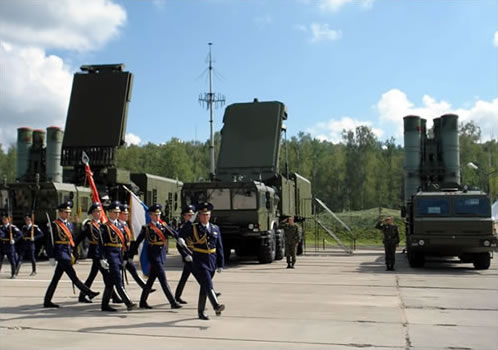
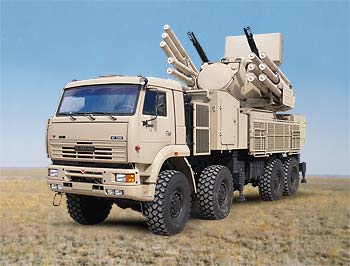
KBP's Pantsir-S1

Recent announcements about deliveries of the Pantsir-S1 highlighted the priority still enjoyed by arms exports over domestic procurement of weapons systems for the Russian Armed Forces.

On 18 March, the Russian Air Forces took delivery of their first 10 Pantsir-S1 antiaircraft missile-gun systems (ZRPK) from the Tula-based Design Bureau of Instrument-building (KBP).  These Pantsir-S1 systems will march on Red Square during the coming 9 May Victory Day parade, before heading to the Elektrostal-based 606th Guards Air Defense Missile Regiment that also has the S-400.  Some of the regiment’s Pantsir-S1s will participate in live-fire exercises at Ashuluk in April.

The Pantsir-S1 will replace the 1970s-era Tunguska-M1 in Russian air defense units.  A short- and medium-range missile-gun system, it provides point defense for civilian or military assets like S-400 SAMs.  VVS Deputy CINC for Air Defense, General-Lieutenant Sergey Razygrayev has said three Pantsir-S1 systems will be deployed around each S-400 launcher.

The Pantsir-S1 has 2 twin-barrel 30-mm 2A38M antiaircraft guns and 12 57E6-E SAMs.  It is reportedly effective against targets with a reflective surface of 2-3 square centimeters and speeds to 1,000 meters per second, at a maximum range of 20 kilometers and altitude of 15 kilometers.

The Pantsir-S1 can be mounted on various vehicles and ships, and General-Lieutenant Razygrayev has said it will become a standard air defense system for each of Russia’s armed services and combat arms in the future.

When the VVS got its 10 Pantsir-S1 systems, the KBP deputy general director announced that the Air Forces will receive more than 20 units in coming years.  An unnamed source told ITAR-TASS, the VVS would get 25 Pantsir-S1 by 2012.

Development of the Pantsir-S1 dates back to the early and mid-1990s.

The United Arab Emirates (UAE) signed a contract to buy 50 Pantsir-S1s for $734 million in 2000. Syria also contracted for 36 systems.  Ex-Defense Minister, now Deputy PM for the OPK Sergey Ivanov said in early 2008 that 24 systems would go to customers in 2008, from a total order book of 64 for the Pantsir-S1 (of course, 50 + 36 should be 86, not 64).  But the Pantsir-S1 didn’t finish development and testing until some time in 2008, and entered production later in 2008 or in 2009.

Pantsir-S1 deliveries to the UAE and Syria reportedly began in 2009, and the system is already supposedly operational in the UAE.  An OPK source told Interfaks that the first stage of Pantsir-S1 deliveries to these two countries had been successfully completed.

This month Moscow announced the sale of 38 Pantsir-S1s to Algeria for $500 million.  The systems are supposed to be delivered this year and next.  The Russians are reportedly close to a Pantsir-S1 export deal with Libya, and Saudi Arabia, India, and Belarus have been mentioned as other potential buyers of the system.

So these are pretty lucrative sales for KBP, roughly $13-15 million per unit.

Now back to the Russian Armed Forces which have only 10 newly-received Pantsir-S1 themselves.

In late 2007, the commander of Troop Air Defense for the Russian Ground Troops gave his opinion that Pantsir-S1 needed improvements before it could enter his inventory, specifically he wanted its size reduced and better performance against certain types of targets.  For its part, the VVS had been looking, and waiting, for Pantsir-S1 since at least 2002.  AVN reported in late 2008 that the VVS wants to buy more than 100 of the systems.

Even if the Defense Ministry paid $15 million (unlikely), 100 is still a modest buy of $1.5 billion against annual military procurement of about $40 billion these days.  But one can guess that the military is haggling with KBP over the price it’ll pay for the Pantsir-S1.  And this purchase has to fit with other defense procurement and KBP’s production for its foreign buyers.

Makarov Describes the Army He’s Building

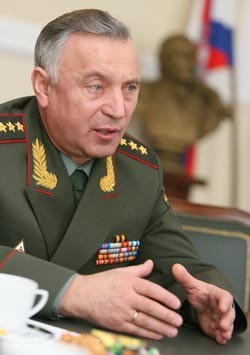
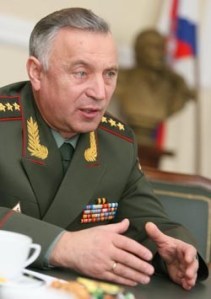
Nikolay Makarov (photo: Viktor Vasenin)

Today’s Rossiyskaya gazeta interview with General Staff Chief Nikolay Makarov has lots of questions and answers on the state of U.S.-Russian negotiations on a new strategic arms treaty, and on missile defense.  If you’re interested in those, you’ll need to read for yourself.

If you’re interested in the other things Makarov said, read on.

Asked isn’t it strange that Russia’s army would be cut when NATO is drawing closer to its borders, Makarov answers:

“We proceeded from the fact that the world has changed to a significant degree in the last 15-20 years.  Russia needs armed forces capable of reacting promptly to any threats and challenges.  Our army, if you take the first Chechen campaign, couldn’t cope with these functions.  To fulfill missions we were forced to man military units with, as a rule, untrained soldiers and officers in the course of combat actions.”

Makarov goes on, saying, after 1996, the army manned 13 percent of its regiments at 80 percent of their wartime complement, so they would be ready for action in a few days if needed.  The remaining 87 percent stayed at cadre level, with equipment and supplies in storage.  So Russia kept a big army that ate up enormous resources, but couldn’t carry out missions. Officers and warrants were almost 50 percent of personnel, and there weren’t enough soldiers.  Possible variants for the best structure were considered and the brigade was selected.  And today any brigade can be ready for action in only one hour, according to Makarov.

Makarov says, in Afghanistan and Chechnya, battalions were reinforced with reconnaissance, artillery, air defense, logistics, and repair units before they deployed for combat.  But battalion commanders weren’t so good at commanding these attached units not normally in their TO&E.  So, says Makarov, it was decided to add these units to battalions, so their commanders can learn how to employ them.  And three battalions organized as such and fully manned comes to 4,500 or 5,000 men–a ‘half division’ rather than a regiment.  And, he notes, battalions can operate independently or as part of brigade tactical groups.

He goes on to explain the Russian Army’s changed outlook:

“In the past we fought with multimillion-man groupings of troops, the basis of which were fronts.  The experience of military conflicts of the past decades showed that such a war was possible, but unlikely.  In the future, troops will go over to actively maneuvering actions.  The actions of inter-service groupings on the entire depth of the enemy’s force structure are replacing frontal battles.  The sides will try to destroy critically important objectives, and also conduct noncontact combat actions.”

The interviewer asks Makarov why only 2 tank brigades in 85 Ground Troops brigades, doesn’t the infantry need armored support?

Makarov answers that, like cavalry in the new age of automatic weapons, today the tank’s role is becoming secondary.  But what’s causing the change? He says it’s the information and artificial intelligence inside equipment, highly accurate weapons used as part of a single information space, and weapons that ‘see’ and ‘know’ everything and can be used against troops and targets in automatic mode.  But he calls robot-tanks with highly accurate weapons a thing of the future at this point.  And Makarov adds that no one is forsaking tanks:

“Here you’re talking only two brigades. Actually we are filling motorized rifle brigades with a great number of tanks.”

Makarov explains the advantages of modular brigades and battalions. Modularity means freedom in structuring battalions and brigades.  If we need a fist of motorized rifle and tank battalions and artillery batteries, we make it.  Commanders in the past didn’t have this freedom.  The entire army force structure was laid out for the conduct of a large-scale war.

Makarov explains modularity as a reaction to Chechnya and even World War II where C2 and force structure was created out of troop units that weren’t coordinated [неслажённые –a difficult one in English, troops that weren’t previously trained and melded together into a cohesive unit or formation].

Asked if there aren’t place in the RF where one can fight with divisions, Makarov says the Russian Army hasn’t gone completely away from divisions [but almost].  But he goes on to insist that their modular nature allows brigades to be used just as well as divisions in Siberia or the Far East, just as well in a large-scale war as independently.

Asked how the army can be trained to fight in a new way, he says:

“The last twenty years there was no intensive combat training in the Russian Army, graduates of commissioning schools and academies didn’t reinforce their theoretical knowledge with practical actions.  And like a foreign language–if there’s no practice, in 2-3 years it’s forgotten.  At the same time, officers without such practice rose in position and rank, some even served to the point of commanding armies.”

“Two tasks stood before us.  First of all, to change the mentality of commanders and their views on war.  It certainly wouldn’t be the one they were taught in the past.  Troop actions, capabilities and forms of their employment have become absolutely different.”

“In order to get to a common understanding, a common methodology is needed.  We are beginning to introduce it, but we are dedicating the current year to individual training of servicemen and combat coordination [слажевание]  of brigades.  From January to February 2010 at the base of the Military Academy of the General Staff we conducted supplementary courses with military district, fleet, and army commanders and their deputies.  Officers ranking from general-colonel to colonel serve in these positions in the armed forces.  Special demands are made on them as organizers, directors, those directly responsible for teaching and training subordinate military command and control organs and troops.”

“We’ve built a training chain, but we understand that this is just the first step.  Everything that officers study in theory still needs to be assimilated in practice.  For this in the second half of May we plan to conduct an operational assembly on the base of one of the units of the Moscow Military District where we are developing a single methodology of training in brigades and below.”

Makarov says 148 new ‘programmatic-regulation documents’ have already been developed.  The Kavkaz, Zapad, and Ladoga exercises last year showed some problems with them, but working groups from the Center for Military-Strategic Research and the Main Combat Training Directorate are reworking them.  The revised regulations will be used in Vostok-2010.  The goal is to have a new combat training program and new combat manuals before 1 October.  Once approved, they’ll be used to organize training starting in 2011.

Makarov also takes this opportunity to expound on his views of netcentric command and control.  He mentions that the U.S. war in Iraq showed that former canons about needing to have 2-3 or 5-6 times superiority in forces and means for military victory no longer necessarily apply.  He says Moscow has the ambitious goal of achieving netcentric command and control in 2-3 years, but the future system is being established in the SKVO this year.

The last issue raised for part one of Makarov’s interview–contract service.  Makarov says the media claimed he had recognized the failure of military reform, when what he really addressed were the miscalculations in contract service over a period of several years.

He says 6-month conscripts were forced into contracts just to meet the [previous] Genshtab’s dictate to have not less than 95 percent contractees in permanent readiness units.  He says these guys were not professionals, but rather just highly [well, not terribly highly] paid conscript soldiers who left the army at the end of their two years anyway.  So, Makarov concludes, it’s no surprise that contract service became a fiasco.

But he adds, we aren’t turning away from it.  A fully contract army would be the very best variant if Russia could afford it [can’t it?], but it can’t according to Makarov.  So he continues:

“Therefore we want to select as professionals only those who’ve served in the army [as conscripts], and only for positions determining the combat capability of military units, related to the operation of complex and expensive equipment.  In the Navy, practically all positions are such.  In motorized rifle brigades not less than 20 percent of the TO&E will be contractees–tank, antiaircraft, and artillery system drivers, gunner-operators, some other specialties.  Plus sergeants.”

“Moreover, if a sergeant is a professional, has served 10-15 years and the level of his training is higher than a new lieutenant, he should get more than the young officer.  We understand that the pay of a contract soldier has to guarantee the attractiveness of military service.  All this will be put into the new pay system.”

Asked about housing for contractees, Makarov says professional soldiers and sergeants need to live like officers in service apartments or dormitories.

More on the Unified Tactical Level Command and Control System

On 7 March, Russkiy Newsweek spent some time on Sozvezdiye [Constellation], aka the Unified Tactical Level Command and Control System (YeSU TZ).  The system is sometimes called by the name of its manufacturer–Sozvezdiye.  General Staff Chief Makarov in February said the system would be ready by November.

Russkiy Newsweek concludes, if it actually appears, it will be a technological revolution.  One Defense Ministry interlocutor said it now takes a day for orders to reach field commands from Moscow, but they will go practically in real time with this system.

The author, Viktor Poltavtsev, says NATO already operates in a netcentric fashion, and Makarov is quoted about how an Iraqi Army superior in tanks and artillery was defeated by smaller coalition forces that could see and forecast events, calculate variants, and receive possible solutions in real time.  Poltavtsev says, in the Genshtab, they believe the U.S. Army was 80 times more powerful than its opponent as a result of this information advantage.

But back to Sozvezdiye, Anatoliy Tsyganok thinks this not-yet-fielded system is already obsolete.  He says:

“Every Defense Minister picks his toy.  Igor Sergeyev–Bulava, Sergey Ivanov–GLONASS.  The current minister–the command and control system.”

Despite willingness to entertain possible arms imports in many areas, there is a fear of imports when it comes to command and control systems. Aleksandr Golts notes that Russia lacks a component base–it can’t produce chips or circuit boards, but doesn’t want to buy them abroad either.

The Georgians’ U.S.-made Harris system reportedly performed magnificently in 2008.  One Sozvezdiye associate said that, when the smoke of that little war cleared, it was obvious the Russian Army had no communications, old or new, and things began to stir in the Genshtab.  But Sozvezdiye’s testing has brought mixed results.  YeSU TZ was tested last summer during Kavkaz-2009.

Poltavtsev gives a little explanatory background.  Akatsiya, around since the mid-1990s, is a Genshtab-Military District level comms system that was produced by Sistemprom.  But it didn’t make too much sense without a tactical system to reach brigades-battalions-companies and individual soldiers.

Enter Sozvezdiye.  The Voronezh NII of Communications (aka Sozvezdiye) has worked since 2000 on a tactical level system.  Its specialty heretofore had been satellite radio comms.

Sistemprom awaits the completion of Sozvezdiye’s system so it can connect the two, to create a single command and control system.  As Poltavtsev describes it, generals will sit at Akatsiya stations and command divisions or brigades that have Akveduk.  Brigade commanders will use Akveduk to command their battalions and companies in real time using fast, well-protected channels.

So YeSU TZ is supposed to be the computer network that unites the battlefield–people, equipment, artillery, etc., like a computer game.

Battalion and company commanders are supposed to be able to use digital channels to get reconnaissance photos, video, and other data, to give commands to troops, and to connect to higher staff elements.  Today the commander still has to scream into the radio, but tomorrow he might send soldiers orders to their hand-held devices.

But this is still theoretical.  Everything will depend on the reliability of the equipment and comms channels.  And the system can be blocked if the RF spectrum is suppressed.  The system might not work against a modern, well-equipped enemy that can do this.

Poltavtsev says Russian EW (or REC) systems were used against Sozvezdiye during testing in December at Alabino.  And mobile phones, Internet, radios, and even some hospital equipment in the area stopped working as a result.  A Sozvezdiye rep says their system was jammed on the Taman brigade’s range, but they can get around this by changing transmitters.

The main thing, according to him, is developing algorithms for use in combat that everyone understands.  Users say Sozvezdiye is complex and difficult to use, and it will take a while for commanders to sort out its arrows and symbology.

The Defense Ministry has acknowledged that YeSU TZ needs significant reworking, but there’s no other way.  General Staff Chief Makarov said everyone built their own C2 systems in the past; there were 16 military C2 systems in Soviet days.  Now a common one is being built.  However, Poltavtsev asked a PAK FA developer if his system is already integrated into Sozvezdiye, and he asked what it was, he’d never heard of it.

An interesting account of Sozvezdiye . . . it sounds a little like the story of Bulava, i.e. ‘we have to unify our different systems,’ ‘there’s no other way but to make it work,’ etc.  These are understandable, even commendable at times, goals and sentiments, but they don’t always lead to development of successful military systems.  Sometimes the primary goal has to be a system that works.  And sometimes designers and builders even have to start over.

Serdyukov’s Post-Collegium TV Interview

After last Friday’s Defense Ministry collegium, Serdyukov was interviewed on Rossiya 24.

He probably fielded more pointed questions than normal, but he easily navigated them.  At times, he answered partially and the interviewer didn’t follow up with the next logical question.

Asked about officers dismissed in 2009, he said the armed forces shed 65,000 of them, who retired on age or health grounds, requested dismissal, or violated their contracts.  There was no mention of those put in limbo outside the TO&E, without duty posts and only their rank pay to live on.  These are the officers who can’t formally be dismissed because they don’t have housing, and are living at their ‘commander’s disposal.’  There was also no mention of how many warrant officers were put out in 2009.

Serdyukov said some officers accepted civilianized posts, and 4,000 received job retraining–a pretty small number against the large need for it.

The Defense Minister said dedovshchina was officially down 15 percent, and he doesn’t want only platoon and company commanders punished when it happens in their units.  He wants to see all levels of command take more responsibility for the problem.  Not sure what he’s insinuating, but it could be a warning to higher ups that they could suffer too when big time violence cases hit the news and make the Arbat military district look bad.

Serdyukov talked about higher officer training and appraisals, mentioning the assembly for 550 officers from the military districts and army commands.  He said we tried to make them understand what it is we’re trying to do.  But many lacked the knowledge and necessary skills–presumably to continue in the service.  See today’s Nezavisimaya gazeta.  Viktor Litovkin writes about generals and senior officers dismissed under Serdyukov.  Military district and fleet staffs which used to number 500-700 officers have been cut to 300.  Trimming the ‘bloated egg’ is generally a good idea, but as Litovkin says, it really depends on the quality of those left behind.

Back to Serdyukov’s interview . . . in cutting the military educational establishment from 65 to 10 mega-institutions, he said fewer officers will be needed but the quality of their training must be improved.  The 10 left standing have or will have their faculty members assessed for fitness to serve and they’ll get facility improvements.

On contract service which General Staff Chief Makarov has pronounced dead, Serdyukov said:

“The results of the program were not satisfactory.  In reality, we underestimated the situation somewhat, as regards who should switch to contract service and on what terms, or with what pay.”

“. . . the next program should be revised in an attempt after all to think it out regarding what specific positions should be filled by contract service personnel.  Of course, this applies to complex skills, where expensive equipment is operated.”

Nevertheless, he noted that he expects the contract sergeant program [albeit small-scale and apparently no longer funded] to succeed.

He said the army borrowed from foreign military experience in deciding on the shift from divisions to brigades.  He said the latter’s potential is virtually the same or even greater in some cases than that of the former.

Serdyukov said the Defense Ministry has reported to the Supreme CINC on its view of how it would like to reequip over the next 5-10 years.  He repeated that cuts to R&D and maintenance had allowed for bigger buys of new arms in 2008 and 2009.

He admitted Bulava hasn’t been successful, but he expects this system to be put right and completed.

He addressed possible foreign arms purchases:

“. . . in some areas we are lagging behind quite badly.  This relates not just to the Navy but also other services.  We are buying things in single numbers right now.  They are things like UAVs, all kinds of sights, night vision equipment–it is a very broad spectrum where we are specifically lagging.”

Despite reports that Moscow would be negotiating only with Paris on Mistral, Serdyukov claimed Russia is talking to the Netherlands and Spain.  He denied it was no more than a glorified cruise ship, saying it could perform many roles and had many different capabilities.

Moscow Considering Italian Light Armored Vehicles?

Russkiy Newsweek yesterday said a source close to the Defense Ministry claims Moscow is considering buying Italian IVECO M65 vehicles, also known  as the LMV (Light Multirole Vehicle).  The source said negotiations are in the final stage, and LMVs are reportedly being tested in Russia, but opinions on their suitability for Russian conditions are varied.

Another problem–the LMV is basically an analogue of Russia’s Tigr, produced by Arzamas Machinebuilding Plant, a company belonging ultimately to Oleg Deripaska.  The LMV is 1.5 or 2 times more expensive than Tigr and carries fewer personnel.  But it is considered more explosion resistant.  Deripaska’s people dispute this, however, saying it depends on how close the vehicles are to the explosion.

Russkiy Newsweek says the LMV was shown to Putin last year, and Medvedev this year.  It adds LMV to a list of proposed or actual Russian arms buys abroad, including British sniper rifles, Israeli UAVs, and French Mistral helicopter carriers.  The possibility that United Shipbuilding Corporation (OSK or ОСК) chairman and Deputy PM Igor Sechin (a long-time Kremlin insider and Putin crony) could still derail the Mistral deal is raised, but somehow this seems unlikely now for many reasons.  Why wreck a lucrative deal when you can get a piece of it instead?

The article concludes noting that this is the logical continuation of a new Russian military-technical policy–Russia can no longer be considered a closed market and soon Russian companies will have to compete with foreign producers for this internal market, according to CAST’s Ruslan Pukhov.

But there’s more to this story than that . . . some foreign samples are always good if you can get them, some palms might get greased in the process too.  It’s not a bad idea to scare the domestic defense industries, but are they really in a condition to compete with foreign producers?  Rather than stimulate them to get better and more efficient, they could just collapse in the face of a real competition for sales.  And it really goes against everything Russian to rely on foreigners, especially when they’re part of an allegedly hostile NATO.  But mucking about in NATO’s Old European rear area isn’t bad for stirring a little alliance discord.  Just weeks ago too the Russian press had stories featuring President Medvedev with the Tigr and the VDV seems pretty committed to the vehicle.  Let’s just say many factors are in play, which will be the critical ones?

Medvedev Speaks at Defense Ministry Collegium

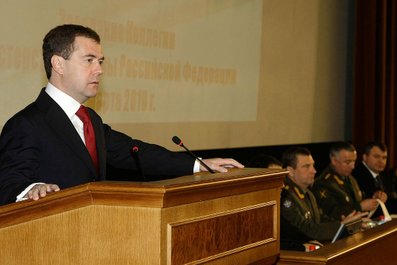
President Medvedev (photo: kremlin.ru)

In his remarks [text and video], President Dmitriy Medvedev reviewed the results of 2009 and talked about future plans for the armed forces.

He focused first on the international situation, noting that, “. . . today we have no requirement to increase further our strategic deterrence potential,” although it remains a determining factor in Russia’s conduct of independent policies and the preservation of its sovereignty.

He noted Moscow’s new law authorizing the use of force to protect Russian citizens abroad, and he pointed to unresolved conflicts on Russia’s borders [where presumably the new law could be used].

Medvedev acknowledged some positive tendencies such as work on a new strategic arms control agreement and renewed Russia-NATO contacts.  But he called the West’s reaction to Russia’s draft treaty on European security a barometer of relations with the U.S. and NATO.  He said it could prevent conflicts like Georgia-South Ossetia.  Medvedev asserted that, unfortunately, far from all countries and politicians drew the correct lessons from the August 2008 events.  And, unfortunately, he said the reestablishment of Georgia’s military potential continues with external assistance.

Then Medvedev turned more to the exact points of his speech.

He said the main goal is the qualitative improvement of the armed forces, the creation of a modern army and fleet equipped with the newest weapons.  He said last year the organizational base for this was established, as planned, without expending additonal resources.

In 2009, Moscow got its authorized personnel down to 1 million, and, according to the President, the Defense Ministry largely achieved its task of getting to the military’s future combat composition.  Medvedev said the results of Osen-2009 confrmed this, and more exercises like it are needed and need to have a ‘systematic character.’  Because, “Without this there simply are no armed forces.”

Medvedev called the training of officers the ‘most important task. Motivated, high-class specialists are needed, but the recently degraded military educational system and its material base need improvement. Medvedev said particular attention also needs to go to sergeants.  They need to be capable of replacing front-line officers when needed, according to the Supreme CINC.

On to rearmament . . .

Medvedev called the task of reequipping the troops with new armaments ‘extremely complex and very important.’  He said last year Russia stabilized the condition of its arms and equipment, despite the financial crisis, and fulfilled the GOZ, although not without problems.

He called the contracting mechanism for arms purchases ‘not effective enough,’ and said we are  working on this, but it’s slow.  This year the State Armaments Program, 2011-2020 will be written.  Medvedev gave the government the task of renewing arms and equipment at an average rate of 9-11 percent annually to allow Moscow to reach 70 percent modern armaments by 2020.  Reequipping has to be supported by full and timely financing.  He referred to his Poslaniye list of  priority systems and arms to be acquired.  He said this task will not be adjusted, and old weapons need to be decommissioned [He seems to have gotten it into his head that new means good and old bad which is not necessarily the case with Russian weapons.  What happens if you scrap lots of stuff, but you don’t succeed in producing new stuff?]. 

Medvedev said, as he’s already said more than once, steps are needed to bring order to the use, storage, and upkeep of missiles, ammunition, and explosives.  The events of the last year have shown there are problems here [alluding to Ulyanovsk, Karabash, etc.].

Medvedev noted another issue, providing the armed forces with automated command and control, and information systems, and transferring the military to digital comms by 2012, as put forth in the Poslaniye.  He said Zapad-2009 worked on mobile automated C2, but this was only a beginning to the work, which needs to be intensified, because “the communications situation is problematic.”

The President said forces will increase their combat readiness in their new TO&E structures [aren’t they 95 or 98 percent combat ready already?].  The main effort will be forming and training inter-service troop and force groupings, and supporting nuclear deterrence forces.  Medvedev said he’ll attend the main, key phases the coming Vostok-2010 operational-strategic exercise.

Medvedev obligatorily cited increasing the prestige of military service and improving the social defense of servicemen as a priority task.  

“I’d like to note that all obligations of the state to current and released servicemen will be fulfilled unconditionally, I will not accept any amendments for budget changes, or for other reasons.”

Medvedev said the government has the clear task to guarantee that all servicemen needing permanent housing have it by the end of this year, and service housing by the end of 2012.

“The realization of this task is not going badly, I will also take this under my personal control.”

Finally, Medvedev spoke for a moment to pay issues.  Increasing pay, and instituting a new pay system for active duty troops from the beginning of 2012, and increasing pensions to retired military men [but nothing specific promised].

He said he thinks premium pay or the well-known Order 400 brought respectable results, and it will be important to preserve ways of rewarding servicemen with extra money under the new pay system, and he expects proposals on doing this.

Defense Minister Serdyukov had some comments after Medvedev’s speech, but they’ll have to wait until tomorrow.

Happy Defender’s Day

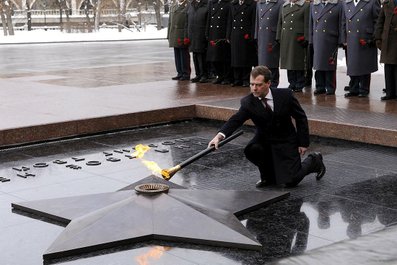
Medvedev Lights Flame at Tomb of the Unknown Along Kremlin Wall

In his Defender’s Day eve address on Monday, President Dmitriy Medvedev said:

“The defense of native land, service in the army and fleet has always been considered our holy duty.  And those who chose the military profession as the business of their entire lives command great respect among our people.”

Apparently, not too holy since Medvedev didn’t serve, even though he would have been due for conscription at the zenith of the mass mobilization Soviet Army and one of the coldest points of the Cold War [1983].  Of course, there are lots of presidents who didn’t serve in their countries’ armed forces.

Medvedev went on to thank Russia’s veterans with the 65th anniversary of the Great Victory fast approaching [9 May].

Then he noted:

“. . . strengthening the defense capability of our country–this, absolutely, is the fundamental basis for our development.  Our strategic goal is the formation of an effective army and navy, adequate for the level of modern threats, capable of withstanding any level of aggression and being a real factor in guaranteeing international stability.”

“Before us stands the main mission–to reequip the army and fleet with the newest armaments.  It is essential to concentrate resources, all our best forces, and our country has done this more than once, in order to create new quality types of military equipment and finally escape from a system of “patching holes” in old armaments.  Some has already been accomplished here, but this is a basic task for the near future.”

“Strengthening Armed Forces personnel will also remain a priority.  People who have received a modern quality education answering the demands of the time need to be occupied with military affairs.  People who are prepared to complete contemporary combat missions, to complete them in the most effective way and, absolutely, physically and morally prepared.”

“The most important condition for the successful modernization of the Armed Forces–this is increasing the quality of life for servicemen.  The current military labor stimulus system (I have in mind the so-called order 400) is already giving positive results today.  From 2012 new salaries will be paid to all our country’s officers.”

“Everything necessary is being done so that this year all military men needing permanent housing will receive it.  I am keeping this issue under my personal control.”

“By the end of 2012 the issue of providing servicemen with service housing will be fully resolved.  I am sure that such guarantees will increase the wellbeing of your families and the prestige of military service as a whole.”

“Next it is important also that all measures to transfer the army and fleet to a new quality should be fulfilled efficiently and on schedule.  I am expecting precisely this from the Defense Ministry.”

On Tuesday, Medvedev participated in reigniting the eternal flame on the grave of the unknown soldier below the Kremlin wall.  The flame had been moved temporarily to Victory Park on Poklonnaya gora during the renovation of the tomb of the unknown.

Medvedev also visited a military unit in the Moscow suburbs and had tea with a senior lieutenant and his family in their new apartment.

The KPRF and its leader, Gennadiy Zyuganov, played the lead in presenting an opposite point of view on Defender’s Day.  The KPRF faithful marched from Triumfalnaya ploshchad to Teatralnaya ploshchad for a rally.  The party predicted 10,000 attendees, the police said there were 1,500, and Ekho Moskvy reported 4,000.

One KPRF leader said his party was coming out in defense of the army and fleet, their history, their power and against this senseless reform which Defense Minister Anatoliy Serdyukov is conducting.  He said the KPRF would hold rallies in 8 regions where elections are being held on 14 March.  Those demonstrations, however, were focused on more ‘bread and butter’ issues like communal service rate increases.

Zyuganov himself was in vintage form, saying:

“The army is currently in an exceptionally poor state.  A totally useless man is today in charge of the army.  He has no right to hold this office.  Not a single military man would want to pronounce the family name of Serdyukov properly, without adding some insult.  This means that Mr Putin and Mr Medvedev have put in charge of the army a man who is incapable of teaching servicemen, rallying them together or setting key objectives concerning military security and army training and equipment of our armed forces.”

He continued, saying Russia has “no possibility not only to produce, but even to reform its existing military complex.”  He claimed Russia is 10 years behind NATO in military potential, and he said Russia’s strategic forces are “on their last legs.”  Addressing Prime Minister Putin, he asked why a minister like Serdyukov was being retained.

IA Regnum reported on a rally in support of army reform and modernization led by United Russia youth wing Molodaya gvardiya and the local branch of veteran’s organization Combat Brotherhood in Ulyanovsk.  Press reports said attendees were looking forward to restarting An-124 transport aircraft production at Aviastar, and having OPK enterprises serve as a locomotive for the rebirth of local industry.

Limited Productive Capacity, High Demand for Arms and Equipment

Surprisingly little attention, beyond routine press service reports, went to last Tuesday’s (16 February) government conference on the State Armaments Program, 2011-2020 (GPV-2020).  RIAN and older media reporting indicates the GPV-2020 will be adopted next month.

Prime Minister Putin told the attendees, “We are talking about the time frames and kinds of weapons systems we need to provide to our army and fleet, that have to be put into the arms inventory.”  Noting that nuclear deterrence forces, space, and air defense would be emphasized, Putin also said:

“We have to satisfy, as I already said, the troops’ need for modern communications, command and control, reconnaissance and, of course, complete the fifth generation aircraft, new combatant designs for the Navy.”

He reiterated earlier declarations that modern armaments in the forces must be 30 percent by 2015, and 70 percent by 2020.

Other Putin sound bytes:

“We have to provide essential financial resources for this task.  The Finance Ministry, the Economic Development Ministry have made the necessary calculations, and today we’ll need to analyze them.  Right off I want to note that we can’t allow any inflated estimates, ineffective expenditures.”

“The State Armaments Program has to give long-term guidance for developing the defense-industrial complex itself.  This must enable our enterprises to embark on a corresponding modernization.”

“We’ve conducted a whole series of meetings on these issues, but the Defense Ministry must provide the corresponding technical parameters.  We have to support the technological equipping of our defense-industrial complex exactly under these parameters.”

Finally, Putin indicated defense orders will go to enterprises that will be in a condition to produce truly competitive systems in terms of combat power, range, and protection.

Participants in the conference also reportedly discussed a new draft Federal Targeted Program (FTP or ФЦП) on the Development of the OPK.

On 15 February, Putin met with Industry Minister Khristenko and Director of the Federal Service for Military-Technical Cooperation (FSMTС or ФСВТС) Mikhail Dmitriyev.  Khristenko told Putin last year OPK enterprises received 148 billion rubles in state support (6 billion in credits, 60 billion in capital injections, 76 billion in state-guaranteed credits, and 6 billion in subsidized interest rates on export credits).  According to Khristenko, this support allowed the OPK to increase its production 10 percent.

Unnamed Defense Ministry sources said the 76 billion rubles in state-guaranteed credits are difficult to use, and not all were used.  The 60 billion rubles in capital injections were basically a direct budgetary grant, and, according to one aviation plant manager, 20 billion of it went (get this!) to compensate RSK MiG and other producers for the fiasco with their 34 faulty MiG-29s sold to, and returned by, Algeria.

FSMTC Director Dmitriyev told Putin the volume of Russia’s current arms export contracts is $34 billion, and exports will be $9-10 billion over the next two years.

Aleksey Nikolskiy writing for Vedomosti indicated Dmitriyev said several enterprises have orders for some systems scheduled out to 2017, and some foreign customers have raised the issue of quicker deliveries.  He argued that additional production capacity is needed, but Putin proposed only to review the issue of synchronizing domestic and export orders for arms.  He said, “We have to understand in what time frame we can and have to produce for ourselves and our foreign partners.”

A source close to Rosoboroneksport said the issue concerned limitations in production capacity for the S-300PMU2 and S-400 air defense systems, the Su-35 fighter, and surface-to-surface missiles that don’t allow for simultaneously meeting the demands of foreign customers and the Russian Armed Forces.  Vedomosti noted that VVS CINC Zelin already complained about limited productive capacity for the S-400.  A similar jam exists with the Su-35, which is supposed to enter the VVS and some foreign air forces by the end of 2011.  A Defense Ministry source said there’s a proposal to build two new factories for air defense systems, and to enlarge existing enterprises producing critical equipment, and the government might soon adopt the proposal.

Konstantin Makiyenko of CAST (ЦАСТ) told Vedomosti, for the past 2 years, Rosoboroneksport has received more orders than what it has supplied abroad, and the lack of sufficient productive capacity has become the main limiting factor on the growth of arms exports.  He says either increase the capacity or the army will have to wait for arms it doesn’t need too much, but air defense systems and fighters don’t fall into the category of things not urgently needed.

As Mikhail Rastopshin and others have been so kind to note, there have been a raft of OPK development and armaments programs over the years, but they don’t seem to get completed, each melding into the next albeit under a longer deadline.   In early 2009, Dmitriy Litovkin estimated no more than 20 percent of any arms program has ever been accomplished, even during the years of high oil revenues.

And you can’t do an armaments program without OPK development, and Russia’s defense-industrial base has been increasingly poorly positioned to support the arms program in recent years, according to Rastopshin and others.  And don’t forget about declining RDT&E.  Hard times for research institutes and design bureaus could mean that, rather than modern or futuristic weapons based on ‘new physical principles,’ new units of obsolete designs could be produced under an armaments program.

Here’s a telling reminder.  The  much-vaunted 2003 Urgent Tasks of the Development of the Russian Armed Forces document called for modern weapons at the level of 35 percent in 2010, 40-45 percent in 2015, and 100 percent by 2020-2025.  And now Moscow’s talking 30 percent by 2015 and only 70 percent by 2020.

As recently as 2006, the Russian military claimed 20 percent of its weapons inventory was modern.  But in March 2009, Defense Minister Serdyukov admitted the starting point was actually lower:

“. . . the bulk of [arms and equipment] are physically and morally obsolete. Natural loss is not being compensated by procurement.  As a result, the proportion of modern arms and military equipment is around 10 percent.”

This was when President Medvedev said large-scale rearmament would begin in 2011.

Nevertheless, in his November 2009 address to the Federal Assembly, Medvedev said:

“One of the most difficult yet fundamental tasks is reequipping the troops with new systems and models of armaments and military hardware.  There is no need to discuss some abstract notions here: one needs to obtain these weapons.  Next year, more than 30 land and sea-based ballistic missiles, five Iskander missile systems, about 300 modern armored vehicles, 30 helicopters, 28 warplanes, three nuclear submarines, and one corvette-class combatant must be delivered to the troops, as well as 11 spacecraft.  All this has to be done.”

A pretty daunting list when foreign customers are asking for their weapons too.

When Will the Air Forces Get More S-400s?

First S-400 Battalion on Duty in 2007 (photo: Leonid Yakutin)

On 9 February, RIA Novosti quoted Air Forces CINC Aleksandr Zelin:

“All that has been planned and must be supplied in the coming years, has been agreed with Almaz-Antey, will be fulfilled on time.  The S-400 antiaircraft missile system is fully entering the Air Forces’ weapons inventory.  The shift in the schedule for its supply has some organizational but mainly a technical character.”

Reminding the press that he’s member of the Almaz-Antey board of directors, Zelin said, “At the last session, we talked over all issues connected with planned supplies of the S-400 to the Air Forces.”

It sounds like Zelin is admitting the S-400 has been delayed, and the reasons are technical in nature.  Maybe there’s been some problem in the S-400’s operations or capabilities. 

So where does the S-400 stand?  Two battalions were fielded at Elektrostal near Moscow in 2007 and 2008, and Air Forces spokesmen have said repeatedly that 5 additional battalions will be delivered this year. The State Armaments Program, 2007-2015, called for 18 battalions by 2015.  But, as Mikhail Rastopshin has said, 18 battalions don’t cover Russia’s main administrative and industrial centers or support its strategic nuclear forces. 

In the midst of his late November criticism of Russian defense industry’s inability to provide the VVS with the UAVs it needs, Zelin also said Russian needs a second factory to produce the S-400 Triumf and other future air defense systems.  According to him, Almaz-Antey cannot fully satisfy the country’s demand for S-400 systems.  Not sounding too sure, he added that, “In 2010, we need to receive another five battalions, but everything depends on the industry and financing.”

Commenting on the S-400 tests at Ashuluk, Zelin said he was satisfied with the results, but the tactical-technical characteristics in the system are “still less than we wanted.”  He may be referring to lingering, well-known problems with the S-400’s long-range missiles.

VVS CINC General-Colonel Aleksandr Zelin

Zelin went on to criticize the pace of development of the next generation S-500:

“Development of this system doesn’t satisfy me.  We would like for the existing potential in the Almaz-Antey concern to be doubled or even tripled.”

He said he planned to raise the S-500 development issue at the December board meeting.

More recently, on 28 January, Rosoboroneksport General Director Isaykin indicated that, although he has foreign orders for the S-400, Russia’s requirements would be met first.

On 17 September, Almaz General Director Ashurbeyli told ITAR-TASS that the S-500 would need 4-5 years to complete.  On possible S-400 export orders, he said he could only say two countries had signed large agreements for more than 10 battalions, but contracts remained to be finalized.  But Zelin made another statement this day that the system would go first to Russia’s armed forces.

So to recap.  The S-400 supply schedule has shifted for technical reasons.  The VVS hasn’t gotten a battalion since 2008.  Zelin admits he’s not fully happy with the S-400’s capabilities.  He says everything depends on the manufacturer, with whom he’s unhappy.  Meanwhile, foreign customers are already lined up for the S-400 that Russia can’t get and Almaz-Antey is marching off on the new S-500.