Category Archives: Force Structure

Two New Armies for the Central Military District

This week General-Lieutenant Vladimir Chirkin spoke to Krasnaya zvezda about several things.  Recall that Chirkin is acting commander of the troops of the ‘Combined Strategic Command of the Red Banner Central Military District.’  He has been commander of the SibVO until now of course.

His interview brought two things immediately into focus.  First, it appears that OSKs will actually be unified or combined strategic commands rather than ‘operational-strategic commands.’  Either way the acronym is OSK.  But combined strategic command connotes a couple significant things.  They may really unify all armed services and branches on their territory for warfighting.  Second, they are beyond the ‘operational-strategic’ level of warfare; they are intended to be strategic.

In this interview, Chirkin was asked and talked at length about the scale and scope of Vostok-2010 in Siberia, as well as the performance of his troops in the exercise.

Asked about the formation of the four new OSKs, Chirkin provided a short dissertation on why the Armed Forces command and control system is being overhauled:

“Recently the Russian Federation adopted a new National Security Strategy and Military Doctrine.  The Defense Ministry and General Staff put amendments in these documents.  Possible threats of wars and conflicts, basic forms and capabilities for fulfilling strategic missions were determined.  The National Security Concept of the Russian Federation proposes that the state could encounter real and potential threats.  I won’t reveal all the subtleties, but I will say one thing — the new system of command and control is being created accounting for the realities of the current time and changing international situation, so the state can independently confront possible threats to its security and the security of its allies, and achieve strategic goals.”

“Such a decision was predicated on the realities of our times and repeatedly  thought over by both the General Staff of the Armed Forces and the country’s leadership.  Reforming the system at all levels is the basis of military reform.  In a word, this decision strengthens the preceding results and gives the process a new turn.”

Chirkin says the formation of his new OSK is not interfering with planned combat training at the brigade level and below.

He says there shouldn’t be any concern about excess officers in his command:

“Officers who meet all requirements and wish to continue serving will be appointed to positions.  Firstly, the Combined Strategic Commands in Yekaterinburg and Khabarovsk [i.e. Eastern Military District] will require supplements of several hundred officers ready to serve in their directorates, departments, and services.  You understand the territories and quantity of troops are increasing.  And this means professional-administrators will be needed, and there are not just a few of these among SibVO officers.”

“Secondly, in Chita a combined arms army will be formed.  Officers and civilian personnel will also be required there.  Besides, in Transbaykal, several more formations and units will be formed, which must make up a large formation [i.e. объединение, an army].  And this, you understand, is hundreds more officer positions.  The main thing is an officer should be a qualified specialist, a master of his trade and have the desire to continue serving.”

Recall in early June, General Staff Chief Makarov told the Federation Council three new armies comprising six brigades would be formed, and so it looks like Makarov’s old home, the erstwhile SibVO, and its massive territory in its new Combined Strategic Command of the Central Military District incarnation, will receive two of the new armies.  Look for generals with a strong SibVO pedigree to command them.  No indication of where Makarov’s third new army will appear.  The Eastern Military District might be a good bet.

As a postscript, Chirkin noted that the SibVO has gotten 4,500 apartments to distribute to dismissed or retired officers.

Frontal, Army Aviation to OSK Commanders

Air Forces CINC, General-Colonel Aleksandr Zelin had many announcements yesterday on the eve of his service’s holiday, but none more interesting than the not-completely-surprising news that frontal and army aviation will transfer from the Air Forces to be directly subordinate to Russia’s four new ‘operational-strategic commands.’

Zelin said:

“The Air Forces will remain a service of the Armed Forces, its Main Command [Glavkomat or Главкомат] will continue functioning, the transfer of four Air Forces and Air Defense commands [i.e. armies] to the commanders of the new military districts — Western, Southern, Central and Eastern is planned.”

“Frontal and army aviation is transferring to the commanders of these districts and, accordingly, to the unified strategic commands.  As regards the aviation component of the RF strategic nuclear triad — Long-Range Aviation, it, like Military-Transport Aviation and the Operational-Strategic Command of Aerospace Defense [ОСК ВКО] will remain immediately subordinate to the Air Forces CINC.”

So what’s happened?

After years of lobbying, army aviation is leaving the Air Forces, but not exactly returning to the Ground Troops.  It is, however, returning to a Ground Troops-dominated environment in the OSKs.

The OSKs look more and more like U.S.-style unified, combatant commands, and the RF armed services like force providers.  

One supposes that the Air Forces, like the Navy, will have to continue playing a very large role in developing doctrine, tactics, acquisition, training, and operations and maintenance of frontal aviation at least, and probably army aviation as well. 

Zelin had more fragmentary comments on this subject.  The Air Forces CINC will retain:

“. . . immediate authority to direct combat training of all aviation and air defense forces, development of all directive documents, and also material-technical support.”

“This entire system is arranged just to optimize command and control and concentrate the main forces and means in the troops [i.e. OSKs].”

He added that these measures must:

“. . . prevent theft and waste of material and financial means and guarantee their strict centralization.”

One wonders how aspects of this ‘material-technical support’ (MTO) role for the Air Forces CINC will track with General-Colonel Bulgakov’s new MTO empire in the increasingly civilian Defense Ministry.

No One, Except Us!

VDV Day Revelry

No service (or branch), except the VDV, generates this kind of media attention for its anniversary.

On 2 August, the VDV will celebrate its 80th birthday, and to mark this nice round number, the holiday will actually be a three-day fiesta running from 31 July.

Also marking the occasion, a new documentary film entitled ‘Landmarks of History, 80 Years of the VDV’ has been released, but, surprisingly, it wasn’t picked up by theaters or television. 

According to Rossiyskaya gazeta, the Moscow city government paid for its production.

VDV Commander, General-Lieutenant Vladimir Shamanov stars in the documentary, providing lots of the commentary, noting that the VDV are already ‘new profile’ since they are permanently ready, mobile, and physically fit.  Including its generals.  Shamanov told press conference he just recently made two jumps.

A VDV press-service representative told Nezavisimaya gazeta:

“Unfortunately, the VDV anniversary film will hardly be shown to a broad central TV audience at present.  For some reason, the central television channels have no particular desire to reflect this day comprehensively, but of course they will show people in striped tee shirts swimming in fountains.”

Ah, yes, the fountains . . . General-Lieutenant Shamanov told the press mobile groups of VDV and Moscow OMON troops would work together to keep airborne guys from bathing in the capital’s fountains on the branch’s birthday.  Interestingly, he had to admit to ITAR-TASS that he was perplexed by an announcement that the police have permitted dips in fountains for several years, having found that trying to prevent them only led to conflicts.  Police also said they would be on-hand to make sure nothing happens to bathers, according to Nakanune.ru.

While sounding reasonable and accommodating, the Moscow OMON Commander also noted that OMON, the GUVD’s 2nd Operational Regiment, and VV troops were ready to “respond to events.”  He expects 5,000 VDV revelers.  About 1,700 police, including 350 OMON (of whom 109 are former VDV themselves), will be on duty, according to Svpressa.ru.  It claimed former and current VDV officers would also help in keeping order.  The OMON Commander told Vesti.ru, “In recent years we’ve come to mutual understanding largely thanks to VDV veterans who now serve in the Moscow police.”

Of course, it doesn’t do for the regime to have two elite silovik forces square off in the capital.

Beyond announcing that the VDV is already fully subscribed when it comes to the ‘new profile,’ Shamanov also made his obligatory statement / promise that the VDV preserves its independence and  role as the reserve of the VGK to reinforce strategic directions.

He commented to ITAR-TASS on the VDV’s capacity for air drops:

“In realizing the measures in the State Program of Armaments – 2020, the VDV will be capable of landing by parachute an airborne or air assault division.  Now the question hinges on the degree of readiness of the existing fleet of Il-76 military-transport aircraft, but also on how these possibilities will be after the realization of the State Program of Armaments, calculated out to 2020.  A month ago we agreed on the draft GPV.  The modernization of the existing fleet of Il-76 aircraft and an increase in their number is in there.  It also provides for the purchase of Russian-Ukrainian An-70 aircraft, refurbishment of existing An-124 aircraft and the construction of 20 new aircraft of this type.”

He continued:

“. . . we also need to use the American experience in using civil aviation aircraft in the interests of the military.  All this would allow us by 2017 to establish the possibility of landing a full airborne or air assault division.”

“. . . it’s possible to solve it even more quickly by a combination, when the first echelon is approximately 30 percent airborne – landing by parachute, the rest by runway.  We could accomplish this task in three months after receiving the order.”

Answering a question about helicopters and air mobility for the VDV, Shamanov said:

“With the General Staff, we’ve defined a concept for establishing an army aviation brigade in the VDV in the future.”

And on army aviation’s transfer to the Air Forces in 2002:

“It would be the right decision to return army aviation to the Ground Troops, as it’s done throughout the world.”

Shamanov also told RIA Novosti 120 men from 104th Parachute Regiment of the 76th Airborne Division will stay in Kyrgyzstan until parliamentary elections are held.

TsOPI Critiques Serdyukov’s Reforms

In last week’s Nezavisimoye voyennoye obozreniye, IMEMO’s Vladimir Yevseyev presented the results of a recent round table on reform in the RF Armed Forces. The Center for Social-Political Initiatives (TsOPI or ЦОПИ), with support from Germany’s Rosa Luxemburg Foundation, sponsored the event.

Yevseyev described early reform as cutting personnel without changing the army’s structures during a time of political paralysis in the 1990s.  In the Putin era, he says there were still failures and the army’s equipment levels dropped, but the army began to believe it could still fight.

At this time, former Defense Minister Ivanov more than once declared the end of army reform, the troops started to get limited quantities of new weapons, and there was an unsuccessful attempt to move to professional enlisted force.  Yevseyev tries unconvincingly to point out successes in the Putin-Ivanov period.  His leading examples are especially dubious:

“— the elimination of cadre units and formations and forming of permanent readiness units numbering nearly 200 thousand servicemen on a contract basis.”

“— partial fulfillment of the federal targeted program of transition to manning with servicemen conducting military service on contract in a number of formations and military units in 2004-2007 that as a whole with a corresponding change in legislation in 2008 allowed a reduction in the conscripted service term to one year.”

The hollow unit problem wasn’t tackled until late in 2008, and Yevseyev has already labeled contract service a failure.  Moreover, the contract service program probably didn’t attract more than 80,000 soldiers.

And contract service didn’t have anything to do with one-year conscript service.  That change was made to try to encourage more young Russian men to serve rather than avoid serving.  Professional enlisted service, had it worked, would have allowed Moscow to continue drafting only 260,000 men per year for two years, rather than 540,000 per year to serve for a year as it is now.

But Yevseyev comes to the right conclusion:

“. . . radical change in the reform of the Armed Forces did not happen.  The main reason for this was that the Russian leadership could not take the fundamentally important decision on bringing the size of the Armed Forces into correspondence with the economic possibilities we have and with observable (future) external threats.”

Yevseyev writes that the most acute phase of military reform came with Defense Minister Serdyukov, and the war with Georgia, which revealed the army’s shortcomings.
 
But, says Yevseyev, Serdyukov’s initiatives like reducing officers and cutting warrants ran into difficulties.  Forty thousand officers placed outside the TO&E couldn’t be retired because they still lack permanent housing.  And many would-be officer graduates in 2009 and 2010 were forced into sergeant’s duties.

Yevseyev says Serdyukov’s reform is bringing an increased flow of negative consequences as shown in the results of TsOPI’s polling. It surveyed more than 2,500 people, including nearly 1,700 servicemen, in nine major cities.  According to 61 percent of respondents, reform has degraded the entire military command and control system.  Sixty-four percent said the army’s ‘new profile’ has seriously reduced their social status.  Thirty-two percent are not sure their housing, pension, and pay rights will be observed during Serdyukov’s reform.  Twenty-three percent are worried about their outplacement rights, and 8 percent about their medical benefits.

Yevseyev and his colleagues discussed three major problems for the Armed Forces:  rearmament, infrastructure, and manning.

They say 40 percent of Soviet arms and equipment were modern at the end of the 1980s, with the percentage declining to only 10-12 percent by 2005, and 5 percent at present.  They give a useful rundown of what’s been produced over recent years.

In 2004-2008:

  • 36 ‘Topol-M’ ICBMs;
  • 2 battalions of Iskander SSMs;
  • 2 battalions of S-400 SAMs;
  • 150 T-90 tanks;
  • 700 armored combat vehicles;
  • 20 self-propelled artillery systems;
  • 1 Tu-160 strategic bomber;
  • 3 Su-34 bombers;
  • 30 helicopters;
  • 1 diesel submarine;
  • 2 corvettes; and
  • 13 smaller ships and auxiliaries.

In 2009:

  • 49 new or modernized aircraft;
  • 31 helicopters;
  • 304 armored combat vehicles; and
  • 20 artillery systems.

Yevseyev and company conclude:

“It would seem that the situation with equipping the country’s Armed Forces is beginning to be corrected.  But in reality such rates of military equipment supply allow full rearmament across 30-50 years, which significantly exceeds the length of its service life.”

So this will make it difficult to increase the share of new weapons and equipment to 30 percent by 2015, even for permanent readiness units and formations.

They point next to the massive lingering Russian military structure.  Four years ago there were 26,000 military organizations of one type or another, and now only 6,000.  And that will be reduced to 2,500.  But they say, instead of consolidating and realizing cost savings, some of this process was fake, and some organizations were just named as subsidiaries [filialy] of larger ones.  As an example, they cite the shift from regiments to brigades and 1,000 reported TO&E changes, of which only 30 actually involved a physical unit relocation.

Finally, Yevseyev and the round table participants point to a potential unit leadership void when officers and professional enlisted are being cut (or not recruited) at the same time.  They say, given the training time they need, conscripts shouldn’t comprise more than 30 percent of a permanent readiness unit.

Yevseyev sums up:

“. . . the process of implementing military reform in the Russian Armed Forces now prompts the most serious misgivings.  In essence, the military personnel training system is being destroyed, the decline in the Armed Forces’ equipping continues, their system of manning and command and control is being broken.  All this leads to the weakening of the country’s defense capability and requires taking immediate measures to eliminate the negative consequences we are already experiencing.”

Not Enough Officers in ‘New Type’ Brigades?

In today’s Vedomosti, Aleksey Nikolskiy writes that Vostok-2010 has revealed a problem with officer manning in Russia’s ‘new type’ brigades.

In the course of the exercise, practically all SibVO and DVO permanent readiness units have been ordered to training ranges to test out their new TO&E and train their higher-level command elements.

Nikolskiy says:

“In the words of an officer of one of the motorized rifle brigades participating in the exercise, the new structures sent to the troops at the end of 2008 after the beginning of Armed Forces reform showed that officer manning and supply services are extremely inadequate, for this reason part of the brigades’ forces — for example, air defense means — can’t physically reach the training range.  There were bigger problems also with material support of the troops.”

Vedomosti’s source also says the troops are expecting new brigade structures in August that, according to the rumor, will contain even fewer officers.  A brigade’s officers will reportedly be halved, from 200 to 100, and this will just make the situation worse.  However, an officer from the Defense Ministry’s central apparatus says the new structures are being prepared based on the shortcomings of the exercise, and, if it’s decided there aren’t enough officers, their number will increase.

Testing Army Reforms in Vostok-2010

Readers seem eager for anything they can get on Vostok-2010.  Here’s something. 

Russia’s largest maneuvers of the year, Vostok-2010, began June 29, and continue until July 8.  This broad-scale operational-strategic exercise (OSU or ОСУ) encompasses the Siberian and Far East MDs, as well as the Pacific Fleet—in other words, what will reportedly become the new Far East MD or operational-strategic command (OSK or ОСК) before the end of 2010.  

General Staff Chief, Army General Nikolay Makarov talked to RIA Novosti and ITAR-TASS at length about Vostok-2010 recently.  He said the Far East was chosen for its broad expanses, limited infrastructure, and difficult weather and climate.  Eleven combined arms, 3 air forces, and 4 naval training ranges will be used.  Makarov noted up to 20,000 soldiers, 2,500 weapons systems and pieces of equipment, 70 aircraft, and 30 ships will take part in the exercise. 

Makarov said Vostok-2010 will be a logical continuation of last year’s large training events.  Beyond Defense Ministry forces, operational groups and sub-units from the MVD, FSB, FSO, MChS, and FSIN will participate.

As is customary, Makarov said the maneuvers:

“. . . are not directed against any real country or military-political bloc.  They have an exclusively defensive orientation for ensuring the security and defense of the state’s interests on the Far East border against a notional enemy.”

And the exercise’s theme is:

“. . . preparation and employment of formations [military units] in a new TO&E structure to fulfill missions in isolated sectors to ensure the Russian Federation’s military security.”

Makarov said the maneuvers will:

  • Check the effectiveness of the newly-created three-level system of troop command and control;
  • Evaluate the readiness of new TO&E formations and military units to  conduct combat actions in isolated sectors in a constantly changing situation, as well as their mobility and combat possibilities;
  • Resolve training and command and control issues at the operational-strategic and operational level while conducting combat actions;       
  • Organize coordination of military command and control organs with the troops and military formations of other federal ministries and departments, and also local organs of executive authority in resolving joint missions; and
  • Investigate the capabilities of a unified system of material-technical support (MTO) which was created during the structural reformation of the army and fleet.

The exercise will include special operations, air defense and ship combat firings, and air and amphibious assaults.  Makarov said the RVSN will join the exercise play, but no ICBM training launches will occur.  Military transports will bring independent sub-units from the Moscow and Volga-Ural MDs to join the exercise, but they will draw their weapons and equipment from Siberian and Far East storage bases.

Makarov noted the participation of an unidentified number of Su-24M and Su-34 aircraft arriving from Central Russia during a direct flight with aerial refueling.   Black Sea Fleet flagship Slava-class CG Moskva and Northern Fleet Kirov-class CGN Petr Velikiy also completed long-range cruises to participate.

Makarov said new operational and operational-strategic level command and control posts will be used in the exercise, as will ‘fifth generation’ radio communications gear and future soldier systems under development at Sozvezdiye.  Iskander operational-tactical missiles and Russian-made UAVs will also be employed.

Siberian MD Commander, General-Lieutenant Vladimir Chirkin told Krasnaya zvezda the exercise will focus on defensive operations, but also special operations to localize and destroy irregular armed formations in several RF regions.  He said there will be more than a little new given that new combat regulations will be used.  He added:

“We’re moving away from linear tactics, from large-scale front operations.  As the experience of local wars and armed conflicts in recent years shows, there’s no need to utilize a massive quantity of forces and means to conduct front and army operations.”

In Nezavisimaya gazeta, Vladimir Mukhin focused on the logistics of Vostok-2010.  He noted Rear Services Chief, General-Colonel Dmitriy Bulgakov’s expectation that President Medvedev will soon issue a decree combining the jobs of Chief of Armaments and Chief of Rear Services.  And leaving First Deputy Defense Minister Popovkin’s old job vacant could be a hint of this.  After Vostok-2010, Mukhin expects a new deputy defense minister for material-technical support (MTO), presumably Bulgakov, to be appointed.

A lot of the activity before Vostok-2010 has apparently involved trying out new combat service and support arrangements.  A special logistics exercise tested the new MTO system.  And this year, according to Mukhin’s information, ten MTO brigades will be formed, one for each combined arms army.  The Railroad Troops will reportedly be downgraded to a directorate and each MD (OSK) will absorb the Railroad Troops units on their territory.

Krasnaya zvezda described these exercises.  Rear Services troops used 4,000 men, 30 units of different sizes, and 1,000 pieces of equipment in a pipeline-building exercise, training to repair damaged bridges over the Aga River, and refueling a brigade before its Onon River crossing.

General-Colonel Bulgakov talked about the new MTO regiments and the exercises.  He said they are permanent combat readiness units which have all necessary troops support structures and sub-units.  This was the first test of the new TO&E structure for logistics.  Based on the results, Bulgakov thinks this year the army can move from material support regiments (PMO) to material support brigades.  In every district (OSK), there will be a minimum of two, according to him.  Unlike regiments, material support brigades (BMOs?) will have repair and maintenance battalions.  Brigades were chosen to conform as much as possible to the prevailing three link ‘district-army-brigade’ command scheme.

Trud’s Mikhail Lukanin put Vostok-2010’s most difficult missions this way:

  • Moving troops great distances, including Siberian river crossings;
  • Supplying fuel, ammunition, and food to the area of combat actions;
  • Conducting an amphibious assault under enemy fire.

Prominent commentators view Vostok-2010 as a test of the success of Defense Minister Serdyukov’s army reforms.  Trud talked to independent defense analyst Aleksandr Khramchikhin who said:

“Military reform has gone on already for more than a year and a half, but there’s still no answer to the main question:  what have we gotten from it?  That is, after radical cuts in the officer ranks, the reorganization of military command and control organs, turning former divisions into combined arms brigades, are the Armed Forces capable of conducting modern combat actions.”

Anatoliy Tsyganok believes the army made a hash of Zapad-2009, with only 30 percent  of Russia’s maneuver brigades receiving good evaluations, most only satisfactory, and a handful unsatisfactory.  Presumably, he doesn’t expect to be more impressed by Vostok-2010.

Light Armor Acquisition Still Undecided

RIA Novosti reports the Defense Ministry is still undecided about purchasing European-made light armor for its military vehicles.  Defense Minister Serdyukov has said Russia might buy it from a German company.

Monday Deputy Defense Minister, Armaments Chief Vladimir Popovkin visited Italian firm IVECO’s display at Eurosatory-2010 in Paris.  IVECO uses German technology in fabricating light armor. 

Popovkin said:

“Issue of acquiring light armor and technology for its fabrication still isn’t decided.  Domestic scientific-research institutes still haven’t answered us about whether they’re ready and capable of making such armor.  If they make it, then we’ll use it, if they don’t, we’ll search for ways of getting Western technology for its subsequent production in Russia.”

Popovkin also indicated leading military producers are actively developing a new class of wheeled armored vehicles.  He said in the Russian Army’s modernization there are plans to establish light, medium, and heavy brigades.  Light brigades will have wheeled, medium wheeled and tracked, and heavy only tracked vehicles.  

A RIA Novosti source said:

“A lot depends on the deployment locations of these brigades and the combat missions they’ll be given.  This will be the determining factor for supplying brigades with this or that equipment.”

As an example, he mentioned IVECO’s development of a 29-ton wheeled tank with composite armor and a 120-mm main gun.

There Will Be Professionals, But Later

In Thursday’s Vedomosti, Aleksey Nikolskiy wrote about Defense Minister Serdyukov’s remarks on contract service to the Federation Council.  Serdyukov and General Staff Chief Makarov have cited different figures on the current number of contractees (150,000 vs. 190,000), but agree they’ll be cut.  Professionals will come not only later, but in a smaller numbers.  And contractees will occupy only certain duties.

Nikolskiy cites a figure of only 50,000 contractees signed on during Russia’s failed 2003-2007 attempt to set up a professional enlisted force.

A future smaller number of contract NCOs could receive pay equivalent to that of junior officers.  Except that junior officer pay is supposed to increase dramatically toward 2012 under the new pay system.

According to Nikolskiy’s interlocutors, a new table of organization will soon spell out exactly where contractees will serve, i.e. there will reportedly be few driver-mechanic contractees, while the number of senior NCO billets will increase.

While contract soldiers decrease, how will Moscow manage its commitment to keep conscripts out of ‘hot spots’ (i.e. potential combat zones)?  As recently as April, the Defense Ministry had to reassure the public it had no intention of stationing draftees in Chechnya.

Here’s Nikolskiy verbatim:

“In the long run, contractees in the army will increase from 150,000 to 250,000, but first they will cut them to pick the best and pay them more.”

“Defense Minister Anatoliy Serdyukov told reporters in the Federation Council yesterday there are no plans to abandon contractee servicemen and their number in the future will increase to 200,000-250,000. The day before in the defense committee of the upper chamber, the Genshtab chief Nikolay Makarov said the number of contractees will be significantly reduced compared with the current 190,000.  According to him, contractees will occupy only duties in the Navy, Air Forces and Air Defense requiring good professional training, and also in permanent readiness units.  Only conscript soldiers will serve in the remaining posts.”

“An officer from the Defense Ministry central apparatus explains that Serdyukov’s and Makarov’s statements don’t contradict one another.  In the long run, depending on developing financial conditions, the number of contractees will grow, but first they will reduce them to get rid of ballast which got into these posts during the first attempt at professionalization of the army.”

“In 2003 the FTsP “Transition to Manning with Soldiers Conducting Military Service on Contract in Some Formations and Military Units” was adopted at a cost of more than 20 billion rubles.  According to it, by 2007, the number of contractees in soldier and sergeant duties in permanent readiness units should have gotten to 150,000.  However, they began to fulfill this program from the wrong end, said an officer, having simply mechanically increased the number of contractees in posts not worrying about their training or paying a normal wage.  As a result, they took less than 50,000 and the program collapsed, as the Defense Ministry’s leaders confirmed this year.  Now, after their reduction, the number of contractees will be increased carefully, take well trained people into posts and pay them wages equivalent to salaries of junior officers, said Vedomosti’s source.  At President Dmitriy Medvedev’s meeting on Monday [7 June], increasing wages was discussed and a figure was named—from 25,000 rubles [monthly].”
 
“In the words of an officer from one of the Ground Troops’ motorized rifle brigades, the latest order about contractees came to the unit at the beginning of the year and it indicated there should be no more than 5 percent of them among the number of soldiers and sergeants in driver duties, though more posts for contract sergeants as company and battery sergeant-majors were introduced.”
 
“According to him, you can’t judge where exactly contractees will serve until the introduction of new tables of organization which they’ve promised to do in coming months.”

OSK Commanders Will Directly Control Navy and Air Forces

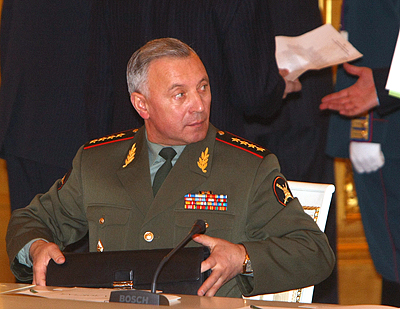
Army General Makarov

Russian General Staff Chief, Army General Nikolay Makarov briefed the Federation Council’s Defense and Security Committee today, and, according to Interfaks, he has made the decision to replace Russia’s six military districts with four that will function as operational-strategic commands (OSK).  He said:

“We will propose on the base of six military districts to establish four military districts, to the commander of which all forces and means deployed on their territory, including Navy, Air Forces and Air Defense, will be subordinate.  And subordinate not operationally, but directly.”

“Ground-, sea- and air-based nuclear deterrence forces will remain under the General Staff.”

“Our proposal on establishing four operational-strategic commands is now with the country’s president and I think that this issue will be favorably resolved soon.”

Infox.ru cited Makarov on the creation of three additional combined arms armies for several strategic axes: 

“We conducted a careful analysis of current threats and challenges and came to the conclusion that it’s necessary to create additional combined arms armies on several strategic axes.  There will be three in all.”

Makarov added that one army would be based in Chita, and six additional motorized rifle brigades will be formed to flesh out the newly created armies.

And Makarov wasn’t done . . .

According again to Interfaks, Makarov told these members of Russia’s upper house of parliament that ten combined air (8) and naval air (2) bases will be established in Russia.  Until recently, the military had been talking about new “first- and second-rank air bases” that were basically Air Forces’ equivalents of Ground Troops’ brigades.  This approach may have been abandoned in favor of a smaller number of larger air bases.  The choice of the word ‘combined’ [объединённые] makes these things sound like they’re now equivalent to armies.

Makarov explained that Russia has 245 airfields:

“The approximate cost of using one airfield is 1 billion rubles per year.  This amount is prohibitive, therefore we took a decision on enlarging air bases.”

After this change, Russia will only have 27 airfields, according to the General Staff Chief, and the combined air and naval air bases will be spread out over Russia in cities like Voronezh, Chelyabinsk, Domna (near Chita), and Komsomolsk-na-Amure.

Makarov said the goal was not only excellent conditions for fulfilling flight missions, but also for the everyday lives of servicemen and their families:

“We’re doing everything so that our pilots and their families can live in human conditions.”

Makarov told the assembled lawmakers that Russia will complete contract to buy Mistral from the French:

“Concerning Mistral, the contractual obligations are practically ready.  I think we’ll buy this ship.”

“We need such a ship.  In the Far East, it’s simply essential.”

He went to say, it’s needed around the Kurils which “generally have nothing to defend them.”  And he elaborated:

“Earlier there was an army there.  There’s no one there to cover them, we need mobile means so at the necessary time we can deliver a landing force quickly.”

He repeated his past comments to the effect that Mistral is 4-5 times bigger than Russia’s largest amphibious ship, the Ivan Rogov class.

Tomorrow it’s Serdyukov’s turn to speak to the Federation Council, so prepare for some more news.