Category Archives: Force Structure

Makarov Interview

Voyenno-promyshlennyy kuryer published an interview with the Chief of the General Staff, Army General Nikolay Makarov last Tuesday.  It’s not exactly a hard-ball interview.  But it’s fairly consistent with his other statements.  Among the priorities, preserving mobilization appears again.  Inter-service C2 in the new OSKs is a big theme.  He can’t explain why the Air Forces aren’t getting more new aircraft, and PVO sounds like it’s destined for joining VKO under the Space Troops. 

VPK asked about the possibility of changes in Russia’s military doctrine following the NATO-Russia summit and more talk of a strategic partnership.  Makarov said the approach of NATO infrastructure to Russia’s borders and the alliance’s continued “open door” policy vis-a-vis Ukraine and Georgia are still factors in Russia’s military doctrine.  Therefore, there’s no need to adjust it.

Makarov expounded on the concept of force and force structure development [строительство] to 2020 adopted by President Medvedev last April 19.  Its main measures include:

  • Establishment of the air-space (aerospace) defense (VKO) system;
  • Formation of the optimal composition of inter-service troop (force) groupings on strategic axes;
  • Supporting mobilization of military formations and troop groupings;
  • Establishing modern command and control systems;
  • Deploying military towns of a new troop basing system;
  • Reequipping formations and units with new and future types of armaments and military equipment;
  • Resolving social protection issues of servicemen.

Asked about military science and operational training, Makarov said the main task of the military-scientific complex is to “support the training and employment of the Armed Forces in their new profile, especially inter-service training of the military command and control organs” of the new MDs / OSKs. 

Makarov admitted that Russia lags behind developed countries in reconnaissance and command and control, and is still using communications systems developed in the 1990s.  He continued:

“Another problem is the fact that every service and troop branch of the Armed Forces developed its own means of automation and communications without looking at the others.  The command and control systems of the Ground Troops, Navy, and Air Forces didn’t interface with each other, that lowered the possibilities for controlling troop groupings on the operational-strategic and operational level.”

He says the General Staff has given the OPK requirements for high-tech digital reconnaissance and communications systems.  Industry is already developing a fundamentally new, sixth generation radio system with digital signal processing to implement a net organization in radio communications.  He says it’s being built as a unitary, integrated net at all levels, from the General Staff to the individual soldier on the battlefield.  Command and control systems will get 300 billion rubles under GPV-2020, according to Makarov.

Sounding very much the net-centric warfare disciple, Makarov says the main task is to form a unitary information space uniting reconnaissance, navigation, command and control, and new generation weapons.

Makarov doesn’t have a good answer when asked why the Air Forces don’t have a single fully reequipped unit despite increased defense expenditures.  He maintains they are getting new aircraft and their units are now all permanently combat ready and fully equipped and manned.

On aerospace defense, Makarov says PVO, PRO, SPRN, and KKP (space monitoring) will be concentrated in the hands of one commander, but:

“I’d like to note this won’t be a simple, mechanistic merger of different military entities under the leadership of a new strategic command.  Their deep integration and echelonment by mission, information exchange, and interception fire is envisaged.  We’ve already started fulfilling the initial measures on this issue.”

Obviously speaking much prior to last week’s news about reversing cuts in the officer ranks, Makarov addressed the moratorium on inducting new cadets.  He said 78.5 percent of 2010 VVUZ graduates became officers.  Others, he says, who wanted to stay in the service were temporarily placed in lower-ranking [i.e. sergeant] posts, but will participate in command training and form a cadre reserve for filling officer positions.

Lastly, Makarov talked about the new military pay system coming next year.  Military retirees have been especially concerned about its effect on pensions.  Makarov didn’t say much to assuage them.  He said there will be no difference in pensions depending on when servicemen retired, and a commission under Finance Ministry leadership is working on the issue.  That will probably reassure army pensioners.
Walking Back Serdyukov’s Personnel Policies (Part II)

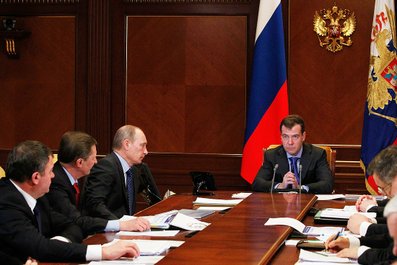
Medvedev in Meeting on Military Pay (photo: Kremlin.ru)

So officers were cut too drastically, and their numbers are going to be increased.

One recalls Ilya Kramnik saying officer cuts were causing serious tension in the ranks.  As if to prove the point, on Wednesday, near Novosibirsk, a drunken major living outside the “shtat” threatened to blow up his room in the unit’s dormitory.  This summer Aleksey Nikolskiy said halving officers caused trouble for brigades in the Vostok-2010 exercise.

But it’s not just an officer shortage that’s led to this policy reversal.  Difficulties with conscription and sergeants have forced the Defense Ministry to plug holes with more officers. 

Aleksandr Sharavin talked to BFM.ru about the situation:

“I think this is connected with the fact that now the situation in the army is very tense.  They cut officers from 450 thousand [sic] to 150.  They cut warrant officers completely, and professional sergeants aren’t appearing, we didn’t train them, and still can’t do this.  What we’ve got is a lot of conscript soldiers, few contractees, generally no professional sergeants, and a triple load laid on the remaining officers.  Now we have to compensate by increasing the number of officers.”  

Increasing the officer ranks wasn’t the only personnel policy reversal announced on 2 February.  A preliminary decision to increase contractees in the Armed Forces was also discussed.  Serdyukov said:

“This issue isn’t finally decided, but we have a proposal for an increase.  The Security Council was ordered to review this issue, in the course of the month a concrete figure – how much the number of contractees will be increased from 2012 – will be determined.”     

Utro.ru entitled it’s coverage of this story “Army Reform Reversed,” and reminded readers that army contract service was curtailed last winter because the military couldn’t afford it.  And now apparently it can?

We don’t know how many contract sergeants might be added starting next year.  In fact, no one seems to know how many there are now.  Newsru.com claims the army currently has 180,000 contract soldiers, sergeants, and warrants.  If that’s true, the Armed Forces are about 900,000.  But if there are fewer contractees, and conscripts are less than 560,000, then the Armed Forces are that much below 900,000.

Can an about-face on the elimination of warrant officers be far behind?

As early as 27 January, Rossiyskaya gazeta reported Deputy Defense Minister Pankov said some cadets might be inducted into VVUZy in 2011.  It was just back in the fall that the Defense Ministry put a two-year moratorium on them.  As it is, VVUZy now have about 45,000 cadets in the classes of 2011, 2012, and 2013.

But the Defense Ministry is looking at having these would-be officers join 5,000 other former cadets as sergeants.  The Defense Ministry is talking about salaries as high as 40,000 rubles a month for professional NCOs.  But current NCO training efforts in VVUZy are going very slowly, and the army wants 250,000 of them, according to Nezavisimaya gazeta.

Let’s return for a bit to Medvedev’s Tuesday session on raising pay for servicemen and law enforcement.  We’re talking Defense Ministry, MVD, MChS, FSB, FSO, and SVR here.  Men with ranks, badges, and guns.  Medvedev called higher pay for them:

“. . . an issue of state importance.  In the last analysis, our efforts to reform the Armed Forces, create a new profile of the Armed Forces and, of course, reform the system of law enforcement organs, including reforming the Internal Affairs Ministry and creating police depend on it.”

The Defense Ministry is talking median pay of 50,000 rubles a month for lieutenants starting in 2012.  Just a sampling . . . a cadet would get 18,200, a contract soldier 24,800, a squad sergeant 34,600, and a brigade commander 93,800 rubles per month.

NG’s Vladimir Mukhin reports the Finance Ministry believes the new military pay plan will cost another 1 percent of Russia’s GDP, taking the defense budget from nearly 3 to nearly 4 percent of GDP.  All this while the government wonders whether outyear budgets will be in deficit or not.

The last couple days represent the first major defeat for Serdyukov.  His military personnel policies are a complete and utter shambles.  Political analyst Aleksey Mukhin commented to BFM.ru on Defense Minister Serdyukov’s prospects: 

“ It’s fully possible that soon they’ll call him enemy No. 1 for the reform which is being conducted.”

If they don’t already.  One guesses he’ll keep his post though.

So after flirting briefly with paying relatively few officers more money, the Defense Ministry’s going to pay more officers more money instead.  And this is more officers at the same time President Medvedev’s ordered a 20 percent cut in government bureaucracy.

The fact is military reform’s gone beyond the military now and become more of a factor in domestic politics.  Vlasti are just a bit nervous about social stability in the runup to elections this year and next, and are also a little worried about the guys with the guns.  For the regime, the extra money is worth keeping 70,000 potential ex-officer opponents out of the streets.  It may feel this provides some insurance that the guys with guns will do as they’re told.

As BFM.ru concludes, the Tunisian [or Egyptian] “virus” could spread.  And the terrorist threat is high.  So Russia’s leadership has to think about an effective and combat capable army.

Commentator Sergey Markov told BFM.ru that the regime wants to increase the number of officers who can fight, but it will continue cutting those in support functions and replacing them with civilians:

“But everyone understands perfectly that you can’t do without a real combat force.”

Walking Back Serdyukov’s Personnel Policies (Part I)

And so it’s begun. 

The first of Defense Minister Serdyukov’s major reform planks – cutting the officer corps from 355,000 to 150,000, or no more than 15 percent of the million-man army – has been reversed.

The Armed Forces’ officer manning level was apparently one topic in yesterday’s meeting between President Medvedev and his “power” ministers about plans to raise pay for servicemen in 2012.

Serdyukov told the media about the decision to increase officers in the Armed Forces by 70,000:

“A decision’s been taken to increase officer personnel by 70 thousand.  This is connected with the fact that we’re deploying additional military units, establishing military-space defense, that is, an entire service (of troops), and the increase is happening in connection with this.”

First, this raised some interesting questions about VKO.  Is it really going to become a service (vid or вид).  After all, the Space Troops are only a service branch (род войск) right now.  That’s quite a promotion.  And are we really supposed to believe the expansion of VKO or the Space Troops will require 70,000 additional officers? 

Of course not, it’s a convenient excuse to walk back a large part of the 50 percent cut in army officers Serdyukov announced when he launched his reforms in October 2008.

Most media outlets were pretty confused on what this means for officer numbers.  They assumed the Russian Army’s at 150,000 officers right now, just add 70,000 for a total of 220,000.  But it’s not so simple.

When Serdyukov started cutting officers, there were 305,000 occupied officer billets.  Krasnaya zvezda said the Armed Forces had 181,000 officers at the end of last year.  So a grand total of 124,000 officers were either discharged, placed outside the “org-shtat” at their commander’s “disposition,” or forced to accept an NCO billet between late 2008 and the end of 2010.  Returning 70,000 to the ranks might leave us wondering only about what happened to the other 54,000.  And 181,000 plus 70,000 takes the officer corps basically back to 250,000, or fully one-quarter of the million-man army.

The army officer corps has endured considerable sturm und drang in a little over two years all for the sake of shedding just 55,000 officers.

More on this tomorrow.

Fox News on the Russian Military

We laughed, we cried, two thumbs way down to Fox News for yesterday’s story on the Russian military.  It makes us wonder what kind of crap they say and write on topics we don’t know anything about.  Well, actually, we already know how bad that drek is too.

Now, no one who frequents this blog will accuse your present author of giving Moscow credit for much.  No, of course not.  But Fox News has succeeded in taking the absurd in Russian defense policy and making it ridiculous.  Fox’s article couldn’t garner a C in a high school journalism class.

At the risk of getting some of the stink on us, let’s examine the piece a little:

  1. Ahem, if you didn’t notice, the Russian military’s been falling apart for a long time.  And, actually, in the most objective sense, experts who’ve watched the process would say Defense Minister Serdyukov and his cronies may have arrested the process some over the last 4 years.
  2. Yes, CAST did put out a new monograph, but it’s a slender volume, and certainly neither comprehensive nor groundbreaking in any sense.  CAST is valuable, but hardly well-known.  And its leadership is probably not fully independent of the current regime.
  3. Fox’s claim that Russia only has 8-10 thousand deployable troops is a ridiculous misreading of intentionally hyperbolic statements in the CAST report.  No serious analyst believes that Russian forces aren’t more ready today than they were 5, 10, or 15 years ago.  But this is a relative comparison.  It doesn’t mean they’re sufficiently ready, in sufficient quantity, to execute the missions they’ve set for themselves.
  4. The Russians have already beat the furniture salesman stuff to death, but one supposes it’s still funny to a nonspecialist audience in the U.S., a country where actors become governors and presidents (and good ones at that).  But even the most basic journalistic accounts normally note that Serdyukov married well, gaining a father-in-law with a strong connection to Vladimir Putin.  And Serdyukov’s no dummy; he probably engineered most of the tax case against Khodorkovskiy.  Not sure Fox knows who Khodorkovskiy is though.  The bottom line is, most people accept Serdyukov as a savvy and tough bureaucrat with talent, who was specifically selected to do a job he’s well-suited for.  Doesn’t mean he hasn’t pissed off Russian military men.  That’s exactly what he was supposed to do.
  5. Fox missed the point that Serdyukov was sent in to stop the stealing, not to cut the military’s budget.  Does Fox realize the $78 billion that DoD’s going to trim over five years isn’t much less than what Russia’s military budget will be over that period?  Duh.
  6. Fox saves itself a little by referring to Felgengauer, but it can’t spell his name.
  7. Russian defense industry has problems, yes, but buying abroad is more complex than Fox’s passing mention.  Fox didn’t bother to Google Mistral either.
  8. Fox’s military expert is wrong; Russia still has a military.  But the U.S. needs to worry about whether and what kind it will have in the future.  We don’t need a “sick man of Eurasia,” and a military vacuum there wouldn’t be good for Americans.  And we also need to worry if there will be a country there, by the way.  Fox’s retired general is right, however, when he reminds that Russia is still a nuclear weapons superpower, and it is relying on nukes heavily for its security.  And its conventional weaknesses increase the risks of miscalculation.  But this has been the case for much of the past 20 years. 

But none of this is a news story.  The news story is that even skeptics have to admit the Russian military is doing a little better, and it’ll be interesting to find out how much better the next time it goes into action.  It’ll be interesting to see if it’s somewhere on the former Soviet imperial periphery, or against another internal threat in the North Caucasus.

The Russian media reactions to the Fox article are just starting, we’ll see if they get interesting.

But thanks Fox for providing something to write about this morning.

Solomonov on Need for Increased Missile Production

MIT General Designer Yuriy Solomonov told Interfaks yesterday Russia needs to increase intercontinental ballistic missile production in the coming years to preserve its strategic nuclear forces (SYaS or СЯС).  See a more complete version of his remarks at Arms-expo.ru.  He said:

“We have two years at our disposition to be in a condition, proceeding from implementation of the production preparation program, to get all cooperation ready for the possibility of manufacturing a large quantity of products.  Many times more than have been made previously.”

He said Russia has produced 6-10 missiles per year over the last ten years.  And he acknowledged that plans for increased production volume may not be fulfilled:

“All this rests, with respect to corporate enterprises, on resolving the task of allocating them investment.  And the regulatory-technical base — the way officials interpret it — doesn’t allow for resolving this task.  If it isn’t resolved, it’s possible to say unequivocally that the task of significantly increasing the volume of products delivered by 2013 won’t be fulfilled either.”

So he’s saying the reluctant state will need to invest in Votkinsk and its component suppliers?

Solomonov notes that the Votkinsk plant, manufacturer of the Topol-M and RS-24 ICBMs, produced up to 120 Pioner (SS-20) medium-range missiles a year between 1980 and 1987.  He says:

“It follows from this that the production capabilities of the factory undoubtedly allow it to realize, proceeding from this potential, production of a substantially larger quantity of missiles than in the preceding ten years.”

The Results of Reform

Trud’s Mikhail Lukanin offered an interesting one last Wednesday . . . with help from other frequent commentators, he takes a swag at describing the results of Anatoliy Serdyukov’s nearly 4-year tenure as Defense Minister.

It’s interesting because it’s unclear if Lukanin’s article is intended to damn by faint praise, to be sarcastic, or was ordered by someone.  Maybe he intends to say these are just results, the good and the bad.

It’s easy to see some good in Lukanin’s first five, but his final three are pretty much unleavened.

The Army’s Become More Mobile

Lukanin quotes Vitaliy Shlykov:

“Until 2008, our army looked like fragments of the old, Soviet one, weighed down with heavy weapons, oriented toward global nuclear war with practically the entire world.”

He says even in the August war against Georgia the army was still “Soviet” — slow to stand up, with an archaic command and control structure.  But now the situation’s changed with mobile brigades that can answer an alert in 1 hour instead of days.

The Army’s Rid Itself of the Spirit of the Barracks

Valentina Melnikova tells Lukanin that the soldier’s life has changed cardinally under Serdyukov.  She says, until recently, one-third of soldiers were typically involved in nonmilitary work every day.  Now soldiers are gradually being freed from such duties as commercial firms take them on.

New Equipment Has Come to the Troops

Lukanin writes that finally a start’s been given to the largest rearmament of the army in post-Soviet times.  One that will take new weapons and equipment from about 10 percent of today’s inventory to 90-100 percent [official sources only claim 70 percent] by 2020.

Lukanin quotes Ruslan Pukhov:

“The Navy alone will receive 40 submarines and 36 new ships, and the Air Forces 1,500 aircraft in the next decade.”

Officer Pay Has Grown

Lukanin says lieutenants and majors made 14 and 20 thousand rubles per month respectively before Serdyukov’s reform,  but now 50 and 70 thousand if they receive premium pay for outstanding combat training results.  And from 2012, premium payments will be included in their permanent duty pay, and 50 thousand rubles will be the minimum base pay for officers.

Lukanin quotes Aleksandr Khramchikhin: 

“The officers of our army are actually comparable with the armies of developed countries in pay levels. “

They Didn’t Talk Reform to Death

Lukanin says experts think it’s good Serdyukov’s reform was pursued energetically, without lengthy discussion and debate.  Pukhov gives the cut from 6 to 4 military districts as an example:

“At one time, it would have taken years to transfer a huge quantity of officers and generals from place to place, but the Defense Ministry did this in just 4-5 months.”

They Stopped Training Officers

Lukanin refers to Serdyukov’s halt to inducting new cadets into officer commissioning schools until at least 2012.  He says 2010 graduates were either released or accepted sergeant positions.  This led to the departure of experienced instructors, and their replacement with younger officers lacking the necessary experience.

Sergeants Almost Ceased to Exist

Contract sergeants were dispersed in 2009-2010.  The Defense Ministry considers them poorly trained, and in no way superior to ordinary [conscript] soldiers.  Now it’s counting completely on conscripts with an even lower level of training.

There’s Nothing to Defend Against China

Here Lukanin notes that some results of reform have put people on guard.  Anatoliy Tsyganok tells him tank units have been practically eliminated: 

“Now only 2,000 tanks, old models at that, remain in the army.”

In Tsyganok’s opinion, tanks are still very relevant for the defense of Russia’s border with China.

What do we make of all this?

  • It’s good that the Russian Army was restructured into smaller, more combat ready formations, i.e. brigades, and sub-units. 
  • We really have no clear picture of the extent and success of outsourcing nonmilitary tasks in the army.  Meanwhile, the “spirit of the barracks” is alive and well when it comes to dedovshchina and violence in the ranks. 
  • The promise of another rearmament program shimmers on the horizon, but it’s not delivering much yet, and there are plenty of serious obstacles to completing it. 
  • The officer pay picture has improved, but the Defense Ministry has real work to do this year to implement a fully new pay system next year.  Meanwhile, several years of premium pay have caused divisions and disaffection in the officer corps. 
  • Moving out smartly on reform was a change over endless talk, but there are areas where more circumspection might have served Serdyukov well. 
  • The Defense Ministry definitely had to stop feeding more officers into an army with a 1:1 officer-conscript ratio.  We’ll have to see what kind of officers the remaining VVUZy produce when the induction of cadets restarts. 
  • Aborting contract service cut the army’s losses on the failed centerpiece military personnel policy of the 2000s.  But something will have to take its place eventually to produce more professional NCOs and soldiers. 
  • Russia is probably right to deemphasize its heavy armor.  It doesn’t appear to have much of a place in the coming rearmament plan.  And tanks really aren’t the answer to Moscow’s largely unstated security concerns vis-a-vis China anyway.

So what’s Serdyukov’s scorecard?  A mixed bag.  Probably more good than bad, but we’ll have to wait to see which results stand and prove positive over the long term.  Definitely superior to his predecessor’s tenure.  Expect more Serdyukov anniversary articles as 15 February approaches.

20 Percent Undermanning and Declining Contract Service

Nezavisimaya gazeta’s Vladimir Mukhin writes this morning that the results of the fall draft are still being tallied, but the General Staff has already announced that several regions didn’t meet their conscription plans.  And so, for the first time in recent years, the Armed Forces is facing undermanned conscript soldier and sergeant ranks, while the number of contract soldiers continues its decline.

Mukhin harks back to Defense Minister Anatoliy Serdyukov’s recent Duma session, where he admitted that the army’s demand for soldiers is not being fully met.  The exact quantitative deficit is a secret, but Mukhin says even a crude estimate tells him the military is at least 20 percent undermanned.

The Armed Forces now officially have less than 500,000 conscripts, 181,000 officers, and 120,000 contractees (800,000 in all, roughly), although approved manning is 1 million.

Mukhin concludes:

“It goes without saying, undermanning affects their combat readiness.  And measures taken to resolve the problem, let’s say it directly, are hard to call adequate.”

A retired VDV general tells Mukhin contractees in the Pskov-based 76th Airborne Division (VDD or ВДД) dropped from 20 percent of personnel to 12 percent in 2010.  The outflow was due to low pay of 11,000 rubles per month against an oblast average of about 18,000. 

Mukhin forgets to mention that the 76th VDD was the cradle of “Pskov experiment” with contract service in 2003.  It led to the wider Federal Targeted Program, 2004-2007, which General Staff Chief Makarov declared a failure early last year.

The Pskov-based 2nd Spetsnaz Brigade recently received a Defense Ministry order not to extend professional contractees, and to replace them with conscript soldiers and sergeants from training sub-units (i.e. guys who’ve been in the army all of three months).

Mukhin’s ex-general says:

“We don’t have to say what Spetsnaz brigades do.  Namely, as before, they carry out not training, but combat missions in North Caucasus hot spots.  You can’t train a good Spetsnaz soldier in a year even, much less three months.  I don’t want to be the prophet of doom, but this means the likelihood of casualties will grow in a combat situation.”

A good article by Mukhin.  His general’s words will likely be borne out.  Anyone who followed both Chechen wars can see the Russian Army lining itself up to relearn the bitter lessons of those conflicts when it comes to choosing between professionals and draftees.

More Appointments, Dismissals, Etc.

Yesterday’s decree on military appointments, dismissals, etc., is extremely long.  It’s part of the process of redistributing staff personnel from 6 into 4 MDs.  The Southern and Eastern MD staffs, in particular, get fleshed out by it.  The outline of the new MD staff structure becomes visible with these changes.  And the breadth and depth of the rotation and change in personnel pretty much assures it’ll take a while for the commands of the new MDs to operate smoothly.

There are other individual notable points in this list.  There’s now a Main Combat Training Directorate (GUBP or ГУБП) inside the Ground Troops, instead of a directorate.  Maybe this is part of replacing the Defense Ministry-level GUBP.  The MDs have their own troop training directorates . . . it’s interesting that the 3rd Air-Space (i.e. Aerospace) Defense Brigade is subordinate to the Baltic Fleet rather than the Western MD . . . a 49th Army has popped up in the Southern MD . . . Ryadovoy.ru says it’s headquartered in the former RVSN communications institute in Stavropol . . . Air Defense Chiefs renamed Chiefs of Air Defense Troops and Aviation.

Here’s what the 9 January decree does.

Appoint:

  • Captain 1st Rank Ildar Ferdinandovich Akhmerov, Deputy Commander, Primorskiy Mixed Forces Flotilla, Pacific Fleet.
  • General-Major Vladimir Vladimirovich Derkach, Chief of Staff, First Deputy Commander, Space Troops, relieved of duty as Deputy Commander, Space Troops.
  • Colonel Sergey Borisovich Ryzhkov, Commander, 39th Independent Motorized Rifle Brigade, Eastern MD.
  • General-Lieutenant Nikolay Vasilyevich Bogdanovskiy, Deputy CINC, Ground Troops, Chief, Main Combat Training Directorate, Ground Troops, relieved of duty as Commander, Leningrad MD.
  • Colonel Yuriy Aleksandrovich Popov, Commander, 3rd Air-Space Defense Brigade, Baltic Fleet.
  • General-Major Viktor Borisovich Astapov, Chief of Staff, First Deputy Commander, 49th Army, relieved of duty as Deputy Commander, 41st Army.
  • General-Major Sergey Sergeyevich Bashkin, Chief, Air Defense Troops and Aviation, Southern MD, relieved of duty as Chief, Air Defense Troops, North Caucasus MD.
  • Captain 1st Rank Oleg Georgiyevich Gurinov, Chief, Naval Directorate, Southern MD.
  • Colonel Igor Vladimirovich Dashko, Chief of Reconnaissance, Deputy Chief of Staff for Reconnaissance, Southern MD, relieved of duty as Chief of Reconnaissance, Deputy Chief of Staff for Reconnaissance, North Caucasus MD.
  • Colonel Igor Mikhaylovich Yemelyanov, Chief, Radiological, Chemical and Biological Defense (РХБЗ) Troops, Southern MD, relieved of duty as Chief, Radiological, Chemical and Biological Defense Troops, North Caucasus MD.
  • Colonel Igor Gennadyevich Kovalenko, Deputy Chief of Staff, Southern MD.
  • General-Major Andrey Anatolyevich Kozlov, Chief, Railroad Troops Directorate, Southern MD, relieved of duty as Commander, 7th Territorial Command, Railroad Troops.
  • General-Major Andrey Nikolayevich Kolesov, Chief, Organization-Mobilization Directorate, Deputy Chief of Staff for Organization-Mobilization Work, Southern MD, relieved of duty as Chief, Organization-Mobilization Directorate, Deputy Chief of Staff for Organization-Mobilization Work, North Caucasus MD.
  • General-Major Sergey Vasilyevich Kuralenko, Commander, 49th Army, relieved of duty as Chief of Staff, First Deputy Commander, 5th Army.
  • Colonel Aleksey Pavlovich Lemyakin, Chief, Material-Technical Support Planning and Coordination Directorate, Southern MD, relieved of duty as Chief of Rear Services, Deputy Commander for Rear Services,  2nd Army.
  • Colonel Oleg Gennadyevich Maltsev, Chief, Automotive Service, Southern MD, relieved of duty as Chief, Automotive Service, North Caucasus MD.
  • Colonel Mikhail Yevgenyevich Mizintsev, Chief, Operational Directorate, Deputy Chief of Staff, Southern MD, relieved of duty as Chief, Operational Directorate, Deputy Chief of Staff, North Caucasus MD.
  • Colonel Sergey Mikhaylovich Panevchik, Chief, Personnel Directorate, Southern MD, relieved of duty as Chief, Personnel Directorate, North Caucasus MD.
  • General-Major Fraiz Fazlyakhmetovich Salyyev, Chief, Technical Support Directorate, Southern MD, relieved of duty as Chief of Staff, Armament, First Deputy Chief of Armaments, North Caucasus MD.
  • General-Major Vladimir Vladimirovich Samoylov, Deputy Commander, 49th Army.
  • General-Major Oleg Yuryevich Torgashev, Chief, Troop Training Directorate, Southern MD, relieved of duty as  Chief, Combat Training Directorate, Moscow MD.
  • Colonel Oleg Viktorovich Chernyavskiy, Chief, Armor Service, Southern MD, relieved of duty as Chief, Armaments, Deputy Commander for Armaments, 5th Army.
  • General-Major Aleksandr Nikolayevich Shvetsov, Deputy Commander for Material-Technical Support, Southern MD, relieved of duty as Chief, Rear Services, Deputy Commander for Rear Services, Leningrad MD.
  • Colonel Stepan Stepanovich Yaroshchuk, Chief, Missile Troops and Artillery, Southern MD.
  • Colonel Sergey Anatolyevich Bakaneyev, Chief, Missile Troops and Artillery, Eastern MD, relieved of duty as Commander, 39th Independent Motorized Rifle Brigade, Far East MD.
  • Rear-Admiral Yuriy Yuryevich Berdnikov, Chief, Naval Directorate, Eastern MD, relieved of duty as Deputy Commander, Troops and Forces in the North-East.
  • Rear-Admiral Vladimir Nikolayevich Vdovenko, Deputy Commander, Troops and Forces in the North-East.
  • Colonel Andrey Aleksandrovich Volkov, Chief, Radiological, Chemical and Biological Defense Troops, Eastern MD, relieved of duty as Chief, Radiological, Chemical and Biological Defense Troops, Siberian MD.
  • Colonel Vladimir Andreyevich Voropayev, Deputy Chief, Main Communications Directorate, RF Armed Forces, relieved of duty as Chief of Communications, Deputy Chief of Staff for Communications, Volga-Ural MD.
  • Colonel Aleksandr Vladimirovich Glushchenko, Chief, Automotive Service, Eastern MD, relieved of duty as Chief, Automotive Service, Far East MD.
  • General-Major Vladimir Vladimirovich Gorodnichiy, Deputy Commander for Material-Technical Support, Eastern MD, relieved of duty as Chief, Armaments, Deputy Commander for Armaments, Siberian MD.
  • General-Major Aleksandr Vladimirovich Dvornikov, Deputy Commander, Eastern MD, relieved of duty as Commander, 5th Army.
  • Colonel Sergey Anatolyevich Dolotin, Deputy Commander for Personnel Work, Chief, Personnel Work Directorate, Eastern MD, relieved of duty as Deputy Commander for Socialization Work, Far East MD.
  • Colonel Sergey Romanovich Yeger, Chief, Railroad Troops Directorate, Eastern MD.
  • General-Major Sergey Aleksandrovich Zhmurin, Chief, Air Defense Troops and Aviation, Eastern MD, relieved of duty as Deputy Chief for Training and Scientific Work, Military Academy of Troop Air Defense, RF Armed Forces.
  • General-Major Andrey Nikolayevich Serdyukov, Commander, 5th Army, relieved of duty as Deputy Commander, 5th Army.
  • General-Major Konstantin Georgiyevich Kastornov, Deputy Commander, 5th Army, relieved of duty as Commander, 70th Independent Motorized Rifle Brigade.
  • Captain 1st Rank Valeriya Pavlovich Kostin, Chief, Personnel Directorate, Eastern MD, relieved of duty as Chief, Personnel Directorate, Pacific Fleet.
  • Colonel Aleksey Vladimirovich Ostrovskiy, Commander, 70th Independent Motorized Rifle Brigade.
  • General-Major Aleksandr Vasilyevich Peryazev, Chief, Troop Training Directorate, Eastern MD, relieved of duty as Chief, Combat Training Directorate, Far East MD.
  • Colonel Pavel Vladimirovich Petrunin, Chief of Reconnaissance, Deputy Chief of Staff for Reconnaissance, Eastern MD.
  • Colonel Yevgeniy Valentinovich Poplavskiy, Chief of Staff, First Deputy Commander, 29th Army, relieved of duty as Chief, Operational Directorate, Deputy Chief of Staff, Volga-Ural MD.
  • General-Major Aleksandr Vladimirovich Romanchuk, Commander, 29th Army, relieved of duty as Chief of Staff, First Deputy Commander, 41st Army.
  • Colonel Vladimir Petrovich Ryzhkovich, Chief, Technical Support Directorate, Eastern MD, relieved of duty as Chief, Armaments, Deputy Commander for Armaments, 36th Army.
  • Colonel Konstantin Yevgenyevich Smeshko, Chief, Engineering Troops, Eastern MD, relieved of duty as Chief, Engineering Troops, Far East MD.
  • Colonel Valeriy Mikhaylovich Timoshenko, Chief, Armor Service, Eastern MD, relieved of duty as Chief, Armor Service, Far East MD.
  • Colonel Vladimir Viktorovich Trishunkin, Chief, Material-Technical Support Planning and Coordination Directorate, Eastern MD, relieved of duty as Chief of Staff, First Deputy Chief of Rear Services, Far East MD.
  • General-Major Sergey Valeryevich Chebotarev, Deputy Commander, 29th Army, relieved of duty as Commander, 7th Military Base, North Caucasus MD.
  • Colonel Aleksey Yuryevich Avdeyev, Deputy Commander, 41st Army, relieved of duty as Chief, Organization-Mobilization Directorate, Deputy Chief of Staff for Organization-Mobilization Work, Siberian MD.
  • General-Major Vladimir Ivanovich Ashitok, Chief, Troop Training Directorate, Central MD, relieved of duty as Chief, Combat Training Directorate, Volga-Ural MD.
  • Colonel Oleg Anatolyevich Bragin, Chief, Railroad Troops Directorate, Central MD, relieved of duty as Commander, 5th Territorial Command, Railroad Troops.
  • Colonel Andrey Zaurovich Gagloyev, Chief, Engineering Troops, Central MD.
  • Colonel Aleksandr Albertovich Glushchenko, Chief, Missile Troops and Artillery, Central MD.
  • Colonel Oleg Vitalyevich Demyanenko, Chief of Communications, Deputy Chief of Staff for Communications, Central MD.
  • General-Major Sergey Yuryevich Istrakov, Deputy Commander, Central MD, relieved of duty as Deputy Commander, Siberian MD.
  • Colonel Oleg Valeryevich Karpov, Chief, Rear Support Directorate, Central MD.
  • Colonel Aleksandr Nikolayevich Logachev, Chief, Armor Service, Central MD, relieved of duty as Chief, Armor Service, Volga-Ural MD.
  • General-Major Aleksandr Ivanovich Nesterov, Chief, Personnel Directorate, Central MD, relieved of duty as Chief, Personnel Directorate, Volga-Ural MD.
  • Colonel Oleg Olegovich Polguyev, Chief of Reconnaissance, Deputy Chief of Staff for Reconnaissance, Central MD.
  • General-Major Yuriy Aleksandrovich Svintsov, Deputy Commander for Material-Technical Support, Central MD, relieved of duty as Chief of Rear Services, Deputy Commander for Rear Services, Volga-Ural MD.
  • Colonel Mikhail Vyacheslavovich Smyslov, Deputy Commander for Personnel Work, Chief, Personnel Work Directorate, Central MD, relieved of duty as Deputy Commander for Socialization Work, Siberian MD.
  • Colonel Igor Petrovich Sokorenko, Chief, Operational Directorate, Deputy Chief of Staff, Central MD.
  • Colonel Yevgeniy Nikolayevich Tuchkov, Chief, Air Defense Troops and Aviation, Central MD, relieved of duty as Chief, Air Defense Troops, Volga-Ural MD.
  • General-Major Sergey Viktorovich Khokh, Chief, Technical Support Directorate, Central MD, relieved of duty as Chief, Armaments, Deputy Commander for Armaments, 2nd Army.
  • General-Major Eduard Anatolyevich Cherkasov, Chief, Radiological, Chemical and Biological Defense Troops, Central MD, relieved of duty as Deputy Chief of Armaments, Ground Troops.
  • General-Major Sergey Anatolyevich Chuvakin, Deputy Chief of Staff, Central MD, relieved of duty as Deputy Chief of Staff, Volga-Ural MD.
  • Colonel Leonid Vladimirovich Chumakov, Chief, Material-Technical Support Planning and Coordination Directorate, Central MD, relieved of duty as Chief of Staff of Rear Services, First Deputy Chief of Rear Services, Volga-Ural MD.

Relieve of duty:

  • Colonel Vadim Vladimirovich Karpovich, Deputy Chief, Missile Troops and Artillery, RF Armed Forces.
  • Colonel Sergey Vladimirovich Bibik, Chief, Armor Service, Armaments Directorate, Moscow MD.
  • Colonel Andrey Aleksandrovich Mityushkin, Chief, Rear Services, Deputy Commander for Rear Services, Moscow MD.
  • Colonel Vladimir Levontyevich Zharov, Deputy Commander for Socialization Work, Moscow MD.
  • Colonel Stepan Aleksandrovich Vorontsov, Chief of Rear Services, Deputy Commander for Rear Services, 41st Army.
  • Colonel Viktor Viktorovich Tarayev, Chief, Armaments, Deputy Commander for Armaments, 41st Army.
  • Colonel Zabit Sabirovich Kheirbekov, Chief, Armaments, Deputy Commander for Armaments, 35th Army.

Relieve of duty and dismiss from military service:

  • General-Major Mikhail Gennadyevich Krasnov, Chief, Serpukhov Branch, Military Academy of the RVSN.
  • General-Major Sergey Leonidovich Melnikov, Chief, Economic, Finance and Accounting Directorate, RF Federal Service of Special Construction.
  • General-Lieutenant Aleksey Nikolayevich Nemkov, First Deputy Director, Federal Agency of Special Construction.

Dismiss from military service:

  • General-Major Igor Alekseyevich Fedotov.
  • General-Major Yuriy Alekseyevich Gusev.
  • General-Major Aleksandr Grigoryevich Bondarenko.
  • General-Major Andrey Stepanovich Konyukhov.

New Year’s Peep Show (Part II)

On with Krasnaya zvezda’s peep into the Defense Ministry’s organizational and force development document . . .

What about strategic nuclear forces in the future:

“Their further development will support a guaranteed counter to forecast changes in the strategic balance of forces, connected in the first place with the deployment of a U.S. global anti-missile system, but also the growing potential of U.S. and NATO highly accurate weapons.”

The three-component structure of the SYaS (land, sea, and air) will be preserved.  And the plan repeats earlier assurances that the SYaS will be 70 percent modern by 2015, and 100 percent by 2020, as a result of the GPV.

Does the composition of the armed forces meet today’s threats?

The document says, despite everything, the threat of aggression against Russia has receded, and there’s no need to maintain a multimillion-man army.  But it sounds like they’re still trying to convince people.  Then there’s this.

Russia can still mobilize.  The document offers reassurance that, in wartime, storage bases can outfit a significant number of new formations and units.  The districts have preserved a mobilization base, and mobilization deployment plans.  This comes after the Defense Ministry has spent a good bit of time and effort denigrating the old system of hollow cadre-level units.  Who is manning storage bases and cadre units after recent downsizing, cuts, and consolidations?

The document re-runs the rationale for four MDs / OSKs.  It calls the MD an inter-service strategic territorial large formation [объединение].  The old MD system didn’t correspond to existing military threats.  To repulse aggression, a large formation of the troops and forces of several districts and fleets is needed.  On strategic axes, there were no organs to unite ground, air, and naval forces.  In a crisis, temporary, uncoordinated inter-service command and control organs were established.  The army lacked commanders capable of planning and conducting operations in TVDs.  Old MDs didn’t correspond to air defense boundaries.  New MD / OSK commanders are personally responsible for security in their regions, and uniting forces under them has shortened their response times and increased their striking power.

What about command and control?  There’s an emerging two-pipe system — the military plans for the use and development of the armed forces on the one hand, and civilians plan for their support on the other.  The new three-level command system works like this — main commands of services, armies, and brigades answer for tactical issues, and the General Staff, OSKs, and armies answer for operational issues.  The army-level command looks like an important hinge in this scheme.  In days past, their staffs were never very large.  The General Staff has lost duplicative functions and become a full-fledged strategic planning organ.

Where is the line drawn between the main commands of the services and the OSKs:

“The main commands of the services concentrate their efforts on the organizational development of the services, the organization of combat training, junior specialist [i.e. conscript] training, planning of peacekeeping activity and support in special aspects.”

“The unified strategic command of the military district is becoming the inter-service command and control organ, dedicated to planning and controlling all armies, brigades and military units in the inter-service troop grouping on the strategic axis, with the exception of those in the composition of strategic nuclear forces.”

Now any MD / OSK commander worth his salt will want to train and exercise the forces he’ll fight with.  He may impinge on the diminished role of the main commands to the extent that he does it.

KZ’s review of the document finishes up talking about combat possibilities and combat potential.  It claims that, far from just cutting, the TO&E of formations and units has been optimized and their combat possibilities increased.  The example given is the new Western MD vs. the old Leningrad MD.  It says the combat potential of the former is 13 times greater than the latter.  Not exactly tough since the latter didn’t have a single combined arms army.  Finally, it says resources reclaimed by cutting units give a “chance for real rearming of the army and fleet, and not endless modernization and repair of obsolete and worn-out armaments and military equipment.”

New Year’s Peep Show (Part I)

Yes, the season of little or no news continues . . . but there’s always something to write. 

On 29 December, Krasnaya zvezda provided a little holiday treat — a year-ending issue filled with official views on a variety of topics:

  • Priorities of Armed Forces Organizational Development.
  • Armed Forces Manning.
  • State Program of Armaments.
  • Global Political-Military Situation.
  • Improving the Military VUZ System.
  • State of Military Discipline.
  • Transition to a Unitary System of Armed Forces Material-Technical Support.
  • Provision of Housing to Servicemen.

A cornucopia of data for discerning and careful readers.

Caught up in the joy of the holidays, many probably overlooked these articles.

Let’s have a look at the first one — Priorities of Armed Forces Organizational Development.

What’s interesting is we’re given a little peep show into a much more interesting, detailed, and lengthy document — “The Concept of Organizational and Force Development of the Armed Forces of the Russian Federation in the Period to 2020” — approved by President Dmitriy Medvedev on 19 April 2010, with absolutely no fanfare.

What we don’t know is how this little peek inside the document was edited.  We don’t know what was emphasized, or left out, and why.

A couple preliminaries.  First, the title in the vernacular is “строительства и развития Вооружённых Сил.”  We really don’t want to say “Construction and Development” or “Building and Development” or something like that.  We’re not talking a suburban Moscow water park here.  By the same token, “Organizational Development and Development” sounds dumb. 

What we’re really talking here is force structure planning and force development.  The emergence of this planning document isn’t surprising given that they got a new national security concept in 2009, and a new military doctrine in early 2010.  This article also makes the point that, besides this ten-year military organizational development plan, there are also five- and one-year plans.

We’re going to move quickly today.  So pay attention.

The priorities are:  strategic deterrence (SYaS and VKO); building inter-service groupings on strategic axes (as in OSKs); building a new command and control system; reequipping in line with GPV-2020; a new education and training system for officers and sergeants; and resolving ever-present issues of social defense [i.e. pay and benefits] of servicemen.

What does it mean for each service?

  • For the Ground Troops, get organized on the axes and prepare to be mobile. 
  • For the Air Forces, emphasize supporting the Ground Troops and Navy.  Improve VTA and airfields for strategic mobility.
  • For Navy, support personnel and combat readiness of naval SYaS.  Series construction of multipurpose nuclear submarines and surface ships.
  • For RVSN, preserve the structure of ground SYaS.  Complete rearmament with fifth generation missiles.
  • For Space Troops, deploy formations with future missile attack warning and space monitoring systems.  Complete the full orbital grouping with future satellite systems.
  • For VDV, improve training, especially inter-service training.  Reequip with armaments, military equipment, and specialized equipment.

Sounds like Ground Troops have to make do with the weapons and equipment they have.

Stay tuned for Part II.