Category Archives: Ground Troops

Master and Commanders

Major media outlets covered President Dmitriy Medvedev’s dialogue with five commanders (three Ground Troops, two Navy) at Gorokhovets.  But one’s own look at what was said, and how it was said, is sometimes better.

The Supreme CINC took some surprisingly forthright views and questions from his commanders.  He didn’t make specific promises about providing the troops new assault helicopters, better protected combat vehicles, or tanks.  He just kept saying the GPV will be fulfilled.

Medvedev told one commander “we all know well what kind of army we had” before this most recent reform began in late 2008.  This is funny since it’s a slam on Vladimir Putin, who was responsible for the army’s condition for most of this decade.

Much of the dialogue depends on an artificial dichotomy between combat (combat training) and noncombat (housekeeping) officers, and on the need to shed the latter.  It is easy now, of course, to belittle officers in the 1990s, and much of the 2000s, who tried to keep their subordinates paid and housed, and conscripts from beating or killing each other, at a time when there was not enough money, fuel, equipment, or even troops for training.  A lot of officers neglected those housekeeping duties and turned to private schemes, crime, or corruption in those days. 

The two naval officers practically beg Medvedev for contractees because their conscripts can’t learn their jobs in one year.  The Supreme CINC is supportive, but he won’t do it until the concept is fiscally viable (not a bad idea since the most recent contract service effort was spoiled by failure to deliver pay and benefits that would attract professional enlisted).

And, finally, Medvedev revealed he is committed to finding Russia access to naval facilities abroad to support the Navy’s deployments.

But let’s look at exactly what was said . . .

VDV Colonel Igor Timofeyev, commander of the 56th Independent Air-Assault Brigade, told Medvedev his troops would like Army Aviation to have new helicopter types, for landing troops and providing effective fire support, i.e. all-purpose assault helicopters.  He also said his companies depend on UAZ vehicles for transport, which lack sufficient personnel protection, and can’t mount extra firepower.  Then he gets to his point . . . having seen new vehicles at Gorokhovets, he hopes he will have them in his own formation soon.

Medvedev avoids responding directly:

“Of course, the fact is what we have today is undoubtedly better than what we had at the beginning of this decade, but all this is still very, very far from what we are aiming for.  You mentioned ‘UAZy.’  I could also name other vehicles, I simply won’t do this in order not to put anyone in an awkward position.  But, unfortunately, the degree of their protection from very simple types of armaments, including infantry-type armaments, is practically nil.  We haven’t even been working on proper armor plating for a very long time, because we considered it expensive.  The mission now is to ensure that all transportation means, all our light and heavier types of transport means receive an effective defense against infantry weapons and, if possible, against heavier types of weapons.  This is definitely more expensive, but these are the lives of people, the lives of our servicemen, this is ultimately the effectiveness of the employment of the Armed Forces.  Therefore it’s essential for us to work on this, just as we will, of course, work on and fulfill the State Program of Armaments as a whole.”

The Supreme CINC doesn’t address the colonel’s call for better air support, and he admits the VDV’s vehicles are inadequate, but promises only that everyone’s transport means are going to receive more protection.  But nothing specific.

Next it’s the turn of Colonel Yakov Ryazantsev, commander of the 57th Independent Motorized Rifle Brigade.  Ryazantsev talks about the difficult process of dismissing officers who forgot about combat readiness and combat training or weren’t prepared to work under ‘modern conditions.’

Medvedev took this opportunity to say this is the reason for much criticism of the military reform process:

“Often in the media and in the statements of independent analysts we read very severe things about how the reforms are being conducted, about the condition of the Armed Forces’ combat capability.  This is normal, undoubtedly, because there should be critical stories, should be investigation of what is being done.  We have an open society, and the Armed Forces cannot appear like a closed corporation in this sense.  Nevertheless, sometimes these judgements bear an exceedingly severe character.  Some of them concern dismissals from the ranks of the Armed Forces.  In this context, I have a question for you:  what number of servicemen in your view in percentage terms were dismissed from your brigade?”

Ryazantsev goes one better and gives precise numbers:  415 officers of 611 in the former 81st Motorized Rifle Division were dismissed.  He says they were officers who focused on ‘everyday problems’ rather than the fulfillment of military service duties.

Meandering a bit, Medvedev returns to the issue of combat training vs. housekeeping, saying:

“And we all know well what kind of army we had.  We were just talking about ‘paper’ divisions and cadre sub-units.  That’s all there was.  And not just, by the way, in latest Russian history, but in the Soviet period it was, since every year the number of cadre units increased and increased.  How did this reflect on our combat capability?  It’s clear how.  And officers, unfortunately, who served in such places, were occupied mainly with housekeeping tasks.”

“But today those who aren’t prepared to serve are not allowed to serve.  So what you just said, once again strengthens my certainty in this.”

Next Colonel Valentin Rogalev, commander of the 74th Independent Motorized Rifle Brigade, tells Medvedev he can’t say his arms and equipment are fully adequate, especially when it comes to tanks and BMPs.  Referring to the GPV and plans to modernize 30 percent of equipment by 2015, Rogalev says:

“And we hope, Comrade Supreme CINC, that fundamentally new types of tanks and BMPs with greater firepower and also increased crew protection will enter the arms inventory soon, not as single units, but systematically.  This will significantly raise the brigade’s combat possibilities.”

In his response, Medvedev talks about galvanizing the OPK to produce what the army needs, about the GPV, and about spending money wisely, but he doesn’t promise Colonel Rogalev anything.

Then the Navy took over.  Captain First Rank Sergey Pinchuk described the condition of his Baltic Fleet surface ship brigade:

“In the ship formation I command, 10 years ago there were ships with an average service life of 10-15, but some even with 25 years.  They were mainly technically inoperable, technically unready, insufficiently manned, with minimal supplies, ships generally didn’t go to sea for years.  Today new ships have entered the formation.  They are multipurpose corvette class ships for missions in the near ocean zone.”

“The armaments and military equipment mounted on the new ships allows us to cut personnel on the ship substantially, practically by three times.  And the requirements on this personnel have increased significantly.  Besides officers, these are contract servicemen.  You talked about them today.  In the fleet, large effort on their training, education, creation of favorable service conditions is being conducted.  However, one would like to see that this category of servicemen has also found support at the state level.”

In his response to Pinchuk, Medvedev acknowledges that “we are still just preparing” to support contractees in terms of competitive pay and normal service and living conditions.

One wonders how long it will take to get ready . . . they spent most of the past decade preparing to implement contract service before pulling the plug earlier this year.

Nevertheless, Medvedev insists “I understand this and the Defense Ministry leadership understands,” and we “will return to the issue of supporting contractees in the near future.”

Again, no commitment.

Last up is Captain First Rank Ildar Akhmerov, commander of the 44th ASW Ship Brigade.  Akhmerov describes greatly increased underway time and Horn of Africa antipiracy operations by his four ships, and then concludes the sea time and servicing of complex shipboard equipment and systems are increasing the requirements on the training of all crew members.  The price of a mistake far from Russia is too high.  As formation commander, he says he has to increase the number of contractees on deployed ships by taking them from other ships, because conscripts can’t master complex equipment in their short time.  So in the fleet and the district, they’ve made great efforts in selecting contractees, and providing them housing.  But at present, this issue remains highly important not only at the level of a fleet formation, a district, but even on a state level.

Akhmerov continues saying his ships in the Gulf of Aden need higher quality rear and technical support than other ships.  But Russia has no bases in foreign countries in the Indian or Pacific Ocean where his ships could take on supplies, repair, and get some kind of rest for their crews.  This is presently done by support ships in the detachment of ships, but a shore base would increase the quality of rear and technical support and reduce costs.

Medvedev responds:

“On contractees, I just told your colleague.  We, of course, understand this problem.  And the fact that you have to pull contractees from other ships is not very healthy.  Now we simply have to understand what sum will be sufficient to motivate contractees.  We have discussed this more than once in Sovbez sessions, the Minister and Chief of the General Staff participated in this discussion.  I think here we will need to some degree to proceed from lieutenant’s pay, but for this we need to prepare so that this decision will be financially supported.  But, I repeat yet again, without modern, well-paid, socially motivated contractees in the army, nothing, of course, will occur in the Armed Forces.”

On the issue of foreign bases, he said:

“As you know, bases on the territory of foreign states aren’t created on the order of President of the Russian Federation.  For this, it’s necessary to conduct complex political-diplomatic work . . . .”

“I won’t hide from you that we have some ideas on this issue, but I won’t say them out loud for understandable reasons.  But it’s obvious that when, let’s say, support ships follow ships, this is very expensive and the expenditures are really huge.  And this is very often ineffective when this support train has to drag itself over the territory of the entire world ocean.  In this sense, our current partners have much better conditions, because they have staked out bases in the most varied parts of the world, visit and replenish themselves.  Generally, this is an issue which demands really attentive state interest.”
Short Takes

A Navy Main Staff source has told Interfaks that Borey-class SSBN Yuriy Dolgorukiy will launch its first Bulava SLBM on 17 December.

The RVSN has decided to implement testing for narcotics use among its personnel, according to ITAR-TASS.  It will begin next year.  The RVSN spokesman provided no explanation why his branch will institute drug testing. 

RIA Novosti reports Russia will have contract reservists from 2016.  GOMU Chief Vasiliy Smirnov tells the wire service conscripts will be asked if they want to stay in the reserves for pay.  Russia’s requirement for reserves should be lower in the future given the recent shift to smaller, higher readiness forces and away from cadre units that would need fleshing out with mobilized reservists.  This story’s been around for a while.  It’s not clear how much reservists would be paid, or what their commitment would be.  It hasn’t been easy for military commissariats to mobilize reservists even for infrequent exercises and training assemblies in the past.

Lenta.ua is reporting a Defense Aerospace story that the Indians have moved acceptance of the Admiral Gorshkov (Vikramaditya) carrier off from the beginning to the end of 2012 because the ship will need more work.

RIA Novosti cites military medical sources saying VDV Commander, General-Lieutenant Shamanov may not be discharged from the hospital until after 1 January.

IA Regnum reports the Chelyabinsk governor has complained to Defense Minister Serdyukov about the resumption of explosive ammunition disposal at Chebarkul, and also about Su-24 flights over Chelyabinsk.

RIA Novosti and Lifenews.ru report that a document creating a Russian DARPA may soon be put before President Medvedev.  The agency would be independent of the Defense Ministry, but conduct ‘breakthrough research in the interests of national security.’  The idea was first raised back in September.

Shurygin on the VDV’s Discontent

Writing in Zavtra, Vladislav Shurygin has added his take on Sunday’s VDV protest.  As usual, it’s a different cut with different details, but a unique one that shouldn’t be ignored.

Here’s the gist.  Shurygin says it’s not just the VDV’s discontent, but the military’s.  He enumerates the VDV’s specific grievances.  He claims the airborne has lost its status as the Supreme CINC’s strategic reserve and been placed operationally under OSKs West, South, Central, and East. 

Much of Shurygin’s article comes down to the VDV’s alleged loss of elite status.  Others, however, would say Serdyukov’s handled the airborne with kid gloves compared to how other services have suffered.  They might also say it’s high time the VDV got knocked down a notch or two.  

Shurygin seems to want to say that vlasti are more worried, or should be more worried, about discontent in the army than they appear.  He says Serdyukov can’t be dislodged from the Defense Ministry by his opponents, only the internal imperatives of vlasti will move him to another job; then he’ll be replaced by someone who’ll begin his own reform.

Shurygin quotes one Russian Airborne Union (SDR or СДР) official on how servicemen are left socially unprotected:

“In the framework of this reform which is destructive for the country, the overwhelming majority of servicemen have been dismissed without serving the term enabling them to get a pension.  Half of them don’t have housing.  Our country already has a sad experience of dismantling troops.  In the distant 1950s, the Defense Ministry decided to eliminate Naval Infantry under the pretext of missile-nuclear weapons development, saying that, if necessary, conventional infantry could fully replace it.  Nearly 50 years later history’s repeating itself.  Only now the VDV and Spetsnaz ended up in the role of unneeded forces.”

Shurygin continues:

“Meanwhile, the attitude of high state officials toward the VDV has been drawing criticism for a long time already.  In July, when the VDV observed its 80th anniversary, neither the Supreme CINC, nor the Prime Minister appeared at a ceremonial concert in the Kremlin palace and they didn’t even send the nominal greeting customary in such instances.  Then a directive according to which the VDV command would become subordinate to the Main Command of the Ground Troops was prepared, and VDV formations and units are in fact being transferred into operational subordination to the commands of strategic axes ‘North,’ [sic] ‘West,’ ‘South,’ and ‘East.’  That is, they’re being taken from the reserve of and immediate subordination to the Supreme CINC of the RF Armed Forces.  Add to this the estrangement of the VDV from work with premilitary youth in DOSAAF and the elimination of the Ryazan Airborne Higher Military Command School, which has been dropped into the Ground Troops training center (Combined Arms Academy), and the elimination of the VDV Personnel Directorate, which will put a final end to the elite status of the VDV, traditionally proud of its own unique personnel school.  In fact, a quiet destruction of the troops is going on.”

Shurygin says VDV Commander Shamanov’s doctors say confidentially that, in intensive care, he was in no condition for paperwork, and his right hand was immobilized when he supposedly authored his message urging VDV on Poklonnaya Gora to avoid confronting the Defense Ministry.   

So Shurygin doubts Shamanov wrote this, but he doesn’t allow for the possibility that the general dictated words to be issued in his name.

Shurygin adds that sources close to the Defense Ministry say the Shamanov document turned up in the hands of Deputy Defense Minister Nikolay Pankov, was edited by his people, and sent to the hospital for Shamanov’s signature as he was being wheeled into surgery. 

Shurygin shifts gears reprinting part of an interview he gave Baltinform prior to the Poklonnaya Gora demonstration.  Asked about Serdyukov, he says:

“The reform Serdyukov is conducting causes confusion in specialists.  The opposition to the pogrom he’s conducted in the army is very great.  Tens of thousands of people are opposed — they really see what is happening in the troops, and are trying to get this information to the public.”

“The fact that this [Seltsy] scandal received publicity is not evidence of conspiracy, but evidence of the crudest error in Serdyukov’s judgment, who left himself open, conducting himself rudely and offending an honored officer, a Hero of Russia.  And this outrageous incident only became the latest reason again to raise the theme of reform.  If the main reformer conducts himself in such an unworthy manner, then this automatically calls forth questions about the entire reform he’s conducted.  I think that opposition to Serdyukov is located not at the Kremlin level or any mysterious officials, but at the level of those whom military reform has literally ‘run over like a tank.'”

 I relate to [Serdyukov] as an absolutely incompetent person who occupies a job that is not his.  And for three years already he’s been learning the completely new business of managing the army at the cost of huge damage to the latter.  First they constantly destroy army structures like a house of cards, then they try to ‘sculpt’ and create something out of them.”

  “Some directives are suspended, others are given out and then are suspended.  The army leadership is feverishly searching as if trying to get a careening wagon down a hill in the necessary direction, but still just increasing the chaos and disintegration.  Massive break-ups were undertaken in place of approaching reforms from a scientific viewpoint and working out experiments on specially selected parts.”

“The Armed Forces have been ‘cut to the bone.’  They’ve broken everything in them, both the bad, and the good.  They broke it, then observed the mistakes, and are now trying to correct them.”

Asked if Serdyukov will finish his reforms or be replaced because of complaints from his opponents, Shurygin concludes:

“It seems to me he’ll go to that phase when it’ll be officially acknowledged that the reform has taken place.  Then a moment will come when it’s necessary to make a change in the official hierarchy, and Serdyukov will be transferred to another position.  The one who comes into his place, will begin his own reform anew, perhaps, a more ‘quiet’ one.  But he won’t avoid long work analyzing the mess of forest cut down by Serdyukov.”

Vox Populi

How did readers react to the Vedomosti editorial supporting Defense Minister Serdyukov and his reforms?  Basically, two ways — perhaps about 30 percent expressed qualified agreement, and 70 percent believed it was paid PR written, if not by Serdyukov himself, then by one of his minions.

None of this is scientific, of course.  It’s just an attempt to make sense of 84 posted comments on the article.  Vedomosti is a mainstream, semi-liberal paper (certainly neither far left nor far right) with an educated readership.  Take it for granted that those disagreeing with the editorial were more likely to comment.

With that said . . . let’s look at opponents of the piece.

The thrust of their comments, if it’s even possible to summarize them, boils down to this: 

  • The editorial is part of a ‘special operation’ to rehabilitate Serdyukov and reforms after the Seltsy dust-up (was it really that serious or damaging?), and to head off Achalov’s 10,000-man meeting (which Achalov now says will be more like 5,000).
  • The editorial fails to recognize how demoralized the army is by reforms and a reformer like Serdyukov.  One reader even suggested that, after buying arms abroad, Russia might once again hire foreign officers too.
  • The editorial’s opponents say it’s Serdyukov who’s destroyed the army, and one argued you can only reform the army if you were commissioned a lieutenant and fought in a ‘hot spot.’
  • Finally, less polemical types argued Vedomosti didn’t address the state of the Russian Army’s combat capability under Serdyukov.  One said cutting is not reform, and the division-to-brigade transformation was really no more than a recognition of the true state of affairs in most formations.  Another suggested going to Siberia or the Far East and sounding the combat alarm in a motorized rifle brigade to observe directly how combat readiness has collapsed (of course, maybe that’s why this year’s training is to focus on small units).

The comments of those who agree with the editorial actually mesh up kind of nicely (at least for purposes of contrast) with those above:

  • The army was destroyed in the 1990s by its own bloated cadre officer corps that turned into a band of uniformed profiteers (but were they any different from other Russians at that time?).  This generals’ mafia was capable neither of defending the country nor returning conscript sons home safely to their mothers.  One reader said the near-disaster in South Ossetia only confirmed the correctness of Serdyukov’s direction.
  • These readers said the right civilian makes a good Defense Minister.  One compared Serdyukov (once again) to Robert McNamara.
  • Another reader said he supports Serdyukov, but he still can’t tell if Russia’s combat readiness or the effectiveness of its defense expenditures is higher under him or not.
  • A final reader wants to give Serdyukov a chance and more time to see if he can improve the country’s defense capability.  He says he was a conscript in 2000-02 and only fired his weapon three times during that period.

Goodbye GRU Spetsnaz, Hello Army Spetsnaz

Writing in last Friday’s Stoletiye.ru, Rossiyskaya gazeta correspondent Sergey Ptichkin says that, practically on its 60th anniversary, GRU Spetsnaz have landed in a most unexpected place – the Ground Troops.  His piece is full of bitter sarcasm.

Ptichkin concludes:

“The GRU Spetsnaz brigades have transferred into the Ground Troops structure.  Several units have disbanded altogether.  Ranks for duties have been lowered.  Now a senior lieutenant will command a reconnaissance group, and that’s the ceiling.  All warrant officers have been dismissed – there’s no longer such a rank in the army.  And it’s strange that professional sergeants haven’t magically appeared in place of full-grown warrants.  The issue of halting parachute training for reconnaissance men is on the agenda.  Really, why parachutes if they’ve become ‘pure infantrymen?’  They can deliver them to any rebellious village in the mountains or forests on trains or in KamAZes.”

According to Ptichkin, professional Spetsnaz believe:

“. . . it’s simply impossible to train an eighteen-year-old boy into a genuine reconnaissance man-saboteur in one year.  In Afghanistan, Spetsnaz soldiers were sent out only after a year of intensive combat training.  That is real service, when a professional military reconnaissance man was born even at the very lowest level, began a year after callup, but now they’re dismissed into the reserves where they forget everything they learned after a few months.”

Ptichkin recalls the GRU Spetsnaz’ anniversary ten years ago.  Even though their relations with the Spetsnaz were tense, the Defense Minister and General Staff Chief came and paid their respects.

But this year:

“Neither the Defense Minister, nor the Chief of the General Staff, not even their current chief – the Ground Troops CINC came.”

“Many veterans and even serving officers consider this day a quiet farewell to the GRU Spetsnaz, born 60 years ago.  It’s possible something more mobile, combat ready, and effective will take its place.”

So he’s thrown Putin and Medvedev’s own description of the kind of army they want back at them.  Of course, the Spetsnaz have always considered themselves the ultimate fighting force.

Ptichkin says the Defense Minister didn’t even issue a traditional order of recognition for the day of Spetsnaz troops.

“There is still the symbol of military reconnaissance – the bat [literally, ‘flying mouse’].  But very soon it’ll be possible to boldly replace this silent night hunter on the emblem with a grey field mouse.  A sweet and inoffensive ground-pounder.”

ITAR-TASS’ coverage of the Spetsnaz anniversary also clearly identified them as subordinate to the Ground Troops, CINC General-Colonel Aleksandr Postnikov, and his Chief of Reconnaissance, Deputy Chief of Staff for Reconnaissance, Colonel Vladimir Mardusin.

The press service said Mardusin indicated that:

“. . . at present, army Spetsnaz are organized in independent brigades of special designation, which exist in every military district, and battalions in several combined arms formations of the Southern Military District.  Within the formation of the new profile of the armed forces, independent brigades of special designation were transferred to the Ground Troops and are in direct subordination to military district commanders / unified strategic commands.”

Izvestiya’s Dmitriy Litovkin predicted the GRU Spetsnaz’ transfer from the General Staff’s Main Intelligence Directorate (GRU) to the Ground Troops last November on the day of military intelligence (6 November).  This was after the 67th, 12th, and 3rd Spetsnaz brigades were disbanded, and even the 16th was in danger of the same.

Igor Korotchenko told Litovkin:

“It’s possible to judge what’s happening in the GRU only through open information.  For example, one of the results of the reform is taking the force component from the GRU and resubordinating Spetsnaz to the military district commanders.  Only space, radioelectronic, and agent reconnaissance, and also the analytic service remain in today’s ‘Aquarium.’”

Just a reminder, this would mean they were taken even before the six old MDs were reformed into 4 MDs / OSKs.  The poor performance of the GRU generally and the Spetsnaz specifically in the 2008 Georgian conflict may have provided impetus for the change.  Litovkin and others have reported that the GRU and Spetsnaz received an ‘unsatisfactory’ for their efforts in that brief war.   Meanwhile, subordinating Spetsnaz to warfighting MD CINCs on different strategic directions would seem to make sense, the angst of the GRU, its officers, and veterans notwithstanding.

We should, however, get back to the original Ptichkin article.  It has a lot of interesting stuff you might want to peruse.  Some is hyperbolic though, so take it with a grain of salt . . .

He describes all details of their formation from 24 October 1950.  The Spetsnaz were subordinate to the General Staff (GRU) because they were first and foremost strategic, and strategic nuclear, warfighting assets designed to disrupt U.S. and NATO capabilities – nuclear weapons, logistics, transport, communications, etc. – in deep rear areas, including even North America.

And, according to Ptichkin, they were supermen capable of singly accomplishing missions not even combined arms sub-units could handle.  And the Spetsnaz were more secret than Soviet nuclear weapons; not even all generals or marshals knew about more than their general outlines.

Everything changed with Afghanistan and glasnost.  Every power structure wanted its own special forces.  And the GRU Spetsnaz were thrust into the forefront of a war they weren’t created for.  But through the skill of their commanders they adapted and were successful.  Ptichkin claims a single Spetsnaz detachment could pacify an entire province.  And, according to him, if the Spetsnaz had been unleashed fully, the Afghan war would have been won and the country under Soviet control by the mid-1980s.

He says Tajikistan in 1992 proves this isn’t a fantasy.  The 15th Spetsnaz brigade under Colonel Vladimir Kvachkov, one of the accused in the Chubays’ assassination attempt, was given a free hand there and pacified the country. 

Ptichkin says Spetsnaz weren’t so involved in the First Chechen War, and the results were bad of course.  But they were used more extensively in the Second Chechen.  And he claims the Chechen Spetsnaz battalion under Sulim Yamadayev prevented Georgian saboteurs from blowing the Roki tunnel in August 2008.

And so, says Ptichkin, for 30 years, Spetsnaz have fought in places they weren’t intended to be, but have fought beautifully anyway.  Instead of landing in he main enemy’s rear areas, they are sitting on their own territory prepared, in extreme circumstances, to be sent to the next hot spot in the CIS, and not further afield.

As proof of how they’ve been used, it’s interesting to note the holiday press which says 8 Spetsnaz became Heroes of the Soviet Union in 40 years, but 44 have become Heroes of the Russian Federation in less than 20 years.

More Testing for YeSU TZ

RIA Novosti reports that, starting tomorrow, the Defense Ministry will test its developmental Unified Tactical Level Command and Control System (YeSU TZ or ЕСУ ТЗ) on its range at Alabino in Moscow Oblast until 23 October. 

This is not the first time the system’s been tested, but a Ground Troops spokesman says:

“In the course of the exercises for the first time the capability of the given system to support the work of sub-unit [battalion and below] command and control organs equipped with its command and control stations [YeSU TZ] will be tested in the course of combined arms combat.”

As is often the case, the 5th Independent Taman Motorized Rifle Brigade will be used in the testing.  Command and control for the brigade will also employ “new technical means.”

Proposals and recommendations on the use of the automated system will be made for combat regulations based on the results of the exercise.  Mi-24 helicopters, Su-25 aircraft, and Russian-produced UAVs will also participate.

Contract Service Not Quite Abandoned

In St. Petersburg Thursday, Anatoliy Serdyukov explained that the Defense Ministry is cutting the number of contractees due to a lack of funding:

“We don’t have the resources to maintain contractees in the amount we want, therefore a reduction in contractees and an increase in conscripts are occurring.”

He made the remarks in response to complaints about higher draft numbers in a meeting with human rights activists.  

Serdyukov said the transition to permanent combat readiness units requires the Defense Ministry to take a full draft contingent, meaning that an increased number of those with an unfulfilled military obligation are being conscripted. 

But he repeated past statements that the armed forces will drop by 134,000 at some point to a level of one million personnel.

According to Svpressa.ru, at the March Defense Ministry collegium Serdyukov admitted:

“We are not satisfied with the results of this [contract service] program.  We somewhat underestimated the situation in units – who should transfer to contract, on what conditions, with what kind of pay.”

RIA Novosti cited GOMU Chief Vasiliy Smirnov from the end of July when he said that contractees will man more than 100,000 soldier and sergeant billets in the Russian military.  This press item added Smirnov’s comments that contractees will be 20 percent of the armed forces, and currently number 210,000.  And money freed up by the reduction in contractees will go to increased pay for other unidentified servicemen.

Some of this reporting – especially Smirnov’s 100,000 and 20 percent figures – seems garbled, but it’s just that some key background’s been left out.  Let’s rebuild some context around last week’s statements, so they make more sense.

Looking back on what was said officially last winter, General Staff Chief Nikolay Makarov had a much harder edge on his pronouncements about the failure of contract service.  Serdyukov was much less categorical; he emphasized that contract service was being cut, not abandoned.

Makarov and Serdyukov offered different figures on contractees; the former said 190,000 and the latter 150,000.  And Smirnov said 210,000.  Recall all three figures probably included 79,000 or less recruited in the 2004-2007 program.

Serdyukov said first the contract service program will be cut – perhaps down to Smirnov’s 100,000 – then eventually expanded to 200,000 or 250,000.  In his March interview, even Makarov said ideally a motorized rifle brigade should have about 20 percent professional enlisted personnel. 

At Alabino in May, Serdyukov said contract service is being reworked.  The key thing is he’s yet to explain exactly how he’ll do it.  For the time being, he’s saying there’s no money for it, but it remains on the agenda.

For now, contractees will or may be cut to Smirnov’s 100,000 level, but if they expand back to 200,000 somehow in the future, they would be 20 percent of Serdyukov’s million-man army.  For now, they’re going to be 18 or 13 percent of the army, and drop maybe as low as 10 percent before increasing (maybe).

We should also recall Valentina Melnikova’s admonition not to believe Russian generals (or defense ministers) when they say they can’t afford a professional army.  They just have other priorities right now.

Creating ‘New Profile’ Army Not Easy in Far East

A variety of press reports indicate establishing a ‘new profile’ army in the Far East is a difficult and increasingly protracted process.

On 7 September, ITAR-TASS said General Staff Chief, Army General Nikolay Makarov was in Chita to resolve a number of army problems.  The press service noted Makarov was accompanied by new Eastern Military District (MD) Commander, Vice-Admiral Konstantin Sidenko.

Specifically, Makarov was in eastern Siberia (now part of the Eastern MD) working on ‘military organizational development [строительство]’ – a Russian euphemism for TO&E changes and force restructuring – and development of base military towns and their social infrastructure.  In plain English, the General Staff Chief was in the Transbaykal sticks sorting out which units go into this or that brigade, or get disbanded, and how to provide housing and a modicum of other basic services for their soldiers, officers, and families.

But Makarov and Sidenko may have worse problems further east.

On 8 September, ITAR-TASS published a small, but significant report claiming that Khabarovsk Kray’s military garrisons and towns are not ready for winter.

Preparation for heating season in the majority of military buildings in Khabarovsk Kray is breaking down, according to the Kray’s emergency situations commission.  The poor state of preparation of communal infrastructure (i.e. boilers, coal supplies, steam pipes, etc.) and apartment blocks in Lazo, Bikin, and Vanino Rayons is alarming.

A Kray official said, “. . . supplies of winter fuel haven’t been established, boiler equipment hasn’t been repaired, facilities don’t have personnel.”  In Vanino, workers repairing a major boiler received layoff notices.  Days before the start of heating season, several boilers have been completely dismantled and there are no supplies of coal, according to the news agency.

 The emergency situations commission noted that:

“The Defense Ministry has begun transferring housing-communal servicing functions for its garrisons to private organizations, but this process has bogged down.”

The military’s Housing Management Directorate (KEU) representatives in the Far East didn’t deny the problems, but blamed them on a catastrophic lack of financing.  The military’s indebtedness to Far East communal services providers over the first 7 months of the year is 181.6 million rubles, and Khabarovsk Kray accounts for more than 88 million of this amount.

The first deputy chairman of the Khabarovsk Kray government has asked military prosecutors to intervene and force the army to prepare the region’s military towns and villages adequately and forestall emergency situations this winter.

All this comes on top of reports of similar problems last fall.  

Half of Russia’s 85 new army brigades had to move units and construct new barracks, housing, and other essential infrastructure for them, and this was proving especially difficult in the Far East. 

Almost a year ago, Vladivostok’s largest newspaper Zolotoy rog reported that officers in two newly organized brigades in the Far East were in danger of being stranded in ‘open fields,’ or field conditions, because they lacked materials and funding to prepare their garrisons.  However, the deputy commander of 5th Combined Arms Army assured the media that barracks and other buildings were being repaired for brigades at Barabash and Sibirtsevo.

Zolotoy rog reported that one battalion commander took out a private loan to repair barracks for his men.  Some officers who arrived at Barabash left after seeing the condition of their new garrison, and the brigade also had trouble keeping battalion commanders for the same reason.  The brigades reportedly turned to Primorskiy Kray’s governor for help.

So what are we to make of all this?

First, having Makarov travel out east to straighten up a mess is something of a no-confidence vote in new Eastern MD Commander Sidenko.  It’s a particularly inauspicious start since many eyes are on Sidenko to see how he performs as the first naval officer to lead this major ground-oriented command.

Second, Khabarovsk Kray had some pretty stark criticism for Defense Minister Serdyukov’s policy of privatizing logistics support functions for the army.  What might work in the new Western or Southern MDs may not work well in the remote reaches of the Eastern MD.

Third, this early warning of problems may be an attempt to prevent another ‘Steppe’ garrison crisis in Transbaykal this winter.  And the problems are not confined to active military garrisons.  Lots of remote former garrisons – with real living retirees – are caught in limbo between military and civilian municipal services.  Pereyaslavka’s problems last winter are just one case of this.  Pereyaslavka happens to be the administrative center of Lazo Rayon, cited this year as the scene of potential problems this winter.

So while the Defense Ministry and media focus almost exclusively on the attractive leading edge of the army’s ‘new profile,’ it pays to remember that Russian military reform has a large, messy trailing edge that’s found in places like Lazo, Bikin, Vanino, Barabash, Sibirtsevo, and Pereyaslavka.

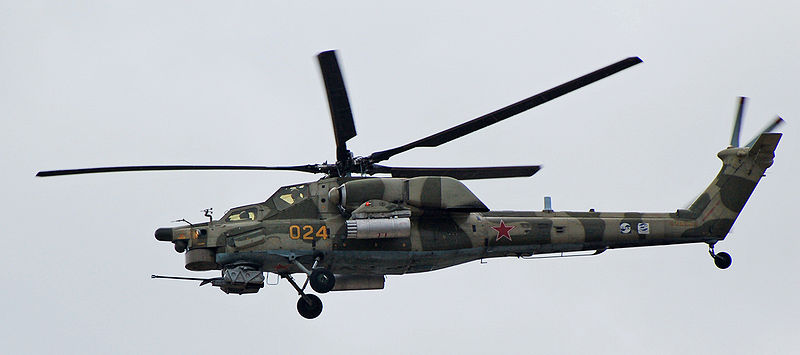
Russia is Priority for Mi-28N Deliveries

Mi-28N (photo: Denis Rossin)

Yesterday Rostov Helicopter Plant (‘Rosvertol’) General Director Boris Slyusar said the Russian Armed Forces are the priority for Mi-28N ‘Night Hunter’ deliveries, despite what he claims are many profitable offers from abroad.  According to ITAR-TASS, he said:

“We have many requests for the Mi-28N, but the RF Defense Ministry still doesn’t have these systems in sufficient quantity, and we will take its interests into account first.”

Slyusar didn’t give the number of Mi-28N helicopters in Russian forces, but he said the North Caucasus Military District (NCMD) has about 20 ‘Night Hunters,’ and there will be more.  He added:

“Our task is to create in the district’s [NCMD’s] troops in 2011 two groupings of Mi-28N.”

Who knows what he means by groupings.  Squadrons?  A second squadron or two additional squadrons?  The information on the number of Mi-28N delivered is unclear and contradictory.  In late 2009, Deputy Prime Minister Sergey Ivanov rather dubiously claimed Russia had already procured 27.

In May, a ‘Rosvertol’ marketing official said Russia would receive two squadrons of Mi-28N helicopters before 2011.  She said two Mi-28N went to the pilot training center at Torzhok in early 2008, and ten more — apparently for the NCMD’s Budennovsk-based 487th Helicopter Regiment — were delivered in 2009.  In mid-2009, ‘Helicopters of Russia’ General Director Andrey Shibitov also told Interfaks-AVN the Russian military had 12 Mi-28N helicopters.

So the question still stands:  a second squadron of maybe 10 helicopters, or two additional squadrons?  One thing’s certain, this goal’s been pushed from 2010 to 2011.

‘Rosvertol’ General Director Slyusar indicated his company sold 10 billion rubles of products in 2009,  and this year sales are more than 15 billion rubles.  Receipts from domestic and export sales are about equal.  By 2015, the company has an ambitious goal of $1 billion in sales.  Slyusar says the company is moving on this plan with modernization, equipment purchases, and people.

Winners and Losers in Organizing New MDs and Armies

Today a Ground Troops spokesman told ITAR-TASS three current Leningrad Military District (MD) brigades will form a 6th Combined Arms Army (CAA) in the new Western MD.  The 200th, 138th, and 25th Motorized Rifle Brigades will comprise the new army, and its headquarters will probably be Agalatovo, just north of St. Petersburg.  The spokesman also said a surface-to-air missile brigade and independent engineering brigade will be added to the Western MD.

These comments came in conjunction with a visit by Ground Troops CINC, General-Colonel Aleksandr Postnikov to the region to check on the formation of the new MD.  The spokesman said Postnikov may be working on peacetime coordination between the district’s Ground Troops, the Northern and Baltic Fleets, and Air Forces units.  He said, in wartime, “everything’s clear – [the district’s] commander directly commands everything deployed within the district’s boundaries.  But there’s still no experience of coordination in peacetime and we need to get it.”

Nezavisimaya gazeta’s Vladimir Mukhin also wrote today that the third new CAA will be based in Maykop, Southern MD.  Mukhin says that staffs, commands, formations, and military units in the Far East, Siberian, and Moscow MDs are being liquidated in the shift to four new MDs / OSKs, and, as a result, several thousand officers will be placed outside the TO&E beginning 1 September.  He thinks many of them won’t find vacant posts, and will be discharged from the army.

Serdyukov’s Defense Ministry will also be putting some soon-to-be-vacant properties up for sale, e.g. Moscow MD headquarters (Polina Osipenko Street, Moscow), Far East MD headquarters (Seryshev Street, Khabarovsk).  The initial asking prices for these buildings and land will be several billion U.S. dollars.  As long planned, proceeds from these sales, along with the sale of the Navy Main Staff, military educational institutions, and other military establishments in Moscow, are supposed to fund construction of housing for servicemen as well as military garrison infrastructure in new army deployment locations.

Mukhin talked to General-Lieutenant Yuriy Netkachev about Maykop.  Netkachev says Moscow is resurrecting the army headquarters located there until 1993.  He believes Maykop was chosen to reinforce against threats from Georgia as well as threats to the 2014 Winter Olympics in Sochi.

In the Central MD, Mukhin says the 67th Spetsnaz Brigade will move yet again, from IVVAIU in Irkutsk to Chita or Transbaykal Kray.  The IVVAIU building will be sold.

Mukhin sees Moscow’s demilitarization and moving forces closer to their likely operational theaters as the right policy, but asks if it’s underpinned with resources.  It has serious impact on servicemen and their families, and they’ve been forgotten in this process.

Mukhin quotes servicemen’s union chief Oleg Shvedkov:

“Continuing steps to transition the troops into a new profile supposes not only a significant cut in professional servicemen, but also their relocation to a new place of service.  And this means new everyday life problems are possible:  transfers, absence of housing, work for spouses, education for children, and the like.  The Defense Ministry is trying to resolve these issues on its own, but it would be more correct for the government to work on them through a special federal program.”