Category Archives: Ground Troops

Iskander-M “Brigade Set” Delivery

Some significant news from late June and early July, largely (or entirely) overlooked by Western observers . . .
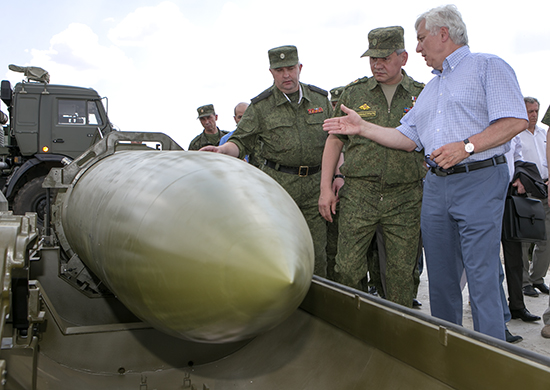
Designer Kashin Shows Shoygu the Iskander-M (photo: Mil.ru)

Designer Kashin Shows Shoygu the Iskander-M (photo: Mil.ru)

Defense Minister Sergey Shoygu presided over the first delivery of a “brigade set” of Iskander-M (SS-26 / Stone) short-range ballistic missile systems at Kapustin Yar on 28 June.

According to Mil.ru, uniformed and civilian Defense Ministry officials, industry representatives, and journalists were present for the test range ceremony.

The delivery followed the MOD’s announcement last month that Iskander-M system components will no longer be supplied separately to the army, only in “brigade sets.”  The military department also reported a “long-term” contract for deliveries of the missile system until 2017 was concluded with the producer.

A complete “brigade set” includes missiles, launchers, transport-loaders, command-staff, data processing, check-out, and maintenance vehicles, and training systems.
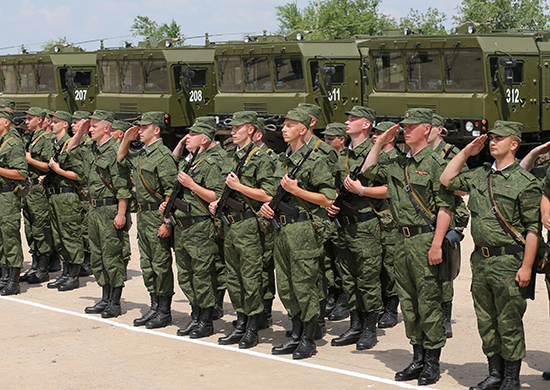
Missile Troops at Attention in Front of Iskander-M Launchers (photo: Mil.ru)

Missile Troops at Attention in Front of Iskander-M Launchers (photo: Mil.ru)

Shoygu reiterated that the MOD intends to reequip all ten Ground Forces missile brigades with Iskander-M before the end of 2017.  Ten brigades should deploy at least 120 missiles, not including reloads.  The Iskander-M is the only weapons system to be 100 percent procured before 2020, according to the MOD’s recently publicized Action Plan.

At Kapustin Yar, Iskander-M designer Valeriy Kashin of the Kolomna Machine-Building Design Bureau told reporters the military will receive another “brigade set” before year’s end, according to Nezavisimaya gazeta and Komsomolskaya pravda.

But completing the military’s order in less than five years could prove difficult for Russia’s defense industries.

NG reported Kashin said enterprises working on the Iskander-M have to “intensify” their activities several fold to meet the MOD deadline.  Seventeen specialized manufacturers are scheduled to upgrade and retool under a 40 billion ruble ($1.2 billion) investment effort.

However, actual reconstruction of production lines will not begin until 2014, according to online daily Vzglyad.

Shoygu told those in attendance at Kapustin Yar the most important step now is establishing the “essential infrastructure” for the deployment of new arms and equipment. He reemphasized this in a 1 July MOD videoconference by calling for special attention to synchronizing the delivery of weapons with the construction of bases and other support infrastructure where they will be deployed (and with the training of those who will operate them).

The defense minister stated that the MOD currently awaits completion of military construction projects worth 314 billion rubles ($9.7 billion). He said he wants the backlog eliminated before November.

An NVO correspondent present at Kapustin Yar reports that the just delivered Iskander-M brigade’s new facilities will be complete in September.

The newest Iskander-M brigade is likely intended for the Southern Military District, which presently only has one battalion of the new missiles. 

Shoygu is right to focus on arranging the appropriate infrastructure for Russia’s new armaments because it has traditionally neglected support and lifecycle investments in its military equipment.
Combat Readiness Percentages

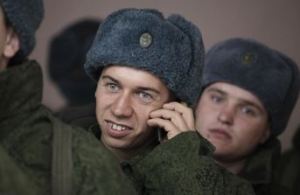
Conscript on His Mobilnik (photo: Reuters

Conscript on His Mobilnik (photo: Reuters)

Nezavisimaya gazeta’s editorial has the title above.  It’s sub-titled “An Unprejudiced Look at Military Reform.”

Here’s what it says.

“One of the most serious accusations against the former defense minister and former chief of the General Staff is the low combat readiness of armed forces units and sub-units caused by the military reform they conducted.  And the basic argument is the fact that only 15 of 35 combined arms brigades of permanent combat readiness are manned at 100%, the rest have personnel deficits from 20 to 30%.”

“There’s some truth in this.  If you figure the number of servicemen in the force structure — 220 thousand officers, 186 thousand contractees, 320 thousand conscripts and 50-60 thousand VUZ cadets — then the million required by the president’s decree has in no way been gathered.  But the main cause of this is by no means military reform, but the demographic situation in the country for which neither Serdyukov nor Makarov can answer.  And increasing conscript service, as proposed by some [Duma] deputies, can’t patch this hole.  And only those who contrary to Suvorovist science trained to fight the old way with numbers, and not skill, can talk about combat readiness relying just on arithmetical calculations.”

“Many concepts are part of combat readiness.  And not just manning.  Among its components, in particular, are the presence of modern combat equipment and combat support systems in the force, high operational-tactical qualifications of officers, their combat experience, skill and training of personnel…  The military reform of Serdyukov and Makarov, it seems, managed to deal with the last indicator.  We’ll cite just one fact — the average flying time of Russian Air Forces pilots reached 125 hours per pilot in 2012.  And squadron commanders flew 175 hours, and at Vyazma air base — more than 215 hours.  If you remember just several years ago our pilots had an average flying time of 30-40 hours, some of them generally 5-7 hours a year, and they got lost in the sky over the Baltic, then who would dare say that our military aviation is suffering from a lack of combat readiness.”

“The picture is approximately the same in the Ground Troops where soldiers and officers literally don’t leave the training grounds, conducting integrated tactical and operational-tactical exercises jointly with the Air Forces and Air Defense, with the Naval Infantry — if they’re on maritime axes.  They can’t complain about low combat readiness even in the Navy, whose ships, earlier tied to the piers, today ply the waters of the world’s oceans year-round, joining in the struggle against pirates in the Gulf of Aden.  They don’t complain of boredom in the VDV where over the past year more than 65 exercises of varying scale and intensity have been conducted, together with 1,150 combat training events, including more than 800 section- and 270 platoon-level combat firings, 73 company and 14 battalion tactical exercises.  Including with USA spetsnaz on American territory.  Additionally, the blue berets completed several tens of thousands of parachute jumps…  If these are not indicators of combat readiness, then what kind of percentages can you talk about?!”

“One more indicator of combat readiness is the evaluation of strategic nuclear deterrence forces which President Vladimir Putin recently carried out.  Launches of ground, naval and air-launched missiles were conducted then with high accuracy.  And the Supremo directed them from the Unified Central Command Post created in the framework of the reform this very year.”

“Yes, the reform according to the prescriptions of the ex-minister and the ex-NGSh has many deficiencies and mistakes.  ‘NG’ and ‘NVO’ wrote about them not once or twice.  We hope the new Defense Ministry leadership will rectify and correct them.  But not one more or less serious army dared test the combat readiness of our country’s armed forces after August 2008.  And no percentages can refute this fact.”

Yes, Serdyukov and Makarov are to blame for the mistakes of army reform.  Primarily for moving too fast across too broad a front without without adequately understanding the situation and consequences of their actions.  In some sense, this was their task — to break the logjam on military reform.  And that some people in Serdyukov’s team were venal didn’t help matters.

But NG’s right to argue they aren’t to blame for undermanning that leaves only 15 maneuver brigades at full personnel strength.  That’s a number not different from Putin’s first and second terms, the 1990s, or the late Soviet period.

NG’s also right to point to higher levels of training activity as an unalloyed good thing from Moscow’s perspective.  It’s a start.  It’s a function of having money and fuel, and a political leadership willing to allocate them.  But it’s only a necessary condition for building a modern army.  Sizeable Russian forces are probably ready to leave garrison when ordered.

The sufficient condition goes deeper.  Are those formations and units armed, equipped, supported, as well as trained to execute the missions their leadership envisions (and ones it doesn’t)?  It’s simply much harder to tell if they are ready for battle, if they will be capable in combat.  Much depends on the situation and scenario into which they’re thrown.  If, as NG alludes, Georgia should test the Russian Army’s readiness, it would perform better than in 2008.  It would probably do better in a new North Caucasus counterinsurgency.  But these cases are on the low intensity side of the warfare spectrum.  But perhaps they’re the most likely places where the Armed Forces would be employed.

But let there be no mistake, training activity doesn’t equal combat readiness, and combat readiness doesn’t equal combat capability.  It is significant and necessary, yes, but not sufficient.  One has to know a lot more about the condition of the forces and what goes on in those exercises.

Putin on Ground Troops and VDV

Meeting on GPV for Ground Troops and VDV

Kremlin.ru has the transcript of President Putin’s introductory remarks yesterday at a meeting on the land armaments portion of the State Armaments Program, the GPV.  This is his second review of where things stand.  Recall in mid-June he held a session on the Air Forces and the GPV.

Noting that “leading countries” are increasing the potential of their ground forces with new reconnaissance, C2, and “highly accurate” systems, as well as modern armor, Putin continued:

“I remind you in the framework of the state armaments program to 2020 it’s planned to allocate more than 2.6 trillion rubles to outfitting the Ground and Airborne forces.  We have to reequip units and sub-units, to fill the troops with new equipment with these resources.  By 2020 its share must be not less than 70 percent.”

“So 10 ‘Iskander-M’ brigade missile systems, 9 S-300V4 army brigade SAM systems, more than 2,300 tanks, nearly 2,000 self-propelled artillery and gun systems, and also more than 30,000 units of automotive equipment alone must enter the Ground Troops.  Besides this, it’s planned to introduce new communications, C2, advanced reconnaissance systems, individual soldier systems.”

As previously, the president stressed that complete fulfillment on schedule and at agreed prices is “very important.”

Then Putin turned to three problem areas.

First, fielding new weapons systems is complicated by the involvement of many sub-contractors.  A breakdown in one contract can cause an entire effort to fail.  Putin cited the VDV’s new BMD and YeSU TZ as examples:

“[BMDs] still haven’t gone through state testing and, as a result, haven’t been accepted into the inventory.  In turn, this is impeding development of practically all the VDV’s weapons sub-systems.  Today I’d like to hear, respected colleagues, why the task of the state program in the area of armor development and supply to the VDV hasn’t been fulfilled.”

“Creating a unified command and control system for troops and weapons at the tactical level [YeSU TZ] is another example.  The test model still doesn’t fully answer the requirements the Defense Ministry set out.  And I’d like also today to hear how this question is being resolved.”

Refer here and here for recent words on the BMD-4M and YeSU TZ.

Second, the Ground Troops and VDV spend too little on R&D (10 and 5 percent of what they spend on serial purchases and repairs respectively).  And the R&D money is put toward a small number of projects.  The president wants more work on advanced soldier systems, infantry weapons, individual protection, and comms.

Third, and finally, there’s a mess in Russia’s munitions industry.  There’s no long-term plan for ammunition makers, and this presents a problem for new arms systems.  The time has come, Putin said, to determine how the Defense Ministry and enterprises in this sector will interact.

President Putin has really seized on the GPV.  It seems near and dear to him.  Or perhaps it seems more tractable than Russia’s political and economic problems.  More amenable to his directive leadership and manual control.

The cases Putin mentioned are longstanding, well-known “poster children” for the problems of the OPK, i.e. easy and logical targets.  One wonders what more pressing and acute, if less publicly advertised, military-industrial difficulties were discussed.  Putin’s focus on R&D is also a bit odd when you consider it’s been blamed for waste and slashed.

Putin didn’t address strong rumors and denials of slipping the schedule for GPV 2011-2020 to 2016-2023.

Does the GPV Look Like This?

If Putin keeps on the GPV, perhaps we’ll gain a somewhat sharper picture of how it’s shared out.  It’d be interesting to learn where the RVSN and VVKO fit.

Defense News

Some Russian defense news from June 8, 2012 . . .

Kremlin.ru and other sites noted several designers of the prefab or modular Voronezh BMEW radar have received a 2011 State Prize for Science and Technology.  The new system can be deployed 3-4 times faster, costs four times less to operate, and requires six times fewer personnel to service than the previous generation of radars, according to press reports.  TsAMTO carried the story as well as a review of the state of Voronezh deployments.

Izvestiya reported details on a consolidation of Russia’s munitions producers.  It’s been predicted for many months.  The country’s 56 producers will be reorganized into 5 holdings, with Bazalt, Pribor, and Mashinostroitel leading three of them.  A Bazalt rep basically admits the sector’s a mess, and it’ll take several years to organize the industry.

But Bloomberg and other media reported U.S. defense firms are actually looking to Rosoboroneksport for the purchase of munitions from Russian producers.

Topwar.ru carried an Interfaks story saying Delta IV-class SSBN Novomoskovsk is nearing the end of a modernization to extend its service life to 2021.  The sub went to sea for some trials last week.  It is, by the way, the newest of the class.  Zvezdochka is also working on Verkhoturye, and both SSBNs will reportedly return to service by the end of 2012.  See this earlier-posted related item.

RIAN reported an OSK source claims the Navy will buy up to ten support ships per year starting in 2013 to rebuild Russia’s naval auxiliary fleet.

General Staff Chief Nikolay Makarov addressed the possibility of Finland joining NATO while in Helsinki.  He said this threatens Russia’s security.  But there were Western news service reports saying he said Finland’s military cooperation with NATO by itself is a threat to Moscow.  Voice of Russia covered the negative reactions of Finnish politicians as well as Russian commentators pointing out that the general’s view on another possible broadening of NATO is understandable.  VPK.name highlighted the story.

NVO interviewed new Ground Troops CINC, General-Colonel Vladimir Chirkin on his plans for army acquisition.  Chirkin said UAVs, reconnaissance systems like Strelets, Rys armored vehicles, S-300V4, Buk-M3, Tor-M2, and Verba SAMs, Iskander-M, Tornado-G (S), Msta-S, and Khrizantema-S missile and artillery systems, comms equipment, T-72B1(2), and BTR-82A will be procured out to 2015.  RIAN carried the abridged version.

“New Profile” Brigades

Representative "New Profile" Brigade

Not long ago someone asked what Russia’s “new profile” brigades look like.  There’s a good bit available on this. 

General Staff Chief Makarov signed off on the TO&E (org-shtat) as far back as three years ago, just a couple months after Defense Minister Serdyukov’s reforms were launched. 

The org chart for a typical motorized rifle brigade shown above is inelegant.  Some elements aren’t represented due to your author’s lack of graphic skills.  Among important missing items are the artillery command recce battery and air defense radar platoon.

The sniper platoon has been part of the new TO&E, but its existence was only emphasized by the media of late.

And this post doesn’t delve into precisely how postulated Russian light, medium, and heavy brigades might differ.

The manpower looks to be under 4,400 officers and men, 327 officers and 4,066 soldiers (including 1,005 sergeants) to be exact.  Russia’s officer corps bloat doesn’t seem to apply to serving out here “in the troops,” as they say.  Officers are only 8 percent of the brigade’s personnel. 

However, this representative brigade is (or was) commanded by a general-major (O-7), and had 5 full colonels, and 29 O-5s.  There are almost as many majors (43) as captains (68), and a fairly low number of senior lieutenants (181).

In terms of equipment, battalions remain battalions — 40 tanks or armored vehicles per.  The SP howitzers are 152mm 2S19 Msta-S or 2S3M Akatsiya and/or 122mm 2S1 Gvozdika.  MRLs are the venerable BM-21 Grad, in a battalion of three batteries with six launchers per.  Antitank artillery is towed and ATGMs are Konkurs (AT-5 / Spandrel) and Shturm-S (AT-6A / Spiral).  Air defense isn’t particularly modern consisting of batteries of 2S6 Tunguska (SA-19 / Grison), Strela-10 (SA-13 / Gopher), and Osa (SA-8B / Gecko). 

Other English-language observers have looked at the same data.  This one shows the organization and manpower distribution for a brigade’s sub-units (battalion-level and lower).  This one does much the same with some guessing at tactical organization and equipment.

P.S.  One forgotten thing here is how logistics and maintenance may, or may not, have changed at the brigade level with Serdyukov’s outsourcing, Oboronservis, and taking soldiers off noncore (i.e. non-combat) duties.  But the supply and repair battalions still appear on the org charts.

A Rock and a Hard Place

Russians in Tajikistan (photo: RIA Novosti / Vladimir Fedorenko)

Conscripts or contractees?  It’s difficult for the Russian Army to get the right kind of conscripts, where it needs them.  But, over time, it hasn’t been any easier to obtain long-term contract enlisted either. 

Last week, Izvestiya wrote about army plans to replace conscripts currently serving in its 201st Military Base in Tajikistan with contractees. 

An officer in the formation told the paper it’s too costly to keep 3,000 conscripts in Tajikistan, and, by the end of 2012, the Russian Army will replace half with contractees.  A GOMU source tells the paper replacing all 3,000 at once is “unrealistic.”  Contractees will reportedly serve on three-year deals getting 30,000 rubles per month.

The situation for Russians in Tajikistan, the officer says, is strained, and Tajik authorities regularly detain conscripts for one reason or another.  As an example, he cites the case of a conscript driver who killed three Tajiks last January.  Thus, he concludes, it would be easier with “professionals” – contractees —  who “know what they’re doing, and can be responsible for their actions.”

But there’s no reason to think contractees will avoid trouble any better than conscripts.  The first contract experiment proved that.  Contractees are more costly and just as difficult to control, if not more than their conscripted brother-soldiers.

According to Izvestiya, the 201st now has 5,500 personnel, including the 3,000 conscripts.

An old Krasnaya zvezda report says, in early 2007 – at the height of the first, failed attempt at introducing contract service – the military base had 7,000 servicemen in all, about 60 or 65 percent contractees.  Its two maneuver units had 50 percent or fewer in their ranks.

Back then, the Defense Ministry daily said the military was all set to send conscripts in place of hired soldiers.  It was hard to convince older, experienced men to go to Tajikistan because of the difficult living conditions and prospects for serving on contract in Russia.

As Izvestiya’s interlocutor intimated, relations between Moscow and Dushanbe are a bit strained right now, prompting some to wonder out loud if manning the 201st won’t become a moot issue.

Suit, Countersuit Over GOZ

Kurganmashzavod (photo: Nakanune.ru)

This story should be of particular interest to those following the VDV, Ground Troops, and their combat vehicles.  The specific problems of KMZ illustrate general dilemmas of the GOZ.  The GOZ money trail is slippery.  And it explains why modern, or at least new, weapons and equipment aren’t produced or delivered, and the GOZ is only partially fulfilled. 

RIA Novosti (via Vedomosti) reports the Defense Ministry filed suits against Kurganmashzavod (KMZ), of “Tractor Plants” Concern, for breaking GOZ contracts.  KMZ, in turn, entered three countersuits seeking 1.5 billion rubles from the Defense Ministry for violating its contracts.

KMZ claims the Defense Ministry stopped accepting its products in fall 2010, causing the factory to fail to meet its obligations.  RIA Novosti reports First Deputy Defense Minister Aleksandr Sukhorukov said KMZ would be fined 3 billion rubles for breaking its 2010 contract to produce the BMP-3.  Two billion has also been cited.  The first hearing will be next week.

Nakanune.ru indicates KMZ had no GOZ contracts for 2011, during which the plant counted on 12 billion rubles worth of production.  Instead, it produced only 4.7 billion worth for the first eight months of the year.

In May, Main Military Prosecutor Sergey Fridinskiy pointed to KMZ as a prototypical failure of the GOZ.  The factory got an advance of 350 million rubles but, instead of sending money to its sub-contractors, it used it on internal needs.

Academy of Military Sciences Professor and PIR-Center Conventional Arms Program Director Vadim Kozyulin says:

“I understand that the enterprise’s leadership could have its own reasons.  The plant has many problems which could look more important and pressing from a local viewpoint.  But some way or other the resources to fill the order for the supply of armored equipment for the VDV came in, but went for something else.”

Kozyulin says they have the same problem in other enterprises, “but ‘Kurganmashzavod’ fell right under the chop.”  He says it won’t go well for KMZ, and the Defense Ministry may refuse to give the factory future orders. 

Nakanune also cites CAST analyst Dmitriy Vasiliyev who agrees this isn’t just KMZ’s problem, but a problem of the Gosoboronzakaz as a whole.  Igor Korotchenko suggests KMZ has little chance of winning its case, and needs to seek an out-of-court settlement.  But perhaps it’s too late already. 

It may be that KMZ is being made into a convenient example because others want to take it over.  It is an area of the OPK that could stand some consolidation.

Kozyulin suggests troubled KMZ should merge with Uralvagonzavod (UVZ).  UVZ and Russian Machines are apparently after KMZ parent “Tractor Plants” Concern.  They’ve approached Vnezhekonombank, which owns 100 percent of its shares, about managing “Tractor Plants” Concern, but the choice of a managing firm has been put off until 2012.

It certainly sounds like KMZ is headed downhill.  The dueling law suits, the untangling of KMZ’s management, and, at some point, the reorganization and restoration of its production capability will take time.  This means possibly years of delays in filling armored vehicle orders for the VDV and Ground Troops.

You may recall United Russia member Igor Barinov excoriated KMZ earlier this year for its poor handling of GOZ funds.  VDV Commander, General-Lieutenant Vladimir Shamanov also blamed KMZ for delays in getting the first BMD-4Ms for his troops. 

Russian Military Power

Finland’s National Defense University has published a study entitled Russian Politico-Military Development and Finland.  If the media reporting is accurate, it may read a little like a latter-day Soviet Military Power.

Now few have read the document since there’s only a two-page English precis to go with press accounts of its contents.  Perhaps the entire thing will appear in English soon.

But here’s the gist. 

NATO and other Western countries believe war is an outdated idea, and U.S. power and interest in Europe are waning.  Russia, meanwhile, is seeking to revise the verdict of the Cold War, restore its great power status, and regain the Soviet sphere of influence.

It’s modernizing its crumbling armed forces with increasing investments [i.e. the 19-trillion-ruble State Program of Armaments or GPV 2011-2020].  The formation of the Unified Strategic Command (OSK) West (aka the new Western MD) has shifted the Russian Army’s center of gravity from Western Europe to the Northwest [at Finland].  And:

“The Russian armed forces are being improved by forming high-readiness forces with a capability of achieving operational results directly from peacetime employment.”

Finally, the study’s authors seem to see a Russian military resurgence that needs to be met by reinvigorating Finland’s territorial defense system:

“A large military reserve force is an indication of the will to defend the country, and has a major preventative value.”

It’s worth challenging three central propositions here.

Russia’s “increasing investments” in its military.  The Finnish report is reacting a priori to plans for large outlays for defense procurement that may or may not happen.  They authors are concerned about Russia’s intention to modernize, and what its forces might look like after modernization.  The current GPV could go the way of its predecessors; the first annual state defense order (GOZ) to fulfill the GPV isn’t exactly proceeding smoothly.  It’s important also to consider what’s being modernized.  In many cases, Moscow plans to replace arms and equipment from the 1980s and earlier, and not everything will be a world-class fourth- or fifth-generation weapons system.  Lots of the “new” models will be based on late Soviet-era designs.  

The shift to the Northwest.  To some extent, there may be an effort to get forces closer to their likely theater of operations.  But hysterical assertions of vastly increased Russian forces shouldn’t be taken seriously.  It’s largely the same forces organized differently, and certainly not all opposite Finland.  The creation of OSK West or the Western MD was also an attempt to cut redundant command and staff echelons and get the Ground Troops out of the expensive environs of Moscow and Moscow Oblast.  One could easily argue the Defense Ministry’s placed a higher priority on forces in the Southern or Eastern MDs. 

The formation of high readiness units.  The report’s authors are quoted as saying Russia’s high readiness forces will be ready to leave garrison, and begin offensive operations in an hour, according to Vzglyad’s interpretation of a Russian-language media outlet in Estonia.  In reality, the forces are now more highly ready to depart the garrison and get combat orders.  No one can say what those orders will say.  Any combat missions will have to be carried out by troops who generally have less than six months in the army, and they’ll be lucky to execute a successful defensive operation.  Also, let’s hope the Finnish study says that this high readiness was really more about getting rid of useless, hollow, low readiness cadre units.

But, as Newsru cites a former deputy commander of the OGV(s) in the North Caucasus, it’s hardly possible to talk about Russian efforts to encircle anyone “in the condition which we’re in, and with those obvious army problems which we have.”

No one should misunderstand.  The Finns are to be admired for their perspicacity when it comes to Moscow.  They’re keen observers of what’s happening in Russia.  They have to be. 

But there’s obviously a huge issue of perspective.  Things look very different from Helsinki, Washington, Paris, London, and Berlin.  Russia’s capabilities are somewhat hyped in a public debate about what level of forces and readiness Finland needs to deter Russia.

But, all in all, it doesn’t help anyone in the long-term to inflate [re-inflate?] a Soviet-style military threat.  A realistic assessment of Russian capabilities and intentions will lead to practical, affordable measures to counter them.

“Moor” GRU Changes

GRU Headquarters

Yesterday we got diametrically opposed views of the GRU.  Argumenty nedeli  argues the situation inside the GRU is a mess.  Rossiyskaya gazeta, however, defends the GRU’s exiting chief, General-Colonel Shlyakhturov and the reforms made in Russia’s military intelligence agency.

Argumenty writes that the Main Intelligence Directorate is being “optimized” into a simple directorate, and this is evidence that Russian military intelligence simply no longer exists.  To news about Shlyakhturov’s departure, the paper says GRU officers have Schiller’s reaction:  “The Moor has done his work, the Moor can leave.”  

A GRU officer tells Argumenty that the agent operations staff has been completely destroyed, and information “extraction” tasks are no longer levied.  “Radiotechnical” [SIGINT] and space reconnaissance sub-units that remain now take orders from more important armed services and branches.  Central staff and analytical sub-units have been cut to the minimum.  This month the General Staff Chief directed the GRU to dismiss personnel on age grounds where possible [maybe Shlyakhturov included], and rotate others to the military districts. 

And, the officer says, it’s been announced that in the next round of reforms in 2012 the GRU will become a simple directorate [rather than a main directorate] of the Genshtab, and relocate to the Genshtab building on the Arbat.  

President Putin Visiting the New GRU Headquarters in 2006

The officer tells Argumenty only rear support and cleaners will remain, and any of Anatoliy Serdyukov’s former tax inspectorate chiefs can manage them.  He says the majority of “the boys” actually prefer this turn of events, and have already found jobs in the civilian world.  He adds that the new GRU building on Khodynka will be sold, and it’s important not to leave secure comms and secret documents behind.  There were precedents for that, the officer joked bitterly.

If this officer’s version pans out, you can bet the GRU complex, and the Moscow real estate it sits on, will fetch a high price for the controllers of Defense Ministry coffers.

RG offers a more positive spin on what’s happening in the GRU.  Firstly, it says there’s no intrigue in Shlyakhturov’s exit.  It’s simply on age grounds.  The paper says the soon-to-be ex-GRU chief was well-respected, and implemented the reforms required of him. 

The fact is, it contends, the agency managed to avoid most of the changes that shook the rest of the country and Armed Forces in the past two decades.  It was organized in same way as when it was established in Soviet times [i.e. it was organized for the Cold War and World War III], and was naturally somewhat out-of-step with the state’s new “social-political structure” and needed to be changed.  And Shlyakhturov implemented changes that other chiefs [i.e. there was only one–Korabelnikov] couldn’t.

Instead of more than 100 GRU generals, according to RG, there are now only 20.  Spetsnaz brigades were cut and given over to Ground Troops reconnaissance.  And there were other changes either secret or understandable only to professionals [so much for civilian control].

Not all the transformations were palatable, RG writes:

“But the majority of cadre military intelligence men are sure that Aleksandr Vasilyevich conducted a completely unavoidable reform in the softest and most optimal form.  No one would have coped better with this mission than him.

RG indicates Shlyakhturov is in good health, and will likely take a post in a big business or serve as an advisor to the Defense Minister.

For good measure, the paper concludes:

“Intelligence men are sure that a competent reform of the Genshtab’s Main Directorate will be only beneficial, giving the GRU more mobility, and providing technical intelligence monitoring systems with the most modern equipment.”

All in all, it seems quite an apology for Shlyakhturov and the state of the GRU. 

Makarov’s Press-Conference (Part III)

Army General Makarov (photo: RIA Novosti / Aleksey Nikolskiy)

Still plumbing General Staff Chief Makarov’s Monday press-conference . . .

Makarov indicated Russia’s Israeli-made UAVs will be used in the Tsentr-2011 exercise.  According to Krasnaya zvezda, he once again worked Vega over for wasting years and money without meeting the military’s requirements, forcing it to turn to Israel to obtain unmanned aircraft.

According to Interfaks, the General Staff Chief asserted Russia won’t buy anything but PGMs for its combat aircraft:

“The purchase of conventional [unguided] means has stopped.  We are buying only highly-accurate means.”

“Western countries conduct military operations almost without ground forces.  Aircraft operate outside the air defense zone and sustain minimal losses.”

Izvestiya noted, however, replacing Russia’s dumb bombs with smart weapons won’t be cheap.  Tens of thousands of rubles versus millions.  But one of the paper’s interlocutors concluded:

“The Defense Ministry believes there’s money for buying them, contracts for the first deliveries of new munitions have already been concluded.”

He estimates they will comprise perhaps half of Russia’s aviation weapons inventory by 2020.

Izvestiya quoted Ruslan Pukhov to the effect that guided ASMs made up only 1 percent of Russia’s stockpile in the five-day war with Georgia, and Russian aircraft had to brave Georgia’s air defenses on most missions, losing four Su-25, two Su-24, and a Tu-22M3.  He added, however, that a Su-34 employed an anti-radar Kh-31P to destroy a radar in Gori.

Lenta.ru recalled General-Lieutenant Igor Sadofyev’s late 2010 comments about plans for a radical increase in PGMs and UAVs in the Air Forces by 2020.  You can refresh your memory here.

Some military commentators and news outlets managed to tie together Makarov’s comments on Arab revolutions, Central Asian exercises, snipers, and sniper rifles in interesting, but not always accurate, ways.

KZ summarized Makarov pretty simply as saying the armed conflicts in Arab countries were difficult to predict, and similar events can’t be ruled out in Central Asia.  In its replay of his remarks, he said:

“. . . we should be ready for everything, therefore we are working on this in the exercises.”

So, Moscow’s pretty obviously looking at the possible repetition of a Libyan or Syrian scenario somewhere in Central Asia . . . no surprise there . . . makes sense.

Komsomolskaya pravda said:

“Our military isn’t hiding the fact that current exercises are directly linked to the probable export of military aggression from Afghanistan into the Central Asian republics after NATO troops withdraw from there.”

It cites Makarov:

“[The exercises] envision developing variants for localizing armed conflicts on the territory of these countries.”

That doesn’t really sound Libyan or Syrian, does it?  It’s not internal.  It’s good old external spillover.  Oh well, as long as it’s “localized” on someone else’s territory, and doesn’t cross Russia’s borders.

ITAR-TASS’s version of Makarov got people more spun up:

“The world situation is complex, quickly changing, particularly in North Africa and the Middle East.  It was difficult to forecast what happened in a number of countries of this region, events developed with great speed.  Now no one can say what will happen next.  But this is a signal for all states.  We military men need to be prepared for the worst scenarios.”

This led a few outlets to take the next step on their own, i.e. a repeat of the Arab scenario inside Russia.

You can read likely exaggerations of what Makarov really said in Gazeta.ru or Rbcdaily.ru.  In its version, the latter claimed Makarov didn’t exclude internal unrest following the Arab example in Russia, and the army has to be ready for the worst case scenario of political developments inside the country.

Pouring gas on the fire it lit, Rbcdaily introduced the sniper issue here.

Of course, snipers are great for urban warfare or urban unrest.  Rbcdaily’s Defense Ministry source says Makarov plans to put independent sniper platoons in every brigade.  They’ll be armed with British rifles, of course.  And the snipers themselves will have to be long-term professionals – contractees, so that’ll have to wait until the middle of next year.

Igor Korotchenko tells Rbcdaily:

“A sniper is a piece of work, he can’t be trained in a year, therefore they must absolutely be professional contractees.  We can’t count on conscript soldiers here, like in the old days when there were enough gifted guys who learned to fire the SVD well among the conscripts.”

KZ didn’t mention Makarov talking about snipers.

Just to finish this off, Makarov’s Syrian comments weren’t construed or misconstrued as much.  KZ said simply that he said Russia is not planning a military presence in Syria, nor the introduction of extra security measures at its material-technical support base in Tartus.

ITAR-TASS put it this way:

“This base remains in our hands.  Besides it, our advisors work in Syria.  That’s enough.  We don’t intend to adopt any preventative measures.  . . . we have to watch closely those forces opposing the government.  There are legal demands, and there are opposition demands which, in our view, need to be ignored because they are illegal.”