Category Archives: Law, Order, and Discipline

Military-Theft Forces

Prosecutors Rate the Most Corrupt Service Branches

40-50 Percent of State Defense Order Simply Stolen in Recent Years . . . no wonder large-scale procurement hasn’t happened.  Serdyukov supporter Korotchenko tries to paint opponents of military reforms as people trying to protect their corrupt schemes.  This surely goes on, but there also have to be people opposing them for reasons other than greed.  Finally, it’s at least conceivable that, if Serdyukov doesn’t make progress against corruption, it could cost him his job (if he stays that long, he is approaching the four-year mark).  Thus endeth the precis for this post . . .

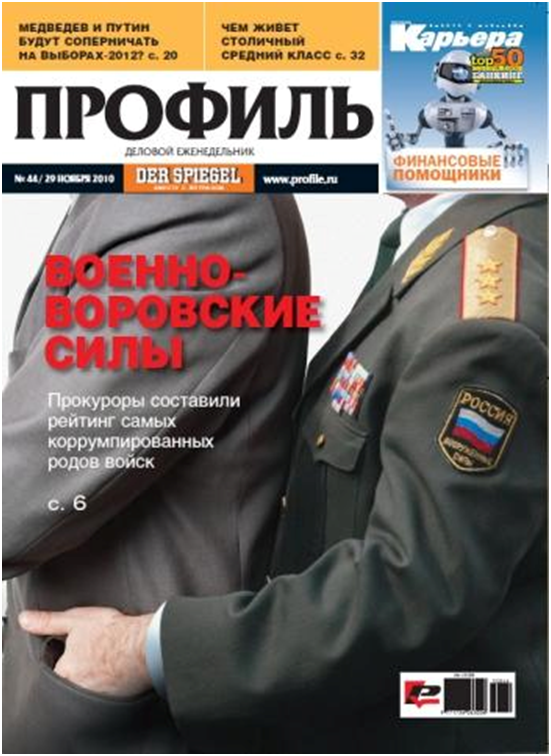
This week Profil investigates military corruption.  The magazine notes the number and scale of Defense Ministry corruption cases is growing by leaps and bounds, reaching losses of 2.2 billion rubles for the first ten months of 2010.  It concludes, despite a significant cut in the officer corps and Defense Minister Anatoliy Serdyukov’s battle against “thieves in broad stripes [generals],” the number of corruption crimes is not only not declining, but has substantially increased.  Profil obtained an analytical report compiled by the Main Military Prosecutor (GVP) showing who has stolen how much this year.

The GVP presented its report to a closed session of the Duma Defense Committee.  It says its analysis shows “efforts to counteract corruption in the troops are insufficiently effective.”

Profil’s first graphic . . .

Growth of Corruption Crimes in the Army (First 10 Months of 2010)

Troops/Military District/Fleet                     2009       2010       Growth (%)

North Caucasus MD                                             184          311                 69

Moscow MD                                                              94           152                61.7

Air-Assault Troops (VDV)                                 34            119                250

Siberian MD                                                             76            117                 54

Strategic Missile Troops (RVSN)                  59              93                 57.6       

Northern Fleet                                                      50              59                 18

Space Troops                                                        27              44                 63

Caspian Flotilla                                                      5                  7                 40

Black Sea Fleet                                                      2                  6                 200

Profil suggests the recent wave of military retirements signed off by President Dmitriy Medvedev could have been sparked by corruption charges.  While possible, there’s no evidence to support this thesis. 

A Profil source in the Defense Ministry says, not surprisingly, officials responsible for the State Defense Order (GOZ or ГОЗ), capital construction, and the disposition of military property (first and foremost real estate) inflict the greatest losses on the budget.  The article quotes Igor Korotchenko:

“In the course of recent years, 40-50% of resources allocated for the State Defense Order were simply stolen.  This happened, for example, when money was directed at the fulfillment of some concrete work, but there were no real results.  Write-offs appeared in the end or a weapons system was developed that simply didn’t meet its technical requirements.”

Profil suggests that many officers are rushing to get one last bite of military money before Serdyukov’s reforms completely derail their schemes.  It cites Ruslan Pukhov offering two different explanations for rising military corruption:

“Feeling an impending dismissal, officials are probably trying to take the maximum from their positions.  However, it can’t be ruled out that the prosecutor has really reinforced his work in different areas.  Corruption is an acute issue for the prosecutor.”

Pukhov thinks that, although the percentage increase in corruption looks really bad for the VDV, “corruption in the armed forces is spread equally and the growth in corruption crimes in separate branches or districts is connected only with where they are being investigated.”

A very good point, Mr. Pukhov.  Yes, the results of this little anticorruption experiment are very much influenced by where and how it is being conducted.  One should also pay much more attention to the absolute numbers of corruption cases than the percentage changes, and nothing has been said about the relative size of the various parts of the armed forces . . . no per capita figures are provided.  Are 44 crimes in the relatively small Space Troops more significant than 152 in the larger Moscow MD?

Korotchenko, a fairly strong Serdyukov proponent, says the Defense Minister and his tax service colleagues are beginning to break existing corrupt ties, institute financial transparency, and deprive the generals of the right to conclude any contracts.  Dividing the Ministry into military and civilian halves will keep military men out of financial expenditures, and this “process of shifting generals out of the feeding trough” will continue until 2012.  The generals will provide requirements, and civilians will allocate the financing.

A second graphic with some absolute figures on losses due to corruption . . .

Growth of Corruption Crimes in the Army (First 10 Months of 2010)

Troops                                                                  Loss Amount                      Annual Growth

                                                                           (millions of rubles)                        (times)

Strategic Missile Troops (RVSN)                      59.8                                            15          

Air-Assault Troops (VDV)                                   57.5                                            12.2

Space Troops                                                            47.6                                              2.2

Korotchenko claims:

“The campaign against Serdyukov is mainly heated up by those people who’ve been deprived of the feeding trough.  So, the director of a large defense enterprise has for many years sawed off rubles by the billion every year in the transfer of money that comes to fulfill the Gosoboronzakaz.  When Serdyukov deprived this director of such a trough, he began to finance any actions directed at discrediting and, possibly, even removing the Defense Minister.”

So, Korotchenko asserts most conflicts over army reform are banal conflicts of interest for those who can’t steal like they used to.  But didn’t the GVP just say they’re doing a better job of stealing than ever before?

Korotchenko continues:

“Of course, Serdyukov is not an angel, and many of his actions on the military reform plane call forth questions, but it’s another thing that before he arrived, corruption in the Defense Ministry had achieved such a level that he was forced to cut to the bone.  Many scandals proceed only because their financial-economic interests were affected:  the meetings of the airborne guys is just one in this series.”

Then Profil turns to Vitaliy Shlykov, who says:

“Broad publicity for corruption scandals in the Defense Ministry cannot but affect the minister.”

But he believes the Kremlin knows no one can fight corruption like Serdyukov, therefore the GVP report isn’t a real blow to him.

Profil concludes, so far, Serdyukov hasn’t squandered the trust placed in him, but the struggle against corruption only strengthens him as long as it’s a success.  If corruption keeps growing, it’s possible the Defense Minister himself could wind up on the “shot list.”

Serdyukov’s Carte Blanche

In an editorial Monday, Vedomosti supported the carte blanche President Dmitriy Medvedev has apparently given Defense Minister Anatoliy Serdyukov and his military reforms.  The paper likes the reforms enough that it wants the President to think about the possible effectiveness of the ‘army method’ in reforming the MVD.  Here’s what Vedomosti had to say:

“Renaming the Army”

“Dmitriy Medvedev’s and Anatoliy Serdykov’s joint trip to a model Moscow suburban military unit went beyond the protocol of the visit.  The President’s speech in awarding outstanding military men became a new signal to officers, the army, and society:  ‘Despite the fact that all changes are difficult, they are necessary…  Everything that is now being done is directed at establishing modern and effective armed forces.  Here there are both problems and good decisions, I am following this personally as Supreme CINC.’  The Kremlin demonstrated that, despite the recent media scandal, it trusts the civilian Defense Minister, won’t bow to the generals’ and veterans’ opposition, and intends to continue its planned military reform.”

“The new carte blanche for Serdyukov for further transformation is important for many reasons.  The current minister is not the first civilian director of the military department.  However, he specifically replaced a campaign of reforming with systematic transformations.  In his inheritance from Sergey Ivanov, Serdyukov received a much truncated army of the Soviet type, not answering modern requirements.  Dedovshchina, obsolete armaments (modern equipment is not much more than 10% of the general inventory) and command and control, and manning were its main problems.  Add to this corruption among the generals which prevented equipping the army with new types of armaments and communications.  The victorious August war of 2008 showed that the victors couldn’t suppress the enemy’s aviation and artillery and were inferior to the vanquished in modern communications and reconnaissance means.”

“Serdyukov’s attempts to establish control over expenditures on purchases for the army met severe resistance from rear services officers and generals.  Not long ago he acknowledged to journalists:  ‘When I came to the Defense Ministry, speaking plainly, I was surrounded by large amounts of thievery.  Financial licentiousness, the impunity of people whom no one had checked out (…) was so deeply ingrained that it had already become a way of thinking.’  The minister confirms that the transparency of the defense order is a ways off.  The unnecessary secrecy of the military budget is interfering with this.  Meanwhile, progress in the struggle against traders in shoulderboards is obvious.  In 2006, corruption cases were started against seven generals, in 2007, when Serdyukov became minister, — against 16, in 2008 — against 20, in the first half of this year — against eight more.”

“Besides this, the Defense Ministry put up for sale unneeded property and facilities which were being illegally rented out to enrich a few people, and didn’t allow for building apartment blocks for officers needing housing on these grounds.”

“On the whole, it’s possible also to consider organizational transformations a success:  the transition to a more modern system of command and control and the reduction in the excess number of generals and higher officers.  In 2008, of 249 generals and admirals who underwent certification [аттестация], 50 were dismissed, and 130 sent to new places of service.  One can’t avoid mistakes in cutting and dismissing officers, but those deprived of a sinecure cried loudest of all about the collapse of the army and treason.”

“The struggle with barracks hooliganism goes on with varying success.  According to the Main Military Prosecutor’s data, in 2006, more than 5,800 people suffered beatings from fellow servicemen, in 2009 — 3,000.  And for the first five months of 2010, 1,167 soldiers suffered from dedovshchina — 1.5 times more than the analogous period of 2009, of them, four died.  The cause is not only in the growth — because of the cut in the service term — the number of new conscripts went from 123,000 in the fall of 2006 to the current 270,600.  Generals, having botched the program costing 84 billion rubles to transfer to contract, now are forced to call up those with criminal records.  Military police will remain a paper tiger for ‘dedy’ and ethnic clans.  We note that Serdyukov hasn’t forsaken a professional army, but put off its creation until the time when the Defense Ministry will be able to select and not collect contractees through deception and duress.”

“Nevertheless, it’s notable that over 3 and 1/2 years, the reform, being conducted by independent managers without legal changes and loud renamings, has really moved forward.  It’s possible it’s worth the President considering the effectiveness of the army method in reforming the MVD.”

Larger Significance of the Serdyukov Flap

Pavel Felgengauer

You’ll find bits of the following by Pavel Felgengauer in various English language articles, but not his full argument as laid out here.

Writing in Novaya gazeta this week, military commentator Pavel Felgengauer concludes that Defense Minister Anatoliy Serdyukov remains in place, but the army’s problems are growing.  He says:

“Today a dangerous situation of general decay in discipline and order is taking shape which could lead to a loss of control over the armed forces.”

The slow disintegration of the Soviet Armed Forces required Serdyukov to take immediate, radical, and often not well thought out reforms, according to Felgengauer.  Mass officer and warrant officer dismissals have put 70 thousand outside the TO&E “at the command’s disposition,” essentially just waiting for dismissal.  Only 10,000 are junior officers whom the Defense Ministry owes little by way of benefits.

A bit of explanation that Felgengauer doesn’t give you.  We haven’t had any independent observer put this number so high.  These 70,000 are waiting for housing because, by law, surplus officers can’t be discharged until they get permanent apartments.  But they aren’t living on much while they wait.  Because they don’t have duty posts, they get only rank pay, not various monthly supplements that officers in active positions get.  Rank pay might be only 30 percent of what they received when they were in the TO&E.

But back to Felgengauer.  He turns next to NCOs.  He says experts say, with a million-man army and 150,000 officers, the Russian Armed Forces need 200,000 or 300,000 sergeants.  But in Serdyukov’s ‘new profile’ TO&E, there are billets for only 90,000 contractee-specialists and NCOs together.

And these are the guys who’re supposed to help the shrunken officer corps keep order in the ranks.

Felgengauer then recites the Main Military Prosecutor’s announcement that barracks violence is up 50 percent in 2010.  He says incidents of open ‘hooliganism,’ criminal violence, and inter-ethnic conflict are all rising.  And only a declining number of officers is there to hold all this together – with the help of an inadequate NCO corps.  This is why, says Felgengauer, the Soviet officer corps relied on dedovshchina as a lever to keep order among the troops.  He may be suggesting Russian officers are doing the same thing now.

He concludes many are dissatisfied with this state of affairs, and they all focus blame on Serdyukov, somewhat unfairly, according to Felgengauer.  Criticism is focused on the man who actually tried to fix Russia’s decaying defense department, and not his predecessors who drove it to ruin.

Of course, one could ask Felgengauer isn’t this the fate of all reformers?  Maybe those being reformed were happy with the decaying and ineffective bureaucracy and forces that were comfortable, and perhaps profitable, for them.

Felgengauer returns to the issue of attempts to train NCOs.  Instead of officers, military schools are supposed to prepare sergeants instead.  But only the erstwhile Ryazan Higher Airborne Command School is actually doing it, and, ironically, this is where the storm over Serdyukov arose.

Felgengauer concludes that Putin and Medvedev agreed with Serdyukov’s reforms, and so they aren’t ready to dismiss him now.  But the problems and tensions surrounding the Defense Ministry are growing.

In a kind of postscript, Felgengauer sees the decision for military police as something of a ridiculous answer to disorder in the army.  First, they will be selected from the ranks of the most disgruntled – the dismissed officers.  The concept behind using some ‘dissatisfied-dismissed’ to keep order among other dissatisfied is just a little inscrutable.  And, in the best case, it’ll take over a year to change all the laws and regulations to allow military police to operate.  Will Serdyukov and his reforms remain intact by then?

Recommended Reading

Take a few minutes and read two posts from Paul Goble’s Window on Eurasia —Russian Commander Appeals to Mufti to Help Restore Order in His Unit and Russian General Staff to Experiment with ‘Mono-Ethnic’ and ‘Mono-Religious’ Units.

Goble reviews recent problems with insubordination and violence by conscripts from Dagestan at an air base in Perm.  The situation is similar to others written about on these pages.  The second article reports on rumors the army is ready to entertain the idea of single-nationality units to forestall some of these problems.

Not long ago Tatar parents actually argued for monoethnic units to protect their conscript sons from ‘dedovshchina on nationality grounds.’  Once again, conscripts from Dagestan were the perpetrators of the violence in many cases.

The possibility of ethnic units to control zemlyachestvo in the army runs counter to the Defense Ministry’s current policy of letting more conscripts serve closer to home if possible.  Presumably a unit of men from Dagestan wouldn’t serve anywhere near their homes.  At the same time, such a unit could be the source of many problems with the locals in a predominantly Russian area.

Fridinskiy vs. Serdyukov on Dedovshchina

Barracks violence in Russia has risen by at least 50 percent thus far in 2010; this isn’t exactly news since the Main Military Prosecutor announced the same thing back in July.  But his comments on the situation provide an interesting contrast with what Defense Minister Serdyukov said in his interview this week.

ITAR-TASS reported on Main Military Prosecutor (GVP or ГВП) Sergey Fridinskiy’s statement that increasing the number of conscripts in Russia’s armed forces has led, as he predicted, to a rise in ‘nonregulation relations.’  And some 3,000 servicemen have suffered from hazing and other violence in the barracks.

Fridinskiy said:

“If we’re talking about nonregulation manifestations, then, of course, they worry everyone – both society and military prosecutors – since they infringe on the life and health of servicemen, and therefore we view them in the most severe way.  Amid a reduction in general criminality, the quantity of cases of barracks violence rose by almost a third over nine months of this year.”

Among the 3,000 victims, Fridinskiy reported:

“Nine men died, and another 96 suffered serious harm to their health.”

“Our joint efforts – both with commands and with civil society institutions – really allowed us not only to stop negative processes in the army environment, but even to prevent many serious consequences.  The curve of nonregulation manifestations certainly went lower.  However, since last year, the situation began to change again.  Since the fall [of 2009], we felt that the sharp increase in conscript soldiers could lead to a deterioration in legal order among the troops.  And we talked about this.  And so it happened.”

“There’s no need to fear.  And I will say that, on the whole, the crime level among the troops is declining.  Based on the results of the first eight months, the number of registered crimes fell almost 10 percent.  There are a lot of military units where there are practically no legal violations.”

Fridinskiy called the doubling of the draftee contingent one of the reasons for the growth in ‘nonregulation manifestations.’  He said more than 1,400 soldiers and sergeants were convicted of assault and battery through August.  Then Fridinskiy added a second reason – great negligence in the work of officers.

GVP data shows approximately one-third of the victims of violence are draftees in their first 2-3 months of service, and the offenders, on the other hand, have served 8-9 months.  So, Fridinskiy concludes, the informal division of conscripts into ‘seniors’ and ‘juniors’ in the barracks hasn’t gone away.

Fridinskiy noted that instead of ‘youthful boldness,’ barracks violence is now more often motivated by baser motives.  The number of ‘nonregulation manifestations’ connected with theft and extortion has grown more than 50 percent.  And he said:

“They steal mobile phones and money most often – just exactly like it happens on city streets.”

So, let’s go back to Defense Minister Serdyukov’s analysis of barracks violence.  Asked whether one-year conscription is having any effect on dedovshchina, he said: 

“There are more nonregulation instances in absolute terms.  But this doesn’t scare me, because there are more conscripts.  The situation has to level out with time.  And the statistics will begin to fall perfectly precisely.  Particularly when you account for our methods:  we are very demanding with commanders on this, even up to dismissal in cases with deadly consequences.  Human rights advocates have already begun to criticize me for dismissing many of them for nothing.” 

So Serdyukov and Fridinskiy agree there are more, and they surely know if there are more in relative terms as well.  Say incidents per 1,000 soldiers.  But they aren’t saying. 

And the argument that there’s more violence because there are more conscripts doesn’t necessarily hold water either.  Before the shift to 1-year conscription, about 130,000 guys were inducted every six months in 4 cycles over 2 years, for a total of roughly 520,000 conscripts at any given time.  The only thing that’s changed is that they’re taken in two large tranches now . . . if it’s 260,000 guys, that’s still 520,000 soldiers at any moment.

In late 2009, Serdyukov called hazing and other violence a major unresolved problem, and clearly the situation will be even worse by late 2010.  Don’t forget that dedovshchina and other violence remains the number one reason why Russian men don’t want to serve, and it’s significant it’s rising at the very moment the army’s trying to put ever-expanding numbers of guys [280,000 this fall] in uniform.  It certainly doesn’t make the job easier. 

Serdyukov’s answer above really sounds like soft-peddling an intractable problem.  He thinks this will magically “level out” by itself.  And he’s counting on commanders to rectify it, the very people Fridinskiy says are to blame.

Serdyukov Offers Access to Military Units

Varying media accounts of Defense Minister Serdyukov’s meeting Thursday with defenders of conscript rights lead one to think they attended different meetings.

But the Defense Minister deserves praise for facing some of the army’s sharpest critics.  And for apparently saying he wants to meet them routinely, according to Krasnaya zvezda.  His predecessors rarely did.

The headline story from the meeting was Serdyukov’s offer for civilian activists to accompany conscripts through the induction process until they reach their place of service, and settle into their units.  He also offered fuller access to the military’s bases.

RIA Novosti  quoted him:

“We want to propose an option for accompanying conscripts:  take part in the callup commission, and then go with them to units and see how they are billeted.” 

He added that he is prepared to let civilian representatives into all military units, with the exception of an unknown number of secret ones.

According to ITAR-TASS, he said:

“The Defense Ministry on the whole is interested in public organizations having access to military units.”

So Serdyukov bowed to greater civilian involvement, if not control or oversight, and also stumped for his efforts to ‘humanize’ conscript service in the armed forces.

His offer was interesting for the catch it included . . . these civil society representatives have to participate in the callup commission before they can go with new soldiers to their units. 

Maybe Serdyukov thinks they won’t take up the offer.  Maybe he thinks, if they do, they’ll dirty their hands in the difficult work of deciding who has to serve, or doesn’t, and where.  Maybe sorting through far-from-ideal candidates and still trying to meet manpower quotas will temper their criticism.

But it may give conscript rights activists even better insight into induction process problems and abuses than they already have.   We’ll see.

Serdyukov touted efforts to enable conscripts, especially those with dependent parents and children, to serve as close to home as possible, rather than sending them as far away as possible like in the past.

But Valentina Melnikova of the Union of Committees of Soldiers’ Mothers (SKSM or СКСМ) believes no one is fulfilling Serdyukov’s order to assign draftees closer to home:

“In military commissariats no one pays attention to this.”

According to Lenta.ru, Serdyukov cited his other innovations – introducing a rest hour after lunch, lifting virtually all restrictions on the use of cell phones by conscripts, giving them a chance to earn a weekend pass, and freeing them from all housekeeping and maintenance chores in their barracks, units, and garrisons.  But neither Serdyukov nor the media could say how widely these initiatives have been implemented. 

According to Krasnaya zvezda, Serdyukov wants to revive moribund parents’ committees introduced several years ago, but found impractical when young men served in remote areas far from home.  If they’re closer to home, their parents might be able to visit their units.  Serdyukov also mentioned the 4-year-old Defense Ministry Public Council.  Krasnaya zvezda reported that Melnikova is heading its working group to coordinate its activities with other public and human rights organizations.  Serdyukov expressed the hope that such a unification of efforts will be beneficial.

IA Regnum reports that Petersburg’s Ella Polyakova gave Serdyukov a detailed report on violations of conscript rights complete with statistics, concrete examples, and proposals to better protect them.

Polyakova would like to remove examining physicians from the callup commission, and from the control of the voyenkomat.  She said their qualifications need improvement also.  She objected to Serdyukov’s cuts in military medicine and called for better psychiatric assistance for conscripts in their units.

Polyakova says Serdyukov’s officer cuts have worsened the situation in the barracks.  Sergeants who were supposed to replace officers are ill-prepared for greater responsibility, and barracks violence has spiked as a result.  The Main Military Prosecutor’s figures support her.  Sergey Fridinskiy recently reported that hazing and other barracks violence increased 50 percent in the first five months of 2010.

Newsru.com reported Tatyana Kuznetsova’s concern about the army stretching its definition of fitness and taking men who should be deferred or exempt for health reasons:

“But, as we know, right away, having just reached the troops, many guys turned up in hospitals which were overflowing.  Like in a war, they laid in three rows, on the floor, in corridors.  These boys were called up sick, with chronic illnesses that weren’t discovered during the callup.  They weren’t discovered on purpose.”

All in all, it’s clear that, no matter how often they get together, Defense Minister Serdyukov and human rights activists will continue to disagree about the state of the army and how to change it.

According to IA Regnum, when Serdyukov said there’s no money for contract service, the activists asked him to explain:

“. . . how much money is being expended from budgets at all levels to fulfill the conscription plan in the ranks of the armed forces, as a result of which young men who are sick, invalids, and psychologically unstable end up in the army.  And next compare this with the amounts of expenditures to dismiss conscripts from the army after several months for health reasons, and to pay compensation to the families of those who have died or become invalids in peacetime.”

Story of a Noncombat Loss

Albert Kiyamov (photo: Chita.ru)

A recent case illustrates why most Russians don’t want their sons – especially talented, well-educated ones – to serve in the army.  It’s a tale of senseless violence and abuse going beyond dedovshchina , bullying, or hazing.  And it highlights how contract service makes sadistic riff-raff into unprofessional NCOs, and tormentors of the conscripts they’re intended to lead.  

For their part, more VUZ graduates are ending up in the army given the military’s need for higher numbers of draftees and its tighter enforcement of conscription rules.  The army believes more educated conscripts will make service safer, but it may just make them the victims of violence in the ranks. 

The investigation into the May death of a conscript named Albert Kiyamov in Transbaykal Kray recently ended with the filing of criminal charges against company sergeant Sergey Lugovets. 

Kiyamov was a promising graduate with a degree in nuclear physics, who’d been picked for a job in the Scientific-Research Institute of Nuclear Reactors.  But he got called-up in April.  According to Newsru.com, his family thinks his poor vision should have made him unfit to serve. 

Lugovets enlisted in the army despite a suspended sentence for theft in Volgograd Oblast, and became a sergeant in the headquarters company of the 36th Independent Motorized Rifle Brigade in Borzya (v/ch 06705).  According to Utro.ru, he quickly established ‘his order’ in the company.  And he picked Kiyamov to be his main victim. 

Kiyamov endured days of beatings and humiliation from Lugovets before jumping to his death from a fourth-story barracks window on May 14. 

According to Newsru.com, the command told Kiyamov’s family it was a simple suicide, but they refused to accept this, believing – based on the number of bruises and abrasions on his body – he’d been beaten, then thrown from the window.  The SibVO military prosecutor at first denied observing evidence of prior beatings on Kiyamov’s body.  But an investigation ensued. 

Sergeant Lugovets didn’t deny his guilt, but claimed he was trying to ‘teach’ Kiyamov how to conduct himself around his ‘seniors.’  He faces a possible 10-year sentence for “violating regulation rules of relations between servicemen, entailing serious consequences.” 

The unit’s officers were attending an exercise at the time of this incident, and military investigators gave them a warning to eliminate the kinds of violations that led to Lugovets’ abuse of Kiyamov.  

Vitaliy Cherkasov, Director of the Transbaykal Legal Defense Center, told Newsru.com about a similar incident in Borzya more recently, but, in this case, the soldier sustained serious injuries, and survived to be discharged from the army.  A legal defense group told Utro.ru the Kiyamov tragedy was possible because the Defense Ministry allows men with criminal records to sign up for contract service [of course, it drafts some with criminal records too]. 

Units in Borzya, and the Transbaykal generally, have a substantial history of problems with violence and abuse in the ranks.  On the positive side, investigators are getting to the truth in some cases, but too late for kids like Albert Kiyamov.

Melee in the 4th Tank Brigade

An embarrassing melee for the Russian military . . . Viktor Baranets from Komsomolskaya pravda has received confirmation – including video posted on his paper’s website — of a major brawl in the Naro-Fominsk-based 4th Independent Tank Brigade (once part of the elite Kantemir Tank Division).  The video from 4 or 5 July shows a large hand-to-hand battle on the parade ground.  It wasn’t posted until 10 August.  The entire incident was apparently a flare-up from an earlier confrontation between Russian soldiers and, yes once again, conscripts from Dagestan.

An ‘unofficial’ version Baranets got from a Defense Ministry spokesman indicates that, the day before the big fight, some Russian recon unit conscripts got in a scrape with Dagestanis in a local club (conscripts able to leave the garrison – part of Defense Minister Serdyukov’s effort to ‘humanize’ military service). 

Newsru.com also has the video.  It got a Moscow Military District spokesman to confirm that the mass fight grew out of a smaller conflict between soldiers from an air defense battalion and from a reconnaissance company. 

According to Baranets’ version, the next day a large group of soldiers from Dagestan attacked six Russian troops.  One of the latter managed to get help.  The brigade commander ran out and emptied his Kalashnikov over his troops’ heads.

Ten soldiers went to the hospital, several Dagestanis went to the guardhouse.  And, according to Baranets,  they are organizing a separate company for these ‘hot-tempered southerners.’  He says these things are common where there are high concentrations of soldiers from Dagestan.  He concludes they happen because Dagestanis refuse to subordinate themselves to anyone but their compatriots.

The entire incident was kept quiet because officers were threatened with the loss of their monthly and yearly premium pay if they talked about it.

RIA Novosti reported some extra official information from the military prosecutor.  The brigade’s chief of staff, deputy commander for socialization work, and six other officers received disciplinary reprimands, and two others [sub-unit commanders] were dismissed.  Three conscripts face criminal charges from the fight involving 20 men.  But as Newsru.com points out, the video looks like more than 20 men were fighting. 

Most of the press coverage also noted the recent Baltic Fleet case in which Dagestanis forced other conscripts to spell out the word KAVKAZ with their bodies.  Forum.msk wrote that most of the seven Dagestanis implicated in this incident received sentences over one year in prison.

There are, of course, lots of other incidents of this nature worthy of attention.  People have forgotten April’s confrontation in Kamenka, or last November’s incident at the Shilovskiy range below Novosibirsk.  There was also the alleged beating of 44 Dagestani soldiers in Aleysk in mid-2009.  On 20 and 21 February 2007, Viktor Baranets wrote about 140 Dagestanis who took over their regiment on Kunashir in the southern Kurils in late 2006.

It’s always hard (maybe impossible) to say whether it’s the Dagestanis or the Russians (the Slavs, etc.) who are to blame in these instances.  But it’s certain this is a complicated relationship that’s making life difficult in the army.  And the problem is getting worse.

Vladimir Yermolin’s Grani.ru blog contained some good thoughts on it.  He says the Russian Army has long since become a battlefield without rules.  Not only was the 4th Tank Brigade incident open clan warfare, but it took place in broad daylight, apparently without officers present.  Yermolin believes inter-ethnic skirmishes are growing in force, scale, and bloodiness.  No one in the army knows how to deal with this clan problem, so why not legalize it and give it an organizational form that might control it [one supposes he means it’s time not only to end extraterritoriality in manning, but actually create national units].  Next time the commander might not be able to handle the situation like he did this time.

Finally, Yermolin concludes:

“In a country which has already been in a condition of permanent Caucasian war for almost two decades, you could say extremely harsh feelings of people locked in the barracks is a natural development.”

Prosecutorial Prophylaxis

In this instance, the military legal system’s effort to prevent the scourge of dedovshchina, or hazing and other violence against servicemen . . . .

Today’s Krasnaya zvezda covered military prosecutors’ special campaign to warn servicemen against breaking the ‘regulation rules of relations’ between them this month.  The paper talked to the acting military prosecutor of the SibVO’s Yurga garrison to find out what measures he’s trying.

Recall our last mention of Yurga covered its role as test bed for Defense Minister Serdyukov’s attempt to ‘humanize’ military service, so this is obviously a good spot to work to uproot dedovshchina culture.

The Yurga prosecutor said he’s used anonymous questionaires to gather a ‘sufficiently complete picture of the existing situation.’  Taking this and information from sub-unit commanders, the prosecutor proceeds to ‘individual prophylactic conversations.’  He calls such ‘prosecutorial warnings’ a very effective instrument; 18-year-old soldiers have to sign a paper acknowledging they’ve been warned about possible criminal liability for violating regulations and this may have a psychological and deterrent effect on them.

The prosecutor also conducts round tables and extra dissemination of special SibVO ‘pamphlets’ in sub-units.  More on these later.  The pamphlets include a hotline number for reporting violations of law and order (presuming that conscripts have a phone, and aren’t afraid of who’s listening to their call).  He puts up displays informing soldiers of judicial punishments meted out for various violations.  All and all, the prosecutor expects more inquiries coming into his office this month as a result of the campaign.

Moskovskiy komsomolets has a number of these ‘pamphlets’ and concludes they’re generally given to conscripts all over Russia.  They urge the victims of barracks violence not to break the law themselves, show courage, and, if absolutely necessary, hide on the grounds of the unit rather than go AWOL.  But, the paper notes, the ‘pamphlets’ don’t say how long to hide out, or how to eat while hiding.

The ‘pamphlets’ urge conscripts to tell their tormentors that they intend to go to their commander, and to believe that the law is on their side.  It exhorts them not to even think about resorting to using a weapon or committing suicide.

Moskovskiy komsomolets concludes, for all their absurdity, the pamphlets show the fundamental plague of today’s army remains the legal illiteracy of conscripts, their inclination toward violence, and the inability of their officers to cope with them.

Vesti FM interviewed ‘Citizen and Army’ coordinator Sergey Krivenko about the pamphlets.  He said at least they show the Defense Ministry acknowledges dedovshchina is a problem, and it’s growing, not declining.  He believes the pamphlets’ appearance is an indication of hopelessness; military reform is not transforming conscript service or giving conscripts adequate legal protection.

VDV Day Recap

VDV Day (photo: Dmitriy Lebedev / Kommersant)

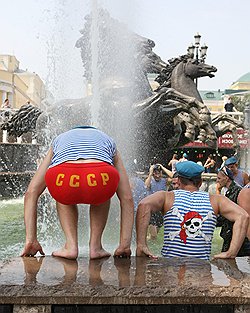
Just closing the loop . . . there were “no large incidents or violations of public order” during VDV Day celebrations yesterday, according to an MVD spokeswoman who talked to RIA Novosti.  She said 106,000 Russians joined in 525 commemorative activities in 347 cities. 

However, RIA Novosti reported a fight on Manege Square next to the Kremlin late Monday evening.  The incident involved young men from Dagestan and former VDV men.  Two of the latter were hospitalized with head injuries, while a third suffered a gunshot wound.  RIA Novosti reported 20 ‘Dagestanis’ held by police while they investigated to determine identity of the shooter.  No former VDV men were arrested.  

Vesti.ru reported a similar version, adding that OMON troops intervened to stop the fight.  Obshchaya gazeta cited an Interfaks law enforcement source who said quick police action kept things from escalating. 

Other media outlets had different details.  Regions.ru said seven were injured, including three hospitalized–one man with a serious knife wound, and two others with broken ribs and bones.  It said 15 ‘Dagestanis’ were detained.  It also provided two versions of how the fight began.  In one, the ‘Dagestanis’ attacked the VDV veterans; in the other, the VDV men started it by stealing watermelons from a vendor near Samarkandskiy bulvar. 

Novyye izvestiya reported that VDV men burned a black BMW near Krymskiy Val while one of them videotaped the scene.  It concluded that the revelry was down because of the holiday falling on Monday and the heat. 

RIA Novosti called the day peaceful on the whole, with 24 VDV men arrested for minor violations.  Fifteen were treated for injuries, including 9 who were intoxicated.  From the bizarro file, police stopped a drunken man dressed like VDV (but supposedly lacking any relationship to the Airborne Troops) as he tried to drive a tractor across Red Square. 

Newsru.com reported on an incident in Yekaterinburg.  It said a group of three VDV guys got into a scuffle at a ‘non-Russian’ cafe.  In the end, 40-50 VDV brawled with 15-20 men of ‘non-Slavic appearance.’  There were no serious injuries, but the VDV reportedly damaged the premises heavily.

Reporting from Krasnodar, RIA Novosti said local police noted no serious violations of public order, but still had to deal with several obstreperous groups of VDV veterans.  They detained 50 men, and sent 15 others to sobering-up stations.