Category Archives: Law, Order, and Discipline

No One, Except Us!

VDV Day Revelry

No service (or branch), except the VDV, generates this kind of media attention for its anniversary.

On 2 August, the VDV will celebrate its 80th birthday, and to mark this nice round number, the holiday will actually be a three-day fiesta running from 31 July.

Also marking the occasion, a new documentary film entitled ‘Landmarks of History, 80 Years of the VDV’ has been released, but, surprisingly, it wasn’t picked up by theaters or television. 

According to Rossiyskaya gazeta, the Moscow city government paid for its production.

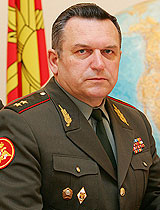
VDV Commander, General-Lieutenant Vladimir Shamanov stars in the documentary, providing lots of the commentary, noting that the VDV are already ‘new profile’ since they are permanently ready, mobile, and physically fit.  Including its generals.  Shamanov told press conference he just recently made two jumps.

A VDV press-service representative told Nezavisimaya gazeta:

“Unfortunately, the VDV anniversary film will hardly be shown to a broad central TV audience at present.  For some reason, the central television channels have no particular desire to reflect this day comprehensively, but of course they will show people in striped tee shirts swimming in fountains.”

Ah, yes, the fountains . . . General-Lieutenant Shamanov told the press mobile groups of VDV and Moscow OMON troops would work together to keep airborne guys from bathing in the capital’s fountains on the branch’s birthday.  Interestingly, he had to admit to ITAR-TASS that he was perplexed by an announcement that the police have permitted dips in fountains for several years, having found that trying to prevent them only led to conflicts.  Police also said they would be on-hand to make sure nothing happens to bathers, according to Nakanune.ru.

While sounding reasonable and accommodating, the Moscow OMON Commander also noted that OMON, the GUVD’s 2nd Operational Regiment, and VV troops were ready to “respond to events.”  He expects 5,000 VDV revelers.  About 1,700 police, including 350 OMON (of whom 109 are former VDV themselves), will be on duty, according to Svpressa.ru.  It claimed former and current VDV officers would also help in keeping order.  The OMON Commander told Vesti.ru, “In recent years we’ve come to mutual understanding largely thanks to VDV veterans who now serve in the Moscow police.”

Of course, it doesn’t do for the regime to have two elite silovik forces square off in the capital.

Beyond announcing that the VDV is already fully subscribed when it comes to the ‘new profile,’ Shamanov also made his obligatory statement / promise that the VDV preserves its independence and  role as the reserve of the VGK to reinforce strategic directions.

He commented to ITAR-TASS on the VDV’s capacity for air drops:

“In realizing the measures in the State Program of Armaments – 2020, the VDV will be capable of landing by parachute an airborne or air assault division.  Now the question hinges on the degree of readiness of the existing fleet of Il-76 military-transport aircraft, but also on how these possibilities will be after the realization of the State Program of Armaments, calculated out to 2020.  A month ago we agreed on the draft GPV.  The modernization of the existing fleet of Il-76 aircraft and an increase in their number is in there.  It also provides for the purchase of Russian-Ukrainian An-70 aircraft, refurbishment of existing An-124 aircraft and the construction of 20 new aircraft of this type.”

He continued:

“. . . we also need to use the American experience in using civil aviation aircraft in the interests of the military.  All this would allow us by 2017 to establish the possibility of landing a full airborne or air assault division.”

“. . . it’s possible to solve it even more quickly by a combination, when the first echelon is approximately 30 percent airborne – landing by parachute, the rest by runway.  We could accomplish this task in three months after receiving the order.”

Answering a question about helicopters and air mobility for the VDV, Shamanov said:

“With the General Staff, we’ve defined a concept for establishing an army aviation brigade in the VDV in the future.”

And on army aviation’s transfer to the Air Forces in 2002:

“It would be the right decision to return army aviation to the Ground Troops, as it’s done throughout the world.”

Shamanov also told RIA Novosti 120 men from 104th Parachute Regiment of the 76th Airborne Division will stay in Kyrgyzstan until parliamentary elections are held.
High-Level Corruption Up, Crime Down in Military

A little more news on the military crime and corruption front.  Corruption is up at least 26 percent year-on-year for the first half of 2010.  General military crime, however, is down more than 10 percent.  Officer crime is down 11 percent.  And draft evasion declined by a factor of two.  Without reciting his recent figures on a 50 percent increase in dedovshchina, GVP Sergey Fridinskiy noted that prosecutors need to ‘activate their work’ against ‘nonregulation events,’ now that there’s a much larger number of conscripts in the ranks.

How do these numbers track with the past?  Just a few days ago, the GVP said general crime was down by 12 percent in all military units and by 15 percent in the Armed Forces.  The decline in general crime follows a reported decline in 2009 as well.  Corruption has accelerated in 2010 apparently.  In January and February, it was only up by 10 percent.  The number of officers convicted in corruption cases looks to be about the same this year as last, but the GVP may be on a pace to convict more generals in 2010.

“More Than 250 Officers Convicted for Corruption Offenses Since Beginning of Year — GVP”

“MOSCOW, 27 July – RIA Novosti. More than 250 officers, including seven higher ranks [general or flag officers], have been convicted for crimes of a corruption nature in the first half of 2010, the RF Main Military Prosecutor Sergey Fridinskiy announced Tuesday at an expanded session of the department’s collegium.”

“‘The quantity of offenses in the given (corruption) area for the first six months of 2010 increased by almost 26 percent.  The quantity of misappropriations, embezzlement, and exceeding duty authority grew.  270 officers, including seven higher ranks [general or flag officers], were convicted for such crimes in the indicated period,’ – the press-service announcement quoted Fridinskiy.”

“According to him, military prosecutors uncovered more than 128 thousand legal violations, nearly 17 thousand officials were brought to account, more than 4.6 thousand people were convicted for various crimes, and the rights of more than 270 thousand servicemen were restored.  And 3.3 billion rubles were returned to the state as a result of prosecutorial investigations.”

“At the same time, the prosecutor noted a tendency toward a reduced number of crimes in the RF Armed Forces.”

“For the first half year in the RF Armed Forces, other troops, military formations and organs 10.5% fewer crimes were committed than in the same period of 2009.  The quantity of grave and particularly grave crimes, including those causing grave bodily harm, declined.  The quantity of  military service evaders declined almost two times.  In the current half year a decline – almost by 11% – was registered in the number of crimes committed by officers,” – Fridinskiy was quoted in the statement.”

“Taking note of the increased number of conscripts, the Main Military Prosecutor directed his subordinates to activate their work to uncover nonregulation events in military collectives, the announcement said.  Fridinskiy noted that ‘in connection with the continued growth of these legal violations we must, together with commands, come up with steps to more effectively implement systematic measures to prevent and interdict them.'”

Fridinskiy enumerated some predictable priorities for the GVP’s work during the balance of 2010 — struggle against corruption and misuse of budget resources, oversight of military reform, fulfilling legislation on the State Defense Order (GOZ), and ensuring housing and other social benefits for servicemen.

Dedovshchina in RF Army Up 50 Percent — GVP

A translation, no commentary . . .

“MOSCOW, 21 Jul – RIA Novosti.  The level of dedovshchina [violent hazing usually perpetrated by senior soldiers] in the Russian Army grew 1.5 times for the first five months of this year compared with the same period in 2009, according to analytical information provided to the RF Federation Council by the Main Military Prosecutor (GVP).  1,167 servicemen have suffered from nonregulation manifestations in 2010, four have died, and more than 90% of offenses were committed by conscript servicemen.”

“As the GVP notes, the number of corruption-related crimes is also growing.  Material losses from them amount to almost a billion rubles this year.” 

“At the same time, the GVP notes that the general crime level in the state’s military organization has declined by more than 12% over five months this year compared with the same period of 2009, and by almost 15% in the armed forces.”

“In particular, the amount of evasion of military service declined by almost two-fold.”

More Drugs, Extremism in the Army

According to ITAR-TASS, Main Military Prosecutor Sergey Fridinskiy today warned colleagues at an inter-governmental meeting on military-patriotic indoctrination that anti-drug measures among minors are not having the intended effect, and: 

“Based on last year’s results, the growth of crime connected with illegal trade in narcotic and dangerous substances in the troops (of all power structures) exceeded 70 percent.” 

For his part, Deputy Defense Minister, State Secretary Nikolay Pankov agreed that drug-addicted youth pose a threat not just to the army, but the whole country.  He added: 

“The ‘drug addiction’ diagnosis is becoming customary for draft commissions.” 

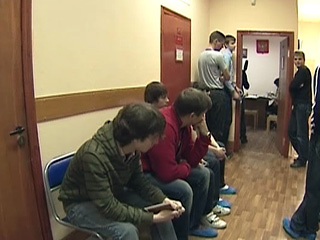
At the Draft Board (photo: Newsru.com)

And as if on cue, today from a Ural region draftee assembly point in Yegorshino came the story of 100 young men who arrived recently high on marijuana in hopes of being deferred from conscript service for dependence on narcotics. 

The voyenkomat reported nothing like 100 guys showing up before the draft board in a state of ‘narcotic intoxication’ has previously happened. 

A voyenkomat representative said: 

“There’s never been such a thing, we are sure this is a particular feature of the current draft.  The young guys intentionally used narcotics in order not to end up in the army.” 

According to Newsru.com, a State Narcotics Control officer for Sverdlovsk Oblast is investigating the ‘stoners’ who came from Nizhniy Tagil, Yekaterinburg, and Pervouralsk.  The voyenkomat said these men would be returned to their towns for additional medical observation and rehabilitation. 

ITAR-TASS reported more of Pankov’s comments on a different subject.  He said: 

“In Russia, nearly 150 extremist youth groups are active, the participants in them live mainly in big cities.” 

Pankov didn’t rule out that young extremists could spread from large cities to small towns and lightly populated areas, saying: 

“This is highly probable.  All this comes into military collectives and leads to the growth of nonregulation relations, so-called ‘dedovshchina.'”  

This is just one reason the army’s always preferred country boys from the ‘sticks’ rather than city guys.

The topics of drugs and nationalism in the army, if not taboo outright, have been little discussed.  Some honest talk about these problems might be the first step in solving them.

Yesterday’s Military Crime Report

The number and details of military crimes reported in yesterday’s press were above average and more interesting than usual.  They illustrate the kinds of pathologies the Defense Ministry confronts on a daily basis.

From Toglyatti, a noncombat loss.  An army conscript hung himself.  The military has reported nothing suspicious about this, except that the young man had transferred to this unit from another.  Conscripts sometimes obtain transfers to escape hazing, dedovshchina, etc.

From the MVO, the district’s chief of staff, first deputy commander of Rocket Troops and Artillery, one Colonel Aleksandr Zemlyanskiy, stands accused of using a conscript to guard and do household chores at his dacha in Moscow Oblast for five months last year.  The RF Prosecutor’s Investigative Committee’s Military Investigative Directorate investigated Zemlyanskiy’s case.  That’s a lot of investigating.  The colonel faces up to 4 years in prison.

From Reutov near Moscow, the personnel chief for an MVO unit, one Lieutenant Colonel Dmitriy Vasin, stands accused of demanding bribes in exchange for performing normal duties.  Obtaining the next military rank cost 15,000 rubles, an expedited dismissal from the armed forces cost 70,000 rubles.  For an extra 20,000, officers could get dismissed from the service and keep a place in the unit’s line for permanent housing.  Vasin could get 5 years.

From Chechnya, the SKVO, the finance chief of a unit got 4 years for exceeding his authority by paying out 3 million rubles to ten individuals with a court order for back combat pay owed to them.  The finance chief did not seek his commander’s permission to issue the pay although he knew their court documents were forgeries.

From the DVO, near Khabarovsk, a former unit commander got a year for extorting 3,000 rubles a month from an officer put outside the TO&E on health grounds, but kept on the unit’s books since he lacked permanent housing.  The 3,000 was the price for keeping him on the books, without him having to report to the unit every day.   

In the DVO, a lieutenant forced 9 contractees to work unpaid for four years in a private security company called “Deon.”  And he also stole their military pay amounting to 3 million rubles over time.  He beat one of the men.  The lieutenant got a 4 year sentence.

Lastly, again from the DVO, Novaya gazeta reports today on a case from 2008.  The VSU has started a criminal case against a former deputy regiment commander for socialization work, one Lieutenant Colonel Novokhatniy. 

He abused a handcuffed conscript on the parade ground in front of 500 men.  No one tried to stop it, and one of Novokhatniy’s subordinates videotaped the incident (you can view it on the Novgaz link). 

Local authorities complained about lawlessness, fights, and even murders at the regiment in letters to the Defense Minister, General Prosecutor, and DVO Commander:

“The condition of discipline in the unit can’t stand any criticism, it’s time to defend the civilian population from the contingent sent to serve here.”

One officer finally complained to the regiment commander and military prosecutor, and Novokhatniy punched him.  But all the incidents were hushed up, and Novokhatniy actually ran and won election to the rayon assembly for the South Kurils as a member of the ruling United Russia party. 

At some point, the officer who was punched turned the videotape of the incident over to the DVO’s VSU.  And the VSU came after Novokhatniy, who readily admitted his actions, as well as a couple of his cronies.

All in all, a remarkable day of military crime reports; not a typical day exactly, but remarkable, and lamentable.

Policy To-and-Fro on Military Police

State Secretary and Deputy Defense Minister Nikolay Pankov probably didn’t surprise a lot of people when he announced the latest Defense Ministry flip (or flop this time?) on the military police issue last week.

 Pankov announced that:

 “The Defense Ministry has found the establishment of military police inexpedient at this stage of Army and Navy reform.  Directive documents on the establishment of military police in the Russian Army have been suspended, and orders on the formation of these structures in the military districts and the fleets have lost force.”

 Later, the press quoted Pankov differently:

 “I wouldn’t say it so categorically – this work is suspended for now.”

But he didn’t elaborate on the Defense Ministry’s reasons for stopping or suspending the effort at this moment.

Military police units are, or were, supposed to stand up in 2010.  Their mission was to maintain order and discipline, and prevent hazing and other barracks violence and crime, primarily thefts of military property.  A military police department started working in the Defense Ministry’s Main Combat Training and Troop Service Directorate last December, drawing up plans and training programs for the new MP units.

In early February, a Defense Ministry representative denied press reports that Defense Minister Serdyukov had suspended work on the military police force.  But a source in the Defense Ministry’s press service told the media that “the documents establishing it have been sent to the appropriate legal directorates for reworking.”  He said that forming the military police would require amendments in federal legislation beyond the Defense Minister’s purview.

The back-and-forth, on-and-off nature of Russia’s yet-to-be created military police calls into question the Defense Ministry’s capacity to formulate and implement policies, or at least to do it so its doesn’t  look foolish.  Why would any military district commander or brigade chief of staff hurry to introduce any new policy or regulation that might just be overturned 6 months from now, or never implemented at all? 

As with the rumored halt in February, the latest stop may in fact be related to legal issues, but they usually only become an obstacle when they’re really protecting someone’s bureaucratic empire.  In this case, the military prosecutor and MVD are obviously very interested parties when it comes to devising a military police policy.  And they are pretty big hitters vis-à-vis the Defense Ministry.

The Defense Ministry already has plenty of people and organizations involved in military law enforcement, but they seem unable or unwilling to organize and cooperate to do the job.  Existing military law enforcement mechanisms could be made to work properly. 

Another sticking point may continue to be who will be in charge of a new military police force.  The prosecutor and MVD probably don’t want military police to answer to the Defense Ministry.  Military commanders could misuse or corrupt military police who would be enforcing laws on those commanders as well as ordinary servicemen.

Svpressa.ru talked to Anatoliy Tsyganok in this vein.  He said:

 “It once again attests to poorly thought-out reforms, zigzagging from side to side, senseless expenditure of resources needed for reequipping the army, and social programs.”

From the get-go, Tsyganok was against spending a ‘not small’ amount of money on a new structure seen as a panacea for all the army’s ills, at a time when the existing military command structure should be able to handle military police functions.

Tsyganok continues:

“. . . I came out not against military police per se, but against the dissipation of resources allocated for army reform:  the fact that they change conscripts for contractees, but then reverse this, the fact that they bring Yudashkin to design uniforms, but then chuck it, now here’s the confusion with military police.  It’d be better to use these resources on weapons for the army.  Russia’s military-industrial complex exports 90 percent of its production.  Aircraft to China and India, helicopters to Latin America and Middle Eastern countries.  Automatic weapons to Venezuela.  But the Russian Army scrapes by with old weapons.  At the same time money is invested in not well thought-out projects.”

“At present our servicemen who have violated order or broken the law are sent to do their time in basements, in special trenches, in storage areas.  Serdyukov doesn’t have financial resources even to build apartments for officers, there can’t even be talk about guardhouses.”

 “Now order among the troops is controlled by commandant (komendatura) forces, commandant patrols, commandant platoons and regiments, internal details; military traffic police structures are active.  This is a huge force.  For example, in Moscow there are 10 districts.  An integral commandant regiment patrols every district.  And is this little?  But military prosecutors, special departments [OO – FSB men—особисты or osobisty, embedded in large military groupings, units, and garrisons] also exist to maintain legal order in the army.  We need to force all this organizational and personnel mass to work effectively.  But for this the Defense Ministry itself needs to work effectively, and not spend money on schemes.”

 “The Defense Ministry leadership in answer to criticism about rampant crime in the army created nothing but the appearance of vigorous activity.  It’s hard to keep order, but forming something else at the expense of budget resources is easy.”

 “The failure of the project was sealed in its very organizational basis.  They proposed to subordinate the military police to the Defense Ministry in the person of the first deputy minister.  The fact is the very same operational structure of military control and repression would wind up in the hands of military leaders themselves.  This is a criminally corrupt thing.  Any Defense Minister, major troop commander, or independent unit commander could arrest on any pretext and end the contract of any inconvenient serviceman.”

Tsyganok kind of skirts around the issue without saying so, but it may be there’s not enough money to pay for building a military police force.

 Interfaks cited Duma Defense Committee Deputy Chairman Mikhail Babich, who called on the Defense Ministry to be more cautious about making changes in the armed forces and to avoid revoking its own decisions, as may be happening in the case of military police.  Babich is a somewhat critical and independent-minded member of Putin’s United Russia party.  He also said armed forces reforms require serious budget expenditures, so every time this or that program is dropped, the reasons should be closely studied and analyzed.  He concludes:

“I think the Defense Minister should hold to account those who were responsible for drawing up and implementing programs deemed unsuccessful.  First of all, this means the federal targeted program for recruiting professional sergeants in 2009-2015, which has not really started and the allocated money was spent on different purposes.”

Babich goes on to note that it’s still unclear what’s happening with Russia’s 85 permanent readiness combined arms brigades that replaced divisions in the Ground Troops.

“The Defense Ministry is keeping silent about this but it’s already clear that plans to establish permanent readiness combined arms brigades have fallen through.  As a result, it’s been decided to divide them into three types:  heavy, medium, and light.  Yet again everything is being done by rule of thumb.”

The Trouble Brigade

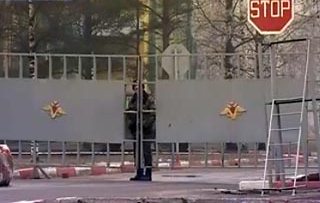
Trouble at the Gate (photo: tv100.ru)

Things go from bad to worse for the LenVO’s troubled 138th Independent Motorized Rifle Brigade, based at Kamenka.  A possibly armed standoff involving Dagestan natives outside one battalion, a suspicious suicide, two noncombat losses in live fire training at night, the list goes on . . .

At mid-day Saturday, 20 men from Dagestan’s diaspora living near the area showed up at the gate of one of the brigade’s battalions in Sapernoye.  They were seeking revenge on a lieutenant, himself a native of Dagestan, for some unidentified reason.  The unit fired warning shots, and local police came and detained some of the men, and dispersed the others.

Newsru.com put the number of men from Dagestan at 40, with 18 detained by police.

A law enforcement source told Gazeta.ru that a dispute between a former contractee from Dagestan, living in area, and the lieutenant from Dagestan was the reason for the incident, but the nature of the dispute between the two men is unclear.

The battalion commander came to the group of men, and tried to talk with them, but after some talking they again tried to get through to the battalion’s barracks.  ITAR-TASS reports he was escorting two of the men to the barracks to try to resolve the situation when the others tried to enter the base.  The commander then raised the unit’s alarm, and warning shots were fired.  The nearest police had to come from Priozersk, 50 kilometers away.  Before the incident at the gate, there was apparently a fight between two groups of Dagestan natives at a school.  The Priozersk police deny reports that the group at the gate was armed.

The LenVO Commander reportedly came to Sapernoye and talked to local elders from Dagestan.  Locally registered residents originally from Dagestan apparently tried to stop this group of men who are reportedly unregistered ‘transients.’

In Sapernoye, they say the men beat battalion commander Andrey Myshyakov; he declined to comment, but said everything was fine with him.  Newsru.com reported that he suffered moderate head injuries after the beating.  ITAR-TASS also says he was beaten and hospitalized in stable condition.  Its source is the press service of the Military Investigative Directorate (VSU) of the RF SKP.

Gazeta.ru says that police and FSB military counterintelligence officers are on the streets of Sapernoye.  The investigation into this incident continues.

There was an earlier incident, in August 2005, in which two lieutenants found a conscript from Dagestan dressed in civilian clothes in a local bar.  When they ordered him back to the barracks, the situation escalated into nearly three nights of fights at the bar.  Four lieutenants were beaten, and the Dagestan natives apparently called for reinforcements from their kinsmen in St. Petersburg.

Also over the weekend, the 138th Brigade revealed the reported suicide of a conscript who was working as a bookkeeper for the brigade.  He had an honors degree from the Kaluga Budget and Finance Academy.

Investigators have reliably determined that he didn’t kill himself because of poor relations with other servicemen, and his family and friends say there’s no way he’d have hung himself.  St. Petersburg’s ‘Soldiers’ Mothers’ believe his ‘suicide’ could be connected with his work in the brigade’s finance section, where nothing happens without machinations.  They believe he may have learned about irregularies in the formation’s finances.

On the night of 8-9 April, two 138th brigade lieutenants were killed in a tank fire accident on its Bobochinskiy Range.  Apparently, a junior sergeant commanding a tank lost orientation and fired into the rear part of the range, directly hitting its central fire control point and killing the two officers.  A host of investigators continues to examine the circumstances.  The press noted a September 2008 incident in which an MRL fired off range, putting one rocket within 50 meters of a highway, damaging a vehicle but not harming its occupants.

Finally, the aftermath of sergeants beating conscripts in the brigade this fall . . . recall that the Defense Ministry did a vertical stroke on the brigade’s leadership for this, 8 officers were dismissed, but that’s not all.

It’s come to light since that, on his way out, the soon-to-be ex-brigade commander and other dismissed officers managed to receive hefty bonuses of 2-3 million rubles.  Officers who kept their posts got nothing.  For his misuse of his soon-to-be ex-post and the brigade’s finances, the former brigade commander could get 4 years in prison.

Major Beating at Shilovskiy

According to Kommersant, prosecutors have charged an artillery battalion commander from a motorized rifle brigade based below Novosibirsk with exceeding his authority by beating four conscripts from Dagestan.  A senior investigator from the Military-Investigative Department of the Prosecutor’s Investigative Committee for the Novosibirsk Garrison reports that the incident occurred last November at the Shilovskiy range when Major Nikolay Levyy beat two draftees from Dagestan in his office, then smashed their cell phones.  Levyy had been critical of the pair on more than one occasion. 

Two more natives of Dagestan got it from the major in front of the formation.  The investigator determined that Renat Magomedov got the worst of it when the major asked whether Magomedov would fight for the battalion or his own people if he had to choose, and Magomedov responded for his compatriots.

After this, the investigator reported, Slavic servicemen proceeded to beat all four soldiers from Dagestan.  Major Levyy looked on without intervening.  That evening, the events spiraled into a larger fight.  Russian servicemen herded dozens of Caucasian servicemen into one barracks and locked them  down.  Overnight, the unit’s officers managed to quiet the disturbance, and all soldiers from Dagestan were later sent to other units.

Major Levyy was relieved of duty pending the outcome of his case.  He did not admit his guilt, but also refused to incriminate himself by giving evidence.  The events involving the other fighting are still under investigation.

The media accounts note that this is not the first mass fight between Caucasians and Slavs at Shilovskiy.  The last one occurred on 8 January 2007 when officers had to fire warning shots to break it up, according to Kommersant.  Law enforcement only found out when one soldier turned up in the hospital with a ruptured spleen several days later.

Some press reminded readers of the early July 2009 incident in which 200 Russian and other soldiers reportedly fought with 44 conscripts from Dagestan at Aleysk, also in the SibVO.

Some thoughts on this news item . . .

The major smashing the soldiers’ cell phones is interesting.  Commanders say they don’t like soldiers having them because new conscripts have them taken away by older soldiers, contractees, and officers.  Commanders say cell phones jeopardize their units’ secrecy and security.  But they probably don’t like them because cell phones are a lifeline to call for help in cases where conscripts are being abused or mistreated.  This tends to get the commander in trouble, one way or the other.

Would the major ask a soldier from Dagestan if he would fight for his battalion or for his compatriots if there weren’t already some pretty serious interethnic violence, conflicts, and tensions in his unit?

Shilovskiy is basically a SibVO arms and equipment storage base left  unchanged despite the army’s ‘new profile.’  Levyy, like other Russian officers, probably faced the reality that there are now fewer officers, warrants, and contract sergeants to supervise increased numbers of conscripts.  The commander also faces more demands from his superiors, the SibVO, Genshtab, and Defense Ministry today with the push for the ‘new profile.’  It likely breeds frustration that drives higher levels of officer crime from year to year.  It’s interesting that it’s the battalion commander himself using his fists against soldiers, and not their own battery commanders, captains, or lieutenants.

A major in Levyy’s position is damned if he doesn’t and damned if he doesn’t.  If he acts, he has few levers at his disposal—where are the new military police, the guardhouses, the old military commandant?  So he resorts to his fists and something akin to prison camp order.  And if he doesn’t act, he can’t keep order at all and the situation just gets worse.

There are lots of other incidents involving conscripts from Dagestan either giving, or taking, beatings in the armed forces.  And we’ll look at some in days to come.  But interethnic tensions in the Russian Army don’t always involve just soldiers from Dagestan.

Military Police, Open Up!

On 12 March, Krasnaya zvezda profiled what might be the armed forces’ first military police department (OVP) in the Astrakhan military garrison, under the Navy’s Caspian Flotilla.

A Statute and Instruction cover the authority and operations of Russia’s military police (MPs).  The KZ article says their formal functions reinforcing discipline, providing security, conducting antiterrorism measures, and controlling traffic.

Russian military police are a long time coming and far from all are happy about the idea.  Instituting an MP force was first debated in the mid-1990s, but it didn’t happen.  The major sticking point was whether the military police would answer to, or be independent of, the Defense Ministry.

As recently as very late 2005, Deputy Defense Minister Nikolay Pankov didn’t support the idea, but hardly a month later, after the notorious Sychev abuse case, then-President Putin and then-Defense Minister Ivanov came out for establishing a military police force, primarily to halt violent crime and abuse in the barracks.  But the concept fell by the wayside after several months of debate.

Just as suddenly as the thought of military police disappeared, it resurfaced last fall.  The force was to be established on 1 December with a strength of 5,000 personnel, and military police units were to work jointly with local military komendaturas [commandant’s offices] for the first year before subsuming them.

As in the 1990s, the idea encountered considerable opposition primarily from the RF Human Rights Ombudsman Vladimir Lukin and Main Military Prosecutor Sergey Fridinskiy.  Lukin supports military police but only if they are independent of the Defense Ministry.  He has said military officials don’t need one more bureaucratic apparatus.  For his part, Fridinskiy said:

“We need to think clearly about all aspects of this issue, including those connected with legal and financial support. Moreover, where will we find such a number of qualified people?  In our country’s conditions, it’s not a certainty that military police will bring positive changes.  Where is the guarantee that we won’t get the very same excesses that they always talk about in connection with the [civilian] police–we aren’t selecting different people, it’s all the same contingent.”

Fridinskiy seems to be worried about military prosecutors tripping over MPs, or MPs fouling the work of his prosecutors.  He definitely doesn’t entertain the idea that they could work well together. 

There were press rumors over the winter that Defense Minister Serdyukov had decided to scrap the plan to institute MPs, but defense spokesmen denied the reports.  And at least the very first OVP has appeared and gotten some publicity.

The Astrakhan garrison’s OVP chief is an O-4 who once served as head of the security department for an armaments storage base, and chief of the garrison’s guardhouse.  His KZ interviewer says the OVP Chief knows all the ins and outs of garrison service firsthand.

The OVP Chief says the composition of an OVP is determined by the size, locations, and characteristics of the garrison it serves.  His OVP has a security and convoy section, investigation section, and an MP platoon, and he describes its initial capabilities as modest.

The security and convoy section guards and transports prisoners to the prosecutor’s and military-investigative organs, to disciplinary battalions, or investigative detention.  The investigative section prepares cases against soldiers accused of disciplinary offenses.  The MP platoon is responsible for patrol service, preventing crime, and maintaining discipline within the garrison.

The article indicates the OVP will spend a lot of its efforts on searching for AWOL soldiers.  The OVP Chief indicated that komendaturas and military commissariats haven’t been able to concentrate on this job in the past for lack of resources.  Russian AWOLs are known as ‘sochintsy’ from the abbreviation SOCh, or those ‘willfully leaving the unit.’

The Astrakhan OVP Chief recognizes that liaison and relations with unit commanders, local civilian law enforcement, and municipal authorities will be key for him to do his job.  More likely and problematic, however, is the possibility of crossed wires with military prosecutors or the local branch of the military-investigative directorate.  There are already lots of investigators out there investigating military incidents.  The investigative authority of the MPs was a contentious issue in the debate over them.

Russia’s 5,000-strong MP force is a modest start for a million-man army, and the success of the effort can’t be judged until it’s possible to see how many, or how few, OVPs are established.  Past initiatives in military law enforcement aren’t particularly encouraging.

For example, the 2005 effort to reestablish the guardhouse–administrative confinement–in order to do away with the army’s five disciplinary battalions (disbats)–the idea was abandoned when Serdyukov arrived because it required sending men guilty of more serious offenses into the civilian penal system where, unlike the disbat, they would get a permanent criminal record.  The guardhouse effort also went unrealized because it was costly; 98 old guardhouses needed to be rebuilt and 44 new ones were proposed.  And so the disbat lives.  Similarly, the Defense Ministry may discover it doesn’t want to pay to create a lot of OVPs.

Only time will tell how far or wide MPs will be implemented.

State of the ‘New Profile’ in One District

General-Lieutenant Bogdanovskiy

Leningrad Military District (LenVO) Commander, General-Lieutenant Nikolay Bogdanovskiy held a news conference today and, along with talking about the upcoming Victory Day parade on St. Petersburg’s Palace Square, he talked about his district’s ‘new profile.’

Firstly, following General Staff Chief Makarov, Bogdanovskiy said contractees will be reduced and conscripts increased.

Specifically, he stated:

“. . . the number of contractees will be signficantly reduced, many of those who showed themselves incapable of serving will need to be dismissed.”

The LenVO needs 25,000 draftees from this spring’s consription campaign beginning on 1 April. But he said this won’t create problems because, last fall, 100,000 young men came through the LenVO’s voyenkomaty and 25,000 were deemed fit to serve.

The LenVO Commander said, in the process of ongoing personnel cuts, 1,600 officers and 1,200 warrants have been ‘placed at the disposition’ of their commanding officers, but only 346 and 284 respectively have been discharged from the service.

These are surprisingly small numbers.

So, in the LenVO at least, only 22 percent of the officers destined for dismissal could actually be dismissed with the benefits and apartments owed them.  The other 78 percent remain in limbo, without duty posts and living on their rank pay [perhaps one-fourth of their former total monthly pay].  And 24 percent of warrants could be sent home with benefits and housing while the other 76 percent wait for these things.

Bogdanovskiy has also asked St. Petersburg’s governor to resolve a situation with owners of garages located on land the Defense Ministry claims near the village of Yukki, where the LenVO now wants to build apartments for servicemen.  But that one will be hard; the Defense Ministry’s old nemesis Rosimushchestvo says the property doesn’t belong to the military.  The builder and construction equipment have already been out to the site with the intention of knocking down the garages.  Boganovskiy says the plan is to put 50 apartment houses on this territory.

The LenVO Commander also acknowledged problems with military housing built in the district:

“I’ve more than once tried to sort out the quality problem in the housing in Pushkin.”

He indicated the problems started small, but failure to fix them in a timely manner means ten times the amount of money must be spent to repair them now.  But he promised to do so by the end of spring.

On the force structure front, he says the LenVO’s reforms were largely completed in 2009.  Ten brigades and other units were formed or reformed in the process [the district has 3 combined arms brigades–the 25th, 138th, and 200th].

Regarding problems with the command and violence in the 138th Independent Motorized Rifle Brigade at Kamenka, Bogdanovskiy said:

“. . . we haven’t managed to complete fully tasks connected with discipline–in particular, in the 138th Kamenka Brigade the commander, chief of staff, and assistants for armaments and socialization work were dismissed because of events there.  Now the situation is normalizing, we are trying not to repeat past mistakes.”

Interesting insights into what the Serdyukov’s reforms have meant for one, albeit small and not particularly significant, district.  But, if such a large percentage of officers are being left ‘at the disposal’ of their commanders, can one believe Serdyukov’s assertion that 65,000 officers were put out of the armed forces last year?  Does this include a small number of dismissed and a much larger number of those left ‘at the disposal’ of commanders?  On an issue closely tied to officer cuts, can one believe that the Defense Ministry really obtained 45,000 apartments last year if so many soon-to-be-ex-officers are ‘at the disposal’ awaiting them?

It would seem that, if Serdyukov has failed, or been unable, to move as speedily on officer reductions as he wanted, the door might be left open for someone to reverse this policy, especially if a large number of potentially angry officers remains for a long time in the limbo of being neither in, nor out of, the army.