Category Archives: Manpower

Makarov on Iran, Lasers, Deferments, and Bulava

Attending today’s OPK modernization meeting in Ramenskoye, General Staff Chief, Army General Nikolay Makarov talked to the press, and said:

“A decision not to supply Iran with the S-300 was made, it, of course, falls under the sanctions.  The leadership made a decision to stop the supply process, we are fulfilling it.”   

He wouldn’t say the contract to supply them has been broken.  Apparently asked if the missiles could be provided in the future, Makarov said:

“We’ll see, this will depend on Iran’s conduct.”

Unnamed official sources put the price of the Iranian S-300 contract at hundreds of millions of dollars.

ITAR-TASS reiterated Defense Minister Serdyukov’s 20 August comment on providing Iran the S-300:

“We aren’t supplying anything.  There’s no decision on supplying them.”

Makarov’s comments coincided with President Medvedev’s ukaz implementing UNSCR 1929 from 9 June.  The ukaz expressly listed the S-300 as an item not to be transferred from Russia to Iran. 

Asked about Russia’s military laser program, Army General Makarov said development is on-going:

“Work on a combat laser goes on throughout the world, including here.”

He added that it was premature to talk about the characteristics of Russia’s laser system.

Answering another question, Makarov said student draft deferments won’t be abolished:

“The possibility of ending deferments for students is not being considered.  This issue is too socially significant.”

“There are many other measures which will allow us to resolve the situation [with the draft].”

He added that he expects Serdyukov to talk about the draft at Friday’s Defense Ministry collegium.

Asked if compulsory military service will be increased from 12 months, he said, “I don’t know if there’s sense in this.”

But Makarov went on to vent his frustration about conscription:

“Today not more than 13 percent of young people are called up, the rest aren’t called up for health reasons.  We need to understand what is happening .  It can’t be that only 13 percent of our young people are healthy.  Among people getting a deferment or exemption from the army on health grounds, 40 percent of them had documents either purchased or manufactured in some way.  In other words, there’s an issue, and we need to toughen monitoring in this area.”

Thirteen percent is really low.  And the corruption rate when it comes to health exams in commissariats is at least 40 percent.  We need to explore his numbers and math.  These are startling figures.

Makarov paid a little respect to Serdyukov’s fledgling effort to ‘humanize’ conscript service:

“A number of measures to reduce the load on prospective conscripts are being reviewed.”

Finally, press questions turned to the pending Bulava SLBM tests.  Makarov said:

“The missiles which we’re preparing to launch were produced from beginning to end under strict monitoring by military acceptance, the Defense Ministry, and the Military-Industrial Commission.  A great deal will depend on these launches.  If the launches are unsuccessful, then we have to shake up fundamentally the entire cycle of missile production.”

On the timing of the next Bulava test, Makarov contradicted Serdyukov’s last statement by saying:

“It’s doubtful this will happen in September.”

Serdyukov Meets Gates at Pentagon

Mr. Serdyukov Goes to Washington (photo: ITAR-TASS)

ITAR-TASS reports Defense Minister Anatoliy Serdyukov and his U.S. counterpart Robert Gates will meet for a total of 5 hours today.  And the Russian press service concludes: 

“This is highly unusual and attests to the great significance the U.S. Defense Department attaches to the visit.” 

Aside from all the customary ceremonies, there will be three sets of talks today.  The morning session is dedicated to discussing military reform plans and defense spending on both sides.  ITAR-TASS says the Americans consider this the most important topic from their viewpoint. 

The press service quotes The New York Times saying the two men “simultaneously declared war on longstanding and ineffective bureaucratic organizations,” adding that they’ll find a common language as they compare their efforts. 

A working lunch will be devoted to nuclear arms control and missile defense.  RIA Novosti quoted a Defense Department spokesman who said you can’t meet Russians without discussing missile defense, but it won’t be the main topic of the visit.  Today’s afternoon session will cover a variety of regional and global security problems.  Serdyukov will visit an unspecified U.S. Army base as well as the Naval Academy. 

In an interview published in today’s Kommersant, Gates said: 

“I’ve attentively followed Defense Minister Serdyukov’s reform efforts.  I have the impression that the scale and depth of the reforms he’s conducting correspond to what I’m trying to do in the U.S.  The thing is in the coming years we don’t expect significant budget increases.  Therefore, we have to decide how best to use the resources we have.” 

“I know the Russian Defense Minister has an interest in how to select highly professional soldiers and how to keep them in the armed forces, how to exert command and control of the armed forces in order to strengthen national security.  This is especially complicated in the face of economic problems standing before each of our countries.” 

Apparently, Gates doesn’t understand precisely.  The Defense Ministry already has an answer — to jettison its failed professional contract service program, return to reliance on conscripted soldiers, and see if they can train and retain some professional NCOs. 

Asked if Russia’s a threat to the U.S. and about its new ballistic missiles, Gates replied:  

“No.  I don’t view Russia as a threat.  We are partners in some areas and competitors in others.  But we cooperate on important issues.” 

Good answer. 

“From the viewpoint of our program modernization the new SOA agreement is a great achievement.  Just as the agreements which preceded it.  They establish rules of the game which provide transparency and predictability.  Modernization programs within the bounds of the new SOA agreement are absolutely normal.  We’ll conduct our own modernization. 

Asked about cooperation on missile defense and the Gabala radar specifically, Gates said the U.S. is interested in Gabala and in the possibility of establishing a missile launch data exchange center [JDEC] in Moscow.

More Talk of Raising Draft Age to 30

Appearing on Thursday’s RIA Novosti talk show ‘Civil Defense,’ Deputy Defense Minister, State Secretary Nikolay Pankov claimed raising the upper age limit for conscription would benefit the army, and Russian society as a whole.

Under Russian law, men aged 18 to 27 are subject to the draft.  In April, GOMU Chief Vasiliy Smirnov floated the possibility of increasing the age to 30 as a way to help fill the army’s ranks at a time when 270,000 new conscripts are needed every six months, and contract service has failed to produce sufficient numbers of professional soldiers.

Pankov told his interviewer:

“I think this question [of raising the draft age limit] is very productive, and I wouldn’t reject this idea.”

But he admitted it needs more study.

After Smirnov’s April trial balloon, Defense Minister Serdyukov and General Staff Chief Makarov backed awayfrom raising the draft age, saying they were only ‘reviewing options.’

The issue really boils down to this:  how many 27-year-olds are the Russians currently drafting, and how much would drafting 28-, 29-, and 30-year-olds really help fill gaps in the ranks?

One has to conclude the return on conscription greatly diminishes at the outer edge, while resistance to it increases.  Forum.msk editor Anatoliy Baranov commented that raising the draft age limit to 30 is unpopular because average life expectancy for men is less than 60.  He continues:

“Of course, against the background of a general decline in the draft contingent by almost 2 times for social and demographic reasons, there are no and can’t be solutions fully compensating for this ‘demographic hole.’”

“How do you keep general military training and not draft everyone into the army at the same time?  There are, of course, solutions, but the current Defense Ministry leadership, it seems, consciously ‘overlooks’ them.”

Baranov seems to be saying, if the military wants a million-man army, with 600,000-700,000 conscripts, it’ll have to increase, not the draft age, but the draft term from one year back to 18-months or two years.

Bad News for Would-Be Officers

Future Officer, or Sergeant? (photo: RIA Novosti / Valeriy Titiyevskiy)

There’s no better time for bad news about changes in military education than the beginning of Russia’s academic year.

The Defense Ministry said Monday it’s stopping induction of cadets into military higher educational institutions (VVUZy or ВВУЗы).  And new students will not matriculate next year either.

There’s no doubt there’s lots of excess capacity that needs to be cut from Russia’s military education system, but, as usual, there seems to be more angst about the way the process is being managed than about the need for some kind of change itself.  The Defense Ministry is trying to ram many young men who signed up to be officers into sergeant’s billets, and generally changing the rules in the middle of the game.  There’s no doubt large numbers of VVUZ professors and other teaching staff will be pushed out of the service, but the Defense Ministry is denying this for now.  Perhaps most interesting, RIA Novosti elected to editorialize on this issue, saying it exemplifies the Defense Ministry’s, and the Defense Minister’s, poor way of dealing with the public and presenting its initiatives.

Deputy Chief of the Defense Ministry’s Main Personnel Directorate (GUK or ГУК), Tamara Fraltsova (who doubles as Chief of the Military Education Directorate) made the announcement during a video conference marking the opening of the Presidential Cadet Corps in Orenburg.  Specifically, she said:

“In the course of this year and next, the Defense Ministry is refraining from selecting cadets for its VUZy.”

“This is connected to an overabundance of officer personnel and a deficit of officer positions in the Armed Forces.”

“At present, graduation of cadets exceeds the officer positions we have in the Armed Forces by four times.”

In other words, the military educational system is still too big, and needs more cuts.  There are 56 teaching institutions in all – VVUZy and their branches (filialy). 

The ‘overabundance’ of officers is part and parcel of Defense Minister Serdyukov’s ‘new profile’ reforms in which officers are being reduced to 150,000 from well in excess of 300,000 in late 2008. 

Fraltsova has previously indicated VVUZy would be cut further and unified into ten ‘inter-service scientific-training centers.’  Duplicative or overlapping specialty training will also be eliminated.

Izvestiya reported that Fraltsova said the military education system is still configured to support a 4-million-man, rather than a 1-million-man, army.

Nevertheless, Fraltsova maintained that all 15,000 VVUZ graduates were placed in military billets last year.  But she didn’t say what kind of billets.

Krasnaya zvezda quoted her:

“. . . there is a chance for higher quality manning of the Armed Forces.  So, the requirements for future officers must be stricter.”

“There is a need for a review and selection of military specialties, according to which education in military VUZy is provided.  Part of [these specialties] will be transferred to the civilian ranks, part will go into to the duty category of sergeant personnel.”

There’s been media reporting for months that any cadet receiving even a single ‘2’ – an unsatisfactory mark – is now drummed out.  But this doesn’t eliminate many – 70 percent of cadets graduate without ever getting even a ‘3,’ according to the Defense Ministry.

Writing in Komsomolskaya pravda, Viktor Baranets indicated that only 100 of 600 lieutenants who arrived in the Pacific Fleet got officer jobs, and, in Voronezh, only the very top-ranked graduates found officer posts in the Air Forces.  About 20 percent of cadets normally graduate ‘with distinction.’  So the remaining 80 percent either accepted a sergeant position, or immediate dismissal into the reserves and the civilian world.  

Grani.ru reported that most graduates of the Defense Ministry’s Military University – a social sciences institution located in Moscow – got a ‘free diploma’ and an immediate discharge.   

According to Izvestiya, Fraltsova said there are only 5,000 command positions in the Armed Forces against an influx of 15,000 newly-commissioned junior officers.  The paper quotes her:

“Let them compete for what they will get.  The rest simply received a free higher education.  In my opinion, this is fair.”

She claims these changes are improving student performance, and she wants to use competitive ratings to make initial officer assignments.

She dismisses worries about the impact of cadet reductions on VVUZy teaching staffs because, in many cases, they’ll be busy teaching noncommissioned officers.  Some will be one-year conscript sergeants, and others three-year contractees getting nearly 3 years of post-secondary schooling.

Fraltsova revealed that 60 percent of VVUZy already teach on a ‘for-profit’ basis, and this will fully employ their instructors.

The effects of officer corps cuts, and VVUZy cuts, have rippled down to Russia’s venerable Suvorov and Nakhimov schools.  Without places in VVUZy, these young men will have to seek spots in other power ministry academies, if they want to be officers.  Premilitary Suvorov and Nakhimov schools now have to compete for students with the new Presidential Cadet Corps, which are supposed to train youth for the civil service in each federal district.

Forum.msk’s Anatoliy Baranov remarked that Fraltsova and her ilk “will suddenly observe in 10-15 years that everyone in higher military institutions has died, and there is no one and no way to teach new officers.”  Leonid Ivashov told Gzt.ru simply, “We are witnessing the destruction of Russian military education.”

RIA Novosti published surprisingly stark criticism of Fraltsova’s (and Serdyukov’s) performance. 

First, it quoted her:

“. . . not everyone in Russian society is sympathetic to this initiative.  Yes, these are very severe measures, not many like them, and we are being subjected to criticism for this decision.”

The news agency said Fraltsova’s press conference left the media with the impression that the Defense Ministry still doesn’t know what to do about the military education system.

It called the halt in VVUZ induction a ‘radical step,’ which calls attention to the Defense Ministry’s secretiveness in making important decisions.  The agency complains that, since 2008, when the ‘new profile’ started, the media and society have learned about most changes after the fact.  Veterans and other social groups have written to Serdyukov asking to give input, but it’s not clear their letters are even answered.  RIA Novosti concludes, in this case, the military department has once again ‘stepped on a rake.’

Yesterday Deputy Defense Minister, State Secretary Nikolay Pankov went on TV in damage control mode, saying these changes are intended to improve military education as well as to save money.  He intimated there will be lots more pain in going from 56 to 10 institutions.  Pankov said 20 percent of this year’s 10,000 VVUZ graduates will become sergeants instead of officers, but the Defense Ministry will keep these reluctant NCOs in mind if officer billets come open.

Melee in the 4th Tank Brigade

An embarrassing melee for the Russian military . . . Viktor Baranets from Komsomolskaya pravda has received confirmation – including video posted on his paper’s website — of a major brawl in the Naro-Fominsk-based 4th Independent Tank Brigade (once part of the elite Kantemir Tank Division).  The video from 4 or 5 July shows a large hand-to-hand battle on the parade ground.  It wasn’t posted until 10 August.  The entire incident was apparently a flare-up from an earlier confrontation between Russian soldiers and, yes once again, conscripts from Dagestan.

An ‘unofficial’ version Baranets got from a Defense Ministry spokesman indicates that, the day before the big fight, some Russian recon unit conscripts got in a scrape with Dagestanis in a local club (conscripts able to leave the garrison – part of Defense Minister Serdyukov’s effort to ‘humanize’ military service). 

Newsru.com also has the video.  It got a Moscow Military District spokesman to confirm that the mass fight grew out of a smaller conflict between soldiers from an air defense battalion and from a reconnaissance company. 

According to Baranets’ version, the next day a large group of soldiers from Dagestan attacked six Russian troops.  One of the latter managed to get help.  The brigade commander ran out and emptied his Kalashnikov over his troops’ heads.

Ten soldiers went to the hospital, several Dagestanis went to the guardhouse.  And, according to Baranets,  they are organizing a separate company for these ‘hot-tempered southerners.’  He says these things are common where there are high concentrations of soldiers from Dagestan.  He concludes they happen because Dagestanis refuse to subordinate themselves to anyone but their compatriots.

The entire incident was kept quiet because officers were threatened with the loss of their monthly and yearly premium pay if they talked about it.

RIA Novosti reported some extra official information from the military prosecutor.  The brigade’s chief of staff, deputy commander for socialization work, and six other officers received disciplinary reprimands, and two others [sub-unit commanders] were dismissed.  Three conscripts face criminal charges from the fight involving 20 men.  But as Newsru.com points out, the video looks like more than 20 men were fighting. 

Most of the press coverage also noted the recent Baltic Fleet case in which Dagestanis forced other conscripts to spell out the word KAVKAZ with their bodies.  Forum.msk wrote that most of the seven Dagestanis implicated in this incident received sentences over one year in prison.

There are, of course, lots of other incidents of this nature worthy of attention.  People have forgotten April’s confrontation in Kamenka, or last November’s incident at the Shilovskiy range below Novosibirsk.  There was also the alleged beating of 44 Dagestani soldiers in Aleysk in mid-2009.  On 20 and 21 February 2007, Viktor Baranets wrote about 140 Dagestanis who took over their regiment on Kunashir in the southern Kurils in late 2006.

It’s always hard (maybe impossible) to say whether it’s the Dagestanis or the Russians (the Slavs, etc.) who are to blame in these instances.  But it’s certain this is a complicated relationship that’s making life difficult in the army.  And the problem is getting worse.

Vladimir Yermolin’s Grani.ru blog contained some good thoughts on it.  He says the Russian Army has long since become a battlefield without rules.  Not only was the 4th Tank Brigade incident open clan warfare, but it took place in broad daylight, apparently without officers present.  Yermolin believes inter-ethnic skirmishes are growing in force, scale, and bloodiness.  No one in the army knows how to deal with this clan problem, so why not legalize it and give it an organizational form that might control it [one supposes he means it’s time not only to end extraterritoriality in manning, but actually create national units].  Next time the commander might not be able to handle the situation like he did this time.

Finally, Yermolin concludes:

“In a country which has already been in a condition of permanent Caucasian war for almost two decades, you could say extremely harsh feelings of people locked in the barracks is a natural development.”

Training Helo Pilots at Syzran


SVVAUL Cadet in a Simulator

Krasnaya zvezda often profiles parts of the Russian military, and on 30 July, it interviewed the Chief of the Syzran Higher Military Aviation School for Pilots (SVVAUL or СВВАУЛ), Colonel Nikolay Yartsev.  Yartsev is a 1984 graduate of the school, a Hero of the Russian Federation, an Honored Military Pilot of the RF, and Pilot-Sniper.

SVVAUL is Russia’s sole higher military educational institution for helicopter pilot training.  In its various incarnations, it’s existed for 70 years.  It trains helicopter pilots for the Air Forces, Navy, and other ‘power’ ministries and departments.  It’s a 5-year commissioning school, so some of the initial two years isn’t particularly specific to helicopter training. 

Asked if the current level of cadet training in the school meets the demands of the time, Yartsev points out that SVVAUL is accredited through 2012 and fulfills the ‘state order’ for military specialists in helicopter aviation.  It is fully staffed with professors and instructors; more than half have scholarly credentials.  All have great teaching experience, and many have not only years of service in operational forces, but also long combat experience.

Yartsev goes on to say SVVAUL can train 1,500 cadets simultaneously.  Its faculties have displays, mock-ups, and examples of weapons and equipment that support the practical direction of student training.

Yartsev says, thanks to the Air Forces, two years ago the school got a modern Mi-24 simulator, and this year an even more modern one.  It’s supposed to get two more simulators, a KT-24P and Mi-8.

The school has an 8-hectare field training base including 3 airfields for its 3 training-helicopter regiments.  In their third year, cadets learn to fly the Mi-2U, and SVVAUL is preparing to switch to the Ansat-U for primary training.

In their fourth and fifth years, students fly Mi-24 and Mi-8 helicopters.  They get 35 hours as pilot and 10 as pilot-navigator (operator) in this phase of training.  Yartsev says in 2009 the average cadet graduated with 135 flight hours, but a few got about 250 hours along with their third class pilot’s qualification.

Yartsev describes the Russian helicopter pilots’ experience in the Afghan war.  He says the USSR lost 333 helicopters and hundreds of pilots and crew members.  Twelve SVVAUL graduates became Heroes of the Soviet Union.  Thirty became Heroes of the Russian Federation while in combat in the North Caucasus.

Information available about Fort Rucker, home of the U.S. Army’s helicopter school, provides an interesting contrast.  Fort Rucker trains current officers and warrants to become rotary-wing pilots in as little as 9 months.  The program may train as many as 4,000 student pilots every year.  It looks like each student gets over 200 hours flying a TH-67 trainer and 70 hours in simulators, before even beginning many hours of advanced flight training in whichever specific combat helicopter they’ll eventually fly.  U.S. Army aviation has over 100 simulators in use and dozens in procurement.

Prosecutorial Prophylaxis

In this instance, the military legal system’s effort to prevent the scourge of dedovshchina, or hazing and other violence against servicemen . . . .

Today’s Krasnaya zvezda covered military prosecutors’ special campaign to warn servicemen against breaking the ‘regulation rules of relations’ between them this month.  The paper talked to the acting military prosecutor of the SibVO’s Yurga garrison to find out what measures he’s trying.

Recall our last mention of Yurga covered its role as test bed for Defense Minister Serdyukov’s attempt to ‘humanize’ military service, so this is obviously a good spot to work to uproot dedovshchina culture.

The Yurga prosecutor said he’s used anonymous questionaires to gather a ‘sufficiently complete picture of the existing situation.’  Taking this and information from sub-unit commanders, the prosecutor proceeds to ‘individual prophylactic conversations.’  He calls such ‘prosecutorial warnings’ a very effective instrument; 18-year-old soldiers have to sign a paper acknowledging they’ve been warned about possible criminal liability for violating regulations and this may have a psychological and deterrent effect on them.

The prosecutor also conducts round tables and extra dissemination of special SibVO ‘pamphlets’ in sub-units.  More on these later.  The pamphlets include a hotline number for reporting violations of law and order (presuming that conscripts have a phone, and aren’t afraid of who’s listening to their call).  He puts up displays informing soldiers of judicial punishments meted out for various violations.  All and all, the prosecutor expects more inquiries coming into his office this month as a result of the campaign.

Moskovskiy komsomolets has a number of these ‘pamphlets’ and concludes they’re generally given to conscripts all over Russia.  They urge the victims of barracks violence not to break the law themselves, show courage, and, if absolutely necessary, hide on the grounds of the unit rather than go AWOL.  But, the paper notes, the ‘pamphlets’ don’t say how long to hide out, or how to eat while hiding.

The ‘pamphlets’ urge conscripts to tell their tormentors that they intend to go to their commander, and to believe that the law is on their side.  It exhorts them not to even think about resorting to using a weapon or committing suicide.

Moskovskiy komsomolets concludes, for all their absurdity, the pamphlets show the fundamental plague of today’s army remains the legal illiteracy of conscripts, their inclination toward violence, and the inability of their officers to cope with them.

Vesti FM interviewed ‘Citizen and Army’ coordinator Sergey Krivenko about the pamphlets.  He said at least they show the Defense Ministry acknowledges dedovshchina is a problem, and it’s growing, not declining.  He believes the pamphlets’ appearance is an indication of hopelessness; military reform is not transforming conscript service or giving conscripts adequate legal protection.

Medvedev Opens Discussion on Conscription Changes

Presidential Meeting on Conscription (photo: Kremlin.ru)

Talk of military conscription changes has swirled in recent months.  Many potential changes have been attributed to General Staff Chief Makarov or his deputy, GOMU Chief Vasiliy Smirnov.  

While they talked about extending the draft age to 30, or tightening deferments, Defense Minister Serdyukov played ‘good cop,’ launching initiatives to ‘humanize’ military service, and make more men willing to serve.

In the last week, the press has published favorable reports on the just-concluded spring draft campaign.  But, meeting with PA officials and ministers in Gorki yesterday, President Medvedev sounded a different note, indicating that a deeper look at Russia’s military manpower resources and policies is needed. 

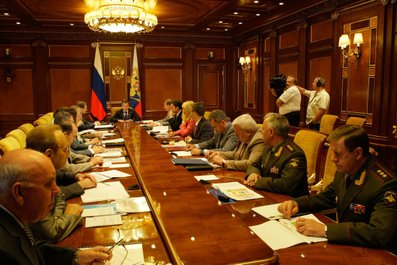
The meeting included relevant ministers, but not Prime Minister Putin.  Along with Makarov and Smirnov, Defense Minister Serdyukov and ROSTO / DOSAAF Chief Sergey Mayev attended.  Smirnov appears in uniform (bottom right of the picture), though it’s been thought he retired and put on civilian clothes.  He’s already 60, so he’s beyond the age limit for a general-colonel.  He’s served in the General Staff since 1982.  He was a GOMU directorate chief in the mid-1990s, then Deputy Chief, and Chief since August 2002.  Few Russian military officials should know their issues as well as Smirnov.

The key points in Medvedev’s meeting kickoff are that (a) Armed Forces’ manpower requirements are not being met; (b) no decisions on conscription changes have yet been taken; and (c) the public is supposed to get at least some kind of input on the issue.

Kremlin.ru’s coverage of the beginning of the meeting follows.

“Dmitriy Medvedev spoke of the need to conduct a rigorous analysis of the situation with military conscription and draw up proposals for its improvement.”

* * *

“D. MEDVEDEV:  Good day, colleagues!”

“We have an important issue for the life of our state — the issue of military conscription.  It’s clear that the overall effectiveness of the state, and ensuring security in the country depends on how we man our Armed Forces, and our law enforcement organs.”

“It’s clear that now there are complications:  army and navy requirements for conscripts are not being fully met.  This is connected to the demographic component, to demographic problems; this is connected to the health problems of young people.  All these issues have been discussed more than once both in meetings, and in the mass media.  We have to talk conceptually about what to do next.”

“There’s a range of proposals.  I want to say right off that all these proposals are still just proposals.  They need careful analysis.  Not a single one has any kind of preliminary approval, and we need to discuss them.”

“At first we’ll discuss them with the participation of the leadership of the Government, Presidential Administration, Armed Forces leaders, law enforcement structures, and special services.  Subsequent to such a type of decision all the same it needs to be discussed with the broader circle of society.  It’s essential to take public opinion into account in any case  because this concerns a sufficiently significant number of people in our country.”

TsOPI Critiques Serdyukov’s Reforms

In last week’s Nezavisimoye voyennoye obozreniye, IMEMO’s Vladimir Yevseyev presented the results of a recent round table on reform in the RF Armed Forces. The Center for Social-Political Initiatives (TsOPI or ЦОПИ), with support from Germany’s Rosa Luxemburg Foundation, sponsored the event.

Yevseyev described early reform as cutting personnel without changing the army’s structures during a time of political paralysis in the 1990s.  In the Putin era, he says there were still failures and the army’s equipment levels dropped, but the army began to believe it could still fight.

At this time, former Defense Minister Ivanov more than once declared the end of army reform, the troops started to get limited quantities of new weapons, and there was an unsuccessful attempt to move to professional enlisted force.  Yevseyev tries unconvincingly to point out successes in the Putin-Ivanov period.  His leading examples are especially dubious:

“— the elimination of cadre units and formations and forming of permanent readiness units numbering nearly 200 thousand servicemen on a contract basis.”

“— partial fulfillment of the federal targeted program of transition to manning with servicemen conducting military service on contract in a number of formations and military units in 2004-2007 that as a whole with a corresponding change in legislation in 2008 allowed a reduction in the conscripted service term to one year.”

The hollow unit problem wasn’t tackled until late in 2008, and Yevseyev has already labeled contract service a failure.  Moreover, the contract service program probably didn’t attract more than 80,000 soldiers.

And contract service didn’t have anything to do with one-year conscript service.  That change was made to try to encourage more young Russian men to serve rather than avoid serving.  Professional enlisted service, had it worked, would have allowed Moscow to continue drafting only 260,000 men per year for two years, rather than 540,000 per year to serve for a year as it is now.

But Yevseyev comes to the right conclusion:

“. . . radical change in the reform of the Armed Forces did not happen.  The main reason for this was that the Russian leadership could not take the fundamentally important decision on bringing the size of the Armed Forces into correspondence with the economic possibilities we have and with observable (future) external threats.”

Yevseyev writes that the most acute phase of military reform came with Defense Minister Serdyukov, and the war with Georgia, which revealed the army’s shortcomings.
 
But, says Yevseyev, Serdyukov’s initiatives like reducing officers and cutting warrants ran into difficulties.  Forty thousand officers placed outside the TO&E couldn’t be retired because they still lack permanent housing.  And many would-be officer graduates in 2009 and 2010 were forced into sergeant’s duties.

Yevseyev says Serdyukov’s reform is bringing an increased flow of negative consequences as shown in the results of TsOPI’s polling. It surveyed more than 2,500 people, including nearly 1,700 servicemen, in nine major cities.  According to 61 percent of respondents, reform has degraded the entire military command and control system.  Sixty-four percent said the army’s ‘new profile’ has seriously reduced their social status.  Thirty-two percent are not sure their housing, pension, and pay rights will be observed during Serdyukov’s reform.  Twenty-three percent are worried about their outplacement rights, and 8 percent about their medical benefits.

Yevseyev and his colleagues discussed three major problems for the Armed Forces:  rearmament, infrastructure, and manning.

They say 40 percent of Soviet arms and equipment were modern at the end of the 1980s, with the percentage declining to only 10-12 percent by 2005, and 5 percent at present.  They give a useful rundown of what’s been produced over recent years.

In 2004-2008:

  • 36 ‘Topol-M’ ICBMs;
  • 2 battalions of Iskander SSMs;
  • 2 battalions of S-400 SAMs;
  • 150 T-90 tanks;
  • 700 armored combat vehicles;
  • 20 self-propelled artillery systems;
  • 1 Tu-160 strategic bomber;
  • 3 Su-34 bombers;
  • 30 helicopters;
  • 1 diesel submarine;
  • 2 corvettes; and
  • 13 smaller ships and auxiliaries.

In 2009:

  • 49 new or modernized aircraft;
  • 31 helicopters;
  • 304 armored combat vehicles; and
  • 20 artillery systems.

Yevseyev and company conclude:

“It would seem that the situation with equipping the country’s Armed Forces is beginning to be corrected.  But in reality such rates of military equipment supply allow full rearmament across 30-50 years, which significantly exceeds the length of its service life.”

So this will make it difficult to increase the share of new weapons and equipment to 30 percent by 2015, even for permanent readiness units and formations.

They point next to the massive lingering Russian military structure.  Four years ago there were 26,000 military organizations of one type or another, and now only 6,000.  And that will be reduced to 2,500.  But they say, instead of consolidating and realizing cost savings, some of this process was fake, and some organizations were just named as subsidiaries [filialy] of larger ones.  As an example, they cite the shift from regiments to brigades and 1,000 reported TO&E changes, of which only 30 actually involved a physical unit relocation.

Finally, Yevseyev and the round table participants point to a potential unit leadership void when officers and professional enlisted are being cut (or not recruited) at the same time.  They say, given the training time they need, conscripts shouldn’t comprise more than 30 percent of a permanent readiness unit.

Yevseyev sums up:

“. . . the process of implementing military reform in the Russian Armed Forces now prompts the most serious misgivings.  In essence, the military personnel training system is being destroyed, the decline in the Armed Forces’ equipping continues, their system of manning and command and control is being broken.  All this leads to the weakening of the country’s defense capability and requires taking immediate measures to eliminate the negative consequences we are already experiencing.”

Kramnik on Vostok-2010 and Military Reform

This is complete finally.

Ilya Kramnik’s RIA Novosti piece about the exercise has been quoted by others, but it hasn’t gotten attention as a whole on its own.

So what does Kramnik think?  He cites Makiyenko to the effect that Vostok-2010 showed that reform has been positive for the army, but there are, of course, problems.  Troops aren’t uniformly well-trained, and the failure of contract service has really hurt.  But Kramnik gives Defense Minister Serdyukov a lot of credit, on the order of being a 21st century Milyutin.  But back to the problems again.  Things like contract service, tension over officer cuts and premium pay, military education cuts, and the failure to deliver new weapons have to be fixed.  But Kramnik believes Serdyukov is the kind of guy who’ll go back and fix what he didn’t get right or get done.  Then Kramnik shifts to the type of conflict the military reform is preparing the Russian Army to fight.  Obviously [?] not a nuclear one, but rather, again turning to Makiyenko, a Central Asian local war scenario that might threaten the RF’s internal stability.  The conclusion is that, if reform stays on track and occurs quickly, the army will be able to meet this challenge.  Some, however, might well argue that even a properly and rapidly reformed Russian Army might not be enough to contain and damp down the kind of conflagration Makiyenko describes.  Finally, Kramnik concludes that even the U.S. front isn’t secure; an American regime in 2012 or 2016 might take to renewed active support of new ‘color revolutions’ in Moscow’s back (or front) yard.

Here’s a verbatim text:

“The official results of the just ended ‘Vostok-2010’ exercise are still being reckoned, and this will be done by the Defense Ministry.  Meanwhile, it’s already possible to make some conclusions.” 

“‘Vostok-2010’ was the largest of all in the post-Soviet period of Russian history.  More than 20 thousand men, 75 aircraft, 40 combat and auxiliary ships took part on the ground, in the air, and at sea in maneuvers conducted from Altay Kray to Vladivostok.”

“The aim of the exercise was to check the three-level command structure — operational-strategic command – operational command – brigade, and other new elements in the Armed Forces command and control and support system, and to uncover deficiencies needing correction.  An expert of the Russian Center for the Analysis of Strategies and Technologies Konstantin Makiyenko expressed his opinion on the recent maneuvers:  ‘The recent maneuvers fully refuted the propagated myth about how the army is being destroyed as a result of the actions of the current Defense Ministry leadership.  It’s obvious the army is alive and developing.  Units participating in the exercise demonstrated their combat capability, despite the fact that they are not in the ranks of the best military districts, and scarcely armed with the most modern equipment.'”

“‘It’s especially worth focusing on the good morale of the officer personnel — it’s not possible to speak of general enthusiasm, of course, but I didn’t see dim eyes among the officers.  As a group, they are interested in the success of the current reform and hope for its success.'”

“While agreeing with this point of view, one has to note that the situation with soldiers looks a little different, both RIA Novosti’s reviewer [Kramnik] and Konstantin Makiyenko have also noted this.  Very much depends on the branch of troops and the basic training of the soldiers themselves.  Contract-servicemen in a ‘Tochka-U’ operational-tactical missile launch battery look and are trained much better than conscript-soldiers in motorized rifle units.  In the words of motorized rifle officers up to the battalion commander level, the reduction in the number of contractees has negatively affected platoon and company training.  Ideally, the service term of a specialist-soldier (mechanic-driver, weapons system operator, etc.) needs to be three years, that is achievable only on the contract manning principle for these positions.”

“Speaking about the attainability of the announced goals of the reform, one can say the following:   the will of the military leadership which certainly exists, is the main component of success, a firm understanding of the goal is also obvious, and the possession of authority — it’s not possible to doubt this.  As a result, the current Defense Ministry leadership needs only time to realize its ideas.  Overall, the military reform being conducted is the most significant event of Russian history in the last ten years — since the suppression of the separatist rebellion in the North Caucasus.  The Serdyukov-Makarov reform in the military sphere is the most radical and deepest since the time of Mikhail Frunze’s reforms in the 1920s, if not since Dmitriy Milyutin in the 1860s and 1870s.”

“As proof, it’s possible to note the fact that the Defense Ministry leadership is constantly searching and ready to correct those steps which, when checked, turn out to be incorrect or unattainable in real political-economic conditions.  So, the current principles of manning the army will undergo a serious correction:  it’s obvious that neither the organization of contract service, nor, even more, the existing format of conscript service corresponds to the demands of the time.”

“Evaluating the correspondence of the Defense Ministry leadership to its missions, it’s possible to say, that at present Russia has the most appropriate military leadership since the collapse of the USSR.  At the same time, it’s obvious that the radicalism of the reform, the compressed time of its implementation, unavoidable resistance in the environment and hard economic conditions didn’t allow for avoiding a large number of mistakes and excesses.  Among the most fundamental failures it’s possible to name the collapse of the army’s transition to the contract manning principle, serious social tension arising in connection with the rapid reduction of officer personnel, the ambiguous situation with the scale of servicemen’s complaints after the introduction of the differential pay system [premium pay or Serdyukov’s Order No. 400?], the hurried and not completely thought out reform of military education and many, many other things.  It’s  particularly worth focusing on the implementation of the state armaments programs which fail one after another, not being executed in a significant part.  As a result, the lag of Russia’s Armed Forces behind the most developed countries in the level of  technical equipping continues to grow such that in conditions of a quantitative lag it could become very dangerous.  All these mistakes have to be corrected, since they impact on rudiments of the army’s combat capability.”

“For what type of wars does Russia’s new army need to prepare?  Obviously, the time of long wars between the great powers has gone into the past — nuclear weapons haven’t left chances for such a development of events.  The most probable type of conflict in which the Russian Army will be involved is a local conflict on Russia’s borders and the territory of the former USSR, in the course of which there could be clashes with the most varied enemy:  from a regular army to many bandit formations and terrorist groups.”

“In Konstantin Makiyenko’s opinion, Central Asia presents the greatest danger in the future of a possible hot conflict with Russia’s direct participation:  ‘The U.S. and NATO, obviously, are less and less controlling the Afghanistan situation, and it’s not excluded that in the foreseeable future they may have to abandon this country.  The return to power in Afghanistan of the ‘Taliban’ movement looks most realistic in the event of such a development of events.  The arrival of Islamic radicals in power would unavoidably be a catalyst for conflicts on the territory of former Soviet republics of the region already riven by contradictions.  Weak authoritarian regimes in Tajikistan, Turkmenistan and Uzbekistan, not to mention what’s become the ‘failed government’ in Kyrgyzstan, could be easy prey for the Taliban.  As a result, Russia might be forced to consider the likelihood of a large Asian conflagration which it would have to prevent, or if it didn’t succeed — extinguish, at a minimum with the aim of preserving its own internal stability.  One very much wants to believe that the reform will bear fruit before the described situation becomes a reality.'”

“Besides the described scenario it follows to study also the probability of another development of events:  as experience has shown, on the territory of former USSR republics, the rise of openly anti-Russian regimes with external support at their disposal can’t be excluded.  For today, such a situation is a low probability due to the fact that the current administration in the U.S. — the main sponsor of ‘colored revolutions,’ is clearly not inclined to continue the policy of George Bush.  However by 2012, if President Obama loses the election, the situation could change, and this risk is even greater in 2016 when the administration will change in any case.  Meanwhile, you have to note that even the Democrats remaining in power in the U.S. is not a guarantee of a peaceful life:  Obama’s point of view on a coexistence format with Russia is hardly shared by all his fellow party members.  In the worst case, a return to the next variant of Cold War and new spiral of the arms race isn’t excluded.”

“The coming decade isn’t promising Russia an easy life.  The success of military reform is all the more important.”