Category Archives: Manpower

Defense News

Some Russian defense news from August 6, 2012 (and a bit earlier too) . . .

Militaryparitet.com picked up the VVS CINC in Interfax.ru talking about the   Su-35 flight test program, and serial production beginning in 2014, or even next year.  PAK FA, he said, will be produced from, or after the start of, 2015.

Preliminaries for Rubezh-2012 (photo: Mil.ru)

Mil.ru and KZ published on the beginning of Rubezh-2012 — the ODKB’s Collective Rapid Deployment Force exercise at Chebarkul.  Vladimir Mukhin, however, writes in today’s NG about “fault lines” in collective defense.  He contrasts the alliance’s exercise activity with its inaction against real Central Asian instability.

Coastal rocket and artillery units have been busy.  Mil.ru showed the DP-62 Damba MLRS firing from the beach on Kamchatka, and TsAMTO covered a Western MD press-release about Northern Fleet launches of  Rubezh and Redut coastal antiship missiles.

KZ today issued its take on the Navy CINC’s comments during Ekho Moskvy’s Voyennyy sovet program last week.  It’s always interesting to compare the KZ summary with Ekho’s transcript.

Mil.ru reports the well-nigh forgotten future professional sergeants in training at Ryazan will graduate in November.  It says 130 will head off for new assignments.

Recall this grew out of the failed 2003-2007 contract service program, and utilized space available due to the drastic reduction in officer training.  Izvestiya provided a late 2010 look into how few men showed up and lasted at Ryazan.  In early 2011, the Defense Ministry slashed the funding and largely euthanized the stillborn effort.  One waits to see how it’ll find 425,000 contractees in the future.

Reacting to Felgengauer

A good friend asked for a reaction to Pavel Felgengauer’s latest piece.

This author agrees with many of Felgengauer’s views, though not all of them.  In particular, this observer is unable to declare, like Felgengauer, that Russia’s military reform is failing abjectly, despite its uneven results.

Let’s look at his article.

Mr. Felgengauer presented the essence of Defense Minister Serdyukov’s dustup with Prime Minister Medvedev last week.  Serdyukov said outright, if the PM wanted to fire someone for failing to prepare semi-abandoned military towns for handover to regional authorities, he should fire him.

You may have read on these pages, the problem of no-longer-needed military towns is an enormous one.  There’s a veritable archipelago of hundreds of voyengorodki throughout Russia.  They’ve long since lost their purpose and support from the Defense Ministry.  Fixing them to transfer to civilian control is an enormous task, probably beyond the Defense Ministry’s current financing and capabilities.

One Putin campaign pledge for 2012 was not to foist broken down military infrastructure on Russia’s regions and localities.  And, though left unsaid, the problems of voyengorodki are connected to the military housing woes.  If more apartments were ready for occupancy, there might be fewer ex-servicemen living in the archipelago of former military towns.

Felgengauer could have written about how the Serdyukov-Medvedev flap reflects wider tensions in Russia’s ruling elite.  Between Putin’s people and Medvedev’s.  He did say the scandal showed the latter’s relative powerlessness.

Felgengauer might have clarified for some folks that, under the constitution, the Defense Minister answers to the President first, and the PM second.  Not so for most ministers.

He mentioned the situation harked back to Serdyukov’s reported ambivalence about continuing in his job.  There was also pre-election talk that Serdyukov might be replaced at the start of Putin’s third term.  But Felgengauer concludes Putin wanted to keep him in the post regardless.

Felgengauer suggests Serdyukov might suffer a “mental meltdown.”  He could have reacquainted readers with the temper and frustration Serdyukov showed the VDV in Ryazan in late 2010.

Turning to strictly military issues, Felgengauer concludes, “. . . the actual capabilities of the military after almost four years of Serdyukov’s reforms are questionable.”

Despite efforts to move away from reliance on hollow units, and increase permanently ready units, woeful undermanning (Vedomosti, June 9) leaves newly formed army brigades crippled, “with most of them not ready to be used in combat as full units in any circumstances.”

He continues:

“Most of the soldiers are one-year serving conscripts, called up two times a year, so half of them at any moment have been serving less than 6 months — not yet trained to be battle-ready at all.”

Let’s examine all this a bit.

Undermanning certainly exists.  The lack of detail on the strength of Russia’s new brigades make things somewhat sketchy.  If (a very big if) the brigades aren’t large, 300,000 conscripts might stretch to cover them, barely.

If the 45 maneuver units have only 3,000 draftees each, that’s 135,000.  Add maybe 60,000 (40 x 1,500) in other brigades, and Russia uses 200,000, or two-thirds, of its conscripts for the Ground Troops.

If these brigades are fully equipped and can depart garrison in an hour or two, they’re technically permanently ready.  But, as Felgengauer points out, six months is not adequate time for combat training, so it’s not clear what missions they can accomplish.  The issue is more combat capability than readiness.  Permanent readiness is a starting point, not an end in itself.

Felgengauer rightly notes that Serdyukov’s reform has lacked a strategic objective and defined doctrine.  One might say it’s failed to prioritize goals, problems, and threats.  Felgengauer says “attempts to meet all other possible threats [besides the U.S. / NATO] resulted in thinly spreading out limited resources.”

This author agrees completely.

Felgengauer ends, weakly, saying military food service was outsourced to make conscript service more attractive, and Putin might abandon it.  He views it as a failed military reform.  It may be, but outsourcing was really introduced to keep draftees in training 100 percent of the time rather than in non-military duties like KP.

We’ll return to the issue of whether military reform is succeeding or failing another time.

Defense Policy Reset?

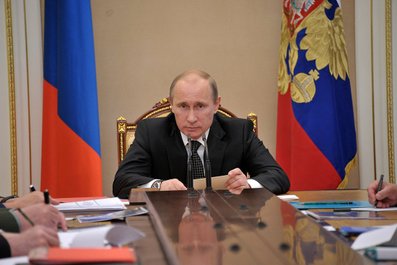
RF President Vladimir Putin last week held the first meeting of his third term to discuss military priorities with senior uniformed officers.

President Putin

He looked less impressive, and less in command of his brief in the video of his introductory remarks than on similar past occasions.

But he clearly laid out his main concerns for Russia’s top Armed Forces leaders:  training, Aerospace Defense Troops, rearmament, contract manning, pay, and housing.

He seemed confounded by the Defense Ministry’s failure to pay new, higher military salaries on time, and by the continuing lag in providing housing to servicemen.  He said his Control Directorate is investigating both situations.

Taking it from the top, Putin said the state of military training and exercises today is completely changed from past years when the Armed Forces were rarely active.  The president twice emphasized conducting joint exercises with Russia’s allies in the CSTO, CIS, and SCO.

His second priority is developing the newly created and reformed Aerospace Defense Troops.

His third is rearmament.  He repeated the familiar goal of replacing 30 percent of weapons and equipment with new generation systems over the next three years (2015), and 70, or in some cases 100, percent five years after that (2020).  And he added:

“I ask you to report promptly about all instances of breakdowns or incomplete deliveries, if you identify them.  Everyone participating in Gosoboronzakaz work must bear personal responsibility.”

The fourth priority is manning, and the earlier announced effort to increase professional soldiers in the ranks to 425,000.  This, he says, would increase their numbers two and a half times, reportedly from 170,000 today.  Putin made the customary comments about carefully screening and selecting enlisted troops, and giving them incentives to serve well.

Fifth and finally, Putin emphasized efforts to provide better social support for servicemen, specifically, this year’s increase raising military pay by up to three times, and his attempt to provide all military men permanent housing in 2013 and service housing by 2014.  He said:

“Sufficient resources have been allocated for this, the necessary amount has been reserved.”

“But I have to note that, to this point, there are many problems in the provision of housing and calculation of pay, unacceptable breakdowns and procrastination, open professional negligence by officials.  And even if on paper and in reports everything is normal, in fact in real life servicemen and their families at times encounter various kinds of bureaucratic procrastination, often with a formalistic indifferent approach.”

“I’ve directed the Russian Federation President’s Control Directorate to conduct a corresponding check in all these areas.  Unacceptable facts are being encountered, already in the first stages of this check this is clear:  this is both delays in the transmission of pay, and the impossibility of normally finalizing the paperwork for an apartment.  Fitting conclusions will be drawn according to the results of the check, and instructions will be formulated.  But today already I’m asking Defense Ministry representatives to report what measures are being adopted to correct the situation.  May is ending, and normal work with pay still hasn’t been smoothed out.  We already talked about these issues more than once.”

Where are outside observers left?

  • Training and exercises have increased as a function of more budget and fuel, but this didn’t happen until the late 2000s.
  • Aerospace Defense Troops are another structural reorganization, potentially a good one, not unlike other reorganizations since the 1990s.
  • Rearmament is a serious downfall.  Despite the Putin factor, nothing really happened on this score until late 2009.  It’s complicated by the difficulties of fixing a dilapidated OPK.  And, although there may be some favorable signs, success here remains to be seen.
  • Contract service is a second serious downfall.  Putin’s first effort to professionalize the army started in 2002.  The General Staff Chief declared it a dismal failure eight years later.  The Defense Minister revived it on an enlarged scale one year after that.  Demographic reality and draft problems leave Moscow no other choice.
  • Low military pay is a downfall.  It became more of a realistic priority with Serdyukov’s arrival in the Defense Ministry, but it was still five long years before the new, higher pay system was implemented.  And Putin admits how poorly it’s functioning.
  • Housing is also a downfall.  Despite progress since Putin first really addressed the issue in 2005, it’s still problematic.  And the president publicly moved back his timetable for a solution.

The downfall areas are problems requiring a long-term, sustained commitment to resolve.  Putin 2.0 is wrestling with the same military issues he identified back in 2000.  It’s still far from certain he can or will bring them to a successful conclusion.

This author believes there’s been progress on Russia’s military issues during the 12 years of Putin’s time as national leader.  But future economic or political challenges could derail progress toward rebuilding the country as a full-scope military power.

Is Putin resetting or rebooting defense policy?  Yes, at least jumpstarting it on key issues.  But a restarted or jumpstarted computer, car, or policy usually works (or doesn’t work) the same way it did before it stalled.  So this isn’t necessarily the path to a successful finish.  But no one ever said making and implementing policy was easy.

Putin and the Army (Part II)

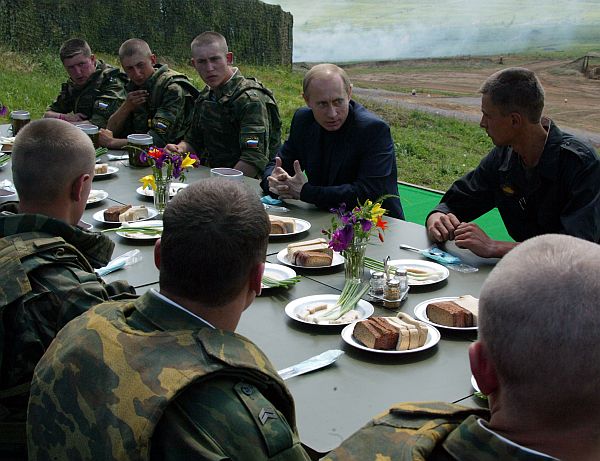
Putin Eating with Soldiers

Continuing with Prime Minister Putin’s latest pre-election article on the army . . . Russia Today published a translated version.

Describing the army’s “social dimension,” Putin says a modern army requires well-trained officers and soldiers on whom more demands can be placed.  And they, in turn, deserve pay commensurate with that of specialists and managers elsewhere in the economy.

Hence, the new pay system for officers this year which practically tripled their remuneration.

Putin mentions that military pensions were increased 1.6 times (60 percent), and he promises they will now increase annually by not less than 2 percent over inflation.

Retired or dismissed servicemen will get a “special certificate” good for further education or for retraining.

Then Putin tackles the painful military housing issue.  After recounting its history, he says, in 2008-2011, the army obtained or constructed 140,000 permanent and 46,000 service apartments.  But he admits:

“. . . despite the fact that the program turned out to be larger in scale than earlier planned, the problem still wasn’t resolved.”

He says the accounting of officers needing apartments was conducted poorly, org-shtat measures [dismissals] weren’t coordinated with the presentation of housing, and the situation has to be corrected.

Putin is, of course, alluding to the fact that maybe 30,000 or 80,000 of those 140,000 apartments the Defense Ministry acquired or built remain unoccupied.  But he’s not exactly tackling the problem head-on.

Putin says the “eternal” permanent and service apartment problems will finally be resolved in 2013 and 2014 respectively.

But in mid-December, in his “live broadcast,” Putin said his new deadlines were 2012 and 2013.  So, he’s just given himself an extra year on each.

Putin says the military’s mortgage savings program now has 180,000 participants, and 20,000 apartments have been acquired through it.

He also notes that regions and municipalities won’t have broken down military towns and infrastructure foisted upon them.

Next, manning. 

Putin gives the familiar figures–there are 220,000 officers and 186,000 sergeants and soldiers who now serve on contracts.  Over five years, the army will try to recruit 50,000 professional soldiers each year. 

Selection, Putin says, will be strict, and contractees will be trained in special centers and sergeant schools.

In the reported one-million-man Russian Armed Forces, 700,000 personnel will be professionals by 2017.  Conscripts will be reduced to 145,000 by 2020.

Putin says the mixed contract-conscript system of manning used for quite some time was just a compromise because Russia couldn’t afford an all-volunteer army.

However, politicians and generals always extolled the mixed system because it retained a universal obligation (at least theoretically) and kept the military from becoming “mercenaries.”

Putin endorses military police and priests in the ranks to keep order among remaining conscripts.  He also promises those who serve as draftees assistance with education and preferences in entering the government service.

The Prime Minister admits Russia lacks a concept for its national military reserve system, and developing one is a near-term task.

Although the course is set for a professional contract army, Putin still wants young men to prepare for service.  So don’t forget about military-patriotic indoctrination, military-applied sports, and DOSAAF.

And Putin indicates he supports Deputy PM Dmitriy Rogozin’s proposal for a Volunteer Movement of the National Front in Support of the Army, Navy, and OPK.

Part III will be the final five pages on the OPK.

No One to Call (Part II)

Let’s continue our look at the just-completed fall draft before returning to the issue of contract service.

In Nezavisimaya gazeta, Sergey Konovalov counts 220,000 officers and 180,000 contractees at present, then quotes retired general Yuriy Netkachev:

“If we add the number of men called into the troops in the spring and fall of last year (135,900 [sic] and 218,000 lads respectively), then with authorized manning of the army and navy at one million men, undermanning is not less than 15%.  Given such indicators, it doesn’t do to talk about the full combat readiness of the troops.”

With due respect to Netkachev, this adds up to just over 750,000 men in the RF Armed Forces.  That would be 25 percent undermanning against a million-man army. 

Konovalov cites KSMR’s Valentina Melnikova on legal violations in the recent draft.  The fall call-up possibly set a record for rights violations even though it was the smallest post-Soviet draft.  Melnikova claims 6,000 violations were reported — one for every 20 men inducted.  And, according to Konovalov, prosecutorial data seems to support her number.  The main violation was simply drafting guys not fit to serve.  Melnikova believes commissariats did this consciously because it was the only way they could reach even relatively low target numbers.

Konovalov turns to military sociologist Colonel Eduard Rodyukov who worries that, following a precedent set in Chechnya, the Defense Ministry is not inducting men from Dagestan.  Only 121 were inducted against the republic’s plan for 3,320.  And those few entering the army appeared to be Slavs rather than Avars, Dargins, Kumyks, etc.

Rodyukov concludes:

“This is unjust.  In Moscow, to fulfill the call-up plan, they shave everyone for the army – both lame and near-sighted, but in Dagestan and Chechnya potential recruits are sent into the reserve [without serving as conscripts].  A peculiar Slavicization of military collectives is occurring, the structure of which doesn’t correspond to the country’s population.  But the Russian Army is not an imperial army.  It should be international [i.e. interethnic].”

Konovalov believes conscription’s been cut in other “hot” republics of the North Caucasus as well.

Let’s come back to a larger point where we started.  If conscription of Caucasians has been pared for fear of having them in the ranks, overall conscription has been cut in favor of having 425,000 professional volunteers in the army by 2017. 

The Defense Minister recently said he’d go as far as 90 percent contractees and only 10 percent conscripts in the Armed Forces if the budget allowed for it.

Viktor Baranets addresses, in understated fashion, the difficulty of going from about 180,000 contractees today to 425,000:

“But this requires enormous expenditures.  A soldier or contract-sergeant also needs, besides uniforms, weapons, and corresponding social benefits, to be given good housing (and among them there are also many who are married).”

Yes, housing was a huge downfall of the 2003-2007 contract service effort.  So was failure to recruit the right men, and make contract service truly different from being a conscript.

Baranets goes on to suggest G.I. bill-type benefits (privileged VUZ admittance, government hiring preferences, etc.) for Russia’s contractees.

But pay can’t be underestimated as the primary factor in whether the Russian Army can attract contractees this time.

In 2004, a newly-signed contractee might have gotten 10,000 rubles a month.  After accounting for inflation, the Defense Ministry will have to pay at least 20,000 today to give enlisted the same deal. 

General Staff Chief Makarov has talked about minimum pay of 23,000 — not much more than what was offered in 2004 after inflation.  As always, much depends on the supplements and bonuses an individual serviceman receives. 

Contract pay may be better than it was.  But it’s going to be, as Baranets said, an enormous expense.  We’ll have to see if it’s an affordable and sustainable one.

No One to Call (Part I)

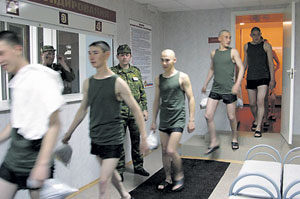
Shaved and Ready to Serve (photo: Yelena Fazliullina / Nezavisimaya gazeta)

“We could call-up 11.7% of all young men.  Of them, 60% got out on health grounds.  Therefore, the RF Defense Ministry confronts the fact that there is almost no one to call-up into the RF Armed Forces.”

Army General Nikolay Makarov

So the General Staff Chief declared on November 11, 2011, and he’s been quoted to this effect many times since. 

Just nine months earlier, the Defense Ministry declared professional contract service would be the primary method of manning the Armed Forces.  And a year before that, the Defense Minister and General Staff Chief said the exact opposite:  conscription would be primary and contract service would be curtailed.  

But the impossibility of manning a million-man Russian Army by means of the draft was clearly understood by many observers at that time.

The Defense Ministry recently issued its customary press-release indicating 100-percent fulfillment of the fall draft campaign.  

Only 135,850 young men were conscripted for one year of obligatory military service.  This was about 80,000 fewer than the number inducted during the spring draft (218,720), and less than half the fall 2010 call-up (280,000). 

This fall’s 135,850 twelve-month soldiers are just about the same number of men typically drafted for a two-year service term in the mid-2000s.

Viktor Baranets published his archive of annual conscription numbers back to 1999, which is handy.  He makes the point that, in contrast to today’s 12 percent or less, 20 percent of available men were being drafted as late as the late 1990s.

Let’s suppose if Makarov’s 12 percent go to serve and 60 percent are excused for health reasons, then 28 percent are escaping through deferments (mostly educational) or evasion. 

Makarov’s precise 11.7 percent or 135,850 conscripts would mean his total draft pool was under 1.2 million men.  This seems odd because census numbers say Russia should have at least two million 18- and 19-year-old men right now.  And that’s not even mentioning some 21- or 22-year-olds who get caught in the commissar’s dragnet. 

There might be some math your author can’t fathom, but it could also be that the widely-reported number of 200,000 long-term draft (or draft summons) evaders is actually much, much higher.

Let’s look at a fairly detailed report on conscription in one oblast — Sverdlovsk.  Nakanune.ru reports the oblast’s military commissar sent out 25,000 draft notices to the region’s youth. 

Almost half were unfit for health reasons, leaving, let’s suppose, 13,000 young men to sort through.  But this, of course, means Sverdlovsk’s a lot healthier place than many places.

Of those 13,000, some 6,000 had deferments.  So we’re down to 7,000 candidate-soldiers.  Of them, 4,056 were inducted this fall. 

That’s a deferment rate of 24 percent for all men summoned to the draft board.  And 4,056 is 16 percent of those summoned.  The MVD got 700 men (3 percent), and the Armed Forces presumably got 3,356 (13 percent).

Now unmentioned are the 2,944 not deferred and not drafted.  Who knows how they might be counted.  But they might be guys evading the draft by simply going missing.  For those keeping score, that could be an 11.7 percent evasion rate.  Just as many dudes avoiding service as going to serve this fall.

The Sociological Center

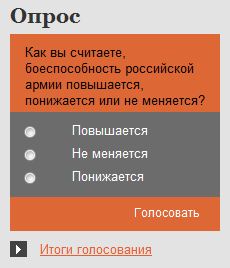
Is the Russian Army's Combat Capability Increasing?

A nice find on Mil.ru . . . the Defense Ministry website has the Internet poll above on its front page.  If you click on Voting Results, you go to the results of all surveys conducted by the Defense Ministry’s Sociological Center.

To this particular question, 78 percent of respondents said its combat capability is decreasing.

Stepping back a bit, clicking on Sociological Center goes to a narrative explaining a little about it.  Its purpose is monitoring social processes in the military to work out scientifically-founded proposals on the morale-psychological support of military organizational development, training, and employment of the Armed Forces.  It also provides information support to commanders, staffs, and personnel officers.  The Center is charged with collecting data about the socio-economic circumstances of servicemen and their families.

The military opinion surveying effort has been around for a while.  During the first big push for contract service beginning in 2003, Defense Ministry pollsters actively asked contractees, or prospective ones, what attracted or discouraged them from signing up.

We’re not told how or when these survey questions were asked.  They’re likely Internet polls rather than more scientific random sampling. 

But one still admires the brutal honesty of publishing these results.  They don’t accord with what Defense Minister Anatoliy Serdyukov wants to see or hear three years after launching military reform.  They indicate how far the Russians have to go to turn around the perception, if not the reality, of life in the Armed Forces.  At the same time, getting feedback is a critical step in correcting their problems.

Your author has regrouped the survey results on various questions thematically.  In the interests of brevity, only the answer with the highest percentage is shown.

Let’s start with other combat capability-related questions:

  • How do you evaluate the Russian Army’s current combat capability?  72 percent said low.
  • Is three months sufficient to train a military specialist?  82 percent said no.
  • What effect is the humanization of service having on combat readiness?  71 percent said it is causing it to decline.
  • Are you satisfied by the media’s presentation of Armed Forces exercises?  75 percent said no.
  • How do you evaluate the present level of combat training?  74 percent said poor.
  • Can the Armed Forces reliably guarantee Russia’s security?  81 percent said no.
  • Is there now a military threat to Russia from other countries?  79 percent said yes.

Some very general questions:

  • Do you approve of the Russian Army’s activity?  62 percent said no.
  • How do you feel when you talk about the Armed Forces?  52 percent said negative.
  • Is it necessary for the media to discuss negative events in the Armed Forces?  75 percent said yes.
  • How does the media portray the activities of the Armed Forces?  64 percent said not objectively.
  • Do you agree that “A powerful army is a powerful Russia?”  80 percent said yes.

On conscription:

  • Should draft evaders be punished?  68 percent said yes.
  • How do you feel about draft evasion?  59 percent said negative.
  • Does military service promote striving for a healthy way of life?  56 percent said yes.
  • Would you want a close relative to serve in the army?  68 percent said no.

On law and order in the ranks:

  • Who should control the military police?  52 percent said the Defense Ministry.
  • Do officers have enough powers to keep order?  84 percent said no.
  • How do you assess measures to counter corruption in the army?  66 percent said they have little effect.
  • Is “dedovshchina” an acute problem?  62 percent said yes.

On personnel, pay, and benefits:

  • Should Order No. 400 premium pay continue or be discontinued?  80 percent said discontinue it.
  • How do you feel about rotating officers’ duty stations?  51 percent are negative.
  • How has Order No. 400 affected corruption in the army?  88 percent said it’s caused it to grow.
  • Is there a “cadre famine” in the Armed Forces?  83 percent said yes.
  • How do you evaluate the consequences of Order No. 400?  89 percent are negative.
  • Where should priests be located?  42 percent said in battalions.
  • Will priests help in forming healthy moral relations in the military collective?  55 percent said no.
  • How do you evaluate the effect of the military mortgage system?  74 percent said low.
  • Will higher pay in 2012 raise the social status of servicemen?  58 percent said no.
  • Will requalifying military arsenal workers increase safety?  65 percent said no.
  • Do military families live better or worse than people in your region?  77 percent said worse.
  • Are social guarantees for servicemen sufficient?  86 percent said no.
  • Has the prestige of the Armed Forces increased in the course of military reform?  59 percent said it remains at the previous level.

The responses on the army’s capabilities weren’t new.  One is surprised, however, at how negative respondents were on premium pay, how little they expect from higher officer pay, and the lack of any improved perception of the prestige of military service.

Serdyukov Year-Ender (Part III)

A good day to finish old business . . . this covers the second half of Defense Minister Anatoliy Serdyukov’s Rossiyskaya gazeta interview.  Serdyukov, while remaining on message, seems tired or uninspired in giving this interview.  He reviews old ground rather than breaking any new.

Serdyukov talks about coming to grips with large existing stockpiles of tanks, BMPs, BTRs, guns, and automatic rifles, and indicates he’s waiting for the defense sector to propose some fundamentally new systems.  In regard to Kalashnikovs, the Defense Ministry is open to new developments from private firms but isn’t eschewing future AK purchases from its traditional supplier either.

On Mistral, Serdyukov tells RG the French will decide where it’s best to produce units 3 and 4, and Sevmash is the likely place.  But he wants them to come in cheaper than number 1 and 2 being built in France.  He expects Russia to acquire leading edge shipbuilding techniques in the process.

Serdyukov shows a flash of interest when asked about conclusions from Russia’s recent space launch failures:

“One conclusion — we have to change our approach to military acceptance.  And we’re occupied with this.  Next year we want to reformat it.  There’s already understanding about what has to be done in training units for military acceptance specialists, their incentives, and technical equipping.”

“Generally, this is a serious question.  We haven’t devoted the due attention to military acceptance because of various obstacles.  Now we are smoothing out the situation.  Not so long ago the prime minister had a conference, and Vladimir Vladimirovich Putin gave a whole series of instructions on price formation and tracking contracts.  Acceptance and production quality was one issue.  Today this task is being worked, and we are preparing proposals by the end of the year [2011].”

Serdyukov says voyenpredy can be civilians, but they should be former military men with lots of practical experience.

The last significant point in the second half of Serdyukov’s interview is his call for differentiated training for new professional sergeants — 3 or 4 months for those in motorized rifle units and 2 years or more for EW or communications specialists, for example.  The comparison he gives is training equivalent to technical secondary school or old school for warrant officers.  He indicates he’s not afraid future NCOs will become “eternal students.”

Serdyukov Year-Ender (Part II)

After talking GOZ-2011 and contracting with OPK enterprises, Defense Minister Anatoliy Serdyukov fielded Rossiyskaya gazeta questions on pay, military sanatorium-resort (i.e. vacation) benefits, apartments, contractees, opposition to reforms, and MPs.

He said increased pay will more than offset the loss of vacation benefits.

The military will have acquired 135,000 apartments by the end of 2011.  It will obtain another 25,000 next year according to Serdyukov.

He rejected any suggestion officers were deceived or Prime Minister Vladimir Putin “set up” when it came to the original 2010 and 2012 deadlines for solving permanent and service apartment problems:

“No one was deceived.  You know the number of those without apartments in the army sharply increased after the transition of the Armed Forces to a new profile began.  The dismissal of servicemen accompanied this process.  Unfortunately, the registration of those needing housing was conducted badly.”

“Precisely because of this, the lists for the receipt of housing rose from 70 thousand to 170 thousand.  It’s understandable that a hundred thousand increase could in no way be “inserted” into the bounds of 2010.”

On contractees, Serdyukov said there will be 180,000 in 2012, and 50,000 will be added each year until the number reaches 425,000 in 2017.  He added the optimal ratio, in his view, is 80 percent contractees to 20 percent conscripts.  But, if financing allowed, he’d go to 90-10.  Conscripts will serve primarily as infantrymen in motorized rifle brigades where less technical skill is required.

Asked the usual question on resistance to his steps to renew the army, Serdyukov said reforms weren’t all to his credit; they were devised mainly in the Defense Ministry by uniformed officers.  He said he can’t say there was strong resistance but rather misunderstanding about changes being made.  Without prompting, Serdyukov identified personnel downsizing, dismissals, and officers placed outside the shtat [TO&E] as sources of opposition to his work.

Serdyukov claimed there would be fewer inquiries from Duma deputies if they visited units instead of relying on newspaper articles and information from the Internet.

Finally, for the first half of his interview, Serdyukov talked about launching Russia’s military police.  First, the MP garrison service will stand up, followed by disciplinary battalions and the military automobile inspectorate.  Troops from line units will no longer guard cargoes or bases, he said.  MPs will be responsible for order in garrisons.  He concluded:

“In my view, this will bring real changes in barracks life, it will fight barracks hooliganism.”

Serdyukov would say dedovshchina doesn’t exist, and he wouldn’t bring himself to say simply barracks violence.  But, in essence, he acknowledges that “real changes” in the barracks are needed. 

He said a Main Directorate of Military Police has been created and General-Lieutenant Surovikin will head it.  The MPs will have several thousand specially trained personnel, including possibly some officers now outside the shtat.

Year Two

This blog completed its second year yesterday.  There were 288 posts in year two (a few less than last year).  Just a couple to go to reach 600 posts since December 10, 2009. 

One hopes the reading was half as worthwhile as the writing.  But frustration lingers.  It’s impossible to follow everything.  Adding Twitter provided a “release valve” for overflowing news.  Still there’s tension between posting short items and writing more detailed pieces drawing together many different sources. 

In 2011, Defense Minister Anatoliy Serdyukov and General Staff Chief Nikolay Makarov had plenty of interviews, official appearances, and other public utterances to cover.  There were a large number of high-level personnel changes, retirements, and dismissals to report.

Serdyukov eased a little on cutting the officer corps.  The Defense Ministry readied its new higher pay system while scandal plagued the stopgap premium pay scheme.  Military housing remained a major headache as always.

Moscow hit a wall on manpower and had to accept undermanning.  After acknowledging there aren’t enough potential draftees, the military is starting over (yet again) with an effort to create professional enlisted and NCOs through contract service.

This year began with questions about the GPV’s feasibility, but devolved into immediate problems with GOZ-2011.  The Russians threw money at the OPK without looking at the defense sector’s (and the procurement bureaucracy’s) capability to turn financing into the kind of weapons and equipment the military requires.  Difficulties ramping up production of naval and missile systems occupied media attention.  The public debate over the relative merits of buying Russian or foreign weapons made several headlines.     

So where is Russia’s military?

To this observer, the Russian Armed Forces are improving and beginning serious rearmament.  But the hour is late.  Significant future problems could derail recent positive changes.  These include new and old, unsolved economic, budgetary, social, demographic, and possibly even political challenges.  Not to mention purely military obstacles to modernizing the army and navy.

Your visits and page views grew significantly in year two.  Page views are about 400 a day, 2,000+ a week, and 9,000-10,000 a month.  We’ll see if this is the ceiling for this rather specialized topic.

Your views, opinions, and arguments are always appreciated.  Those sharing or highlighting data and evidence on issues are particularly valuable.