Category Archives: Military Leadership

Not a Fish, But a Crawdad (Part II)

Topwar’s summation of the Kommersant story on Defense Minister Serdyukov’s retention brought many comments in its forum.  They came mainly from conservative critics of Serdyukov and President Putin.

It’s a tough slog for anyone suggesting Serdyukov has done things that were overdue and necessary.  Anatoliy Eduardovich is roundly criticized for destroying what existed, and not putting anything better in its place.  Worse, some call him a traitor serving “Western interests.”

S_mirnov writes only a real idiot, or one who values an apartment more than his country, could believe Serdyukov is the best man to guarantee officers housing.  To him, the reappointment of Serdyukov is akin to giving the Titanic’s captain a new ship and having him sail to the same destination with surviving passengers.

Sinandju concludes not sending Serdyukov into retirement is just another sign of what Putin’s oligarchic-bureaucratic government is all about.

Redpartyzan alleges there were more questions about Serdyukov’s performance in office than ministers who were not reappointed.

BigLexey says Serdyukov’s been kept around to be a scapegoat for the army’s problems at an appropriate time, so the president and prime minister won’t be blamed.

Kadet787 from Belarus shares a poem about Russia appointing as Defense Minister not a wolf or bear, but an ass who sells military property for half what its worth.

To Topwar’s suggestion that time might tell about Serdyukov’s continuing tenure, Older replies all of Taburetkin’s wonders have been seen and Putin and Medvedev have behaved strangely.

Then Teves from Germany asserts Serdyukov remains because he did what Putin wanted despite the illusions of “superpatriots.”

Borisst64 analyzes the situation like this:

“The aim of Serdyukov’s appointment was clear from the start – destroying the structure of the country’s VS [Armed Forces], if they leave him, it means severe decisions (cuts, relocations, etc.) will still be implemented. The logic is understandable, the people’s attitude toward Serdyukov is negative, still they are patient, and we’ll appoint a new one [Defense Minister] when everything is perfect and nothing threatens the [new Armed Forces] image.”

Olegych picks up the defense of the Defense Minister:

“Serdyukov is a normal, honest Defense Minister, cleaning up all the bullsh** accumulated for decades.  Dedovshchina, thievery, ruined bases and military units, the lack of arms and POL supplies, the absence of housing – that’s what was, and what would be left.  And if you poured trillions of rubles into the sad MO [Defense Ministry] structure that existed before him, the result would be poor.  In the context given, Serdyukov is not a fighter, but a finance officer, a controller of resources, of tightly planned and justified expenditures.  And here’s the entire answer to why he remains at his post.  He remains at his post because there are real and tangible results from his leadership:  housing acquired, new armaments introduced, increased pay, an increase in exercises and flights, the destruction of millions of tons of old and dangerous ammunition, untangling the flywheel of the Gosoboronzakaz.  Cutting the number of servicemen and training institutions is an essential and necessary step, because there are no resources to maintain them.”

For a bit, the discussion devolves to Putin, whether “the Tsar is good and the boyars bad,” and whether it’s OK to insult the president.  And, more interestingly, whether Putin will eventually lose support and give rise to more “bolotniki.”

There’s a final counter to Olegych when Drugar says:

“Why Serdyukov is again Defense Minister is obvious.  The only thing not understood is what servicemen and the army / fleet as a whole are waiting for.  Generally, judging by recent events, the army is turning into a commercial enterprise, this transformation of everything and all to a civilian basis has allowed turning the servicing of army structures into a fantastically profitable and absolutely unpunishable business!  It’s possible to steal billions, imagine how much it costs to feed, clothe soldiers, repair equipment, supply spare parts, build-repair, and the like.  But, if someone will say it, report, Mr. Serdyukov – a MILITARY SECRET, gentlemen, a military secret . . .  This is the finale, the culmination of the Putinist corruption scheme!  So in Russia they still never steal . . .  People have become mute and blind from propaganda and zombification, have lost the ability to think (!), they are accustomed to softened up facts from the state’s zombie box [television].  Pronouncing ‘that yes they’re all d*cks there in the end,’ every one will stay home and continue hoping Putin will steal, steal, but remember about the people . . .  In vain.”

No absolute answer why Serdyukov remains, but some interesting and reasonably educated opinions.
Not a Fish, But a Crawdad (Part I)

It’s nice when you send yourself on a sabbatical.  But it’s terrible when your first post of the month doesn’t come until the 24th.  Seriously, this author should be flogged for neglecting the reader.  And he isn’t exactly prepared to dive back into frenetic posting either.  Only to hang more text out here now and again.

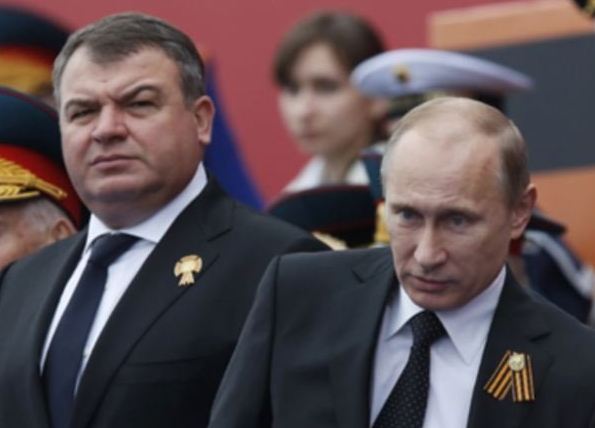
Serdyukov with Putin (photo: AFP)

This topic and title were stolen from Topwar.ru.  The site picked up on Kommersant’s examination of why Anatoliy Serdyukov was one of only five ministers to retain his post in the first Putin 2.0 government.

Kommersant claims Serdyukov came somewhat close to being retired in December when, at then-Prime Minister Putin’s behest, FSB Director Bortnikov searched out potential replacements.  Bortnikov looked at Rostekh’s Chemezov, Roskosmos’ Popovkin, and Deputy PM and OPK steward Rogozin.  The former pair convinced Putin of the “inexpedience” of making either of them Defense Minister in Serdyukov’s place.  Rogozin reportedly was willing, but, of course, already had a higher-ranking post.

Kommersant’s Ivan Safronov cited Aleksandr Kanshin and a Defense Ministry apparat source to the effect that Putin decided it’d be better to have Serdyukov see the military reform process through to its conclusion.

For its part, Topwar.ru also attributes Serdyukov’s “unsinkability” to a desire to avoid changing leadership in the midst of reform.  It also writes that Anatoliy Eduardovich turned out to be, at least in some ways, the best available and most willing candidate.  Topwar sums Serdyukov’s position up with this adage:

“When there aren’t any fish, even a crawdad is a fish.”

But Anatoliy Rak isn’t likely to replace Taburetkin as a nickname for the Defense Minister.

The most interesting part of Topwar’s account, however, may be the large number of commentaries, which we’ll look at in part II of this post.

Putin and the Army (Part I)

Putin Flanked by Green Suits (photo: Konstantin Zavrazhin)

Candidate Vladimir Putin’s election manifesto on the military and national security appeared in today’s Rossiyskaya gazeta.  The rambling 6,500-word essay reads like most campaign literature — a series of feel-good sound bites with inconvenient facts, details, and background left out.

But let’s get at it.

Putin says the changing world presents risks of an unpredictable nature.  He insinuates that Russia should expect challenges to its sovereignty over its natural resources.  It can’t tempt others by weakness.  Strategic nuclear deterrence preserved Russia’s sovereignty in the difficult 1990s as it does today.

Putin continues his habit of excoriating the long-ago 1990s but largely ignoring what he did or didn’t do during the 2000s.

He points right off to the GPV’s 19 trillion rubles to modernize the Armed Forces, and the coming FTsP’s 3 trillion for the OPK.  And, he says, he’s convinced the country can afford these expenditures.

Putin then turns to the nature of future war.  He wants the military to “look over the horizon” at the nature of threats in 30-50 years to determine what the army will need.

Deterrence has worked, and Russia keeps its nuclear “powder” dry.  But Putin points to the mass introduction of long-range, precise conventional arms becoming decisive even in a global conflict.

Someone tell Putin this is not news.  But there’s more.

Putin reveals that space and information (or cyber) warfare may be decisive in the future.  Beyond this, he continues, new beam, geophysical, wave, genetic, and even psychophysical weapons may be developed.  Their effects may be comparable to nuclear weapons but more acceptable politically.  So, expect the role of nuclear weapons in deterring aggression to decline.

He then segues wildly to responding quickly and effectively to other new challenges, and how Russia’s ODKB partners will help stabilize the “Eurasian space.”

OK.

Putin proceeds to a long-winded explanation of how the army saved Russia in the terrible 1990s.  As mentioned earlier, he doesn’t have a lot to say about the eight years he was Supreme CINC.

Putin claims he rejected a proposal (he attributes to then General Staff Chief Kvashnin) to move SSBNs from the Pacific and consolidate them in the Northern Fleet.  He says permanent readiness units with contractees were formed on all strategic axes, and, he claims, they allowed Russia to “force Georgia to peace” in August 2008.

No mention that the large-scale introduction of contract service failed miserably during this time.  Also no mention of “winning” the Second Chechen War by ceding federal control of that republic to a brutal young warlord.

Putin rightly notes the Soviet Army’s mobilization model made no sense for Russia, and there was no alternative to building a New Army [starting in late 2008 when he was not president, and after things went so well for the army in Georgia].  He admits there were difficulties and mistakes in this process, but goes on to describe his view of what’s been done in the army.

Full-up permanent readiness brigades have replaced old cadre units.  “Non-core, auxiliary functions” have been moved out of the army to maximize time for training.  And effective Defense Ministry sub-units responsible for the military order have to guarantee the effective formation of technical requirements for the development and production of arms and equipment.

Yes, but that’s not happening yet.

Putin lists other changes in the Russian military.  C2 organs cut by 50 percent.  Four districts with air, air defense, and naval forces subordinate to them.  Seven large air bases established.  Twenty-eight airfields renovated, and 12 more set for this year.  The share of modern ICBMs increased from 13 to 25 percent.  Ten more regiments to be reequipped with Yars or Topol-M.  Putin says Russia has accepted its new strategic ALCM.  Dolgorukiy and Nevskiy will soon enter the fleet.  The Navy’s renewed its presence on the world’s oceans.

Then the Prime Minister turns to tasks for the next ten years — rearmament:  nuclear forces, VKO, comms, recce, C2, EW, UAVs and unmanned strike systems, transport aviation, individual soldier systems and protection, precision weapons and defense against them.  And he reemphasizes, new generation precision weapons need development and a larger place in Russia’s future doctrine.

Putin seems to say Russia’s happier with the capability of defeating any missile defense than trying to develop its own.  He again promises effective, asymmetrical steps to counter any U.S. MD.

Then, a ten-year acquisition laundry list from candidate Putin:

  • 400 ICBMs and SLBMs.
  • 8 Borey SSBNs.
  • About 20 multipurpose submarines.
  • More than 50 surface ships.
  • Nearly 100 military satellites.
  • More than 600 aircraft.
  • More than 1,000 helicopters.
  • 28 regimental sets of S-400.
  • 38 battalions of Vityaz SAMs.
  • 10 brigades of Iskander-M.
  • More than 2,300 tanks.
  • About 2,000 SP artillery systems.
  • 17,000 military vehicles.

The tanks are really surprising.  And the list doesn’t really even match the ten-year tasks Putin set out.

Look for the second half later.  It covers army social issues and the OPK.

Thickening Clouds

Deputy PM Rogozin and Serdyukov (photo: Yuriy Magas)

Anatoliy Serdyukov completed his fifth year as Russia’s Defense Minister on Wednesday (February 15).

But the inimitable Argumenty nedeli concludes “clouds are thickening” around him. 

AN says Serdyukov’s in the “eye of a storm” of PA cadre changes, and he’s begun sacrificing subordinates to save himself.

The paper’s Defense Ministry source claims there will be a large number of resignations from “support structures controlled by the military department,” i.e. the quasi-commercialized, civilianized logistic agencies established to outsource “non-core” military functions.

OAO Slavyanka — responsible for housing and communal services in military towns — will lose its general director, Aleksandr Yelkin, over poor winter preparations and boiler breakdowns in Murmansk, Kaliningrad, and the Far East. 

Not surprisingly, the source says this decision followed Prime Minister Putin’s harsh criticism of Serdyukov on February 9.  See Kommersant, Komsomolskaya pravda, Nezavisimaya gazeta, or Newsru.com for more on this.

The general director of Agroprom — an affiliate of OAO Oboronservis — Natalya Dynkova, lost her position for “redistributing” the military food procurement market.  Agroprom declined an AN request for comment on Dynkova’s situation.

AN’s source also says Serdyukov’s apparat chief [chief of staff] Yelena Vasilyeva is also “hanging by a thread.”  From detention, the indicted former chief of GVMU, General-Major Aleksandr Belevitin has given evidence against her. 

Several months ago, AN claimed dustups with Vasilyeva led to former Deputy Defense Minister Mokretsov’s departure as well as complaints from high-ranking civilians and officers.

Finally, AN’s officer source says the FSB is investigating and arresting some people connected to the Defense Ministry’s commercial structures.  He concludes Serdyukov is ridding himself of people who could compromise him or interfere with him finding a place in once-and-future president Putin’s new government this spring.

BFM.ru sounded a separate but similar note reporting that the chief of a firm entrusted with selling excess Defense Ministry property is suspected of fraud. 

General director of the “Expert” Legal Support Center, Ye. F. Smetanova  allegedly sold military property for reduced prices in exchange for kickbacks ranging from 5 to 25 percent of the transaction, according to the MVD.  She reportedly received 18 million rubles for endorsing the sale of four Samara Voyentorgy for 147 million. 

Investigators are trying to identify other Defense Ministry properties sold with kickbacks as well as possible co-conspirators in the schemes.

In 2011, the Defense Ministry conducted 43 auctions and sold real estate for 4.7 billion rubles.  Movable military property was sold to the tune of 560 million.

It’s worth recalling the Main Military Prosecutor’s words about the scale of Defense Ministry corruption in 2011.  He singled out commercial firms outsourcing for the military and violations of auction rules as particular problems, along with routine kickbacks and bribery.

Where does this leave us?

Things aren’t so rosy for Serdyukov right now. 

For one thing, Rogozin’s replacement of the virtually invisible Sergey Ivanov has probably been a near-daily irritation for the Defense Minister.

Even after five years, it’s still hard to get a handle on all the military’s “financial flows.” 

And resignations and reports of corruption don’t reflect well on Serdyukov.

Still, Serdyukov remains a member of Team Putin, and he’s probably secure.  The election season makes everyone nervous, and it’s hard to say who’s driving corruption charges.  Shaking out some incompetent or corrupt defense officials might serve to create the impression that Prime Minister Putin’s on top of things.

Revenge of the Fallen

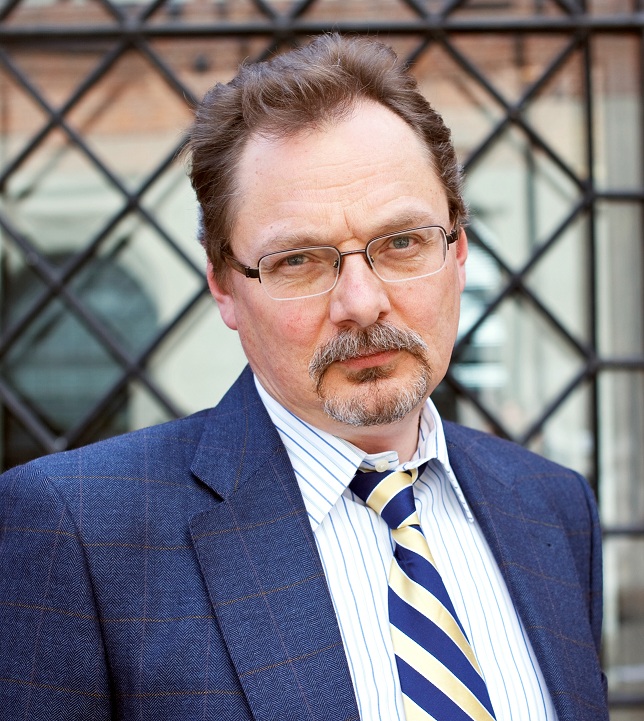
Ivan Safronov

Well, more like Return of the Retired, or Dawn of the Dismissed, or whatever.  Your attention’s been grabbed (hopefully).

Last Thursday, Kommersant’s Ivan Safronov reported the Defense Ministry will bring 4,011 ex-general officers back as civilian advisers and consultants, primarily in military districts (unified strategic commands — OSKs) and large operational-tactical formations (armies).  The idea, apparently, is for today’s top commanders to benefit from the experience of their predecessors.

Safronov’s report is based on claims from a source in Defense Minister Serdyukov’s apparat, his immediate staff.  The plan to deploy retired generals as advisers got Serdyukov’s approval on January 20.

The former higher officers will also work as scientific associates in VVUZy and in military commissariats.

Kommersant’s source said these men generally have advanced education and a wealth of combat troop and administrative experience to share with today’s commanders.

Safronov turns to Vitaliy Tsymbal to describe how deploying a huge number of ex-generals contradicts earlier Defense Ministry policy:

“There’s no particular logic evident in this, many now retired generals are already remote from military affairs.  This is a sufficiently magnanimous gesture on the part of the minister, but it doesn’t have some kind of deeper sense in it.  Earlier nothing stopped him from dismissing the very same generals for various reasons.”

According to Safronov’s source, it remains only to determine what to pay the returning generals. 

Who knows if any of this will actually happen?  But if it does, it’s another walk back on a key plank of military reform.  Remember the walk back on keeping 220,000 rather than only 150,000 officers?

In late 2009, General Staff Chief Nikolay Makarov said the Defense Ministry had cut 420 of 1,200 generals in the Armed Forces.  With current manning, the remaining 780 generals are enough for a relatively high 1-to-1,000 ratio to other personnel.  So they’ll be digging deep for 4,011 former generals.  Who and what will they find?  

In late 2010, Makarov almost bragged about cutting useless, superannuated officers:

“During this time [before 2009], we grew an entire generation of officers and generals who ceased to understand the very essence of military service, they didn’t have experience in training and educating personnel.”

However, those officers and generals saw it differently, for example:

“Ill-conceived reform has left the Russian Army without a central combat training methodology – that is, now no one knows what and how we teach soldiers and officers on the battlefield.”

So either Serdyukov’s shift to a new, younger, and more junior generation of military leaders isn’t working out, or there’s some other reason for bringing the older dudes back.  One obvious possibility would be to keep them from being openly and publicly critical of Putin’s regime and Serdyukov’s Defense Ministry on the eve of the presidential election.  Maybe some can be bought for a small supplement to their pensions.  A couple things are more certain.  If the old generals arrive, their former subordinates — now in charge — probably won’t like having them around.  The old guys probably won’t enjoy it much either.  And the whole scheme may not even get off the ground, or last very long if it does.

Cadre Changes

RIA Novosti noted yesterday the new 58th Army Commander is General-Major Andrey Gurulev.  Gurulev was previously its chief of staff.  His boss, General-Major Andrey Kartapolov also moved up to be Deputy Commander, Southern MD.

Krasnaya zvezda published a personnel decree from January 20 that somehow managed to slip past.  It included the following changes.

Relieve of duty:

  • Colonel Oleg Viktorovich Averin, Chief, Missile-Artillery Armament Service, Western MD.
  • Colonel Vyacheslav Nikolayevich Gurov, Commander, 6th Independent Tank Brigade, 20th Army.

Appoint:

  • Lieutenant Colonel Mikhail Vladimirovich Yerofeyev, Chief, Missile-Artillery Armament Service, Western MD.
  • Colonel Andrey Vladimirovich Lipikhin, Commander, 6th Air Defense Brigade.
  • Colonel Vladimir Pavlovich Omelyanovich, Commander, 6th Independent Tank Brigade, 20th Army.

Dismiss:

  • General-Lieutenant Khamit Iskarovich Kamalov.

Medvedev Visits GRU Headquarters

General-Major Sergun Welcomes Medvedev and Serdyukov

President Dmitriy Medvedev, accompanied by Defense Minister Serdyukov and General Staff Chief Makarov, paid a visit on GRU headquarters yesterday.

Medvedev came to bestow state awards on GRU officers.  Presidential visits to the home of Russian military intelligence are rare, and usually come in connection with its anniversary (November 5).

So we have to suppose the lame-duck Supreme CINC and possible future prime minister went to the GRU to (a) bolster its newly-appointed chief, General-Major Igor Sergun, and (b) try to boost the morale of a service hard-hit by cuts and reorganizations under Serdyukov’s reforms.  Medvedev’s brief remarks seemed to confirm as much.

According to Kremlin.ru, after giving the GRU obligatory praise, Medvedev told its officers that the world situation is changing and “it requires adjustments not just in intelligence priorities, but also methods . . . .”

He continued:

“Consequently, a reorganization of the entire system of military intelligence has also occurred.  These changes have been introduced.  The results of the recent past show that the GRU is successfully coping with its established missions.  And on the whole military intelligence is performing professionally and effectively.”

“Of course, we need to increase the operational potential of the service, and its information potential, and its analytical potential.”  

Medvedev’s “on the whole” was a recognition of a state of affairs that is something less than fully optimal.  How much we don’t know.  He also seemed to be dealing with an audience more accustomed to, and happier with, operations than analysis.

The president went on to note the GRU’s traditional role in monitoring the global political-military situation, forecasting threats, tracking military-technical and defense industrial developments, and, especially, in counteracting international terrorism.

Kremlin.ru provided this video of Medvedev’s remarks.

Will Serdyukov Go?

Pavel Baev

Back to a familiar topic . . . is it possible or likely Defense Minister Anatoliy Serdyukov will resign or be dismissed from his post prior to the March 4 presidential election?  It is, of course, a topic that won’t quit.  At least not for the next two months. 

Pavel Baev discussed this with BFM.ru over the holiday. 
 
We looked at Baev’s view of Serdyukov’s reforms back in the spring.  He was neither sanguine about them nor forgiving of mistakes made.
 
We also looked earlier at a couple considerations of whether Serdyukov might leave or be forced out of the Defense Ministry. 
 
In August, Mikhail Rostovskiy thought Serdyukov’s position pretty secure, and this author postulated, with once-and-future president Vladimir Putin secure in the Kremlin again, Anatoliy Eduardovich might find relief from the defense portfolio in a job both cushier and more to his liking.
 
In April, Aleksey Makarkin also thought Serdyukov was pretty safe.
 
It’s obvious that the aftermath of the December 4 Duma elections changed a lot of things.
 
Now Oslo-based Professor Baev thinks Serdyukov could be sacrificed in the election run-up for nothing other than loyal performance of the tasks Putin set him to in February 2007.
 
Baev says Putin believes his regime faces an old-fashioned Cold War-style political threat.  Various Western “circles” (NATO, NGOs, CIA) think the regime’s exhausted itself.  Any possible replacement would be welcome to them.
 
Then we get to the essence of Baev’s argument — the fact that the Defense Minister has generated great dissatisfaction and irritation among Russia’s defense factory directors.  Without a serious go-between in the Military-Industrial Commission, Serdyukov’s become the focus of their ire.  They blame him and his subordinates for rejecting Russian weapons and equipment, and claim they’ve hurt Russia’s reputation as an arms exporter.
 
His case in point is the complaint from railcar and armor producer Uralvagonzavod during Putin’s December 15 “direct broadcast” Q and A with citizens.  A caller asked Putin to take Serdyukov and General Staff Chief Makarov by the neck, and replace the former with a “clearheaded Defense Minister.”
 

Baev’s interviewer asks whether Serdyukov will keep his current seat under Putin 2.0:

“. . . I think that the Defense Minister will be replaced even before the election.  The Armed Forces and military enterprises are a large and serious part of the electorate.  It was possible to extinguish accumulated irritation with the promise of money since after long promises they raised pay for officers, although not as substantially as was said.  It’s also possible to give money to OPK enterprises and sacrifice an unliked minister.”

But a resignation won’t be enough:

“I don’t think so because the problems have gone too far.  It’s hardly possible to put the protest mood just on one minister.  Everyone understands perfectly that it’s not the minister who started all this and carried all this out, no one suspects Serdyukov of being a confirmed reformer, having a program, or being a man motivated by a sense of his own mission.  He is a manager, an executive, and extremely stubborn, but he didn’t start this, and that’s clear.  And I don’t think Serdyukov will hold onto the minister’s chair.  The problems and conflicts have become so acute that it’s becoming costly to him.  I think they’ve had enough of him.”

Baev concludes that another civilian should take over the Defense Ministry, and continue separating its intertwined military and civilian functions.  He doubts Serdyukov’s replacement will reverse anything, but simply move forward on the problems reforms have created.

Serdyukov’s departure seems like more of a possibility now than before the Duma elections.  As Baev suggests, Putin could sacrifice his Defense Minister to appease his numerous unhappy defense industrial constituents.  Serdyukov’s fate may hinge on how badly Putin needs a boost for March 4. 

The Defense Minister’s 5-year anniversary comes next month and provides an opportunity for a change short of dismissal.  This author gets the impression Serdyukov’s energy for his difficult job has declined lately.

As for Uralvagonzavod, its workers are unlikely to quit sniping at the Defense Minister.  They, along with other military vehicle makers, have reportedly learned their defense order for 2012 has been drastically cut in favor of procurement in 3-5 years.

Cadre Changes

President Medvedev’s military personnel decree from December 22.  

Recall that Colonel Yartsev is being investigated for “taxing” the premium pay his pilots were receiving.

Appoint:

  • Colonel Dmitriy Vilorovich Gorbatenko, Chief, Troop Training Directorate,  Western MD.
  • Captain 1st Rank Oleg Vladimirovich Zhuravlev, Commander, Leningrad Naval Base, Baltic Fleet.

Relieve:

  • Colonel of Medical Service Aleksey Eduardovich Nikitin, Chief, 2nd Directorate, Deputy Chief, Main Military-Medical Directorate, RF Defense Ministry.
  • Colonel Nikolay Nikolayevich Yartsev, Chief, Air Forces Training-Scientific Center “Air Forces Academy Named for Professor N. Ye. Zhukovskiy and Yu. A. Gagarin” Branch (Syzran, Samara Oblast).

Relieve and dismiss:

  • Vice-Admiral Sergey Ivanovich Menyaylo, Deputy Commander, Black Sea Fleet.

Dismiss:

  • General-Major Bagir Yusif ogly Fatullayev.

Medvedev Talks Bulava Acceptance

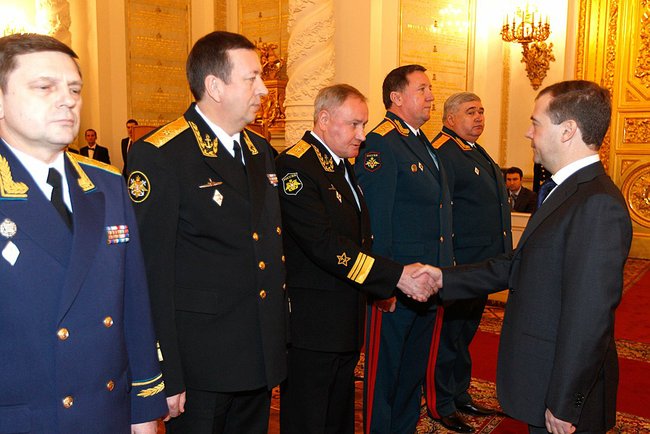
Medvedev Shakes Korolev's Hand

This post is admittedly as much about using a good photo and video as relaying something you haven’t heard.  But the visuals bring the subject to life a little.  At any rate, the lengthy Russian holiday season is upon us, so any post (even one with fluff) is better than none. 

Tuesday Russia’s lame duck President and Supreme CINC Dmitriy Medvedev greeted a group of military men — Armed Forces, MVD, FSB, SVR, and MChS officers — in the Grand Kremlin Palace’s St. George’s Hall to congratulate them on their new command positions or promotions to higher ranks.

Shown above are (from right) Southern MD Commander Aleksandr Galkin, Central MD Commander Vladimir Chirkin, Northern Fleet Commander Vladimir Korolev, Black Sea Fleet Commander Aleksandr Fedotenkov, and VVKO Commander Oleg Ostapenko.

Galkin and Chirkin are apparently there to mark their elevation to three-star general-colonel rank, while the latter three are now at new posts.  And Ostapenko’s sporting a blue uniform.  Didn’t the ex-Space Troops wear green reflecting their RVSN roots?

Kremlin.ru published some of Medvedev’s remarks to his senior officer audience:

“In recent years, we have modernized the Armed Forces in the most substantial way, optimized the structure and manning of the army and navy, improved the combat command and control system, and strengthened the strategic nuclear deterrent forces.  From 1 December of this year, new troops –Aerospace Defense Troops began combat duty, and in November a new radar station for monitoring air space in the western direction was brought into operation.”

“The army and navy have to resolve an entire series of missions relative to supporting the national development strategy and, accordingly, military organizational development during the period of the coming 10 years.  One of the most important goals is the technical reequipping of troops.  Our key priority remains further reequipping of the troops, and weapons and equipment of the most modern and next generation.  And of course, this task also demands the preparation of specialists, demands the preparation of personnel who will be fully capable of using this equipment as intended.  Therefore, it is important to guarantee the proper level of professional knowledge in cadets and young officers.”

“We are continuing the improvement of our armament, and our equipment.  In this context, I would like to note specifically that despite the problems currently remaining in the missile-space sector, nevertheless, we have just made a very important step:  we completed the flight testing cycle of a naval strategic nuclear forces system, I have ‘Bulava’ in mind.  This cycle, I remind you, was not simple, and went forward with certain problems.  Still our industry proved it can develop new, modern, and highly efficient types of strategic weapons.  One of them is the ‘Bulava’ system, which now, after all this testing, will be accepted into the arms inventory.”

Pervyy kanal covered the ceremony, showing Medvedev, three VVKO and/or Air Forces general-majors, a Bulava launch, and assorted siloviki, including Sergey Ivanov, Nikolay Patrushev, Rashid Nurgaliyev, and Aleksandr Bortnikov.

The first general-major wearing the blue uniform is Sergey Popov, late chief of air defense for VVS, now Commander of VVKO’s Air and Missile Defense Command.  The second couldn’t be identified by your author.  The third is Igor Makushev, Commander, 1st Air Forces and Air Defense Command (perhaps just the 1st Air Forces Command since the advent of VVKO).

But returning to Medvedev and Bulava . . . the Supreme CINC’s words unleashed minor euphoria about the SLBM’s imminent acceptance. 

For example, on December 28, RIA Novosti reported its highly-placed Defense Ministry source claimed a decision on accepting the Bulava-Borey weapons system is before the country’s political leadership.

But Medvedev didn’t say the missile is now ready to be accepted.  He just said it would be, and we already knew that.  Also, he never mentioned Borey-class SSBN Yuriy Dolgorukiy which must be accepted in tandem with Bulava for this strategic weapons system to achieve IOC.

Vedomosti’s Defense Ministry source was more on the mark saying Bulava “practice” launches could continue for some time. 

Going slow would seem to track with Defense Minister Serdyukov’s apparently unhurried approach toward Bulava at this point.  There have been reports that Dolgorukiy isn’t ready, and launches next spring and summer could come from Borey unit 2 Aleksandr Nevskiy by then.

At any rate, the Bulava program’s come a long way from the nadir of its December 2009 failure.  But this isn’t exactly the end of the road either.  Moscow still has to work out a reliable and well-controlled production run of some 128 missiles (and 768 warheads) plus spares.  Not to mention ramping up construction and completion of eight Borey-class boats.

Thank you for reading this meandering post, as well as others this year.  Your author wishes you a happy 2012.

С новым годом!