Category Archives: Military Leadership

Sergun Replaces Shlyakhturov

Press sources report 52-year-old General-Major (one-star) Igor Sergun has replaced General-Colonel Aleksandr Shlyakhturov as GRU Chief.  Not surprisingly, little is known about Sergun.

Izvestiya reports Shlyakhturov’s departure was in the works for some time, and Sergun took over the job on December 22.  The paper’s Genshtab source says Sergun headed an unidentified GRU directorate prior to relieving his predecessor.  Knowledgable outside observers who spoke with Izvestiya believe Sergun arrives at a difficult time, following reforms and personnel cuts implemented by Shlyakhturov.

While not necessarily a “youth movement,” Sergun’s appointment follows a trend of putting lower-ranking officers and generals in charge of key Defense Ministry and General Staff directorates.

Komsomolskaya’s Viktor Baranets claims Sergun is the first to head the military intelligence agency at such a low rank.

Novyy region added a bit, saying Sergun is 54 (born in 1957) and was a colonel serving as military attache in Albania in 1998, according to press from that time.

Cadre Changes

President Medvedev’s December 8 decree . . . some appointments in VVKO.

Appoint:

  • Colonel Viktor Musavirovich Afzalov, Commander, 4th Air Defense Brigade, relieved as Commander, 4th Aerospace Defense Brigade.
  • General-Lieutenant Valeriy Aleksandrovich Bratishchenko, Deputy Commander, Air and Missile Defense Command, relieved as Deputy Commander, Operational-Strategic Command of Aerospace Defense.
  • Colonel Andrey Gennadyevich Demin, Chief of Staff, First Deputy Commander, Air and Missile Defense Command, relieved as Commander, 1st Aerospace Defense Brigade, 1st Air Forces and Air Defense Command.
  • Colonel Andrey Vasilyevich Ilin, Chief, 153rd Main Space Test Center.
  • Colonel Anatoliy Nikolayevich Nestechuk, Deputy Commander, Space Command.

Relieve:

  • General-Major Aleksandr Ivanovich Afinogentov, Chief of Staff, First Deputy Commander, Long-Range Aviation.

Defense Ministry Collegium

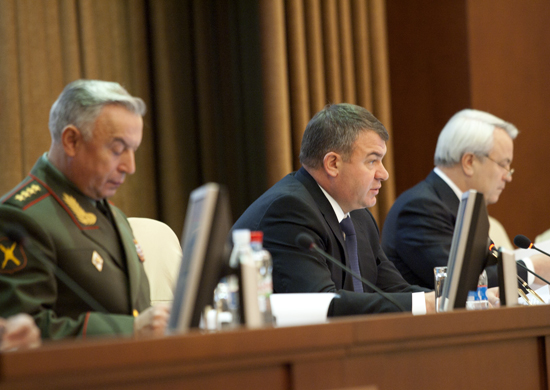
Serdyukov Flanked by Makarov and Pankov

November’s the time for year-end evaluations in the Russian military, and the Defense Ministry had its collegium yesterday.  Mil.ru printed Defense Minister Serdyukov’s introductory remarks.

First on his mind was complete fulfillment of the State Defense Order next year, and signing all GOZ-2012 contracts next month.  He said all responsibility for ordering will be transferred to a “Federal Procurement Agency.”

Some media sources assumed this means Rosoboronpostavka.  This author thinks it could be something new.  It’s important, so here’s exactly what Mil.ru says he said:

“Next year the functions of the ordering organ are being fully transferred to the Federal Procurement Agency.”

If that means Rosoboronpostavka, why not just say Rosoboronpostavka?  ITAR-TASS actually replaced Serdyukov’s words “Federal Procurement Agency” with Rosoboronpostavka.  At the very least, not everyone’s working from the same sheet of music.  But continuing with Serdyukov’s remarks . . .

Unlike large-scale strategic exercises of recent years, the coming year will stress tactical-level training.  But Southern MD exercises will test the new Armed Forces command and control system.

He noted establishment of VVKO by December 1, and said it will “intercept any targets right up to hypersonic speeds, both in the air and in space.”

Military police will start working in the troops in 2012, according to Serdyukov.  They are still occupied at present with selecting personnel, writing regs, etc.  Serdyukov earlier said they’d be functioning in 2011.

The Defense Minister indicated all service functions in the Armed Forces will be outsourced next year.

Without much fanfare, he said the new system of enlisted contract service will start in 2012.

Serdyukov said stimulus pay for officers will continue alongside their newly-approved higher pay.

First Deputy Defense Minister, Chief of the General Staff Nikolay Makarov delivered the collegium’s main report, but the press wasn’t invited to stay.

Meanwhile, today NG sources “don’t exclude” that Anatoliy Serdyukov could soon leave the Defense Ministry to become Finance Minister.  There’s talk Russia’s NATO Permrep Dmitriy Rogozin could succeed him as Defense Minister [because he toured the 58th Army with Medvedev this week].

There are always rumors like these.  Recently it was said Makarov would be “sacrificed” as an electoral offering to military men who don’t like him.  Sometimes the rumors bear out, sometimes not.  More important are the reasons behind any personnel changes. 

Is Putin or Medvedev likely to find a more effective steward of the military than Serdyukov?  Probably not.  The fiery politician Rogozin would be a dramatic change from the retiring technocrat Serdyukov.  The former would inspire and appeal to the troops more than the latter, but not do a better job.  Of course, we shouldn’t assume capability is the leadership’s most important criterion in picking a Defense Minister.

Makarov Reports to Public Chamber

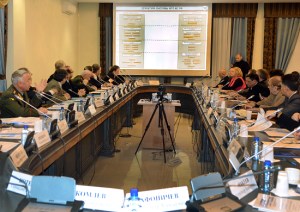
Makarov Briefs the Public Chamber

According to Mil.ru, General Staff Chief, Army General Nikolay Makarov reported to the Public Chamber today as part of its hearings on “The New Profile of the Russian Army:  Results, Problems, Prospects.”  Here’s a sampling of what he discussed.

According to ITAR-TASS, Makarov said there are 186,400 contract servicemen today, and there will be 425,000 in 2016.  Recruiters will work throughout Russia starting next year.  Prospective contractees will train for three months before signing contracts.  Minimum pay will be 23,000 rubles.  Makarov said 2012 will be a test year, and from 2013, 50,000 contractees will be signed up each year.

RIA Novosti printed Makarov’s stark assessment of Russia’s conscript manpower.  The General Staff Chief said, of all men liable to conscription, only 11.7 percent can be called up, and 60 percent of them are excluded for health reasons.  So, he concludes:

“Therefore we are practically faced with the fact that there is almost no one to callup into the Armed Forces.”

He said Russia’s current mobilization reserve consists of 700,000 ex-conscripts. 

Makarov suggested increasing the prestige of military service through a veteran’s preference system.  Former soldiers and officers would enjoy a priority in hiring for government service, according to RIA Novosti.

ITAR-TASS quoted Makarov on cuts in military command and control organs.  He indicated they’ve been cut by a factor of four — from 51,000 to 13,435 personnel, and this process continues.  One-third of C2 organs were disbanded, and the rest reduced in size several times. 

He indicated that, when the Defense Ministry’s central apparatus numbered 51,000, it occupied more than 20 buildings in Moscow.  The apparat is now in a single building.  Other buildings were sold off.  But Makarov assured his audience the effectiveness of C2 hasn’t declined because of the reductions.

Regarding the new pay system for officers, RIA Novosti wrote that Makarov said higher pay basically implements the old Order No. 400 on premium pay, but officers will still have the chance to receive extra “stimulus” pay under the new system.

ITAR-TASS printed Makarov’s figures on efforts to get rid of old ammunition.  According to the General Staff Chief, at the start of the year, Russia had 119.5 million tons of old munitions to destroy, but now only 7 million.  Less than one percent could be dismantled; the vast majority had to be blown up.  Makarov indicated the number of ammunition storage sites will drop from 161 at present to about 30.

Makarov defended his past criticism of domestic weapons and equipment by giving more examples where foreign systems are superior to Russian ones (i.e. tanks, MLRS, satellites), according to ITAR-TASS.  The general argued for increasing the range and service life of systems as well as providing better protection for soldiers operating them.

RIA Novosti reported Makarov intends to continue pushing for lower prices on arms and equipment the military’s buying.  He intimated there will be a “specialized department” for negotiating with producers.  He claimed shipbuilding contracts with OSK were concluded on the Defense Ministry’s terms.  He added that the military has given Almaz-Antey two years to build two new factories to produce the S-500, according to RIA Novosti.

ITAR-TASS relayed Makarov’s remarks on Russia’s airfields.  Makarov indicated Russia has cut from 357 military airfields down to 26 that he describes as meeting world standards.  Russia has eight air bases. 

He said pilot flight hours are at 90 per year.  He said it’s planned to increase them to 130 next year, and then to 220 at some point.

ITAR-TASS and RIA Novosti carried the General Staff Chief’s comments about threats on Russia’s borders: 

“Under certain conditions, local and regional conflicts can grow into mass ones with the employment of nuclear weapons.”

“The conflict which could occur in connection with the withdrawal of American troops [from Afghanistan] could lead to a local, regional and even large-scale one.  And we have to be ready for it.”

It’s 60-40 for Serdyukov

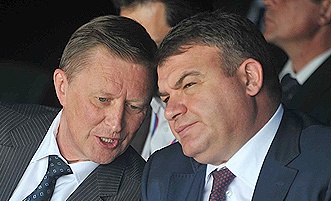
Serdyukov and Ivanov (photo: Komsomolskaya pravda)

After a couple months and 50 votes, Defense Minister Anatoliy Serdyukov got past his predecessor Sergey Ivanov by a margin of 30 votes to 20 for the title of better defense minister.

It was interesting.  Serdyukov (your author’s choice) jumped out to a big lead, and Ivanov spent the rest of the time trying hard to catch up, but never quite making it.  Every time Ivanov started to, Serdyukov supporters came out and boosted his numbers.

It was surprising though.  Your author thought Serdyukov would crush Ivanov.

Of course, none of this was scientific.  And it was a fallacious comparison.  The men arrived in different circumstances and experienced different situations.

For this author’s money, though, Serdyukov has done a much better job with the hand he was dealt.  Primarily because he’s actually done some things.  And he broke the uniformed military’s grip on defense policymaking.  Granted, the results haven’t been exactly perfect.  And, over time, views of Serdyukov will be influenced by what comes after him.  But 60 percent in this little poll isn’t a bad showing for a guy who encountered and tamed a lot of resistance along the way.

Ivanov, by contrast, was timid, tentative, and generally ineffective, in this writer’s view.  To be fair, he held less favorable cards by comparison, especially early on.

It may possible, of course, that the 20 votes for Ivanov are anti-Serdyukov votes rather than pro-Ivanov.

If you voted and would like to comment about your thinking either way, others would be interested to read it.

The GRU’s Smiling Face

General-Colonel Aleksandr Shlyakhturov

One would like to get off the GRU topic, but we have to follow the news to some extent.  General-Colonel Shlyakhturov not only spoke in advance of the November 5 military intelligence anniversary, but actually posed for a photo sporting a smile and his third star.

We don’t learn much here.  There are confirmations of what we’d already heard and read recently, or even long ago.  The GRU’s adapted for new missions, but keeps the old ones.  The threat from Georgia is emphasized as in previous years.  Military intelligence still falls under the Genshtab.  Shlyakhturov admits to restructuring and reducing, but insists the GRU’s still a “full-service” intelligence agency.  Spetsnaz has gone to the MDs, but the GRU still has a train and equip role.  Shlyakhturov hints that military intelligence is still very interested in foreign technology.

Interviewed in Rossiyskaya gazeta, the GRU Chief tells the paper how much times have changed, and the military intelligence agency now talks in terms of many-sided and multivector threats, rather than the “probable enemy.”

Shlyakhturov expounds on how terrorists and extremists pose the “greatest danger,” and the GRU monitors the situation in regions, like Georgia, from which this danger may emanate.  He’s quick, however, to deny that Russian special services have engaged in any subversive activity whatsoever against sovereign Georgia.  But, he says, the GRU will provide timely warning to the country’s military-political leadership if Tbilisi prepares “new military provocations against Russia and its regional allies.”  Changing tack, Shlyakhturov stresses that the GRU puts great stock in cooperating with special services of other countries to get threat information.

The GRU Chief says the agency is focused on “new” issues like economics, natural resources, and nuclear proliferation.  But it hasn’t lost focus on the disposition of foreign armies and armaments in different theaters of military operations and other issues that affect the employment and development of Russia’s Armed Forces.

Asked about reporting to the president, Shlyakhturov emphasizes that, as always, the GRU reports directly to the Defense Minister and Genshtab.  But the GRU’s most important documents still reach the president, prime minister, and Security Council, and influence Russia’s foreign and defense policies.

Shlyakhturov says the GRU has redistributed its efforts to focus on regions posing a threat to Russia’s interests and security, “hot spots” where terrorists and extremists operate, and crisis zones where international stability is threatened.

The GRU Chief admits there has been a reorganization and reduction in his agency.  As he puts it:

“Here’s the main thing you need to understand:   the changed world situation objectively required adjustments in intelligence priorities and their implementation mechanism.”

He notes, however, that the GRU still has operational, technical, information-analytical, and support sub-units as well as what he claims is a very spartan central apparatus, or headquarters staff.

Spetsnaz has, Shlyakhturov admits, gone to the MDs, fleets, and VDV, but he says they’re still part of operational intelligence, and the GRU provides their doctrine, training, and equipment.

Finally, he says the GRU remains interested in foreign technology developments, and its work here supports R&D efforts, the OPK, and the state program of armaments.

GRU Rumors

Moskovskiy komsomolets reported some rumors about the GRU yesterday.  But one may or may not want to put stock in them. 

MK reports that the country’s leadership is still working over a candidate for chief of the GRU.  General-Colonel Shlyakhturov’s request for retirement was given a month ago, and the president has signed it.  But MK claims the issue of GRU reform is also being decided.

The media’s widely reported that the retiring Shlyakhturov will become Chairman of the Board of the Defense Ministry’s Oboronservis corporation, which is consolidating, civilianizing, and outsourcing most of the military’s logistics and support services.  More recently, it’s been said he’ll occupy the same position with Russia’s lead ballistic missile design bureau, MIT.

MK claims Shlyakhturov isn’t retiring for failing to fulfill his mission, or for disputes with the leadership, or for age reasons (since he was already too old), or for poor health.  According to the paper’s Genshtab source, it’s because a reform awaits the GRU.

MK’s source reports there’s a plan to unify the GRU and SVR into one powerful intelligence center.  The GRU would be cut down to just an intelligence directorate with Russia’s military attaches and intelligence posts around the country, etc.

MK also reports a key appointment.  One general Vladimir Stepanovich Alekseyev has reportedly become First Deputy Chief of the GRU.  He was chief of intelligence for the former Moscow MD, then for the Far East MD.  He returned to Moscow to be chief of the GRU’s 14th Directorate (Spetsnaz), according to MK’s GRU source.  The paper says he could be chief of the GRU in the future.  Alekseyev is from GRU operational agent intelligence inside Russia and the “near abroad.”  Shlyakhturov was from strategic agent intelligence, that is, spies and operations in the “far abroad.”

OK, some of the odd stuff here . . . for one, there’s already been reform in the GRU, so wouldn’t this be more reform, or more radical reform?  MK makes the good point that it’s not clear why Shlyakhturov’s retiring — he’s been too old for a long time, so why now?  Maybe it is a much bigger restructuring that eliminates the “G” in GRU.  There’s long been talk of merging GRU and SVR, but the paper strangely refers to SVR being formally within the FSB’s structure (?!).  Now about Alekseyev . . . perhaps he’s the guy who would head an RU focused on Russia’s strategic approaches and the CIS (i.e. military opintel), while the GRU’s remaining “far abroad” assets chop to the SVR.  This makes some sense since RU-type work and opintel seems to be where the GRU failed in Georgia.  And then SVR gets swallowed by an even bigger fish, the FSB, in a grand reanimation of the KGB for Putin’s third presidential term.  But, as said at the top, one may not want to see too much in all this.

Cadre Changes

President Medvedev’s decree yesterday dismissed Russia’s senior military representative to NATO, Army General Aleksey Maslov, who was once Ground Troops CINC.  Fifty-eight-year-old Maslov leaves a little early for a four-star general.  No word on whether he requested to retire.  At any rate, other generals might be shuffled about to fill the NATO milrep spot, or it might be gapped for a time.

But on to the decree.

Appoint:

  • Captain 1st Rank Igor Valentinovich Grachev, Chief, Missile-Artillery Armaments Directorate, Northern Fleet.
  • Colonel Sergey Semenovich Nyrkov, Commander, 9th Independent Motorized Rifle Brigade.

Relieve:

  • Colonel Sergey Faatovich Akhmetshin, Deputy Chief, Main Staff, Air Forces.
  • Colonel Dmitriy Valeryevich Laptev, Commander, 9th Aerospace Defense Brigade.

Relieve and dismiss from military service:

  • Rear-Admiral Yuriy Prokopyevich Yeremin, Chief, Navy Military Training-Scientific Center “Naval Academy” (1st Branch, St. Petersburg).
  • General-Major Aleksandr Viktorovich Shapekin, Chief of Staff, First Deputy Commander, Operational-Strategic Command of Aerospace Defense.

Dismiss from military service:

  • Army General Aleksey Fedorovich Maslov.

Cadre Changes

In yesterday’s decree, President Medvedev retired General-Lieutenant Sadofyev, Deputy CINC of the Air Forces and Aviation Chief.  As you’ve read, he was sometimes the service’s spokesman, especially on modernization issues.  Sadofyev turned 55 (normal age limit for two-stars) in January.  At one time,  he looked like a candidate to replace Air Forces CINC, General-Colonel Zelin, who continues to serve. 

Medvedev made General-Major Vladimir Gradusov Deputy CINC of the Air Forces.  He wasn’t given the Aviation Chief title to replace Sadofyev directly.  But he has the background for it.

General-Major Gradusov

As the decree said, Gradusov comes from the 185th Combat Training and Combat Employment Center in Ashuluk.  Krasnaya zvezda recently profiled him. 

He’s 53 (maybe 52).  Native of Moscow Oblast.  Trained at the Kharkov Higher Military Aviation School for Pilots.  Served as pilot-instructor at Kharkov.  Commanded the training squadron at the Krasnodar Higher Aviation School,  training foreign students on the L-39 and MiG-21. 

He’s commanded fighter regiments, and served in the former Kiev, North Caucasus, Transbaykal, and Siberian MDs.  In 2003, he left the post of aviation chief of the Siberian MD’s air and air defense army for the training center job in Ashuluk. 

He’s mastered the L-29, L-39, MiG-21 (all mods), MiG-29, MiG-31, and An-26.  Apparently not a Sukhoy guy.  KZ notes without elaboration that Gradusov has been in combat.

But on with the decree . . .

Appoint:

  • Colonel Andrey Mikhaylovich Bulyga, Chief, Material-Technical Support Planning and Coordination Directorate, Central MD.
  • General-Major Vladimir Yuryevich Gradusov, Deputy CINC, Air Forces, relieved as Chief, 185th Combat Training and Combat Employment Center.
  • Lieutenant Colonel Andrey Borisovich Yefimov, Chief, Missile-Artillery Armament Service, Southern MD.
  • General-Major Fraiz Fazlyakhmetovich Salyyev, Chief, Technical Support Directorate, Central MD, relieved as Chief, Technical Support Directorate, Southern MD.
  • Colonel Mikhail Anatolyevich Khvostenkov, Chief, Missile-Artillery Armament Service, Eastern MD.

Relieve and dismiss from military service:

  • Rear-Admiral Vitaliy Nikolayevich Ivanov, Chief of Fleet Communications, Deputy Chief of Staff for Communications, Pacific Fleet.
  • General-Lieutenant Igor Vasilyevich Sadofyev, Chief of Aviation, Deputy CINC of the Air Forces for Aviation.

Cadre Changes

This is President Medvedev’s decree from Monday which has the swap of General-Lieutenant Zarudnitskiy for Tretyak as Chief of the GOU.

Relieve:

  • General-Major Valeriy Leonidovich Shemyakin, Deputy Commander, Military-Transport Aviation.

Relieve and dismiss from military service:

  • General-Major Yevgeniy Anatolyevich Derbin, Deputy Chief, State Administration and National Security Faculty, RF Armed Forces Military Academy of the General Staff.
  • General-Lieutenant Andrey Vitalyevich Tretyak, Chief, Main Operations Directorate, RF Armed Forces General Staff — Deputy Chief, RF Armed Forces General Staff.

Appoint:

  • Colonel Dmitriy Anatolyevich Voloshin, Chief, Combat Training, Long-Range, Military-Transport and Special Aviation, Chief Inspector-Pilot.
  • General-Lieutenant Vladimir Borisovich Zarudnitskiy, Chief, Main Operations Directorate, RF Armed Forces General Staff, Deputy Chief, RF Armed Forces General Staff, relieved as Deputy Commander, Southern MD.