Category Archives: Military Leadership

Naginskiy at Spetsstroy

The dust’s settled a bit on this story . . . in a 22 April decree, President Medvedev replaced Nikolay Abroskin as Director of the Federal Agency for Special Construction (Spetsstroy), putting Deputy Defense Minister Grigoriy Naginskiy in Abroskin’s place.
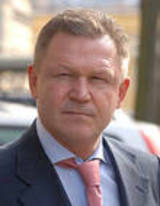
Grigoriy Naginskiy

What does the change at the top of this large, government-financed construction firm — nominally under Defense Ministry control — indicate?

Ending Abroskin’s 13-year tenure in the Spetsstroy empire took four years. According to Kompromat.ru, Defense Minister Serdyukov’s wanted Abroskin out from beginning, but, unlike in other personnel situations, it took him a while to win out.

The media says the anti-Abroskin operation was methodical.  On his 60th birthday, four-star Army General Abroskin was dismissed from the Armed Forces, but left in his civilianized post.  This created the convenient precedent to have another civilian succeed him.  Then Medvedev dismissed Abroskin’s long-time deputies and allies. 

According to Kommersant, Spetsstroy’s annual collegium in late March was a solemn affair, devoted mainly to talk about order, discipline, and anticorruption efforts.  But the Main Military Prosecutor wouldn’t tell Kommersant whether it was investigating Abroskin or anyone else at Spetsstroy.  Then the final stroke on Abroskin came three weeks later.

Spetsstroy’s a semi-militarized agency with ranks and, until this spring, conscripts, under formal Defense Ministry control, but traditionally and generally acting as an independent federal agency.  As its name suggests, Spetsstroy is responsible for special government construction projects – in the Soviet and Russian past, it built secret industrial, defense, and specialized facilities, but has also built more mundane military housing, bases, garrisons, road, and electrical power projects.  It also builds major state infrastructure like hydroelectric stations, dams, and bridges. 

Most of Spetsstroy’s work is no longer for the Defense Ministry.  Kommersant says only 26 percent of its 2010 work was for the Defense Ministry.  A Defense Ministry official told Vedomosti the territorial divisions of Spetsstroy, in particular, work essentially like private construction firms and contractors.  Kompromat put its 2009 revenue at 67.7 billion rubles, making it a large company, even a market leader, by Russian standards.

Its most recent controversy revolves around the alleged “Putin palace” on the Black Sea.  According to Newsru.com and other media outlets, Spetsstroy is building a billion-dollar residence for Prime Minister Putin’s personal use.  The money for the elaborate Italianate mansion allegedly came from Putin’s rich business cronies.

Now about Naginskiy . . . you remember his arrival at the Defense Ministry in early 2010 to be Serdyukov’s deputy for housing and construction.  The 52-year-old Piter native’s a construction magnate who got rich renovating nuclear power plants, and then entered politics.  He joined United Russia in 2002, and served in the Leningrad Oblast assembly before representing his region in the Federation Council.

According to Forbes, he’s the richest official in the Defense Ministry, but he’s only 45th on the list of millionaires in government service.  His family income was over 100 million rubles in 2009.  Finans places him as the 163rd richest Russian. 

But Argumenty nedeli makes the point Naginskiy didn’t exactly cover himself with glory while directing military housing acquisition.  An unnamed Defense Ministry official tells Argumenty:

“The state program to provide housing to all officers and retirees is 15-20 percent complete.  Billions have been absorbed, but more and more are needed.  Deputy Minister Naginskiy, who directed it [military housing] last year, during construction site visits by the president and prime minister vowed and swore that everything would be done on time.  Now instead of the planned 2011 when they promised to provide housing, the authorities are forced to talk about the end of 2013.”

Recall also that Naginskiy went without portfolio starting in mid-2010, and his colleague Deputy Minister Shevtsova found housing in her lap.

All the good journalistic coverage of the Spetsstroy story agrees on one, well two, things.  Getting rid of Abroskin was all about controlling an agency that was too independent and, more importantly, controlling its money.  As Kompromat concludes, it’s natural for Serdyukov to want his man to have his hands on these large “financial flows.”  Kompromat suggested Serdyukov may have also had his eye on selling some of Spetsstroy’s expensive Moscow real estate. 

But this isn’t all there is to the story . . .

  • Argumenty makes the point that Serdyukov has holes in his top management team.  Six months without a main finance officer has left the Defense Ministry behind on placing armaments contracts (again threatening a bad year for GOZ fulfillment).  And now Serdyukov’s lost First Deputy Defense Minister Popovkin to Roskosmos.  Popovkin’s replacement will be a huge story.  Even if Shevtsova has the housing issue, Serdyukov absolutely has to replace Chistova and Popovkin.  And Nezavisimaya gazeta suggests Serdyukov will soon appoint a new deputy primarily responsible for establishing aerospace defense (VKO).
  • Ruslan Pukhov tells Vedomosti the whole situation proves Serdyukov still has carte blanche from the country’s leadership, and NG claims Serdyukov’s political position has never been stronger.
  • Kommersant makes a point of saying that Abroskin doesn’t appear on the list of Russia’s richest bureaucrats, suggesting of course that this career serviceman might have amassed a fortune, but can’t report it because it was obtained through graft.  Perhaps the paper’s larger point is that appointing a wealthy executive from a private firm is the only chance for avoiding corruption in a high-level post.

Could Serdyukov Go?

Svpressa.ru asked yesterday if it’s possible Defense Minister Anatoliy Serdyukov might be dismissed in the runup to the presidential election.

It asked political analyst Aleksey Makarkin if any ministers might be dismissed to appease angry voters.  Svpressa noted the Kremlin has something of a tradition of firing some high-ranking officials to garner the electorate’s good will.  The media outlet asked him which current ministers might be sacrificed.

Makarkin answered:

“Society is pretty calmly inclined toward the current ministers.  But the people and the elite have different irritants.  If, let’s say, in the elite, great attention is given the role of Deputy Prime Minister Igor Sechin, then the populace is poorly informed about what he’s doing.  It happens that there’s what they write in the business press, and there’s what they show on television.  And the public, on the whole, watches television.”

“I think if ministerial dismissals happen, they will be connected not with an allegeric reaction among the people.  There are ministers that have complicated relations with the bureaucratic structures they direct.  These relations have formed in the course not of decades, but of centuries.  Now problems are notable in two such bureaucracies.”

“The first is the Defense Ministry which from the very beginning was very critical of Anatoliy Serdyukov — a strictly civilian person without a general’s rank.  The second is the Ministry of Health and Social Development.  It’s true the situation there is somewhat different.  It wasn’t initially negative for Tatyana Golikova.  But she isn’t a doctor, and she’s running up against a sufficiently cohesive medical community.”

“The difference [between Serdyukov’s and Golikova’s situations] is that Serdyukov has military men as his subordinates.  They aren’t inclined toward opposition demonstrations, and military retirees don’t have real influence on army processes.  There was the situation when Serdyukov had a conflict with the VDV Academy in Ryazan.  But General-Lieutenant Vladimir Shamanov, a well-known army figure, thought it best not to exacerbate the affair — the brakes were quickly put on the conflict.”

“Of course, internal dissatisfaction with Serdyukov is strong in the military.  Whereas at first this was dissatisfaction with the minister’s persona itself, the details of his biography (Serdyukov was once in the furniture business), but later with his activity in seriously reforming the army (that is the work to which they assigned Serdyukov).”

“Yes, it’s possible to recall the army reform under Aleksandr II — one of the greatest reforms of that time, together with freeing the serfs.  Then Milyutin’s military reform was also met very critically by a significant part of the military corporation.  They accused him of being a professor who didn’t have sufficient military experience.  And his accusers were famous combat generals . . .”

“Serdyukov’s situation is more complex, because he’s an outsider.  Naturally, the reforms he’s conducting — cutting the army as a whole, cutting generals, restructuring the military district system, taking the shoulderboards off some representatives of the military corporation, whose duties civilians can fulfill — are causing serious disapproval.”

It’s interesting to hear a purely political perspective on where Serdyukov and the Defense Ministry stand.  But it seems unlikely the Defense Minister would be cut loose when this would be a more public admission of failure than the recent reversal of several of his policies.  Serdyukov is more likely to be moved aside under cover of an ostensible elevation.

Makarkin’s right when he points out that army problems almost exclusively concern and affect the military caste.  They are routinely low on the list of worries of average Russians.   

But Makarkin shouldn’t dismiss the significance of unhappiness among military veterans and retirees.  True, they don’t necessarily have influence.  Their attitudes toward defense policymaking roughly mirror the moods of active duty military men who can’t attend political demonstrations or speak out in public.  Most Moscow commentators, like Makarkin, have probably gotten used to not pausing long to ponder what Russian military men think about politics.

Another Trouble Brigade

Today’s Presidential ukaz on military personnel changes is attracting attention because it relieved and dismissed General-Lieutenant Vadim Volkovitsky from the service.  Of late Volkovitskiy was First Deputy CINC of the Air Forces (VVS), and Chief of the Main Staff. 

General-Lieutenant Volkovitskiy

He’s a career air defender who’s been a two-star for the last ten years.  He’ll be 55, statutory retirement age next Friday.  He commanded air and air defense troops in the Urals in 2006, and came to Moscow and the VVS headquarters in 2007.

We don’t really know why Volkovitskiy’s going out right on time, but it does seem President Medvedev and Defense Minister Serdyukov have made an effort to keep senior officers from serving forever.

God-Forsaken Pechenga

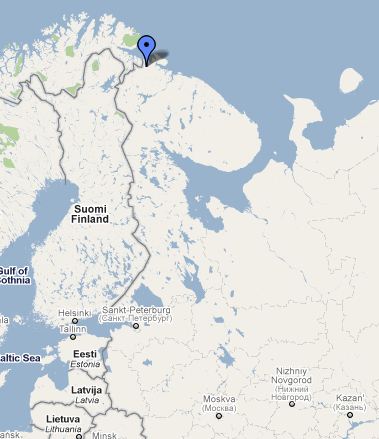
Far more interesting is the President relieving Colonel Vitaliy Leonidovich Razgonov, Commander of the 200th Independent Motorized Rifle Brigade based at god-forsaken Pechenga.  He’s only been commander there for 18 months. 

The 200th Brigade remains in its Cold War deployment along the Russian border with Norway.  It’s probably not what the Defense Ministry has in mind for its future Arctic brigade. 

This brigade has more than its share of trouble, and Colonel Razgonov’s apparent inability to control his men might — repeat might — have something to do with the change of command.  The ukaz, of course, gives no reason.

Just on Monday, Komsomolskaya pravda published on all of v / ch 08275’s problems.  The paper’s reporters say this command is unable to maintain elementary order.  The brigade’s officers complain that today’s young men are already so corrupted that the army can’t fix them, and that they don’t have any tools to deal with disorder among their men.  But KP says the soldiers don’t look disorderly during the day, but become that way at night when they’re unsupervised in the barracks.  The paper suggests the officers themselves are corrupt and disorderly at Pechenga.

Several weeks ago a conscript from Dagestan got three and a half years for killing an ethnic Russian junior sergeant in June 2010.  The command initially tried to make it look like an accident rather than murder.  Svpressa.ru suggests 4 or 5 men from Dagestan beat the victim.  The Soldiers’ Mothers Committee helped his family get the military prosecutors on the case.

Another conscript was beaten severely right on the brigade’s parade ground in early March.  According to IA Regnum, the young man — a graduate of the Murmansk School of Music — had two operations and his spleen was removed.

Last September a conscript shot and killed another conscript before shooting himself to death.  The parents of the shooter don’t believe this version of what happened, and have turned to the Soldiers’ Mothers Committee for help.

Last May, the chief of the brigade’s missile-artillery service stabbed his wife and six-year-old son to death.  He was subsequently diagnosed as a paranoid-schizophrenic.  This can happen anywhere, but it’s interesting it happened in a place already so afflicted with misfortune.  One wonders if there isn’t more to the story.

Where does this leave us?

It’s hard to say.  All the evidence of trouble is, so to say, circumstantial when it comes to Colonel Razgonov and whether he’s up to the job or has been derelict.  We don’t have enough information.  Maybe Razgonov himself asked to be relieved.  Who knows?  But it may be that someone in the chain, in the Defense Ministry or elsewhere, recognized a situation that needs to change.  The question now is will it?

Popovkin to Roskosmos?

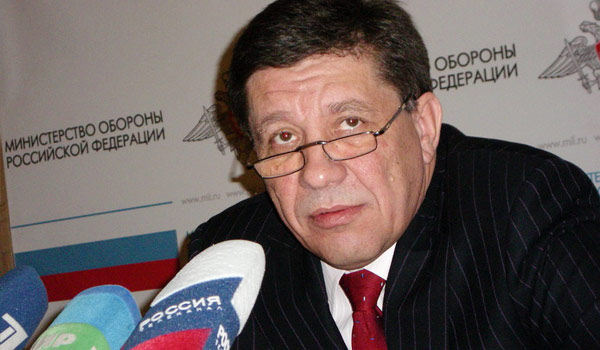
Vladimir Popovkin (photo: Sobakidendy-news.ru)

Friday Marker.ru reported rumors from its sources saying First Deputy Defense Minister, and GPV 2011-2020 architect, Vladimir Popovkin will relieve Anatoliy Perminov as Director of Roskosmos.  This is interesting because it supposedly features a little tandem tension between President Medvedev and Prime Minister Putin.

Marker.ru’s Ivan Cheberko writes that Perminov will resign at “his own request,” and become a presidential adviser for space issues.  For his part, Popovkin had hoped to replace Sergey Ivanov as Deputy Prime Minister with responsibility for the defense-industrial sector.  But Medvedev and Putin couldn’t agree on Ivanov’s fate, according to Cheberko’s report, and they proposed that Popovkin should head Roskosmos.

A source close to Perminov told Cheberko the Popovkin decision was made last week:

“The president and prime minister couldn’t determine Ivanov’s future, and they proposed Popovkin to head Roskosmos.  The Defense Minister has already signed the corresponding paperwork.”

Cheberko’s two independent missile-space sector sources say there have been three candidates for the Roskosmos job — Popovkin, Popovkin ally and deputy General-Lieutenant Oleg Frolov, and Roskosmos Deputy Director Vitaliy Davydov.  Frolov reportedly would have gotten the job if Popovkin took Ivanov’s spot.  Roskosmos rank-and-file lobbied for Davydov in hopes of avoiding changes Popovkin would make.  His views diverge from those of the agency’s current leadership, and he’s expected to make many personnel and organizational changes.  Among other things, Cheberko highlights Popovkin’s strong support for a new liquid-fueled heavy ICBM versus missile designer Yuriy Solomonov’s vocal public opposition to such a plan.

Unfortunately, Mr. Cheberko only dug so deep.  There’s a bit more to this story.

On the eve of the 18 March expanded collegium, Sergey Ivanov told the Federation Council the Defense Ministry was to blame for late placement of the State Defense Order (Гособоронзаказ, ГОЗ, or GOZ) this year.  Even prior, he had lots of sharp public criticism for Perminov, Roskosmos, and their failures.  Of course, Ivanov himself has long suffered at Putin’s hands over GLONASS, so he’s just letting stuff roll downhill, so to speak.

In his collegium speech, President Medvedev railed about problems with the GOZ last year, and demanded a “post-flight debriefing” to identify which industry and state officials are to blame.

Prime Minister Putin followed the collegium with a March 21 government session on the defense order at the Votkinsk missile plant.  Ivanov and Perminov were there, and probably Popovkin too.  The latter was very much on the defensive afterwards, asserting that GOZ-2010 was fulfilled “on the whole.”  And he blamed last summer’s heat wave and forest fires for disrupting defense production.

So where’s it leave us?

As Marker.ru implies, it appears Popovkin’s position isn’t too strong, and he could be headed out of the Defense Ministry after only 8 months on the job.  This would take away one of the louder proponents of buying arms and equipment abroad if necessary.  It begs the question who replaces Popovkin, and what does it mean.  Possibly someone closer to Serdyukov.  Never known for his skill as a political infighter, Sergey Ivanov actually comes out of this looking like a semi-adept bureaucratic warrior.  It’s interesting to imagine Medvedev and Putin discussing Ivanov’s fate when he was once thought the frontrunner in Operation Successor 2008.

Would the Army Oppose Siloviki Loyal to Putin?

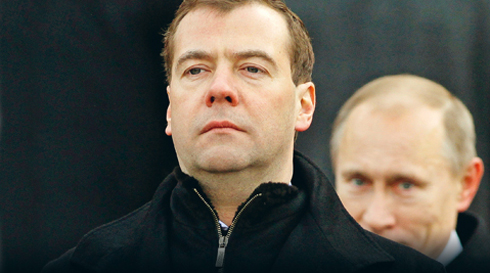
Medvedev and Putin (photo: Reuters)

An unnamed FSB veteran thinks it would.

Monday New Times published a piece on the state of the tandem and political prospects over the next year leading up to the elections which will determine who will be Russia’s president until 2018.

The article’s authors ask whether Medvedev and Putin, frightened by North African events, might be determined to preserve the status quo by any means.  Or perhaps the president and prime minister face an inevitable clash.  The authors have consulted unnamed experts and present their findings.  Scenario No. 2 is Apocalypse Tomorrow.  The mood of the siloviki – in this case, rank-and-file men with uniforms, ranks, and guns – is key to Scenario No. 2 – the tandem blown up.  The authors ask “how would the siloviki conduct themselves if Medvedev decided to fire the premier and his entire government?  On whom would the experts bet?”

The authors asked former USSR intelligence and special service veterans of coup d’etats to sketch out what we’d see in the event of Apocalypse Tomorrow.  They sketch out some of the things Putin and the government would do in addition to calling for the support of the siloviki.

In the end, the article examines the possibility that Putin might agree to go, with the right personal and financial guarantees in place.  His situation is not, after all, exactly like Mubarak’s or Qaddafi’s.

The article ends like this:

“’Putin can hardly count on the silovik bloc if the matter gets to mass bloodshed,’ even a highly placed employee of the FSB’s Spetsnaz Center, which today joins in its structure Directorate A (formerly Group A) and Directorate V (formerly Group Vympel).  ‘His sole full-blooded reserve capable of entering the fray is the Internal Troops [VV], and mainly the VV Spetsnaz’ – the so-called maroon berets.  ‘They are the ones in 1993, after one of the Vympel groups refused to participate in suppressing the civilian population, who fulfilled the given mission’ (this means preventing the storming of the Ostankino television center – New Times).  ‘As far as the FSB Spetsnaz goes, after so many years of ‘reforming’ silovik sub-units, officers will scarcely be zealous in putting down civilians.  Quite the opposite.  It wasn’t for this that they risked their lives in the Caucasus.’  The weakest link, in the opinion of the same expert, is the army:  ‘Among the troops there’s a lot of negative information and dissatisfaction with the reforms that are being introduced.  Promises that a lieutenant will soon receive 50 thousand rubles just remain promises, the apartment issue isn’t resolved.  After the mass dismissal of officers – just in the past year 140 thousand completely young ‘reservists’ were put out in the streets – they will easily return to the ranks [i.e. Serdyukov’s reversal increasing the officer ranks by 70,000], but now they know who their enemy is.  Plus the disbanding of the GRU Spetsnaz.  As a result, the opposition will have something to oppose the Internal Troops.  So the generals will think a thousand times before giving the order to open fire, and if there is the slightest suspicion about the illegitimacy of the mission received, they’ll do everything to sabotage it.’”

“The experts polled by New Times come together on one thing:  a bloody scenario has a greater than 50% probability in one case:  if the premier and his closest silovik circle seriously fear for their lives and property and don’t get a security guarantee.  And now before their eyes there’s even a living example:  going peacefully into retirement Mubarak has a chance to preserve part of his billions frozen in Switzerland, Qaddafi shooting at his own people no longer has such a chance.”

Interesting scenarios, but there are a couple things your present author isn’t so sure about.  Firstly, two things not factored in that could be significant are:  the mood of the average militiaman [i.e. cop] who are very numerous and are also being ‘reformed,’ and the unhappiness among military retirees and older vets demonstrated recently in their Moscow assembly and last year on Poklonnaya gora.  One’s not sure, though, if they’re more supportive of Medvedev or Putin.  Given the choice, they’d probably shoot both.  Secondly, is Medvedev really the type to enter that kind of standoff (or any standoff actually) while holding very few, if any, good cards to play?  At the same time, one is cautious about assuming rational actors.  It’s perfectly conceivable the Russians could blunder and miscalculate their way into Apocalypse Tomorrow.

Meanwhile, Ancentr.ru was following a similar tack earlier this week . . . it looked at the recent personnel decisions regarding General-Lieutenant Valeriy Yevnevich which moved him from the GUBP to Deputy Chief of the General Staff and then to Assistant to the Defense Minister (ostensibly, to advise on peacekeeping activities).  The website thinks this interesting since Yevnevich is a ‘political’ general who as Taman division commander supported President Yeltsin in the 1993 battle with his opponents.  And, it says, such a decisive and staunch supporter of ‘democracy’ as Yevnevich could be useful to vlasti in a responsible post given the general growth in political tension in society, including also a “rise in disloyalty in the army.”  For example, he could command special VDV or other sub-units in an emergency to ensure their loyalty to the regime.  Ancentr.ru goes on to detail other reports from NVO’s Vladimir Mukhin about the level of discontent in the army’s ranks as well as ex-General Staff Chief and Security Council staff member Yuriy Baluyevskiy’s possible role as leader of a military backlash against Defense Minister Serdyukov’s reforms.

Serdyukov’s Anniversary

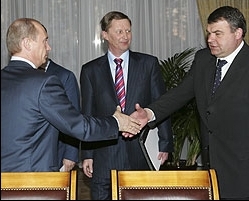
Putin Welcomes Serdyukov as Ivanov Looks On

The fourth anniversary of Anatoliy Serdyukov’s appointment came and went quietly enough on 15 February.  But WikiLeaks has come through as if to mark the occasion.  

On Friday, it posted an Amembassy Moscow assessment of Defense Minister Serdyukov a month and a half after he arrived in the “Arbat Military District.”  Mindful of hindsight bias, one can’t judge this cable too harshly.  But it’s an interesting retrospective on what was expected of the man going in, and what has happened since.

As stated all over the Russian media, Amembassy anticipated Serdyukov would impose discipline on the “Ministry’s notoriously loose financial control system,” and not otherwise initiate major changes.

Aleksandr Golts told Amembassy:

“Serdyukov’s inexperience on military issues would undermine his credibility with the General Staff and other senior officers, hindering his ability to push through needed reforms.”

A bit silly in retrospect.  Yes, he had no credibility with the Genshtab, nor it with him.  But he didn’t care and pushed right through the Genshtab, cutting the Genshtab (it suffered first in the reforms) and building his own bureaucratic machinery in the Defense Ministry.

Amembassy claimed that Serdyukov dismissed then-Chief of the Main Directorate of International Military Cooperation (GU MVS) General-Colonel Anatoliy Mazurkevich, and that Serdyukov’s auditors might be driving other corrupt officers into resignations or dismissals.

The cable describes the Defense Minister aptly as a “detail-oriented micromanager and ruthless policy administrator.” 

But what it doesn’t note (and what has become patently obvious over the last four years) is that the Defense Ministry, and the Russian military, is an unwieldy and untidy establishment not well-suited to micromanagement.  Talk about trying to turn an aircraft carrier on a dime . . . not gonna happen here. 

A couple stories come to mind . . . Serdyukov trying to put new uniforms on the troops, one of his first initiatives.  Now maybe only 20 percent of the troops have them, and the parents of those that do say the new uniforms aren’t as good against the cold as the old ones.

Also, Serdyukov talking about one new brigade commander who didn’t implement his directives.  It’s a big country and a big army.  What Moscow says isn’t always relevant in Chita, etc.

Next, Amembassy summarized the views of Ivan Safranchuk this way:

“He thought the Ministry establishment would try to ‘outlast’ any reforms that Serdyukov sought to impose, with the brass counting on Serdyukov to adjust to their way of thinking — or at least to stay out of their way.  Safranchuk told us that former DefMin Ivanov ultimately had not made a significant impact on how things functioned within the Ministry, despite his reform efforts, and predicted the same fate for Serdyukov.”

This one turned out to be pretty wrong, didn’t it?  There may still be some elements awaiting Serdyukov’s departure and a return to the way things used to be, but too much has changed.  The military establishment can’t ever be exactly what it used to be.  And the brass was definitely no match for Serdyukov, and he didn’t stay out of their way, but rather sent many of them down the highway.  And this Defense Minister has had a greater impact in four years than Sergey Ivanov in nearly six.  Ivanov’s fate was not to be Putin’s successor, and to muddle around in his next job, i.e. First Deputy PM.  As for Serdyukov’s fate, we’ll have to see.  As for his impact, at least some is likely to be lasting.  How long?  Only until the next determined reformer arrives.  None of this is to say Serdyukov’s impact is all positive, mind you.  Some changes may have messed things up worse than they were.  But he got reform off the dime in a way Ivanov never dreamed.

Here’s video of Putin’s meeting with Ivanov and Serdyukov on 15 February 2007.

The cable continues:

“Sergey Sumbayev, a former journalist with Krasnaya zvezda (Red Star), told us that management and accountability within the Ministry were dysfunctional and fostered inefficiency and corruption.  He referred both to financial accountability and responsibility for policy implementation.  Sumbayev thought the Ministry’s entrenched bureaucracy resisted, mostly successfully, institutional change, which generated considerable waste and delayed delivery of modern weapons systems to the armed forces.”

Sumbayev also told Amembassy:

“. . . management experience and tenacious work ethic make [Serdyukov] the ideal ‘technical’ manager that the Ministry needs.  While acknowledging Serdyukov’s political connections, Sumbayev did not think Serdyukov harbored any political ambitions.  He was chosen mainly for his managerial expertise, loyalty, and willingness to please his political bosses.  Serdyukov could probably make progress in streamlining the Ministry’s management structure, reducing waste, and exerting more control over its financial accounting systems.  One year, however, would not be sufficient to accomplish these tasks.”

“Sumbayev speculated that keeping the General Staff off-balance and focused on internal matters over the next year was one of Putin’s objectives in appointing Serdyukov. In this respect, he suggested that Serdyukov had a mandate to shake things up in the Ministry without sparking too much discontent.”

Amembassy concluded that:

“Serdyukov has his work cut out for him in bringing order to a Ministry badly in need of reform.”

Serdyukov’s made progress, but this final assessment probably remains true four years on.

Shamanov Returns to Duty

VDV Commander, General-Lieutenant Vladimir Shamanov reported for duty today a little more than three months after his BMW was slammed by a truck on the highway between Tula and Moscow.

Shamanov was discharged from Burdenko Main Military Clinical Hospital in late December, and has been on rehabilitation leave in Sochi since then.

Also injured in the accident, then-acting commander of the Tula-based 106th Airborne Division, Colonel Aleksey Naumets remains in the hospital in satisfactory condition after more surgery.

The Tajik national who rammed into Shamanov’s service vehicle admitted his guilt in the accident.  He remains in custody while the investigation and court proceedings continue.

New Deputy Defense Minister

Antonov with Medvedev and Serdyukov (photo: Kremlin.ru)

Today President Medvedev made Anatoliy Ivanovich Antonov Deputy Defense Minister for International Military Cooperation.  He’ll bear responsibility for organizing and conducting the Ministry’s contacts with foreign military departments.  Kremlin.ru notes Antonov was one of the negotiators for the new Treaty on Strategic Offensive Arms.  Medvedev said Antonov’s experience in this successful negotiating process will enable him to fulfill his new duties effectively.

Anatoliy Antonov

PIR-Tsentr’s short biography of Ambassador Antonov says he’s been serving as Director of the Foreign Ministry’s Security and Disarmament Issues Department.  He was born in 1955.  In 1978, he graduated the USSR Foreign Ministry’s Moscow State Institute of International Relations (MGIMO or МГИМО).  In 1983, he completed graduate study at the same institution.  Antonov’s worked in the Foreign Ministry since 1978.  He’s headed government delegations in G8, NPT, Inhumane Weapons Convention, and multilateral export control negotiations.  He’s a member of the U.N. Secretary General’s Consultative Council on Disarmament.

In mid-2007, Antonov helped then-President Putin unveil his offer to use Russia’s Gabala and Armavir radars in NATO missile defense, according to Novosti KM.RU.

Antonov makes nine deputies to Serdyukov; a tenth deputy slot for finance-economic work has been vacant since Vera Chistova’s departure in the fall.

Antonov’s quite different from his predecessors in this job.

International military cooperation seemed to fall off the Defense Ministry’s radar for a while after Anatoliy Serdyukov took over.  You may recall, former Main Directorate for International Military Cooperation (GU MVS) Chief, General-Colonel Anatoliy Mazurkevich fled the Defense Ministry when Serdyukov arrived.  GU MVS essentially disappeared from the military department’s organizational chart.

GU MVS’ roots stretch back to the General Staff’s old 10th Main Directorate, which had a long history of involvement in arranging arms sales and providing military advisors and training to Soviet client states in the bad old days.

General Staff Chief Makarov’s Retirement Rumored

On Thursday, Argumenty nedeli said its source claims Defense Minister Serdyukov will soon send some well-known generals into retirement.  The Defense Ministry press service, of course, denies it.

AN’s source says the departure of these generals isn’t due to conflict between them and Serdyukov, but rather to the latter’s policy of “rejuvenating” Russia’s high command.  Among those who will allegedly be retired:

  • General Staff Chief, Army General Nikolay Makarov (61).
  • Deputy Defense Minister for Rear Services, General-Colonel Dmitriy Bulgakov (56).
  • Air Forces CINC, General-Colonel Aleksandr Zelin (57).
  • Navy CINC, Admiral Vladimir Vysotskiy (56).
  • Space Troops Commander, General-Lieutenant Oleg Ostapenko (53).

It’s interesting because none of them is really up against the legal age limit for leaving military service.  And Makarov apparently already has a service term extension from President Medvedev. 

One presumes, according to AN’s information, that the Ground Troops CINC, and RVSN and VDV Commanders are safe for now.

AN also expects some of the newly appointed MD commanders to be dismissed or moved to new posts.

There are other angles to AN’s story besides more rotation in cadres.

First, it repeats earlier press on trouble in finding a replacement for “key military department figure,” former Deputy Defense Minister for Finance-Economic Work Vera Chistova who left her post three months ago. 

An AN source in the Finance-Economic Service claims the lack of a replacement puts in doubt Prime Minister Putin’s promise to deliver a 6.5 percent increase in military pensions on 1 April.  Budget resources weren’t allocated for this.  And there’s still no candidate to replace Chistova.  And without one such issues simply won’t be resolved. 

AN doesn’t mention also that as active duty officer pay is reformed this year, the Defense Ministry will have to figure what to do about retiree pay.  If, as expected, they break the long-standing link between active pay and military pensions, the vets aren’t going to be very happy just before the 2011 and 2012 elections.  Putin just courted representatives of veterans’ organizations about a week ago.

According to AN, the Defense Minister has offered the military finance portfolio to more than one official at different levels in the Finance and Economic Development Ministries, but all of them declined.

The military department’s officers are also talking loudly about the coming appointment of a new Serdyukov deputy who will be called in to “correctly”  track the military’s political preferences ahead of the fast-approaching legislative and presidential elections.  

A high-ranking but unnamed military man tells AN

“He will be an important civilian and definitely a member of ‘United Russia.’  It goes without saying this is connected with the upcoming parliamentary and presidential elections.  The negative mood of officers is great, it is directed against the minister, his assistants and the party of power which is conducting the reforms without considering the human costs.”

Zelin Out?

An Interfaks source in the Defense Ministry says Air Forces CINC, General-Colonel Aleksandr Zelin might be retiring on age grounds.  The rumor goes that Zelin’s Deputy for Aviation, General-Lieutenant Igor Sadofyev will relieve him, while Zelin moves into a defense industry job.  RIA Novosti reports the same story, citing several media outlets.  The Air Forces spokesman, meanwhile, says the VVS cannot comment because it doesn’t have any information to this effect.

RIA Novosti talked to defense commentator Igor Korotchenko, who expressed caution about the Zelin rumor, but said the move to four MDs / OSKs has diminished the service CINC’s influence:

“The role and place of the main commands of the services of the Armed Forces has been reduced accordingly.  Practically all aviation, except strategic, will be subordinate to the OSK commander.”

He says the story of Zelin’s possible departure may have surfaced because of the downgrading of the service CINCs.

It’s interesting that age was cited since Zelin’s only 57, and can serve until age 60 under the law.  He’s headed the VVS since May 2007. 

The three-star general was the subject of dismissal rumors in 2009 when the General Staff Chief and Defense Minister were allegedly unhappy with his insufficient command of air-space (aerospace) defense (VKO) issues.  See Newsru.com and Grani.ru for that story.