Category Archives: Military Leadership

Will the Genshtab and OSKs Replace the Glavkomaty?

Writing in Vremya novostey yesterday, Nikolay Khorunzhiy claims the recently-concluded, largest post-Soviet exercise – Vostok-2010 – was intended to test the establishment of four operational-strategic commands (OSK or ОСК) in place of Russia’s six military districts, as well as the establishment of structural sub-units of the General Staff in place of the Main Commands (Glavkomaty or Главкоматы) of the Ground Troops, Air Forces, and Navy.

Khorunzhiy continues:

“It’s proposed that the army’s new structure will allow a sharp cut in the steps in passing commands from 16 levels to three, and increase their precision and reliability.  On 6 July, President Dmitriy Medvedev signed a decree establishing OSKs.  Part of the authority of central command and control organs, but also that earlier entrusted to the Glavkomaty, are going to the OSKs.”

The 6 July decree still hasn’t appeared publicly. 

Khorunzhiy notes that then-General Staff Chief Yuriy Baluyevskiy tested the transition to regional commands during Baykal-2006:

“Then he didn’t manage to break the resistance of district commanders who didn’t want to share their authority with OSK commanders.”

Khorunzhiy digresses to the precursors of OSKs, without calling them High Commands of Forces.  Former General Staff Chief Nikolay Ogarkov set out to reform the army’s command and control:

“The instrument of such a reform he considered main commands on strategic directions (theaters of military operations, in modern terminology) which would improve coordination between services and troop branches and would strengthen the unity of command in combat units (permanent readiness units).”

Ogarkov viewed the Soviet North-Western, Western, and South-Western main commands of troops from World War II as prototypes, but these Glavkomaty were only intermediate links between the Headquarters,  Supreme High Command [Stavka VGK] and the fronts, but received no authority, troops, or communications.  Khorunzhiy contrasts this to Vasilevskiy being sent to fight the Japanese in 1945; he had authority and troops.

Then, in 1978, Army General Vasiliy Petrov was sent out to establish the Main Command of Troops of the Far East, and he had authority up to appoint regiment commanders and arrange cooperation with neighboring states.  The situation of troops in the Far East sharply improved.

Ogarkov set off then to establish main commands on strategic directions, and improve command and control and readiness in yearly exercises (West, East, Autumn).  But in 1984, Ogarkov himself was sent off to be CINC of the Western direction in Legnica.  He failed to get enough authority for these commanders from the CPSU or Defense Ministry, and these main commands were eliminated in 1991.

But Khorunzhiy goes on to describe today’s OSK as an ultimate victory for Ogarkov over the ‘parochial interests of the army elite.’  He doesn’t seem to wonder whether it might be too soon to declare victory.

He finishes by looking at the KPRF’s call for a parliamentary investigation and special Duma session on how Serdyukov’s reforms are ‘disarming Russia.’  In particular, Khorunzhiy quotes the KPRF press-service:

“The system of military districts which has existed for centuries has just been eliminated.  In place of them incomprehensible strategic commands have been established according to an American template.  It’s obvious that this endless modernization of military structures is leading unavoidably to the loss of troop controllability.”

What’s it all mean . . . ?

The possible elimination of the Main Commands — the service headquarters — would be a big deal (no one mentioned what might happen to VDV, Space Troops, or RVSN branch commands).   

This would obviously greatly strengthen General Staff Chief Makarov, and really make him lord and master of the uniformed military.  It would strengthen the General Staff (except Serdyukov’s been cutting its personnel, like the rest of the Central Apparatus).

Would it give Makarov too much power?  Maybe, or maybe not if Serdyukov thinks he can fire him and get another general whenever necessary.

The possibility of eliminating service headquarters makes Navy CINC Vysotskiy’s reticence to talk about moving to St. Petersburg in the midst of a command and control reorganization make more sense.  Maybe he was telling us there’s a much bigger issue at work than just OSKs.

Perhaps in the most objective sense, getting rid of the Glavkomaty would reduce personnel and some resistance to new ideas.  But wouldn’t it also throw away yet another place where the regime should seek good alternative ideas, counterarguments, and feedback on its plans?
Interim OSK Commanders Named

Late Thursday Interfaks learned that Defense Minister Anatoliy Serdyukov signed an order naming acting commanders of Russia’s four new military districts, or operational-strategic commands (OSKs).

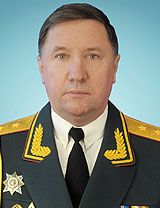
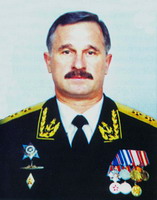
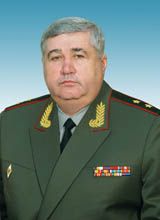
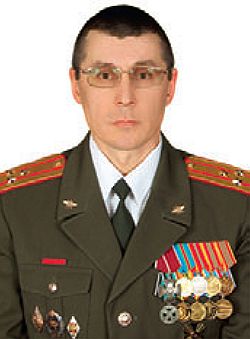
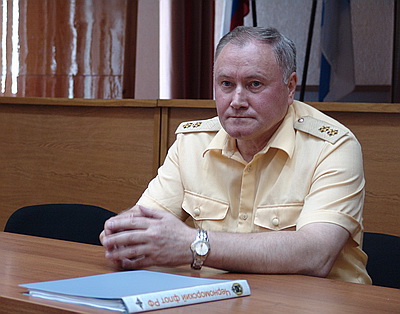
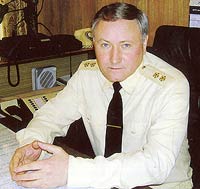
Volga-Ural MD Commander, General-Colonel Arkadiy Bakhin will be the interim commander of the new Western MD.  Siberian MD Commander, General-Lieutenant Vladimir Chirkin will temporarily head the new Central MD.  Pacific Fleet Commander, Admiral Konstantin Sidenko will command the new Far East MD for now.  And North Caucasus MD Commander, General-Lieutenant Aleksandr Galkin will head the the new Southern MD. 

General-Colonel Bakhin

General-Lieutenant Chirkin

Admiral Sidenko

General-Lieutenant Galkin

Serdyukov wants the new command and control scheme operating from the start of the new training year on 1 December.

Kommersant noted general surprise that a naval officer was picked to head the Far East MD.  Ground Troops generals have always commanded the army-dominated MDs.  But a Navy Main Staff source said Sidenko is not new to commanding army units; he once commanded the combined Navy-Ground Troops force on Kamchatka.

Kommersant also said extramural Defense Ministry collegiums will evaluate the effectiveness of these reorganizations before the end of the year.

Makarov’s Guys Take Key Posts

Bakhin, Chirkin, and Galkin prospered under General Staff Chief Nikolay Makarov when he was Siberian MD Commander from 2002-2007.  Each of them served as an army commander, deputy MD commander, and chief of staff, first deputy MD commander under Makarov in Siberia (or immediately after his departure for Moscow).  Chirkin served as Bakhin’s chief of staff, first deputy commander of the Volga-Ural MD, before becoming Siberian MD Commander this year.

Sidenko is a submariner, and most of his career has been in the Pacific Fleet.  His experience as ‘Commander of Troops and Forces in the North-East’ is, interestingly enough, a little similar to Makarov’s late 1990s time as ‘Commander of Ground and Coastal Troops, Deputy Commander of the Baltic Fleet for Ground and Coastal Troops.’

Bulgakov Adds More to His Portfolio?

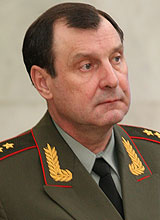
General-Colonel Bulgakov

In addition to his new title Deputy Defense Minister for Material-Technical Support and his responsibility for arms and equipment supplies, General-Colonel Dmitriy Bulgakov has apparently also picked up Grigoriy Naginskiy’s duties as Chief of Housing and Construction. 

Bulgakov accompanied Prime Minister Putin on a tour of military apartments under construction in Volgograd today.  The contractor told Putin the land was acquired three years ago, but delays in installing utilities held up construction until this year.  They also complicated the process and added 5,000 rubles to the per-square-meter cost of the apartments. 

Bulgakov was quoted saying the first batch of apartments in the new mikrorayon for servicemen (739 apartments) will be turned over in December.  He also said 1,978 servicemen need housing in the city.

Deputy Signals Chief Goes Down for Corruption

Colonel Andrey Kolupov (photo: Kommersant)

While President Medvedev may despair of the continuing corruption plague in Russian government and society, the Defense Ministry went after a fairly high-ranking figure this week. 

There’s been nothing general on the military corruption situation since earlier this year, so the Kolupov case is just an interesting, isolated one. 

A decorated combat veteran of Chechnya and Dagestan, Colonel Kolupov is the General Staff’s Deputy Chief of Communications, and he was in line to succeed his retiring boss until a check uncovered his failure to return a Defense Ministry apartment in Voronezh when he received another one in Moscow. 

In 1996, he had a 54-square-meter apartment in Voronezh with his wife and daughter.  In 2002, Kolupov became a senior officer of the MVO’s communications directorate.  Two years later he had a second daughter and received a three-room, 81.7-square-meter Moscow apartment, which he privatized in 2008, according to Kommersant

Meanwhile, Kolupov let his mother-in-law to privatize the service apartment in Voronezh rather than returning it to the Defense Ministry.  The loss to the state was put at 6.3 million rubles.  The colonel has been charged with large-scale fraud.  He apparently hasn’t acknowledged wrongdoing, and refused to speak with Kommersant

Kolupov’s housing machinations are less egregious than ones occurring in the Railroad Troops Command in recent years.  But there seems to be a campaign against apartment manipulations by senior military officers.  Generally, it might be possible to conclude that the Defense Ministry’s anticorruption efforts are relatively more vigorous and effective than those of other ministries, but it would also be impossible to prove this with any certainty.  And the key word is relatively.  The scale of Defense Ministry efforts may not be significant in an absolute sense against the scope of its overall corruption problem.  One can easily think of other apartment- and housing-related corruption, involving military men and civilians, that isn’t scrutinized similarly.

New Commander, Old Fleet

Vice-Admiral Korolev (photo: Novyy Region)

As expected, Northern Fleet Chief of Staff and First Deputy Commander, Vice-Admiral Vladimir Ivanovich Korolev (Королёв) officially replaced Vice-Admiral Aleksandr Kletskov as Commander of the Black Sea Fleet on 2 July.  

Turning 55 next month, Kletskov retired on age grounds, but, as only Kommersant bothered to note, Korolev turned 55 in February, so President Medvedev has either officially extended his service a couple years, or plans to give him another star, allowing him to serve to 60, under the law. 

Novyy Region quoted Navy CINC Admiral Vysotskiy introducing the new BSF Commander: 

“Vice-Admiral Korolev is a competent leader, possessing good personal knowledge and work habits, both in the staff and in command duties.” 

About Korolev’s background . . . after finishing officer commissioning school in 1976, he was assigned to a Northern Fleet nuclear submarine, serving as a division head in the navigation department.  

According to Kommersant, in the mid-1980s, he served in the Gadzhiyevo-based 24th Division of Submarines (24th DiPL).  He eventually served as executive officer and commander of Victor II-class (proyekt 671RT) SSNs  K-488 and K-387.  He completed mid-career Higher Specialized Officer’s Classes in 1987. 

In 1993, he became Deputy Commander of the 24th DiPL, and completed his advanced education at the Kuznetsov Naval Academy in 1995.  He then moved to the Northern Fleet’s Operations Directorate as chief of an unidentified department, then chief of fleet ASW.  

By August 2000, he was Commander of the 24th DiPL, and in 2002 became Commander of the Sayda Guba-based 12th Squadron (24th and 18th DiPLs). 

On 19 November 2007, Korolev became Deputy Commander of the Northern Fleet, and was appointed Chief of Staff and First Deputy Commander in August 2009. 

Media reports haven’t mentioned whether he’s married or has children. 

Korolev faces a large number of unresolved military and social issues in his fleet.  It has an extremely high percentage of old ships that aren’t combat capable.  Some problems with Ukraine persist despite the recent improvement in relations and the Kharkov agreement extending Russia’s Crimean presence to 2042, as well as the promise of 15 new ships and submarines which followed it. 

Independent analyst Aleksandr Khramchikhin told Novyy Region Korolev inherited a fleet in bad shape: 

“The fleet is in a state of disappearance, complete collapse.  It’s obvious the commander needs to stave off this collapse somehow.  But I don’t understand very well how this can be done.  Because these promises of numerous ships don’t correspond very much to the record of recent decades, and it’s extremely hard to believe in them.” 

“The basic mission of the fleet commander is to try to keep the fleet from dying, even though its service life is close to zero.  He can’t do anything because he doesn’t build ships.  The Black Sea Fleet has gone to the limit of obsolescence.  It’s the very oldest of our fleets.  It’s the only one of the fleets in which there are still ships built in the 1960s.  It’s the only one in which there’s been practically no kind of renewal in the post-Soviet period.” 

“It’s hard to understand what missions are being given to the BSF.  Let’s say it can’t even be closely compared with the Turkish Navy in forces, it is so much weaker.  I repeat, our entire Navy is in a state close to collapse, but the Black Sea Fleet is in first place in this regard.” 

An anonymous BSF staff source told Novyy Region Korolev’s first task is to replenish the fleet with new ships, not just secondhand Baltic Fleet units.  His second job is placing orders for repair and construction of ships not just at the BSF’s 13th Factory, but at Ukrainian shipyards as well.  

The fleet’s social problems are next.  It has hundreds of officers whose duties were eliminated, but they can’t be dismissed since they don’t have apartments.  The source says these guys are walking around in uniform, but have no jobs.  Korolev’s fourth task is a related one–returning Moscow Mayor Luzhkov to full engagement in Sevastopol.  Luzhkov is no longer building apartments there as he has in the past owing to a dust-up with the Defense Ministry over the handling of property in Sevastopol.  

Lastly, Korolev has some real naval missions to worry about like securing southern energy routes, the 2014 Winter Olympics, antipiracy operations, and keeping a Russian presence in the Mediterranean. 

Regarding Admiral Vystoskiy’s promise of new ships and submarines for the BSF, Moscow Defense Brief analyst Mikhail Barabanov told Kommersant the civilian and military leadership may see the fleet’s reinforcement a priority because it may more likely see real combat action than the Northern and Pacific Fleets.  

A Kommersant BSF staff source describes Korolev’s main mission not as planning for new ships by 2020, but simply supporting the combat capability of a fleet contracting before our eyes.

Naginskiy ‘Freed’ From Housing Duties

Grigoriy Naginskiy

This morning’s press reported (with varying degrees of accuracy) that the Chief of Housing and Construction, Deputy Defense Minister Grigoriy Naginskiy has been ‘freed’ from his principal duties, but remains a Deputy Defense Minister.  See Kremlin.ru for the text of President Medvedev’s decree.

The midst of a year of trying to deliver on huge permanent military housing promises seems an odd time to make yet another change of housing chief.

The decree also moved a two-star named Sergey Zhirov from his post as Chief of Staff, First Deputy Chief of Rear Services to a position called “Director of the Department of Planning and Coordination of Rear Support of the Defense Ministry.”

These could be the opening moves in Defense Minister Serdyukov’s reported effort to establish a unified material support establishment responsible for arms, equipment, and all logistics.

Not Enough Officers in ‘New Type’ Brigades?

In today’s Vedomosti, Aleksey Nikolskiy writes that Vostok-2010 has revealed a problem with officer manning in Russia’s ‘new type’ brigades.

In the course of the exercise, practically all SibVO and DVO permanent readiness units have been ordered to training ranges to test out their new TO&E and train their higher-level command elements.

Nikolskiy says:

“In the words of an officer of one of the motorized rifle brigades participating in the exercise, the new structures sent to the troops at the end of 2008 after the beginning of Armed Forces reform showed that officer manning and supply services are extremely inadequate, for this reason part of the brigades’ forces — for example, air defense means — can’t physically reach the training range.  There were bigger problems also with material support of the troops.”

Vedomosti’s source also says the troops are expecting new brigade structures in August that, according to the rumor, will contain even fewer officers.  A brigade’s officers will reportedly be halved, from 200 to 100, and this will just make the situation worse.  However, an officer from the Defense Ministry’s central apparatus says the new structures are being prepared based on the shortcomings of the exercise, and, if it’s decided there aren’t enough officers, their number will increase.

Korolev Said Next BSF Commander

Vice-Admiral Korolev

Northern Fleet Deputy Commander and Chief of Staff, Vice-Admiral Vladimir Ivanovich Korolev (Королёв or kor-ol-YOV) will replace current Black Sea Fleet Commander Vice-Admiral Aleksandr Kletskov when he turns 55 in August, according to a ‘highly placed’ RIA Novosti source in the Navy Main Staff.

Rumors to this effect have been around.  In early June, Rupor.info cited an Interfaks story on this.  But Kletskov deputy Vice-Admiral Sergey Menyaylo was not ruled out as a possible successor.

The RIA Novosti source claimed Kletskov was already on leave, and Korolev participated in last week’s talks between Russian Defense Minister Serdyukov and his Ukrainian counterpart in Crimea.

Korolev looks to be a career Northern Fleet submariner.

Popovkin for Kolmakov

A long-swirling rumor that First Deputy Defense Minister, General-Colonel Aleksandr Kolmakov would be forced into retirement became a fact this week.  Talk of this dated to March.  Defense Minister Serdyukov didn’t want both of his first deputies [Kolmakov and General Staff Chief Makarov] occupied with combat training and readiness, reportedly wanting to end this unnecessary division and competition.  More recently, Aleksandr Golts said Kolmakov’s and Makarov’s activities with operational troops intersected, even though nothing was ever heard about tensions between the two generals. 

Argumenty nedeli indicates Kolmakov more than once firmly, but tactfully, expressed his disagreement with Serdyukov’s reforms, specifically the elimination of warrant officers and the posting of excess officers in sergeant’s duties.

It’s not precisely clear who will benefit from Kolmakov’s departure.  The press largely assumes it’s the Genshtab and the main commands of the armed services and branches, but it’s no longer as easy as that.  Golts linked the Kolmakov change with the move to 4 military districts or operational-strategic commands (OSK or ОСК).  He argues that putting all ground, air, and naval forces under 4 operational commands would weaken all central supervisory organs, including the Genshtab and main commands.  As for Kolmakov’s Main Combat Training Directorate, it might move somewhere else, morph into something else, or simply disband.

Deputy Defense Minister and Armaments Chief Vladimir Popovkin takes his old portfolio and responsibilities to his new post as First Deputy Defense Minister.  So as much of the Russian media has noted, rearmament is an entirely new priority and job description for the First Deputy.  One wonders if Popovkin will even have a successor in his old position. 

All observers seem to agree, however, that the swap of Popovkin for Kolmakov and rearmament for troop training focuses the Defense Ministry on providing the troops what they need and the Genshtab and uniformed commanders on training them.  Read Kommersant and Rossiyskaya gazeta for more on this.

Popovkin himself told Rossiyskaya gazeta

“We decided to divide the Defense Ministry’s administrative and operational functions.  A civilian  channel is being created which will support the troops.  A second channel will conduct combat training, all troop activities connected with the operation and use of armaments and military equipment.  It’s been decided to withdraw purchases of armaments and everything else from the duties of the Chief of Rear Services and the Chief of Armaments and to appoint a responsible person who will order and purchase all this.”

This would all seem to connect in the person of Nadezhda Sinikova, whom Medvedev and Serdyukov recently appointed to head and invigorate Rosoboronpostavka.  Military men will continue to make their own orders and requests, but Sinikova’s organization will deal directly with suppliers.

Here’s what President Dmitriy Medvedev said to Popovkin on 22 June:

“Naturally I wish you success and hope that the sector you will coordinate, – this is, first of all, the armaments sector and military equipment and the resolution of a series of issues connected with the civilian component  in the Defense Ministry, – will develop successfully, and we will be able to realize this state armaments program which we are now coordinating.”

“This is a large-scale program, complex, intense, however, at this time, it is directed at establishing on the current foundation a modern, effective armaments system for our army, to reequip, and fully supply it in the framework of those priorities on which we agreed and which must create the basis for the development of our Armed Forces in the future to 2020 and even to 2030.”

“This is a large, complex task.  I hope we have forever gone away from the situation of patching holes in the Armed Forces, which was characteristic in the 1990s and the beginning of this century, and we have set out on a different basis of work.”

“But here methodical, scrupulous work is needed especially with military equipment suppliers because they are sometimes pampered and don’t provide quality, and very unpleasant price increases appear for us.  Therefore we have to hold everything taut, but at the same time acquire everything our Armed Forces need to be combat capable and well trained.”

Gazeta.ru asked to Deputy Chairman of the Duma Defense Committee Igor Barinov to explain what Medvedev was saying about the Defense Ministry’s suppliers:

“Prices on VPK products are growing out of proportion with the growth of inflation and taxes.  For example, the ‘Topol-M’ increased 2.5 times in 3 years, and a sniper rifle cost less than 30 thousand rubles at the beginning of the 2000s, but now the Defense Ministry buys them for 400 thousand.”

“Enterprises don’t want to reduce defects, they place incomprehensible prices on their own products—some places because of corruption, some places because of a lack of restraint.  It’s impossible to allocate money if a process of systematizing price formation doesn’t occur.”

In Vremya novostey, Pavel Felgengauer describes Popovkin as one of the drivers of the current military reforms:

“Popovkin was the first to begin publicly saying that the problems of the Russian VPK are connected with a large lag behind the West.  And he was first to acknowledge that Russian space system use large amounts of Western components.  Before him no one publicly talked about this.  And in 2008 Popovkin was first to announce that Russia will buy foreign military equipment, and not just components.”

An informed, anonymous source also told Vremya novostey that Popovkin is an “old acquaintance” of Medvedev and Putin.  And he will be the Defense Ministry’s real number two man, pushing Army General Makarov lower in the de facto hierarchy [of course, this overlooks the very good likelihood that Serdyukov maintains his own hierarchy based on his own team of trusties and it probably doesn’t include any ex-generals like Popovkin].

Popovkin’s official bio can be found here.

Karakayev Replaces Shvaychenko as RVSN Commander

Lots of action near the top of the Russian military pyramid today . . . 

General-Lieutenant Andrey Shvaychenko’s exceptionally brief tenure as RVSN Commander came to an abrupt and unexpected end.  He just turned 57 on June 18, and only commanded Russia’s land-based strategic forces for a little over 10 months.  His predecessor—Nikolay Solovtsov—served for 8 years. 

Already past retirement age for his two-star rank, President Medvedev and Defense Minister Serdyukov apparently decided to replace rather than promote him. 

The timing of Shvaychenko’s replacement is interesting and most likely not accidental, to say the least.  The Russians have swapped out a key figure just as they enter the process of ratifying a new strategic arms treaty with the United States. 

General-Lieutenant Sergey Viktorovich Karakayev replaces Shvaychenko.  Like his predecessor, he’s a two-star general, but 8 years younger.  He served as Chief of Staff, First Deputy Commander of the RVSN just since last October.  He occupied RVSN command positions up to and including missile division commander and Vladimir Missile Army commander in 2006-2008.  

General-Lieutenant Karakayev

Somewhat atypically, he served some time as a department chief in the Defense Ministry’s Main Personnel Directorate.  He completed studies in the civilian North-Western State Service Academy before finishing the General Staff Academy.  He holds a doctorate in military science.  His full biography is here

Kremlin.ru provided the following excerpt from today’s Gorki meeting between Medvedev, Serdyukov, and Karakayev: 

“This is a serious position.  The functioning of our nuclear shield depends on work in these duties.  And of course, I hope that you will do everything necessary, everything dependent on you to apply your knowledge, your experience for the good of the country, to create the right RVSN command and control system.” 

“Despite the fact that we are reducing our nuclear arsenal, this must not affect the combat core within the limits of that agreement which is currently operative for us, and within the limits of that agreement which is in ratification.” 

“Generally, it’s necessary to do everything so that our Rocket Troops of Strategic Designation will be fully combat ready and can fulfill their established missions.” 

Karakayev gave a customarily brief response: 

“Comrade Supreme Commander-in-Chief, I will not fail.” 

Pervyy kanal covered also covered the Gorki meeting, if you’d like some video.  

The change in the RVSN may be a result of the bumps and bruises of reaching internal agreement to go forward with the new strategic offensive arms treaty.  Or maybe not.  But something’s clearly wrong; a ten-month tenure is clearly far off the norm.  Medvedev’s short comments aren’t much to go on, but they seem to say (a) Shvaychenko wasn’t doing the job the way his masters wanted; (b) the masters want an improved strategic nuclear command and control system; (c) the new arms treaty doesn’t threaten Russia’s nuclear deterrence capability and, therefore, is a good deal for Moscow; and (d) the RVSN Commander needs to focus his attention on the optimal operation of whatever weapons systems provided him by the country’s leadership.  And Karakayev indicated in front of the cameras that he’s on-board with all this. 

Armaments Chief Vladimir Popovkin also replaced First Deputy Defense Minister, General-Colonel  Aleksandr Kolmakov.  Popovkin seems to have accommodated Serdyukov, and fit well into the Defense Minister’s ‘new profile.’  The ex-Space Troops general seems to be the type of official the civilian leadership wants in its more civilian Defense Ministry.  He will keep charge of the weapons portfolio, and training and readiness accounts overseen by Kolmakov will probably go back to the Genshtab.  But more on this one tomorrow.