Category Archives: Navy

Suicidal Lieutenants

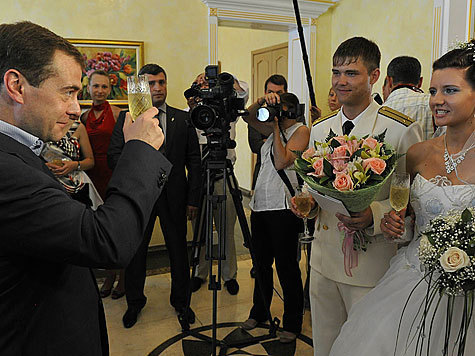
President Toasts the Kuropatkins (photo: Aleksandr Astafyev)

The Pacific Fleet command and investigators say the shooting of a 22-year-old lieutenant assigned to a 35-year-old LST in Fokino was a suicide attempt, and not the result of ‘nonregulation relations’ or dedovshchina.  The incident occurred 1 December.  Lieutenant Maksim Kuropatkin was found with a gunshot wound to the head, and he remains in a coma.  Investigators say he shot himself with his service sidearm in the presence of two witnesses.  No criminal case has been initiated.  Their preliminary conclusion is that Kuropatkin suffered a nervous breakdown caused by difficulty adapting to life in the service.

Moskovskiy komsomolets point out the Kuropatkin case is a little special because President Dmitriy Medvedev was the surprise guest of honor at the lieutenant’s wedding in early July.  Medvedev was touring the Far East, and arrived at Birobidzhan’s wedding palace in time to witness three marriages including Kuropatkin’s.  Medvedev wished the lieutenant and his bride a “long happy family life.”  He ordered the governor of the Jewish AO to find apartments for all three couples.  About a month ago, the Kuropatkins got their apartment.

Kuropatkin’s family doesn’t believe his shooting was a suicide attempt.  They say he was always goal-oriented, and aimed for a military career from age 14 (presumably he attended a Nakhimov Naval School).  He graduated from the Pacific Naval Institute late this spring, married, and had been in his first assignment only a couple months.

They also say Kuropatkin recently mentioned the name of a senior officer who often picked on him, and was constantly nagging him to draw up some kind of documents, and when Kuropatkin refused, he said, “Well, that’s it, it’s the end for you.” 

A 24-year-old lieutenant named Ivan Yegorov died in what was also called a suicide aboard Slava-class CG Varyag in mid-November.  MK sums up saying:

“According to the opinion of knowledgeable people, dedovshchina in the officer environment ranges up to physical violence and shootings.”

RIA Novosti also reported a Baltic Fleet suicide this week.  A 23-year-old lieutenant from the Pionerskiy garrison reportedly shot himself in the chest with a Makarov pistol.  He apparently left a note.  The chair of the Kaliningrad Committee of Soldiers’ Mothers said she was completely surprised by this incident, adding that there have never been “any signals” of problems from the unit where this lieutenant served.

Scapegoat Biront Wins in Court, for Now

Lieutenant Colonel Biront (photo: http://www.odnoklassniki.ru)

Last Tuesday, the Lyubertsy Garrison Military Court held President Medvedev’s dismissal of Lieutenant Colonel Viktor Biront to be illegal.  Recall Biront was the President’s and the Defense Ministry’s scapegoat when the 2512th Central Aviation-Technical Base of Naval Aviation burned in this summer’s infernos near Moscow.

A criminal case for negligence was also raised against Biront, but, according to Moskovskiy komsomolets, they punished him by dismissing him “in connection with nonfulfillment of contract.”  Biront fought back, and an inquiry revealed that, as of 1 February, the base’s firefighting unit had been disbanded, a 50-meter fire break hadn’t been established, and firefighting supplies were absent.  Biront had informed his leadership, but was ignored.  Biront’s lawyer also argued that his client had an impeccable 26-year service record, and had only been in charge of the Kolomna base for 3 months and 25 days.

The lawyer said Biront was left with 70 sailors to dig a fire safety zone around an 8-kilometer perimeter.  And Biront’s predecessor was fined for trying to dig this zone on his own.  The lawyer says the Defense Ministry plans to appeal the overturning of Biront’s dismissal.

In its coverage, Kommersant said Biront’s lawyer pointed out that every due process was violated in his client’s case: 

“First an investigation is performed regarding the disciplinary violation which served as the basis for dismissal, then the serviceman should be familiarized with its results and guaranteed the right to present his objections.  None of this was done.”

The lawyer continues, “The president gave the order to sort it all out and dismiss the guilty, but they didn’t sort it out and found a scapegoat among the unit’s officers.”

In Kommersant’s version, Biront and 30 sailors fought the fires armed with nothing but axes. 

One officer told the paper a chain reaction following Biront’s victory was likely, as others dismissed make similar appeals based on the lack of due process.

So, one can conclude that Medvedev’s ‘tough guy’ on-the-spot firing in the 4 August special Sovbez session was really nothing more than feelgood PR at best, or stupid at worst.  But, if they want to get Biront, they will, especially for being impudent enough to fight the system, and not being a quiet, cooperative victim. 

Biront is one of those allegedly superfluous officers denigrated by the victors in Serdyukov’s ‘new profile’ reforms for being a ‘housekeeper,’ uninterested or unprepared to conduct combat training.

The news about the Biront case has received very little media attention.

The Navy and State Armaments Program 2011-2020

One could make a study of nothing but forecasts about the Russian Navy’s future.  They vary pretty widely.  But Trud’s military correspondent, Mikhail Lukanin, published an interesting and realistic one on 24 November.

Lukanin claims the details of future Navy procurement plans have been revealed to Trud.  This assumes the Navy (or someone) actually knows what they are at this point . . . a debatable proposition.  At any rate, what he presents sounds pretty reasonable and achievable, whether or not it has any official sanction.

Lukanin breaks the news that the largest part of Russia’s military expenditures and arms procurement over the next 10 years will be for the Navy.  He cites Ruslan Pukhov:

“Of the 19 trillion rubles allocated in the budget for the purchase of new armaments until 2020, the fleet’s share comes to 5 trillion, that is significantly more than any other service of the Armed Forces.”

If this turns out to be true, it is a significant amount, 500 billion rubles (more than $16 billion) per annum over the coming decade, if the Defense Ministry gets its promised amount, and the Navy gets its.  Lukanin says the Navy, which got only four new ships in the last 20 years, will be the military’s priority for the very first time.  He says, according to ‘plans,’ the Navy will receive 36 submarines and 40 surface combatants.

Lukanin explains all this with a quote from former First Deputy CINC of the Navy, Fleet Admiral Ivan Kapitanets:

“Sharply reinforced attention to the fleet is explained by the fact that Russia’s military-political leadership, judging by everything, has come to the conclusion that the state’s naval power is more important than ground forces.”

He points to the rapid U.S. defeat of a strong Yugoslav Army in 1999 using only air power, much of which was carrier-launched.

But Lukanin also cites Anatoliy Tsyganok, who believes a continental power like Russia can never undervalue its land troops.

With all this said, Lukanin addresses what will come out of Russia’s new ‘naval concept’ in which the U.S. is no longer the enemy, and ships aren’t built for a single purpose like killing carriers.  He lists:

  • 8 SSBNs.
  • 22 SSNs and diesel-electric submarines (yes, this would be 30, not 36, as it said at the top, and at least two of the SSBNs are complete, well almost).
  • 12 frigates like the new Admiral Gorshkov frigate (proyekt 22350).
  • 20 Steregushchiy corvettes (proyekt 20380).
  • 10 amphibious landing ships, 4 Mistral type ships and 6 Ivan Gren-class LSTs (proyekt 11711).

Citing unnamed ‘analysts,’ Lukanin posits four missions that would be fulfilled exclusively by Russia’s naval forces:

  • Securing Russia’s oil and gas resources, facilities, and transport on the world’s oceans.
  • Protecting maritime trade links from piracy.
  • Providing a naval counterweight to China’s population and military manpower on Russia’s Far East borders.  Lukanin’s analysts contend the Chinese Navy is relatively weak, and the “Pacific Fleet even in its current, far from perfect condition is superior to the Chinese in combat potential by several times” (was the same thing said about the Japanese before Tsushima?).
  • Showing the flag in the Middle East, Southeast Asia, and Latin America to interest countries in closer ties and arms contracts with Russia.

Lastly, Lukanin looks at how the importance and roles of Russia’s individual fleets will change.  He calls this the turn to the Pacific.  He says the Pacific Fleet will get most of the Navy’s large surface ships, and half of its nuclear submarines.  It will get the first Mistral, and has the mission of deterring both China and Japan.  The Northern Fleet will retain its importance as home to many SSBNs, and because of Russia’s oil and gas claims in the Arctic.  But its surface force will decline.  The Black Sea Fleet will be a focus of renewal; it is looking at a Mistral, 12 new corvettes, and 6 new submarines.  Its focus is Georgia, and South Stream.  The Baltic Fleet will be reduced, losing ships to the Black Sea Fleet, though it will get 2-3 new corvettes.

So what it comes down to is, can the Navy get everything Lukanin listed?  ‘Back of the envelope’ math says yes.  What he listed might cost $30 billion, maybe $40 at the extreme.  There is also stuff the Navy’s discussed but he didn’t mention (carriers, refurbishing CGNs, restarting the WIG program, new naval aircraft).

What are the impediments to carrying off such a program?  Firstly, actually getting the promised amount of financing.  GPVs are easy to launch, but don’t get finished before they’re superceded by another one.  In short, over a ten-year period, it’s unlikely the Navy will get the planned amount.  Even if it does, how much will the corruption ‘tax’ eat away at the amount?  Short answer – a lot. 

Beyond financing, there’s another complex issue – can Russia’s naval industry produce this list in the coming decade?  How much productive capacity is available, what condition is the infrastructure in?  Is there sufficient skilled labor for what shipyards pay and where they’re located?  Recent experience says things aren’t good on this score.  Some yards are still pretty full with foreign orders, Sevmash seems full with Russian orders, and other yards are in poor shape.  In short, it seems it is taking longer than planned to get new ships and submarines in the water.

Perhaps the present author is just not an optimist.  Moscow can afford the ‘plan’ Lukanin describes, but actually completing it will be difficult for a lot of reasons.

Dolgorukiy, Bulava, Severodvinsk

Submarine-related news notes . . .

Russian press services have announced that the state commission on the Bulava has finished analyzing the results of the last two launches.  The next test will be in the second half of December, and the exact date will depend on White Sea weather conditions.

It’s pretty, but not absolutely, certain that new Borey-class SSBN Yuriy Dolgorukiy will be the launch platform.  The final decision on this will be made in the first ten days of December.  One supposes another shot from Dmitriy Donskoy remains a remote possibility.

If the pending launch is a success, the next phase of testing will begin in May 2011.

Regarding fourth generation (proyekt 885, Yasen) SSN Severodvinsk, the boat is still fitting out, and the Navy expects it to join the fleet in 2011.  Like DolgorukiySeverodvinsk was under construction for many years.  ITAR-TASS said this morning 6 of these submarines are now planned.

Material-Technical Supply Points for the Navy

Picking up from President Medvedev’s admission that he has some ideas on the issue of naval bases abroad . . .

A source in military circles told ITAR-TASS today Russia is not conducting negotiations on new military bases abroad, but, if necessary, it’s prepared to return to this issue.  The source says: 

“There are also material-technical supply points for our Navy, and there’s talk about the fact that we’re continuing to resolve questions on their status, [but] we aren’t conducting new negotiations on the establishment of new bases.”

The source said, if necessary, Russia would establish new bases:

“But the main thing here is to arrange it so that they [new bases] would operate on a reliable legal basis.” 

The source gave Cam Ranh as an example of a former naval base which could be used in the future as a material-technical supply point: 

“A base is when a military contingent is located on a permanent basis, weapons are stockpiled, combat missions are set forth, but Russia even has a material-technical supply point in the Maldives.”

So they won’t actually be bases?  It seems pretty obvious that, to be useful, they’d have to have a degree of permanence, and maintenance capabilities and personnel, and stockpiles of POL and spare parts.

Master and Commanders

Major media outlets covered President Dmitriy Medvedev’s dialogue with five commanders (three Ground Troops, two Navy) at Gorokhovets.  But one’s own look at what was said, and how it was said, is sometimes better.

The Supreme CINC took some surprisingly forthright views and questions from his commanders.  He didn’t make specific promises about providing the troops new assault helicopters, better protected combat vehicles, or tanks.  He just kept saying the GPV will be fulfilled.

Medvedev told one commander “we all know well what kind of army we had” before this most recent reform began in late 2008.  This is funny since it’s a slam on Vladimir Putin, who was responsible for the army’s condition for most of this decade.

Much of the dialogue depends on an artificial dichotomy between combat (combat training) and noncombat (housekeeping) officers, and on the need to shed the latter.  It is easy now, of course, to belittle officers in the 1990s, and much of the 2000s, who tried to keep their subordinates paid and housed, and conscripts from beating or killing each other, at a time when there was not enough money, fuel, equipment, or even troops for training.  A lot of officers neglected those housekeeping duties and turned to private schemes, crime, or corruption in those days. 

The two naval officers practically beg Medvedev for contractees because their conscripts can’t learn their jobs in one year.  The Supreme CINC is supportive, but he won’t do it until the concept is fiscally viable (not a bad idea since the most recent contract service effort was spoiled by failure to deliver pay and benefits that would attract professional enlisted).

And, finally, Medvedev revealed he is committed to finding Russia access to naval facilities abroad to support the Navy’s deployments.

But let’s look at exactly what was said . . .

VDV Colonel Igor Timofeyev, commander of the 56th Independent Air-Assault Brigade, told Medvedev his troops would like Army Aviation to have new helicopter types, for landing troops and providing effective fire support, i.e. all-purpose assault helicopters.  He also said his companies depend on UAZ vehicles for transport, which lack sufficient personnel protection, and can’t mount extra firepower.  Then he gets to his point . . . having seen new vehicles at Gorokhovets, he hopes he will have them in his own formation soon.

Medvedev avoids responding directly:

“Of course, the fact is what we have today is undoubtedly better than what we had at the beginning of this decade, but all this is still very, very far from what we are aiming for.  You mentioned ‘UAZy.’  I could also name other vehicles, I simply won’t do this in order not to put anyone in an awkward position.  But, unfortunately, the degree of their protection from very simple types of armaments, including infantry-type armaments, is practically nil.  We haven’t even been working on proper armor plating for a very long time, because we considered it expensive.  The mission now is to ensure that all transportation means, all our light and heavier types of transport means receive an effective defense against infantry weapons and, if possible, against heavier types of weapons.  This is definitely more expensive, but these are the lives of people, the lives of our servicemen, this is ultimately the effectiveness of the employment of the Armed Forces.  Therefore it’s essential for us to work on this, just as we will, of course, work on and fulfill the State Program of Armaments as a whole.”

The Supreme CINC doesn’t address the colonel’s call for better air support, and he admits the VDV’s vehicles are inadequate, but promises only that everyone’s transport means are going to receive more protection.  But nothing specific.

Next it’s the turn of Colonel Yakov Ryazantsev, commander of the 57th Independent Motorized Rifle Brigade.  Ryazantsev talks about the difficult process of dismissing officers who forgot about combat readiness and combat training or weren’t prepared to work under ‘modern conditions.’

Medvedev took this opportunity to say this is the reason for much criticism of the military reform process:

“Often in the media and in the statements of independent analysts we read very severe things about how the reforms are being conducted, about the condition of the Armed Forces’ combat capability.  This is normal, undoubtedly, because there should be critical stories, should be investigation of what is being done.  We have an open society, and the Armed Forces cannot appear like a closed corporation in this sense.  Nevertheless, sometimes these judgements bear an exceedingly severe character.  Some of them concern dismissals from the ranks of the Armed Forces.  In this context, I have a question for you:  what number of servicemen in your view in percentage terms were dismissed from your brigade?”

Ryazantsev goes one better and gives precise numbers:  415 officers of 611 in the former 81st Motorized Rifle Division were dismissed.  He says they were officers who focused on ‘everyday problems’ rather than the fulfillment of military service duties.

Meandering a bit, Medvedev returns to the issue of combat training vs. housekeeping, saying:

“And we all know well what kind of army we had.  We were just talking about ‘paper’ divisions and cadre sub-units.  That’s all there was.  And not just, by the way, in latest Russian history, but in the Soviet period it was, since every year the number of cadre units increased and increased.  How did this reflect on our combat capability?  It’s clear how.  And officers, unfortunately, who served in such places, were occupied mainly with housekeeping tasks.”

“But today those who aren’t prepared to serve are not allowed to serve.  So what you just said, once again strengthens my certainty in this.”

Next Colonel Valentin Rogalev, commander of the 74th Independent Motorized Rifle Brigade, tells Medvedev he can’t say his arms and equipment are fully adequate, especially when it comes to tanks and BMPs.  Referring to the GPV and plans to modernize 30 percent of equipment by 2015, Rogalev says:

“And we hope, Comrade Supreme CINC, that fundamentally new types of tanks and BMPs with greater firepower and also increased crew protection will enter the arms inventory soon, not as single units, but systematically.  This will significantly raise the brigade’s combat possibilities.”

In his response, Medvedev talks about galvanizing the OPK to produce what the army needs, about the GPV, and about spending money wisely, but he doesn’t promise Colonel Rogalev anything.

Then the Navy took over.  Captain First Rank Sergey Pinchuk described the condition of his Baltic Fleet surface ship brigade:

“In the ship formation I command, 10 years ago there were ships with an average service life of 10-15, but some even with 25 years.  They were mainly technically inoperable, technically unready, insufficiently manned, with minimal supplies, ships generally didn’t go to sea for years.  Today new ships have entered the formation.  They are multipurpose corvette class ships for missions in the near ocean zone.”

“The armaments and military equipment mounted on the new ships allows us to cut personnel on the ship substantially, practically by three times.  And the requirements on this personnel have increased significantly.  Besides officers, these are contract servicemen.  You talked about them today.  In the fleet, large effort on their training, education, creation of favorable service conditions is being conducted.  However, one would like to see that this category of servicemen has also found support at the state level.”

In his response to Pinchuk, Medvedev acknowledges that “we are still just preparing” to support contractees in terms of competitive pay and normal service and living conditions.

One wonders how long it will take to get ready . . . they spent most of the past decade preparing to implement contract service before pulling the plug earlier this year.

Nevertheless, Medvedev insists “I understand this and the Defense Ministry leadership understands,” and we “will return to the issue of supporting contractees in the near future.”

Again, no commitment.

Last up is Captain First Rank Ildar Akhmerov, commander of the 44th ASW Ship Brigade.  Akhmerov describes greatly increased underway time and Horn of Africa antipiracy operations by his four ships, and then concludes the sea time and servicing of complex shipboard equipment and systems are increasing the requirements on the training of all crew members.  The price of a mistake far from Russia is too high.  As formation commander, he says he has to increase the number of contractees on deployed ships by taking them from other ships, because conscripts can’t master complex equipment in their short time.  So in the fleet and the district, they’ve made great efforts in selecting contractees, and providing them housing.  But at present, this issue remains highly important not only at the level of a fleet formation, a district, but even on a state level.

Akhmerov continues saying his ships in the Gulf of Aden need higher quality rear and technical support than other ships.  But Russia has no bases in foreign countries in the Indian or Pacific Ocean where his ships could take on supplies, repair, and get some kind of rest for their crews.  This is presently done by support ships in the detachment of ships, but a shore base would increase the quality of rear and technical support and reduce costs.

Medvedev responds:

“On contractees, I just told your colleague.  We, of course, understand this problem.  And the fact that you have to pull contractees from other ships is not very healthy.  Now we simply have to understand what sum will be sufficient to motivate contractees.  We have discussed this more than once in Sovbez sessions, the Minister and Chief of the General Staff participated in this discussion.  I think here we will need to some degree to proceed from lieutenant’s pay, but for this we need to prepare so that this decision will be financially supported.  But, I repeat yet again, without modern, well-paid, socially motivated contractees in the army, nothing, of course, will occur in the Armed Forces.”

On the issue of foreign bases, he said:

“As you know, bases on the territory of foreign states aren’t created on the order of President of the Russian Federation.  For this, it’s necessary to conduct complex political-diplomatic work . . . .”

“I won’t hide from you that we have some ideas on this issue, but I won’t say them out loud for understandable reasons.  But it’s obvious that when, let’s say, support ships follow ships, this is very expensive and the expenditures are really huge.  And this is very often ineffective when this support train has to drag itself over the territory of the entire world ocean.  In this sense, our current partners have much better conditions, because they have staked out bases in the most varied parts of the world, visit and replenish themselves.  Generally, this is an issue which demands really attentive state interest.”

A Base By Any Other Name?

Medvedev with Vietnamese Counterpart Nguyen Minh Triet (photo: Kremlin.ru)

Cam Ranh was sure to be a topic for President Dmitriy Medvedev’s Vietnam trip.  But not a major one if Medvedev foreign policy assistant Sergey Prikhodko is to be believed.  Nevertheless, Prikhodko kept alive the idea of renewing some kind of Russian naval presence in Vietnam, whether called a base or a ‘material-technical support point.’  Prikhodko intimates the latter wouldn’t be anything like the former since times have changed so much.  Others will say the name it’s given is less signficant than what it actually turns out to be (if anything).

On Friday RIA Novosti quoted Prikhodko by name, on the eve of the Vietnam trip, saying:

“I don’t think we need to reestablish (in its old form) a base at Cam Ranh.”

And he claimed there was nothing concerning Cam Ranh in the documents  prepared for the visit.

Today ITAR-TASS coyly cited a Presidential Administration source (using Prikhodko’s exact words) who said Moscow is not tabling the issue of fully reestablishing a naval base at Cam Ranh:   

“Russia has material-technical support points for its Navy in many countries, you undoubtedly know them – from the Maldives on an occasional basis to Syria.  Naturally, the Vietnamese are interested in maximum capitalization on what was done by them and us.  But I don’t think we need to raise the issue of reestablishing the base.”

“It’s logical that in the framework of regular Russian Navy exercises, particularly in recent times, given our increased cooperation with European Union and NATO on antipiracy problems, this is an acute issue.  There’s nothing supernatural here.  And the fact is, in order for our ships to resupply with food and replenish in an efficient manner, they need infrastructure capabilities.”

“The idea of the base belongs to the Vietnamese side, it involves using the good groundwork and experience which Vietnam and Russia had earlier in supporting the security of navigation, supplying ships with food, with refueling.  It’s likely we’re talking about the possibilities of material-technical support of Russian ship cruises.”

“This is not the central subject (in the high-level talks), we have no enemies in this region as in past times, but to have the possibility to visit ports on regular and standard conditions wouldn’t be bad.”

“I don’t know the military’s plans in relation to this base and suppose that they don’t have any.  We’re talking about supporting the reliable functioning of our ships, including those fulfilling functions of various types of our cooperation with international organizations.”

Comparing the possibility of Cam Ranh with the existing situation with Syria, he said:

“This [Cam Ranh] is even better than the Syrian variant.  When it comes to Syria, we are always looking around at the reaction of neighbors, Israel, for example.  Here [Cam Ranh] it’s a much softer and more transparent variant.”

“There are complexities connected with ships passing the Strait of Malacca.  Therefore, on the level of public announcements, all countries in the region are interested that we should send military vessels there.”

It all seems like an awful lot of talk for something that ain’t goin’ happen . . .

Return to Cam Ranh?

Russia Departs Cam Ranh in 2002 (photo: ITAR-TASS)

The Russian Navy’s possible return to Vietnam became the latest military rumor floated in the media last week.  If it happens, it won’t have exactly the same purposes as in 1979, and it probably won’t be on the same scale.  But it will be part and parcel of the issue of being, or wanting to remain, a naval power.  Moscow might have to ask itself if it still is one, or will be one in the future.

On Wednesday, former Navy Main Staff Chief, Admiral Viktor Kravchenko told Interfaks the Navy is proposing to reestablish a material-technical support base (PMTO or ПМТО) at Cam Ranh.

The news service quotes Kravchenko:

“Without a system of bases for deployment, full support of Navy ships in distant waters is problematic.  Navy surface ships and submarines need repair, resupply, and crew rest to fulfill a wide range of missions on the world’s oceans.  If as before Russia considers itself a naval power, the reestablishment and creation of basing points like Cam Ranh is unavoidable.”

A Defense Ministry source told Nezavisimaya gazeta that:

“The [Navy] Glavkomat has finished work on the documents considering and substantiating the need to reestablish a basing point to support Russian ships in the Asia-Pacific region.  If there is a political decision, then the Navy is prepared to reestablish a working base in three years.”

The base would support ships on antipiracy missions in the Pacific and Indian Oceans, according to the source.

The Chairman of the Duma Defense Committee’s Subcommittee on Military-Technical Cooperation, former Captain First Rank Mikhail Nenashev told Interfaks:

“The rent for a naval base at Cam Ranh, in the end, would cost Russia less than regular support of combatants on the world’s oceans using auxiliary ships, tankers, and repair ships.”

And:

“Reestablishing a base at Cam Ranh would help strengthen and develop cooperation with Vietnam and the Asia-Pacific region countries not only in military, but in many others spheres of activity.”

Izvestiya says, Moscow doesn’t intend to return to a Cold War-style global military confrontation with Washington – it has not the forces, means, or desire for it – but the ‘Cam Ranh initiative’ shows that a gradual reanimation of specific military bases abroad could happen.

According to Newsru.com and Vremya novostey, in 1979, Moscow and Hanoi signed a 25-year agreement by which the Soviet Pacific Fleet’s 17th Squadron gained access to Cam Ranh.  Vietnam allowed the Soviet Navy to base 10 surface ships, 8 submarines with a submarine support ship, and 6 auxiliaries at the port.  Later, the 922nd PMTO was established at the Vietnamese port.  The Soviets had POL storage, an ASW and missile armaments base and technical service unit, a Naval Infantry sub-unit, and an air regiment at Cam Ranh.

The base was initially free, but Hanoi asked for $300 million in rent in 1998.  In 2001, Moscow decided not to extend its agreement with Vietnam, and the last Russian elements departed Cam Ranh in mid-2002.  The decisionmaking around the Cam Ranh withdrawal (likewise for Lourdes, Cuba) is anything but clear-cut.  But then President Putin probably made the decision, reportedly against the advice of many senior uniformed officers, in an effort to save money for the military at home, and to make nice with Washington.  Former high-ranking General Staff officer Leonid Ivashov claims the $300 million rent, at least, shouldn’t have been an issue since it could have been written off against Vietnam’s $10 billion debt to Moscow.

Prime Minister Putin’s December 2009 Hanoi visit and major arms deal, including six proyekt 636 diesel submarines, with Vietnam may have started movement on a return to Cam Ranh.  Defense Minister Serdyukov went to Hanoi in February and told Rossiyskaya gazeta the Vietnamese were very interested in constructing a Navy repair plant and Russian help with naval logistics.  However, Serdyukov claimed the Vietnamese didn’t propose anything about Cam Ranh.  But NG’s Vladimir Mukhin speculates a deal for a renewed Russian presence at the base might be inked during President Medvedev’s late October trip to Vietnam.

Izvestiya quotes independent military analyst Aleksandr Khramchikhin:

“Theoretically, I welcome the reestablishment of a Navy base at Cam Ranh.  For Russia, it is a very composite and most useful facility abroad. Without it, the operations of the Pacific Fleet are impeded.  Also very little remains of the Pacific Fleet.  This fact, however, doesn’t change the usefulness of the base at Cam Ranh.  Such a step could, of course, create certain foreign policy difficulties for Russia.  I suppose the U.S. and China will express dissatisfaction, but this will hardly have any real effect.  As concerns Vietnam, it would pay to view it as our most important ally.  Russia largely cast it aside after the collapse of the USSR.  This was a gross mistake worth correcting.”

It’s worth recalling Khramchikhin may view Vietnam through a slightly Sinophobic prism.

Talking to NG, Duma Deputy, and former Black Sea Fleet commander, Vladimir Komoyedov worries there won’t be anything to deploy at Cam Ranh:

“The Pacific Fleet, whose ships need to control the waters of South-East Asia, has hardly received any new units for the last two decades.  And what will we deploy to Cam Ranh?”

What Serdyukov Said About Piter

Late, but worth capturing for future reference . . . .

By way of recap, on 3 September, Vice-Admiral Burtsev told the press the Navy headquarters move to St. Petersburg was off, and this was decided over a year ago.  But later the same day, he claimed he’d been misunderstood.

Then, on 8 September, Defense Minister Serdyukov took up the issue . . . whether he was asked or just elected to address this, we don’t know.

ITAR-TASS claims he put an end to recent media speculation about the Main Staff’s eventual move to Piter.

Serdyukov said:

 “No one has cancelled the decision to transfer the Navy Main Staff.  The planned work is on-going.  We said from the beginning that we didn’t intend to do this in the course of any short period of time, for example, in a year.  This is happening not quickly, but according to readiness.  At Admiralty in St. Petersburg, the place where the Main Staff will be located, renovation is on-going.  Within the limits of the work’s completion, we will move.     

“As far as the Command and Control Post (KPU or КПУ) goes, it won’t be transferred quickly, not even in the coming one-two years.  We will outfit it with absolutely new equipment, new resources.  There will be an absolutely new KPU.  The old KPU, most likely, will be mothballed.  Transferring it wouldn’t make any sense.  So there aren’t any changes in our plans.”

Be all this as it may, it seems like a sign that the Defense Ministry, Serdyukov, or someone else, and the Navy were (or are) still at odds over moving its headquarters to the northern capital.

Flip-Flopping on Navy Move to Piter

Late Friday, First Deputy Chief of the Navy Main Staff, Vice-Admiral Burtsev claimed the entire Russian media misinterpreted his remarks about the cancellation of the Navy headquarters move to St. Petersburg. 

That’s quite a feat . . . making everyone misunderstand what you’ve said . . . and this from a guy who’s pretty much an official Navy spokesman.  It sounds more like the flip-flopping on this issue continues . . . ‘bulldogs still fighting under the rug,’ so to speak.  And someone made Burtsev retract his comments by way of claiming no one managed to understand what he was saying.

According to ITAR-TASS, Burtsev now says:

“I believe it’s necessary to make several substantial adjustments in information linked to me disseminated yesterday about the terms of the transfer of the Navy Main Staff to St. Petersburg.  There has not been any suspension of the decision on such a transfer.”

“The mass media incorrectly interpreted my words about work toward the full transfer of the Navy Main Staff not being completed in 2010.”

He says the transfer:

“. . . is happening on schedule, a number of structural sub-units and units of the Main Command are already fully working in St. Petersburg.”

“First of all, these are the auxiliary command and control post, supporting peacetime command and control of forces, and also sub-units of military acceptance [voyenpredy], shipbuilding and radioelectronic warfare, and a number of organs of the naval scientific committee.”

“The full-scale transfer of the Main Command to St. Petersburg requires establishment of a qualitatively new infrastructural foundation, which is being laid down at the present time.  This concerns primarily sub-units responsible for command and control of naval strategic nuclear forces, groupings at sea, but also some other operational sub-units which, incidentally, are located not just in Moscow, but in other territorial components of the RF.”

“I want to note again:  the transfer of the Navy Main Command to St. Petersburg is occurring on schedule, in accordance with decisions taken earlier, in the bounds of the plan for reform of Russia’s Armed Forces.”