Category Archives: Navy

No Navy Headquarters Move to Piter

First Deputy Chief of the Navy Main Staff, Vice-Admiral Oleg Burtsev told journalists today the Navy headquarters will not move from Moscow to St. Petersburg.  He says the decision not to move was taken a year ago.  He declined to say whether the Main Staff will remain in its current location in Moscow.  But he added:

“Two variants for the location of the staff are being reviewed, but the decision about which of them to choose has not been made.”

The Main Staff won’t remain on Bolshoy Kozlovskiy Lane, near the Krasnyye Borota Metro, and media sources are saying it will either move into the Genshtab’s building on Znamenka, or into the Frunze Military Academy (Combined Arms Academy) building.

The idea for the move came from Putin ally and Duma Speaker Boris Gryzlov in 2007, and received support, not surprisingly, from St. Petersburg politicos.  Affected naval officers actively opposed the move, and their seniors were ambivalent at best.  It looks like Serdyukov’s Defense Ministry slow-rolled until the decision was reversed.  Not that it opposed the idea of freeing up expensive property for sale, but the cost and disruption of moving the Navy headquarters was prohibitive.

The Navy Main Staff and the Petersburg Move

Yesterday’s Gazeta.ru recapped a brief Interfaks item saying the much-discussed Navy Main Staff move from Moscow to St. Petersburg will be delayed for an undetermined period of time.  A Main Staff source told Interfaks:

“The transfer of the Navy Main Staff to Petersburg is put off to an undetermined time.  Now the main efforts are concentrated on a radical optimization of its structure, which must be finished before year’s end.”

“At present the process of forming a compact command and control structure, which, being located in Petersburg, will be as close to the fleet as possible, is ongoing.”

The source says the group of staff officers who moved to Petersburg at the beginning of 2010 will stay in Admiralty and act as a Glavkomat representative.  Navy CINC Admiral Vysotskiy has an office there, and he routinely visits St. Petersburg.

So maybe the ‘radical optimization’ [i.e. cut] in the Navy Main Staff is not going as smoothly as hoped back in the winter.  Recall there were unofficial hopes and reports that the staff would be cut by mid-summer allowing the move to start at that time.

Vice-Admiral Chirkov and the Pacific Fleet

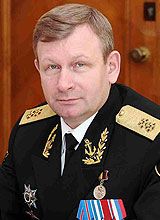
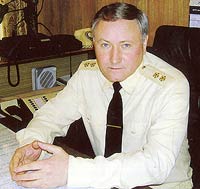
Vice-Admiral Chirkov

Baltic Fleet Commander, Vice-Admiral Viktor Chirkov is apparently being tapped to replace Vice-Admiral Konstantin Sidenko in the Pacific Fleet, according to Russian press agencies and a Kommersant source in the Navy Main Staff.  

Sidenko will command the new Eastern Military District and Combined Strategic Command (OSK) East.  Chirkov will be replaced in the Baltic Fleet by his chief of staff, Rear-Admiral Sergey Farkov.  Kommersant’s source calls these changes a ‘normal rotation.’ 

Gzt.ru’s source says the Pacific Fleet is expecting the Chirkov announcement ‘any minute,’ but drawing up the papers, including the President’s decree on the appointment, is ongoing. 

Viktor Viktorovich Chirkov is a surface warfare officer with Pacific Fleet roots.  He was born on 8 September 1959 in Alma-Ata, capital of the former Kazakh SSR.  In 1982, he graduated from the Vladivostok Higher Naval School and became head of the mine-torpedo department on old Riga-class corvette Lun in the Pacific Fleet.  He served as assistant commander of a corvette, then executive officer of Kotlin-class destroyer Vozbuzhdennyy.  

In 1986-1987, Chirkov completed Higher Special Officers’ Classes in Leningrad, and became commander of the infamous Krivak-class frigate Storozhevoy.  Under a mutinous crew, this Soviet Baltic Fleet unit tried, unsuccessfully, to defect in 1975.  Later it transferred to the Pacific Fleet. 

From 1990 to 1993, Chirkov commanded Udaloy-class destroyer Admiral Spirodonov.  He was deputy chief of staff for an ASW ship division, deputy division commander, and commander of an ASW ship division during 1993-1998.  In 1997, he completed the Kuznetsov Naval Academy as a correspondence student.  

After graduating from the Military Academy of the General Staff in 2000, Chirkov served for five years as chief of staff, first deputy commander of Troops and Forces in the North-East on Kamchatka.  In the first years of this assignment, he served under Vice-Admiral Sidenko.  

In 2005-2007, he commanded the Primorskiy Mixed Forces Flotilla.  For the next two years, he was chief of staff, first deputy commander of the Baltic Fleet, and became its commander in September 2009. 

Chirkov is married with two sons. 

A Pacific Fleet staff source told Gzt.ru Chirkov is happily anticipated since he’s an old friend and ‘not an outsider.’  Another calls him a wise and honorable officer who knows his business. 

Vitaliy Shlykov talked to Gzt.ru about the Pacific Fleet’s growing importance: 

“In the Baltic there’s nothing to do, everyone’s friends, allies.  But the Pacific Ocean is the future, it’s necessary to turn all attention there.  And we don’t have enemies there, so there’s time to strengthen this fleet before there’s a confrontation between the U.S. and China.” 

“Of course, given this state of affairs, the significance of the fleet is growing sharply in comparison with Russia’s other fleets.” 

NVO’s Viktor Litovkin notes that Chirkin will be first to command the Pacific Fleet in its new condition of subordination to OSK East.  He thinks the new commander has multiple problems to solve, including obtaining new ships, dismantling old nuclear submarines, and building housing for servicemen.  Chirkin will also have to grapple with getting contract sailors, rather than conscripts, to man his afloat forces for long deployments.

Lieutenant Colonel Biront’s Defense

Sounding somewhat dazed, Lieutenant Colonel Viktor Biront told Life News his story about how and why the naval aviation depot near Kolomna burned.  According to Biront, higher authorities were completely informed about his situation days before the facility burned, but ignored repeated requests for assistance.

Biront says firefighters worked to save expensive dachas near his base, but weren’t as willing to help him.

According to Biront, the base he commanded for only three months before the fire had just lost 19 officers and 36 warrants as a result of Defense Minister Serdyukov’s cuts in both personnel categories.  He also lost his firefighting unit in February.

Biront describes how he managed to trade his car to get use of a fire engine.

Reports of the value of property lost have varied widely, but Biront indicates they saved most of what was worth saving.

Here’s the interview verbatim: 

“The lieutenant colonel dismissed because of the fire relates how he and his sailors saved the air base from fire for 10 days.”

“Relieved of duty as military base commander after the big fire, 43-year-old Lieutenant Colonel Viktor Biront tells in an exclusive interview with Life News how he and his subordinates saved the military unit from the fire.”

“The morning of 29 July the lieutenant colonel went to the perimeter and posted people on the edge of the burning forest.”

“’Everyone worked in the forest – both civilians and military,’ said Viktor Ivanovich.  ‘I was there also, only leaving periodically to call and request help.  The chiefs of Civil Defense and Emergency Situations came to evaluate the situation.  Then a strong wind started – the gusts were nearly 20 meters per second – and drove everything from the depth of the forest.  It was terrible to be in the fiery pockets.  Here, look – hands, feet all burned.  We stood on the perimeter, still 1.5 kilometers from the facility.  What a terrible picture – the fire was a wall in the forest.  I gave the order to evacuate.  I was last to leave there, because I was shouting to the last so the boys wouldn’t die there.’”

“According to Viktor Biront, the firemen arrived only two hours after the call.”

“’It’s as if we don’t exist for the city:  neither MChS, nor police . . . no one was with us,’ said the lieutenant colonel.  ‘They saved 1.5 million dollar dachas here.  There were both cordons and police there.  The first help came after several hours – no matter how much I called, how much I asked.  Only after a couple hours a firefighting helicopter flew in.  We can’t get through there – everything’s burning, everything’s blazing . . .  I quickly recounted the people.  Then equipment came from Moscow, and by night a deputy defense minister arrived.  It was impossible to go in.  Sailors were simply suffocating in gas masks – they were saturated with smoke.  I gave the command to take them off . . .’”

“The massive fire that destroyed property worth billions of rubles was preceded by 10 days of struggle with the fire.  And over these 10 days, the big bosses, despite all requests, didn’t take any clear decision about how to save the air base.  In fact, saving it depended only on 40 sailors and their commander.  115 hectares – almost three per man.”

“’I’ve been in the position for three months, they gave me this unit in May in a new composition, after reductions,’ Biront says.  ‘They cut 19 officers, 36 warrants.  In all 40 sailors remained, eleven sergeants and four officers – and this is all the people for such a large unit.  Plus civilian personnel whom I treated with great understanding.  I couldn’t send female clerks into the battle with the fire because the average age of my workers is 58-60.  The pay is low, 5-7 thousand, only female pensioners who’ve worked here a long time do this work.  They also helped as they could.  Men came into the forest with axes and shovels – tried to stop the flames.’”

“’The forest near the unit burned for 10 days,’ Viktor Ivanovich continues.  ‘I turned to them repeatedly, high officials came, had meetings here, made plans, a certain Mr. Shumeyev – deputy for security, an ecologist came here.  The sailors stood two days on the perimeter, not allowing the fire to spread.  I called Civil Defense and Emergency Situations.  Sometimes they gave help, but sometimes they refused.  I didn’t have my own firefighting team – they eliminated it in February of this year.  There was simply an ad hoc firefighting team, they dug themselves in and fought by all means.  When I saw this was all very difficult – I put my non-TO&E car to use, I had to give it to the firemen.  Generally, it’s use is forbidden, we used it because I had to pay money.  They brought a fire engine and handed it over there.  I secured a driver, whom we used to the fullest extent.  We hosed, knocked down flames, in general, battling though I didn’t have specialists.  We had to teach our officers who were extinguishing the fire.’”

“’In principle, we coped with the fire the first ten days,’ says the dismissed commander.  ‘I reported to Moscow by phone, by morning reports, by faxes.  I asked for help.  One time they gave equipment.  A KamAZ came from Shcherbinka from the airport, poured out two cisterns and went back.  Local civilians were all in action – villages burning, the government likewise, then they left 14 castoff portable fire extinguishers, literally the day before the conflagration.  They took them from the unit two kilometers into the forest.’”

“They didn’t manage to save the base.  Viktor Biront learned about his dismissal on the television news. At this moment he’s again writing a statement in the prosecutor’s office.  In this document he indicated that they managed to save property worth 40 million rubles.”

“’My people saved the new equipment.  The burned up property there had expired service lives and required repairs.  But then everything was finished, all closed, but they told us we were all morons generally.  Here it’s burning, and they are crawling through hell and saving equipment.  I’m not defending myself, I’ve told it like it is.  In theory in three months I should have cleared out everything that grew up in this forest over 60 years.  Because in 60 years no one ever did anything there.’”

President’s Tough Talk to Defense Minister Serdyukov

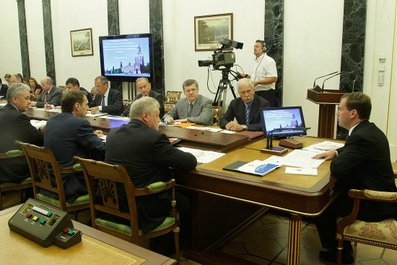
Medvedev at Security Council Meeting

Let’s look at President Dmitriy Medvedev’s criticism of the Navy and the Defense Ministry, his warnings and dismissals of some Navy officers.  It looks somewhat like a script torn from Vladimir Putin’s ‘tough guy’ handbook. 

Kommersant recounted the details of what sparked the President’s ire.  On 29 July, a fire burned the 2512th Central Aviation-Equipment Base of Naval Aviation and Air Defense near Kolomna, several dozen kilometers southeast of Moscow.  The Prosecutor’s Investigative Committee (SK) said the blaze destroyed the staff headquarters, finance unit, club, two bays of vehicle parking, 13 warehouses with various items of aviation equipment, and 17 open equipment storage stands with vehicles on them. 

Medvedev addressed yesterday’s Security Council meeting: 

“I instructed the Defense Ministry to take part in the firefighting effort and help to protect the civilian population, but sadly, in a number of cases, the ministry has proved unable to protect itself.  A fire took place in Moscow Oblast that has caused very serious damage.  The ministry has already carried out a preliminary internal investigation, and the investigation will continue of course.  The evidence so far indicates that this is quite simply a case of neglect of duty and criminal negligence, when personnel failed to bring under control a fire that was not spreading particularly fast, and no one even knew where the base’s commanders had gone.  I have therefore taken the following decision.”      

“Regarding the Navy’s senior command:  Navy CINC Admiral Vysotskiy has been warned about not fulfilling his duties; Chief of the Navy Main Staff and First Deputy CINC  Tatarinov has been warned about not fulfilling his duties; Deputy Chief of Navy Rear Services Sergeyev is dismissed; Chief of Naval Aviation Kuklev is dismissed; Deputy Chief of Naval Aviation Colonel Rasskazov is dismissed; Acting Deputy Chief of Naval Aviation Rear Services Monakov is dismissed; the chief of base 2512 is dismissed.”  

“I am also instructing the Defense Ministry to dismiss a number of other officers and personnel for disciplinary violations.  If anything similar happens in other places and other departments I will do exactly the same again, and without the slightest regret.” 

After discussing the fire situation with other ministers, Medvedev turned back to Defense Minister Serdyukov later in the meeting: 

“Now the Defense Ministry.  I already announced certain decisions.  The Minister needs to take everything under direct control.  Conduct a meeting today with the Ministry’s leadership and say that, if anything else like this burns, everyone will answer for it.” 

“Are there any concerns about the current situation?” 

Serdyukov responded saying plans have been made, operational groups established at all command levels.  Personnel and equipment have been put at the disposal of MChS and regional authorities.  And he noted that Deputy Defense Minister, General-Colonel Dmitriy Bulgakov is his point man for the fire emergency. 

Medvedev chided Serdyukov because the Vladimir Oblast governor had to go to the Defense Ministry for help instead of suitably empowered local commanders. 

Serdyukov said ‘corresponding’ orders have gone to all commanders and garrisons.  He continued with the Defense Ministry’s support of MChS — 11,000 servicemen, thousands of pieces of equipment, 33 kilometers of water pipelines laid in four rayons.  After Bulgakov’s visit to the Federal Nuclear Research Center in Sarov yesterday, another two battalions and special equipment were allocated to efforts there.  Serdyukov said another 28,000 troops can be brought into firefighting in the Central Federal District within 3-12 days. 

Serdyukov concluded: 

“We are taking all steps in full measure, we reinforced all facilities (there are 164 of them, but in immediate areas where there are fires there are 22) behind every responsible commander.  We are conducting all measures there:  increased volumes of water reserves for extinguishing fires, equipment has been brought in, extra personnel, everything literally transferred into a barracks condition, therefore all necessary steps for this, in fact, have been accomplished.  Therefore I submit that this sad incident that happened at base 2512 will not be repeated.” 

Kommersant helped out with a full run-down on the ranks and names of the lesser known Navy officers:  Rear-Admiral Sergey Sergeyev, General-Major Nikolay Kuklev, Colonel Sergey Rasskazov, Colonel Sergey Monakov, and Base Chief Colonel Viktor Biront. 

RIA Novosti covered Serdyukov’s firing of other officers at the base.  They included:  Deputy Base Chief Major R. Gidayatov; Deputy Chief Main Engineer Lieutenant Colonel V. Marchenko; Support and Security Company Commander Major A. Yermolov; Chief of the Material-Technical Support Department V. Karandak; and Chief of the 7th Storage Department V. Melsisidenkov. 

Today the SK said a criminal negligence case has been initiated.  Gazeta ru said, per usual Russian practice, top officials have blamed lower-ranking ones, in this case Navy officers, allowing the ‘untouchables’ to demonstrate their toughness and avoid responsibility.  Kommersant noted that the warnings for Vysotskiy and Tatarinov are just a step from dismissal.  But history shows other general and flag officers have gotten such warnings and still moved forward in their careers. 

Gzt.ru broached the subject of whether this could provide Medvedev an occasion to purge the Defense Ministry and fill it with his ‘own people.’ Konstantin Sivkov and Aleksandr Konovalov agree that he could use this opportunity.  But one has to ask, does this make sense in the scheme of tandem politics?  Medvedev has changed few in the cast inherited from Putin, and he’s very unlikely to start with a stolid Team Putin guy like Serdyukov.  Especially when he appears to be the first man to make some real headway in fixing the post-Soviet military.

Bulava SLBM Test Next Month

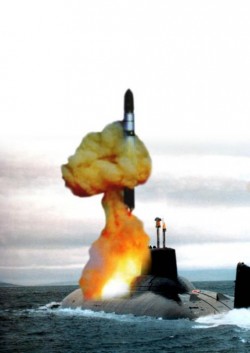
Bulava

This afternoon a Navy Main Staff source told Interfaks the next Bulava SLBM test will occur in mid-August from modified proyekt 941 Akula (Typhoon-class) SSBN TK-208 Dmitriy Donskoy.  This is earlier than previously announced.  The Navy source also claimed that the new proyekt 955 SSBN Yuriy Dolgorukiy will be the launch platform for one of this year’s three planned Bulava tests.  He also reiterated that Russian military men are committed to Bulava, seeing no alternative to it as the Navy’s nuclear deterrent for the future.

In May, Defense Minister Serdyukov said three identical Bulava missiles are being assembled in the hope of discovering a common flaw in their construction.  Serdyukov said the next Bulava launch wouldn’t occur before November at the earliest.

New Commander, Old Fleet

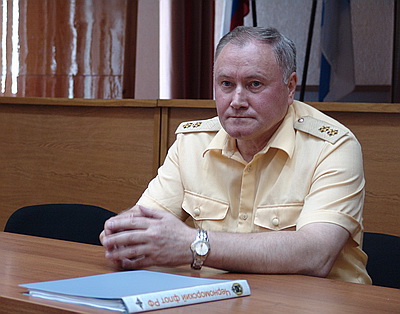
Vice-Admiral Korolev (photo: Novyy Region)

As expected, Northern Fleet Chief of Staff and First Deputy Commander, Vice-Admiral Vladimir Ivanovich Korolev (Королёв) officially replaced Vice-Admiral Aleksandr Kletskov as Commander of the Black Sea Fleet on 2 July.  

Turning 55 next month, Kletskov retired on age grounds, but, as only Kommersant bothered to note, Korolev turned 55 in February, so President Medvedev has either officially extended his service a couple years, or plans to give him another star, allowing him to serve to 60, under the law. 

Novyy Region quoted Navy CINC Admiral Vysotskiy introducing the new BSF Commander: 

“Vice-Admiral Korolev is a competent leader, possessing good personal knowledge and work habits, both in the staff and in command duties.” 

About Korolev’s background . . . after finishing officer commissioning school in 1976, he was assigned to a Northern Fleet nuclear submarine, serving as a division head in the navigation department.  

According to Kommersant, in the mid-1980s, he served in the Gadzhiyevo-based 24th Division of Submarines (24th DiPL).  He eventually served as executive officer and commander of Victor II-class (proyekt 671RT) SSNs  K-488 and K-387.  He completed mid-career Higher Specialized Officer’s Classes in 1987. 

In 1993, he became Deputy Commander of the 24th DiPL, and completed his advanced education at the Kuznetsov Naval Academy in 1995.  He then moved to the Northern Fleet’s Operations Directorate as chief of an unidentified department, then chief of fleet ASW.  

By August 2000, he was Commander of the 24th DiPL, and in 2002 became Commander of the Sayda Guba-based 12th Squadron (24th and 18th DiPLs). 

On 19 November 2007, Korolev became Deputy Commander of the Northern Fleet, and was appointed Chief of Staff and First Deputy Commander in August 2009. 

Media reports haven’t mentioned whether he’s married or has children. 

Korolev faces a large number of unresolved military and social issues in his fleet.  It has an extremely high percentage of old ships that aren’t combat capable.  Some problems with Ukraine persist despite the recent improvement in relations and the Kharkov agreement extending Russia’s Crimean presence to 2042, as well as the promise of 15 new ships and submarines which followed it. 

Independent analyst Aleksandr Khramchikhin told Novyy Region Korolev inherited a fleet in bad shape: 

“The fleet is in a state of disappearance, complete collapse.  It’s obvious the commander needs to stave off this collapse somehow.  But I don’t understand very well how this can be done.  Because these promises of numerous ships don’t correspond very much to the record of recent decades, and it’s extremely hard to believe in them.” 

“The basic mission of the fleet commander is to try to keep the fleet from dying, even though its service life is close to zero.  He can’t do anything because he doesn’t build ships.  The Black Sea Fleet has gone to the limit of obsolescence.  It’s the very oldest of our fleets.  It’s the only one of the fleets in which there are still ships built in the 1960s.  It’s the only one in which there’s been practically no kind of renewal in the post-Soviet period.” 

“It’s hard to understand what missions are being given to the BSF.  Let’s say it can’t even be closely compared with the Turkish Navy in forces, it is so much weaker.  I repeat, our entire Navy is in a state close to collapse, but the Black Sea Fleet is in first place in this regard.” 

An anonymous BSF staff source told Novyy Region Korolev’s first task is to replenish the fleet with new ships, not just secondhand Baltic Fleet units.  His second job is placing orders for repair and construction of ships not just at the BSF’s 13th Factory, but at Ukrainian shipyards as well.  

The fleet’s social problems are next.  It has hundreds of officers whose duties were eliminated, but they can’t be dismissed since they don’t have apartments.  The source says these guys are walking around in uniform, but have no jobs.  Korolev’s fourth task is a related one–returning Moscow Mayor Luzhkov to full engagement in Sevastopol.  Luzhkov is no longer building apartments there as he has in the past owing to a dust-up with the Defense Ministry over the handling of property in Sevastopol.  

Lastly, Korolev has some real naval missions to worry about like securing southern energy routes, the 2014 Winter Olympics, antipiracy operations, and keeping a Russian presence in the Mediterranean. 

Regarding Admiral Vystoskiy’s promise of new ships and submarines for the BSF, Moscow Defense Brief analyst Mikhail Barabanov told Kommersant the civilian and military leadership may see the fleet’s reinforcement a priority because it may more likely see real combat action than the Northern and Pacific Fleets.  

A Kommersant BSF staff source describes Korolev’s main mission not as planning for new ships by 2020, but simply supporting the combat capability of a fleet contracting before our eyes.

Testing Army Reforms in Vostok-2010

Readers seem eager for anything they can get on Vostok-2010.  Here’s something. 

Russia’s largest maneuvers of the year, Vostok-2010, began June 29, and continue until July 8.  This broad-scale operational-strategic exercise (OSU or ОСУ) encompasses the Siberian and Far East MDs, as well as the Pacific Fleet—in other words, what will reportedly become the new Far East MD or operational-strategic command (OSK or ОСК) before the end of 2010.  

General Staff Chief, Army General Nikolay Makarov talked to RIA Novosti and ITAR-TASS at length about Vostok-2010 recently.  He said the Far East was chosen for its broad expanses, limited infrastructure, and difficult weather and climate.  Eleven combined arms, 3 air forces, and 4 naval training ranges will be used.  Makarov noted up to 20,000 soldiers, 2,500 weapons systems and pieces of equipment, 70 aircraft, and 30 ships will take part in the exercise. 

Makarov said Vostok-2010 will be a logical continuation of last year’s large training events.  Beyond Defense Ministry forces, operational groups and sub-units from the MVD, FSB, FSO, MChS, and FSIN will participate.

As is customary, Makarov said the maneuvers:

“. . . are not directed against any real country or military-political bloc.  They have an exclusively defensive orientation for ensuring the security and defense of the state’s interests on the Far East border against a notional enemy.”

And the exercise’s theme is:

“. . . preparation and employment of formations [military units] in a new TO&E structure to fulfill missions in isolated sectors to ensure the Russian Federation’s military security.”

Makarov said the maneuvers will:

  • Check the effectiveness of the newly-created three-level system of troop command and control;
  • Evaluate the readiness of new TO&E formations and military units to  conduct combat actions in isolated sectors in a constantly changing situation, as well as their mobility and combat possibilities;
  • Resolve training and command and control issues at the operational-strategic and operational level while conducting combat actions;       
  • Organize coordination of military command and control organs with the troops and military formations of other federal ministries and departments, and also local organs of executive authority in resolving joint missions; and
  • Investigate the capabilities of a unified system of material-technical support (MTO) which was created during the structural reformation of the army and fleet.

The exercise will include special operations, air defense and ship combat firings, and air and amphibious assaults.  Makarov said the RVSN will join the exercise play, but no ICBM training launches will occur.  Military transports will bring independent sub-units from the Moscow and Volga-Ural MDs to join the exercise, but they will draw their weapons and equipment from Siberian and Far East storage bases.

Makarov noted the participation of an unidentified number of Su-24M and Su-34 aircraft arriving from Central Russia during a direct flight with aerial refueling.   Black Sea Fleet flagship Slava-class CG Moskva and Northern Fleet Kirov-class CGN Petr Velikiy also completed long-range cruises to participate.

Makarov said new operational and operational-strategic level command and control posts will be used in the exercise, as will ‘fifth generation’ radio communications gear and future soldier systems under development at Sozvezdiye.  Iskander operational-tactical missiles and Russian-made UAVs will also be employed.

Siberian MD Commander, General-Lieutenant Vladimir Chirkin told Krasnaya zvezda the exercise will focus on defensive operations, but also special operations to localize and destroy irregular armed formations in several RF regions.  He said there will be more than a little new given that new combat regulations will be used.  He added:

“We’re moving away from linear tactics, from large-scale front operations.  As the experience of local wars and armed conflicts in recent years shows, there’s no need to utilize a massive quantity of forces and means to conduct front and army operations.”

In Nezavisimaya gazeta, Vladimir Mukhin focused on the logistics of Vostok-2010.  He noted Rear Services Chief, General-Colonel Dmitriy Bulgakov’s expectation that President Medvedev will soon issue a decree combining the jobs of Chief of Armaments and Chief of Rear Services.  And leaving First Deputy Defense Minister Popovkin’s old job vacant could be a hint of this.  After Vostok-2010, Mukhin expects a new deputy defense minister for material-technical support (MTO), presumably Bulgakov, to be appointed.

A lot of the activity before Vostok-2010 has apparently involved trying out new combat service and support arrangements.  A special logistics exercise tested the new MTO system.  And this year, according to Mukhin’s information, ten MTO brigades will be formed, one for each combined arms army.  The Railroad Troops will reportedly be downgraded to a directorate and each MD (OSK) will absorb the Railroad Troops units on their territory.

Krasnaya zvezda described these exercises.  Rear Services troops used 4,000 men, 30 units of different sizes, and 1,000 pieces of equipment in a pipeline-building exercise, training to repair damaged bridges over the Aga River, and refueling a brigade before its Onon River crossing.

General-Colonel Bulgakov talked about the new MTO regiments and the exercises.  He said they are permanent combat readiness units which have all necessary troops support structures and sub-units.  This was the first test of the new TO&E structure for logistics.  Based on the results, Bulgakov thinks this year the army can move from material support regiments (PMO) to material support brigades.  In every district (OSK), there will be a minimum of two, according to him.  Unlike regiments, material support brigades (BMOs?) will have repair and maintenance battalions.  Brigades were chosen to conform as much as possible to the prevailing three link ‘district-army-brigade’ command scheme.

Trud’s Mikhail Lukanin put Vostok-2010’s most difficult missions this way:

  • Moving troops great distances, including Siberian river crossings;
  • Supplying fuel, ammunition, and food to the area of combat actions;
  • Conducting an amphibious assault under enemy fire.

Prominent commentators view Vostok-2010 as a test of the success of Defense Minister Serdyukov’s army reforms.  Trud talked to independent defense analyst Aleksandr Khramchikhin who said:

“Military reform has gone on already for more than a year and a half, but there’s still no answer to the main question:  what have we gotten from it?  That is, after radical cuts in the officer ranks, the reorganization of military command and control organs, turning former divisions into combined arms brigades, are the Armed Forces capable of conducting modern combat actions.”

Anatoliy Tsyganok believes the army made a hash of Zapad-2009, with only 30 percent  of Russia’s maneuver brigades receiving good evaluations, most only satisfactory, and a handful unsatisfactory.  Presumably, he doesn’t expect to be more impressed by Vostok-2010.

Korolev Said Next BSF Commander

Vice-Admiral Korolev

Northern Fleet Deputy Commander and Chief of Staff, Vice-Admiral Vladimir Ivanovich Korolev (Королёв or kor-ol-YOV) will replace current Black Sea Fleet Commander Vice-Admiral Aleksandr Kletskov when he turns 55 in August, according to a ‘highly placed’ RIA Novosti source in the Navy Main Staff.

Rumors to this effect have been around.  In early June, Rupor.info cited an Interfaks story on this.  But Kletskov deputy Vice-Admiral Sergey Menyaylo was not ruled out as a possible successor.

The RIA Novosti source claimed Kletskov was already on leave, and Korolev participated in last week’s talks between Russian Defense Minister Serdyukov and his Ukrainian counterpart in Crimea.

Korolev looks to be a career Northern Fleet submariner.

Three Identical Missiles

The Defense Ministry’s inter-departmental commission didn’t make any announcement about its work or the causes of Bulava SLBM test failures as had been anticipated on 20 May.  If this commission has clues about the missile’s problems, it didn’t reveal them.  But Kommersant concludes that the Defense Ministry hasn’t reliably determined the causes of previous failed launches.

However, on 21 May, Defense Minister Serdyukov announced a new approach to Bulava testing.  The Russians will make three identical missiles and launch them in hopes of pinpointing the same problem in each.  It’s a gamble, but it could work.

RIA Novosti quoted Serdyukov:

“The problem of the unsuccessful ‘Bulava’ missile launches lies in the assembly process.  We do not see any other violations there.  The whole matter is missile assembly quality.  Each unsuccessful launch has its own causes.  They are all different.”

“Now we are working on making three absolutely identical missiles.  We believe that this will allow us to precisely locate the mistake, if there is one, since it must be repeated in all three missiles.  Now we are working on how to control the assembly process in order to know that all the missiles are identical.  Toward November, I think, we can begin launching the missiles.  After this we will be able to identify the cause precisely.”

Earlier reports had said the next Bulava test would occur in June, but Serdyukov now says November at the earliest.  Over six years, only 5 of 12 Bulava launches have been successful or ‘partially successful.’  The missile launched on 9 December 2009 self-destructed after a third stage engine problem.  Grani.ru recalled that other recent problems included steering system and stage separation malfunctions.  Moscow had intended to put the Bulava on its new Borey, or Proyekt 955, SSBNs starting in 2007.

Gzt.ru describes the new three missile approach as an expensive “hit or miss” method.  The Defense Ministry hopes launching identical missiles will point to the same problem in each, if there is one.  But if they still manifest different problems, Moscow will be no closer to pinning them down.  The risk is another year without getting any closer to a new SLBM.

Gzt.ru concludes:

“Serdyukov didn’t specify what will happen if in the November series of launches of ‘Bulava’ each time a different component of the missile fails.  Apparently, this possibility isn’t being considered.”

Also in Gzt.ru, Defense Ministry critic Konstantin Sivkov describes the three missile plan as absurd and expensive.  With each missile costing 300 million rubles, it’s a 1 billion ruble effort and there’s no guarantee the bug, or bugs, will be identified.  He believes the designers will have to conduct stand tests where all components can be checked under controlled conditions.  He blames defective parts allowed into the system due to inadequate production controls.

Gazeta.ru cited one Andrey Ionin, a missile designer, who agrees the problem lies in the absence of technological discipline in the enterprises of the Russian OPK.  He says:

“Cooperation by several hundred enterprises, working under different forms of ownership, in different parts of the country, without observing all rules of technological discipline is pointless.” 

Nevertheless, simultaneous assembly of three missiles could be a way of searching for mistakes in Bulava.

MIT missile designer Yuriy Solomonov has said repeatedly it’s defective materials, production process breakdowns, and the lack of quality control, but neither he nor military men are saying which materials or processes they suspect.  He’s also said Russia lacks 50 materials needed for solid-fuel missile production.

In Kommersant, former RVSN general Viktor Yesin claims the Defense Ministry’s inter-departmental commission investigating Bulava has determined that enterprises didn’t cooperate and provided poor quality parts for the missile.  Still he sees no alternative to Bulava and believes its design is workable.