Category Archives: Serdyukov’s Reforms

Shurygin on the VDV’s Discontent

Writing in Zavtra, Vladislav Shurygin has added his take on Sunday’s VDV protest.  As usual, it’s a different cut with different details, but a unique one that shouldn’t be ignored.

Here’s the gist.  Shurygin says it’s not just the VDV’s discontent, but the military’s.  He enumerates the VDV’s specific grievances.  He claims the airborne has lost its status as the Supreme CINC’s strategic reserve and been placed operationally under OSKs West, South, Central, and East. 

Much of Shurygin’s article comes down to the VDV’s alleged loss of elite status.  Others, however, would say Serdyukov’s handled the airborne with kid gloves compared to how other services have suffered.  They might also say it’s high time the VDV got knocked down a notch or two.  

Shurygin seems to want to say that vlasti are more worried, or should be more worried, about discontent in the army than they appear.  He says Serdyukov can’t be dislodged from the Defense Ministry by his opponents, only the internal imperatives of vlasti will move him to another job; then he’ll be replaced by someone who’ll begin his own reform.

Shurygin quotes one Russian Airborne Union (SDR or СДР) official on how servicemen are left socially unprotected:

“In the framework of this reform which is destructive for the country, the overwhelming majority of servicemen have been dismissed without serving the term enabling them to get a pension.  Half of them don’t have housing.  Our country already has a sad experience of dismantling troops.  In the distant 1950s, the Defense Ministry decided to eliminate Naval Infantry under the pretext of missile-nuclear weapons development, saying that, if necessary, conventional infantry could fully replace it.  Nearly 50 years later history’s repeating itself.  Only now the VDV and Spetsnaz ended up in the role of unneeded forces.”

Shurygin continues:

“Meanwhile, the attitude of high state officials toward the VDV has been drawing criticism for a long time already.  In July, when the VDV observed its 80th anniversary, neither the Supreme CINC, nor the Prime Minister appeared at a ceremonial concert in the Kremlin palace and they didn’t even send the nominal greeting customary in such instances.  Then a directive according to which the VDV command would become subordinate to the Main Command of the Ground Troops was prepared, and VDV formations and units are in fact being transferred into operational subordination to the commands of strategic axes ‘North,’ [sic] ‘West,’ ‘South,’ and ‘East.’  That is, they’re being taken from the reserve of and immediate subordination to the Supreme CINC of the RF Armed Forces.  Add to this the estrangement of the VDV from work with premilitary youth in DOSAAF and the elimination of the Ryazan Airborne Higher Military Command School, which has been dropped into the Ground Troops training center (Combined Arms Academy), and the elimination of the VDV Personnel Directorate, which will put a final end to the elite status of the VDV, traditionally proud of its own unique personnel school.  In fact, a quiet destruction of the troops is going on.”

Shurygin says VDV Commander Shamanov’s doctors say confidentially that, in intensive care, he was in no condition for paperwork, and his right hand was immobilized when he supposedly authored his message urging VDV on Poklonnaya Gora to avoid confronting the Defense Ministry.   

So Shurygin doubts Shamanov wrote this, but he doesn’t allow for the possibility that the general dictated words to be issued in his name.

Shurygin adds that sources close to the Defense Ministry say the Shamanov document turned up in the hands of Deputy Defense Minister Nikolay Pankov, was edited by his people, and sent to the hospital for Shamanov’s signature as he was being wheeled into surgery. 

Shurygin shifts gears reprinting part of an interview he gave Baltinform prior to the Poklonnaya Gora demonstration.  Asked about Serdyukov, he says:

“The reform Serdyukov is conducting causes confusion in specialists.  The opposition to the pogrom he’s conducted in the army is very great.  Tens of thousands of people are opposed — they really see what is happening in the troops, and are trying to get this information to the public.”

“The fact that this [Seltsy] scandal received publicity is not evidence of conspiracy, but evidence of the crudest error in Serdyukov’s judgment, who left himself open, conducting himself rudely and offending an honored officer, a Hero of Russia.  And this outrageous incident only became the latest reason again to raise the theme of reform.  If the main reformer conducts himself in such an unworthy manner, then this automatically calls forth questions about the entire reform he’s conducted.  I think that opposition to Serdyukov is located not at the Kremlin level or any mysterious officials, but at the level of those whom military reform has literally ‘run over like a tank.'”

 I relate to [Serdyukov] as an absolutely incompetent person who occupies a job that is not his.  And for three years already he’s been learning the completely new business of managing the army at the cost of huge damage to the latter.  First they constantly destroy army structures like a house of cards, then they try to ‘sculpt’ and create something out of them.”

  “Some directives are suspended, others are given out and then are suspended.  The army leadership is feverishly searching as if trying to get a careening wagon down a hill in the necessary direction, but still just increasing the chaos and disintegration.  Massive break-ups were undertaken in place of approaching reforms from a scientific viewpoint and working out experiments on specially selected parts.”

“The Armed Forces have been ‘cut to the bone.’  They’ve broken everything in them, both the bad, and the good.  They broke it, then observed the mistakes, and are now trying to correct them.”

Asked if Serdyukov will finish his reforms or be replaced because of complaints from his opponents, Shurygin concludes:

“It seems to me he’ll go to that phase when it’ll be officially acknowledged that the reform has taken place.  Then a moment will come when it’s necessary to make a change in the official hierarchy, and Serdyukov will be transferred to another position.  The one who comes into his place, will begin his own reform anew, perhaps, a more ‘quiet’ one.  But he won’t avoid long work analyzing the mess of forest cut down by Serdyukov.”
Army Outsourcing

Defense Minister Anatoliy Serdyukov conducted another extramural collegium Wednesday, this time in Khabarovsk.  Serdyukov and company congratulated themselves for completing the ‘large-scale work’ of forming the Eastern Military District (VVO or ВВО), and the other three new districts, ahead of schedule.  This reshuffling was done in less than a year, so it probably really doesn’t count as ‘large-scale work.’

General Staff Chief Nikolay Makarov reported the VVO has operated since 1 October.  For his part, Serdyukov noted:

“The Eastern Military District is the largest in combat composition, area, and length of ground and maritime borders.”

The VVO sports the Pacific Fleet, an air and air defense army, and four combined arms armies, leading the Defense Minister to conclude:

“Unifying all forces and means under a single commander allowed for a substantial increase in the combat possibilities and potential of the district.”

Possibly, yes, but it remains to be realized and proven . . . since the very same forces have just been aggregated in a new way.  Is this new whole more than the sum of its parts, or not?

Attendees discussed unified logistics as well as unified combat forces.  Reports said along with unified commands a unified system of material-technical support (MTO) is being established in the military districts.  As previously reported, it is supposed to unite arms supply and logistics in one function and organization.

At any rate, the collegium had new or semi-new business as well . . .

Serdyukov, Makarov, and other attendees also discussed Defense Ministry outsourcing.

Before the meeting, Makarov told wire services the issue of delimiting spheres of activity between the military department and outside organizations that will provide support functions for servicemen and military towns, including heating, electricity, and food service, would be discussed.  According to Rossiyskaya gazeta, Makarov said:

“We need to clearly determine the bounds within which structures should work to support the everyday life of military bodies.”

Speaking like an old-hand, Makarov said the outsourcing system will take care of noncore tasks like feeding the troops and providing utilities to military towns.  The Defense Ministry’s board of directors discussed transferring responsibilities and corresponding property to these contractors.  Are they going to operate or own these assets?

RG reminded readers 340,000 troops are supposed to be fed by civilian firms by year’s end.  They include students in cadet corps, Suvorov schools, military VUZy, and patients in Defense Ministry hospitals.  The paper said outsourced food service would be coming soon to permanent readiness units.  And laundry services, part of military transportation, and equipment supply, including aviation, POL, and support for all deployed Navy ships, will be outsourced.

Finally, Army General Makarov said the collegium discussed in detail the issue of replacing or scrapping worn out equipment.  According to RIA Novosti, Makarov indicated there’ll be a major inventory and weeding out of what’s usable and what isn’t:

“In the course of 2011, everything that’s inoperable, particularly, in the aviation and ship inventory, we will manage to restore and put back on the line.  That which has outlived its time according to its parameters should be withdrawn from service.  This is quite a solid sum which could be redirected to acquiring new types of equipment and armaments.”

Not sure how much they make on this scrap sale.  Not so long ago the Defense Ministry said it was cutting repairs (as well as RDT&E) to focus more money on buying new systems.

Officer Discontent on Poklonnaya Gora

Reviewing the press on Sunday’s VDV meeting on Poklonnaya Gora, one could say there’s an inclination to dismiss it as the howling of old cranks who don’t constitute an organized challenge to anything or anyone.  But behind that initial take, some media saw palpable discontent among officers, both retired and active duty.  Nezavisimaya gazeta suggested there might be more below the surface of this rather feeble demonstration – either more powerful interests or much larger numbers of affected individuals.  Ekspert concluded, at a minimum, the whole episode might lead Defense Minister Serdyukov to take the opinions of officers more seriously.      

The VDV demonstration goes back to the 30 September Seltsy incident, and the Russian Airborne Union’s (SDR) call for Serdyukov resign for insulting Hero of Russia, Colonel Krasov as well as for destroying the army.  Kommersant put the number of participants at about 1,500.  Retired General-Colonel Vyacheslav Achalov and other organizers threaten to resume protesting on 17 November if President Medvedev doesn’t fire Serdyukov.  They also want General Staff Chief Nikolay Makarov, Deputy Defense Minister Nikolay Pankov, and Main Personnel Directorate Chief Viktor Goremykin to resign. 

The conspiracy-minded protesters maintain that Vladimir Shamanov’s crash was no accident; they think someone tried to kill him since he’s the only man standing in the way of the VDV’s ruin.

The Defense Ministry didn’t officially comment on yesterday’s protest, but Kommersant garnered an unofficial reaction.  An unnamed Defense Ministry representative said:

“Criticism should be constructive.  When memorial days like 7 November are used for political purposes, it’s unseemly.  Moreover, criticizing the minister for the reform is premature, since it’s not complete yet.”

So the Defense Ministry didn’t think the protest was helpful, but they also think 7 November is still a holiday.  The last is the best though.  Exactly when, where, and how are opponents supposed to raise their objections?  When everything’s over and done with?  Another insight into current regime thinking about the proper interaction of politics and policymaking . . . none.

Nezavisimaya gazeta was most interested that it wasn’t just the usual non-systemic outcasts at the VDV rally, but Just Russia (Справедливая Россия) flags showed that some of the official opposition was there too.  Federation Council Speaker and Just Russia leader Sergey Mironov was once a VDV senior sergeant himself.  NG sees SR trying to play an army card to its advantage while remaining part of the official opposition.

The paper says Mironov could be using the military, and showing support for officers against Serdyukov (and Medvedev by extension) for his own purposes.  And he’s politicizing the army – something not done in recent years and generally considered unacceptable.  NG indicates some think there’s more to all this than just a reaction to Serdyukov’s alleged rudeness to the VDV:

“There is, incidentally, an opinion that the [Seltsy] incident was only a pretext, and the interests of some military circles and retired officers connected to them, who feed off the army and are dissatisfied with the current military reform, are behind the protest.”

Novyye Izvestiya describes Poklonnaya Gora as quite the retrograde affair replete with Soviet flags, and the usual representatives of the radical opposition.

One participant bragged to its reporter after passing through one of many metal detectors:

“We don’t need weapons, we could take the Kremlin with a stool leg.”

But Novyye had more serious points too, like one ex-VDV who complained of Serdyukov’s cuts in military medicine, and his commercialization of military hospitals.  He asked:

“What military doctors will be on the battlefield?  There aren’t any remaining.  But there’s no one to fight, in a year’s army service what can you learn?  Only to sweep the parade ground.”

The paper concludes VDV veterans believe only military men can solve the army’s problems, the army needs to be mobile and highly capable, and it shouldn’t be shameful to serve in it.  At least everyone seems to agree on the last two.

Writing for Ekspert, Stanislav Kuvaldin describes Seltsy and Poklonnaya Gora as a breakdown in communications between the Defense Minister and the officer corps.  One SDR leader told Kuvaldin:

“Serving officers are silent, but they think the same things.  We grew them and indoctrinated them.”

He went on to say that even if they are silent about Serdyukov and reforms in exchange for today’s higher officer pay, it doesn’t mean they’ve been suppressed.

A key element of Serdyukov’s reform is basically tripling officer pay, and this higher pay is already a serious factor in calculations about serving, but it hasn’t happened yet (except for those getting special premium pay).  Nevertheless, potentially higher pay won’t automatically mean Serdyukov will be more popular, and it doesn’t mean the VDV will get over Serdyukov’s insult to one of its officers and a Hero of Russia, according to Kuvaldin.

Kuvaldin reports the Defense Ministry may compromise on some of the VDV’s more specific complaints, i.e. not moving the VDV Headquarters to Ryazan and preserving the VDV Museum, but not reversing the VDV Higher Military Command School’s subordination to the Combined Arms Academy.

In the end, Kuvaldin writes, this dissatisfaction is only creating tense moments for Serdyukov, not a serious threat:

“In the end, if after two years of reforms, vulgar insults to the head of one military school have become the cause for veterans to come out, it’s possible only to talk about an unpleasant emotional backdrop for the minister, but not about a hypothetical organized resistance.”

However, possibly, the situation will force the minister to deal with officers’ opinions more attentively and respectfully.

But this author wouldn’t bet on it.

In a not particularly surprising postscript, the GAI stopped SDR leader Pavel Popovskikh — former colonel, VDV Reconnaissance Chief, and defendant in the murder of journalist Dmitriy Kholodov — for driving drunk after the demonstration.  The story was widely reported, but an alternative version hasn’t gotten as much play.  Segodnya.ru reported that Popovskikh’s friends and others say he stopped drinking long ago.  The website also says Vladislav Shurygin wrote in his blog that traffic cops were ordered to stop Popovskikh and check him for alcohol, but they sheepishly released him with an apology when they found he was sober.

Chistova Goes with Sobyanin

Effective today Vera Chistova will head the Moscow city government’s finance department under new Mayor Sergey Sobyanin.  She served for about a year and a half as Deputy Defense Minister for Finance-Economic Work.  Defense Minister Anatoliy Serdyukov picked Chistova to replace Ivanov-era appointee Lyubov Kudelina in April 2009.

Look for Serdyukov to elevate another of his tax service minions into Chistova’s job . . . or he could move one of his current deputy defense ministers into the post.  Chistova and Kudelina both came from the Minfin’s Department of Budget Policy for Military and Law Enforcement Services, and State Defense Order.

Poklonnaya Gora Coverage

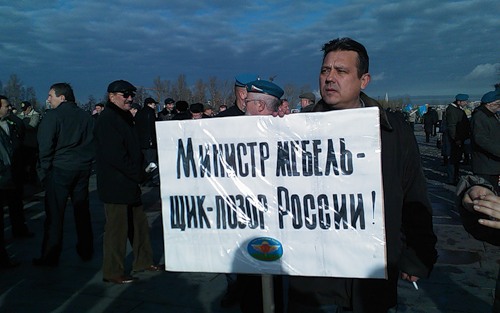
Furniture Man Minister Is Russia's Shame

A Livejournal blogger’s provided photos and comments on today’s meeting of airborne and other veterans on Poklonnaya Gora.  Organized by former VDV Commander Achalov, the protest is dedicated to denouncing Defense Minister Anatoliy Serdyukov and his reforms.  The blogger puts the number of demonstrators at less than 4,000.

According to Lenta.ru, current and former VDV generals have appealed to airborne veterans not to get into it with the Defense Ministry.  They included current chief of staff, Nikolay Ignatov, former Commander Georgiy Shpak, and former First Deputy Defense Minister Aleksandr Kolmakov.  An address from VDV Commander General-Lieutentant Vladimir Shamanov, who remains in the hospital following last weekend’s car accident, was also read.

Shamanov asserted that an ‘unprecedented propaganda campaign’ has been unleashed against Serdyukov in the last month to force his dismissal.  He added that some of ‘our respected and honored comrades’ have been drawn into this ‘politicized game.’

He said everyone from platoon commander to Defense Minister makes mistakes:

“However, this doesn’t mean that we need to demand their immediate resignation for every miscalculation.”

Sounding like the ultimate devotee of civilian control of the army, Shamanov said Serdyukov is making long overdue changes at the Supreme CINC’s direction.  He denied the VDV has lost any combat capability due to Serdyukov’s reforms and again promised it’ll remain an independent branch, receive new weapons and equipment, and get two more formations.  

He told airborne men ‘not to believe loud, but misleading announcements about how the VDV’s combat capability will supposedly decline.’  He said corrupt people of all stripes and so-called oppositionists are against the army’s renewal.

Shamanov called on delegates to this ‘conference’ of the Russian Airborne Union not to allow themselves to be dragged into an unnecessary confrontation with the Defense Ministry.

Not One of My Generals Looks Down on Me

Serdyukov with Der Spiegel (photo: Yevgeniy Kondakov)

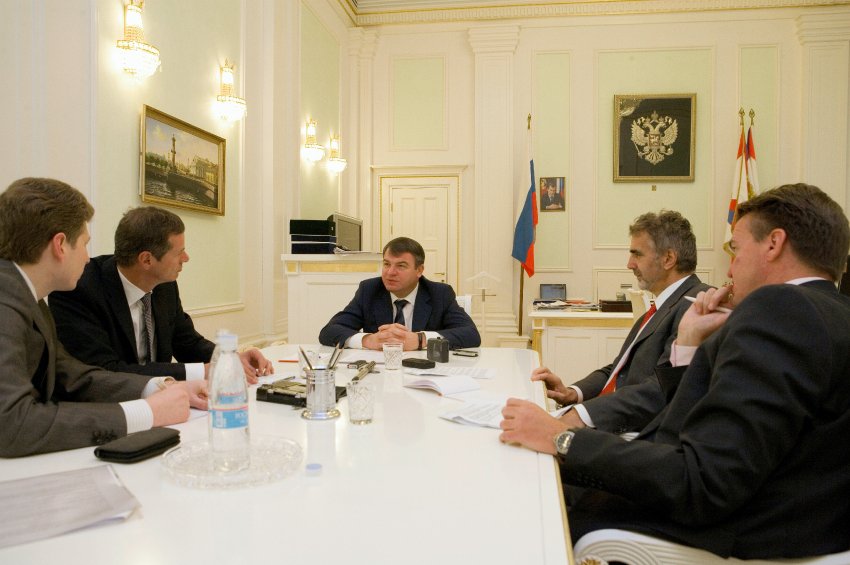
Let’s look at Defense Minister Serdyukov’s two most recent media interactions, starting with his interview Sunday on Rossiya TV’s ‘News of the Week’ program.  If anyone finds the video for this, please send it in.  As it is, we have just the wire service snippets.  Better than nothing.  Much of this you will have heard before, but there will be things of interest, so don’t stop reading.

On the army’s winter preparations, Serdyukov said the Defense Ministry has studied the ‘serious emergencies’ [so there were more than just Steppe] in military garrisons last winter, and taken necessary measures to prepare the army for this winter.  He says the army is 98-99 percent ready, so he concludes this winter will go very quietly. 

This is, of course, quite a contrast with what Minregion and Basargin have reported, as well as with Severomorsk’s predicament.  There hasn’t been any press release announcing that the Severomorsk garrison’s utilities debt has been cleared, or that the heat’s been turned on yet.  The Navy had been preparing to move several hundred people from buildings belonging to eight different units without heat.

On allowing parents and public representatives to accompany conscripts to their service locations, Serdyukov had this comment:

“It seems to me this removes a certain tension from both parents and public organizations.  And this worried us enough, therefore we, including commanders, became more seriously inclined to it.”

Serdyukov issued yet another denial of any intent to change the current one-year draft term:

“Once again I want to say we don’t intend to increase the term (of service).  The term is 12 months, and so it will remain.”

He called a professional army a goal “we still can’t allow ourselves.”

He commented, yet again, on Russia’s plans for foreign arms purchases:

“Unfortunately, in recent years, in a number of (cases) and types of equipment we have fallen behind a little.  This, certainly, concerns both armored equipment and communications and UAVs somewhat.  We, naturally, won’t go over to mass purchases of foreign armaments and military equipment, we will only buy that which interests us, in limited quantities, to understand and evaluate those tactical-technical characteristics which they possess, on the one hand, and on the other – to try to formulate for our industry what we want to see from ourselves very soon.”

Serdyukov mentioned again Russia’s desire for two large amphibious carriers from abroad, and confirmed that two more would be built in Russian shipyards using the full technical documentation transferred along with the first two units.

The Defense Minister described a three-stage military reform to 2020:

“In the first part there are TO&E measures, and we have essentially already completed them.  We’ve gone to 1 million (servicemen) in size, of them 150 thousand will be officers, on the order of 100-120 thousand will be professional noncommissioned personnel, and the rest will be conscript soldiers.”

“The second task is, naturally, social issues which we need to take care of for our officers.  And armaments are the third task.  Armaments is a quite lengthy process.  We’ve broken it into two parts:  to 2015 is the first phase and out to 2020 will be the second.  We need to get to these parameters:  by 2015 modern equipment in the army must be not less than 30 percent and by 2025 on the order of 70 percent.  We believe that 2020 will be the completion of the transition to a new profile of the armed forces.”

It looks like Serdyukov is giving more wiggle room on rearmament.  Most reports to date have quoted Defense Ministry representatives saying 70-100 percent new arms by 2020.  Well, perhaps ITAR-TASS heard it wrong.  For this writer’s money, even 30 percent in 2015 looks like a longshot.

Also, not really much to say about those military social issues – and this presumably would be the main focus now since task one’s pretty much done and task three’s a long-term deal.

Even the pretty much completed task one is interesting.  Many press and media outlets seized on this one to finally understand, more precisely, the composition of the armed forces.  So Serdyukov says they’re down to 150,000 officers already.  And with a thinner layer of sergeants, that leaves between 730,000 and 750,000 conscripts at any given time.  But drafting 270,000 semiannually would leave Moscow short by roughly 200,000 conscripts.  Better round up those evaders.  And with all the varying comments, it’s very hard to say if Russia’s at one million men (150,000 officers) yet or not.

But moving on . . . on 27 October Der Spiegel copped an interview with Serdyukov.  It focused on relations and cooperation with NATO, Europe, and the U.S., and Russia’s view of missile defense, but there was stuff on Serdyukov’s reforms.  The Defense Minister told Spiegel flatly:

“As far as weapons go, in recent years, no modern weapons have been bought for the Russian Army.  Our armaments are largely outdated.”

Quite a stark admission he might not make to a Russian magazine.  Perhaps he’s willing to be a little more painfully blunt with a Western publication.

On buying abroad, Serdyukov told Spiegel that Russia can produce everything it needs, but some things are simpler, cheaper, and quicker to get from foreign producers.  He confessed that Russian industry has fallen behind the last 20 years.

Serdyukov goes on to discuss the million-man army, the imbalance in officers and grunts, eliminating corruption, Rosoboronpostavka, and cutting administrative layers. 

Then he’s asked why military men might oppose his changes:

“It’s obvious.  Who wants to lose his job?  Over the coming three years, we will cut the size of the officer corps to one hundred fifty thousand men.  At the same time, we will make service in the army more attractive, in particular, by raising pay.  The attractiveness of army service has now reached the very lowest level.”

Again, are they at 150,000 officers or not?  No one’s clear on this.  And one would think, with all Serdyukov’s efforts, serving might already be a little more attractive.

Asked if he’s worried about a military putsch, Serdyukov said:

“This doesn’t worry me.  We aren’t taking any impetuous measures.”

Of course, impetuous depends on whether you’re on the giving or receiving end of policy.

His interviewers asked if it’s easier for a civilian to conduct reforms in the military.  Serdyukov said:

“I can’t do everything myself.  We are working in a team – the Chief of the General Staff and my deputies.  It’s possible some things are simpler for me to do because I’m not connected to certain traditions and understandings which exist in the army.  I see problems from the outside, and because of this it’s easier for me to ask why we can’t do things differently.”

And finally they asked him if a general can take a civilian seriously, and he replied:

“I can assure you not one of my generals looks down on me.”

Shades of Seltsy perhaps . . . it seems it would have sufficed to say something bland like ‘we have our own spheres and mutual respect’ or we’ve created a two-branch Defense Ministry with civilians occupied with this and military men with that.  But instead Serdyukov comes off sounding like it’s a choice between dominating and being dominated.

Vox Populi

How did readers react to the Vedomosti editorial supporting Defense Minister Serdyukov and his reforms?  Basically, two ways — perhaps about 30 percent expressed qualified agreement, and 70 percent believed it was paid PR written, if not by Serdyukov himself, then by one of his minions.

None of this is scientific, of course.  It’s just an attempt to make sense of 84 posted comments on the article.  Vedomosti is a mainstream, semi-liberal paper (certainly neither far left nor far right) with an educated readership.  Take it for granted that those disagreeing with the editorial were more likely to comment.

With that said . . . let’s look at opponents of the piece.

The thrust of their comments, if it’s even possible to summarize them, boils down to this: 

  • The editorial is part of a ‘special operation’ to rehabilitate Serdyukov and reforms after the Seltsy dust-up (was it really that serious or damaging?), and to head off Achalov’s 10,000-man meeting (which Achalov now says will be more like 5,000).
  • The editorial fails to recognize how demoralized the army is by reforms and a reformer like Serdyukov.  One reader even suggested that, after buying arms abroad, Russia might once again hire foreign officers too.
  • The editorial’s opponents say it’s Serdyukov who’s destroyed the army, and one argued you can only reform the army if you were commissioned a lieutenant and fought in a ‘hot spot.’
  • Finally, less polemical types argued Vedomosti didn’t address the state of the Russian Army’s combat capability under Serdyukov.  One said cutting is not reform, and the division-to-brigade transformation was really no more than a recognition of the true state of affairs in most formations.  Another suggested going to Siberia or the Far East and sounding the combat alarm in a motorized rifle brigade to observe directly how combat readiness has collapsed (of course, maybe that’s why this year’s training is to focus on small units).

The comments of those who agree with the editorial actually mesh up kind of nicely (at least for purposes of contrast) with those above:

  • The army was destroyed in the 1990s by its own bloated cadre officer corps that turned into a band of uniformed profiteers (but were they any different from other Russians at that time?).  This generals’ mafia was capable neither of defending the country nor returning conscript sons home safely to their mothers.  One reader said the near-disaster in South Ossetia only confirmed the correctness of Serdyukov’s direction.
  • These readers said the right civilian makes a good Defense Minister.  One compared Serdyukov (once again) to Robert McNamara.
  • Another reader said he supports Serdyukov, but he still can’t tell if Russia’s combat readiness or the effectiveness of its defense expenditures is higher under him or not.
  • A final reader wants to give Serdyukov a chance and more time to see if he can improve the country’s defense capability.  He says he was a conscript in 2000-02 and only fired his weapon three times during that period.

Serdyukov’s Carte Blanche

In an editorial Monday, Vedomosti supported the carte blanche President Dmitriy Medvedev has apparently given Defense Minister Anatoliy Serdyukov and his military reforms.  The paper likes the reforms enough that it wants the President to think about the possible effectiveness of the ‘army method’ in reforming the MVD.  Here’s what Vedomosti had to say:

“Renaming the Army”

“Dmitriy Medvedev’s and Anatoliy Serdykov’s joint trip to a model Moscow suburban military unit went beyond the protocol of the visit.  The President’s speech in awarding outstanding military men became a new signal to officers, the army, and society:  ‘Despite the fact that all changes are difficult, they are necessary…  Everything that is now being done is directed at establishing modern and effective armed forces.  Here there are both problems and good decisions, I am following this personally as Supreme CINC.’  The Kremlin demonstrated that, despite the recent media scandal, it trusts the civilian Defense Minister, won’t bow to the generals’ and veterans’ opposition, and intends to continue its planned military reform.”

“The new carte blanche for Serdyukov for further transformation is important for many reasons.  The current minister is not the first civilian director of the military department.  However, he specifically replaced a campaign of reforming with systematic transformations.  In his inheritance from Sergey Ivanov, Serdyukov received a much truncated army of the Soviet type, not answering modern requirements.  Dedovshchina, obsolete armaments (modern equipment is not much more than 10% of the general inventory) and command and control, and manning were its main problems.  Add to this corruption among the generals which prevented equipping the army with new types of armaments and communications.  The victorious August war of 2008 showed that the victors couldn’t suppress the enemy’s aviation and artillery and were inferior to the vanquished in modern communications and reconnaissance means.”

“Serdyukov’s attempts to establish control over expenditures on purchases for the army met severe resistance from rear services officers and generals.  Not long ago he acknowledged to journalists:  ‘When I came to the Defense Ministry, speaking plainly, I was surrounded by large amounts of thievery.  Financial licentiousness, the impunity of people whom no one had checked out (…) was so deeply ingrained that it had already become a way of thinking.’  The minister confirms that the transparency of the defense order is a ways off.  The unnecessary secrecy of the military budget is interfering with this.  Meanwhile, progress in the struggle against traders in shoulderboards is obvious.  In 2006, corruption cases were started against seven generals, in 2007, when Serdyukov became minister, — against 16, in 2008 — against 20, in the first half of this year — against eight more.”

“Besides this, the Defense Ministry put up for sale unneeded property and facilities which were being illegally rented out to enrich a few people, and didn’t allow for building apartment blocks for officers needing housing on these grounds.”

“On the whole, it’s possible also to consider organizational transformations a success:  the transition to a more modern system of command and control and the reduction in the excess number of generals and higher officers.  In 2008, of 249 generals and admirals who underwent certification [аттестация], 50 were dismissed, and 130 sent to new places of service.  One can’t avoid mistakes in cutting and dismissing officers, but those deprived of a sinecure cried loudest of all about the collapse of the army and treason.”

“The struggle with barracks hooliganism goes on with varying success.  According to the Main Military Prosecutor’s data, in 2006, more than 5,800 people suffered beatings from fellow servicemen, in 2009 — 3,000.  And for the first five months of 2010, 1,167 soldiers suffered from dedovshchina — 1.5 times more than the analogous period of 2009, of them, four died.  The cause is not only in the growth — because of the cut in the service term — the number of new conscripts went from 123,000 in the fall of 2006 to the current 270,600.  Generals, having botched the program costing 84 billion rubles to transfer to contract, now are forced to call up those with criminal records.  Military police will remain a paper tiger for ‘dedy’ and ethnic clans.  We note that Serdyukov hasn’t forsaken a professional army, but put off its creation until the time when the Defense Ministry will be able to select and not collect contractees through deception and duress.”

“Nevertheless, it’s notable that over 3 and 1/2 years, the reform, being conducted by independent managers without legal changes and loud renamings, has really moved forward.  It’s possible it’s worth the President considering the effectiveness of the army method in reforming the MVD.”

Medvedev in Solnechnogorsk

President Medvedev (photo: Izvestiya / Yekaterina Shtukina)

Thursday President Dmitriy Medvedev made his most recent foray among the troops, and expressed what sounds something like a defense of his somewhat embattled Defense Minister, and his military reforms.

At Solnechnogorsk’s Center for Retraining and Improving Rifleman Qualifications, the President decorated some officers.  According to Kremlin.ru, he said:

“Our army is changing now.  And despite the fact that all changes are difficult, they are necessary. Because we understand:  if we can’t make our armed forces modern and effective, more combat capable, better armed, if officers receive pay that doesn’t motivate them to work properly, then we won’t have a proper defense.  Therefore, everything now being done is directed at creating modern and effective armed forces.  There are both problems and good decisions here, I am following them personally as Supreme CINC and I intend to continue to do so.”

He also congratulated General-Colonel Arkadiy Bakhin and Admiral Konstantin Sidenko after appointing them to be permanent commanders of the new Western and Eastern MDs respectively.

At the center, Medvedev inspected the school where Russia’s snipers are trained, and inspected the weapons they use.  The school has practically every type of infantry weapon, including NATO ones.

Izvestiya and Kommersant reported that officers there still venerate the Kalashnikov’s reliability and simplicity, but lament its ergonomics and low single shot density.  A new Kalashnikov will begin testing next year, and Izvestiya imagines the officers told the President what requirements for the new weapon will be, since today’s Russian Army can afford to buy the best.  Kommersant and RIA Novosti both noted that Kalashnikov lags behind Western manufacturers, so this all sounded a little like a rerun of recent domestic production vs. foreign procurement debates.

Medvedev visited the nearby military town of Timonovo, and viewed newly built apartment blocks for Space Troops officers.  Officers already in their apartments told Medvedev they are happy with the quality of the construction.  The President also met several dozen residents, families, and military retirees.  Some of the latter who served at Baykonur but received permanent apartments in Moscow Oblast complained of losing their higher pension ‘coefficient’ when they returned to Russia, and Medvedev promised to look into this.

He talked with representatives of the management company contracted to maintain these buildings for the Defense Ministry.  They said residents complain mostly about poor drinking water, and Governor Boris Gromov said this was because of old pipes that he promised to replace.  Medvedev gave Timonovo a positive evaluation, calling it: 

“A good town, normal level of support.”

This was Medvedev’s first trip to see the troops in a while, and he seems like he generally doesn’t go too often or too far to observe them.  He watched the naval portion of Vostok-2010 in July, and visited Alabino in May.

Goodbye GRU Spetsnaz, Hello Army Spetsnaz

Writing in last Friday’s Stoletiye.ru, Rossiyskaya gazeta correspondent Sergey Ptichkin says that, practically on its 60th anniversary, GRU Spetsnaz have landed in a most unexpected place – the Ground Troops.  His piece is full of bitter sarcasm.

Ptichkin concludes:

“The GRU Spetsnaz brigades have transferred into the Ground Troops structure.  Several units have disbanded altogether.  Ranks for duties have been lowered.  Now a senior lieutenant will command a reconnaissance group, and that’s the ceiling.  All warrant officers have been dismissed – there’s no longer such a rank in the army.  And it’s strange that professional sergeants haven’t magically appeared in place of full-grown warrants.  The issue of halting parachute training for reconnaissance men is on the agenda.  Really, why parachutes if they’ve become ‘pure infantrymen?’  They can deliver them to any rebellious village in the mountains or forests on trains or in KamAZes.”

According to Ptichkin, professional Spetsnaz believe:

“. . . it’s simply impossible to train an eighteen-year-old boy into a genuine reconnaissance man-saboteur in one year.  In Afghanistan, Spetsnaz soldiers were sent out only after a year of intensive combat training.  That is real service, when a professional military reconnaissance man was born even at the very lowest level, began a year after callup, but now they’re dismissed into the reserves where they forget everything they learned after a few months.”

Ptichkin recalls the GRU Spetsnaz’ anniversary ten years ago.  Even though their relations with the Spetsnaz were tense, the Defense Minister and General Staff Chief came and paid their respects.

But this year:

“Neither the Defense Minister, nor the Chief of the General Staff, not even their current chief – the Ground Troops CINC came.”

“Many veterans and even serving officers consider this day a quiet farewell to the GRU Spetsnaz, born 60 years ago.  It’s possible something more mobile, combat ready, and effective will take its place.”

So he’s thrown Putin and Medvedev’s own description of the kind of army they want back at them.  Of course, the Spetsnaz have always considered themselves the ultimate fighting force.

Ptichkin says the Defense Minister didn’t even issue a traditional order of recognition for the day of Spetsnaz troops.

“There is still the symbol of military reconnaissance – the bat [literally, ‘flying mouse’].  But very soon it’ll be possible to boldly replace this silent night hunter on the emblem with a grey field mouse.  A sweet and inoffensive ground-pounder.”

ITAR-TASS’ coverage of the Spetsnaz anniversary also clearly identified them as subordinate to the Ground Troops, CINC General-Colonel Aleksandr Postnikov, and his Chief of Reconnaissance, Deputy Chief of Staff for Reconnaissance, Colonel Vladimir Mardusin.

The press service said Mardusin indicated that:

“. . . at present, army Spetsnaz are organized in independent brigades of special designation, which exist in every military district, and battalions in several combined arms formations of the Southern Military District.  Within the formation of the new profile of the armed forces, independent brigades of special designation were transferred to the Ground Troops and are in direct subordination to military district commanders / unified strategic commands.”

Izvestiya’s Dmitriy Litovkin predicted the GRU Spetsnaz’ transfer from the General Staff’s Main Intelligence Directorate (GRU) to the Ground Troops last November on the day of military intelligence (6 November).  This was after the 67th, 12th, and 3rd Spetsnaz brigades were disbanded, and even the 16th was in danger of the same.

Igor Korotchenko told Litovkin:

“It’s possible to judge what’s happening in the GRU only through open information.  For example, one of the results of the reform is taking the force component from the GRU and resubordinating Spetsnaz to the military district commanders.  Only space, radioelectronic, and agent reconnaissance, and also the analytic service remain in today’s ‘Aquarium.’”

Just a reminder, this would mean they were taken even before the six old MDs were reformed into 4 MDs / OSKs.  The poor performance of the GRU generally and the Spetsnaz specifically in the 2008 Georgian conflict may have provided impetus for the change.  Litovkin and others have reported that the GRU and Spetsnaz received an ‘unsatisfactory’ for their efforts in that brief war.   Meanwhile, subordinating Spetsnaz to warfighting MD CINCs on different strategic directions would seem to make sense, the angst of the GRU, its officers, and veterans notwithstanding.

We should, however, get back to the original Ptichkin article.  It has a lot of interesting stuff you might want to peruse.  Some is hyperbolic though, so take it with a grain of salt . . .

He describes all details of their formation from 24 October 1950.  The Spetsnaz were subordinate to the General Staff (GRU) because they were first and foremost strategic, and strategic nuclear, warfighting assets designed to disrupt U.S. and NATO capabilities – nuclear weapons, logistics, transport, communications, etc. – in deep rear areas, including even North America.

And, according to Ptichkin, they were supermen capable of singly accomplishing missions not even combined arms sub-units could handle.  And the Spetsnaz were more secret than Soviet nuclear weapons; not even all generals or marshals knew about more than their general outlines.

Everything changed with Afghanistan and glasnost.  Every power structure wanted its own special forces.  And the GRU Spetsnaz were thrust into the forefront of a war they weren’t created for.  But through the skill of their commanders they adapted and were successful.  Ptichkin claims a single Spetsnaz detachment could pacify an entire province.  And, according to him, if the Spetsnaz had been unleashed fully, the Afghan war would have been won and the country under Soviet control by the mid-1980s.

He says Tajikistan in 1992 proves this isn’t a fantasy.  The 15th Spetsnaz brigade under Colonel Vladimir Kvachkov, one of the accused in the Chubays’ assassination attempt, was given a free hand there and pacified the country. 

Ptichkin says Spetsnaz weren’t so involved in the First Chechen War, and the results were bad of course.  But they were used more extensively in the Second Chechen.  And he claims the Chechen Spetsnaz battalion under Sulim Yamadayev prevented Georgian saboteurs from blowing the Roki tunnel in August 2008.

And so, says Ptichkin, for 30 years, Spetsnaz have fought in places they weren’t intended to be, but have fought beautifully anyway.  Instead of landing in he main enemy’s rear areas, they are sitting on their own territory prepared, in extreme circumstances, to be sent to the next hot spot in the CIS, and not further afield.

As proof of how they’ve been used, it’s interesting to note the holiday press which says 8 Spetsnaz became Heroes of the Soviet Union in 40 years, but 44 have become Heroes of the Russian Federation in less than 20 years.