Category Archives: Serdyukov’s Reforms

Not Enough Officers in ‘New Type’ Brigades?

In today’s Vedomosti, Aleksey Nikolskiy writes that Vostok-2010 has revealed a problem with officer manning in Russia’s ‘new type’ brigades.

In the course of the exercise, practically all SibVO and DVO permanent readiness units have been ordered to training ranges to test out their new TO&E and train their higher-level command elements.

Nikolskiy says:

“In the words of an officer of one of the motorized rifle brigades participating in the exercise, the new structures sent to the troops at the end of 2008 after the beginning of Armed Forces reform showed that officer manning and supply services are extremely inadequate, for this reason part of the brigades’ forces — for example, air defense means — can’t physically reach the training range.  There were bigger problems also with material support of the troops.”

Vedomosti’s source also says the troops are expecting new brigade structures in August that, according to the rumor, will contain even fewer officers.  A brigade’s officers will reportedly be halved, from 200 to 100, and this will just make the situation worse.  However, an officer from the Defense Ministry’s central apparatus says the new structures are being prepared based on the shortcomings of the exercise, and, if it’s decided there aren’t enough officers, their number will increase.

Battalion Travels Lighter in Mobilnost Redux

Krasnaya zvezda covered the opening phases of Vostok-2010 for those willing to plod through or skim the article.  Motorized rifle brigades are taking turns practicing defeating bandit groups, the VVS are providing air support to MVD Internal Troops units, and PVO battalions are conducting night firing exercises with new C2 systems.

RIA Novosti and ITAR-TASS reported that nearly 600 Volga-Ural Military District (PUrVO) troops were flown to the Far East on Tuesday (29 June) to participate in summer’s marquee training event.  Four Military-Transport Aviation (VTA or ВТА) Il-76MD transports delivered a battalion tactical group (BTG) with only light weapons to join in the operational-strategic exercise (OSU or ОСУ). 

According to ITAR-TASS, General Staff Chief, Army General Nikolay Makarov said that in the course of Vostok-2010:

“. . . issues are being broadly worked out about the expedience of redeploying at a great distance trained personnel which have to take military equipment held at mobilization bases and immediately go into combat.”

This certainly sounds like a military establishment not fully embracing an idea, at least right away.

According to Krasnaya zvezda, a BTG from the 28th Independent Motorized Rifle Brigade flew 6,000 kilometers from Koltsovo, outside Yekaterinburg, to Vozdvizhenka, north of Ussuriysk, on a 10-hour flight with a refueling stop at Belaya near Irkutsk.  The 28th was built on the base of a regiment of the old 34th MRD.

Krasnaya zvezda said the battalion moved via truck to an armaments and equipment storage base [БХРВТ] at Sibirtsevo for outfitting with heavy equipment.  The 247th BKhRVT was established last year with the remnants of the former 121st MRD.  After removing equipment from storage and some training, they were slated to join tactical combat firing at Sergeyevka.

Acting PUrVO Commander General-Lieutenant Sergey Surovikin saw off the battalion; he commanded the brigade’s forerunner—the 34th MRD in 2004.  The brigade’s commander, Colonel Anatoliy Sinelnikov, was Surovikin’s deputy division commander in 2004 when it first sent a BTG to the Far East.

Krasnaya zvezda asked Surovikin to compare the current redeployment with the earlier one six years ago in Mobilnost-2004:

“Then a sub-unit with all of its TO&E equipment was sent into action.  And it fulfilled its assigned mission.  The current exercise is being conducted according to the General Staff’s decision which specifies checking the expedience of means of redeploying troops on various strategic axes.  In this instance, the exercise is being conducted only with personnel – without transporting combat equipment and heavy weapons to the Far East.  But it allows us to check the possibility of redeploying troops in other strategic directions.  And to conduct such a redeployment in a very short period.  And using for these purposes Military-Transport Aviation aircraft as well as civilian airlines.”

“In this exercise, means of regrouping troops in short time periods are being tried.  By comparison:  if in OSU Mobilnost-2004 we could send a battalion of the 276th Motorized Rifle Regiment of our division by air to the Far East together with its combat equipment and vehicles in 8 days, then this time such a battalion will get there in significantly less time.  And the quantity of aircraft take-offs to transport the very same sub-unit to another theater of military operations was reduced more than ten times.  High strategic mobility is achieved with much lower expenditure of forces and budget resources.”

While not exactly a Russian Reforger, this redeployment exercise looks like working smarter, not harder.  So it represents some payoff from the effort to turn understrength, excess units into mobilization bases.  Of course, one has to believe there’s still some element of the set piece in all this.  The battalion being moved was probably one of the best, and the BKhRVT was probably well-prepared to hand out the necessary weapons and combat vehicles.

Testing Army Reforms in Vostok-2010

Readers seem eager for anything they can get on Vostok-2010.  Here’s something. 

Russia’s largest maneuvers of the year, Vostok-2010, began June 29, and continue until July 8.  This broad-scale operational-strategic exercise (OSU or ОСУ) encompasses the Siberian and Far East MDs, as well as the Pacific Fleet—in other words, what will reportedly become the new Far East MD or operational-strategic command (OSK or ОСК) before the end of 2010.  

General Staff Chief, Army General Nikolay Makarov talked to RIA Novosti and ITAR-TASS at length about Vostok-2010 recently.  He said the Far East was chosen for its broad expanses, limited infrastructure, and difficult weather and climate.  Eleven combined arms, 3 air forces, and 4 naval training ranges will be used.  Makarov noted up to 20,000 soldiers, 2,500 weapons systems and pieces of equipment, 70 aircraft, and 30 ships will take part in the exercise. 

Makarov said Vostok-2010 will be a logical continuation of last year’s large training events.  Beyond Defense Ministry forces, operational groups and sub-units from the MVD, FSB, FSO, MChS, and FSIN will participate.

As is customary, Makarov said the maneuvers:

“. . . are not directed against any real country or military-political bloc.  They have an exclusively defensive orientation for ensuring the security and defense of the state’s interests on the Far East border against a notional enemy.”

And the exercise’s theme is:

“. . . preparation and employment of formations [military units] in a new TO&E structure to fulfill missions in isolated sectors to ensure the Russian Federation’s military security.”

Makarov said the maneuvers will:

  • Check the effectiveness of the newly-created three-level system of troop command and control;
  • Evaluate the readiness of new TO&E formations and military units to  conduct combat actions in isolated sectors in a constantly changing situation, as well as their mobility and combat possibilities;
  • Resolve training and command and control issues at the operational-strategic and operational level while conducting combat actions;       
  • Organize coordination of military command and control organs with the troops and military formations of other federal ministries and departments, and also local organs of executive authority in resolving joint missions; and
  • Investigate the capabilities of a unified system of material-technical support (MTO) which was created during the structural reformation of the army and fleet.

The exercise will include special operations, air defense and ship combat firings, and air and amphibious assaults.  Makarov said the RVSN will join the exercise play, but no ICBM training launches will occur.  Military transports will bring independent sub-units from the Moscow and Volga-Ural MDs to join the exercise, but they will draw their weapons and equipment from Siberian and Far East storage bases.

Makarov noted the participation of an unidentified number of Su-24M and Su-34 aircraft arriving from Central Russia during a direct flight with aerial refueling.   Black Sea Fleet flagship Slava-class CG Moskva and Northern Fleet Kirov-class CGN Petr Velikiy also completed long-range cruises to participate.

Makarov said new operational and operational-strategic level command and control posts will be used in the exercise, as will ‘fifth generation’ radio communications gear and future soldier systems under development at Sozvezdiye.  Iskander operational-tactical missiles and Russian-made UAVs will also be employed.

Siberian MD Commander, General-Lieutenant Vladimir Chirkin told Krasnaya zvezda the exercise will focus on defensive operations, but also special operations to localize and destroy irregular armed formations in several RF regions.  He said there will be more than a little new given that new combat regulations will be used.  He added:

“We’re moving away from linear tactics, from large-scale front operations.  As the experience of local wars and armed conflicts in recent years shows, there’s no need to utilize a massive quantity of forces and means to conduct front and army operations.”

In Nezavisimaya gazeta, Vladimir Mukhin focused on the logistics of Vostok-2010.  He noted Rear Services Chief, General-Colonel Dmitriy Bulgakov’s expectation that President Medvedev will soon issue a decree combining the jobs of Chief of Armaments and Chief of Rear Services.  And leaving First Deputy Defense Minister Popovkin’s old job vacant could be a hint of this.  After Vostok-2010, Mukhin expects a new deputy defense minister for material-technical support (MTO), presumably Bulgakov, to be appointed.

A lot of the activity before Vostok-2010 has apparently involved trying out new combat service and support arrangements.  A special logistics exercise tested the new MTO system.  And this year, according to Mukhin’s information, ten MTO brigades will be formed, one for each combined arms army.  The Railroad Troops will reportedly be downgraded to a directorate and each MD (OSK) will absorb the Railroad Troops units on their territory.

Krasnaya zvezda described these exercises.  Rear Services troops used 4,000 men, 30 units of different sizes, and 1,000 pieces of equipment in a pipeline-building exercise, training to repair damaged bridges over the Aga River, and refueling a brigade before its Onon River crossing.

General-Colonel Bulgakov talked about the new MTO regiments and the exercises.  He said they are permanent combat readiness units which have all necessary troops support structures and sub-units.  This was the first test of the new TO&E structure for logistics.  Based on the results, Bulgakov thinks this year the army can move from material support regiments (PMO) to material support brigades.  In every district (OSK), there will be a minimum of two, according to him.  Unlike regiments, material support brigades (BMOs?) will have repair and maintenance battalions.  Brigades were chosen to conform as much as possible to the prevailing three link ‘district-army-brigade’ command scheme.

Trud’s Mikhail Lukanin put Vostok-2010’s most difficult missions this way:

  • Moving troops great distances, including Siberian river crossings;
  • Supplying fuel, ammunition, and food to the area of combat actions;
  • Conducting an amphibious assault under enemy fire.

Prominent commentators view Vostok-2010 as a test of the success of Defense Minister Serdyukov’s army reforms.  Trud talked to independent defense analyst Aleksandr Khramchikhin who said:

“Military reform has gone on already for more than a year and a half, but there’s still no answer to the main question:  what have we gotten from it?  That is, after radical cuts in the officer ranks, the reorganization of military command and control organs, turning former divisions into combined arms brigades, are the Armed Forces capable of conducting modern combat actions.”

Anatoliy Tsyganok believes the army made a hash of Zapad-2009, with only 30 percent  of Russia’s maneuver brigades receiving good evaluations, most only satisfactory, and a handful unsatisfactory.  Presumably, he doesn’t expect to be more impressed by Vostok-2010.

Popovkin for Kolmakov

A long-swirling rumor that First Deputy Defense Minister, General-Colonel Aleksandr Kolmakov would be forced into retirement became a fact this week.  Talk of this dated to March.  Defense Minister Serdyukov didn’t want both of his first deputies [Kolmakov and General Staff Chief Makarov] occupied with combat training and readiness, reportedly wanting to end this unnecessary division and competition.  More recently, Aleksandr Golts said Kolmakov’s and Makarov’s activities with operational troops intersected, even though nothing was ever heard about tensions between the two generals. 

Argumenty nedeli indicates Kolmakov more than once firmly, but tactfully, expressed his disagreement with Serdyukov’s reforms, specifically the elimination of warrant officers and the posting of excess officers in sergeant’s duties.

It’s not precisely clear who will benefit from Kolmakov’s departure.  The press largely assumes it’s the Genshtab and the main commands of the armed services and branches, but it’s no longer as easy as that.  Golts linked the Kolmakov change with the move to 4 military districts or operational-strategic commands (OSK or ОСК).  He argues that putting all ground, air, and naval forces under 4 operational commands would weaken all central supervisory organs, including the Genshtab and main commands.  As for Kolmakov’s Main Combat Training Directorate, it might move somewhere else, morph into something else, or simply disband.

Deputy Defense Minister and Armaments Chief Vladimir Popovkin takes his old portfolio and responsibilities to his new post as First Deputy Defense Minister.  So as much of the Russian media has noted, rearmament is an entirely new priority and job description for the First Deputy.  One wonders if Popovkin will even have a successor in his old position. 

All observers seem to agree, however, that the swap of Popovkin for Kolmakov and rearmament for troop training focuses the Defense Ministry on providing the troops what they need and the Genshtab and uniformed commanders on training them.  Read Kommersant and Rossiyskaya gazeta for more on this.

Popovkin himself told Rossiyskaya gazeta

“We decided to divide the Defense Ministry’s administrative and operational functions.  A civilian  channel is being created which will support the troops.  A second channel will conduct combat training, all troop activities connected with the operation and use of armaments and military equipment.  It’s been decided to withdraw purchases of armaments and everything else from the duties of the Chief of Rear Services and the Chief of Armaments and to appoint a responsible person who will order and purchase all this.”

This would all seem to connect in the person of Nadezhda Sinikova, whom Medvedev and Serdyukov recently appointed to head and invigorate Rosoboronpostavka.  Military men will continue to make their own orders and requests, but Sinikova’s organization will deal directly with suppliers.

Here’s what President Dmitriy Medvedev said to Popovkin on 22 June:

“Naturally I wish you success and hope that the sector you will coordinate, – this is, first of all, the armaments sector and military equipment and the resolution of a series of issues connected with the civilian component  in the Defense Ministry, – will develop successfully, and we will be able to realize this state armaments program which we are now coordinating.”

“This is a large-scale program, complex, intense, however, at this time, it is directed at establishing on the current foundation a modern, effective armaments system for our army, to reequip, and fully supply it in the framework of those priorities on which we agreed and which must create the basis for the development of our Armed Forces in the future to 2020 and even to 2030.”

“This is a large, complex task.  I hope we have forever gone away from the situation of patching holes in the Armed Forces, which was characteristic in the 1990s and the beginning of this century, and we have set out on a different basis of work.”

“But here methodical, scrupulous work is needed especially with military equipment suppliers because they are sometimes pampered and don’t provide quality, and very unpleasant price increases appear for us.  Therefore we have to hold everything taut, but at the same time acquire everything our Armed Forces need to be combat capable and well trained.”

Gazeta.ru asked to Deputy Chairman of the Duma Defense Committee Igor Barinov to explain what Medvedev was saying about the Defense Ministry’s suppliers:

“Prices on VPK products are growing out of proportion with the growth of inflation and taxes.  For example, the ‘Topol-M’ increased 2.5 times in 3 years, and a sniper rifle cost less than 30 thousand rubles at the beginning of the 2000s, but now the Defense Ministry buys them for 400 thousand.”

“Enterprises don’t want to reduce defects, they place incomprehensible prices on their own products—some places because of corruption, some places because of a lack of restraint.  It’s impossible to allocate money if a process of systematizing price formation doesn’t occur.”

In Vremya novostey, Pavel Felgengauer describes Popovkin as one of the drivers of the current military reforms:

“Popovkin was the first to begin publicly saying that the problems of the Russian VPK are connected with a large lag behind the West.  And he was first to acknowledge that Russian space system use large amounts of Western components.  Before him no one publicly talked about this.  And in 2008 Popovkin was first to announce that Russia will buy foreign military equipment, and not just components.”

An informed, anonymous source also told Vremya novostey that Popovkin is an “old acquaintance” of Medvedev and Putin.  And he will be the Defense Ministry’s real number two man, pushing Army General Makarov lower in the de facto hierarchy [of course, this overlooks the very good likelihood that Serdyukov maintains his own hierarchy based on his own team of trusties and it probably doesn’t include any ex-generals like Popovkin].

Popovkin’s official bio can be found here.

Routine Change of Command or Not?

Kommersant published some extra details on Sergey Karakayev’s career.  He has served in all RVSN command and staff duties.  He began in the 320th Missile Regiment, 7 th Missile Division (Bologoye-4, Tver Oblast) as a group engineer, training and launch group commander, and finally chief of staff.  In 1994, he became a regiment commander, then chief of staff in the 28th Missile Division (Kozelsk-5, Kaluga Oblast).  He commanded this division from 1998-2001.  Then he headed the Second Department, First Directorate, Main Personnel Directorate.  During 2006-2008, he commanded 27 th (Vladimir) Missile Army.  On October 22, 2009, Karakayev became First Deputy Commander and Chief of Staff of the RVSN.

A source told Kommersant Karakayev’s appointment was ‘expected,’ adding that Andrey Shvaychenko requested retirement on 9 June and left on leave.  The source claimed he’d reached the service age limit of 55 for two-star generals, but this isn’t correct.  Shvaychenko actually turned 57 on 18 June.  Kommersant’s interlocutor went on to say that Shvaychenko himself recommended Karakayev to  succeed him.

Academy of Military Sciences strategic arms expert Yuriy Rubtsov told Svobodnaya pressa the change at the top of the RVSN may be related to difficulties in, and disagreements over, modernizing the Russian ICBM force under the new strategic arms agreement. 

According to Rubtsov, the RVSN will have to trim its ICBMs by a third under the new arms treaty.  But new missiles are arriving in the force in only miserly portions, and don’t replace what has to be scrapped.  No matter how much the service lives of ICBMs on combat duty since Soviet times have been extended, they still have to be cut, ultimately in 2015.

Svpressa cites NATO estimates that at most 7 Topols are reaching the RVSN each year.  At such a tempo, it’s essential to keep old weapons a little longer.  A sufficient number of Topol-M missile units have not been created, so the SS-18 and SS-19 still underpin Russia’s delivery of unacceptable damage on the enemy.  But Russia continues unilateral disarmament.  According to Svpressa, in such a situation, the more often you change RVSN Commanders, the easier it is to control them and not allow opposition to your strategic nuclear policy. 

Svpressa speculates maybe replacing Shvaychenko was President Medvedev’s way of flexing his muscles before the U.S. visit, grabbing some attention, and signaling Obama that Russia is disarming as agreed and everything is OK.

Karakayev Replaces Shvaychenko as RVSN Commander

Lots of action near the top of the Russian military pyramid today . . . 

General-Lieutenant Andrey Shvaychenko’s exceptionally brief tenure as RVSN Commander came to an abrupt and unexpected end.  He just turned 57 on June 18, and only commanded Russia’s land-based strategic forces for a little over 10 months.  His predecessor—Nikolay Solovtsov—served for 8 years. 

Already past retirement age for his two-star rank, President Medvedev and Defense Minister Serdyukov apparently decided to replace rather than promote him. 

The timing of Shvaychenko’s replacement is interesting and most likely not accidental, to say the least.  The Russians have swapped out a key figure just as they enter the process of ratifying a new strategic arms treaty with the United States. 

General-Lieutenant Sergey Viktorovich Karakayev replaces Shvaychenko.  Like his predecessor, he’s a two-star general, but 8 years younger.  He served as Chief of Staff, First Deputy Commander of the RVSN just since last October.  He occupied RVSN command positions up to and including missile division commander and Vladimir Missile Army commander in 2006-2008.  

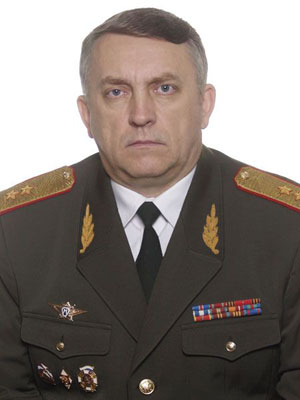
General-Lieutenant Karakayev

Somewhat atypically, he served some time as a department chief in the Defense Ministry’s Main Personnel Directorate.  He completed studies in the civilian North-Western State Service Academy before finishing the General Staff Academy.  He holds a doctorate in military science.  His full biography is here

Kremlin.ru provided the following excerpt from today’s Gorki meeting between Medvedev, Serdyukov, and Karakayev: 

“This is a serious position.  The functioning of our nuclear shield depends on work in these duties.  And of course, I hope that you will do everything necessary, everything dependent on you to apply your knowledge, your experience for the good of the country, to create the right RVSN command and control system.” 

“Despite the fact that we are reducing our nuclear arsenal, this must not affect the combat core within the limits of that agreement which is currently operative for us, and within the limits of that agreement which is in ratification.” 

“Generally, it’s necessary to do everything so that our Rocket Troops of Strategic Designation will be fully combat ready and can fulfill their established missions.” 

Karakayev gave a customarily brief response: 

“Comrade Supreme Commander-in-Chief, I will not fail.” 

Pervyy kanal covered also covered the Gorki meeting, if you’d like some video.  

The change in the RVSN may be a result of the bumps and bruises of reaching internal agreement to go forward with the new strategic offensive arms treaty.  Or maybe not.  But something’s clearly wrong; a ten-month tenure is clearly far off the norm.  Medvedev’s short comments aren’t much to go on, but they seem to say (a) Shvaychenko wasn’t doing the job the way his masters wanted; (b) the masters want an improved strategic nuclear command and control system; (c) the new arms treaty doesn’t threaten Russia’s nuclear deterrence capability and, therefore, is a good deal for Moscow; and (d) the RVSN Commander needs to focus his attention on the optimal operation of whatever weapons systems provided him by the country’s leadership.  And Karakayev indicated in front of the cameras that he’s on-board with all this. 

Armaments Chief Vladimir Popovkin also replaced First Deputy Defense Minister, General-Colonel  Aleksandr Kolmakov.  Popovkin seems to have accommodated Serdyukov, and fit well into the Defense Minister’s ‘new profile.’  The ex-Space Troops general seems to be the type of official the civilian leadership wants in its more civilian Defense Ministry.  He will keep charge of the weapons portfolio, and training and readiness accounts overseen by Kolmakov will probably go back to the Genshtab.  But more on this one tomorrow.

Humanizing and Outsourcing the Army

Press outlets report that the Siberian MD’s Yurga-based 74th Independent Motorized Rifle Brigade is the test bed for Defense Minister Serdyukov’s army ‘humanization’ initiative announced in late April.  And today Chief of Rear Services, Deputy Defense Minister General-Colonel Dmitriy Bulgakov expounded upon the extent of, and near-term plans for, outsourcing of food services in the army. 

The 74th IMRB is trying out a 5-day work week and weekend passes for soldiers.  They are permitted to wear civilian clothes while off-base for the first time.  The brigade has also introduced an after-lunch rest hour into the daily regimen. 

ITAR-TASS quotes brigade commander Colonel Andrey Khoptyar: 

“The intensity of combat training in 2010 has risen significantly, the load on soldiers has increased, therefore extra rest time has been allocated.”

Khoptyar said his soldiers are also getting an additional 30 minutes of sleep at night.

The media describes the 74th IMRB as one of Russia’s best performing and best-outfitted formations.  Some of its soldiers live in ‘hotel-type’ accommodations with four-man rooms and their own bath and shower rooms.

Transferring nonmilitary functions and duties from soldiers and their units to contracted commercial firms was another facet of Serdyukov’s April announcement.  Since December, this brigade’s troops have been spared mess hall duty because a private firm ‘MedStroy’ has taken over responsibility for operating its cafeteria.

IA Regnum described this as a “practical trial of new measures in all-around systematic support of day-to-day troop life by outside civilian organizations on an outsourcing basis.”  As the SibVO spokesman says:

“The main idea of the innovations is to free servicemen, to the maximum extent, from performing noncore tasks, establishing conditions for full-fledged combat training of personnel.”

At present, outsourced food service has already been establishing in the SibVO’s Ulan-Ude, Aleysk, and Yurga brigades, and the district military hospital in Chita.  The process of changing to this system of service has already started in two more permanent readiness brigades, the district training center, rear services units of two SibVO armies, three military schools, and 12 military hospitals this year.

The SibVO spokesman says state contracts worth 1 billion rubles have been concluded which bring 1,000 civilian specialists to provide services to more than 20,000 of the district’s troops.  The contracts include food and laundry services, housing-communal services in military towns, recreation services, and other material-technical support, including POL provision to the tune of more than 71 million rubles.

Beyond experiments in the SibVO, today Armed Forces Rear Services Chief Bulgakov told the press 340,000 soldiers in all permanent readiness units, military-educational institutions, and cadet and Suvorov premilitary schools will be fed through outsourced contracts by this year’s end.  He indicated 180,000 soldiers will be fed in 200 units for an annual cost of 6.5 billion rubles by 1 September.   At present, the logistics head said civilian enterprises are feeding 141,000 soldiers in 99 units, except in inaccessible and distant areas.  According to Bulgakov, commercial firms not only provide quality service, but are more economical than having soldiers perform this work.  Bulgakov added that outsourced food service has:

“. . . eliminated the diversion of personnel from combat training activities, food quality has improved, the variety of food prepared has broadened, culinary culture has been raised; the energy value, chemical composition and full achievement of the norms of food rations are reliably meeting normative requirements.”

Bulgakov spoke to reporters during a special rear services exercise supporting an ‘inter-service force grouping’ in the SibVO.  He pointed out how studying U.S. and NATO experiences influenced the Russian Army’s decision to outsource support functions.  According to ITAR-TASS, he said:

“As a result it was evident that the entire U.S. and NATO contingent in Afghanistan and Iraq at present is outsourcing all material-technical support.”

He added that “civilian specialists from commercial structures in these countries are working both in military units in their places of permanent deployment as well as in ‘hot spots.’”

There Will Be Professionals, But Later

In Thursday’s Vedomosti, Aleksey Nikolskiy wrote about Defense Minister Serdyukov’s remarks on contract service to the Federation Council.  Serdyukov and General Staff Chief Makarov have cited different figures on the current number of contractees (150,000 vs. 190,000), but agree they’ll be cut.  Professionals will come not only later, but in a smaller numbers.  And contractees will occupy only certain duties.

Nikolskiy cites a figure of only 50,000 contractees signed on during Russia’s failed 2003-2007 attempt to set up a professional enlisted force.

A future smaller number of contract NCOs could receive pay equivalent to that of junior officers.  Except that junior officer pay is supposed to increase dramatically toward 2012 under the new pay system.

According to Nikolskiy’s interlocutors, a new table of organization will soon spell out exactly where contractees will serve, i.e. there will reportedly be few driver-mechanic contractees, while the number of senior NCO billets will increase.

While contract soldiers decrease, how will Moscow manage its commitment to keep conscripts out of ‘hot spots’ (i.e. potential combat zones)?  As recently as April, the Defense Ministry had to reassure the public it had no intention of stationing draftees in Chechnya.

Here’s Nikolskiy verbatim:

“In the long run, contractees in the army will increase from 150,000 to 250,000, but first they will cut them to pick the best and pay them more.”

“Defense Minister Anatoliy Serdyukov told reporters in the Federation Council yesterday there are no plans to abandon contractee servicemen and their number in the future will increase to 200,000-250,000. The day before in the defense committee of the upper chamber, the Genshtab chief Nikolay Makarov said the number of contractees will be significantly reduced compared with the current 190,000.  According to him, contractees will occupy only duties in the Navy, Air Forces and Air Defense requiring good professional training, and also in permanent readiness units.  Only conscript soldiers will serve in the remaining posts.”

“An officer from the Defense Ministry central apparatus explains that Serdyukov’s and Makarov’s statements don’t contradict one another.  In the long run, depending on developing financial conditions, the number of contractees will grow, but first they will reduce them to get rid of ballast which got into these posts during the first attempt at professionalization of the army.”

“In 2003 the FTsP “Transition to Manning with Soldiers Conducting Military Service on Contract in Some Formations and Military Units” was adopted at a cost of more than 20 billion rubles.  According to it, by 2007, the number of contractees in soldier and sergeant duties in permanent readiness units should have gotten to 150,000.  However, they began to fulfill this program from the wrong end, said an officer, having simply mechanically increased the number of contractees in posts not worrying about their training or paying a normal wage.  As a result, they took less than 50,000 and the program collapsed, as the Defense Ministry’s leaders confirmed this year.  Now, after their reduction, the number of contractees will be increased carefully, take well trained people into posts and pay them wages equivalent to salaries of junior officers, said Vedomosti’s source.  At President Dmitriy Medvedev’s meeting on Monday [7 June], increasing wages was discussed and a figure was named—from 25,000 rubles [monthly].”
 
“In the words of an officer from one of the Ground Troops’ motorized rifle brigades, the latest order about contractees came to the unit at the beginning of the year and it indicated there should be no more than 5 percent of them among the number of soldiers and sergeants in driver duties, though more posts for contract sergeants as company and battery sergeant-majors were introduced.”
 
“According to him, you can’t judge where exactly contractees will serve until the introduction of new tables of organization which they’ve promised to do in coming months.”

Serdyukov on Contract Service

Wednesday Defense Minister Anatoliy Serdyukov appeared before a closed session of the Federation Council’s ‘government hour,’ and answered 30 prepared questions. 

ITAR-TASS reported the upper legislative chamber’s Speaker Sergey Mironov summarized Serdyukov’s presentation as follows:

“Objectively speaking, we received exhaustive explanations on several positions, some answers explained the situation which had called forth serious questions from the senators.”

Mironov added that Serdyukov’s answers:

“. . . did not completely satisfy FC members.  Personally I and many of my colleagues remained with our own opinions about what is happening in the armed forces.”

Defense and Security Committee Chairman Viktor Ozerov delivered the gist of Serdyukov’s answers to the Russian media, although Serdyukov answered some direct press questions after his session with the legislators.

According to RIA Novosti, Serdyukov said:

“We talked about the transition to the new profile, the numerical composition of the armed forces, the new structure, military units which are being created, draft legislation on pay and proposals concerning the provision of housing to servicemen.”

The major news out of Serdyukov’s parliamentary appearance was the report that he denied Russia is abandoning professional contract service or returning to Soviet-style, all-conscript armed forces.  This contrasted with the recent Newsru.com report saying contractees will soon be drastically cut everywhere except in permanent readiness units, as well as with General Staff Chief Makarov’s February admission that contract service has failed. 

Several media sources reported that Serdyukov indicated contractees would increase 50 percent from a current level of 150,000 to between 200,000 and 250,000.  ITAR-TASS reported his words as:

“In the future it [the number of contractees] will grow, there is potential for this.  In the future the number of contractees will grow to 200-250 thousand, such conditions will be created for them so that they can fulfill their duties as real professionals.”

However, BFM.ru and Regions.ru heard it quite differently.  They reported:

“The Russian Army has not abandoned contract service.  Now in the Armed Forces of Russia there are 150 thousand contractees.  At minimum, this number will be preserved.  If the financial potential of the government allows, we will broaden this component.  Ideally, according to our calculations, the quantity of contractees should be about 200-250 thousand.  They should occupy duties demanding good training and knowledge, service experience.”

According to Ozerov and press sources, Serdyukov addressed other miscellany.

The Defense Minister said the LDPR’s recent draft law proposing to allow young men to buy their way out of the draft for 1 million rubles “raises a whole series of issues.”  He claimed this would interfere with the country’s mobilization potential.  He apparently didn’t say how many guys he thought could afford that much, but he must think a lot can, if it could affect Russia’s human mobilization resources.

Despite recent press indicating a strong presumption that Serdyukov is ready to euthanize premilitary Suvorov and Nakhimov schools (much as VVUZy have been paired back), he told the Federation Council that Suvorov schools will be preserved and strengthened.

Serdyukov demurred from the possibility of more Russian bases abroad, calling them an “expensive pleasure.”

He said the military’s 8,000 plus military towns will be reduced and consolidated into only 184, and those cut would be turned over to the oblasts and republics in which they are located.  The Defense Ministry will discuss with RF subjects and local governments the transfer of housing and other social infrastructure in military towns to their jurisdiction. 

This harks back to the late April announcement about constructing new, large ‘core military towns.’  The smaller number of garrisons sounds more appropriate for a million-man army than 8,000, but taking care of those left stranded without utilities and other services in former garrisons is much more troublesome than simply transferring them to the control of oblasts or local governments.

Serdyukov said the Defense Ministry will acquire 51,000, rather than 45,000 permament apartments for servicemen this year.  He doesn’t see any problem with providing service apartments to every military man by the end of 2012.

He regrets that the Defense Ministry’s request for indexing military pay and pensions has not been approved, but he said this issue is not decided yet.

On the Black Sea Fleet, Ozerov said Serdyukov said the fleet’s personnel will be less than the 24,000 stationed there earlier.  He said Serdyukov said he expects the new Ukrainian government to be much more amenable to discussing deliveries of new weapons and equipment of the Russian fleet.

OSK Commanders Will Directly Control Navy and Air Forces

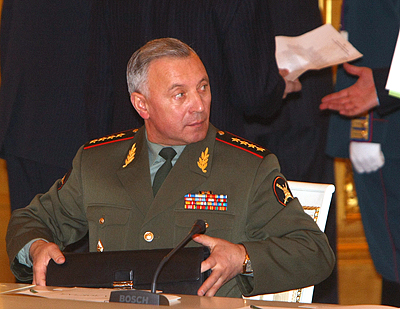
Army General Makarov

Russian General Staff Chief, Army General Nikolay Makarov briefed the Federation Council’s Defense and Security Committee today, and, according to Interfaks, he has made the decision to replace Russia’s six military districts with four that will function as operational-strategic commands (OSK).  He said:

“We will propose on the base of six military districts to establish four military districts, to the commander of which all forces and means deployed on their territory, including Navy, Air Forces and Air Defense, will be subordinate.  And subordinate not operationally, but directly.”

“Ground-, sea- and air-based nuclear deterrence forces will remain under the General Staff.”

“Our proposal on establishing four operational-strategic commands is now with the country’s president and I think that this issue will be favorably resolved soon.”

Infox.ru cited Makarov on the creation of three additional combined arms armies for several strategic axes: 

“We conducted a careful analysis of current threats and challenges and came to the conclusion that it’s necessary to create additional combined arms armies on several strategic axes.  There will be three in all.”

Makarov added that one army would be based in Chita, and six additional motorized rifle brigades will be formed to flesh out the newly created armies.

And Makarov wasn’t done . . .

According again to Interfaks, Makarov told these members of Russia’s upper house of parliament that ten combined air (8) and naval air (2) bases will be established in Russia.  Until recently, the military had been talking about new “first- and second-rank air bases” that were basically Air Forces’ equivalents of Ground Troops’ brigades.  This approach may have been abandoned in favor of a smaller number of larger air bases.  The choice of the word ‘combined’ [объединённые] makes these things sound like they’re now equivalent to armies.

Makarov explained that Russia has 245 airfields:

“The approximate cost of using one airfield is 1 billion rubles per year.  This amount is prohibitive, therefore we took a decision on enlarging air bases.”

After this change, Russia will only have 27 airfields, according to the General Staff Chief, and the combined air and naval air bases will be spread out over Russia in cities like Voronezh, Chelyabinsk, Domna (near Chita), and Komsomolsk-na-Amure.

Makarov said the goal was not only excellent conditions for fulfilling flight missions, but also for the everyday lives of servicemen and their families:

“We’re doing everything so that our pilots and their families can live in human conditions.”

Makarov told the assembled lawmakers that Russia will complete contract to buy Mistral from the French:

“Concerning Mistral, the contractual obligations are practically ready.  I think we’ll buy this ship.”

“We need such a ship.  In the Far East, it’s simply essential.”

He went to say, it’s needed around the Kurils which “generally have nothing to defend them.”  And he elaborated:

“Earlier there was an army there.  There’s no one there to cover them, we need mobile means so at the necessary time we can deliver a landing force quickly.”

He repeated his past comments to the effect that Mistral is 4-5 times bigger than Russia’s largest amphibious ship, the Ivan Rogov class.

Tomorrow it’s Serdyukov’s turn to speak to the Federation Council, so prepare for some more news.