Category Archives: Serdyukov’s Reforms

Demobbing the Central Apparatus

Over the weekend, Moskovskiy komsomolets reported the next wave of reform will civilianize the entire central apparatus of the Defense Ministry.  Civilian administrators will replace uniformed officers everywhere except the Genshtab and “combat support structures.”  Special commissions will select civilians on a competitive basis. 

MK’s Defense Ministry sources claim this phase of reform will be completed by December.  The Main Legal Directorate will civilianize in August-September.  The Press-Service and Information Directorate will be reformed from 1 August.  The Personnel Inspectorate will civilianize also, according to MK’s report.

Needless to say, generals think it strange to let civilians decide the fate of their careers.  But an MK source argued:

“And who prevents them from working just the same, but in civilian attire?  For them, in principle, just like for prosecutors, it’s no different – in shoulderboards or without them, only the knowledge of directive documents and legislative acts is important.”

For counterpoint, MK turned to Leonid Ivashov:

“It’s obvious today that a transition to civilian duties is taking place in the military department.  The second tendency is the domination of women in the new structures.  They head finance, the legal directorate, the apartment-management service, a nice girl headed the directorate for international military cooperation for a time.  Ms. Shevtsova became deputy minister, in charge of construction, a woman – a specialist in taxes and alcohol production heads the military education department . . . .  Don’t think that I’m badly disposed toward women, I like them very much.  I wouldn’t, for example, be irritated if Natalya Narochnitskaya [a well-known scholar, social-political figure, doctor of historical sciences — Ed.) became Defense Minister.  She’s an intelligent analyst, who has tact, and, I think, could bring a lot of useful and healthy things into army structures.  But if managers from business go there and gather such people around them, then the army will turn into some kind of commercial organization.  When they say we are copying the American or other democratic model of an army where the Defense Minister and his department are civilians, this is not true.  Yes, we have a civilian minister.  But I don’t see in a single serious government that people from commercial life come to this post.  They are always politicians, representing some party which controls or consults with them.  But to simply to throw any guy into the military department so – and do what you want, there isn’t anything similar in a single government.”

Ivashov makes the observation that civilianization, and feminization, of the Defense Ministry’s been going on for a while now.  But he spins off into a diatribe against ex-businessman Serdyukov.  It’s not really Serdyukov’s fault there’s no democratic party system to produce politicians who could lead the Defense Ministry.  And one could argue the Defense Ministry was a corrupt commercial organization well back when Ivashov was there, but men in uniforms were the ones making the illicit deals then.  But we digress . . .

Recall at the outset of Serdyukov’s reforms in fall 2008, he indicated he intended to cut the Defense Ministry’s 10,523-strong central apparatus and roughly 11,000 military personnel in command and control organs down to no more than 8,500 in all.  So perhaps now we’re looking at about 4,000 personnel, civilians that is, in the Defense Ministry’s central apparatus.

Dropping officers in favor of civilians in the Defense Ministry might buttress Dmitriy Litovkin’s report last week about a deeper cut in military manpower.

Below One Million?

Dropping Russia’s military manpower level below one million?  Talk about a watershed.  This might be spurious information, but coming from Dmitriy Litovkin, the report has to be taken seriously.  In fine Russian tradition, it could be a trial balloon to elicit public and elite reactions.

In yesterday’s Izvestiya, Litovkin reported that, over the course of two years, the Russian Army will become smaller by 150,000 men, according to a Defense Ministry source.

The impetus for this is the Finance Ministry’s.  Aleksey Kudrin’s been ordered to fight the budget deficit, and he’s got defense and security spending in his sights. 

The source says concrete proposals to cut military expenditures were prepared for a special government conference in early June.  As a result, the government adopted an “additional reduction” of 150,000 servicemen.  This would reportedly save 10 billion rubles in 2010 [sic], and almost 50 billion rubles in 2014.  The article says military staffs have already been cut 40 percent as a result of army reform. 

Litovkin notes Defense Minister Serdyukov has previously called one million the “optimal” manning figure — ostensibly 150,000 officers, 100,000-120,000 contract sergeants, and conscripts for the balance.

But it wasn’t so long ago that the Defense Ministry declared the need for an increase of 70,000 officers, and raising the number of contract NCOs and soldiers to 480,000.  It’s not clear how these new cuts are supposed to jibe with increases proposed earlier this year.  The Supreme CINC [together with his tandem partner] will have to decide.

Litovkin enumerates Defense Minister Serdyukov’s competing costly initiatives — higher officer pay, outsourcing nonmilitary tasks, etc.  According to this, outsourcing alone has already brought 380,000 [!?] civilians into military support positions and this number is supposed to increase.  Litovkin doesn’t close the loop on this, but he seems to imply the high cost of these efforts requires cuts in manpower.

This is all exciting and interesting and occasions a couple thoughts.

One.  The new “optimal” number for the Armed Forces must be 850,000.  Liberal Russian politicians, military analysts, and observers have long argued for this, or an even more radical cut.  But one million has had mystical power.  Russian conservatives will vociferously object that the country’s borders are too extensive to be defended by a single man short of one million, as if even one [or for that matter two] million could do it, or as if sheer manpower’s the best way to parry modern military threats.

Two.  Though not mentioned by Litovkin, isn’t it possible Moscow’s decided to make a virtue of necessity and recognize that demographic and draft problems have left them well short of a fully-manned force of one million anyway?  This could be a small step in the direction of becoming (or at least looking) more like just another European army.

Three.  The inevitable downsides.  Keeping more officers had been intended to deal with the outplacement cost (apartments) and other negative fallout of cutting the officer corps in half, not to mention simply having more officers around to deal with unruly nonprofessional soldiers in the ranks.  And another round of personnel reductions is likely to delay any resumed movement toward a long-term professional enlisted force.

Just the latest fro in the game of Russian defense policy to-and-fro.

Government Hour (Part II)

There was plenty of interesting media coverage of the Defense Minister’s meeting with the Duma on Wednesday, and plenty of criticism of what he said or didn’t say.  Plenty worth covering in a Part II, especially regarding Serdyukov’s effort to shift the blame for another failing GOZ.

Radio Svoboda quoted KPRF deputy Vladimir Ulas putting all the blame for the army’s current state right at Anatoliy Serdyukov’s feet:

“The public clearly understands that the situation in the Armed Forces is far from favorable.  Constant scandals which rock this department, the morale-psychological situation in which personnel, first and foremost, the officer corps, find themselves, both the material condition, and the lack of modern armaments – all these problems are completely real.  I also hoped to hear answers to questions, how the Defense Ministry intends to solve them, from the minister.  But, to my greatest regret, the biggest, in my view, problem of today’s Armed Forces is the absolutely dense incompetence of the military leadership.  With people like Serdyukov still heading our Armed Forces, and he, unfortunately, is far from the only one, hoping for some kind of positive shifts is absolutely senseless.”

There was plenty more to be said about problems with the GOZ, the OPK, and the VPK and Defense Ministry blaming each other for what looks like a failing GOZ-2011.

KPRF deputy Anatoliy Lokot told Nakanune.ru:

“I have the impression that these sessions are ‘closed’ to hide the bitterness of the questions and negative results of the work of Military-Industrial Commission (VPK) and Defense Ministry leaders.”

United Russia’s Igor Barinov reiterated what he said he told President Medvedev a year ago:

“I noted then that the lack of competition and incomprehensible system of price formation in the VPK is a deadend path.  We’re reaping the fruits of this now.  Judge yourself:  one, well, a maximum of two enterprises produce this or that type of our armament or military equipment.  Meanwhile, enterprises getting money from the federal budget dispose of it as they wish.  Prices simply come from the ceiling.  No one bears any responsibility for quality.  No one invests money in improving types of military equipment, in the end it goes that even in infantry weapons we’ve fallen behind.  Our legendary automatic weapon Kalashnikov, the value of which everyone recognized before, now lags the best Western types in tactical-technical characteristics.  And so it is in almost every area, with rare exceptions in the areas of missiles and some aircraft.”

“The Defense Ministry announced it won’t buy airborne combat vehicles [BMDs] and infantry combat vehicles [BMPs] from ‘Kurganmashzavod.’  This enterprise was one of the guilty in breaking the Gosoboronzakaz.  And here’s the thing in this.  ‘Kurganmashzavod’ is part of the United ‘Tractor Plants’ Corporation.  Budget money is shared out with ‘Kurganmashzavod’ in a targeted way for the purchase of equipment, but the corporation’s directors dispose of it according to their discretion, and, naturally, BMP and BMD production is the last thing of concern for the owners of this holding company.”

“If they understand that they can be deprived of budget resources, then this enterprise will be forced to invest in quality, and in cutting defects, and in the improvement of product types.  In addition, strict supervision is needed.  Money was allocated but no one asked anyone about this money, and the result was zero.”

The KPRF’s Lokot also dwelled on the GOZ:

“It’s obvious that if the Gosoboronzakaz isn’t formed in the first half of the year, then nothing will be accomplished in the remaining part of the time since money will only begin coming in at the end of the year.  Serdyukov acknowledged that today 13.4% of all contracts in the plan have been formed.  Some time ago, Sergey Ivanov gave us other numbers.  But I think that this number juggling was caused by competition between the Defense Minister and the Military-Industrial Commission.  Ivanov lumps all the blame on the Defense Ministry, Serdyukov – on the defense-industrial complex.  He even began his [Duma] speech with this, saying that the military-industrial complex is guilty of everything.  They have poor qualifications, technology losses, poor production and so forth.  But really at a minimum the Defense Ministry itself bears 50% percent of the responsibility for such a situation.”

“I have given the example of Novosibirsk proving the obvious guilt of the Defense Ministry in breaking the order.  One of the enterprises – the Lenin Factory, which puts out very important products for infantry weapons, became a victim of Defense Ministry officials.  In January this year, Serdyukov opened a state order tender with his signature, but closed it in March.  Now half the year is gone, and there are no results.  The enterprise isn’t working, products aren’t coming out, 211 million rubles spent on reequipping won’t bring any returns, and now they’re generally talking about cutting part of the work force.

“Right in Novosibirsk at the Comintern Factory the S-400 surface-to-air missile system is being produced on the enterprise’s own money, and not with government resources.  Serdyukov says:  ‘I don’t see anything terrible in this, let the enterprise do it on its own money.’  But where does it get its capital resources?  What world is Serdyukov living in?”

Vedomosti talked to a former Defense Ministry official who basically said the threat of arms purchases abroad really didn’t scare anyone.  And, according to him, although Serdyukov considers defense industry leaders lazy and prone to stealing, everyone understands imports can never replace domestic production.  Finally, a source close to the PA told the business daily that Serdyukov himself opposes the Mistral acquisition because of the large expenditures required to build its base infrastructure.

Government Hour (Part I)

Yesterday Defense Minister Anatoliy Serdyukov appeared for his latest “government hour” to discuss the state of Russia’s defenses with parliamentarians.  One gets the sense his opponents were more on the offense this time than in the past.

The KPRF pushed to have his Duma meeting opened to the press, but its motion failed.  The faction noted Serdyukov’s yet to have an open session.  It’s first deputy chairman, Sergey Reshulskiy said:

“In all the previous closed ‘government hours,’ I never once heard and no one has proven to me that we are discussing anything secret here.”

“What will he [Serdyukov] tell us?  That they are supplying ‘Mistral’ without its full equipment?  This isn’t a secret.  That servicemen sent into retirement aren’t getting housing, this isn’t a secret either.”

Faction member Vladimir Fedotkin said:

“The West knows a hundred times better than we deputies what’s being created in our army.”

United Russia supporters thought Serdyukov’s answers exhaustive, but others were dissatisfied with his presentation.  Reshulskiy said he heard nothing concrete in Serdyukov’s statements about the recent depot explosions, fulfilling the GOZ, or resettling servicemen from the far north.

LDPR member Sergey Ivanov [not to be confused with Serdyukov’s predecessor] said he had counted on having a different conversation with the Defense Minister, and Serdyukov answered questions like a partisan politician.  Ivanov continued:

“In particular, Serdyukov didn’t give any concrete answer why Russia is buying ‘Mistral’ helicopter carriers from France and where they will be deployed.”

Just Russia’s Svetlana Goryacheva said her party “heard very sad things:  everything’s either not completely financed, not fulfilled, not completely fulfilled.  The Gosoboronzakaz is practically broken.”

Serdyukov apparently called the 102nd Arsenal disaster in Udmurtia a “remnant” of the Soviet era.  The munitions located there arrived during the early 1990s pullout from Germany and Hungary.  He blamed the “human factor” as well as “inadequate storage capabilities.”

Serdyukov also reportedly denied any retaliation against the Lipetsk pilots who blew the whistle on premium pay extortion at the base.  He said the scandal would not reflect on them in any way, and they would continue to serve.

The Defense Minister said Russia won’t be buying German Leopard tanks [recall Postnikov’s suggestion that they might be cheaper than a reworked T-72].  Nor is NATO standardization in the offing.

After the ‘government hour,’ United Russia’s Igor Barinov, deputy chairman of the Duma defense committee, told the press the Mistral deal is complete except for formalities, but most deputies believe buying the ships is a mistake:

“I myself am a little skeptical about the possibilities for combat employment of these types of weapons.”

Nakanune.ru had good coverage of the session.  It’s description said problems with the GOZ were front and center.  When Serdyukov explained how officials and factory directors were punished for breaking the GOZ, several deputies suggested that Serdyukov should resign if his qualifications don’t enable him to solve defense production problems.

Barinov also addressed this saying:

“I won’t cite concrete figures, since this could be secret information, but it’s possible to call the situation lamentable.”

Look for Part II tomorrow.

Galkin Promoted

A thing rare in recent times was announced today . . . the promotion of a general officer.  In this case, Southern MD Commander, General-Lieutenant Aleksandr Galkin picked up his third star. 

President Medvedev’s decree on General-Colonel Galkin was dated June 11, according to RIA Novosti.

Large, well-publicized general officer promotion ceremonies used to be the norm, but no longer. 

Recall one of Defense Minister Serdyukov’s objectives was turning the “bloated egg” of the officer corps into a pyramid.  As part of this, he planned to trim 1,100 generals to 900. 

Of course, Serdyukov had to walk back part of his decision on cutting officers this year, but generally it’s clear that lots of O-6s now occupy billets once held by one-stars.  Army commanders routinely two-stars in the past now wear only one.  And MD commanders who typically wore three, have been wearing only two . . . at least until now. 

Galkin joins Western MD Commander, General-Colonel Arkadiy Bakhin at the three-star rank. 

Galkin’s promotion shows the team has to be rewarded for doing the heavy lifting of establishing the “new profile.”  Three-star rank also extends his statutory retirement to 60. 

Central MD Commander, General-Lieutenant Vladimir Chirkin and Eastern MD Commander, Vice-Admiral Konstantin Sidenko are both older than Galkin.  They are likely serving on extensions right now, and might be better candidates for retirement than promotion.  But another star can’t be ruled out.  In Chirkin’s case, the recent arsenal explosions in his AOR won’t help him.

Aleksandr Viktorovich Galkin is especially strongly linked to General Staff Chief, Army General Nikolay Makarov through his service in the former Siberian MD in the 2000s.  Bakhin and Chirkin are also “Siberians” with ties to Makarov.

Some details on Galkin:  He was born March 22, 1958 in Ordzhonikidze (now Vladikavkaz), North-Ossetian ASSR.  He graduated the Ordzhonikidze Higher Combined Arms Command School in 1979, and served in motorized rifle command posts up to chief of staff and deputy commander of a battalion in the GSFG.  He was a battalion commander in the Far East MD.  In 1990, he completed the Frunze Military Academy, and served as a motorized rifle regiment commander in the Transcaucasus, and chief of staff and deputy commander of a motorized rifle division in the Far East MD.  On completing the General Staff Academy in 2003, he served as deputy commander of the 41st Combined Arms Army (Novosibirsk), and chief of staff and first deputy commander of the 36th Combined Arms Army (Borzya).  In 2006-2007, he commanded the 41st.  In 2008, Galkin became deputy commander, then chief of staff and first deputy commander of the Siberian MD.  In early 2010, he became commander of the North Caucasus MD, and the renamed Southern MD early this year.

For Most Corrupt . . .

The winner is . . . the Ministry of Defense.  Novaya gazeta assembled respected independent experts to judge which of the Russian government’s 35 ministries and departments is most corrupt.

The Defense Ministry edged out the Transportation and Economic Development Ministries.  The experts said the five most corrupt (Health and Social Development is fourth and Finance fifth) have the opportunity to “saw off” 100 million to 1 trillion rubles per year (including budget money, and money that doesn’t reach the budget).

A little context.  Recall Defense Minister Anatoliy Serdyukov arrived four plus years ago promising to bring the Armed Forces’ notorious “financial flows” under strict control.  But corruption scandals have only continued to flare around the Arbat Military District.  Just a casual recent look:  the Main Military Prosecutor says 20 percent of GOZ money is being stolen, Lipetsk highlights widespread premium pay extortion, the Chief of the Main Military-Medical Directorate is arrested for corruption.  The list could go on.

Look at the Novaya story in the vernacular for links to its original sources.  Its experts focused on the closed nature of the defense budget, the impossibility of accounting for money allegedly spent on military R&D, the inability to confirm that work was actually performed, inflated prices, and a high rate of kickbacks.

But they also focused on the simple fact that no one is officially in charge of significant amounts of defense money in the federal budget.  Just by looking at budget lines, it’s clear to them that 600 billion rubles in defense spending (and perhaps much more) are simply unaccounted for.

They also focused on Defense Ministry FGUPs that haul in enormous profits but remit little into the budget.  And lastly they noted that fake health deferments from Voyenkomaty amount to an illicit 150-billion-ruble business every year. 

This is how they summarize the corruption situation in the Defense Ministry (below распил or saw cut, a share or cut of illegally obtained money, is translated as sawed off): 

“1.  Anatoliy Serdyukov’s Defense Ministry is the richest and also the most closed of Russian ministries and departments.  This is precisely why the experts considered it the ‘goldmine of the corrupt,’ that is absolute leader in the volume of money which it’s possible to write off  without supervision as ‘expenses,’ the reality of which society doesn’t have the slightest chance of verifying.  The first corruption scandal in the new (Yeltsin-Putin) Russia is directly connected with the Defense Ministry – the plunder of Western Group of Forces property which broke out in 1992-93.”

“In the opinion of experts polled, ‘today’s army purchases and especially ‘development,’ ‘research and development work’ for the army is that sphere where it’s possible to put up to 90% or more of state financing in your own pocket peacefully and where there’s no kind of limit at all.  Not even comparable is civilian construction done at state budget expense, where it would seem there should be the greatest percentage of corruption, but there is a limit there:  in construction it’s necessary to present a final result – a finished facility, therefore here it’s possible to put a maximum of 70% of state resources in your pocket without punishment.  In army ‘development’ there’s no accounting, everything’s classified, and this means it’s impossible to check, therefore in the Defense Ministry they ‘lose’ fantastic sums.  This comes to light only rarely, when military journalists make note of ‘new developments’ at Defense Ministry exhibitions which they already saw several years before.  Meanwhile, the Defense Ministry objects to this:  no, this isn’t old, it’s new, but meticulous military journalists show photos from previous years in which even the serial numbers are the very same as in the new exhibition.”

“Such expert evaluations are largely supported by the not numerous checks of the Main Military Prosecutor when they conduct them.  So, not long ago, the results of checks into the Defense Ministry’s 13th GNII and the Main Military-Medical Directorate, where ‘large-scale thefts of financial resources’ were revealed, were substantiated.  ‘Just in several instances of criminal activity by officials of the 13th GNII and ZAO ‘Kulon’ the theft of more than 40 million rubles was revealed – this is the amount of work which was never fulfilled.  A criminal case in relation to a group of Defense Ministry Main Military-Medical Directorate and State Order Directorate personnel was launched:  they concluded a state contract with a commercial firm to supply medical equipment for more than 26 million rubles, the cost of the equipment purchased from the businessmen was inflated more than 3 times, and the state took a loss of more than 17 million,’ acknowledged the Chief of the Second Directorate of the Main Military Procuracy General-Major of Justice Aleksandr Nikitin.”

“In Kirill Kabanov’s estimation, ‘the figure of 1 trillion rubles which the budget loses in purchases could be understated.  Kickbacks in our state procurement system are 30-40%, in open areas kickbacks are 20%, but in closed, monopolistic ones they go up to 60% — in the Defense Ministry, for example.’

“‘The Defense Ministry, of course, is the kingdom of the fearlessly corrupt.  The ability to classify everything in the world powerfully helps in ‘sawing off’ activity,’ – states Aleksey Navalnyy.”

“The potential corruption of ‘defense expenditures’ lies not just on the fact that society can’t concretely check the designation of every billion of military spending, but it doesn’t even have chances to find out precisely which ministry or department exactly bears responsibility for a good half of ‘defense’ expenditures.  For example, in 2010, the expenditures of the RF federal budget were 10.116 trillion rubles – both the Finance Ministry official site and the Rostat official site attest to this.  But of these only 9.052 was officially distributed among ministries and departments, and more than 1.06 trillion rubles was used by someone unknown, meanwhile more than half of them (0.6 trillion) went to ‘defense expenditures!’  An even more outrageous situation was planned in the RF budget laws for the following years:  in 2011, expenditures are 10.65 trillion, only 9.35 of which are signed off to a departmental structure, in 2012 — 11.3 trillion and 9.4 trillion, in 2013 — 12.2 trillion and 9.5 trillion accordingly, that is with every year the share of ‘no one’s’ expenditures will grow even larger . . .”

“In 2010, budget expenditures ‘on defense’ were 1.28 trillion (!) rubles.  Meanwhile, the Defense Ministry spent 0.98 trillion, of which 0.64 trillion were ‘on defense,’ but the remaining 0.34 trillion — on communal services, education, health, film, TV and pensions.  Spending of the remaining departments ‘on defense’ was in the amount of 0.041 trillion (Minpromtorg –32.4 billion, Rosatom –3.7 billion, Roskosmos — 0.9 billion, Rosaviatsiya — 0.6 billion, etc.; the Defense Ministry’s departments:  Spetsstroy — 1.8 billion, Rosoboronpostavka — 0.5 billion, Rosoboronzakaz — 0.3 billion, FSVTS — 0.3 billion, FSTEK — 0.0 [sic] billion rubles), the total expenditures of all departments ‘on defense’ — 0.68 trillion rubles.  But it’s unknown who — unknown even which ministry or department spent all of 0.6 trillion rubles ‘on defense!!’  It’s understandable that they were spent on the Defense Ministry’s business, but why hide this (no ‘military secret’ really suffers, if the Defense Ministry acknowledges that it spent not 1 trillion, but an entire 1.6 trillion in a year), isn’t it because it’s so much easier to steal ‘no one’s’ 600 billion in defense money?”

“It’s not known which departments spend not just 0.6 trillion in expenditures ‘on defense,’ but also 0.46 trillion of other spending — a number of experts believe they are almost all under the Defense Ministry’s control, the real budget of which is twice as much as the official one and amounts to 2 trillion a year.  So half of this (or even more), in experts’ opinions, gets ‘sawed off.'”

“However, the ‘fat’ life of the Defense Ministry leadership doesn’t end with this.  It turns out to be unknown how and why 15 thousand pieces of property belong to the Defense Ministry.  Where and to whom the proceeds from the use of them go – God only knows.  But on the other hand it is known that they are still also gathering up money for housing construction on these Defense Ministry lands from simple people who then turn into deceived investors.”

“Moreover, the Defense Ministry directs 352 FGUPs (Federal State Unitary Enterprises), from which even in the crisis year 2008, the Defense Ministry received 39.3 billion rubles in proceeds, but there are problems with remitting the profits into the federal budget:  it remitted only 0.092 billion of them.  Another 126 FGUPs are directed by Defense Ministry subordinate Spetsstroy and there’s the same situation with it:  proceeds in 2008 were 62.4 billion, and only 0.017 billion in profits remitted to the federal budget.  Defense Ministry subordinates FSTEK and Rosoboronzakaz direct 4 and 3 FGUPs respectively, their proceeds are 0.8 and 0.2 billion respectively, profits remitted to the budget are 0.001 and 0.0002 billion respectively.”

“The Defense Ministry and its subordinate Rosoboronpostavka glorified themselves with outrageous expenditures of dozens of budget millions to buy furniture for their leadership – certainly made of gold, beautiful wood and natural buffalo hide.  The main defender of the Motherland wouldn’t sit or work on any other furniture . . .  Just three such orders for the leadership cost the budget 60 million rubles, and at the same time 7 million was spent for furniture for average Defense Ministry and Rosoboronpostavka personnel. The Defense Ministry made it known that it also wrote off 45 million on ‘media monitoring’ in 2010(!).”

“The Defense Ministry’s subordinate Spetsstroy has been highlighted in corruption scandals:  in 2010, just one of its FGUPs tried to ‘con’ four banks out of more than 500 million rubles, by not returning credits taken from them and attempting to organize the ‘bankruptcy’ of Spetsstroy FGUPs . . .”

“Besides, in the experts’ opinion, ‘the main preoccupation of voyenkomaty in the last two decades has become the collection of bribes from conscripts,’ since ‘from 80% to 90% of deferments for health are given by voyenkomaty for bribes – exactly for this reason the Defense Ministry is demanding the lifting of student deferments, lifting deferments for the fathers of newborns, but never demands lifting deferments for health.’  Every year nearly 600 thousand deferments ‘for health’ are issued, almost all are for bribes which run in various RF regions from 200 to 400 thousand rubles, so, the overall trade in voyenkomat bribes is nearly 150 billion rubles a year, the experts believe.”

Exploding Arsenals

Media commentaries on the arsenal explosions were outstanding.  Here are excerpts from some . . .

Viktor Myasnikov in Nezavisimaya gazeta:

“The father of one of 300 conscripts assigned to the arsenal, Andrey Chukavin, said three days before the incident he complained on the Defense Ministry website about safety rule and regulation violations in the loading-unloading work.  In his opinion, the arsenal didn’t figure on the quantity of munitions that arrived in the last month.  ‘Conscripts and civilians had to work in two shifts for loading-unloading.  Work went on from 8:30 until three in the morning or later,’ — he told journalists.”

“However, in past years there hasn’t been a single explosion at a civilian enterprises disarming munitions.  Because automated systems of disassembly are working there, safe techniques of eliminating explosives are employed and safety rules are strictly observed.  But it’s more advantageous for the Defense Ministry to use draftees, old-fashioned manual disassembly and save budget resources on its arsenals.  And then the state will spend billions covering the damage from such economizing.”

“Soon, as punishment, the president will dismiss the next batch of generals and colonels.  But the system remains.  So explosions will rumble in the arsenals again in a year or two, or even earlier.”

Itogi’s Oleg Andreyev:

“. . . they’ve made responsible for the explosion in the artillery depot in the Bashkir village of Urman a conscript whose guilt consists probably of not being trained to work with explosive substances.”

“Really everything that’s happening now under Serdyukov’s administration is absolutely natural.  Specifically, under him, the last professionals who received a classical military education departed the Armed Forces.  In essence, continuity was destroyed, and, as they say, the experience of organizing service, literally paid for with blood, drained away into the sand.  Including also experience in storing and servicing explosive substances, munitions and combat means.  To put it differently, there are still shells and missiles, bombs and torpedoes in the arsenals, but experience and skill is lacking!  Explosions in depots don’t just cause deadly fireworks.  In society’s consciousness, the shock wave will raze all of military reform to the ground.”

In Nasha versiya, Vadim Saranov writes:

“Can it be that in June 2010 [sic] after the explosions at the arsenal in Ulyanovsk, the president dismissed an entire handful of generals, but, as we see, nothing came out of this.  On the other hand, several other Defense Ministry decisions, in the opinion of specialists, are increasing by several times the risk of similar events at depots and ranges.  As ‘Nasha versiya’ already wrote, at the beginning of 2010, Defense Minister Anatoliy Serdyukov issued a directive, according to which the Russian Army should rid itself of all old munitions by the end of 2011.  But no kind of serious investment in this program was foreseen.  It was ordered to get rid of shells either by explosive methods or in army arsenal workshops which have obsolete equipment.  Today, according to our Defense Ministry sources, to fulfill these instructions, dismantlement is taking place in a rush in units.  It isn’t excluded that this hurrying itself could even be the cause of future accidents.  Judge yourself:  according to official statements, the first explosion in the depot in Udmurtia happened on the night of 2-3 June during some ‘loading-unloading’ work.  Ask yourself:  from what kind of panic, really, is loading-unloading work conducting at night in a second-rank arsenal?  Did a war start?  According to regulations, at this time there should only be sentries, duty officers, and orderlies on watch.  Then who was handling shells?  How much time did this soldiers rest in the previous day?  For this reason, it can’t be hoped that the events in Bashkiria and Udmurtia will be the last in the series of bombardments of peaceful Russian towns.  The minister’s order will be fulfilled at any price.”

Lastly for this post, Pavel Felgengauer in Novaya gazeta:

“In every separate instance (according to the results of official investigations) the guilty one is either a negligent officer or soldier (one-year conscript) who somehow didn’t handle shells and artillery powder casings carefully enough or threw down a butt.  And then the negligent chiefs who didn’t ensure supervision, order and discipline.  Even if all this is true, it isn’t possible with just one administrative dressing-down, even if Medvedev removed the minister [Serdyukov] as punishment, to solve universally the problems of masses of unneeded, expired munitions in Russia.  It wasn’t under Serdyukov that ammunition began to burn and explode regularly in Russia, and it won’t stop after him.”

“We need, of course, to arrange a reliable, effective and safe system of dismantling old munitions instead of the usual, harmful and dangerous  explosive demolition.  We need to construct reliable storage bases with secondary containment and strong concrete shelters.  Medvedev is right — we have to struggle against sloppiness.”

Felgengauer goes on to note that Russia has had to keep old shells for its old guns and tanks that haven’t been replaced.

“When the chiefs say that the army and navy’s weapons are 90 percent obsolete — this is true, but this isn’t all.  The munitions have become obsolete just the same, if not worse.  That is, old munitions are used and saved, but they from time to time randomly explode, maiming and killing people, destroying buildings.  So here’s the system, because of which it’s impossible to avoid tragedies and accidents.  And in the future, undoubtedly, there will only be more of them since weapons and munitions are getting even older, and discipline in the troops will continue to fall in response to half-baked reforms.”

Not Utopia

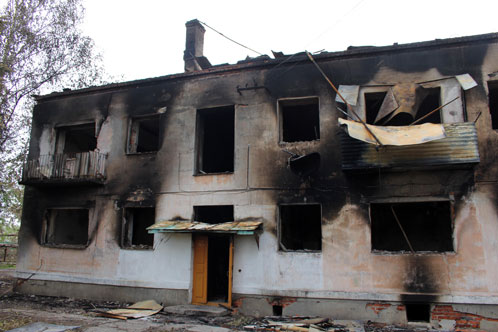
Burned Out Building in Urman Near the 99th Arsenal (photo: Komsomolskaya pravda / Timur Sharipkulov)

Yes, it’s definitely not utopia.

Sometimes it seems Anatoliy Serdyukov resides in a special dystopia reserved for reformers.  In an interview at the very end of last year, Serdyukov said as much.  He admitted his reform of the military isn’t solving every problem.

Addressing munitions dismantlement on December 31, the Defense Minister said:

“The problem is very serious.  For long years, munitions were stockpiled to excess, calculated for a multimillion-man army.  Besides, in the last twenty years, virtually no attention was given to combat training and firings, but the norms of munitions stockpiling remained as before.  As a result, so much ended up in excess that we have work for several years.  To dismantle them by industrial methods is quite complex – there aren’t enough enterprises.  Besides, this is very expensive and not safer than destruction.”

“Therefore, we’re now preparing special teams, certifying equipment, and selecting officers.  They mainly need to be combat engineers.  We’re picking ranges.  We’ve figured where, in what volume, and what we need to blow up, and worked out safe techniques.  We need at a minimum two, maybe three years of such work.  Yes, this will create some temporary discomfort and difficulties.  But it’s impossible to not do this.  If the entire arsenal at Ulyanovsk had blown up, the trouble would have been much more serious.”

Well, he’s right.  It’s a huge problem that has to be resolved. 

There was lots of good (albeit repetitive) news reporting on the two arsenal explosions, and the news analyses and op-eds had a lot of common themes we’ll summarize below.  Many of the same points were made at the time of the 31st Arsenal disaster in 2009.  The major shared ideas are:

  • Russia’s munitions depot problem is enormous, and massive resources are required to resolve it.  The current effort is very belated, and probably grossly underfinanced.  And now the dismantlement and destruction of excess ammunition is being rushed with tragic consequences.
  • Conscripts and crude methods are being employed in place of professional military specialists, civilian experts, and modern equipment.  There’s a willingness to ignore basic safety regulations since draftees are still considered expendable.
  • Military district commanders were not appropriately prepared to supervise storage depots and the dangerous work of eliminating explosives when they took control of them from the Defense Ministry’s Main Missile-Artillery Directorate (GRAU). 
  • The three criticisms above all add to blaming Serdyukov’s reforms for the exploding arsenals.  Critics say he’s rushed the process, forced now sorely-needed ordnance officers out of the army, and taken the situation out of the GRAU’s experienced hands.

Now, to be fair, some of the conditions listed above existed before Serdyukov arrived, and some he created or exacerbated.  And arsenals exploded before.  But these disasters seem to occur more frequently now.

A few other points made by commentators:

  • Trying to destroy munitions on the cheap is leading to even greater losses for the state when it has to compensate injured civilians.
  • Other countries have eliminated huge munitions stockpiles safely, but Russia seems to have a peculiar national tradition of technological carelessness that keeps it from doing the same.
  • The Kremlin and the Defense Ministry won’t find the guilty in these explosions, but some officers and, possibly, officials, will be appointed to fill the role.

Moreover, the MChS says wildfires already cover an area three times larger than this time last year.  Another terrible fire season might threaten many military facilities, including arsenals.

To sum this all up, it’s worth reprinting how Vladislav Shurygin was recapped on these pages 18 months ago:

“He cites the catastrophic state of Russia’s overflowing arsenals and munitions depots.  This summer Serdyukov transferred responsibility for them from the GRAU to the MDs and fleets who aren’t technically prepared to manage them.  Shurygin notes it was GRAU personnel who were punished for the November blasts at the Navy’s arsenal in Ulyanovsk.  Convenient people are punished rather than those who are truly guilty, according to him.”

Korotchenko’s Spin on Military Reform

Igor Korotchenko

Yesterday Radio Svoboda’s Andrey Shariy interviewed Igor Korotchenko about the course of military reform against the backdrop of two huge ammo depot explosions, a major corruption scandal involving the chief of Russian military medicine, and Major Matveyev’s video address alleging MVD VV troops are being fed dog food.

First, Korotchenko gives his take on the backdrop:

“First and foremost, we have to sort out the facts you mentioned.  First on the explosions.  This is really a quite large-scale problem.  Unfortunately, we are encountering the fact that arsenal fires and explosions repeat again and again.  The munition storage and dismantlement system in the RF doesn’t withstand criticism.  Fundamental decisions are essential.”

“Now – about the arrest of the Chief of the Main Military-Medical Directorate.  I propose this fact shows again that they are fighting corruption in the Armed Forces.  In today’s Defense Ministry, these issues are resolved on a fundamentally different level than before:  there are no untouchables.  Stars and broad stripes notwithstanding, any official in the Defense Ministry system, for whom there is concrete evidence indicating corruptibility, is being held to account.  Of course, the ministry is conducting this work jointly with the FSB’s military counterintelligence department.”

“Finally, as concerns feeding soldiers dog food.  This fact doesn’t have a connection to the Defense Ministry since we’re talking about the MVD’s internal troops units.  This is Rashid Nurgaliyev’s jurisdiction.”

Then, specifically regarding progress on military reform, Korotchenko points to the four unified strategic commands (OSKs).  They will have operational control over forces in wartime, and this conforms to modern military principles, including in the West.

The task of building a modern army and C2 system, he says, is being fulfilled.  He repeats the usual words on how fully manned and equipped brigades have replaced the Soviet mobilization army, and a focus on low intensity, irregular warfare has replaced preparations for “mythical wars with NATO.”

But, he admits, the low level of modern arms and equipment is an obstacle.  Hence, Korotchenko continues, the new GPV is supposed to bring the amount of new weaponry in Russia’s forces close to 70 percent over the next ten years.  And he claims today’s soldiers have more rights and no longer function like a slave labor force.

He sums his view up this way:

“Of course, there are many problems with military reform, but the trend is important.  Movement toward qualitatively changing the Russian Army is noticeable.”

Shariy asks Korotchenko if we can say that military reform is going successfully: 

“We can say that in a number of areas there are substantial results.  But reform is going in a complicated way.”

And how does he square the successes he sees with unpleasant news that attracts society’s attention:

“There are successes, and there are problems.  There’s a lot negative.  We need to overcome it.  The army isn’t located in a sterile environment.  If there’s corruption in the country which has a systemic, large-scale character, of course, all this also comes into the Armed Forces.  If there’s crime in the streets, then young men coming to the barracks bring a certain mentality – from here comes nonregulation relations, fighting, sometimes more serious military crimes.”

Korotchenko rejects suggestions that the army’s on the verge of collapse, and military reform is a failure:

“. . . the Armed Forces are changing, it’s important to see this.”

Korotchenko’s a fairly articulate and dogged proponent of Defense Minister Serdyukov’s reforms.  But he typically doesn’t marshal many facts or examples to support his views.  He usually just relies on his own assertions.  But granted, this was a short interview.

A couple things are disturbing though. 

Korotchenko’s argument that ferreting out high-level corruption is a good thing is a tad specious.  It might be a positive trend if there were any evidence that investigators and prosecutors are actually reducing or deterring some military crime.  But thus far, there aren’t any signs of this.

His argument that an army can’t be better than the society from which it draws has been disproven in advance by the armed forces of many countries.  Former Defense Minister Sergey Ivanov is the past master of blaming the army’s ills on prevailing social conditions.  But setting the bar so low inevitably devolves into a justification for a state of affairs in the military that never improves.  But Korotchenko himself says it is changing for the better.  So which is it really?

Lipetsk Scandal Update

Let’s update the action.

It’s rare when a single incident like Lipetsk is deemed serious enough to warrant a quick public response.  But that’s what’s happening.

Defense Minister Anatoliy Serdyukov has ordered checks for corruption in large formations, formations, and units [i.e. army-level down].  His press-service says they’ll look specifically for premium pay kickback schemes.  And servicemen and their families are urged to fill out electronic complaint forms on Mil.ru if they know about extortion rackets.  They don’t need to observe the chain of command either.

Newsru.com has a good recap.  VVS Deputy CINC, General-Major Bondarev has confirmed the existence of a kickback scheme at Lipetsk.  But he also called Sulim and others cowards for not refusing to pay.  He also denied putting any pressure on the men.

As Newsru notes, MK has audio of Bondarev indicating otherwise.  Talking to Sulim, Bondarev claims he’s just angry he wasn’t promoted, his father illegally got him into the elite Lipetsk unit, and warns him that his fellow servicemen will kill him when they lose their premium pay.  The tape also showed that Sulim only wants to resign because of the corruption, not for personal reasons, as Bondarev claims. 

In fact, Sulim hopes to continue serving.

Gazeta.ru focused on Bondarev’s comment that it’s possible violations at Lipetsk are administrative rather than criminal [which would make Kovalskiy no more guilty than Smirnov or Sulim].  Bondarev claims Major Kubarev retracted his support for Sulim [Kubarev’s also being reported as Kubyrev].

Gazeta then talked to Sulim, who points out Bondarev only investigated in the 3rd squadron, not in the 1st or 4th squadrons, because the leadership is trying to limit the damage, and to make it look like it’s one squadron’s problem, and not a base-wide scheme.

You can see Bondarev’s own words in his 24 May interview with Ekho moskvy.

The RVSN actually moved out on this scandal before the Defense Ministry:

“Taking into account the recent events in one of the RF Defense Ministry’s units,  connected with the illegal collection of money from servicemen, and to preclude the occurrence of similar situations in RVSN units, RVSN Commander, General-Lieutenant Sergey Karakayev has decided to establish permanently functioning commissions in every missile army to prevent similar legal violations.”

The press release said commissions will conduct anonymous surveys of officers and their families, and also look for this during inspections.  But there might already be a lot of work to do.

Look at the impassioned comment a retired RVSN lieutenant colonel left on the webpage for Olga Bozhyeva’s interview with Sulim and Smirnov:

“Such kickbacks go on THROUGHOUT Russia’s VS [Armed Forces]!!  It would be possible to jail ALL commanders of ALL units in Russia in good conscience!!”

“I live in the military town of an RVSN division.  Many of my acquaintances are still serving.  Previously they included ONLY SELECTED ‘RELIABLE’ officers in the order for the annual receipt of this mad money (extra MONTHLY pay up to 160-200 thousand rubles!!!) — but not more than 30% of the unit’s officers.  EVERYONE knows that they collect ‘tribute’ from this money paid according to MO RF Order № 400:  and who gets it, and who doesn’t, and their wives, and the osobisty (FSB), and the prosecutors, and even conscript soldiers [know who gets it]!!  And such corruption arranges EVERYTHING — it’s clear that both prosecutors and osobisty get it!  And it also arranges the officers who give the most ‘tribute’ — refuse to pay, they find a reason and deprive you of this mad, undeserved money!!!”

“Of course there’s hostility among officers, and their wives because of the payment of this money!  You bet!  Of two similar officers fulfilling similar duties, one gets SEVERAL TIMES more!!  Not 2, 3, 5, 10, or 20 thousand rubles a months more, but several times more!!!  Meanwhile, it’s usually not the best, but the ‘reliable’ one who will ‘kickback’ money without a fuss!!”

“THIS UNDERMINES ALL FOUNDATIONS of the Russian Army and its COMBAT READINESS!!  ONLY AN ENEMY OF RUSSIA could think up such a thing!!”