Category Archives: Serdyukov’s Reforms

Another Exploding Ammo Dump

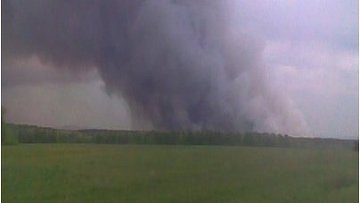
Another Depot Burns and Explodes

This time it’s the 99th Artillery Depot in Bashkortostan.  A fire during the decommissioning of 120mm shells caused the conflagration.  Residents of the nearest populated area, Urman, have been evacuated.  Fragments are flying 3-4 kilometers in all directions.  At least it wasn’t a heavily or densely populated zone.

Here’s RIA Novosti video of the scene.  The press service provided handy background on depot explosions over the last ten years.

And the Defense Ministry had just finished announcing that 20,000 rail cars’ worth of old stocks of munitions for World War III were destroyed during the last year.  But apparently not quickly or safely enough.

Such is the fate of a military reformer . . . Defense Minister Serdyukov’s doing the right thing, getting rid of this old Cold War-era excess, but stockpiles keep blowing up in the very process of trying to eliminate them.  And, as noted before, Serdyukov isn’t making any friends in localties near the demolition work.

Destroying old ammo is necessary, but the Russian military also needs to move faster on the effort to move depots away from cities and towns, and to construct more secure storage facilities.  Both more costly than just blowing up old stuff.

Meanwhile, managers and workers in Russia’s munitions industry have been pretty upset this year that their orders were drastically cut.  They’d obviously prefer to continue working and adding to the stockpile.  See Vladimir Mukhin’s article on this from March.

Loss of Fear or Loss of Faith?

Senior Lieutenant Sulim

Olga Bozhyeva has a great interview with the protagonists of the Lipetsk premium pay extortion scandal.  Essentially, Major Smirnov and Senior Lieutenant Sulim detail a farcical investigation, and what looks like a wider-ranging criminal conspiracy.  The entire Air Forces, not just the Lipetsk center, are in serious damage-control mode.

Bozhyeva introduces the piece as showing that even elite units suffer from corruption, and points out the center’s chief, General-Major Aleksandr Kharchevskiy, gave Vladimir Putin a test flight, and led combat aircraft that overflew Red Square on Victory Day 2010.  The two young aviators told her they had to talk immediately because time is against them.

Smirnov described his experience with the extortion scheme.  He said those refusing to pay got reprimands that could be used to force them out, and, with many officers being cut already, this threat was especially serious.  Or, he says, higher-ups would simply take away their “400” pay, and give it to someone willing to pay tribute.  Smirnov says the extortionists also collected as much as 240,000 rubles a year from conscripts.  He also recalled seeing Sulim’s draft complaint about corruption, and agreeing to support the younger officer.  Their ex-squadron commander, Major Yevgeniy Kubarev, joined them.

The VVS sent Deputy CINC, General-Major Viktor Bondarev to investigate, but, as Smirnov says, everyone who wanted to see him had to talk to the center’s Chief of Staff, Colonel Eduard Kovalskiy (the scheme’s ostensible organizer), Kharchevskiy, the new squadron commander (a Kovalskiy crony), zampolit (and bag man) Colonel Sergey Sidorenko, and FSB man Major Zatsepin first.  Afterwards, Kovalskiy already knew all details of what they told the VVS investigator.  Kovalskiy apparently talked to the father of one officer in an attempt to pressure him against supporting Sulim and Smirnov.  The squadron CO reportedly told one officer, if he talked openly, he’d be the first dismissed.

Sulim confirmed that his father is a VVS one-star general.  Bondarenko asked Sulim, don’t you think they’ll dismiss your father after this?  Then Sulim sums it up:

“So it’s hardly possible to talk about any real observance of legality.  Now you understand why we came to you [Bozhyeva].”

Sulim and Smirnov don’t accuse Kharchevskiy, but Smirnov says he’s afraid the extortion scheme goes higher, up to the VVS Glavkomat, because, if this involved just one colonel and one air group, it would’ve been cleared up quickly.

Smirnov says he and Kubarev have sent their families away from Lipetsk, as a precaution.

At the end, Bozhyeva asks Sulim and Smirnov what results they want from the interview.

Smirnov says:

“Our goal is for a fair, independent commission, a fair prosecutor to come.”

Sulim adds:

“Not from Tambov, but from Moscow.  That is, those people to whom I, in essence, wrote on the Internet.  Otherwise, they’ll choke all of us here with these kinds of investigations.  We’re standing before such a precedent now!”

Smirnov then says, “All the Armed Forces are watching us.”

Then with the wisdom of someone twice his age, Sulim concludes:

“If they manage to strangle us now, then those men that rob officers will lose their fear completely, and those they rob, — they will finally lose their faith in their commanders.  The consequences will be terrible.”

Where’s the Head of the Snake?

A Defense Ministry commission has established some facts of extortion and kickbacks alleged by Air Forces Senior Lieutenant Sulim, according to Interfaks.  The military prosecutor also says the investigation thus far confirms what Sulim charged in his Internet address, and cases are being brought against some officers.

RIA Novosti identifies Colonel Eduard Kovalskiy as a “unit” commander, and Colonel Sergey Sidorenko as his deputy for socialization work.  Yesterday, it looked like Kovalskiy was Sidorenko’s deputy.  But both men are too senior in rank for a squadron.  The two made 2 million rubles off the premium pay extortion scheme since 2010, and will be prosecuted for exceeding their authority.

RIA Novosti cited officials saying Sulim continues to serve, and has not resigned as other media sources claimed.

Lifenews.ru reported five officers from Sulim’s squadron have given statements confirming his allegations.

Yesterday various sources provided excerpts from a long Moskovskiy komsomolets interview with Sulim, and with his deputy squadron commander, Major Anton Smirnov, who’s supporting him. 

Smirnov says he was told he had to participate in the collection of tribute, or his career was over.  He anticipates criminal charges against himself since he had to handle kickbacks.

Of the official investigation thus far, Smirnov says the Defense Ministry and VVS commission was no more than a “fire brigade” sent to “extinguish the scandal.”

 The two officers say officials from all power ministries, the military prosecutor and counterintelligence, have come to their unit, and pressured officers to contradict Sulim’s charges.

According to the MK interview, Sulim tried to resign, but his request lacked all necessary signatures.

We have to look closely at Sulim’s and Smirnov’s long interview, but one issue is salient . . . in this particular scheme to extort premium pay from subordinates, and funnel it upwards, where’s the head of the snake?  And how many schemes like it exist in other units and formations?

Premium Corruption

Senior Lieutenant Igor Sulim

Senior Lieutenant Igor Igoryevich Sulim joins the ranks of new media whistleblowers (most recently, MVD Majors Matveyev and Dymovskiy).

This 24-year-old senior flight-instructor of the Air Forces’ elite 4th Combat Employment and Retraining Center in Lipetsk has gone public complaining of corruption, specifically his commander’s systematic extortion of premium pay from his subordinates. 

Sulim made the charges in an open letter to Defense Minister Serdyukov, Investigative Committee Chairman Bastrykin, and VVS CINC General-Colonel Zelin, which he also placed on the Internet.

Recall that premium pay – aka Order No. 400 or 400-A – is the stopgap measure Serdyukov instituted early in his tenure to raise military pay [for the best performers] until a new, higher pay system could be introduced starting next year.  Premium pay’s allowed the officers to double, triple, or even quadruple their pay, but it’s also been plagued by problems and scandals from the very beginning.

According to Sulim, every month when officers receive their premium pay, they have to give their commander, Colonel Sidorenko, a specific sum.  In Sulim’s case, 13,600 rubles every month.

Life.ru printed excerpts from Sulim’s letter:

“In January of last year, Colonel Kovalskiy got unofficial information on the amounts servicemen needed to hand over after getting their premiums to each sub-unit commander.  Commanders couldn’t refuse this because all were threatened with dismissal during requalification [pereattestatsiya].”

Sulim says every month officers were picked to collect the money which went to Colonel Sidorenko.

“Every month from 140 to 185 thousand rubles were collected from sub-units.  I know that just from the four squadrons of unit 62632-A nearly 7 million rubles were collected in a year.”

“I tried to go to the Tambov Garrison Military Prosecutor.  But evidently Colonel Kovalskiy has good connections there because the commander [Sidorenko] became aware immediately about all those who want to get out from under the yoke of extortion.  And all our efforts led to the start of an investigation into the facts of slander against the unit commander.”

And Sulim’s command took him off flight status in retaliation.

Now a host of investigators — from the VVS, the SK, prosecutors — have flocked to check out Sulim and his allegations.

Where are we on this one?

It may take a while to play out.  If experience is a guide, young whistleblower Sulim may become target rather than hero of the story.  The Russian military [political, or bureaucratic] system doesn’t care much for those “sweep dirt out of the izba.”

Uncontained by the Defense Ministry, this latest scandal could undercut the much-heralded launch of the new pay system next year.  The draft law due for Duma consideration provides for continuing premium pay.

Extortion and theft damaged efforts to use combat pay as a motivator for service during the second Chechen war.  There have always been problems with commanders and finance officers handling pay in cash.

Commanders have used control of cash as a mechanism of control over their subordinates, as a zona-type obshchak for meeting unit needs or meting out a rough social justice, or, at worst, as a source of personal enrichment.  For some time, the military’s talked about electronic funds transfer to avoid pay-related criminal activity.

And Igor Igoryevich Sulim is apparently not just any young pilot.  His father is General-Major Igor Vadimovich Sulim, just relieved of duty in early March as Chief of the VVS’ Directorate of Frontal and Army Aviation.  It’s entirely possible that this personnel action has some connection to his son and his revelations, or vice versa.

Finally, the national angle to the Sulim story.  And what will it, like many other corruption stories, say about Russia’s national struggle against corruption (if there really is one)?

For additional info on Sulim, see Lipetsknews.ru or his complete letter here

There are many infamous cases of premium pay machinations . . . for summary articles see Svpressa.ru or Baranets in Komsomolskaya pravda.

More Appointments, Dismissals

Vedomosti’s been following the rather turgid decrees from Defense Minister Serdyukov, and apparently managed to notice that he’s ordered 30 percent of Armed Forces officers to change duty stations before 1 December (the beginning of the 2012 training year).

Rotating officers every three years is a policy Serdyukov’s pushed since at least late 2009, if not earlier.  And it’s quite a shift in thinking for a military establishment in which officers often served their entire careers in the same district or garrison, or even unit. 

It’s a good and overdue shakeup, but one that brings costs and headaches that the Defense Ministry always wanted to avoid.  For example, in the not-distant past, officers would try to avoid remote assignments, of course, or ones where their wives would find it difficult to work or their children to get a good education.  Or they might not want to go somewhere that couldn’t provide equivalent service housing, or might be a terminal assignment in an undesirable location.

All this is just by way of saying that the cadre moves we’ve followed in President Medvedev’s decrees on Armed Forces personnel changes seem to confirm a pretty unprecedented rate of reassignments and rotations, at least for O-6s and above.  And they’ve confirmed more of an effort to move senior officers up in rank, or out at age 50, 55, or 60.

In any event, an overlooked decree from 30 March.

Appoint:

  • Colonel Nikolay Nikolayevich Galchishak, Commander, 5th Independent Tank Brigade, 36th Army.
  • Colonel Vyacheslav Nikolayevich Gurov, Commander, 6th Independent Tank Brigade, 20th Army.
  • Lieutenant Colonel Vladislav Nikolayevich Yershov, Commander, 21st Independent Motorized Rifle Brigade, 2nd Army.
  • Colonel Sergey Nikolayevich Kombarov, Commander, 7th Independent Tank Brigade.
  • Colonel Eduard Vladimirovich Filatov, Commander, 9th Independent Motorized Rifle Brigade, 20th Army.

Relieve:

  • General-Major Aleksandr Sergeyevich Nikitin, Chief, Operational Directorate, Far East MD.

Relieve and dismiss from military service:

  • General-Major Yuriy Eduardovich Kuznetsov, Commander, 6950th Aviation Base (1st Rank).

Dismiss from military service:

  • General-Major of Justice Grigoriy Petrovich Kuleshov.

Aerospace Defense Troops

Svpressa.ru’s Sergey Ishchenko published an interesting piece on VKO late last Friday.  He wrote that Space Troops Commander, General-Lieutenant Oleg Ostapenko recently reported to the Federation Council on the creation of VKO, making it clear that Ostapenko’s branch, as reported earlier and elsewhere, will be the basis of Russia’s unified VKO due to stand up by 1 December.

Ishchenko makes these additional points:

  • The long-range missile for the S-400 is still in testing.
  • He doubts the S-500 will be delivered in 2015.
  • His interviewee believes the new Aerospace Defense Troops will get all or some of Russia’s SAM force from the VVS.
  • The interviewee thinks the S-500 is on schedule.

Ishchenko says the debate over the lead for VKO didn’t necessarily center on what’s best to protect Russia’s security, but rather on who would receive new resources and general officer billets.

The Air Forces argued they were best suited to lead it, but the Space Troops apparently argued persuasively that they were better prepared to handle Russia’s future transatmospheric threats.

Now, a quick editorial aside from Ishchenko’s narrative . . . this decision is probably a good thing for the Air Forces, which already have their hands full and don’t need more missions.  They stand to lose only some part of the surface-to-air missile business (which hasn’t always been a core mission for them anyway).  And the VVS will benefit by concentrating on their most important tasks.

But back to Ishchenko . . . he provides a fine review of the USSR’s space weapons and space defense efforts, which, arguably, met or exceeded those of the United States.  He notes President Yeltsin’s 1993 decree on creating VKO, for which no one moved so much as a finger, at least partially because of the country’s economic and budgetary predicament at that time. 

Then Ishchenko gets more interesting.  He details the danger posed to Russia by U.S. “noncontact” wars in Iraq (sic), Yugoslavia, and Libya.  These, however, are really wars of the past rather than the future, he says.  Ishchenko moves on to the threat of Prompt Global Strike.

He talks about a hypersonic bomber cruising at Mach 5-7 speeds and altitudes up to 30,000 meters, beyond the reach of Russia’s current SAMs.  Of course, IOC isn’t before 2025, but Moscow needs to start thinking today about how to counter it.  Meanwhile, the state-of-the-art Russian SAM, the S-400, is barely fielded and its extended range missile is still being tested.  Its successor, the S-500, is supposed to be ready in 2015, but Ishchenko is skeptical.

The end of Ishchenko’s article is a brief interview with the chief editor of the journal Vozdushno-kosmicheskaya oborona, Mikhail Khodarenok.  Khodarenok’s a retired colonel, professional air defender, graduate of the General Staff Academy, and former staffer of the General Staff’s Main Operations Directorate (GOU).  In the late 1990s and early 2000s, he was an outstanding military journalist for Nezavisimoye voyennoye obozreniye, but by 2003 or 2004, he left for VKO and Voyenno-promyshlennyy kuryer, both wholly owned by air defense system designer Almaz-Antey.

Ishchenko asks what Khodarenok knows about the process of creating the Aerospace Defense Troops.  The latter hems about not having access to secret directives and documents before concluding:

“But I can say that much has already been determined.  In particular, it’s decided that Space Troops will be the basis of VKO.  Although there were other proposals.  The Air Forces, in particular, proposed taking their service as the basis.”

Asked about this tug-of-war for VKO within the Defense Ministry, he says:

“And this is a beloved Russian pasttime.  In our Armed Forces, they are constantly getting rid of something or resubordinating.  What happened, for example, with army aviation.  In my memory, five times it was given to the Air Forces, then returned to the Ground Troops.  Usually then five years of complete confusion.  Billions lost.  And it all begins again.”

Asked what will be in VKO:

“The basis is the Space Troops.  Evidently, the surface-to-air missile troops (ZRV) will be transferred to them from the VVS.  Fully or partially.  This isn’t determined yet.”

Finally, asked whether Almaz-Antey General Director Igor Ashurbeyli was replaced because of problems with the S-400’s long-range missile or issues in the S-500’s development, Khodarenok says:

“Ashurbeyli’s resignation was not connected with engineering problems in any way.  Neither with difficulties on the S-500, nor on the S-400.”

“I have my suppositions on this score.  But I don’t want to share them.  I repeat:  the most important thing is that the S-500’s development is on schedule.  And this system really will very much help the country’s aerospace defense.”

Navy Main Staff Moving 1 June

Navy Main Staff in Moscow

A Defense Ministry representative told RIA Novosti Friday that the main complex of the Navy’s Main Command has to be emptied before 1 June in connection with its move to St. Petersburg.  This means the Navy Main Staff building on Bolshoy Kozlovskiy.  The representative said 200 admirals and other officers have to head for the northern capital by the end of the month.
 
The source couldn’t say who will occupy the Main Staff’s old digs.  But other Navy Glavkomat buildings in Moscow aren’t being emptied yet.  These include the Navy Armaments Staff on Bolshoy Zlatoustinskiy, the Naval Aviation Staff in Skakovaya Alley, and the Rear Services Staff on Spartakovskaya Square.
 
RIA Novosti notes the back-and-forth, on-again / off-again nature of talk about moving the Navy’s headquarters to Piter.  Admiralty’s had a sign for several years saying it’s the home of the Navy Main Staff and Navy CINC.

The wire service failed to mention that Defense Minister Serdyukov has been solid all along, saying the transfer would happen eventually and gradually, even if his deputies or senior uniformed officers sometimes wavered on the issue.

Sweeping Clean at Spetsstroy

The broom has swept clean at Spetsstroy.

This morning’s ukaz from President Medvedev dismissed:

  • General-Major Vasiliy Petrovich Bogomolov.
  • General-Lieutenant Nikolay Vasilyevich Gulakov.
  • General-Lieutenant Vladimir Vladimirovich Mirzoyev.
  • General-Major Yuriy Fedorovich Onilov.
  • General-Major Aleksandr Vasilyevich Khodos.

RIA Novosti indicated Khodos had been ex-Spetsstroy Chief Abroskin’s Chief Engineer.  Bogomolov was his Deputy for Construction of Special Designation Facilities.  And Mirzoyev was Deputy for Capital Construction and Industry.  Specific duties for Onilov and Gulakov weren’t cited. 

Other Russian media noted they followed others forced out before Abroskin was retired.  Some accounts claimed they were connected to construction of “Putin’s palace” on the Black Sea.

In any event, ex-Deputy Defense Minister, now Spetsstroy Chief Grigoriy Naginskiy has wasted no time in getting a clean slate.  And it’s pretty rare that the wheels of the cadre machinery turn rapidly.  The whole operation must have been in the works for some time.

The Sound of Managed Democracy?

The classic dilemma of civil-military relations . . . is jet noise the sound of freedom — or in this case, of managed democracy?

Or is jet noise a dangerous nuisance?

Last Sunday, Svpressa.ru ran an article on complaints about a major expansion of Baltimor Air Base on the outskirts of Voronezh.  Baltimor also goes by the name Voronezh-B.  This is just the most recent article on local concerns about Baltimor.  Novaya gazeta published on the situation in the middle of last year.

By year’s end, Baltimor is supposed to be Russia’s largest air base, with 200 aircraft, according to Svpressa.  A second, 3,500-meter runway is being built there to accommodate all aircraft types.  Takeoffs and landings at Baltimor occur just a few hundred meters away from apartment blocks.  Residents expect the jet noise to double along with the number of aircraft.  Here’s a video of local aircraft operations.  And another

Svpressa notes the air base was used little after 1990, except for spikes during the Chechen wars.  And from about 4 years ago, it was all but abandoned, overgrown, and broken down.  At the same time,  apartment construction grew outward toward the base.

The resumption and expansion of activity at Baltimor put nearby residents into action.  They believe, with 200 aircraft, flights will be virtually constant.  And a former serviceman told Svpressa he expects the base to have 200 flight days (and nights) a year, with as many as 10 aircraft up simultaneously.

Not surprisingly, residents worry about crashes, about fuel and munitions storage depots, about airport-level noise and vibration, and its effect on young children and infants.  Svpressa reprints their long petition to Voronezh officials asking who and how the air base’s expansion was approved:

“How was such a document signed?  Who was responsible for preparing it?  Why is the population’s opinion supplanted by the conclusions of some ‘experts’ and the silent consent of the oblast administration?”

The website also publishes Air Forces CINC Aleksandr Zelin’s answer.  He asserts they illegally built too close to the airfield, and emphasizes the state’s interest in expanding an existing air base rather than building a new one for “several billion rubles.”

The case of Baltimor Air Base is interesting in its own right, but it’s significant on two other levels.

On the first, the Baltimor situation is evolving in the context of debate over the Air Forces’ force structure and base structure.

Defense Minister Serdyukov’s major reforms pointed immediately at concentrating the Air Forces at fewer bases.  The exact number, however, has shifted constantly downward from 55 at first.  Recall at the 1 April Security Council session on the aviation sector, Medvedev told ministers and officials:

“Now the airfield network of military aviation does not correspond to the basing requirements of aviation groupings.  At the Defense Ministry collegium which took place recently [18 March], I gave orders to establish several large air bases.  Taking into account the deployment of troops, they will be situated on the main strategic axes.”

At the collegium, Serdyukov in fact announced, instead of 33 air bases, there will be eight army aviation bases subordinate to the four military districts / OSKs, and the number of aircraft at each will increase 2.5 or 3 times.  Of course, saying that and getting to that point are two different things entirely. 

Gazeta.ru printed a nice summary of the VVS ground infrastructure issue.  It concluded fewer bases would make things cheaper, but also easier for a potential enemy.  It said a similar effort to resubordinate air and air defense forces to MD commanders in the early 1980s failed.  Rossiyskaya gazeta said experts think the number of air bases should be different for different MDs, as should the mix of aircraft.

It seems, for economic reasons, these large air bases will be picked from the list of existing ones, they won’t necessarily take advantage of vast swaths of unpopulated territory, and they’re likely to irritate the civilian population.

Abandoning old bases and airfields leads to another, longstanding but growing problem of late — the archipelago of unneeded garrisons and military towns.  The Defense Ministry would like to shuffle them off to someone else’s responsibility, and resettling retired military, dependents, and civilian workers elsewhere has been problematic.  BRAC-like processes are especially painful in Russia. 

On the second level, Baltimor could become politically and socially significant.  It’s rare in Russia these days for a military problem to have that kind of potential.  

If politicians ignore or downplay what the locals feel is their basic right to health and environmental protection for the sake of an intangible state interest, there’s a chance Baltimor could become a more serious regional, or even national, issue.  Especially if similar circumstances arise in other cities.

This may seem a stretch, but remember ordinary Russians tend to be galvanized by the local impact of things like auto import tariffs, immigration, building roads through forests, etc.  And concern about the impact of air bases would come on top of other civil-military issues.

In Chelyabinsk, and several other places, the locals are protesting explosive ammunition destruction that is rocking parts of their cities.  Prosecutors already found that the military lied about the size and power of demolition activities not far from Chelyabinsk.  Chelyabinsk residents are also angry about overflights of the city from nearby military airfields.

What Kind of Army?

Not again . . . but yes, Wednesday Trud asked what kind of army does Russia need in the future? 

It’s almost 20 years since the army ceased to be Soviet, and the paper asked five relatively independent experts the same question that’s been asked since 1991 –what is to be done about Russia’s Armed Forces?

Yes, it’s repetitive . . . it’s rare we hear something new, the problem is not ideas and initiatives, it’s implementing them.

At the same time, these commentaries are short and pithy.  They cover a lot of ground, and might be handy.

Korotchenko supports the Defense Ministry’s swerve back toward contractees, since there aren’t enough conscripts.  And he doubts conscripts are up to the task of handling modern weapons.  But he points to the need to end dedovshchina and other barracks violence to attract professional enlisted. 

Sharavin believes the big mobilization army is still needed, and conscription will continue alongside contract service for some time.  He wants more benefits for conscripts who’ve served, and he wants the sons of the bureaucratic elite to serve. 

Belozerov agrees recruiting 425,000 professional soldiers won’t be easy or fast.

Litovkin is harsher; he says there’s no reform, just back and forth on contract service.  He lampoons the current small-scale effort to train professional NCOs.  He ridicules thoughts of a serious mobilization reserve because of the lack of reserve training.

Makiyenko thinks a contract army is cost prohibitive, and the army numbers only about 800,000.  He likes the fighting spirit of soldiers from the Caucasus, opposes segregating them, but hopes Muslim clergymen in the ranks can restrain them. 

Igor Korotchenko:

“Of the million servicemen, ideally we should have 220 thousand officers, 425 thousand contractees and 355 thousand conscripts.   It’s true, not now, but in 10 years.  On the one hand, this is due to the physical impossibility of calling up more — there is simply no one to put under arms according to demographic indicators.  In the last call-up, the army took in 70 thousand fewer conscripts than in the preceding campaigns.  On the other hand, it’s simply scary to entrust those weapons systems, which should be purchased in the coming decade according to the state armaments program (and this is 20 trillion rubles by 2020), to people who were just driven out of the  sticks and into the army for a year.  Whether the Armed Forces want it or not, they are doomed to a certain intellectualization.  However, this is impossible if existing nonregulation relations between servicemen are preserved.  It seems that the Armed Forces leadership has started to understand this.  A program for the humanization of  service which also aims to remove the problem of dodging service (about 200 thousand men) has appeared.  Now in the Ryazan VDV School the first graduating class of professional sergeants is finishing the three-year course of study.  The eradication of nonregulation relations is connected directly with them.”

Aleksandr Sharavin:

“What kind of army to have is determined primarily by the country’s geographic situation.  If there is a potential threat to its territory from neighboring countries, we need a conscript army, through which a large mass of young men pass and allows for having a great mobilization reserve as a result.  If there is no threat, we can limit ourselves to professionals.  Russia has such threats — look closely at the map!”

“Is the transition to a professional army possible in Russia?  I suggest it’s possible, but not necessary. According to the Supreme CINC, we will transition to a new profile of the Armed Forces in 10-15 years.  For this or an even more extended period, conscription will remain.  Possibly in a much easier form — they will serve, not a year, or will call-up not 200 and some thousand, as now, but only 170 thousand men.  In the future, it would do to reduce even this number.  Moreover, reducing it will allow a certain selection and thereby improve the quality of the young men conscripted into the army.”

“In my view, a serving citizen [conscript] can’t receive the current 500 rubles [per month].  Hard military work should be well-paid, otherwise it is objectively devalued.  The rate — not lower than the country’s minimum wage!  We also need to think about other stimuli:  free higher education for those who’ve served, some kind of favorable mortgage credit, and, most importantly, we should only accept those young men who’ve fulfilled their duty to the Homeland into state service.  No references to health conditions can be taken into account.  If there’s strength to be a bureaucrat — get well and find the strength to serve in yourself!  If we need to amend the Constitution for this, we’ll amend it.  Our neighbors in Kazakhstan went this way and got a double benefit:  improved quality of the army contingent and bureaucrats who are not so divorced from the people, as in Russia.”

Vasiliy Belozerov:

“If the political decision is made, it’s possible even now, undoubtedly, to establish a fully volunteer army in Russia.  But do we need this?  I suggest it will be correct and justified if the share of professional sergeants and contractees in the army will be raised gradually.  Since it’s unclear from where a quantity of 425 thousand professionals can be gotten all at once.  They won’t fall from the sky.  We have to remind ourselves that the contingent of both current conscripts and potential professionals is one and the same:  young men 18-28.  This means we have to  create such conditions that it’s not the lumpen who go into the army, but normal men.  And worthy people need worthy conditions.  And there’s one more figure:  based on world experience it’s possible to say that in a professional army in the year for various reasons (health, age, contract termination, etc.) 5 percent of personnel are dismissed.  This means that in a 425,000-man professional corps in a year we have to recruit an additional 20 thousand men.  They also need to be gotten from somewhere.”

Viktor Litovkin:

“As is well-known, the army should know only two states:  either fighting, or preparing for war.  For us, it is either reforming or preparing to reform.  Meanwhile, there’s still no clear presentation of ​​what kind of army we want and what government resources we are prepared to give for this army.”

“In Russia, there is no coherent policy on establishing new Armed Forces.  The fact is the Chief of the Genshtab says we made a monstrous mistake and the Federal Targeted Program for Forming Professional Units failed, therefore we’ll get rid of contractees.  A half year goes by, the very same Genshtab Chief comes to the podium with the words that the country, it turns out, again needs 425 thousand professionals.  Make the basic calculations:  for this number of soldiers we need to have 65 thousand professional junior commanders [NCOs].  And now in Ryazan we have 250 men studying to be sergeants, they’ll graduate next year.  Meanwhile, there’s no data that they’ve selected the next course.  Has anyone thought about this?  And one more thing.  When we say that we need the call-up to create a trained reserve, this is self-deception.  The reserves are so unprepared!  Suppose we trained a soldiers for a year to drive a tank.  What next?  Once or twice a week after work this mechanic-driver has to work on the trainer at the voyenkomat, and every six months — drive a real tank on the range.  Otherwise, in case of war, we get not a trained reserve, but several million 40-year-old guys with beer guts who’ve forgotten which end the machine gun fires from.”

Konstantin Makiyenko:

“In my opinion, the transition to a professional army in Russia is desirable, but absolutely impossible.  A contract army is actually substantially more expensive than a conscript one.  Another thing, our announced one-million-man [army], in my view, likely doesn’t number 800 thousand men.  We have to talk about yet another problem — the coexistence of conscripts from the Caucasus and other regions in the army. Everyone remembers the wild incident, when these guys laid out the word ‘Kavkaz’ using conscripts of other nationalities.  But, on the other hand, conscripts from Dagestan, Chechnya or Kabardino-Balkaria, as a rule, stand-out for the best physical preparation and desire to learn about weapons.  Once the idea was floated to have Caucasians serve in some units, and Russians in others.  At the last session of the Defense Ministry’s Public Council, it was announced that this won’t be.  It was decided to refrain from creating monoethnic military formations of the ‘wild division’ type from the Tsarist Army.  Contradictions between conscripts called up from the Caucasus and other regions of the country will be removed by introducing the institution of military clergy of the Islamic persuasion.”