Category Archives: Shoygu’s Reforms

How the Third World War Begins

What would happen if the U.S. and some NATO allies decided to intervene in eastern Ukraine by supplying Kyiv with arms or by sending their own troops to the front lines?  Mikhail Khodarenok has tried to answer this question, and provides much-needed tonic for Western observers wowed by the Kremlin’s “surprise” exercises since 2013.  He is a conservative critic of the Russian MOD leadership and post-Soviet military “reforms” up to Sergey Shoygu’s tenure.  

Khodarenok argues against allowing Russian forces to be drawn into an escalating conflict because ill-conceived and continual “optimization” has left them unprepared for a conventional war against the West.

Khodarenok is editor-in-chief of Voyenno-promyshlennyy kuryer or VPK. He’s a retired colonel, professional air defender, General Staff Academy grad, and former staffer of the General Staff’s Main Operations Directorate.  In the late 1990s and early 2000s, he was an outstanding military journalist for Nezavisimoye voyennoye obozreniye, but by 2003 or 2004, he left for VPK.

Mikhail Khodarenok

Mikhail Khodarenok

His latest for VPK is interesting, and follows in its entirety.

Script for the Third World War

Volunteers from the USA and Western Europe are interfering in the conflict in south-east Ukraine.

One has to repeat yet again:  statements, from time to time voiced by ultraliberal Russian politicians like “the problem has no military solution” and “all wars end in peace,” have no relationship to reality.  Wars end only one way — a crushing defeat for some and brilliant victory for others.  If the phrase “there is no military solution” appears, this means that one of the parties to the conflict simply has no strength for the victorious conclusion of the war.  And if some armed confrontation ends like a draw, it is so perhaps because of the complete exhaustion of military capabilities on both sides.  Of course, there are possible variants with some very minor deviations from this general line.

Begin with the immediate and future tasks of the parties to the conflict in the south-east Ukraine.

For the Kiev leadership the immediate, and future, and enduring goal for the historically foreseeable future is only one thing:  restoration of the territorial integrity of the country by any means, primarily military ones.  The strategic mission is to wipe the armed formations of the south-east from the face of the earth.  Waiting for negotiations, for changes in the constitution of Ukraine in the right way for the unrecognized patches of territories, for federalization of the south-east — all this is from the realm exclusively of suppositions and imaginary games. Carthage (i.e. the separatist south-east) must be destroyed — and this thesis, without any doubt, will be dominant in all Ukrainian foreign and domestic policy.  To hold other views today among the [Maydan] Square elite means immediate political suicide.  Still Kiev doesn’t have the forces and means to solve the problem militarily.  But this doesn’t at all signify the Ukrainian leadership’s refusal of a policy of crushing the south-east by military means.

It’s necessary to say directly that, on the whole, the external and internal political missions of Ukraine in the south-east are clear and logical.

It’s more complicated with the unrecognized south-east.  Everything here is much foggier.  It’s possible to demand self-determination for these territories, but what then?  How can people live on this piece of land if it is practically impossible to guarantee the economic, financial and any other independence for the south-east (or more precisely, two torn off and extremely curvy pieces of Donetsk and Lugansk Oblasts)?  Demanding federalization is also theoretically permissible, but official Kiev will never, under any circumstances, grant it.  Return to [Maydan] Square?  But so much blood has already been shed, the scale of destruction of the region’s infrastructure is simply astonishing, and the gulf between the parties to the conflict is so great that this is hardly possible without subsequent pogroms and mass shootings of insurgents by Ukraine’s central government.  In general, a complete zugzwang — what to do is not clear to anyone, and the next move can only worsen the situation.  It seems that the political line of the south-east, in these circumstances, can be only one thing — hiding behind a verbal veil and temporizing.  And then, maybe, something will happen.

In this regard, it doesn’t due to forget one important circumstance.  In predicting the future, futurists of all stripes mainly use the very same method.  From the point of view of a representative of anti-aircraft missile troops, as the author was in the past, —  this is the hypothesis of a rectilinear and uniform motion target.  A significant part of the forecasts is based on this postulate.

But there is the “Black Swan” theory.  Its author — Nassim Nicholas Taleb, wrote about it in the book “The Black Swan:  The Impact of the Highly Improbable. ” The theory considers difficult to predict and rare events that involve significant consequences.

In other words, it is impossible to describe the processes of the real world with only mathematics, employing even the most advanced models.  From a certain point anything and everything can go contrary to predictions, extremely askew.  It seems that the unspoken political line of the south-east — to wait is built on this.  And then it will become apparent.  Is it good or bad — only time will tell.

Today in the south-east of Ukraine a cease-fire regime is in effect.  But all parties to the conflict seem to realize that this is not the end, but rather only a pause before the summer campaign.

We now turn to hypothetical scenarios of the developing situation in the south-east of Ukraine (we emphasize — scenarios exclusively from the realm of hypotheses and assumptions).

How does the war in the south-east present itself from the point of view of military art?  Essentially, two Soviet armies are fighting.  One is a 1991 model (it is the armed forces of Ukraine), the other is a somewhat modernized version of the same Soviet army — better trained in an operational-tactical sense, manned by more competent specialists, and commanded better.  And the armed confrontation is currently playing out solely on the ground — with only the forces of combined arms units and sub-units.  The south-east doesn’t have its own air forces, and Ukraine’s — formerly small — air forces have gradually dwindled to nothing in the course of the conflict.  Practically no serviceable aircraft and trained pilots remain for the [Maydan] Square. Volunteers for the south-east on their TO&E air defense equipment helped the development of such a situation a lot.  Sometimes vacationers in their planes acted fairly quietly and unnoticed for the same purpose.  But from the point of view of military art, the armed confrontation in the south-east is all just a somewhat modernized variant of World War II in its final stage.  Neither this nor that side has identified new weapons and military equipment or new techniques and methods of conducting armed warfare.

As is well-known, volunteer-vacationers are fighting on the side of the south-east. With their TO&E weapons as a rule.  But now suppose such a variant (again, purely hypothetical, why not), that volunteers and vacationers from the USA and Western Europe began to arrive in the ranks of the armed forces of Ukraine, also with their TO&E weapons.

Let’s begin with the air forces.  Suppose F-15, F-16, F-22, A-10, “Panavia Tornado,” E-8A, E-3A began landing on the airfields of Kharkov, Poltava, Dnepropetrovsk, Zaporozhye.  Previous identification markings and side numbers painted over, and marked in their place is the trident and yellow-blue banners of Ukraine.  Prior to this, many flights to Ukrainian airbases delivered fuel and the most modern aviation weapons.

Three CSGs (carrier strike groups) are deployed on the Black Sea coast of Bulgaria which has prostituted itself politically for the past 140 years.  The typical composition of each is one nuclear-powered aircraft carrier, two-three guided missile cruisers, three-four guided missile destroyers, three-four nuclear-powered attack submarines.

Armored and mechanized divisions of volunteers from the West outfitted with “Abrams,” “Leopard,” “Leclerc” tanks, “Marder” and “Bradley” BMPs, modern artillery are unloaded in the area of ​​Mariupol, Pavlograd, Izyum, and Lozove.

In addition, we should make note of the volunteer units and sub-units (also manned by vacationers from the USA and Western Europe), electronic warfare, communications, unmanned aerial vehicles and so on, and so on.  Do not forget also about the volunteer logistics and technical support units, without which modern war is unthinkable.

Now a question.  How long would the armed formations of the south-east hold out if a qualitatively different enemy entered the war, if a hail of modern aviation weapons — anti-bunker bombs, laser- and satellite-guided bombs, air- and sea-based cruise missiles showered down on LNR and DNR formations and units?  If the order-of-battle were attacked by the newest armored combat vehicles and artillery?  And the action of all this military splendor was supported by American intelligence of all types which has not even a close analogue in the world?  And the planes of the volunteers of the West chase after every BMP, gun, and tank of the units and formations of the south-east, separately bomb every trench, firing point, and mortar position taken.  And destroy the target with margins commensurate with the size of the trench itself.

We’ll repeat the question:  how long can the armed formations of the south-east hold out?  A day?  Two?  A week?  The answer is unfortunately:  several hours would be good.

Of course, the elder comrades — the Armed Forces of the Russian Federation — of the volunteers of the south-east can support them.  And precisely at this moment — please get shaved(1) — the Third World War has begun.

Such a version of events is the crystal dream of the current Ukrainian leadership. But Anglo-Saxon blood is too dear to shed for the future happiness of some half-wild Ukrainians.  Therefore, such a version of developing events is still to be assessed as the game of a warmed-over imagination.

And if you still continue to fantasize and try to imagine how the development of such a conflict in the South-West Strategic Direction [YuZSN] might look, if all interested sides take part in it under this or that flag.

We say directly — the success of armed confrontation employing only conventional weapons is obvious in this case.  It certainly will be on the side of the West.  Unfortunately, the modern Russian Army is still less than qualitatively different from its Soviet predecessor of the 1991 model.  And there is not very much of the latest weaponry, meeting the highest demands of the XXI century, in it.

For example, at this time, we do not have a single operational large formation [объединение] of the air forces (which by the way are no longer themselves a service of the Armed Forces), equipped with modern aircraft with supplies of the newest aviation weapons for the conduct of at least 30 days of combat actions.

The Black Sea Fleet today, to our great regret, is a branch of the Central Naval Museum.  On the ships of the BSF it would be possible to study the history of Soviet shipbuilding in the 1960-1970s.

Yes, and combined arms formations and units, if you collected everything that is on the territory of the former SKVO(2), you would get not more than 1.5 army corps (by Western standards).  You clearly couldn’t form a 1st Ukrainian Front from the available set of forces and resources.  There are no operational reserves on the district’s territory.  That is, the formations and units clearly do not have the strength for operational-strategic missions on the YuZSN.

To understand the sharpness of the situation, let’s add just one thing:  if there are four-six specialized EW aircraft on every American carrier, then we don’t have a single similar aircraft in our entire air forces.

One should note still one more very important point — the operational outfitting of theater of military actions in the South-West Strategic Direction hardly meets the tasks of conducting combat actions successfully.  The airfield network, the quantity and quality of roads and railways far from fully meet the demands of pursuing armed confrontation.  It suffices to note that some railroads pass through the territory of Ukraine, and the famous quadrangle in which there are generally no railways lies precisely on the YuZSN.  In a word, the first railroad parallel to the front line goes through Ukraine, and the next — only through Volgograd.  And as is well-known, where the railway ends, and so ends the war.

As for the quartering of formations, units, and sub-units of the RF Armed Forces on the YuZSN, they are located mainly in the dispositions of the Soviet-era North Caucasus Military District.  In those days, this district was deep in the rear with a small set of reduced-strength and cadre units and formations.  The situation in this respect has changed a little since 1991.  But now the neighboring country of the district with the most militant and anti-Russian mood is modern Ukraine.

A fully legitimate question arises:  what did you do the last 20 years?  This period in the life of the Russian Armed Forces awaits its impartial historian. Still one can say the following concisely.  All force in the 1990s and 2000s, maybe, went into continuous organizational-staffing measures(3).  Meaning:  form, then disband the very same, then restore it, disband it again, but incidentally with the aims exclusively of optimizing and improving the organizational structure, zeroize military science and education, cut military academies to the root under the well-meaning pretext of relocating them, scatter valuable cadres in the course of continuous cuts and reformations.  Just two words — “reform” and “optimization” — in their harmful effect on the life of the Armed Forces are comparable, perhaps, only with the consequences of delivering a series of MRAUs (massed missile-air strikes).

Perhaps, if we look at the matter critically, nothing qualitatively new was created (in any case this is debatable).  We have essentially marked time for more than 20 years, while other countries have made a breakthrough in military affairs.  If any positive trend has been noted, then it is only with the arrival of Sergey Shoygu in the Ministry of Defense.

And somebody should be responsible for it — at least in terms of an objective analysis of the situation.  Let’s examine try the defense ministers in recent years – from Pavel Grachev to Anatoliy Serdyukov.

Which of them could be called “a prominent builder of the Armed Forces of modern Russia?”  Or write the line in their performance appraisal:  “A talented military theorist, who made a significant contribution to strengthening the defense power of the state?”  Finally, he “developed, established, introduced, and adopted weapons into the arms inventory?”

Try to include the following lines in their testimonials:

“Extraordinary concentration, inquisitive mind, analytical skills, ability to make correct, forward-looking conclusions;”
“Creative mind and a remarkable memory, ability to quickly grasp a situation, to foresee the development of events;”
“Has a rich combat experience, broad erudition, high operational-strategic training, gave all his strength to the training and education of military personnel, to the development of military science;”
“Distinguished by deep knowledge of matters, persistent daily work, high culture and personal manners;”
“Dedication to affairs, high professionalism, intelligence.”

Having presented a line on the [MOD] leaders noted above, we can say — almost nothing suits, however.  Or its suits, but not much.  In the best case, all the enumerated persons were occupied with only one thing — “merge-unmerge,” and then cut.  But court of history is impartial — no matter how so-and-so puffed out his cheeks or furrowed his eyebrows in the past, it is not at all the generals for special assignments from his inner circle who will write his testimonial for him.

By way of conclusion.  What do Russia’s Armed Forces do in the event of such a development of the conflict?  Threaten to use tactical nuclear weapons?  Meaning:  if you do not stop, we will strike at Ukrainian nuclear power plants, chemical facilities, the series of hydroelectric power stations on the Dnieper River in order to create a flood zone and destruction.  But this, as is well-known, is a double-edged sword.  And there are not so many long-range tactical nuclear weapons delivery vehicles.  After all, with our own hands we destroyed the class of missiles most needed for the defense of the country — RSMD(4).

Of course, all the above described and enumerated is no more than speculation, fantasies, and hypotheses.

But there can be only one exit from the Ukrainian crisis — under no circumstances should the Russian Federation Armed Forces be allowed to be dragged into the conflict in the south-east.  Our country, the army and navy, needs to note objectively that we are still not ready for large-scale armed confrontation employing only conventional weapons.  If you sort out all the criteria of the state’s readiness for war (Armed Forces training, preparation of the country’s economy, the preparation of the country’s territory to support the RF Armed Forces, preparing the population for defense), then most of them have very substantial problems.

And it’s necessary to strengthen the country’s defense capability at a forced (downright Bolshevik) tempo, and create Russian Armed Forces which meet the highest standards of modern warfare.  And the first thing is to stop the nervous organizational-staffing(3) delirium.

A post-script to Khodarenok’s opus:  where does he leave us?  

A frozen conflict [a draw — to use his term] is, of course, a win for the Kremlin.  At least through the medium term.  

If the West intervened militarily in the conflict as Khodarenok hypothesizes, both sides would have to make dangerous decisions about working up the conventional escalation ladder.  Moscow might conceivably back away from eastern Ukraine if given a serious bloody nose.  Along the way, the U.S. and EU might also go “nuclear” economically by revoking Russia’s membership in the SWIFT international money transfer system.  

But if, as Khodarenok suggests, the West trumps conventionally, Moscow could consider a game-changing resort to nuclear weapons. With probably only messy endings in store for him anyway, Putin might have fewer compunctions here than the U.S. or NATO.  He would have fewer choices too — escalate again or lose the war (and his grip on power).  Would Russian military men be willing to use nuclear weapons over eastern Ukraine or to save Putin?

There is, of course, an alternative more likely to be chosen by the West:  Cold War-style containment of eastern Ukraine and Russia. It’s a less dangerous, but slow and frustrating process placing much of the burden of nation-state building on pro-Kyiv Ukrainians themselves and on the West’s willingness to finance the emergence of a viable country in contrast to the Russian-backed statelets in the east.  However, this long road is open everywhere to Russian meddling, and frontline NATO allies would require lots of tangible reassurance.

Whatever the policy course, it isn’t clear to this author that the U.S. and the West possess the same fortitude to pursue it that they did in the 1940s and 1950s.  They don’t have the same cohesion in decisionmaking.  Not many are willing to view what happens in Ukraine as a top policy concern.  The U.S. is tired and distracted. Putin’s Kremlin, however, has already defined Ukraine as an immediate and vital interest.


(1) Refers to Alexander the Great having his men shave before battle.
(2) North Caucasus Military District.
(3) A term used in the Russian workplace for reorganizations entailing closure of some entities, establishment of new ones, physical relocations, and personnel transfers and cuts.
(4) Medium and shorter range missiles — covered by the INF Treaty.
Reinforcing Russia’s Western Frontier

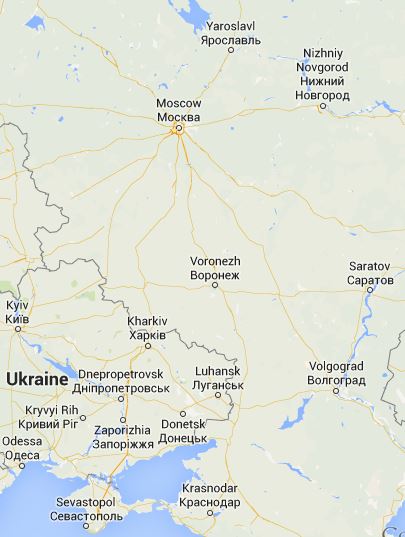
NVO correspondent Vladimir Mukhin recently reported that the MOD will move the Mulino-based 20th Combined Arms Army (CAA) to Voronezh, near Russia’s border with Ukraine.  The governor of Voronezh apparently informed local media about the army’s impending return to the oblast after meeting with Western MD Commander, General-Colonel Anatoliy Sidorov.

Mukhin wrote that the MOD wouldn’t confirm his report, but didn’t deny it.

The 20th CAA was based in Voronezh until 2010, when the MOD, under Anatoliy Serdyukov, transferred it to Mulino (west of Nizhnyy Novgorod).  The 22nd CAA, then in Mulino, disbanded.  Mukhin hints that, in Mulino, the 20th was a relatively hollow reserve force.

Voronezh and the Ukrainian Border

Voronezh and the Ukrainian Border

The change could place a large formation on Moscow’s Western frontline, and improve its base and training infrastructure.  The Boguchar training ground will be recommissioned and enlarged.  The MOD also plans to build a new military garrison town next to Baltimor air base, just south of Voronezh.

Enlarging Boguchar (200 km south of Voronezh, 60 km from the Ukrainian border), according to Mukhin, presents a military administrative problem.  The bigger training area could spill over into Rostov Oblast and the Southern MD. According to Mukhin, local media report Boguchar will house a motorized rifle brigade.

Mukhin says military experts conclude that the redeployment resulted from changes in the Defense Plan recently signed by Putin and from the experience of a year of fighting in eastern Ukraine.

He quotes former Ground Troops Main Staff Chief, General-Lieutenant Sergey Skokov:

“If the 20th CAA staff deploys in Voronezh again, this would be a correct decision I think.  It was obvious then for many military leaders and experts that the transfer of this large formation [объединение] from Voronezh to Mulino (Nizhegorod Oblast) left western Russia naked, and created difficulties for constructing a reliable defense there.  But neither former Defense Minister Anatoliy Serdyukov nor General Staff Chief Nikolay Makarov heeded those opinions then.  Now these mistakes have to be corrected.  And it will be, it seems, expedient to correct them since the situation in Ukraine is tense, and the NATO countries are strengthening their grouping in the immediate vicinity of Russia’s borders.”

According to one source, these formations are subordinate to the 20th CAA:

  • 4th Tank Division (Naro-Fominsk);
  • 2nd Motorized Rifle Division (Kalininets);
  • 6th Independent Tank Brigade (Mulino);
  • 9th Independent Motorized Rifle Brigade (Nizhnyy Novogorod);
  • 288th Artillery Brigade (Mulino);
  • 448th Missile Brigade (Kursk);
  • 112th Missile Brigade (Shuya);
  • 53rd SAM Brigade (Kursk);
  • 49th SAM Brigade (Smolensk);
  • 9th Command and Control Brigade (Mulino);
  • 69th Independent Material-Technical Support Brigade (Mulino);
  • 262nd Military Equipment Storage and Repair Base (Boguchar);
  • 99th Military Equipment Storage and Repair Base (Tver);
  • 7015th Military Equipment Storage and Repair Base (Mulino).

Those around Mulino or Nizhnyy (Shuya, Tver) would be candidates to move southwest if this pans out.  But what about the 4th and 2nd divisions?  Traditional praetorian guards for Kremlin rulers against political challenges and domestic disturbances, they have been southwest of Moscow for many years.  It seems unlikely they’ll move in these times.

Brothers Armed — A Review

Brothers Armed

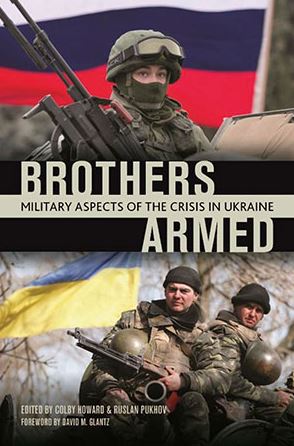
If you follow the Russian military, you need to pick up Brothers Armed:  Military Aspects of the Crisis in Ukraine from the Moscow-based Centre for the Analysis of Strategies and Technologies (CAST) and published by East View Press.

Brothers Armed is a great summary of events in Russia’s seizure of Crimea last February-March as well as in-depth reference detailing the condition of the Russian and Ukrainian militaries.  It isn’t perfect, but it’s good and, most importantly, it’s sui generis.  It came out quickly and no other book covers these issues.  CAST has successfully achieved “relative objectivity” in its approach, as the introduction by David Glantz notes.

Vasiliy Kashin begins Brothers Armed by examining the history of Crimea’s disputed status.  He concludes:

“. . . in several agreements and treaties . . . Russia clearly recognized Ukraine’s territorial integrity within its existing borders [including control of Crimea]. Until the crisis in 2014, Russia had made no attempts to question Ukraine’s rights to Crimea.”

Putin’s move on Crimea was opportunistic, not premeditated, according to Kashin.

Two chapters then explain how Ukraine neglected its rich inheritance from the Soviet military.  In sheer hardware terms, Ukraine suddenly found itself the second most powerful in Europe, and fourth in the world.  The legacy of Soviet defense industry left it with “more than 700 military design bureaus and manufacturing plants that developed and made almost every type of modern weaponry.”  But without obvious threats and an army too large for its needs and finances, Kyiv focused on downsizing rather than preserving its forces.

Following Russia’s short war with Georgia in 2008, a “snap inspection” of the Ukrainian Army’s combat readiness “yielded very alarming results.”  In 2014, this inability to react to a rapidly emerging threat resulted in the loss of Crimea.

Mikhail Barabanov provides two narratives on Russian military reform — before and after the war with Georgia.  He concludes that, although former Defense Minister Serdyukov was despised by the military, he was “instrumental in laying the foundations of a genuinely modern Russian Army.”  His successor has normalized and stabilized the military in the wake of Serdyukov’s changes, but not reversed their intent.

Barabanov argues Crimea vindicated Russia’s transition from a big war mobilization army to leaner high readiness forces for smaller wars (despite lingering problems in manning them fully).

Alexey Nikolsky’s report on the formation and use of Russia’s two new SOF units in the seizure of Crimea makes for an intriguing chapter.  He argues that the SOF units are elite combat elements, unlike GRU Spetsnaz which are tasked with strategic reconnaissance.

Anton Lavrov’s section on Russia’s military operation in Crimea is the meat of Brothers Armed, and it’s a valuable account of what happened on the ground last winter.  He points out that, although Kyiv’s numbers were superior to Moscow’s, its military forces were psychologically, politically, and technically unready to react to the Russian invasion of Crimea.  At a point, he writes, “. . . the Ukrainian government was forced to desist from active attempts to restore its control of Crimea, so as not to risk a full-blown Russian invasion.”

The final chapter is Vyacheslav Tseluyko’s insightful look at where Ukraine’s military needs to go now that Russia is giving it “a crash course in real warfare.” He concludes Kyiv should focus on its most dangerous threat — a Russian invasion of mainland Ukraine — and adopt a territorial defense strategy to prevent a foreign occupation.  Tseluyko advocates drawing the aggressor into protracted fighting in urban areas, making every Ukrainian soldier an infantryman, and employing anti-armor weapons from light helicopters.

Brothers Armed is an object lesson for countries bordering Russia. They and their armed forces need to be ready immediately to respond to challenges to their sovereignty and territorial integrity from their overweening neighbor to the east.  Anything less could be too late.

The book is smoothly translated and features good photos.  A good map lost in the back might have served better up front.

With Brothers Armed on the shelf, one looks forward to a future book about the war in the Donbass.  CAST publishes routinely about the conflict in its English language journal.

Pork à la Russe

Sounds tasty, but (probably) not an actual recipe . . . .

Many no doubt are familiar with the American tradition of “pork-barrel”
politics.  Congress appropriates and spends money in the districts of various representatives to get them to vote for funding they wouldn’t otherwise support. The projects are usually unnecessary, fat, or “pork.”

An item reading like a Russian MOD version of “pork”  appeared in TASS this week.

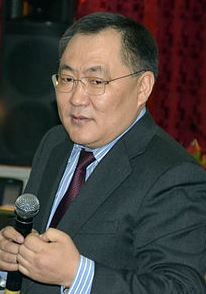
The chief of Tuva — Sholban Kara-ool — announced that the construction of MOD infrastructure in his republic should be a priority in 2015.

Sholban Kara-ool

Sholban Kara-ool

Kara-ool’s press-service told TASS that the chief and his ministers reviewed plans to build a garrison town and training area for a new motorized rifle brigade and for the region’s military commissariat in Kyzyl.  The brigade is the 55 OMSBr (G) —  the 55th Independent Motorized Rifle Brigade (Mountain).

The Ground Troops currently have two mountain brigades — the 33rd in Dagestan and 34th in North Ossetia.

This brigade will number 1,500 men, recruited, somewhat unusually, exclusively among ethnic Tuvans.  They will be contractees signed up for 30-35,000 rubles per month.  TASS indicated the brigade already has 900 candidates.  Their garrison will be near Kyzyl on the right bank of the Yenisey.  According to the news agency, the MOD will also move a railroad troops battalion to Tuva from Krasnoyarsk.

The regional government anticipates the construction will bring 10 billion rubles and 1,000 jobs, while adding communications, energy, and social infrastructure to the Tuvan capital.  Not surprisingly, Tuva’s chief said he expects the stand-up of the new formation to have a positive impact on the local “social-economic situation.”

Kara-ool told his government to remove all contradictions and impediments to fulfill these short-suspense military construction projects.  He added that, should problems outside his competence arise, he won’t hesitate to turn directly to fellow Tuvan Sergey Shoygu to resolve them.

The Russian military is investing more today in infrastructure to house personnel and weapons than at any time in the post-Soviet era.

But establishing the Tuvan brigade and its facilities has to be an expensive project in an impoverished region that never had much, if any, military presence.  Any number of abandoned Russian bases might have been reactivated more cheaply for this purpose.

The brigade will serve, in one of its capacities, as a peacekeeping (or intervention) force in Central Asia.  The Tuvans in the brigade will have a degree of ethnic and  linguistic affinity with Kazakhs and Kyrgyz at least.

Otherwise, stationing it along the remote Russian border with Mongolia seems to be a case of Defense Minister Sergey Shoygu taking care of his boys back home.

Getting the new brigade running is likely to entail some prime opportunities for corruption since that’s how business gets done in Sholban Kara-ool’s fiefdom.

Aerospace Forces

At some point, probably next summer, the Air Forces (VVS) will cease being one of Russia’s three armed services.  The Aerospace Forces (VKS or ВКС) will take their place.  The Aerospace Defense Troops (VVKO) will likewise disappear as a branch and get rolled into the new VKS.  Russia will be left with three services and two branches (not three of each).

RF and Air Forces Flags (photo: Mil.ru)

RF and Air Forces Flags (photo: Mil.ru)

The Aerospace Forces will be responsible for all Russian air forces and air defense (and more).

This news comes on the heels of six months of studious MOD denials that such a move was even contemplated.

It began quietly on 1 December  with Defense Minister Sergey Shoygu’s remarks to a regular military leadership videoconference.

According to Krasnaya zvezda, Shoygu discussed changing the organizational structure of the Air Forces in connection with turning VVKO aerospace defense brigades back into air defense (PVO) divisions.  He said the decision was made in mid-2013 after an analysis of mission fulfillment by the Air Forces.  He explained that:

“The goal of the changes being made is to increase the effectiveness of VVS [Air Forces] command and control, to improve the quality of the organization of everyday activity and planning for the combat employment of the troops.”

It echoed an earlier decision to reverse course on Anatoliy Serdyukov’s large composite air bases and groups and put aircraft back into more dispersed divisions and regiments.

By 10 December, Interfaks-AVN reported that the decision to replace the VVS with the VKS awaited only an official announcement.  

The news agency’s MOD source said:

“Formation of the new service [VKS] will proceed gradually, and, as expected, take several years.  In the course of this period, the forces and means entering the VKS must develop in the direction of unification and standardization of command and control, information and strike systems.”

The source also claimed the first CINC of the new service would be a general officer with experience commanding large inter-service [unified or joint] troop groupings, including aviation and PVO.  The most likely candidate — according to the source — Central MD Commander General-Colonel Vladimir Zarudnitskiy.

Then Defense Minister Shoygu made it official on 18 December when he said creating Aerospace Forces would be a priority task for 2015.

TASS reported the VKS CINC will have deputies for aviation, air defense, missile defense (PRO), and space.  It also indicated that VKS will control all current VVS aviation, including frontal and army aviation.  But its sway over the latter two — with the exception of fighter aircraft — will be “purely nominal,” and they will be employed in “coordination” with MD commanders.  Troop PVO will apparently continue to protect army formations.

Military commentator Igor Korotchenko captured the essence of VKS as a reaction to the possibility of a devastating U.S. aerospace attack on Russia:

“The main function [of VKS] is to guarantee realization of the Russian Federation’s concept of aerospace defense, proceeding from the need to counter existing plans, particularly of the United States of America, to implement the prompt global strike concept.  The Americans are planning in the conceivable future to use precision weapons, including hypersonic ones, to destroy [launch] positions and silos of intercontinental ballistic missiles, command centers, communications centers.  The fact here is that this concept will potentially be a great threat for Russia.  These new structures, the new service of the Russian armed forces will be occupied with its deterrence and neutralization.”

Such a potentially disarming threat might mobilize the military and public against America, but Korotchenko and the VKS will have to wait a very long time for it to materialize.  And if it doesn’t appear, then the deterrent worked, right?  A no-lose proposition from Moscow’s perspective.

VKS will be something of an effort to resurrect or reconstruct Soviet PVO Strany — national air defense — that was dismantled beginning in the late 1970s. Serdyukov’s reorganization of the VVS and creation of VVKO are criticized now as focused solely on saving money.  The current thinking is that all aerospace defense systems should be concentrated in a single service and single CINC with authority and responsibility for protecting the country’s aerospace borders.

The new VKS will be anything but compact, as President Putin often calls on the army to be.  They will be a sprawling enterprise that may be challenging to link and inter-connect for operations as a unified command.  If Serdyukov’s changes were too economy-minded, this one errs on the side of Soviet-style giantism. And now isn’t an auspicious time for expensive undertakings.

There are practical issues too.  How will the VKS CINC manage competing requirements for modern fighter aircraft from frontal aviation and air defense?Their number is limited and insufficient for both needs.  So creation of VKS won’t change the fact that they will be spread thinly over a gigantic landmass.

Moral of the story:  Reform, reorganization, and reshuffling never really end no matter the boss — Serdyukov, Shoygu, etc.  VKS may be the answer for a time, but they’re very unlikely to be the last word. 

P.S.  Various reports on VKS provided some indication of deployments in 2015. What is currently the VKO brigade (or will become a PVO division) in Novosibirsk may receive the S-400 this summer.  Shoygu said the MOD will put an air and air defense army (AVVSiPVO or АВВСиПВО) in the Arctic.  More recently, TASS reported an S-400 regiment will be deployed on Novaya Zemlya.

The NTsUO Chief

The Defense Ministry announced in late October that Russia’s new National Defense Command and Control Center (NTsUO or НЦУО) in the old ground troops command building on Frunzenskaya embankment will be fully operational by December 1.  It has operated on an “experimental combat duty” basis since April.

You can read about the NTsUO here and here.  Or you can look at General Staff Chief Valeriy Gerasimov’s description of what it will do.  It’s an incredibly expansive list of oversight, monitoring, and decision-support functions for state defense in accord with the Defense Plan.  As Gerasimov indicates, the NTsUO will inform Russia’s leadership about what’s happening in the world, the country, and the Armed Forces, and propose alternative courses of action in response to changing situations.

The NTsUO will be the apex of the military command and control system. Military includes not just Defense Ministry forces, but also Russia’s numerous militarized ministries and agencies — FSB, FSO, SVR, MVD, MChS, etc.  And more besides.  But it’s not clear to what extent heavyweights like the FSB and MVD have invested themselves in the NTsUO thus far.

Overlooked in the NTsUO is an intent to give supreme commander-in-chief Vladimir Putin better control over his various siloviki in the event of a genuine internal threat to his rule, i.e. coup, “colored revolution,” Bolotnaya march, Maidan, etc.  The NTsUO appears to be something Gorbachev, Yeltsin, or even Yanukovych would have envied during their political crises.

The NTsUO and its chief may have usurped the role of spokesman for the MOD (which retains its official press-service).

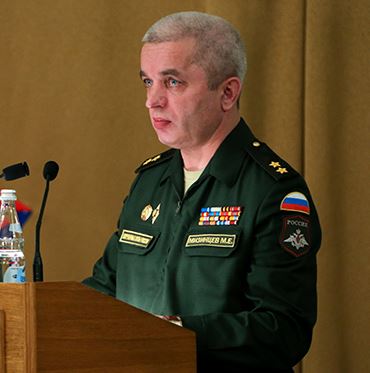
Alongside Defense Minister Shoygu, newly-minted NTsUO chief, General-Lieutenant Mikhail Mizintsev took the lead in briefing the MOD’s Public Council on October 28.  His published report was widely replayed by Russian news agencies.

General-Lieutenant Mikhail Mizintsev (photo:  Mil.ru)

General-Lieutenant Mikhail Mizintsev (photo: Mil.ru)

So what about the NTsUO chief?

Mizintsev is a career staff officer with considerable time spent in tactical reconnaissance.  He was born in rural Vologda oblast on September 10, 1962.  He graduated from the Suvorov premilitary school in Tver in 1980, and the Kiev combined arms command school in 1984.

He commanded reconnaissance or motorized rifle troops up to battalion-level in the GSFG / WGF and Group of Russian Forces in the Transcaucasus.

He finished the mid-career Frunze Military Academy in 1996, and served as a “senior officer-operator” [watch officer] in the General Staff’s Main Operations Directorate (GOU) until 2001.  He returned to the schoolhouse and graduated from the senior-level General Staff Academy in 2003.

Mizintsev served as the chief of an unidentified GOU group through 2007. He then became chief of the operations directorate and deputy chief of staff for the Moscow Military District.  He likely came to the attention of Valeriy Gerasimov at this point.  Gerasimov commanded the district starting in 2009.

From 2010 to 2012, Mizintsev occupied the same post in the North Caucasus / Southern MD.

In August 2012, he became chief of the General Staff’s Central Command Post (TsKP or ЦКП) until it disbanded and he took over the NTsUO.

Mizintsev’s rise from O-6 was quick; he became a one-star in December 2011, then put on two-star general-lieutenant rank barely two years later.

Contract Euphoria

Vadim Koval offered words of caution and perspective on contract service in an October 31 NVO op-ed.  Until 2012 or so, the retired colonel was the official spokesman for the RVSN.

Koval suggests you can’t measure contract service by numbers alone, which merely represent “start-up capital” for the professionalization of the armed forces.

He was prompted a recent official announcement that the MOD has signed up an historically high number of contractees this year — more than 70,000 already — with two months left on the calendar.

The MOD reports, for the first time, the number of soldiers and sergeants serving on contract exceeds the number of conscripts in the ranks.  That means something more than 305,000 — based on fall 2013 and spring 2014 draft campaign target numbers.

Success in finding contractees, Koval writes, is due, in no small part, to an aggressive MOD advertising and recruitment drive this year.  But the greatest attraction for young men is increased training, new arms and equipment, and the overall improved condition of the armed forces.  None of which “remain unnoticed among potential candidates for contract service.”

Still, Koval concludes, even in light of record recruiting numbers, it’s obvious “the defense department’s main work with this category of servicemen is still ahead.”  Defense Minister Sergey Shoygu didn’t fall into euphoria over the numbers, and ordered his subordinates to concentrate on the quality of contractee training, according to Koval.

He writes:

“Even statistics graphically confirm that problems with the quality of recruited contractees exist:  the quantity of contract servicemen dismissed from the Armed Forces in 2014 was 18 thousand.”

Koval finishes noting that much depends on the clarity of the MOD’s response to the challenge of getting and keeping suitable and well-trained soldiers in the military.

It’s surely difficult (well, impossible) to make that 305,000 number jibe with numbers we’ve already seen.  If Moscow had 225,000 or 205,000 at the end of 2013, this year’s 70,000+ would make 295,000 or 275,000 contractees.  Neither of those is 305,000.

It could be that Koval’s very interesting 18,000 number plays into this . . . if that many contractees quit or were drummed out this year, maybe that’s why the numbers don’t equal or exceed 305,000. Perhaps the MOD isn’t counting its attrition — only the manpower it added.

If 18,000 is the number of contractees who left the service, that’s pretty low attrition — about 6 percent.  Last year that percentage looked to be 12 or more.

Where’s My Sub Base

Not His Happy Face (photo: RIA Novosti / Sergey Guneyev)

Not His Happy Face (photo: RIA Novosti / Sergey Guneyev)

Now they’ve done it.

They’ve failed to finish new facilities for Borey-class SSBNs on Kamchatka expeditiously, and they’ve forced Defense Minister Sergey Shoygu to demand “strict control” over their work.

But who “they” are isn’t exactly clear.

According to Mil.ru and RIA Novosti, the annoyed Shoygu said:

“These things are too serious to joke about the time period for their construction.  The joking is over.”

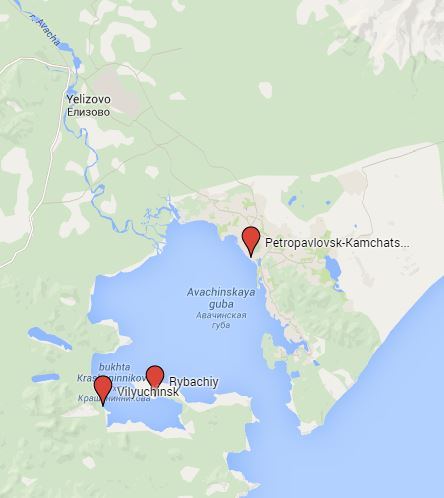
As regards the current plan to base Borey units 2 and 3 at Rybachiy (presumably in 2015):

“At that time everything must be ready.”

Mil.ru reported that the Defense Minister was also dissatisfied with the quality of the construction he observed.

Shoygu laid responsibility on General Staff Chief, Army General Valeriy Gerasimov and Eastern MD Commander, General-Colonel Sergey Surovikin, ordering them to take the work at Rybachiy under “strict control” and to give him a weekly progress report.

Shoygu should have turned to his old friend and subordinate from MChS days, Aleksandr Volosov, who directs the Federal Agency for Special Construction (Spetsstroy).  Spetsstroy is building the new pier zone at Rybachiy.  It used to be known as the Main Directorate for Special Construction (GUSS) in the old days when it fell squarely under the MOD.

Rybachiy and Environs

Rybachiy and Environs

The current Defense Minister’s not the first to ask when his sub base will be ready.

In 2012, President Vladimir Putin revealed that he arranged significant financial assistance from two Russian oil companies to keep the Pacific Fleet strategic sub base open in 2002.

He visited periodically to check progress in modernizing its naval and social facilities.  He was usually unhappy with what he found.

Speaking from Vilyuchinsk in 2004, Putin said:

“They told me here in the past two years an improvement [in military living conditions] was being felt, but I didn’t see this.  The material base of public facilities here is in a pathetic state.  This situation is absolutely intolerable.”

By 2007, according to Izvestiya, he saw some improvement, but still said officials were “just picking their noses” instead of getting Gazprom to gasify Kamchatka.  Army General Anatoliy Grebenyuk, chief of the MOD’s billeting and construction service, and the chief of the Main Military-Medical Directorate were unceremoniously retired for failing to finish their respective work on the remote peninsula.

Gazprom reports that Petropavlovsk-Kamchatskiy was gasified in 2010, but it’s unknown if local gas lines have, as yet, reached the sub base.

As it has long planned, Moscow intends to homeport four Borey-class SSBNs on Kamchatka, starting with Aleksandr Nevskiy and Vladimir Monomakh.  But first it wants a fully functioning system in place to support their operations.

In March, a Navy Main Staff source told ITAR-TASS that the complete system for basing the new submarines – piers, utilities, logistical support, weapons storage facilities, and other infrastructure – still needs to be finished. Consequently, neither SSBN will arrive in the Pacific Fleet earlier than the fall of 2015.

Never As Strong

One’s been reminded recently of the adage (attributed to Churchill and others) that Russia (and its military) is never as strong, nor as weak, as it seems to be.

Its military strength or weakness slides along a scale, constantly shifting. Though appearing to be in one place, it’s often already moving (or starting to move) in the opposite direction.

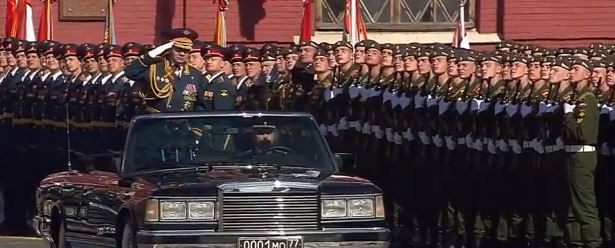
Yesterday’s Red Square military parade marked the 69th anniversary of victory in the Great Patriotic War.  It was quite an impressive display of fair Slavic manhood.

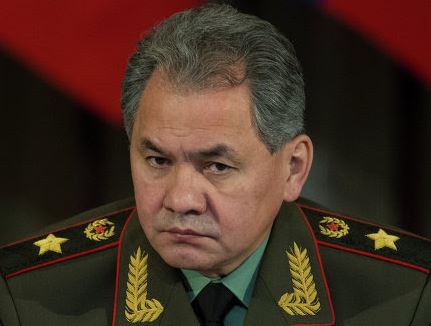
Defense Minister Shoygu Reviews Troops Before 9 May Parade

Defense Minister Shoygu Reviews Troops Before 9 May Parade

As every year, Moscow understandably put its best foot forward.  But we’d do well to remember this isn’t necessarily the face of the entire Russian military.

This is the same country that gave us the Potemkin village and infamous 1955 Soviet Aviation Day flyover (and bomber gap).  Be impressed, but don’t go overboard like many comments you’ll read.

Russia’s armed forces have clearly improved in recent years.  There’s even been an uptick since Shoygu replaced Serdyukov.

But is Russia’s military development on a sustainable trajectory?

Probably not, in this writer’s estimation.

Shoygu Likes Things on a Soviet Scale

Shoygu Likes Things on a Soviet Scale

Shoygu’s efforts appear aimed at returning the armed forces to something approximating Soviet scale (or the unreformed, pre-2008 Russian scale at least).

Despite the problems he ultimately caused, Serdyukov tried — not just to reduce the military’s proportions — but to make it fit its manpower, its logistical support, and its most likely threats.

Russia’s annexation of Crimea and its build-up opposite eastern Ukraine have spurred observers  to assess that Ivan’s 7-feet-tall and growing.  Many of them never looked at Russia’s military prior to March.

One’s strength is inversely proportional to that of the enemy.  Everything is net assessment.  Three long-time analysts have concluded:

“You don’t have to be good to win — just better than your foe.”

“The Russians were capable of confronting an inferior force that is right next door.”

“It’s an impressive operation, but it’s an 80% political operation.  The military are there to stand around and look menacing.  It’s not as if they took Crimea.”

We should also note the Russians already had a huge military presence inside the borders of the country whose territorial integrity and sovereignty they violated.

Russia isn’t the first (and won’t be the last) great power or superpower to use its foreign military bases for such a purpose.

Such actions usually carry a high diplomatic, political, military, and economic price that has to be paid eventually.

Overfulfilling the Plan

News on the Russian military of late carries a distinctly positive tone.  The army is always receiving new weapons systems, completing major training evolutions, and signing up thousands of new contractees.

A contrast from years past when there was either no news or bad news about the military’s development (or lack thereof).  Probably neither editorial line accurately reflects, or reflected, reality.  Things are never as good, or bad, as they’re presented.

Ever an honest contrarian on the widest range of issues, Nezavisimaya gazeta now asks, somewhat obliquely, whether the frenetic activity of Russia’s Ministry of Defense is outrunning its financial support.

In an editorial last Thursday, NG wonders if the MOD can accelerate completion of many tasks without additional financing.

It isn’t the first time financial flags have been raised.  Several times over the last year, reputable media sources asserted that Sergey Shoygu’s MOD would face sequestration soon.  It hasn’t happened yet.  Maybe the possibility is more pregnant given that Russia’s economy is flatlined right now.  In some ways, worse than flatlined (e.g. the ruble exchange rate).

But we digress . . . .

NG reports that Shoygu, at last week’s collegium, reiterated the impermissibility of falling off a single task in the MOD’s “Action Plan 2020.”  The reports of MOD officials said there have been no failures, only many impressive figures about the “thoroughly dynamic process of perfecting the state’s defense system.”

General Staff Chief, Army General Valeriy Gerasimov reported the facts to the assembled generals and high-ranking civilian officials.

To wit, by year’s end, 580 modern bunkers and storage facilities will be built in 15 arms depots as well as 160 facilities for RVSN ground-based strategic nuclear weapons, Ground Troops missile brigades, pre-fab radar stations, Borey and Yasen submarine bases, and new airfields.

NG concludes:

“The fact is the scale of construction is grandiose, fully speaking for those amounts of financing the state is directing at the needs of the Armed Forces.”

The paper gives examples of hardware being acquired . . . 27 BTR-82As for the Western MD in January alone, 12 Su-35S fighters for the Eastern MD in February, 220 aircraft, 8 ships and submarines, 14 SAMs, 50 air defense radars, and more than 200 armored vehicles in 2014.

Meanwhile, the MOD’s capital construction chief Roman Filimonov reported a decision to move deployment of a pre-fab radar in the east up a year to 2014, outfitting of five VDV military towns up two years to 2014-2015, and quicker completion of a host of other projects planned for the more distant future.

Again NG concludes:

“The intentions, of course, are good.  It just pays to remember that last December the parameters of the military budget for 2014-2016 were specified. And no one promised the army any additional money.  And without it hastening fulfillment of plans appears highly problematic.”

An NG news story the following day added:

“We recall that the Minfin came out categorically against any increase in the military budget.  More than this it insisted on moving ‘to the right’ the terms for implementing several defense projects.  It seems in the Armed Forces they agreed with the financiers’ demands.  In the event that directors of central organs of the military command, in whose interests recalculation measures are planned, don’t know how to find sources of financing for new work, they’ve been promised a forced redistribution of resources from facilities already in the plan to facilities appearing with the changes introduced.  The collegium agreed to proposals voiced by Filimonov.”

So what do we take from this?

There’s no imminent threat to funding a rejuvenated Russian military.  The current pace of development, achieved in 2012, will continue while Russia’s economic and political system can bear it.

But the NG articles may foreshadow even tighter budgets.  Independent media are debating how to lift a stagnating economy still based on hydrocarbon rents.  The Sochi Olympic hangover may have just begun.  Government (and military) budget parameters are set, but they never really feel firm.  The MOD  just focuses on the money it has now.

In Soviet central planning, overfulfillment usually meant sacrificing quality to meet quantitative targets and time schedules, to make careers, and to earn bonuses.  Today it means more demand, less supply, tighter markets, and rising prices.  And even in the post-Serdyukov MOD, it means more opportunities for corrupt scheming.