Category Archives: Strategic Forces Modernization

Dizzy with Bulava’s Success?

Iosif Vissarionovich might have accused Bulava’s proponents of dizziness after the SLBM’s test firing on October 7.  There’s no mistaking it was a clear boost to a troubled program.  Success always trumps failure.  It may even turn out that all of Bulava’s design, production, and assembly problems are resolved.  But one would think the history and current state of the Bulava would call for more cautious, guarded optimism.  This successful test was necessary, but far from even close to sufficient to complete the program.

The biggest news story after this successful test was the report that, as a result, the Bulava SLBM and Borey-class SSBN weapons system might be accepted into the arms inventory as early as mid-2011.

A highly-placed Navy Main Staff source told Interfaks:

“Before the end of the year, another two test launches of the missile are planned, if they are as successful as today’s launch, then it’s legitimate to consider the issue of the quickest completion of tests of this strategic system.  I’m proposing that the acceptance of Bulava into the arms inventory could happen in the middle of next year.”

He follows adding that serial production of the SLBM and its deployment in proyekt 955 Borey-class SSBNs will ensue.

The Navy Main Staff source doesn’t go into exactly what ‘quickest completion’ entails, but others do.  Presumably, this means another test from Dmitriy Donskoy before the end of October and, if that’s a success, the first launch from Borey-class Yuriy Dolgorukiy before year’s end.

Vesti.ru conjectures that ‘quickest completion’ might mean a second, ‘insurance’ shot from Yuriy Dolgorukiy in early 2011, then a volley firing of two missiles in spring or early summer.  After this, if every test is a success, the weapons system would be accepted, serial production would begin, and Bulava would be deployed on Yuriy Dolgorukiy.  That’s if everything goes right.

An irrationally exuberant Defense Ministry source even told RIA Novosti:

“The successful launch of the missile gives a basis to suppose that the entire system ‘submarine plus missile’ will be accepted into the Russian Navy’s arms inventory by the end of the year or at the beginning of next.”

Former Armaments Chief Anatoliy Sitnov was pretty confident, telling Interfaks and ARMS-TASS that no specialists are expressing doubts about Bulava, and ‘broken links’ in its production process have been overcome.

Old RVSN general Viktor Yesin told Interfaks he agrees it’s possible to plan for completing Bulava testing by mid-2011.  But he retains some caution:

“The tests conducted instill hope that the two flight tests of the Bulava ballistic missile coming before the end of this year will be successful.  If this happens, it’ll be possible to confirm that the designers and producers overcame a period of failures in the creation of the new submarine-launched missile system.”

Yesin also notes that only the telemetry can say if all the Bulava’s systems were working normally.

Forum.msk’s Anatoliy Baranov is skeptical about making Bulava part of Russia’s strategic nuclear forces even if the next two tests are successful, and make the tally 8 successes in 15 attempts.  He says having a missile you want to produce doesn’t mean you can produce it quickly in the necessary quantity:

“Incidentally, no one has answered for the strategic decision which left the country practically without a naval component of strategic nuclear forces [SYaS].  Don’t believe that the resignation of MIT director Solomonov is a sufficient measure of responsibility considering the possible consequences of such a mistake, and the fact that today our naval strategic nuclear forces [MSYaS] already lag the strategic enemy by a factor of 5.  But even given the most successful confluence of circumstances, we will have a gap between old missiles and submarines going out of service and new ones coming into service because the possibilities of domestic industry in serial production of solid-fuel missiles are very limited.  The Votkinsk factory produces 5-6 solid-fuel ‘Topol-M1’ missiles, there aren’t other producers.  This means the production of new missiles of the ‘Bulava’ type puts an extra load on production which already can’t cope with the creation of new land-based missiles — see, straining the RVSN rearmament program even worse.  In the best case, the necessary complement of armaments for the 3 new ‘Borey’ class SSBNs will be produced in nearly 15 years.  This is a catastrophe.”

Andrey Ionin doesn’t agree with Sitnov above.  He told Gazeta.ru that the Defense Ministry shouldn’t be impatient:

“A state commission report on successful testing and a formal decision on accepting the system for regular use doesn’t change the fact that the problem of low quality in joint production has not been eliminated.”

Carnegie Center Moscow associate Petr Topychkanov says:

“Three successful tests in a row is not a reason to put a type into serial production.”

But, unlike Baranov, he points out that the production run for Bulava doesn’t have to be too big since there are, and will be, relatively few tubes to fill.

Pavel Felgengauer in Novaya gazeta is skeptical about how close the Bulava RVs came to their intended targets, but, more important for this discussion, he calls saying that Bulava is almost ready for deployment after this successful test a “dangerous adventure.”  He adds:

“And here is a ‘raw’ missile, not completely ready and the not tested ‘Yuriy Dolgorukiy,’ a crew which clearly hasn’t mastered its submarine — and missile launches right away.  Very bold to put it mildly.”

Viktor Baranets sums it up:

“A successful launch instills some optimism.  But it’s still a long time before accepting the missile into the arms inventory.  And of 13 launches only 6 (including yesterday’s) [October 7]  were recognized as successful.  Or ‘partially successful.’  But this is not cause to launch the missile into a serial run.  Higher ‘positive indicators’ are needed.  Our specialists and foreign ones believe the quantity of successful launches should be steadily above 90%.”
Successful Bulava Test Reported

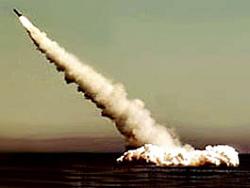
Bulava Launch (photo: ITAR-TASS)

ITAR-TASS reports today’s Bulava SLBM launch from Dmitriy Donskoy was successful.  It was the 13th test overall.  The missile’s warheads impacted on the Kura range on Kamchatka, according to the Defense Ministry press service. 

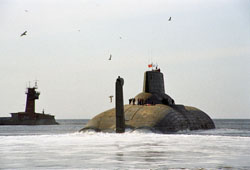
Dmitriy Donskoy fired the Bulava while submerged in the White Sea.  The missile’s flight trajectory was normal.  ITAR-TASS notes Russia’s military command and defense industry prepared for this launch more thoroughly than ever.

Litovkin on What the GPV Will Buy

Viktor Litovkin (photo: RIA Novosti)

Returning to procurement and the GPV . . . in this week’s Delovoy vtornik, NVO’s Viktor Litovkin also asks what will 19 trillion rubles be spent on. 

He says the answer isn’t simple.  During the last 20 years of ‘starvation rations,’ the armed forces got handfuls of essential combat equipment, and, meanwhile, a dangerous imbalance between strike and combat support systems was created.  And this was obvious against Georgia in 2008. 

Litovkin says this imbalance has to be corrected, meanwhile priorities like strategic nuclear forces can’t be forgotten – not just the offensive triad, but also the missile attack early warning system (SPRN), missile defense (PRO), and aerospace defense (VKO). 

Like Viktor Yesin of late, Litovkin asks how Russia will replace its aging strategic offensive arms to stay up to the limits of the Prague / New START agreement.  Half the Russian force is SS-18, SS-19, and SS-25 ICBMs which will be retired in 7-10 years.  Moscow needs to build 400 strategic systems to replace them.  He doesn’t even mention Delta III and IV SSBNs and their aging SLBMS.  And Russia has only the SS-27, RS-24 Yars, Sineva, and Bulava to replace them. 

Litovkin expects a very large amount of money to be spent not just on replacing strategic systems, but also reequipping the enterprises that produce them. 

He turns to his second priority – also demonstrated by the Georgian war – precision-guided weapons, which in turn depend on reconnaissance-information support and equipment in space, on long-range surveillance aircraft [AWACS], and UAVs. 

Priority three – automated command and control systems (ASU).  He cites Popovkin on linking all service C2 systems into one system over 2-3 years. 

Litovkin says you can’t forget about the Navy, but he mentions just the Borey-class SSBNs, and the need for a wide range of surface ships.  And he makes the point [made by many] that Mistral is all well and good, but it’ll have to have multipurpose combatants operating in its battle group.  They need to be built, and they won’t cost a small amount of money. 

One can’t forget aviation either.  Litovkin cites a $100 million per copy cost for 60 fifth generation fighters [that’s a significant 180-billion-ruble bite out of the GPV].  He notes Vega is working on an updated Russian AWACS (A-100).  And, like Korotchenko, he mentions transport aircraft, but also combat and support helicopters. 

And so, says Litovkin, the question arises – isn’t the country putting out a lot of money to rearm its army? 

Viktor Litovkin (photo: Ekho Moskvy)

Being bold, he says, not really.  He actually uses that accursed 22 trillion figure, which is procurement for all power ministries.  If he used 19 trillion, it would be 1.9 trillion or $63 billion per year for Russia against $636 billion for the U.S., $78 billion for China, $58 billion for the U.K., and $51 billion for Japan.  But he doesn’t say this is annual procurement, the GPV, against the total annual defense budget for these other countries.  A bit of comparing one piece of pie to a whole pie.  Nevertheless, he concludes this makes Russia far from champion when it comes to military expenditures. 

Litovkin’s last word is Russia will remain one of the G8 with a powerful, combat capable, and effective army, but without it, only a raw materials appendage of either the West or East. 

But one wonders, hasn’t Russia long been in the G8 without that kind of armed forces?  Doesn’t breaking away from the raw materials supplier role have more to do with developing an open, attractive, innovative, value-added, and competitive economy (and a political system and society to match) than with military power? 

Bulava Launch This Week?

Today Navy CINC, Admiral Vysotskiy told an ITAR-TASS correspondent a Bulava SLBM test is planned this week.  Asked whether the missile would fly, Vysotskiy said he hopes it will:

“If I wasn’t confident, I wouldn’t have made these plans.  Nothing can be ruled out, we aren’t giving guarantees.  But we hope it will fly.”

Vysotskiy noted that preparations for the next launches have been conducted very seriously, and state acceptance made much tighter.

He said Bulava won’t be fired from Borey-class SSBN Yuriy Dolgorukiy until there are successful tests from Dmitriy Donskoy, adding that Dolgorukiy will be ready to launch Bulava in about a month or six weeks.

Dolgorukiy Factory Testing Complete

Borey-class SSBN Yuriy Dolgorukiy

Not a huge news story, but worth keeping continuity on . . . and there are interesting questions — has the fourth Borey really been laid down, and how many launch tubes will be on unit 2, 3, etc.? 

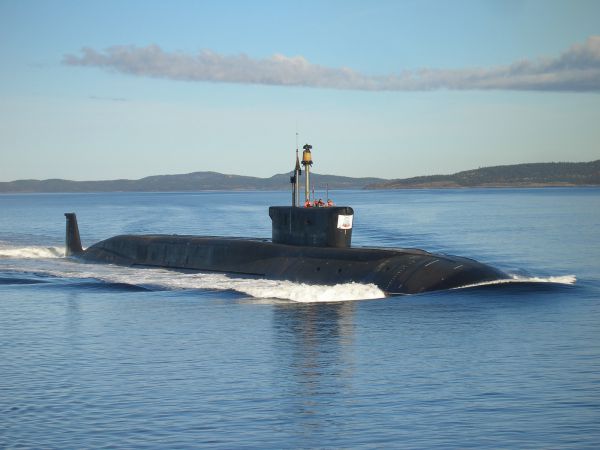
Borey-class SSBN Yuriy Dolgorukiy completed its factory underway testing by 24 September, according to the official Russian news services.  A spokeswoman for Sevmash said the current testing plan was fulfilled, and all established tasks were completed.  Captain First Rank Vladimir Shirin called the last at-sea period ‘excellent.’  All systems reportedly worked well, and minor issues noted during previous cruises were resolved.  The Sevmash delivery team and Dolgorukiy crew are preparing to present the submarine to the state acceptance commission.  But according to Grani.ru, a United Shipbuilding Corporation (OSK) source told Interfaks the obvious – acceptance of Dolgorukiy into the Navy inventory is not being considered since its main weapon – the Bulava SLBM – is not ready.  The Defense Ministry is still hoping that the new SSBN will be the launch platform for one of the next three Bulava tests.

The news services noted there are two additional Boreys, not three, on Sevmash’s buildingways.  So one supposes number four, Saint Nikolay, hasn’t been laid down yet.

The news services maintain the line that the Borey-class boats will have 12 launch tubes each, but Grani.ru, like other media outlets, claims Aleksandr Nevskiy and Vladimir Monomakh are proyekt 955A units and will have 16 tubes, while Saint Nikolay will be a proyekt 955U boat, possibly with 20 tubes.

Makarov on Iran, Lasers, Deferments, and Bulava

Attending today’s OPK modernization meeting in Ramenskoye, General Staff Chief, Army General Nikolay Makarov talked to the press, and said:

“A decision not to supply Iran with the S-300 was made, it, of course, falls under the sanctions.  The leadership made a decision to stop the supply process, we are fulfilling it.”   

He wouldn’t say the contract to supply them has been broken.  Apparently asked if the missiles could be provided in the future, Makarov said:

“We’ll see, this will depend on Iran’s conduct.”

Unnamed official sources put the price of the Iranian S-300 contract at hundreds of millions of dollars.

ITAR-TASS reiterated Defense Minister Serdyukov’s 20 August comment on providing Iran the S-300:

“We aren’t supplying anything.  There’s no decision on supplying them.”

Makarov’s comments coincided with President Medvedev’s ukaz implementing UNSCR 1929 from 9 June.  The ukaz expressly listed the S-300 as an item not to be transferred from Russia to Iran. 

Asked about Russia’s military laser program, Army General Makarov said development is on-going:

“Work on a combat laser goes on throughout the world, including here.”

He added that it was premature to talk about the characteristics of Russia’s laser system.

Answering another question, Makarov said student draft deferments won’t be abolished:

“The possibility of ending deferments for students is not being considered.  This issue is too socially significant.”

“There are many other measures which will allow us to resolve the situation [with the draft].”

He added that he expects Serdyukov to talk about the draft at Friday’s Defense Ministry collegium.

Asked if compulsory military service will be increased from 12 months, he said, “I don’t know if there’s sense in this.”

But Makarov went on to vent his frustration about conscription:

“Today not more than 13 percent of young people are called up, the rest aren’t called up for health reasons.  We need to understand what is happening .  It can’t be that only 13 percent of our young people are healthy.  Among people getting a deferment or exemption from the army on health grounds, 40 percent of them had documents either purchased or manufactured in some way.  In other words, there’s an issue, and we need to toughen monitoring in this area.”

Thirteen percent is really low.  And the corruption rate when it comes to health exams in commissariats is at least 40 percent.  We need to explore his numbers and math.  These are startling figures.

Makarov paid a little respect to Serdyukov’s fledgling effort to ‘humanize’ conscript service:

“A number of measures to reduce the load on prospective conscripts are being reviewed.”

Finally, press questions turned to the pending Bulava SLBM tests.  Makarov said:

“The missiles which we’re preparing to launch were produced from beginning to end under strict monitoring by military acceptance, the Defense Ministry, and the Military-Industrial Commission.  A great deal will depend on these launches.  If the launches are unsuccessful, then we have to shake up fundamentally the entire cycle of missile production.”

On the timing of the next Bulava test, Makarov contradicted Serdyukov’s last statement by saying:

“It’s doubtful this will happen in September.”

Serdyukov on Changing Bulava Production

According to RIA Novosti, Defense Secretary Serdyukov told Russian journalists in Washington Friday that, if the next Bulava launches fail for different reasons, Russia will have to change its system of production and quality control. 

Serdyukov said, if the missiles fail for the same reason, the cause of the failures will be found.   But if the causes turn out to be different, we “have to change the entire production and quality control system for these missiles.”

According to ITAR-TASS, Serdyukov said:

“In the assembly of these missiles we tried to make them fully identical so that they would be like twins [triplets?].” 

“We can’t hurry the testing.  The main thing is that in every assembly cycle there were strict guarantees that we made the missiles absolutely identically and all procedures were followed.”

“The possible defects will be the same, then we will eliminate them, but if they are different, then we have to break down the entire system and find out what is happening in production and quality control. Then it will be clear that the production monitoring is incorrect and it’s absolutely necessary to change it.”

Serdyukov Meets Gates at Pentagon

Mr. Serdyukov Goes to Washington (photo: ITAR-TASS)

ITAR-TASS reports Defense Minister Anatoliy Serdyukov and his U.S. counterpart Robert Gates will meet for a total of 5 hours today.  And the Russian press service concludes: 

“This is highly unusual and attests to the great significance the U.S. Defense Department attaches to the visit.” 

Aside from all the customary ceremonies, there will be three sets of talks today.  The morning session is dedicated to discussing military reform plans and defense spending on both sides.  ITAR-TASS says the Americans consider this the most important topic from their viewpoint. 

The press service quotes The New York Times saying the two men “simultaneously declared war on longstanding and ineffective bureaucratic organizations,” adding that they’ll find a common language as they compare their efforts. 

A working lunch will be devoted to nuclear arms control and missile defense.  RIA Novosti quoted a Defense Department spokesman who said you can’t meet Russians without discussing missile defense, but it won’t be the main topic of the visit.  Today’s afternoon session will cover a variety of regional and global security problems.  Serdyukov will visit an unspecified U.S. Army base as well as the Naval Academy. 

In an interview published in today’s Kommersant, Gates said: 

“I’ve attentively followed Defense Minister Serdyukov’s reform efforts.  I have the impression that the scale and depth of the reforms he’s conducting correspond to what I’m trying to do in the U.S.  The thing is in the coming years we don’t expect significant budget increases.  Therefore, we have to decide how best to use the resources we have.” 

“I know the Russian Defense Minister has an interest in how to select highly professional soldiers and how to keep them in the armed forces, how to exert command and control of the armed forces in order to strengthen national security.  This is especially complicated in the face of economic problems standing before each of our countries.” 

Apparently, Gates doesn’t understand precisely.  The Defense Ministry already has an answer — to jettison its failed professional contract service program, return to reliance on conscripted soldiers, and see if they can train and retain some professional NCOs. 

Asked if Russia’s a threat to the U.S. and about its new ballistic missiles, Gates replied:  

“No.  I don’t view Russia as a threat.  We are partners in some areas and competitors in others.  But we cooperate on important issues.” 

Good answer. 

“From the viewpoint of our program modernization the new SOA agreement is a great achievement.  Just as the agreements which preceded it.  They establish rules of the game which provide transparency and predictability.  Modernization programs within the bounds of the new SOA agreement are absolutely normal.  We’ll conduct our own modernization. 

Asked about cooperation on missile defense and the Gabala radar specifically, Gates said the U.S. is interested in Gabala and in the possibility of establishing a missile launch data exchange center [JDEC] in Moscow.

Bulava Test Postponed At Last Minute?

Dmitriy Donskoy Underway (photo: Sevmash)

According to Rossiyskaya gazeta’s sources, Bulava SLBM test platform Dmitriy Donskoy was on-station in the White Sea for a launch last week, and all test arrangements were laid on — command and control, international notifications, ground and space tracking, telemetry, support and rescue ships, but the launch was put off at the last minute. 

The paper’s space and OPK sources said the Bulava commission had concluded the missile and boat were ready for the launch, and “today there is no reason whatsoever to put it off to a later time.” 

But, Rossiyskaya concludes, it turns out there was a reason serious enough to return the submarine to base.  

So it comes to nothing, and Defense Minister Serdyukov’s 8 September comments added no clarity to the situation, according to the paper’s account. 

So, we don’t know the reason why a launch was prepared, drew close, and didn’t happen.  It suggests some continuing problem or doubt about Bulava’s performance, or continuing disagreement over the system’s readiness for its next test.

Bulava Test in Second Half of September

Defense Minister Anatoliy Serdyukov talked to the press today about the next Bulava SLBM test:

“The next test launch of the Bulava could happen, most likely, in September, but not in the first half of the month.  Definitely.”

“We’ve tried to control the entire process of assembling these missiles as precisely as possible to produce the same parameters. There will be three missiles at a minimum, we need to understand that if failures are repeated in the launches, we’ll learn the cause of unsuccessful launches.”

After reiterating how previous failures had different causes, Serdyukov continued:

“Now at every level and phase of assembly of the missile there was strict control and analysis.  Moreover the commission established to explore the results of the last unsuccessful launch also worked here.  It gave recommendations, we incorporated all of them in preparing for new tests.”

“I believe that launches will be conducted most likely in September according to their readiness.”