Category Archives: Strategic Forces Modernization

Routine Change of Command or Not?

Kommersant published some extra details on Sergey Karakayev’s career.  He has served in all RVSN command and staff duties.  He began in the 320th Missile Regiment, 7 th Missile Division (Bologoye-4, Tver Oblast) as a group engineer, training and launch group commander, and finally chief of staff.  In 1994, he became a regiment commander, then chief of staff in the 28th Missile Division (Kozelsk-5, Kaluga Oblast).  He commanded this division from 1998-2001.  Then he headed the Second Department, First Directorate, Main Personnel Directorate.  During 2006-2008, he commanded 27 th (Vladimir) Missile Army.  On October 22, 2009, Karakayev became First Deputy Commander and Chief of Staff of the RVSN.

A source told Kommersant Karakayev’s appointment was ‘expected,’ adding that Andrey Shvaychenko requested retirement on 9 June and left on leave.  The source claimed he’d reached the service age limit of 55 for two-star generals, but this isn’t correct.  Shvaychenko actually turned 57 on 18 June.  Kommersant’s interlocutor went on to say that Shvaychenko himself recommended Karakayev to  succeed him.

Academy of Military Sciences strategic arms expert Yuriy Rubtsov told Svobodnaya pressa the change at the top of the RVSN may be related to difficulties in, and disagreements over, modernizing the Russian ICBM force under the new strategic arms agreement. 

According to Rubtsov, the RVSN will have to trim its ICBMs by a third under the new arms treaty.  But new missiles are arriving in the force in only miserly portions, and don’t replace what has to be scrapped.  No matter how much the service lives of ICBMs on combat duty since Soviet times have been extended, they still have to be cut, ultimately in 2015.

Svpressa cites NATO estimates that at most 7 Topols are reaching the RVSN each year.  At such a tempo, it’s essential to keep old weapons a little longer.  A sufficient number of Topol-M missile units have not been created, so the SS-18 and SS-19 still underpin Russia’s delivery of unacceptable damage on the enemy.  But Russia continues unilateral disarmament.  According to Svpressa, in such a situation, the more often you change RVSN Commanders, the easier it is to control them and not allow opposition to your strategic nuclear policy. 

Svpressa speculates maybe replacing Shvaychenko was President Medvedev’s way of flexing his muscles before the U.S. visit, grabbing some attention, and signaling Obama that Russia is disarming as agreed and everything is OK.

Karakayev Replaces Shvaychenko as RVSN Commander

Lots of action near the top of the Russian military pyramid today . . . 

General-Lieutenant Andrey Shvaychenko’s exceptionally brief tenure as RVSN Commander came to an abrupt and unexpected end.  He just turned 57 on June 18, and only commanded Russia’s land-based strategic forces for a little over 10 months.  His predecessor—Nikolay Solovtsov—served for 8 years. 

Already past retirement age for his two-star rank, President Medvedev and Defense Minister Serdyukov apparently decided to replace rather than promote him. 

The timing of Shvaychenko’s replacement is interesting and most likely not accidental, to say the least.  The Russians have swapped out a key figure just as they enter the process of ratifying a new strategic arms treaty with the United States. 

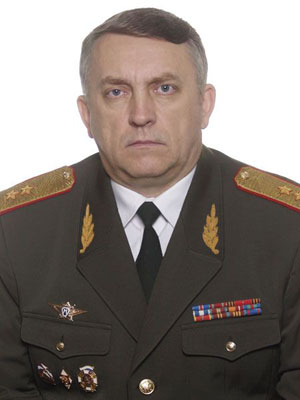
General-Lieutenant Sergey Viktorovich Karakayev replaces Shvaychenko.  Like his predecessor, he’s a two-star general, but 8 years younger.  He served as Chief of Staff, First Deputy Commander of the RVSN just since last October.  He occupied RVSN command positions up to and including missile division commander and Vladimir Missile Army commander in 2006-2008.  

General-Lieutenant Karakayev

Somewhat atypically, he served some time as a department chief in the Defense Ministry’s Main Personnel Directorate.  He completed studies in the civilian North-Western State Service Academy before finishing the General Staff Academy.  He holds a doctorate in military science.  His full biography is here

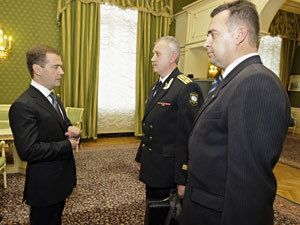
Kremlin.ru provided the following excerpt from today’s Gorki meeting between Medvedev, Serdyukov, and Karakayev: 

“This is a serious position.  The functioning of our nuclear shield depends on work in these duties.  And of course, I hope that you will do everything necessary, everything dependent on you to apply your knowledge, your experience for the good of the country, to create the right RVSN command and control system.” 

“Despite the fact that we are reducing our nuclear arsenal, this must not affect the combat core within the limits of that agreement which is currently operative for us, and within the limits of that agreement which is in ratification.” 

“Generally, it’s necessary to do everything so that our Rocket Troops of Strategic Designation will be fully combat ready and can fulfill their established missions.” 

Karakayev gave a customarily brief response: 

“Comrade Supreme Commander-in-Chief, I will not fail.” 

Pervyy kanal covered also covered the Gorki meeting, if you’d like some video.  

The change in the RVSN may be a result of the bumps and bruises of reaching internal agreement to go forward with the new strategic offensive arms treaty.  Or maybe not.  But something’s clearly wrong; a ten-month tenure is clearly far off the norm.  Medvedev’s short comments aren’t much to go on, but they seem to say (a) Shvaychenko wasn’t doing the job the way his masters wanted; (b) the masters want an improved strategic nuclear command and control system; (c) the new arms treaty doesn’t threaten Russia’s nuclear deterrence capability and, therefore, is a good deal for Moscow; and (d) the RVSN Commander needs to focus his attention on the optimal operation of whatever weapons systems provided him by the country’s leadership.  And Karakayev indicated in front of the cameras that he’s on-board with all this. 

Armaments Chief Vladimir Popovkin also replaced First Deputy Defense Minister, General-Colonel  Aleksandr Kolmakov.  Popovkin seems to have accommodated Serdyukov, and fit well into the Defense Minister’s ‘new profile.’  The ex-Space Troops general seems to be the type of official the civilian leadership wants in its more civilian Defense Ministry.  He will keep charge of the weapons portfolio, and training and readiness accounts overseen by Kolmakov will probably go back to the Genshtab.  But more on this one tomorrow.

Three Identical Missiles

The Defense Ministry’s inter-departmental commission didn’t make any announcement about its work or the causes of Bulava SLBM test failures as had been anticipated on 20 May.  If this commission has clues about the missile’s problems, it didn’t reveal them.  But Kommersant concludes that the Defense Ministry hasn’t reliably determined the causes of previous failed launches.

However, on 21 May, Defense Minister Serdyukov announced a new approach to Bulava testing.  The Russians will make three identical missiles and launch them in hopes of pinpointing the same problem in each.  It’s a gamble, but it could work.

RIA Novosti quoted Serdyukov:

“The problem of the unsuccessful ‘Bulava’ missile launches lies in the assembly process.  We do not see any other violations there.  The whole matter is missile assembly quality.  Each unsuccessful launch has its own causes.  They are all different.”

“Now we are working on making three absolutely identical missiles.  We believe that this will allow us to precisely locate the mistake, if there is one, since it must be repeated in all three missiles.  Now we are working on how to control the assembly process in order to know that all the missiles are identical.  Toward November, I think, we can begin launching the missiles.  After this we will be able to identify the cause precisely.”

Earlier reports had said the next Bulava test would occur in June, but Serdyukov now says November at the earliest.  Over six years, only 5 of 12 Bulava launches have been successful or ‘partially successful.’  The missile launched on 9 December 2009 self-destructed after a third stage engine problem.  Grani.ru recalled that other recent problems included steering system and stage separation malfunctions.  Moscow had intended to put the Bulava on its new Borey, or Proyekt 955, SSBNs starting in 2007.

Gzt.ru describes the new three missile approach as an expensive “hit or miss” method.  The Defense Ministry hopes launching identical missiles will point to the same problem in each, if there is one.  But if they still manifest different problems, Moscow will be no closer to pinning them down.  The risk is another year without getting any closer to a new SLBM.

Gzt.ru concludes:

“Serdyukov didn’t specify what will happen if in the November series of launches of ‘Bulava’ each time a different component of the missile fails.  Apparently, this possibility isn’t being considered.”

Also in Gzt.ru, Defense Ministry critic Konstantin Sivkov describes the three missile plan as absurd and expensive.  With each missile costing 300 million rubles, it’s a 1 billion ruble effort and there’s no guarantee the bug, or bugs, will be identified.  He believes the designers will have to conduct stand tests where all components can be checked under controlled conditions.  He blames defective parts allowed into the system due to inadequate production controls.

Gazeta.ru cited one Andrey Ionin, a missile designer, who agrees the problem lies in the absence of technological discipline in the enterprises of the Russian OPK.  He says:

“Cooperation by several hundred enterprises, working under different forms of ownership, in different parts of the country, without observing all rules of technological discipline is pointless.” 

Nevertheless, simultaneous assembly of three missiles could be a way of searching for mistakes in Bulava.

MIT missile designer Yuriy Solomonov has said repeatedly it’s defective materials, production process breakdowns, and the lack of quality control, but neither he nor military men are saying which materials or processes they suspect.  He’s also said Russia lacks 50 materials needed for solid-fuel missile production.

In Kommersant, former RVSN general Viktor Yesin claims the Defense Ministry’s inter-departmental commission investigating Bulava has determined that enterprises didn’t cooperate and provided poor quality parts for the missile.  Still he sees no alternative to Bulava and believes its design is workable.

Navy CINC on Bulava Findings and Typhoon SSBNs

Speaking Friday in Novorossiysk while accompanying Prime Minister Putin, Navy CINC Admiral Vladimir Vysotskiy said the Bulava SLBM commission will report 20 May on its findings regarding the last unsuccessful test launch.  He also promised:

“We are working continuously and checking the entire process of the missile’s development.”

“Continuous work of voyenpredy [military factory representatives] is being implemented.  Right down to a screw, with the submission of corresponding certificates.”

“. . . all enterprises active in Bulava production are working under control of military acceptance.  We are checking the entire process from beginning to end.”

RIA Novosti reminded readers that, despite a string of unsuccessful tests (only 5 of 12 have been considered successful), the Defense Ministry still considers it ‘unrealistic’ to put another type of ballistic missile in new proyekt 955 SSBNs.

In February, Defense Minister Serdyukov expressed his certainty that Bulava problems would not affect the laydown of the next proyekt 955 submarine, the fourth in the series.  Officially, Moscow says Bulava will be carried through until the necessary result is obtained, and the missile will be the basis of sea-based strategic nuclear forces until 2040-2045.

One has to wonder, what happens if, after all the emphasis on eliminating production defects, Bulava still doesn’t fly?  Where does Moscow turn next for answers.

Vysotskiy also told journalists two proyekt 941 Akula (Typhoon-class SSBNs Arkhangelsk TK-17 and Severstal TK-20) will remain in the Russian Navy’s order-of-battle until 2019.  He said:

“They will be in a combat condition until 2019.  They have very great modernization possibilities.” 

This isn’t the first time he’s said this, but he hasn’t said how the 1980s-era SSBNs might be used or altered:

“There are several options, but the decision has yet to be made.” 

Of course, TK-208 Dmitriy Donskoy was modified to be the Bulava test platform.

Kavkaz, Perimeter, and ‘Dead Hand’

President Medvedev with Cheget Officer-Operator (photo: RIA Novosti)

A retired colonel (probably with some firsthand experience though none is noted) used yesterday’s Komsomolskaya pravda to add to the still fairly small public body of knowledge on Soviet and Russian nuclear command and control.

Colonel Mikhail Timoshenko writes that the Soviet nuclear ‘suitcase’ was created 20 years after the U.S. developed its ‘briefcase.’  Developed in the 1970s under Brezhnev, the Soviet system came in response to the short flight-time of U.S. missiles and fears of a surprise strike.  Short-tenured CPSU General Secretary Chernenko (1984-85) was the first Soviet leader to be accompanied by the ‘suitcase’ and officers responsible for operating it.

According to Timoshenko, the ‘suitcase’ (codenamed Cheget) is part of the Kazbek automated command and control system for strategic nuclear forces and was actually introduced in 1983.  It answered the threat of a sudden nuclear attack in which the Soviet NCA might not reach the command post, or might not be able to send orders over ordinary communication lines.  The system had to have conference-call capabilities so the General Secretary, Defense Minister, and General Staff Chief could all use it.  And it had to be simple for elderly men trying to think and decide under extraordinary stress and time constraints.

Timoshenko paints a little scenario of how it would work.  The silence of the missile attack warning center is broken by an alert signal.  The launch warning puts probable targets and time-to-target information on display screens.  The duty officer asks himself, is it a system malfunction or is it war?  He decides to send the alert signal to the duty general in the Genshtab’s Central Command Post (ЦКП).  The seconds are flying.

The duty general sends the alert signal to the Gensek, Defense Minister, and NGSh as well as the duty officers of the armed services.  The three not-so-young people constituting the NCA have to decide if everyone lives or dies.  Some kind of mistake is possible.  Try the hotline, but the president is playing golf and can’t come to the line.  Or maybe he isn’t playing golf, and he’s really hidden in his bunker.  There are only seconds left to think.

Finally, the codes are entered and the Gensek (or one of the three in the NCA) presses the button.  And in front of the duty crews the indicator panel says, “Order.  Conduct Launch.”  The crews turn their keys and press their launch buttons.  Nuclear war has begun.

Timoshenko says people may wonder whether the Russian nuclear ‘suitcase’ is fundamentally different from the Soviet one.  He answers by saying it’s different in the way it’s put together.

In 1993, the Kazbek system’s service life expired.  ‘Holes’ in Cheget and Kazbek had to be patched.  Only Soviet parts were used in its development, but he USSR’s collapse left almost all microelectronics production ‘abroad.’ It was forbidden to use imported elements that might have ‘bugs.’  And there were practically no specialists remaining who knew all the intricacies of the system and terminal.  But naval officers continued to follow in the RF President’s shadow the way they had the Gensek.  And they were inseparable, practically part of his family, in the next room or behind a wall, checking the system, testing comms channels.

Timoshenko says the next problem was what if the Gensek or President, Defense Minister, and NGSh were spread out all over the country or abroad, and they still needed to be connected instantly.  Can you imagine a Soviet-era Defense Minister being ‘temporarily inaccessible’ for even an hour?

So, Timoshenko says, we had to create the Kavkaz mobile communications system, the signal of which cannot be decoded or jammed.  With such a channel, the three special subscribers could quickly get information on a nuclear attack regardless of their location, the repeater is always with the special subscriber.

But what if somehow the comms didn’t work, Kazbek or the missile attack warning system didn’t work, or all three people with the Cheget were killed? There’d be no one to make decisions or give orders.  Even more improbable–what if missile duty crews can’t launch.  What to do?  A safey net, some insurance was needed.

Simultaneously with Kazbek, development work on the Perimeter system began at Experimental-Design Bureau (ОКБ) Leningrad Polytech.  Perimeter was intended for the assured retaliatory launch of ICBMs and SLBMs, if the enemy has destroyed all command levels.  But the main thing is the system evaluated the situation and made decisions independently.

In Perimeter, there was a component with the name ‘Dead Hand.’  If its sensors reliably confirmed a mass nuclear strike, and the system itself lost comms with the RVSN’s main command nodes, several command missiles with powerful radio transmitters would launch.  Flying over Russian territory, these missiles would repeat a signal and launch codes to Russia’s missile forces.  Having gotten the signal, launch systems would work in automatic mode, giving a guaranteed retaliatory blow to the enemy.

But how can a machine know when it’s time, not too early or too late.  Creating a reliable system with such parameters is highly difficult. Timoshenko says there were lots of conditions that could block the system’s operation.

Testing was conducted from 1979 to 1982.  According to Timoshenko, the U.S. learned of Perimeter from one of its developers in 1993.  And the New York Times published an article entitled, “Russia Has ‘Doomsday’ Machine” on October 3, 1993.

Timoshenko says, at the insistence of its American ‘friends,’ the system was taken off combat duty in June 1995 as part of START I [?].

He goes on to note that naval officers with the nuclear ‘suitcase’ are not so visible these days.  They’ve probably been ordered to keep a low profile.  He relates how Yeltsin handed over his beloved ‘suitcase’ to Putin on the day of his resignation.  But Gorbachev didn’t personally hand his over to Yeltsin.   A general carried it to the new Russian President’s office.

Timoshenko tells one last story.  In 2000, NII AA [presumably the Moscow-based Scientific-Research Institute for Automated Equipment named for Akademik V. S. Semenikhin] was competing the job of chief designer and one candidate was from a Russian-American computer and electronics firm called RAMEK-VS.  Timoshenko says imagine how much would have been paid in Soviet days to get close to the nuclear button and C2 systems.

Thrust Control Problem on Bulava

Bulava Test (photo: IA Rosbalt)

 Aleksey Nikolskiy in Vedomosti reports that Bulava testing will resume this summer.  He says the problem in December may have been a defect in the third stage engine, not a design flaw. 

Tests may resume this summer from the modified Dmitriy Donskoy SSBN.  Yesterday ITAR-TASS reported a minimum of two tests would be conducted from Donskoy.  If successful, testing would move to the missile’s intended platform, the new Proyekt 955 Yuriy Dolgorukiy, this fall.  

A Navy Main Staff representative told Vedomosti that Dolgorukiy would need to fire several missiles in a salvo launch.  An industry source said, if all these tests were successful, a “preliminary document on completion of the first phase of testing” could be signed and serial production of the missile could start. 

The Defense Ministry and OPK commission investigating the December failure has provided optimism for those involved, according to a source close to the commission.  In his words, a third-stage thrust control mechanism produced by the Perm-based NPO Iskra failed in the December test.  So some conclude the missile’s overall design is sound and it makes sense to continue work on it. 

Mikhail Barabanov says “shock work” on Bulava might be risky, since MIT already promised that it could produce the missile quickly and cheaply.  Konstantin Makiyenko reiterates the lack of an alternative missile to keep a naval component in Russia’s strategic nuclear forces. 

Denis Telmanov in Gzt.ru adds that a Defense Ministry source has not excluded the possibility that another design bureau, possibly Kolomna Machinebuilding, has gotten orders to work on a missile.  The Makeyev GRTs is another possibility, but its deputy general designer responded that quick development of a missile was physically impossible.  He said, even from an existing system, it would take 5-6 years.  And he said no one in the country’s leadership has taken a decision to start work on a new missile. 

All stories repeated the expressions of support for Bulava from the Defense Minister and Navy CINC.

What Others Say About Bulava and Borey

New Borey-class SSBN Yuriy Dolgorukiy on Sea Trials

According to Navy Commander-in-Chief Vladimir Vysotskiy, the slight delay in the laydown of the 4th Borey SSBN unit came from “technological causes” unconnected with the problems of the developmental Bulava SLBM.  Vysotskiy also denied that there were any financing problems behind the postponement.  He said, “All preparatory work for the laydown was complete.”  The laydown was moved from 22 December to sometime in the first quarter of 2010.  Sevmash shipyard officials in Severodvinsk report that they weren’t told any more than that.  However, Vladimir Yevseyev of IMEMO told Gazeta.ru the delay in the next Borey is connected with the unsuccessful test launches of Bulava.  Yevseyev said, “There really is a connection with the postponement of the laydown.  The perspectives are unclear, two boats out, one building, but no missiles.  It’s only possible to put Bulava on boats of this class, therefore after the last unsuccessful launch they decided to wait it out, it’d be strange to spend so much money and lay down a boat without missiles.”

Serdyukov Not Abandoning Bulava SLBM

Reporting on a Rossiyskaya gazeta interview to be published Thursday, ITAR-TASS quoted Defense Minister Anatoliy Serdyukov saying he is not giving up on the Bulava, despite a string of unsuccessful test launches.  Asked if the Bulava’s problems influenced the delay in the laydown of the fourth Borey SSBN, Serdyukov stated, “The laydown will happen, and we certainly aren’t abandoning the Bulava.  What’s the cause of unsuccessful launches?  I think there are really many causes, among them, the unpreparedness of the production base to make everything precisely.  Here the question of production discipline still has an impact.  Someone tries to replace materials with others, this also drags a mass of consequences.  In general, there is an entire tangle of problems and, unfortunately, they are not being resolved as quickly as we would like.  Nevertheless, I think that the missile will fly.”

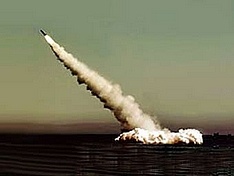
Bulava SLBM Test Failure

The failed Bulava test launch yesterday is today’s big story.  See Myasnikov in Nezavisimaya gazeta or D. Litovkin in Izvestiya for coverage. 

Myasnikov recounts delays this fall in conducting the missile’s 12th test firing.  He recalls the story of how the project was given to MIT under the apparently ill-conceived thought of unifying naval and land-based strategic missiles.  Meanwhile, the SS-N-20  follow-on missile Bark, and the TYPHOON SSBNs to carry it, basically went away.  The Defense Ministry refuses to return to stand tests for Bulava.  Myasnikov says test missiles alone may have already run $3 billion.  The rest of the Navy is starved for resources, but Bulava has a strong lobby to keep it going.

D. Litovkin wonders whether it is Bulava’s control systems or poor manufacturing.  He wants to believe the system will work, but notes that time is running out for the current DELTA IV SSBN force, even with overhaul and modernization.

ITAR-TASS says the Defense Ministry blames a defect in the third-stage engine.