Category Archives: Training and Exercises

Serdyukov Year-Ender (Part III)

A good day to finish old business . . . this covers the second half of Defense Minister Anatoliy Serdyukov’s Rossiyskaya gazeta interview.  Serdyukov, while remaining on message, seems tired or uninspired in giving this interview.  He reviews old ground rather than breaking any new.

Serdyukov talks about coming to grips with large existing stockpiles of tanks, BMPs, BTRs, guns, and automatic rifles, and indicates he’s waiting for the defense sector to propose some fundamentally new systems.  In regard to Kalashnikovs, the Defense Ministry is open to new developments from private firms but isn’t eschewing future AK purchases from its traditional supplier either.

On Mistral, Serdyukov tells RG the French will decide where it’s best to produce units 3 and 4, and Sevmash is the likely place.  But he wants them to come in cheaper than number 1 and 2 being built in France.  He expects Russia to acquire leading edge shipbuilding techniques in the process.

Serdyukov shows a flash of interest when asked about conclusions from Russia’s recent space launch failures:

“One conclusion — we have to change our approach to military acceptance.  And we’re occupied with this.  Next year we want to reformat it.  There’s already understanding about what has to be done in training units for military acceptance specialists, their incentives, and technical equipping.”

“Generally, this is a serious question.  We haven’t devoted the due attention to military acceptance because of various obstacles.  Now we are smoothing out the situation.  Not so long ago the prime minister had a conference, and Vladimir Vladimirovich Putin gave a whole series of instructions on price formation and tracking contracts.  Acceptance and production quality was one issue.  Today this task is being worked, and we are preparing proposals by the end of the year [2011].”

Serdyukov says voyenpredy can be civilians, but they should be former military men with lots of practical experience.

The last significant point in the second half of Serdyukov’s interview is his call for differentiated training for new professional sergeants — 3 or 4 months for those in motorized rifle units and 2 years or more for EW or communications specialists, for example.  The comparison he gives is training equivalent to technical secondary school or old school for warrant officers.  He indicates he’s not afraid future NCOs will become “eternal students.”

Exercise Casualties

Russia’s fall exercises took a toll on some conscripts participating in them.  Three were killed in Union Shield-2011 at Ashuluk, and two more may have died during Tsentr-2011.

Life.ru reports a conscript died on September 26 from injuries sustained in a fall from a railroad platform while loading equipment during Union Shield-2011.

According to IA Regnum, at Ashuluk on September 24, an automated command and control system operator, a draftee, was found dead in a KamAZ.  An officer and two conscripts had to wait for help overnight when their vehicle broke down.  One of the conscripts apparently died during the night. 

On September 20, a Russian attack aircraft fired an errant air-to-surface rocket that flew several kilometers from its intended target before exploding, killing one soldier and injuring a second.  IA Rosbalt also noted Ashuluk was the scene of an August 23 ordnance accident that killed eight soldiers.

News outlets and military spokesmen are publicly disputing whether two tank crewmen died of carbon monoxide poisoning while President Medvedev and Defense Minister Serdyukov reviewed the concluding phase of Tsentr-2011 at Chebarkul on September 27. 

According to Novyy region, a Chelyabinsk rights activist says two conscripts died and the military is trying to cover up the accident.  Another source says the two men are hospitalized in critical and serious condition respectively.  The army says the men were poisoned by powder gases during training before Tsentr, and will soon be discharged from the hospital.  The Central MD’s press-service says the exercise was conducted without incidents, accidents, or equipment failures.

Military prosecutors are investigating at least some of these incidents.

Tsentr-2011

Tsentr-2011

Yesterday Russia and allied military forces in the Collective Security Treaty Organization (CSTO or ODKB) began a series of exercise events which will run until the beginning of October.

Operational-strategic exercise Tsentr-2011 will involve Russian forces and Belorussian, Kyrgyz, Kazakh, and Armenian sub-units in different training scenarios focused on ensuring security on the Central Asian axis, according to Nezavisimaya gazeta.

Twelve thousand personnel, 50 aircraft, 1,000 vehicles and other equipment, and ten combat and support ships will participate under the direction of Russian General Staff Chief, Army General Nikolay Makarov, according to Mil.ru.  Russian forces will include one army brigade as well as operational groups from other militarized agencies — the MVD, FSB, FSO, and MChS.    

Mil.ru said the exercise theme is “Preparation and Employment of Inter-Service Troop (Force) Groupings in the Stabilization of a Situation and Conduct of Military Actions on the Central Asian Strategic Axis.”

NG cites Makarov who said the exercise will focus on “localizing internal as well as external conflicts.” Extrapolating from his earlier comments about North Africa and the Middle East, the paper claims he wants the army to be ready to perform internal police functions like the Syrian Army.

Mil.ru puts it more technically saying the exercise will improve command and staff skills in controlling troops in the transition to wartime, in planning special operations, and in organizing long-distance troop regroupings.  Exercise phases will include special operations to localize an armed conflict in a crisis region, and joint actions by ground and naval force groupings, according to the Defense Ministry website.

The exercise will consist of different evolutions, with different partners, in various locations:

  • The Ground Troops, MVD, and FSB Spetsnaz, writes NG, will practice liberating a town from terrorists and rebels on the Chebarkul training range. 
  • At Gorokhovets, Russia’s 20th Army and Belorussian forces are playing a series of tactical actions against enemy airborne assaults, specops, and “illegal armed formations” in their rear areas [under a separate exercise called Union Shield-2011 or Shchit Soyuza-2011]. 
  • Russian forces are training with Kazakhs on the Caspian, and at Kazakhstan’s Oymasha range.
  • A command-staff exercise of the ODKB’s Collective Rapid Reaction Forces (KSOR) will be conducted at the Lyaur range in Tajikistan.
  • In Kyrgyzstan, the ODKB’s Central Asian Region Collective Rapid Deployment Forces (KSBR TsAR) will conduct a tactical exercise against “illegal armed formations.”

NG sums Tsentr-2011 up with a quote from Vladimir Popov:

“The Russian leadership, although late, has come to the conclusion that the successful resolution of military security issues, including the internal security of allied countries, is possible only through the creation and use of coalition troop groupings in the post-Soviet space.   This is correct, and there’s no need to fear this.”

Developing some collective military intervention capability doesn’t answer questions about real-world conditions where it might be employed.  The questions proceed mainly (but not entirely) from Kyrgyzstan’s experience.  First, will a threatened regime ask for ODKB assistance and under what circumstances?  Second, will the alliance or any allies answer a member-state’s call?  Training and exercises are good, but ultimately not much use unless such political issues are resolved.

Makarov’s Press-Conference (Part III)

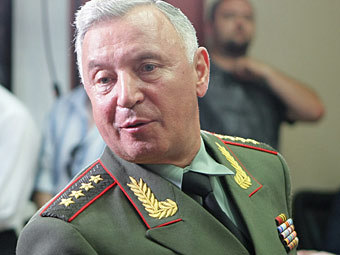
Army General Makarov (photo: RIA Novosti / Aleksey Nikolskiy)

Still plumbing General Staff Chief Makarov’s Monday press-conference . . .

Makarov indicated Russia’s Israeli-made UAVs will be used in the Tsentr-2011 exercise.  According to Krasnaya zvezda, he once again worked Vega over for wasting years and money without meeting the military’s requirements, forcing it to turn to Israel to obtain unmanned aircraft.

According to Interfaks, the General Staff Chief asserted Russia won’t buy anything but PGMs for its combat aircraft:

“The purchase of conventional [unguided] means has stopped.  We are buying only highly-accurate means.”

“Western countries conduct military operations almost without ground forces.  Aircraft operate outside the air defense zone and sustain minimal losses.”

Izvestiya noted, however, replacing Russia’s dumb bombs with smart weapons won’t be cheap.  Tens of thousands of rubles versus millions.  But one of the paper’s interlocutors concluded:

“The Defense Ministry believes there’s money for buying them, contracts for the first deliveries of new munitions have already been concluded.”

He estimates they will comprise perhaps half of Russia’s aviation weapons inventory by 2020.

Izvestiya quoted Ruslan Pukhov to the effect that guided ASMs made up only 1 percent of Russia’s stockpile in the five-day war with Georgia, and Russian aircraft had to brave Georgia’s air defenses on most missions, losing four Su-25, two Su-24, and a Tu-22M3.  He added, however, that a Su-34 employed an anti-radar Kh-31P to destroy a radar in Gori.

Lenta.ru recalled General-Lieutenant Igor Sadofyev’s late 2010 comments about plans for a radical increase in PGMs and UAVs in the Air Forces by 2020.  You can refresh your memory here.

Some military commentators and news outlets managed to tie together Makarov’s comments on Arab revolutions, Central Asian exercises, snipers, and sniper rifles in interesting, but not always accurate, ways.

KZ summarized Makarov pretty simply as saying the armed conflicts in Arab countries were difficult to predict, and similar events can’t be ruled out in Central Asia.  In its replay of his remarks, he said:

“. . . we should be ready for everything, therefore we are working on this in the exercises.”

So, Moscow’s pretty obviously looking at the possible repetition of a Libyan or Syrian scenario somewhere in Central Asia . . . no surprise there . . . makes sense.

Komsomolskaya pravda said:

“Our military isn’t hiding the fact that current exercises are directly linked to the probable export of military aggression from Afghanistan into the Central Asian republics after NATO troops withdraw from there.”

It cites Makarov:

“[The exercises] envision developing variants for localizing armed conflicts on the territory of these countries.”

That doesn’t really sound Libyan or Syrian, does it?  It’s not internal.  It’s good old external spillover.  Oh well, as long as it’s “localized” on someone else’s territory, and doesn’t cross Russia’s borders.

ITAR-TASS’s version of Makarov got people more spun up:

“The world situation is complex, quickly changing, particularly in North Africa and the Middle East.  It was difficult to forecast what happened in a number of countries of this region, events developed with great speed.  Now no one can say what will happen next.  But this is a signal for all states.  We military men need to be prepared for the worst scenarios.”

This led a few outlets to take the next step on their own, i.e. a repeat of the Arab scenario inside Russia.

You can read likely exaggerations of what Makarov really said in Gazeta.ru or Rbcdaily.ru.  In its version, the latter claimed Makarov didn’t exclude internal unrest following the Arab example in Russia, and the army has to be ready for the worst case scenario of political developments inside the country.

Pouring gas on the fire it lit, Rbcdaily introduced the sniper issue here.

Of course, snipers are great for urban warfare or urban unrest.  Rbcdaily’s Defense Ministry source says Makarov plans to put independent sniper platoons in every brigade.  They’ll be armed with British rifles, of course.  And the snipers themselves will have to be long-term professionals – contractees, so that’ll have to wait until the middle of next year.

Igor Korotchenko tells Rbcdaily:

“A sniper is a piece of work, he can’t be trained in a year, therefore they must absolutely be professional contractees.  We can’t count on conscript soldiers here, like in the old days when there were enough gifted guys who learned to fire the SVD well among the conscripts.”

KZ didn’t mention Makarov talking about snipers.

Just to finish this off, Makarov’s Syrian comments weren’t construed or misconstrued as much.  KZ said simply that he said Russia is not planning a military presence in Syria, nor the introduction of extra security measures at its material-technical support base in Tartus.

ITAR-TASS put it this way:

“This base remains in our hands.  Besides it, our advisors work in Syria.  That’s enough.  We don’t intend to adopt any preventative measures.  . . . we have to watch closely those forces opposing the government.  There are legal demands, and there are opposition demands which, in our view, need to be ignored because they are illegal.”

Makarov’s Press-Conference (Part I)

General Staff Chief Nikolay Makarov apparently held a lengthy press-conference today covering many topics.  He’s still advocating buying weapons abroad (when necessary), despite Prime Minister Putin’s strong support of the domestic OPK against the military’s demands.

ITAR-TASS quotes Makarov on the pending Navy headquarters move to Piter:

“Concerning a decision by the Supreme CINC [President Medvedev] to revoke the transfer of the Navy Main Staff to St. Petersburg, there has been no such decision.  We are now working on this issue.”

The General Staff Chief seemed to say there won’t be any diminution of the role or place occupied by service Glavkomaty, according to the news service.  He said the Main Commands of the services of the Armed Forces are part of the military branch of command and control which he heads.

ITAR-TASS quotes Makarov on buying arms and equipment abroad:

“We will need to buy something that isn’t produced with the quality we require.”

He compared domestic Msta-S and longer-range French Caesar howitzers:

“In France, we were shown the work of an artillery battalion which was ready to fire 30 seconds after a march.  Our analogous norm is 15 minutes.  The difference between one minute and 15 minutes is huge.”

“Therefore, we have to acquire something in order not to lag behind, but on the condition of arranging joint production in Russia.”

Interfaks quoted him on buying armor abroad:

“Some technologies certainly have to be bought in the West.”

The Defense Ministry, he says, has no desire to buy arms and equipment abroad if Russia has analogs or more modern models.  But Russia will find it hard to compete with Western firms that are cooperating with each other.  Makarov cited Renault’s APC which uses a Volvo engine.  “Our producers need to make a revolutionary leap,” Makarov concluded.

The General Staff Chief was ambivalent about the T-90 tank, according to ITAR-TASS:

“I visited the Nizhniy Tagil exhibition and got familiar with our T-90 tank.  The tank they showed us, particularly its turret, calls for serious respect.  But we have questions remaining about many drawbacks.”

“. . . the experimental-design work the factory is conducting will allow them to realize those requirements the Russian military is placing on this new product.”

ITAR-TASS also picked up Makarov’s remarks on the Tsentr-2011 exercises:

“We want to work out common approaches to employing armed forces within the ODKB [CSTO] framework.”

“Besides militaries, all other power structures, which are understood as part of the state’s military organization, in the ODKB countries will participate in these exercises.  As far as Russia goes, we want to check the country’s military organization fully by conducting a series of mobilization measures, including also industry.”

“Starting today, we’ve started into mobilization deployment of a number of formations and units according to independent plans.”

Their Man in Pyongyang

Admiral Sidenko

Eastern MD Commander, Admiral Konstantin Sidenko suddenly became the Kremlin’s man in Pyongyang yesterday.  His visit to North Korea was kept tightly wrapped until his departure.

Sidenko will visit the DPRK from August 22-26, while North Korean leader Kim Jong Il is in Russia’s Far East to meet President Medvedev.

Moscow’s once close military relationship with the DPRK declined to practically zero over the past 20 years, hence the surprise of yesterday’s news.  Meanwhile, Russia cultivated military-to-military ties with the rest of northeast Asia — China, Japan, and the Republic of Korea — leaving its old ally in the cold.  Until yesterday.

The Defense Ministry’s press release says Admiral Sidenko will meet command representatives from the Korean People’s Army, and consult on questions of renewing and further developing military and naval cooperation, possibly conducting Russian-Korean humanitarian exercises, and mutual ship visits between the RF and DPRK navies.

Additionally, according to the press release, the sides will discuss the future of cooperation between their Ground Troops, the possibility of conducting joint exercises and training for naval SAR, and also the issue of providing assistance to civilians during natural disasters.

The Russian media has written little thus far on what it means to have a military delegation visit the North Korean capital.  However, AP asked Aleksandr Golts for comments, and this is how the wire service summarized them:

“Military expert Alexander Golts said North Korea’s goal in inviting the Russian military could be to assuage fears of instability as Russia is considering building a natural gas pipeline through North Korea.  The pipeline is expected to be one of the main topics of Kim and Medvedev’s talks.”

“Golts said it was highly unlikely Russia would renew arms sales to North Korea, which would not be in its interests as a participant in the six-party talks.  He also noted the low level of the Russian delegation, which is led by the commander of Russia’s eastern military district.”

One might suppose it’s equally possible the North Koreans wanted the Russian military to visit Pyongyang as part of its quid pro quo for considering a gas pipeline over its territory to South Korea.

Arms sales seem unlikely, but probably because Moscow’s no longer in the game of providing free military aid. 

Admiral Sidenko is a lower level visitor, but it’s traditional for Moscow to send proximate regional commanders on such visits.  MD commanders can be precursors to General Staff Chiefs and Defense Ministers, and higher-profile military relations generally.

It’s almost impossible to know when the DPRK is involved, but this first interaction in nearly ten years automatically means something’s afoot.  The participants themselves probably don’t know where a bit of diplomatic, economic, and military activity will lead.

Three-Month Combat Training

Three-and-a-half years after it started phasing in one-year service, the Russian Army’s condensing combat training into three months so it can put draftees in line units for their remaining months.  One wonders what they’ve tried to this point, or if they’re just now addressing the implications of the shortened draft term.

Twelve weeks of basic training is about the norm by world standards for draftee armies.  But the Russians have compressed what they previously taught over a longer period, so the question is how well conscripts absorb, retain, and employ their lessons.

Officially, Russia’s three-month accelerated combat training program is experimental.  Krasnaya zvezda reports, since June, the 19th Independent Motorized Rifle Brigade in North Ossetia, has been trying a new program to take new draftees and turn them into professionals, ready to serve in combat sub-units [подразделения], in three months.

The army daily claims these new conscripts focus exclusively on the combat training course, which now reportedly includes 1.5-2 times more “practical exercises” than in the past.  The course covers 90 days (536 hours).  It retains the traditional first month of individual training, and the last two consist of training and coordination [слаживание] of sections, platoons, and companies (batteries).  The course ends with several days of test exercises, sub-unit combat firings, and company-tactical exercises.

The brigade’s deputy commander says:

“In the new program, theory has been practically thrown out, the stress is on the practical part.  In connection with cutting the conscript service term to one year, the task of preparing, in three months, a coordinated sub-unit, ready to fulfill missions in various conditions, stands before us.”

The choice of the 19th IMRB wasn’t accidental.  As KZ notes, the formation saw action in the five-day war with Georgia.  It has a “reinforced company-tactical group” of BMP-3s fueled for a 500-kilometer roadmarch ready to depart garrison within 30 minutes, according to KZ.

KZ then describes how outsourcing repair and support work has enabled draftees to focus entirely on combat training.

This week, Mil.ru updated the experiment.  It said the brigade is currently finishing platoon coordination and beginning company coordination, which will continue until mid-August.  The Defense Ministry says the Ground Troops’ Main Combat Training Directorate is monitoring the accelerated program.  In late August, it will oversee the company tactical exercises, and determine their capabilities for action under combat conditions.  Conclusions about the three-month combat training program will come in September.

Writing in Nezavisimaya gazeta yesterday, Vladimir Mukhin questions whether it’s possible to train professionals in three months.  He notes the Southern MD was supposed to be 70 percent contractee-manned by now, according to the Defense Ministry old contract service plan.  Parents of green soldiers feel like their sons are serving in a “hot spot,” according to Mukhin.  Conscripts from this formation died in the Georgian conflict.  The onus is on the political leadership, says Mukhin, rather than military commanders to explain why units here aren’t manned with professionals.

Mukhin quotes former Ground Troops’ Chief, General-Colonel Yuriy Bukreyev:

“If a conscript soldier has basic military training, then it’s possible to give him the skills to employ him in combat conditions in the North Caucasus.  I’m giving the same conclusion from the Soviet Afghan experience again, when I headed the staff of the Turkestan Military District.  But then soldiers served two years.  At first, they were in training sub-units, they underwent additional mountain training in special training centers.  Only afterwards, that is when they’d served in the troops a year or more, were they sent to Afghanistan.  Today conditions are a little different.  The conscript soldier’s service term’s been shortened to 12 months.  And this means the intensity of combat training should increase.  The Ground Troops’ Glavokomat is just conducting an experiment in training first-year soldiers to carry out missions under the conditions of an armed conflict.  We’d like to hope that raw soldiers won’t be drawn into resolving such missions.  Professional sub-units would appear more effective here.  But, unfortunately, in our Armed Forces reliable conditions for the mass recruitment of contractees into the troops still haven’t been established.”

Naval Aviation Chief Interviewed

Hero of Russia, General-Major Igor Kozhin

On Sunday, RIA Novosti interviewed Naval Aviation Chief, General-Major Igor Kozhin on his branch’s 95th anniversary.

The news agency’s recap reminded that Naval Aviation lost its strike assets to the Air Forces on 1 April.  And, by year’s end, all remaining Su-27, MiG-31, Tu-22 and part of its transport aircraft will move to the VVS.  Only land-based ASW and carrier aviation will remain.

Asked about training, General-Major Kozhin focused on cost and retention.  He claimed training a pilot costs a rather exorbitant $1.5 to 2 million annually.  He indicated the need to keep older, experienced personnel — even in a civilian capacity — to train his younger pilots.

On upcoming training, Kozhin said his one regiment of 20 carrier-qualified pilots will conduct 100 takeoffs and landings from the Fleet Admiral of the Soviet Union Kuznetsov in August and September.

Kozhin said Kuznetsov is currently preparing for sea, and there’s no plan for capital repairs even though a replacement isn’t foreseen at this time.

He gave no hint of any impending carrier deployment as rumored earlier this year. 

RIA Novosti asked about renting the NITKA carrier trainer in Ukraine.  Kozhin answered by updating the construction of a similar facility at Yeysk, in Krasnodar Kray.  He said toward fall the takeoff and landing strip will be complete, then landing systems will be installed, and the ground-based carrier simulator will be functional in 2013.  He said the entire Naval Aviation training complex will be finished in 2015.

Finally, on new aircraft, Kozhin said the first four MiG-29K for Naval Aviation could apppear in 2012, but the Defense Ministry will have to sign the contract before mid-August.  Otherwise, the first delivery will be in 2013.  In all, a Navy buy of 20 is planned, but the factory is busy now filling India’s order for fighters for the ex-Gorshkov being renovated at Sevmash.

Making Soldiers in the Southern MD

Nezavisimoye voyennoye obozreniye’s Oleg Vladykin participated in a press-tour of the Southern MD (OSK South), and last Friday he published his take on what he saw.

Deputy District Commander, General-Lieutenant Igor Turchenyuk set the scene, telling assembled journalists about establishing the YuVO last year:

“A substantial — more than two times — growth in the combat potential of the grouping of troops and forces deployed on YuVO territory is the result of the transformations which have been carried out.”

Turchenyuk said the YuVO conducted more than 200 command-staff and tactical exercises, including jointly with air and naval forces, during the winter training period.  This was reportedly seven times greater than comparable training in the old North Caucasus MD.  

Turchenyuk claims the intensity of everyday combat training has increased noticeably, doubling fuel and ammunition expenditure.  Outsourcing food and laundry services and arms and equipment maintenance made this possible.  By eliminating extraneous duties, a more intense 40-hour week has added more than 300 hours of training time to the year.   

Turchenyuk’s main point:

“As a result, we got the chance to prepare a real professional serviceman-specialist even under the conditions of a one-year training cycle.”

And Vladykin’s:

“Of course, it’s hard to argue with figures.  Therefore, I really wanted to confirm with my own eyes how conscript servicemen are being turned into real professionals.”

Vladykin and the others were taken first to the 34th Independent Motorized Rifle Brigade (Mountain), built from scratch on President Putin’s order.  The 34th was established as an elite, model formation as good as any “show” unit elsewhere in the Armed Forces.

But, says Vladykin, not everything turned out as imagined, especially with the formation’s manning. 

The brigade found 5,000 contractees to train as professional mountain infantry, but today, with the cut in contractees, more than half the brigade’s manpower are conscripts.  After seeing some training, Vladykin concludes:

“I won’t say that all soldiers looked like high-class mountain infantry.  But since I know most participants in the exercises have served a little over half a year, I’m ready to acknowledge: they’re not badly trained.”

Next up was the 22nd Independent Brigade of Special Designation (Spetsnaz).  Its professionalism needs to be even higher, but this brigade is currently 60 percent draftee.  Vladykin wonders out loud whether they will be able to carry out the brigade’s missions, and whether it’s possible to grow a real soldier from a conscript.

Lastly, in the 19th Independent Motorized Rifle Brigade, practically all soldiers and junior commanders (NCOs) are conscripts.  Here, says Vladykin, they learned the difference between draftees and contractees in battles in two Chechen campaigns and in South Ossetia.

Its officers reserve judgement about the efficacy of outsourcing rear service functions.  Conscript drivers learn vehicle maintenance from contracted civilian mechanics who won’t be with them in combat.

The brigade’s chief of staff describes how a reinforced company tactical group meets the formation’s permanent (one-hour) readiness requirement in the volatile North Caucasus.  Another officer says duty officers have returned to the barracks to keep order at night.  The officers here don’t fully trust their conscript soldiers and sergeants.

Vladykin doesn’t provide a larger bottom line.  It seems to be that the YuVO may be turning draftees into soldiers, but not true professionals.  For all the figures about the district’s higher training tempo, Vladykin doesn’t seem too impressed.

General Resignation

Tomorrow’s Nezavisimaya gazeta reports Defense Ministry sources claim several young, promising generals have tendered their resignations because of problems with General Staff Chief, Army General Nikolay Makarov.  NG says they include Deputy General Staff Chief and Main Operations Directorate Chief, General-Lieutenant Andrey Tretyak, First Deputy Ground Troops CINC and Main Staff Chief, General-Lieutenant Sergey Skokov, and Genshtab Electronic Warfare Directorate Chief, General-Major Oleg Ivanov, and others.

The paper describes these guys as the Russian Army’s future leaders.  So why do they want to quit?  The reasons, unfortunately, haven’t been advertised (yet).

NG points out that, if Tretyak leaves, the GOU (the cerebral cortex of the “brain of the army”) will have its third chief in four years.  Skokov has been a key man working on automated C2 (YeSU TZ or ЕСУ ТЗ).  A “highly-placed” anonymous officer says it’s because of their disagreement with army reform steps taken by Makarov.  And explicitly not because of any problem with Defense Minister Serdyukov, whom they regard as an effective manager. 

They feel the Armed Forces, during Makarov’s tenure, have been in a provisional, experimental state, living on projects and according to unconfirmed directives (basic instructions and combat regs).  And after three years of “development,” the Genshtab Chief still can’t determine their final shape.  There are no confirmed decisions on service or branch TO&E structures, or their basing areas.  NG’s anonymous contact says the condition of the troops, and their “fantastic” combat training about which Makarov likes to talk, is “a fiction, which could be the topic of a separate conversation.”

The source implies time, money, and other resources have been wasted trying to develop automated C2 for old-fashioned, World War II-type operations.  And this is why Skokov requested his discharge.

NG’s sources believe this “scandal” will have political consequences.  The paper wonders whether President Medvedev will choose to get involved.  A source claims Deputy Defense Minister Nikolay Pankov is supposed to meet with the generals who want to quit, and discuss their problems with Makarov “from the point of view of the state’s interests.”