Category Archives: Training and Exercises

Kramnik on Vostok-2010 and Military Reform

This is complete finally.

Ilya Kramnik’s RIA Novosti piece about the exercise has been quoted by others, but it hasn’t gotten attention as a whole on its own.

So what does Kramnik think?  He cites Makiyenko to the effect that Vostok-2010 showed that reform has been positive for the army, but there are, of course, problems.  Troops aren’t uniformly well-trained, and the failure of contract service has really hurt.  But Kramnik gives Defense Minister Serdyukov a lot of credit, on the order of being a 21st century Milyutin.  But back to the problems again.  Things like contract service, tension over officer cuts and premium pay, military education cuts, and the failure to deliver new weapons have to be fixed.  But Kramnik believes Serdyukov is the kind of guy who’ll go back and fix what he didn’t get right or get done.  Then Kramnik shifts to the type of conflict the military reform is preparing the Russian Army to fight.  Obviously [?] not a nuclear one, but rather, again turning to Makiyenko, a Central Asian local war scenario that might threaten the RF’s internal stability.  The conclusion is that, if reform stays on track and occurs quickly, the army will be able to meet this challenge.  Some, however, might well argue that even a properly and rapidly reformed Russian Army might not be enough to contain and damp down the kind of conflagration Makiyenko describes.  Finally, Kramnik concludes that even the U.S. front isn’t secure; an American regime in 2012 or 2016 might take to renewed active support of new ‘color revolutions’ in Moscow’s back (or front) yard.

Here’s a verbatim text:

“The official results of the just ended ‘Vostok-2010’ exercise are still being reckoned, and this will be done by the Defense Ministry.  Meanwhile, it’s already possible to make some conclusions.” 

“‘Vostok-2010’ was the largest of all in the post-Soviet period of Russian history.  More than 20 thousand men, 75 aircraft, 40 combat and auxiliary ships took part on the ground, in the air, and at sea in maneuvers conducted from Altay Kray to Vladivostok.”

“The aim of the exercise was to check the three-level command structure — operational-strategic command – operational command – brigade, and other new elements in the Armed Forces command and control and support system, and to uncover deficiencies needing correction.  An expert of the Russian Center for the Analysis of Strategies and Technologies Konstantin Makiyenko expressed his opinion on the recent maneuvers:  ‘The recent maneuvers fully refuted the propagated myth about how the army is being destroyed as a result of the actions of the current Defense Ministry leadership.  It’s obvious the army is alive and developing.  Units participating in the exercise demonstrated their combat capability, despite the fact that they are not in the ranks of the best military districts, and scarcely armed with the most modern equipment.'”

“‘It’s especially worth focusing on the good morale of the officer personnel — it’s not possible to speak of general enthusiasm, of course, but I didn’t see dim eyes among the officers.  As a group, they are interested in the success of the current reform and hope for its success.'”

“While agreeing with this point of view, one has to note that the situation with soldiers looks a little different, both RIA Novosti’s reviewer [Kramnik] and Konstantin Makiyenko have also noted this.  Very much depends on the branch of troops and the basic training of the soldiers themselves.  Contract-servicemen in a ‘Tochka-U’ operational-tactical missile launch battery look and are trained much better than conscript-soldiers in motorized rifle units.  In the words of motorized rifle officers up to the battalion commander level, the reduction in the number of contractees has negatively affected platoon and company training.  Ideally, the service term of a specialist-soldier (mechanic-driver, weapons system operator, etc.) needs to be three years, that is achievable only on the contract manning principle for these positions.”

“Speaking about the attainability of the announced goals of the reform, one can say the following:   the will of the military leadership which certainly exists, is the main component of success, a firm understanding of the goal is also obvious, and the possession of authority — it’s not possible to doubt this.  As a result, the current Defense Ministry leadership needs only time to realize its ideas.  Overall, the military reform being conducted is the most significant event of Russian history in the last ten years — since the suppression of the separatist rebellion in the North Caucasus.  The Serdyukov-Makarov reform in the military sphere is the most radical and deepest since the time of Mikhail Frunze’s reforms in the 1920s, if not since Dmitriy Milyutin in the 1860s and 1870s.”

“As proof, it’s possible to note the fact that the Defense Ministry leadership is constantly searching and ready to correct those steps which, when checked, turn out to be incorrect or unattainable in real political-economic conditions.  So, the current principles of manning the army will undergo a serious correction:  it’s obvious that neither the organization of contract service, nor, even more, the existing format of conscript service corresponds to the demands of the time.”

“Evaluating the correspondence of the Defense Ministry leadership to its missions, it’s possible to say, that at present Russia has the most appropriate military leadership since the collapse of the USSR.  At the same time, it’s obvious that the radicalism of the reform, the compressed time of its implementation, unavoidable resistance in the environment and hard economic conditions didn’t allow for avoiding a large number of mistakes and excesses.  Among the most fundamental failures it’s possible to name the collapse of the army’s transition to the contract manning principle, serious social tension arising in connection with the rapid reduction of officer personnel, the ambiguous situation with the scale of servicemen’s complaints after the introduction of the differential pay system [premium pay or Serdyukov’s Order No. 400?], the hurried and not completely thought out reform of military education and many, many other things.  It’s  particularly worth focusing on the implementation of the state armaments programs which fail one after another, not being executed in a significant part.  As a result, the lag of Russia’s Armed Forces behind the most developed countries in the level of  technical equipping continues to grow such that in conditions of a quantitative lag it could become very dangerous.  All these mistakes have to be corrected, since they impact on rudiments of the army’s combat capability.”

“For what type of wars does Russia’s new army need to prepare?  Obviously, the time of long wars between the great powers has gone into the past — nuclear weapons haven’t left chances for such a development of events.  The most probable type of conflict in which the Russian Army will be involved is a local conflict on Russia’s borders and the territory of the former USSR, in the course of which there could be clashes with the most varied enemy:  from a regular army to many bandit formations and terrorist groups.”

“In Konstantin Makiyenko’s opinion, Central Asia presents the greatest danger in the future of a possible hot conflict with Russia’s direct participation:  ‘The U.S. and NATO, obviously, are less and less controlling the Afghanistan situation, and it’s not excluded that in the foreseeable future they may have to abandon this country.  The return to power in Afghanistan of the ‘Taliban’ movement looks most realistic in the event of such a development of events.  The arrival of Islamic radicals in power would unavoidably be a catalyst for conflicts on the territory of former Soviet republics of the region already riven by contradictions.  Weak authoritarian regimes in Tajikistan, Turkmenistan and Uzbekistan, not to mention what’s become the ‘failed government’ in Kyrgyzstan, could be easy prey for the Taliban.  As a result, Russia might be forced to consider the likelihood of a large Asian conflagration which it would have to prevent, or if it didn’t succeed — extinguish, at a minimum with the aim of preserving its own internal stability.  One very much wants to believe that the reform will bear fruit before the described situation becomes a reality.'”

“Besides the described scenario it follows to study also the probability of another development of events:  as experience has shown, on the territory of former USSR republics, the rise of openly anti-Russian regimes with external support at their disposal can’t be excluded.  For today, such a situation is a low probability due to the fact that the current administration in the U.S. — the main sponsor of ‘colored revolutions,’ is clearly not inclined to continue the policy of George Bush.  However by 2012, if President Obama loses the election, the situation could change, and this risk is even greater in 2016 when the administration will change in any case.  Meanwhile, you have to note that even the Democrats remaining in power in the U.S. is not a guarantee of a peaceful life:  Obama’s point of view on a coexistence format with Russia is hardly shared by all his fellow party members.  In the worst case, a return to the next variant of Cold War and new spiral of the arms race isn’t excluded.”

“The coming decade isn’t promising Russia an easy life.  The success of military reform is all the more important.”

Old Weapons Good Enough, or Worn Out?

In Tuesday’s Gzt.ru, Denis Telmanov writes that Vostok-2010 features arms and military equipment that is 20, or sometimes 30 years old.  Neither the Defense Ministry nor independent experts see anything terrible about this, though they worry it could become physically worn out.

Telmanov says the exercise relies on old weapons systems like the Mi-24, Tu-22M3, and the Petr Velikiy.  The latter was laid down in 1986, and didn’t join the fleet until 12 years later.  The overwhelming majority of Pacific Fleet ships in the exercise were also laid down in the 1980s, and are at least 20-plus years old.  Even the vaunted Su-34 first flew in 1990, but didn’t go into operational use until 2007.  The remaining arms and equipment were developed in the 1960s and 1970s, and produced at the end of 1980s and early 1990s.

This state of affairs allows the Defense Ministry to show that the Russian military can fight successfully with the equipment it has.  The military’s press service chief wouldn’t comment for Gzt.ru on the age of systems taking part in Vostok-2010, except to say they’re the same as those on combat duty in formations and units in the rest of the Armed Forces.

The spokesman said:

“Today the army uses the equipment that it has.  And one of the missions of the exercise is to show how effectively established missions can be fulfilled in the new TO&E structure with this equipment.  The effectiveness of military equipment really doesn’t depend so much on its age, as on skill in using it and on how it corresponds to the established missions.  The course of the exercise still shows that the equipment is fully combat ready and allows troops to fulfill these missions put before them completely.  But it’s understood that this in no way diminishes the importance of the planned modernization and introduction of new equipment which will enable troops to act even more effectively.”

He cited EW equipment and the Su-34 as new systems being used in Vostok-2010.

Gzt.ru goes on to remind readers that, for over a year, President Medvedev and Defense Minister Serdyukov have taken pains to tell Russians the majority of the country’s armaments are obsolete or worn out.  Serdyukov said the share of modern military equipment in the inventory was only 10 percent.  That’s when he and Medvedev launched the campaign to increase this figure to 30 percent by 2015 and 70 percent by 2020.

CAST Director Ruslan Pukhov says the absence of serious military threats makes the next ten years a good time to do this:

“. . . Russia has a window of opportunity the next 10 years, and it isn’t threatened by war.  It’s necessary to use these 10 years to bring the armed forces into a condition in which they can repulse any threats which arise.”

Pukhov says the Black Sea and Baltic Fleets should be modernized first, Iskanders deployed to deter Georgia, and S-400s in the Far East to counter North Korean missiles [recall General Staff Chief Makarov’s claim last year that S-400s were there?].

Mikhail Barabanov of Moscow Defense Brief says the problem is not age, but physical wear:

“40-year-old ships and 30-year-old tanks are now almost gone.  In reality, the problem of old equipment in our Armed Forces is not so much its age as the amount of equipment wear and tear.  That leads to breakdowns.  For example, in the Vostok-2010 exercise the guided missile cruiser Moskva didn’t succeed in launching its Vulcan [SS-N-27??] anti-ship missiles.  As a result, missile boats with Moskit missiles destroyed the target.”

Nevertheless, Barabanov remains confident that, even with aging weapons, Russia’s military is superior to neighboring armies, including China’s:

“On the whole, the equipment level of Russian units in the Far East is generally adequate to perform defensive missions, although not at the highest level.  It’s another issue that the equipment is badly worn out.”

Barabanov is not against buying new equipment of older designs:

“Even if industry’s existing models can be criticized for deficiencies from the standpoint of modern requirements, the fact remains they will be physically new, with a full service life, and allow for significantly increasing the combat readiness of troops.”

Telmanov ends by reminding readers of President Medvedev’s late 2009 pledge to provide the military 30 land-based  and naval ballistic missiles, 5 Iskander missile systems, nearly 300 pieces of armored equipment, 30 helicopters, 28 aircraft, 3 nuclear submarines, a corvette, and 11 satellite systems in 2010.

Not Enough Officers in ‘New Type’ Brigades?

In today’s Vedomosti, Aleksey Nikolskiy writes that Vostok-2010 has revealed a problem with officer manning in Russia’s ‘new type’ brigades.

In the course of the exercise, practically all SibVO and DVO permanent readiness units have been ordered to training ranges to test out their new TO&E and train their higher-level command elements.

Nikolskiy says:

“In the words of an officer of one of the motorized rifle brigades participating in the exercise, the new structures sent to the troops at the end of 2008 after the beginning of Armed Forces reform showed that officer manning and supply services are extremely inadequate, for this reason part of the brigades’ forces — for example, air defense means — can’t physically reach the training range.  There were bigger problems also with material support of the troops.”

Vedomosti’s source also says the troops are expecting new brigade structures in August that, according to the rumor, will contain even fewer officers.  A brigade’s officers will reportedly be halved, from 200 to 100, and this will just make the situation worse.  However, an officer from the Defense Ministry’s central apparatus says the new structures are being prepared based on the shortcomings of the exercise, and, if it’s decided there aren’t enough officers, their number will increase.

Battalion Travels Lighter in Mobilnost Redux

Krasnaya zvezda covered the opening phases of Vostok-2010 for those willing to plod through or skim the article.  Motorized rifle brigades are taking turns practicing defeating bandit groups, the VVS are providing air support to MVD Internal Troops units, and PVO battalions are conducting night firing exercises with new C2 systems.

RIA Novosti and ITAR-TASS reported that nearly 600 Volga-Ural Military District (PUrVO) troops were flown to the Far East on Tuesday (29 June) to participate in summer’s marquee training event.  Four Military-Transport Aviation (VTA or ВТА) Il-76MD transports delivered a battalion tactical group (BTG) with only light weapons to join in the operational-strategic exercise (OSU or ОСУ). 

According to ITAR-TASS, General Staff Chief, Army General Nikolay Makarov said that in the course of Vostok-2010:

“. . . issues are being broadly worked out about the expedience of redeploying at a great distance trained personnel which have to take military equipment held at mobilization bases and immediately go into combat.”

This certainly sounds like a military establishment not fully embracing an idea, at least right away.

According to Krasnaya zvezda, a BTG from the 28th Independent Motorized Rifle Brigade flew 6,000 kilometers from Koltsovo, outside Yekaterinburg, to Vozdvizhenka, north of Ussuriysk, on a 10-hour flight with a refueling stop at Belaya near Irkutsk.  The 28th was built on the base of a regiment of the old 34th MRD.

Krasnaya zvezda said the battalion moved via truck to an armaments and equipment storage base [БХРВТ] at Sibirtsevo for outfitting with heavy equipment.  The 247th BKhRVT was established last year with the remnants of the former 121st MRD.  After removing equipment from storage and some training, they were slated to join tactical combat firing at Sergeyevka.

Acting PUrVO Commander General-Lieutenant Sergey Surovikin saw off the battalion; he commanded the brigade’s forerunner—the 34th MRD in 2004.  The brigade’s commander, Colonel Anatoliy Sinelnikov, was Surovikin’s deputy division commander in 2004 when it first sent a BTG to the Far East.

Krasnaya zvezda asked Surovikin to compare the current redeployment with the earlier one six years ago in Mobilnost-2004:

“Then a sub-unit with all of its TO&E equipment was sent into action.  And it fulfilled its assigned mission.  The current exercise is being conducted according to the General Staff’s decision which specifies checking the expedience of means of redeploying troops on various strategic axes.  In this instance, the exercise is being conducted only with personnel – without transporting combat equipment and heavy weapons to the Far East.  But it allows us to check the possibility of redeploying troops in other strategic directions.  And to conduct such a redeployment in a very short period.  And using for these purposes Military-Transport Aviation aircraft as well as civilian airlines.”

“In this exercise, means of regrouping troops in short time periods are being tried.  By comparison:  if in OSU Mobilnost-2004 we could send a battalion of the 276th Motorized Rifle Regiment of our division by air to the Far East together with its combat equipment and vehicles in 8 days, then this time such a battalion will get there in significantly less time.  And the quantity of aircraft take-offs to transport the very same sub-unit to another theater of military operations was reduced more than ten times.  High strategic mobility is achieved with much lower expenditure of forces and budget resources.”

While not exactly a Russian Reforger, this redeployment exercise looks like working smarter, not harder.  So it represents some payoff from the effort to turn understrength, excess units into mobilization bases.  Of course, one has to believe there’s still some element of the set piece in all this.  The battalion being moved was probably one of the best, and the BKhRVT was probably well-prepared to hand out the necessary weapons and combat vehicles.

Testing Army Reforms in Vostok-2010

Readers seem eager for anything they can get on Vostok-2010.  Here’s something. 

Russia’s largest maneuvers of the year, Vostok-2010, began June 29, and continue until July 8.  This broad-scale operational-strategic exercise (OSU or ОСУ) encompasses the Siberian and Far East MDs, as well as the Pacific Fleet—in other words, what will reportedly become the new Far East MD or operational-strategic command (OSK or ОСК) before the end of 2010.  

General Staff Chief, Army General Nikolay Makarov talked to RIA Novosti and ITAR-TASS at length about Vostok-2010 recently.  He said the Far East was chosen for its broad expanses, limited infrastructure, and difficult weather and climate.  Eleven combined arms, 3 air forces, and 4 naval training ranges will be used.  Makarov noted up to 20,000 soldiers, 2,500 weapons systems and pieces of equipment, 70 aircraft, and 30 ships will take part in the exercise. 

Makarov said Vostok-2010 will be a logical continuation of last year’s large training events.  Beyond Defense Ministry forces, operational groups and sub-units from the MVD, FSB, FSO, MChS, and FSIN will participate.

As is customary, Makarov said the maneuvers:

“. . . are not directed against any real country or military-political bloc.  They have an exclusively defensive orientation for ensuring the security and defense of the state’s interests on the Far East border against a notional enemy.”

And the exercise’s theme is:

“. . . preparation and employment of formations [military units] in a new TO&E structure to fulfill missions in isolated sectors to ensure the Russian Federation’s military security.”

Makarov said the maneuvers will:

  • Check the effectiveness of the newly-created three-level system of troop command and control;
  • Evaluate the readiness of new TO&E formations and military units to  conduct combat actions in isolated sectors in a constantly changing situation, as well as their mobility and combat possibilities;
  • Resolve training and command and control issues at the operational-strategic and operational level while conducting combat actions;       
  • Organize coordination of military command and control organs with the troops and military formations of other federal ministries and departments, and also local organs of executive authority in resolving joint missions; and
  • Investigate the capabilities of a unified system of material-technical support (MTO) which was created during the structural reformation of the army and fleet.

The exercise will include special operations, air defense and ship combat firings, and air and amphibious assaults.  Makarov said the RVSN will join the exercise play, but no ICBM training launches will occur.  Military transports will bring independent sub-units from the Moscow and Volga-Ural MDs to join the exercise, but they will draw their weapons and equipment from Siberian and Far East storage bases.

Makarov noted the participation of an unidentified number of Su-24M and Su-34 aircraft arriving from Central Russia during a direct flight with aerial refueling.   Black Sea Fleet flagship Slava-class CG Moskva and Northern Fleet Kirov-class CGN Petr Velikiy also completed long-range cruises to participate.

Makarov said new operational and operational-strategic level command and control posts will be used in the exercise, as will ‘fifth generation’ radio communications gear and future soldier systems under development at Sozvezdiye.  Iskander operational-tactical missiles and Russian-made UAVs will also be employed.

Siberian MD Commander, General-Lieutenant Vladimir Chirkin told Krasnaya zvezda the exercise will focus on defensive operations, but also special operations to localize and destroy irregular armed formations in several RF regions.  He said there will be more than a little new given that new combat regulations will be used.  He added:

“We’re moving away from linear tactics, from large-scale front operations.  As the experience of local wars and armed conflicts in recent years shows, there’s no need to utilize a massive quantity of forces and means to conduct front and army operations.”

In Nezavisimaya gazeta, Vladimir Mukhin focused on the logistics of Vostok-2010.  He noted Rear Services Chief, General-Colonel Dmitriy Bulgakov’s expectation that President Medvedev will soon issue a decree combining the jobs of Chief of Armaments and Chief of Rear Services.  And leaving First Deputy Defense Minister Popovkin’s old job vacant could be a hint of this.  After Vostok-2010, Mukhin expects a new deputy defense minister for material-technical support (MTO), presumably Bulgakov, to be appointed.

A lot of the activity before Vostok-2010 has apparently involved trying out new combat service and support arrangements.  A special logistics exercise tested the new MTO system.  And this year, according to Mukhin’s information, ten MTO brigades will be formed, one for each combined arms army.  The Railroad Troops will reportedly be downgraded to a directorate and each MD (OSK) will absorb the Railroad Troops units on their territory.

Krasnaya zvezda described these exercises.  Rear Services troops used 4,000 men, 30 units of different sizes, and 1,000 pieces of equipment in a pipeline-building exercise, training to repair damaged bridges over the Aga River, and refueling a brigade before its Onon River crossing.

General-Colonel Bulgakov talked about the new MTO regiments and the exercises.  He said they are permanent combat readiness units which have all necessary troops support structures and sub-units.  This was the first test of the new TO&E structure for logistics.  Based on the results, Bulgakov thinks this year the army can move from material support regiments (PMO) to material support brigades.  In every district (OSK), there will be a minimum of two, according to him.  Unlike regiments, material support brigades (BMOs?) will have repair and maintenance battalions.  Brigades were chosen to conform as much as possible to the prevailing three link ‘district-army-brigade’ command scheme.

Trud’s Mikhail Lukanin put Vostok-2010’s most difficult missions this way:

  • Moving troops great distances, including Siberian river crossings;
  • Supplying fuel, ammunition, and food to the area of combat actions;
  • Conducting an amphibious assault under enemy fire.

Prominent commentators view Vostok-2010 as a test of the success of Defense Minister Serdyukov’s army reforms.  Trud talked to independent defense analyst Aleksandr Khramchikhin who said:

“Military reform has gone on already for more than a year and a half, but there’s still no answer to the main question:  what have we gotten from it?  That is, after radical cuts in the officer ranks, the reorganization of military command and control organs, turning former divisions into combined arms brigades, are the Armed Forces capable of conducting modern combat actions.”

Anatoliy Tsyganok believes the army made a hash of Zapad-2009, with only 30 percent  of Russia’s maneuver brigades receiving good evaluations, most only satisfactory, and a handful unsatisfactory.  Presumably, he doesn’t expect to be more impressed by Vostok-2010.

Shamanov’s Press Conference

General-Lieutenant Shamanov

Ever-loquacious VDV Commander, General-Lieutenant Vladimir Shamanov held a wide-ranging press conference on Wednesday.  The Defense Ministry web site covered it hereITAR-TASS also published a number of short items on it. 

Shamanov detailed the work of five immediate deployment VDV battalions, lobbied again for a helicopter regiment, and discussed training issues and his procurement desires.  He joined the dogpile on top of the Russian OPK although he once seemed to defend it, and he credited Putin alone for the initiative to modernize the military’s arms and equipment.

He described his forces as combat ready, and manned and equipped at 100 percent.

Relative to combat readiness, Shamanov announced that the VDV has dedicated five battalions for immediate deployment which, if necessary, will be its first units sent into combat.  He said:

“By agreement with the General Staff, in the VDV we’ve dedicated five battalions for immediate deployment.  The uniqueness of service in these battalions is such that personnel from each of the battalions goes on leave for 45 days as a complete unit.  Therefore, at a minimum four battalions are always ready for combat deployment.  Today one of the sub-units of such a battalion from the 31st Airborne-Assault Brigade (Ulyanovsk) is fulfilling missions in Kyrgyzia [sic].”

Shamanov also gave voice to his desire, more modestly expressed than in April, for some aviation assets for VDV.  Speaking about the VDV’s future development, he said his troops must become airmobile.  To this end, he’s “given the Genshtab’s Main Operations Directorate [GOU] a request on the issue of forming a helicopter regiment in one of the three airborne-assault divisions [DShD or ДШД].”

Shamanov discussed VDV training at great length.  He started, of course, by speaking about jump training.  The parachute jump training plan was 70 percent fulfilled during the winter training period.  He blamed poor weather, saying troops often jumped in minus 30 degrees Celsius—the lowest acceptable temperature.  The plan for jumps from An-2 aircraft was fulfilled, but only 70 percent fulfilled from Il-76 aircraft.  He noted the VDV conducted its first-ever drop of a BMD-2 with its crew on-board, and said this hasn’t been done in 7 years, and then it was a BMD-1.  Use of the BMD-2 was significant, he said, because the BMD-2 represents 80 percent of VDV’s combat vehicle inventory.

Shamanov talked about large Spetsnaz assault group jump training in guided parachutes.  He said the use of guided parachutes allows reconnaissance troops to complete a horizontal flight of 20 kilometers, and:

“Our goal is to get so that such movements reach 40 kilometers, as they do in the Israeli Army.”

The VDV Commander noted that the multi-component Polet-K command and control system was tested for the first time in winter training.  He said: 

“It still isn’t the full suite envisioned in the future.  We are one-third through its introduction into the forces.  This process won’t happen in a year.”

Also for the first time, an artillery sub-unit of the 98th Airborne-Assault Division used Russian-made ‘Eleron’ UAVs for target designation on the Luga training grounds.  Shamanov said five ‘Eleron’ UAVs were employed in the training, and they conducted supplemental reconnaissance to a range of 10 kilometers in advance of fire missions.  This summer, 12 VDV crews will train on Israeli-made UAVs in Moscow Oblast.  Shamanov said:

“Unfortunately, our representatives did not go to Israel where they produce the ‘Hermes’ UAV which has been bought by Russia.”

Shamanov noted more attention to air defense training in the VDV this winter.  There were 40 firings of manportable ‘Strela-10’ and ‘Igla’ SAMs.

For the summer training period, Shamanov noted the VDV has 9,300 conscripts to get through three jumps in the course of 1.5 months.  The VDV will participate in ‘Vostok-2010’ and the CSTO’s ‘Cooperation-2010.’  There will be a VDV-level CSX (КШУ), as well as a CSX involving the 98th VDD (or ВДД).

Following the lessons of the Georgian war, the VDV is periodically training on the Navy’s large assault ships (BDK or БДК).  Shamanov says:

“In the winter training period we transported the 108th Regiment on large assault ships three times.  The exercises ended with a naval assault landing by a reinforced assault-landing battalion (ДШБ).

Last but not least, Shamanov commented on VDV procurement, and transport aircraft in particular:

“Work on the State Armaments Program for 2011-2020 is being completed.  According to our requests, in it there is the modernization of Il-76 aircraft, renewal of production and modernization of An-124 aircraft, the purchase of 30-40 An-70 aircraft.”

An-70

But the VDV Commander stressed these were his requests, and the final say isn’t his.  Utro.ru quoted him:

“In the development of the state [armaments] program, we gave our proposals, whether they’ll be realized in the confirmed version of the state program, I can’t say yet.”

Gzt.ru and Lenta.ru covered the An-70 and An-124 story in detail.

Shamanov said troop testing of the ‘Shakhin’ thermal sight for infantry weapons is complete.  He said:

“There has to be one approach for weapons—they have to be all-weather.  Not long ago the thermal sight ‘Shakhin’ went through troop testing.  After the testing we returned it to the designers for reworking.  We’ve given the task that our weapons work according to the aviation principle—turn your head and firing systems turn after it.”

He commented on air-dropping the BMD-4M, and added that, “The BMD-4M has every chance in the future, owing to its qualities, to be the forces’ main infantry combat vehicle.”

Although he seemed more like a supporter of Russian-made weapons six months ago, Shamanov now applauds Prime Minister Putin [not President Medvedev?] for searching for good weapons and equipment abroad.  Shamanov said the prospect of foreign competitors has forced “the domestic OPK to move,” as reported by Utro.ru.  He continued:

“Last year when industry was told that we’d look for alternatives abroad, they began to move.  In particular, the atmosphere around Mistral is creating a significant context for the domestic OPK.  When people declare that they’re ready to produce 21st century weapons but their equipment is from the 30s and 40s [of the 20th century], how can you talk about the 21st century?  Therefore, every official supports Vladimir Vladimirovich Putin’s initiative on the requirement to renew our armaments.  As long as this doesn’t happen, we’ll being shifting in place, and this won’t be just a lament of Yaroslav’s daughter [reference to the Prince Igor’s wife in the Lay of the Host of Igor after his defeat by the Turkic Polovtsy in 1185].”

At the same time, Shamanov concluded that GAZ and Izhevsk vehicles perform better for the VDV in the snow that equivalent Italian and Canadian ones.

Shamanov also said it’s essential to decide what to buy without any kind of lobbying, and for his part, he bases his decisions on saving soldiers’ lives and fulfilling missions.

Supreme CINC Meets Troops at Alabino

President Medvedev at Alabino

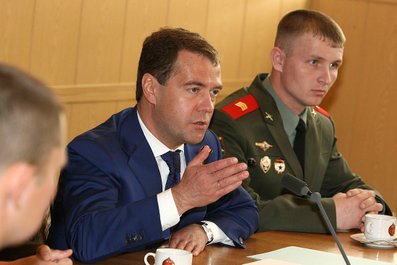
On 5 May, President Medvedev visited Alabino’s 5th Guards Taman Independent Motorized Rifle Brigade (formerly division), a traditional showcase and test bed formation for new equipment and concepts.  

Medvedev and Defense Minister Serdyukov followed up the latter’s late April meeting with the Committee of Soldiers’ Mothers and other public representatives about ‘humanizing’ the armed forces.  At that time, Serdyukov presented ideas for driving the ‘spirit of the prison camp from the army.’  They included freeing soldiers from additional duties to focus completely on training, allowing them more free time, pushing reveille and lights-out back an hour, mandating a rest hour after lunch, instituting a 5-day conscript working week, allowing the possibility of draftees serving close to home, and obtaining weekend passes to leave the garrison. 

Alabino is a place where things like these are typically tried out. 

As Rossiyskaya gazeta put it, Medvedev went to Alabino to see how conscripts live in ‘new profile’ conditions.  He inspected the training grounds, classrooms, and barracks, and answered questions from the new soldiers themselves.  

Medvedev and Serdyukov addressed physical training, one-year conscription, contract service, weekend passes, mobile phones, and hiring civilians to perform nonmilitary support services. 

Taman Brigade Commander Andrey Ivanayev told the Supreme CINC about the experiment with intensive physical training (PT) in his formation.  Ivanayev indicated the troops formerly had 53 hours of PT  per year, but now get 4-5 hours per day, or about 25 per week.  He and Medvedev discussed how soldiers are separated into groups by the physical load they can handle. 

In the Kremlin.ru transcript, Ivanayev said in April testing there were only 88 negative PT evaluations.  According to RIA Novosti’s reporting, Ivanayev thinks the formation’s fitness level has already increased 50 percent.   

Medvedev remarked on the Taman brigade’s outfitting with special PT gear.  He asked Defense Minister Serdyukov about introducing new athletic uniforms in other units.  Serdyukov said:  

“Yes, we are literally this spring buying 50,000 sets and toward fall, apparently, on the order of 100,000 more, the fact is in the course of two years we’re trying to outfit the entire army fully with sports gear for training in summer as well as winter.” 

Most important to the vast majority of Russians, Medvedev told Taman brigade soldiers he doesn’t intend to raise the current 1-year conscription term:  

“That decision on the transition to one-year service which was made, it was painful for us, it isn’t easy, but we won’t change it.  Service in other countries comparable to our country in combat potential is organized in exactly such as way.  And this year still allows us to train a quality specialist, soldier, sergeant.  And despite the fact that there are now certain problems with manning—it’s true, we don’t intend to change the service term.” 

When one soldier asked about enlisted contract service, Medvedev turned to Serdyukov to explain what’s new on this front.  Serdyukov answered: 

“We are now preparing a concept precisely on contract service for soldier and sergeant personnel.  There will be an entire complex of proposals, including on pay, service conduct.  We will equate the entire social package (sergeant like officer) on support, pay and all parameters . . . .” 

“I think in the course of this summer we will prepare and then send you concrete proposals about how this will look, what quantity of contractees we intend to accept, in which specialties particularly and with what kind of pay.” 

Medvedev responded that current pay is not very high, but those who are serving well on it should be retained: 

“However, at the same time, it’s completely obvious according to the well-known principle, better less, but better.  Let there be higher pay and those remaining will really want to serve, instead of us spreading this [pay] among a large quantity of contractees, who won’t have the stimulus, particular desire, or any kind of motive to continue serving and to serve well.” 

When Medvedev pressed him for what he thinks about contractee pay, Moscow MD Commander Valeriy Gerasimov finally said he thinks contractees should get 50-60 percent of lieutenant pay.  Serdyukov said it would be more on the order of 80-85 percent, depending on the duty position.  The more technically complex, the closer to officer pay.  He continues: 

“We are proceeding from the fact that, on the whole, in all the armed forces—a lieutenant from 55, and a sergeant from 35 [thousand rubles per month] . . . .” 

But a little math says that is closer to Gerasimov’s figure, or 64 percent of officer pay . . . 

Medvedev asked his Defense Minister about devising a policy to give conscripts weekend passes to visit home if they live nearby.  Serdyukov said: 

“We are planning over two-three months to proceed on this regime.  Well, naturally, after taking the oath, after he becomes a soldier, after this we’ll introduce it.  We have this really experimental brigade, we are just beginning to work all these approaches out.” 

Medvedev added: 

“Here again we have to proceed from modern approaches.  If a guy serves close by and manning goes according to the territorial principle, then why not let him go home?  Another thing, of course, everyone has to understand what responsibility the soldier carries for any type of infraction in this case, but this is just a question of self-discipline.  You want to go home for the weekend, this means, simply do everything as it’s supposed to be done.” 

Serdyukov chimed in: 

“In the course of five days [of the working week] you need to show the highest indicators, then this will be a particular stimulus for one who wants to pay a visit home on Saturday and Sunday.” 

This policy is especially interesting . . . the possibility of the weekend pass is predicated on several things not really discussed during the Alabino visit.  Working backward, the pass depends on successfully implementing a five-day working week for conscripts.  Then on having conscripts serving relatively close to home in the first place.  At least one voyenkom has already said conscripts from his republic don’t have this chance because they all serve outside their home borders.  A prized weekend pass could also become one more thing to be bought and sold to the highest bidder, or briber.  If implemented, this policy will be difficult to maintain in the face of soldiers who don’t return to the garrison or get into serious trouble while away from it. 

A new conscript asked Medvedev if mobile phones are permitted in the army.  The President asked him if he had one in his pocket, and the soldier replied yes.  Medvedev responded, “Then why did you ask?”  He continued: 

“In fact these rules, as I understand, essentially are established at the unit level, at the level of the corresponding troop formation, but there are no bans on this issue.” 

Gerasimov added that in the Moscow MD anyone may have a cell phone, but they may not be used during training or duty time. 

Discussing training and physical conditioning, Serdyukov turned to one of his earliest initiatives at the Defense Ministry—relieving soldiers from essential nonmilitary duties like kitchen patrol, cleaning, groundskeeping, and utilities maintenance. 

He mentioned the goal of moving to civilian service and support within 12-18 months in all Defense Ministry units, but “everything will depend on our financial condition.  According to preliminary calculations, we have to make do in the bounds of our existing budget.” 

Medvedev said: 

“I think here it’s obvious to everyone that soldiers and officers need to serve the Motherland, be occupied with troop training, improve their physical conditioning, but questions of maintaining the sub-unit, generally, this is an issue which civilian organizations could do successfully for money, as this is done, incidentally, around the world.  Then there won’t be problems with tiresome details and it’ll be possible to concentrate on fundamental service.” 

Civilians already take care of the Taman brigade’s food service, and soon they will maintain its engineering networks, and provide cleaning services.  Serdyukov indicated the FSB is working on licensing firms to work in closed facilities, and Oboronservis will work in remote garrisons where contractors can’t be found.

Electronic Warfare Chief Interviewed

Colonel Oleg Ivanov

 On Radioelectronic Warfare (REB or РЭБ) Specialists’ Day, Krasnaya zvezda interviewed the Chief of REB Troops, Colonel Oleg Anatolyevich Ivanov, about trends and developments in his branch of service.

Ivanov says the growth of information technology for military command and control has given rise to a new kind of confrontation–achieving C2 supremacy and it can exert a decisive influence on a war.  And REB has ‘priority significance’ in this area.  The basic mission of REB is gaining and holding C2 supremacy in combat actions.

Ivanov notes also REB Troops’ role in information protection.  He says they exert control over the military radio transmission network and radio discipline has been pretty good; the number of violations are down.

Ivanov says formations (brigades), units, and sub-units participated in Kavkaz-2009 and Zapad-2009 to create a complex radioelectronic situation for the networks of the exercise participants.  Combined arms units learned to fulfill their missions in conditions of active radioelectronic jamming.  REB units and sub-units worked out their radioelectronic suppression missions against the probable enemy’s targets as well as the radioelectronic defense of their own troops.  REB Troops received positive evaluations.

Asked about defense industry support to the REB Troops, Ivanov says 120 enterprises are involved, and they are largely divided, as in Soviet times, into two practically independent directions–those that work on REB systems and equipment against troop C2 on the one hand, and against weapons C2 on the other.  Sozvezdiye leads the former, and Rostekhnologiya’s ‘Electronic Technologies’ the latter.  He notes that Vega, OSK, and some independent enterprises are players also.

Not surprisingly, Ivanov says to accelerate the development of new EW systems ‘structural integration’ of these OPK enterprises is needed.  And a lead organization to make scientific-technical decisions is needed too.  Coordination of efforts will optimize the use of time and resources for creating new systems and equipment.

But Ivanov doesn’t say who his favorite to be the industry lead is.

Ivanov says Russian EW means are equal to the best foreign counterparts.  They can neutralize and block the most dangerous armaments (particularly, highly-accurate weapons) in real time.  Automated jamming stations from the 1980s and 1990s are serving well with modernization and are meeting current requirements [does this mean there’s been nothing new in the interval?].  But Ivanov says fundamentally new and unique multifunctional systems are being created along with incremental improvements in older systems.  He can’t say more owing to their secret nature.  He thinks it’s possible, however, to say they represent technological breakthroughs.

Ivanov calls EW comparable in effect to the employment of modern highly-accurate weapons, and, by some indicators, even superior to them.

KZ asks Ivanov about personnel issues, particularly one-year conscripts and young officers.

He responds that the issue of training specialists is very acute.  The rapid introduction of new equipment leads to the need for mass retraining of specialists, not just soldiers and sergeants, but officers too.  Officers might get a two-week retraining course, but a soldier takes several months and then only half a year remains for him to serve.

So all personnel are tested in the Inter-Service Training Center to evaluate their capabilities for assimilating the training program, then divided into training groups.  Next, REB Troops are trying to keep trained specialists as contractees.  Lastly, efforts are made to simplify and automate systems to ease demands on personnel.  But practice shows that making a high-class specialist in a year is very difficult, but an acceptable level of skill is possible if servicemen are focused on combat training as prescribed in their programs [i.e. not busy shoveling snow or building the commander’s dacha].

Turning to officers, Ivanov says Russian EW officers have lots of opportunities in the civilian sector, so manning the officer ranks is an ‘issue of special discussion.’  The problem, he says, isn’t as acute as the late 1990s, owing to a rise in status of officers in recent years.  But he doesn’t sound exactly convinced on this score himself.

Summing up the future for REB Troops, Ivanov concludes they have great possibilities, and coming qualitative changes in the development of EW forces and means must support its growth into a specific fundamental type of combat action which in many ways will determine the course and outcome of a battle.

The Trouble Brigade

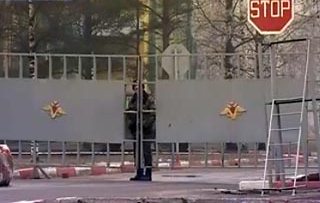
Trouble at the Gate (photo: tv100.ru)

Things go from bad to worse for the LenVO’s troubled 138th Independent Motorized Rifle Brigade, based at Kamenka.  A possibly armed standoff involving Dagestan natives outside one battalion, a suspicious suicide, two noncombat losses in live fire training at night, the list goes on . . .

At mid-day Saturday, 20 men from Dagestan’s diaspora living near the area showed up at the gate of one of the brigade’s battalions in Sapernoye.  They were seeking revenge on a lieutenant, himself a native of Dagestan, for some unidentified reason.  The unit fired warning shots, and local police came and detained some of the men, and dispersed the others.

Newsru.com put the number of men from Dagestan at 40, with 18 detained by police.

A law enforcement source told Gazeta.ru that a dispute between a former contractee from Dagestan, living in area, and the lieutenant from Dagestan was the reason for the incident, but the nature of the dispute between the two men is unclear.

The battalion commander came to the group of men, and tried to talk with them, but after some talking they again tried to get through to the battalion’s barracks.  ITAR-TASS reports he was escorting two of the men to the barracks to try to resolve the situation when the others tried to enter the base.  The commander then raised the unit’s alarm, and warning shots were fired.  The nearest police had to come from Priozersk, 50 kilometers away.  Before the incident at the gate, there was apparently a fight between two groups of Dagestan natives at a school.  The Priozersk police deny reports that the group at the gate was armed.

The LenVO Commander reportedly came to Sapernoye and talked to local elders from Dagestan.  Locally registered residents originally from Dagestan apparently tried to stop this group of men who are reportedly unregistered ‘transients.’

In Sapernoye, they say the men beat battalion commander Andrey Myshyakov; he declined to comment, but said everything was fine with him.  Newsru.com reported that he suffered moderate head injuries after the beating.  ITAR-TASS also says he was beaten and hospitalized in stable condition.  Its source is the press service of the Military Investigative Directorate (VSU) of the RF SKP.

Gazeta.ru says that police and FSB military counterintelligence officers are on the streets of Sapernoye.  The investigation into this incident continues.

There was an earlier incident, in August 2005, in which two lieutenants found a conscript from Dagestan dressed in civilian clothes in a local bar.  When they ordered him back to the barracks, the situation escalated into nearly three nights of fights at the bar.  Four lieutenants were beaten, and the Dagestan natives apparently called for reinforcements from their kinsmen in St. Petersburg.

Also over the weekend, the 138th Brigade revealed the reported suicide of a conscript who was working as a bookkeeper for the brigade.  He had an honors degree from the Kaluga Budget and Finance Academy.

Investigators have reliably determined that he didn’t kill himself because of poor relations with other servicemen, and his family and friends say there’s no way he’d have hung himself.  St. Petersburg’s ‘Soldiers’ Mothers’ believe his ‘suicide’ could be connected with his work in the brigade’s finance section, where nothing happens without machinations.  They believe he may have learned about irregularies in the formation’s finances.

On the night of 8-9 April, two 138th brigade lieutenants were killed in a tank fire accident on its Bobochinskiy Range.  Apparently, a junior sergeant commanding a tank lost orientation and fired into the rear part of the range, directly hitting its central fire control point and killing the two officers.  A host of investigators continues to examine the circumstances.  The press noted a September 2008 incident in which an MRL fired off range, putting one rocket within 50 meters of a highway, damaging a vehicle but not harming its occupants.

Finally, the aftermath of sergeants beating conscripts in the brigade this fall . . . recall that the Defense Ministry did a vertical stroke on the brigade’s leadership for this, 8 officers were dismissed, but that’s not all.

It’s come to light since that, on his way out, the soon-to-be ex-brigade commander and other dismissed officers managed to receive hefty bonuses of 2-3 million rubles.  Officers who kept their posts got nothing.  For his misuse of his soon-to-be ex-post and the brigade’s finances, the former brigade commander could get 4 years in prison.

Second Half of General Staff Chief’s Interview

General Staff Chief Makarov (photo: Viktor Vasenin)

Rossiyskaya gazeta published the second, less substantial, half of Nikolay Makarov’s interview yesterday.

On speculation that the one-year conscription term will be raised, Makarov said:

“No one intends to increase the conscript service term.  But in the Defense Ministry they are thinking of measures to tighten accountability for evading military service.  Today no serious sanctions are applied against evaders.”

Regarding the supply of young men for the army:

“. . . after the transition to 12-month conscript service the callup increased about two times.  But from 2012 the complex demographic situation in the country will add to the problem of manning the armed forces.”

So this is why the military is thinking about clamping down on evasion, which Makarov puts at about 200,000 for all draft-age men.

Asked about measures to make the life of military school and institute cadets more like that of other students, Makarov said changes in the order of the day will have cadets go to classes and exercises in the mornings, and they will be free in the afternoons.  He continues:

“Why do we have to lock cadets in the barracks?  We understand if a person consciously picked the military profession, this means he will study.  If he’s not sure of his choice, he’ll simply get filtered out.”

Makarov indicated the Defense Ministry is looking at having its new state-owned rear services corporation Oboronservis supply militarized security guards for garrisons.  Privatized security companies would relieve servicemen of all guard duty functions and allow them to stop taking personnel away from combat training.  He cites U.S. and Israeli experience in using hired security for these purposes.

Makarov reaffirmed that only professional contract soldiers will serve in Abkhazia and South Ossetia.  He added:

“Even brigades in immediate proximity to the borders will be manned by professional soldiers to the greatest degree.”

That’s a lot of confidence to express in a professional contract service program that he’s deemed a failure.

Makarov indicated the ranks of generals have been trimmed from 1,200 to about 700, but he insisted all combined arms brigades with 3,000 personnel would be led by general-majors, not colonels.  He said generals had been cut in the Defense Ministry’s central apparatus, its main and central directorates, including the Genshtab, and the main commands of the services.  He concluded, “Now to become general, you need to serve with the troops.”

Makarov discussed the evolving training and promotion system for officers:

“Now a system has been built out where an officer after [commissioning] school can occupy at most a company commander position without supplementary training.  They can only be appointed higher through specialized courses.  Candidates for promotion need to complete them, take corresponding examinations.  And then they will pick the best on a competitive basis.  They will appoint them to higher positions.”

Under the old Soviet and Russian system, mid-career education and training didn’t usually come into play until an officer had commanded a battalion and was preparing to move into regimental command or staff positions.

Makarov said the new specialized courses might run 3 weeks for battalion chief of staff positions, or maybe several months for other positions.  He said the army would not be looking at keeping officers in certain posts for obligatory periods.  Some might master their duties in one year, others might not in five, he said.

Asked about whether Russia would accept French helicopter carrier Mistral as a ‘shell’ without weapons and electronics, Makarov said:

“The country’s leadership and the Defense Ministry have an absolutely clear position on this subject.  If a final decision on Mistral is made, then we’ll accept this ship only in a fully equipped form–with all command and control systems, navigation, and armaments.  The only exception is helicopters.  They will be ours.  Everything else must be done to their standards in full form.”

Asked whether the army would conduct reservist assemblies and even callup reservists for short periods, Makarov said no, conscripts are covering Russia’s manpower requirements, and reservist training assemblies would be kept at the level of about 10-15,000 men for the whole country.