Category Archives: Training and Exercises

Makarov Describes the Army He’s Building

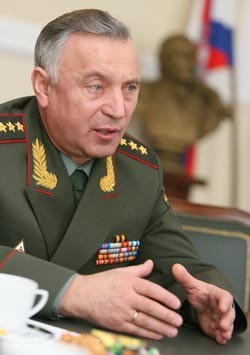
Nikolay Makarov (photo: Viktor Vasenin)

Today’s Rossiyskaya gazeta interview with General Staff Chief Nikolay Makarov has lots of questions and answers on the state of U.S.-Russian negotiations on a new strategic arms treaty, and on missile defense.  If you’re interested in those, you’ll need to read for yourself.

If you’re interested in the other things Makarov said, read on.

Asked isn’t it strange that Russia’s army would be cut when NATO is drawing closer to its borders, Makarov answers:

“We proceeded from the fact that the world has changed to a significant degree in the last 15-20 years.  Russia needs armed forces capable of reacting promptly to any threats and challenges.  Our army, if you take the first Chechen campaign, couldn’t cope with these functions.  To fulfill missions we were forced to man military units with, as a rule, untrained soldiers and officers in the course of combat actions.”

Makarov goes on, saying, after 1996, the army manned 13 percent of its regiments at 80 percent of their wartime complement, so they would be ready for action in a few days if needed.  The remaining 87 percent stayed at cadre level, with equipment and supplies in storage.  So Russia kept a big army that ate up enormous resources, but couldn’t carry out missions. Officers and warrants were almost 50 percent of personnel, and there weren’t enough soldiers.  Possible variants for the best structure were considered and the brigade was selected.  And today any brigade can be ready for action in only one hour, according to Makarov.

Makarov says, in Afghanistan and Chechnya, battalions were reinforced with reconnaissance, artillery, air defense, logistics, and repair units before they deployed for combat.  But battalion commanders weren’t so good at commanding these attached units not normally in their TO&E.  So, says Makarov, it was decided to add these units to battalions, so their commanders can learn how to employ them.  And three battalions organized as such and fully manned comes to 4,500 or 5,000 men–a ‘half division’ rather than a regiment.  And, he notes, battalions can operate independently or as part of brigade tactical groups.

He goes on to explain the Russian Army’s changed outlook:

“In the past we fought with multimillion-man groupings of troops, the basis of which were fronts.  The experience of military conflicts of the past decades showed that such a war was possible, but unlikely.  In the future, troops will go over to actively maneuvering actions.  The actions of inter-service groupings on the entire depth of the enemy’s force structure are replacing frontal battles.  The sides will try to destroy critically important objectives, and also conduct noncontact combat actions.”

The interviewer asks Makarov why only 2 tank brigades in 85 Ground Troops brigades, doesn’t the infantry need armored support?

Makarov answers that, like cavalry in the new age of automatic weapons, today the tank’s role is becoming secondary.  But what’s causing the change? He says it’s the information and artificial intelligence inside equipment, highly accurate weapons used as part of a single information space, and weapons that ‘see’ and ‘know’ everything and can be used against troops and targets in automatic mode.  But he calls robot-tanks with highly accurate weapons a thing of the future at this point.  And Makarov adds that no one is forsaking tanks:

“Here you’re talking only two brigades. Actually we are filling motorized rifle brigades with a great number of tanks.”

Makarov explains the advantages of modular brigades and battalions. Modularity means freedom in structuring battalions and brigades.  If we need a fist of motorized rifle and tank battalions and artillery batteries, we make it.  Commanders in the past didn’t have this freedom.  The entire army force structure was laid out for the conduct of a large-scale war.

Makarov explains modularity as a reaction to Chechnya and even World War II where C2 and force structure was created out of troop units that weren’t coordinated [неслажённые –a difficult one in English, troops that weren’t previously trained and melded together into a cohesive unit or formation].

Asked if there aren’t place in the RF where one can fight with divisions, Makarov says the Russian Army hasn’t gone completely away from divisions [but almost].  But he goes on to insist that their modular nature allows brigades to be used just as well as divisions in Siberia or the Far East, just as well in a large-scale war as independently.

Asked how the army can be trained to fight in a new way, he says:

“The last twenty years there was no intensive combat training in the Russian Army, graduates of commissioning schools and academies didn’t reinforce their theoretical knowledge with practical actions.  And like a foreign language–if there’s no practice, in 2-3 years it’s forgotten.  At the same time, officers without such practice rose in position and rank, some even served to the point of commanding armies.”

“Two tasks stood before us.  First of all, to change the mentality of commanders and their views on war.  It certainly wouldn’t be the one they were taught in the past.  Troop actions, capabilities and forms of their employment have become absolutely different.”

“In order to get to a common understanding, a common methodology is needed.  We are beginning to introduce it, but we are dedicating the current year to individual training of servicemen and combat coordination [слажевание]  of brigades.  From January to February 2010 at the base of the Military Academy of the General Staff we conducted supplementary courses with military district, fleet, and army commanders and their deputies.  Officers ranking from general-colonel to colonel serve in these positions in the armed forces.  Special demands are made on them as organizers, directors, those directly responsible for teaching and training subordinate military command and control organs and troops.”

“We’ve built a training chain, but we understand that this is just the first step.  Everything that officers study in theory still needs to be assimilated in practice.  For this in the second half of May we plan to conduct an operational assembly on the base of one of the units of the Moscow Military District where we are developing a single methodology of training in brigades and below.”

Makarov says 148 new ‘programmatic-regulation documents’ have already been developed.  The Kavkaz, Zapad, and Ladoga exercises last year showed some problems with them, but working groups from the Center for Military-Strategic Research and the Main Combat Training Directorate are reworking them.  The revised regulations will be used in Vostok-2010.  The goal is to have a new combat training program and new combat manuals before 1 October.  Once approved, they’ll be used to organize training starting in 2011.

Makarov also takes this opportunity to expound on his views of netcentric command and control.  He mentions that the U.S. war in Iraq showed that former canons about needing to have 2-3 or 5-6 times superiority in forces and means for military victory no longer necessarily apply.  He says Moscow has the ambitious goal of achieving netcentric command and control in 2-3 years, but the future system is being established in the SKVO this year.

The last issue raised for part one of Makarov’s interview–contract service.  Makarov says the media claimed he had recognized the failure of military reform, when what he really addressed were the miscalculations in contract service over a period of several years.

He says 6-month conscripts were forced into contracts just to meet the [previous] Genshtab’s dictate to have not less than 95 percent contractees in permanent readiness units.  He says these guys were not professionals, but rather just highly [well, not terribly highly] paid conscript soldiers who left the army at the end of their two years anyway.  So, Makarov concludes, it’s no surprise that contract service became a fiasco.

But he adds, we aren’t turning away from it.  A fully contract army would be the very best variant if Russia could afford it [can’t it?], but it can’t according to Makarov.  So he continues:

“Therefore we want to select as professionals only those who’ve served in the army [as conscripts], and only for positions determining the combat capability of military units, related to the operation of complex and expensive equipment.  In the Navy, practically all positions are such.  In motorized rifle brigades not less than 20 percent of the TO&E will be contractees–tank, antiaircraft, and artillery system drivers, gunner-operators, some other specialties.  Plus sergeants.”

“Moreover, if a sergeant is a professional, has served 10-15 years and the level of his training is higher than a new lieutenant, he should get more than the young officer.  We understand that the pay of a contract soldier has to guarantee the attractiveness of military service.  All this will be put into the new pay system.”

Asked about housing for contractees, Makarov says professional soldiers and sergeants need to live like officers in service apartments or dormitories.
Serdyukov’s Post-Collegium TV Interview

After last Friday’s Defense Ministry collegium, Serdyukov was interviewed on Rossiya 24.

He probably fielded more pointed questions than normal, but he easily navigated them.  At times, he answered partially and the interviewer didn’t follow up with the next logical question.

Asked about officers dismissed in 2009, he said the armed forces shed 65,000 of them, who retired on age or health grounds, requested dismissal, or violated their contracts.  There was no mention of those put in limbo outside the TO&E, without duty posts and only their rank pay to live on.  These are the officers who can’t formally be dismissed because they don’t have housing, and are living at their ‘commander’s disposal.’  There was also no mention of how many warrant officers were put out in 2009.

Serdyukov said some officers accepted civilianized posts, and 4,000 received job retraining–a pretty small number against the large need for it.

The Defense Minister said dedovshchina was officially down 15 percent, and he doesn’t want only platoon and company commanders punished when it happens in their units.  He wants to see all levels of command take more responsibility for the problem.  Not sure what he’s insinuating, but it could be a warning to higher ups that they could suffer too when big time violence cases hit the news and make the Arbat military district look bad.

Serdyukov talked about higher officer training and appraisals, mentioning the assembly for 550 officers from the military districts and army commands.  He said we tried to make them understand what it is we’re trying to do.  But many lacked the knowledge and necessary skills–presumably to continue in the service.  See today’s Nezavisimaya gazeta.  Viktor Litovkin writes about generals and senior officers dismissed under Serdyukov.  Military district and fleet staffs which used to number 500-700 officers have been cut to 300.  Trimming the ‘bloated egg’ is generally a good idea, but as Litovkin says, it really depends on the quality of those left behind.

Back to Serdyukov’s interview . . . in cutting the military educational establishment from 65 to 10 mega-institutions, he said fewer officers will be needed but the quality of their training must be improved.  The 10 left standing have or will have their faculty members assessed for fitness to serve and they’ll get facility improvements.

On contract service which General Staff Chief Makarov has pronounced dead, Serdyukov said:

“The results of the program were not satisfactory.  In reality, we underestimated the situation somewhat, as regards who should switch to contract service and on what terms, or with what pay.”

“. . . the next program should be revised in an attempt after all to think it out regarding what specific positions should be filled by contract service personnel.  Of course, this applies to complex skills, where expensive equipment is operated.”

Nevertheless, he noted that he expects the contract sergeant program [albeit small-scale and apparently no longer funded] to succeed.

He said the army borrowed from foreign military experience in deciding on the shift from divisions to brigades.  He said the latter’s potential is virtually the same or even greater in some cases than that of the former.

Serdyukov said the Defense Ministry has reported to the Supreme CINC on its view of how it would like to reequip over the next 5-10 years.  He repeated that cuts to R&D and maintenance had allowed for bigger buys of new arms in 2008 and 2009.

He admitted Bulava hasn’t been successful, but he expects this system to be put right and completed.

He addressed possible foreign arms purchases:

“. . . in some areas we are lagging behind quite badly.  This relates not just to the Navy but also other services.  We are buying things in single numbers right now.  They are things like UAVs, all kinds of sights, night vision equipment–it is a very broad spectrum where we are specifically lagging.”

Despite reports that Moscow would be negotiating only with Paris on Mistral, Serdyukov claimed Russia is talking to the Netherlands and Spain.  He denied it was no more than a glorified cruise ship, saying it could perform many roles and had many different capabilities.

Medvedev Speaks at Defense Ministry Collegium

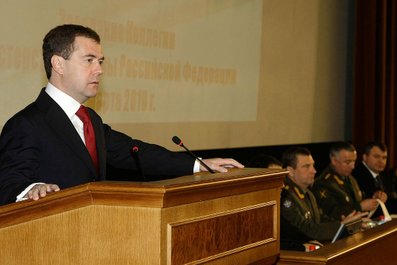
President Medvedev (photo: kremlin.ru)

In his remarks [text and video], President Dmitriy Medvedev reviewed the results of 2009 and talked about future plans for the armed forces.

He focused first on the international situation, noting that, “. . . today we have no requirement to increase further our strategic deterrence potential,” although it remains a determining factor in Russia’s conduct of independent policies and the preservation of its sovereignty.

He noted Moscow’s new law authorizing the use of force to protect Russian citizens abroad, and he pointed to unresolved conflicts on Russia’s borders [where presumably the new law could be used].

Medvedev acknowledged some positive tendencies such as work on a new strategic arms control agreement and renewed Russia-NATO contacts.  But he called the West’s reaction to Russia’s draft treaty on European security a barometer of relations with the U.S. and NATO.  He said it could prevent conflicts like Georgia-South Ossetia.  Medvedev asserted that, unfortunately, far from all countries and politicians drew the correct lessons from the August 2008 events.  And, unfortunately, he said the reestablishment of Georgia’s military potential continues with external assistance.

Then Medvedev turned more to the exact points of his speech.

He said the main goal is the qualitative improvement of the armed forces, the creation of a modern army and fleet equipped with the newest weapons.  He said last year the organizational base for this was established, as planned, without expending additonal resources.

In 2009, Moscow got its authorized personnel down to 1 million, and, according to the President, the Defense Ministry largely achieved its task of getting to the military’s future combat composition.  Medvedev said the results of Osen-2009 confrmed this, and more exercises like it are needed and need to have a ‘systematic character.’  Because, “Without this there simply are no armed forces.”

Medvedev called the training of officers the ‘most important task. Motivated, high-class specialists are needed, but the recently degraded military educational system and its material base need improvement. Medvedev said particular attention also needs to go to sergeants.  They need to be capable of replacing front-line officers when needed, according to the Supreme CINC.

On to rearmament . . .

Medvedev called the task of reequipping the troops with new armaments ‘extremely complex and very important.’  He said last year Russia stabilized the condition of its arms and equipment, despite the financial crisis, and fulfilled the GOZ, although not without problems.

He called the contracting mechanism for arms purchases ‘not effective enough,’ and said we are  working on this, but it’s slow.  This year the State Armaments Program, 2011-2020 will be written.  Medvedev gave the government the task of renewing arms and equipment at an average rate of 9-11 percent annually to allow Moscow to reach 70 percent modern armaments by 2020.  Reequipping has to be supported by full and timely financing.  He referred to his Poslaniye list of  priority systems and arms to be acquired.  He said this task will not be adjusted, and old weapons need to be decommissioned [He seems to have gotten it into his head that new means good and old bad which is not necessarily the case with Russian weapons.  What happens if you scrap lots of stuff, but you don’t succeed in producing new stuff?]. 

Medvedev said, as he’s already said more than once, steps are needed to bring order to the use, storage, and upkeep of missiles, ammunition, and explosives.  The events of the last year have shown there are problems here [alluding to Ulyanovsk, Karabash, etc.].

Medvedev noted another issue, providing the armed forces with automated command and control, and information systems, and transferring the military to digital comms by 2012, as put forth in the Poslaniye.  He said Zapad-2009 worked on mobile automated C2, but this was only a beginning to the work, which needs to be intensified, because “the communications situation is problematic.”

The President said forces will increase their combat readiness in their new TO&E structures [aren’t they 95 or 98 percent combat ready already?].  The main effort will be forming and training inter-service troop and force groupings, and supporting nuclear deterrence forces.  Medvedev said he’ll attend the main, key phases the coming Vostok-2010 operational-strategic exercise.

Medvedev obligatorily cited increasing the prestige of military service and improving the social defense of servicemen as a priority task.  

“I’d like to note that all obligations of the state to current and released servicemen will be fulfilled unconditionally, I will not accept any amendments for budget changes, or for other reasons.”

Medvedev said the government has the clear task to guarantee that all servicemen needing permanent housing have it by the end of this year, and service housing by the end of 2012.

“The realization of this task is not going badly, I will also take this under my personal control.”

Finally, Medvedev spoke for a moment to pay issues.  Increasing pay, and instituting a new pay system for active duty troops from the beginning of 2012, and increasing pensions to retired military men [but nothing specific promised].

He said he thinks premium pay or the well-known Order 400 brought respectable results, and it will be important to preserve ways of rewarding servicemen with extra money under the new pay system, and he expects proposals on doing this.

Defense Minister Serdyukov had some comments after Medvedev’s speech, but they’ll have to wait until tomorrow.

NATO Exercise in Baltic Region

People apparently love this issue, almost as much as information and netcentric warfare . . . .  So, give the people want they want.

Today’s Kommersant says, “They’ve Decided to Have Maneuvers on Russia’s Doorstep.”

The NATO leadership has decided to exercise in the airspace over Lithuania, Latvia, and Estonia, with forces from those countries plus the U.S., France, and Poland.  Kommersant calls it a symbolic start to a large-scale program with the Baltic member-states that will continue through this year.

The staff of NATO’s joint air forces command is quoted as calling the exercises ‘routine’ and having a strictly ‘organizational character.’  But they will also be “a demonstration of alliance solidarity with the countries of the Baltic region that have joined it.”

Participants intend to give special attention to increased coordination between NATO air forces and to patrolling air space.  It will give NATO a great opportunity to use regional air forces and evaluate their readiness.

The Baltic Region Training Event scheduled for 17-20 March was developed at the end of 2008.  France will use its Mirage 2000C, Lithuania its L-39 Albatros, Poland F-16, and the U.S. tanker aircraft.  Latvia and Estonia will provide ground control.  Fighters will land at Tallinn airport for refueling and simulated maintenance.

Kommersant says the issue of serious exercises with the Baltic members came up after Russia’s short war with Georgia in August 2008.  Baltic concerns were reinforced after Moscow’s Zapad-2009 exercise with Belorussia.  According to the paper, Baltic leaders saw in this exercise work on various scenarios for seizing the Baltic countries.  It notes that Russia’s possible purchase of France’s Mistral has also caused a stir in the Baltics and Poland.  Leaders of the former Soviet republics have asked the U.S. to press Paris not to sell it, according to Kommersant.

Washington and Brussels have heard Baltic concerns and planned a series of political and military steps to calm them.  Kommersant names the agreement to place Patriot air defense missiles in Morong, Poland, 75 km from Kaliningrad’s border in April as one of the steps.  NATO’s Parliamentary Assembly will meet in Riga in May.  Also noted is the June amphibious exercise in Estonia in which 500 U.S. Marines will participate.  Kommersant says Estonian officers will command the exercise.

The steps will culminate this fall in a joint ground exercise involving 2,000 U.S., Lithuanian, Latvian, and Estonian troops as well as transport ships.

Newsru.com added a comment from Fedor Lukyanov, chief editor of the foreign affairs journal ‘Russia in Global Politics.’  He noted that the Baltics don’t trust NATO completely, and European members of the alliance most of all, and suspect that they won’t risk relations with Russia in a crisis.  The fact that these will be the first on-the-ground exercises in the Baltics since the countries joined the alliance 6 years ago just serves as extra confirmation of this.

Training Session for High-Level Commanders

The Defense Ministry’s Press Service and Information Directorate reports that leadership personnel from the MDs, fleets, and combined formations [armies] of the armed services have assembled at the General Staff Academy for days of ‘practical study’ of new forms and capabilities for employing the armed forces in today’s conditions in the framework of operational-strategic commands (OSK).

In the course of the exercises, these high-ranking officers will “work out issues touching on the most acute aspects of the army and navy’s life and activities–from organizing combat training and troop service in formations [divisions and brigades] and military units [regiment and lower] within the new organizational structure of the armed forces to their effective employment in possible military conflicts and operations.”

Their study and exercises will include lectures, seminars, ’round tables,’ group operational meetings, etc.  They will be tested and quizzed on the results.  The assemblies will end with demonstration exercises in mobilization preparation which will occur in SibVO military units.  The training session ends on 5 February.

Wonder if they’ll talk about the new service regulations and combat documents that were in the works last year?

The press service renderings of this Defense Ministry announcement didn’t really do it justice, so perhaps this provides a closer reading on what’s going on.

Moscow Makes Note of U.S. Exercise with Estonia

In Gazeta, Denis Telmanov covers plans for a U.S. amphibious landing exercise in Estonia on 11 July.  According to Tallinn, 500 U.S. Marines will land from the USS Whidbey Island (LSD-41) and conduct a 10-day exercise with an Estonian recce battalion.  Estonia’s Defense Minister says this exercise will show that NATO’s serious about defending the Baltic states.  He said it won’t have any aggressive character, and therefore won’t harm relations with Moscow.  Telmanov raises the issue of whether this exercise prepares a defense against Russia in a Georgian-style scenario.

Then Telmanov turns to Leonid Ivashov to comment and he’s at his vitriolic best.  Ivashov calls the exercise hidden aggression against Russia, “When exercises are conducted, a situation is played out, no one just simply conducts exercises.  In every instance, the U.S. wants to work out scenarios of military action in these countries, since they see a threat from Russia.” 

Ivashov thinks the U.S. has the strategic aim of gaining “maneuver room” in the Baltic.  He concludes, “Controlling this territory, it’s possible to organize everything there as it suits–color revolutions, crises.  But the Baltic–this is a sore point for Russia, right next to the second capital–St. Petersburg.  These exercises need to demonstrate how far these three countries have moved away from Russia.”