VDV Gets Army’s Air Assault Brigades

Mil.ru reported today on President Putin’s 11 October ukaz transferring administrative and operational control of air assault brigades in Ussuriysk, Ulan-Ude, and Kamyshin from Eastern and Southern MD Commanders to General-Colonel Vladimir Shamanov and the VDV.

The MOD website says the decree is No. 776; it doesn’t appear on Kremlin.ru yet, but may later.

Mil.ru reported VDV commissions are already surveying the condition of weapons, equipment, and facilities in the three brigades, and converting their training program to match that of the VDV.

Shamanov announced that this change, and others, were pending back in early August.

Re-Industrializing for Military Modernization

Golts

Golts

It’s been Golts overkill.  Despite the risk of overdosing, he has an article in Ogonek from 25 September which merits attention.

One could do much, much worse than to pick him, if you could read only one commentator.

Golts tries to explain why Russia’s OPK, its defense sector, has failed.

He gives prominent examples of defense industrial shortcomings including the most recent Bulava and Proton-M failures.  Interestingly, he says all serially produced Bulava SLBMs are being returned to Votkinsk for inspection.

Calling the list of failures “endless,” he concludes, “Production standards are falling uncontrollably not only in the space sector.”  He continues:

“The thing is not only particular failures.  Experts from the military economics laboratory of the Gaydar Institute suggest that defense order 2013 will be disrupted just as it was in previous years.  According to their data, defense order 2012 was revised and lowered at least three times.  And still it was unfulfilled by approximately 20 percent.  Accounting Chamber auditor Aleksandr Piskunov was extremely forthright in the Duma hearings:  ‘Almost one hundred percent fulfillment of state defense orders for the last 20 years hasn’t interfered with the failure of all armaments programs, with fulfilling them at 30, 40, 50 percent.'”

You may recall reading Piskunov here at the start of April.

Then, Golts notes, Putin himself cast doubt on the OPK’s ability to fulfill the current GPV.  He recalls the late July meeting when Putin indicated he’d entertain slipping ships and submarines due after 2015 into the next GPV (to 2025), so that there aren’t more “failures.”

Putin said work should be organized so producers’ capabilities coincide with the allocated funding.  Money, he said, shouldn’t be hung up in accounts [and stolen] while we wait for ships.  Golts reads this as Putin recognizing that the state of domestic industry is such that it can’t assimilate the gigantic sums allocated to it.

The defense sector has structural problems that endless calls for mobilization to face an aggressive West can’t resolve (i.e. a workforce that’s almost reached retirement age, continued aging of basic production equipment).

Golts again turns to Piskunov, who said only 20 percent of defense enterprises approach world standards in terms of technical equipment, and nearly half are in such a poor state that resurrecting them is senseless — it would be better to start from a “clean slate.”

But Golts focuses on poor coordination and cooperation among enterprises, government customers, and sub-contractors.  He turns to the familiar case of Bulava — 650 different enterprises reportedly have a hand in turning out this missile.

Most damning, Golts compares today’s “so-called united state corporations” unfavorably to Soviet-era defense industry ministries.  Ineffective and bureaucratized, the latter still managed to manufacture massive numbers of weapons.  And Gosplan matched prices for products and production by fiat.  Today’s goskorporatsii can’t.

There’s another important difference, Golts points out.  All Soviet “civilian” industries also produced arms, or parts for them.  Average citizens buying civilian goods helped finance military production with their purchases.

But the largest part of this permanently mobilized industrial system died in the 1990s and surviving parts retooled for other production.  Many in the latter category no longer wanted part of the defense order which would only make them less competitive in their main business.

Then Golts concludes:

“But it’s impossible to begin serial production of armaments without serial production of components.”

Today’s OPK chiefs don’t have the talents of some of Stalin’s industrial commissars, says Golts.  They are, however, good at blaming ex-Defense Minister Serdyukov for “destroying” the voyenpred system.

Golts really gets to it here:

“In reality producers of complex military equipment have a choice.  They can either make components in final assembly plants in a semi-artisan fashion.  Or they can buy them on the side, risking getting crap made in some tent.  It stands to reason the problem isn’t confined to recreating the military acceptance office in enterprises.  Complex chains of sub-contractors have to be established.  And, we note, even with money — this isn’t a banal task.  We’re really talking about new industrialization, the construction of new enterprises.  But just what kind?”

Golts recommends a policy of targeted and specialized re-industrialization.  Because of the expense, he says build specialized component factories to support production of critical systems where Russia is decades behind developed states — communications, reconnaissance, UAVs, precision weapons.  Russia will have to prioritize and Golts doesn’t see tanks, ships, and heavy ICBMs as priorities.  Those who pick the priorities have to withstand attacks from lobbyists for these weapons.

Golts believes Deputy Prime Minister and OPK tsar Dmitriy Rogozin knows the bind he’s in . . . and that’s why he says put off the beginning of serial production of many armaments until the next armaments program (2016-2025).

Golts concludes:

“Generally, the rearmament of the Russian Army is entering a new cycle.  Without any kind of results.”

Another Housing Deadline Missed

Or about to be missed.

Recall some background on Russia’s military housing issue.

In 2012, President Vladimir Putin publicly set his latest deadlines for resolving the military’s housing problems:  2013 for permanent apartments and 2014 for service apartments.  He just awarded himself an extra year on each.  They had been 2012 and 2013.  And 2012 and 2013 weren’t even his original deadlines.

When Sergey Shoygu came to the Defense Ministry last November, he faced at least 80,000 men, officers and former officers, in line for permanent apartments owed them on retirement.

The MOD says there were approximately 60,000 needing them at the beginning of 2013.

The Defense Ministry’s Chief of the Housing Support Department (DZhO or ДЖО) Sergey Pirogov has only been on the job about a month.  Previously DZhO’s deputy chief, he replaced his boss — Galina Semina — a Serdyukov appointee.

Sergey Pirogov

Sergey Pirogov

On 1 October, Pirogov told the RF Public Chamber that 41,400 servicemen will receive permanent apartments in 2013.  He claimed 16,200 already have this year, and 25,200 will receive them in November and December.

There is simply no way the MOD can put more than 25,000 in apartments during the balance of this year.  Despite Pirogov’s statement, there is probably no one who believes him.

Pirogov has called permanent housing a continually “flowing” problem; 24,700 new men joined the line in 2012 and 9,900 this year.

The MOD grapples with its housing problem using two instruments — apartments in their “natural form” or generally despised GZhS, State Housing Certificates.  It also hopes soon to make the One-Time Monetary Payment (YeDV or ЕДВ) a possibility.

If the Finance Ministry will agree on an amount, and the Duma approves some legislation this fall, the YeDV might start on 1 January.  It would be figured on the cost of a square meter of housing, years served, and household size, and presumably won’t be less than 3 million rubles and military men hope it’s a lot, lot more.

In mid-September, Pirogov effectively admitted the military department came to the idea of the YeDV in order to get around the problem of massive corruption in military housing construction.

He also appeared on Ekho Moskvy’s Voyennyy sovet program, and said:

“It’s perfectly obvious that the one-time payment to receive apartments is needed to resolve the issue at once.  Moreover, some universalism is necessary here, a universal mechanism should develop equal rights for all servicemen.  In our opinion, an exit from the difficult situation could be the transition to presenting one-time monetary payments, to acquire or build housing for servicemen, the so-called YeDV.  On what is this based?  Well, look here, according to those figures which the MOD leadership has more than once voiced.  Annually we are paying servicemen, at the disposition [of their commanding officers], a huge amount…  We can’t dismiss a serviceman before providing him housing, and are forced to put him in so-called disposition, and in this case the serviceman receives [rank] pay, he can use sanitorium-resort support, other privileges, given to servicemen, but he can’t be dismissed from the armed forces if he doesn’t have housing.  And in this instance, the MOD will spend up to 30 billion rubles a year supporting our servicemen.  It’s bitter to have to say that the problem of providing housing is long-running enough, and a serviceman can be at the disposition 5 or more years.  And here about that sum which I named, if we multiply it by a quantity of years, we get a simply enormous sum, which the MOD pays out fulfilling its obligations, this is the first conclusion.  The second conclusion is the resources which the MOD actually spends on construction are also enormous.  By any evaluation, it’s on the order of 30 billion rubles a year.  But consider that on average it takes 2-2.5 years to build an apartment block, half a year goes to the necessity of drawing up documents.  And it turns out that 3 years properly here this money is here, it’s hung up, it’s not realized so to say.  Yes, they spent it, on building apartments, they so to say laid it out in such a way.  But even the optimization of additional expenditures, particularly with apartment upkeep.  I also would like to introduce an example, in 2012 we had more than 10 thousand frozen for various reasons, not occupied by servicemen.  It’s natural so to say that these apartments require their upkeep.  But in this case, if we didn’t turn off or didn’t turn on the heat properly, this in turn means correspondingly then already essential repair to newly-built, but not allocated apartments.  And this sum here — it becomes in principle very large and very significant for the MOD.  And more than this, even the colossal expended amounts, about which I already actually spoke, deciding the question with housing construction, we aren’t resolving the problem.”

Lots interesting here . . . Pirogov talks pretty clinically about those left “at the disposition,” but it’s a difficult life for an officer living in his garrison on a fourth of the pay he had when he had a duty post.  And, Pirogov says, the situation goes on a long time and costs up to 30 billion rubles per year. 

Pirogov says the MOD has also been spending 30 billion on housing construction, including on 10,000 unoccupied apartments.  But construction hasn’t solved the housing dilemma.

Maybe the housing situation has improved somewhat, but, as Pirogov admits, it’s still a long way from solved.  And Putin’s deadlines come and go and come again.

Third S-400 Regiment for Moscow Oblast

S-400s at Elektrostal and Dubrovki, Zvenigorod Could be Next

S-400s at Elektrostal and Dubrovki, Zvenigorod Could be Next

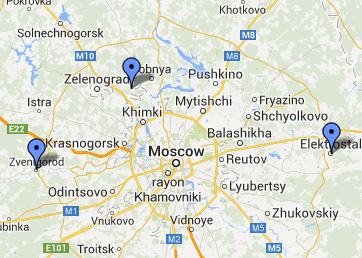
The VVKO’s spokesman told RIA Novosti this week that the next — the sixth — S-400 SAM regiment (or “regimental set” of two launch battalions) will be deployed in Moscow Oblast before the end of 2013.

S-400s are already located east and north of Moscow at Elektrostal and Dubrovki, respectively.  Dubrovki was reported as Dmitrov (actually further north) by Russian media in the past.

Zvenigorod to the west was first mentioned as a deployment location in 2011.  It was supposed to be the third S-400 location before the end of that year.

Russian reportedly operates five S-400 regiments at the present time — Elektrostal and Dubrovki, and one each in the Baltic Fleet (Gvardeysk, Kaliningrad), Nakhodka in the Far East, and the Southern MD.

Find a better version of the map above here.

Facts in Contractee Debate

Perhaps you saw the tweet relaying a RIA Novosti report claiming 900 men  signed up for contract service in Kemerovo this year against only 160 in 2012.

A reader responded that Russia’s recession obviously benefits recruiting, while another said no, it’s the doubling of volunteer pay that’s bringing more men in the door.  The first said twice nothing is still nothing.

You get the idea.

An interesting issue, but one that requires some facts.

We can’t test the idea that it’s the recession.  We can, however, examine (at least a little) the idea that it’s the doubled pay.

The most recent series of Russian contract service experiments began in Pskov in 2002.  The first men to sign up were paid 3,300 rubles per month (rank and duty pay with no supplements).

By 2007 — the end of that effort to add about 130,000 contract enlisted to the army’s ranks — some contractees were earning 9,000, 10,000, or even 12,000 per month.

If we adjust the 3,300 and 12,000 for Russia’s consumer inflation during the intervening years, contractees have to get 10,000 to 20,000 to get equivalent pay today.

The Defense Ministry has said they will get about the same as today’s increased junior officer pay, or 30,000 to 35,000 rubles per month.

So is that doubled or not?

For a contractee who re-ups, maybe it is.  But field research would be required to find out how these guys perceive the proffered pay.

For comparison’s sake, the average Russian monthly wage at this time last year was (according to Rosstat) about 26,000 rubles.

The Russian Army’s tried to professionalize its soldiers since its inception in 1992.  It’s tried especially hard since 2002.  That was during the second Chechen when the prospect of being a conscript sent to a shooting war caused large numbers of young men to evade the draft.  And the Kremlin was already paying relatively good money (about 30,000 rubles per month) in combat bonuses to soldiers willing to go to Chechnya.

But here’s what became obvious during the contract service push in 2002-2007:

  • Promised pay was not always delivered.  If it was, it was sometimes siphoned off by officers and other middlemen.  Now, maybe (just maybe), that’s changed because officer pay has risen fairly dramatically.
  • Promised benefits were not delivered.  Especially when it comes to housing and living conditions.  Contractees were told they’d live better than conscripts in barracks.  The vast majority of times they didn’t.  Service apartments (for married contractees) and even renovated dormitories were generally unavailable.  Money for construction was tight, and tens of thousands of officers were also awaiting housing, or improved housing, owed them.
  • Retention was, not surprisingly, a huge problem.  The majority of contractees were not more stable guys interested in a career as an enlisted man or NCO, but younger men looking to make quick rubles while searching for something better.

Without high retention, contract service was, is, and will be meaningless.  Actually, worse than meaningless because it entails great expense, lots of time and effort, and considerable opportunity cost.

We could talk all day about current contractee accession, but fact is, it really doesn’t matter.  The real test is whether the Russian Armed Forces have 425,000 professional enlisted soldiers by the end of 2017, and how many of them they manage to keep by 2020, 2023, 2026, etc.

P.S.  The quality, knowledge, and training of those 425,000 guys is pretty critical too.

Golts Sidebar

Is a caption even necessary?

Is a caption even necessary?

The Golts article on Sergey Shoygu’s tenure is largely on-point.

But, for whatever reason, Golts neglects a positive change wrought by the new defense minister:  the surprise readiness inspections conducted since the beginning of this year.

While no longer a “surprise” and not as large-scale as the MOD would like us to believe, the exercises demonstrate what’s wrong and needs fixing.

But let’s return to some criticism, or witticism.

Along with Golts’ article, Kommersant published a sidebar listing Shoygu’s “significant” decisions.  Olga Shkurenko compiled it.

“New Annals of Military Organizational Development”

“A Chronicle”

“‘Ogonek’ has recalled the loudest of loud initiatives to strengthen the army and navy put forward during the time Sergey Shoygu has been in the post of defense minister.”

“On 7 November 2012 the minister decided to resurrect the tradition of Suvorov and Nakhimov cadets participating in the 9 May parade.”

On 12 November it became known that shoulderboards soon again will be worn on the shoulders, not on the chest.”

On 7 December it was decided to resubordinate military VUZy to the CINCs and Commanders of the services and branches of the Armed Forces (the MOD’s education department managed them previously).”

On 9 December Shoygu proposed reestablishing the Defense Ministry’s film studio.”

On 24 December the MOD announced that the troops will get a new uniform in 2014 and stop wearing undercollars.”

On 14 January 2013 Shoygu announced that by year’s end the army ‘should forget the word footwrappings.'”

On 25 January the Air Forces agreed with the minister on returning red stars instead of tricolors to the sides of airplanes and helicopters.”

On 4 February Shoygu gave the order ‘to install showers in all military units before the end of 2013.'”

On 26 February plans were announced to reestablish the institution of warrant officers.”

On 7 March mass media announced that the MOD had disposed of gas masks for horses.”

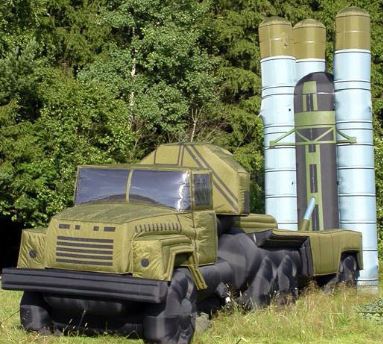
On 13 March ‘Interfaks’ reported from a source in the company ‘Russian Balloon’ that in 2014 purchases of inflatable tanks, aircraft and missile systems would begin.”

On 18 March the MOD press-service said that in 2013 172 dining halls of military units are transferring to the ‘smorgasbord’ feeding system.”

On 29 March the reestablishment of the first sports company was completed.  Then the minister proposed creation of analogous ‘scientific companies.'”

On 2 April the MOD culture directorate was created.  The poster contest ‘Homeland Army’ and the rebirth of army KVN¹ are among its first initiatives.”

On 3 April an OPK source said that the army was rejecting camouflage on tanks and other combat equipment and returning to a one-tone color scheme.”

On 9 and 16 April the recreation of the historic Preobrazhenskiy and Semenovskiy regiments was completed.”

On 4 May the earlier disbanded Taman and Kantemirov tank divisions [sic] were reestablished by decision of the minister.”

On 22 May in the State Duma the minister proposed to send those conducting alternative service in the army and navy to perform construction and housekeeping duties.”

On 23 July after the exercises in the Eastern Military District the MOD chief proposed ‘increasing by several times’ ammunition expenditure norms.”

On 31 July Shoygu ordered commanders to begin every morning in the barracks with a rendition of the Russian Anthem, to compile an obligatory military-patriotic book reading list and take the preparation of demob albums under their control.”

On 14-17 August the first competitions in the tank biathlon took place in the Moscow region at the minister’s initiative.”

On 16 August it was announced that the ‘office suit’ is being introduced for military men and civilians serving in the department.”

On 20 August it became known that in the MOD they are working on the issue of rearranging the Russian anthem in two variants — for a standard choir and for young people.”

¹KVN is a little hard to describe.  Literally, the “Club of the Happy and Resourceful.”  A television game show where teams from various institutions and organizations compete in answering questions and performing skits.

Golts on Shoygu’s Tenure (Part II)

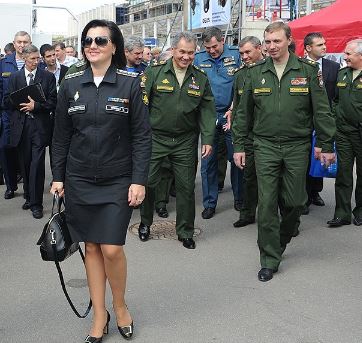
Shevtsova Sporting the "Office Suit" with Four General's Stars

Shevtsova Sporting the “Office Suit” with Four General’s Stars

Continuing with Golts’ Ogonek article, “From Reforms to Uniforms.”

“XXI century style”

“It stands to reason that deeply patriotic content received as a result of regular and repeated performances of the anthem require corresponding forms. Uniforms that is. Shoygu decided to dress all MOD, other staff and management employees in so-called office suits. The minister, his subordinates say, came to the conclusion that wearing a woolen jacket in summer is uncomfortable. So it was decided to sew a uniform reminiscent of the one MChS officers wear.”

“And so now not only the military, but civilian employees of the MOD will have to wear the office suit. Not only that, these same office suits come with shoulderboards. Now every civilian worker has to wear shoulderboards with stars corresponding to his bureaucratic rank. So, at the tank ‘biathlon’ competitions (incidentally, yet another of the minister’s well-known inventions) Deputy Defense Minister Tatyana Shevtsova appeared with four stars on her shoulderboards corresponding to army general rank. And Deputy Minister Anatoliy Antonov, who’s spent his entire life in the diplomatic arena, currently sports general-colonel’s shoulderboards.”

“This redressing is hardly the innocent whim it might appear to be. Really it’s a continuation of that line which began when Shoygu himself donned a general’s uniform at the moment of his appointment as minister of defense. In this logic the Ministry of Defense is not simply the military department, it’s the department where military men command and give orders. And civilian officials turn up there only in the extreme case when they can’t get along without them or there is reluctance to spend money on big salaries to officers. As a result they let civilian employees know that they are not quite military. But cadre officers can’t but experience irritation when civilian bureaucrats receive ‘for nothing’ stars very similar to those which they earned through blood and long years of service.”

“Behind all this is an obvious unwillingness to understand that civilian bureaucrats and servicemen have principally different missions. Civilian bureaucrats are needed to translate the political will of the country’s leadership into the language of military orders, to give the army its missions, to provide the Armed Forces essential financial and material resources, and also armaments. The military themselves have to be occupied with strategic planning and organizing combat training. If those same military men determine threats and missions and are also occupied with material support and financing, this unavoidably will lead to threats multiplying several fold.”

“It seems Sergey Shoygu, an outstanding administrator, to his misfortune ended up somewhere with Dmitriy Rogozin and caught a virus from him which leads the ill person to flamboyant initiatives. Remember the proposals about producing military toys at OPK enterprises, the advertisement of weapons by aged Hollywood stars, and the merger of space and aviation industries? It seems the chief of the military department has set off along the same road.”

“It occurs that the nation’s most popular minister turned up today in a complex situation, from which some organizer talents are clearly not enough to escape. The development of the Armed Forces has gotten to the point of bifurcation. It’s more or less obvious that the missions set down by Serdyukov’s reformers were not fulfilled. Permanent readiness formations exist, it seems, only in the victorious reports of military leaders. Due to the shortage of servicemen in brigades they’re forced to form only permanent readiness battalions which are fully manned. It’s obvious that manning the Armed Forces to one million servicemen in six months as the [supreme] commander-in-chief has demanded is impossible in principle (the single rational explanation for joining MChS to the MOD — an attempt to fulfill the president’s order by bureaucratic means).”

“It’s just as obvious that we aren’t getting any kind of rearmament — the conclusion of a large contract for the production of 37 MiG-35 fighters was just put off to 2016. The main reason is that industry is incapable of meeting a contract. Not everything is OK with the resolution of social problems. Despite promises, the housing line grows, and those who have the right to receive it are not at all in rapture at the idea of being given money instead of apartments.”

“There’s a complex choice in front of Shoygu. It’s possible to go along the path of Serdyukov’s reforms. It would mean honestly announcing that forming million-man Armed Forces is impossible in principle, and attempting to convince the political leadership of the necessity of limiting the army’s size to 600-700 thousand servicemen. And then concentrating on the selection of the quantity of contractees necessary to form fully volunteer Armed Forces. Meanwhile, it’s necessary to engage the defense industry in grievous battles to force it to produce what the army needs and not what it wants. However, all this would place Army General Shoygu in opposition to the Russian military lobby, exactly as it did Serdyukov who is reviled by everyone.”

“The other path is counter-reformation. Agree with the generals’ demands for the return of two-, or better three-year conscript service, return to the mass mobilization army concept, allow VPK [the government’s Military-Industrial Commission] directors to waste the defense budget. But in this case too it’s necessary to grapple with serious conflicts. Not with generals, but with society.”

“Shoygu, however, doesn’t want to lose his ratings. Therefore he’s trying to avoid any conflict. But how do you remain the center of public attention and visible while avoiding fundamental decisions? Here the initiatives about office suits, demob albums and anthem performances go into motion. The danger is the achievements of Serdyukov’s reforms, attained with such difficulty, will go away… in anthem singing.”

Golts on Shoygu’s Tenure (Part I)

Aleksandr Golts is a formidable critic of Russia’s Defense Ministry.  If only the  MOD had a proponent to match wits with him.

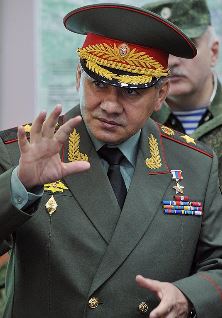
Sergey Shoygu

Sergey Shoygu

Golts’ latest appeared in Ogonek on 2 September.  He gives his view on what is getting Defense Minister Sergey Shoygu’s attention.

Nothing else added or explained.  Just translated:

“From Reforms to Uniforms”

“Aleksandr Golts: The Defense Ministry is overgrown with shoulderboards”

“A series of recent Defense Ministry initiatives occasions more and more questions”

“Aleksandr Golts, Daily Journal observer”

“Recently one of the Moscow papers announced sensational news: Defense Minister Sergey Shoygu proposed that the president subordinate the Ministry of Emergency Situations to the military department. It’s all the same, they say, MOD troops by necessity participate, like now in the Far East, in any large-scale rescue operation. Experts, whom journalists rushed to interrogate, shrugged their shoulders: stupidity, of course. Some, who are older, remembered perfectly how in the beginning of the 90s Sergey Shoygu himself and his associates argued: it was essential to remove the civil defense troops from the Armed Forces to establish MChS on the basis of them. They, the rescuers, really have a completely different mission than the army, which, however you look at it, is concentrated on organizing armed force. Everyone knows: Shoygu resolved this problem perfectly. And so in place of civil defense troops, where they sent all army disciplinary offenders, soon appeared MChS, one of the departments most respected by the public. Moreover, the Armed Forces just went through the very painful Serdyukov reforms which, besides everything else consisted of changing structures and missions, redeployments and resubordinations. In the event of uniting MChS [to the MOD] this bureaucratic wheel would be doomed to turn again, really stopping combat training for another 1-2 years. It was impossible to believe that Shoygu, one of the not numerous talented Russian administrators, could come forth with similar initiatives. However in answer to the question are similar things possible, the experts began to hem and haw and in the end said now everything is possible in Russia.”

“Let’s sing friends”

“The fact is recently news has come from the military department, which, putting it mildly, is ‘more and more wonderful.’  Not long ago they decided to be seriously occupied there with the patriotic indoctrination of Armed Forces personnel. Sergey Shoygu ordered: ‘I ask commanding generals and commanders to ensure that the Anthem of Russia is performed. I order that in military collectives every morning should begin with the singing of the Anthem, no matter what the servicemen are doing.’ And later he ordered the famous Aleksandrov Russian Army ensemble to arrange immediately two versions of the anthem — a model, so to say, strict one, for performance exclusively by a choir and orchestra ensemble, and a pop one, for the military-patriotic indoctrination of the young. Stage stars including Lev Leshchenko and the group ‘Lyubeh’ will be invited to perform it. And this despite the fact that according to the Internal Service Regulations the Russian anthem is performed every day at evening roll call in every military unit. But, apparently, one performance of the anthem isn’t sufficient to achieve the necessary degree of patriotism in servicemen. It seems the degree of patriotism is directly dependent on the frequency of its performance. If so, then it shouldn’t stop at two performances a day, they could sing the anthem every hour. They could, in the end, make the army like a monastery and stand several hours for patriotic morning service. The main thing is results you know.”

“The issue of patriotic indoctrination isn’t exhausted by the performance of the anthem. ‘I’m inclined to have commanders lead the process of preparing demobilization albums¹, since every military unit has its own history,’ said Shoygu. It’s proposed to prepare this, more recently strictly individual, product of the soldierly creativity centrally using modern printing and photographic equipment. It’s curious, will the more recently obligatory element of creating such an album — photos depicting precisely what the demob dreams of doing when he leaves his military unit be centrally produced… Obviously, army political workers believe he intends to sing the state anthem again. But this isn’t all. ‘If we aren’t able to prepare a single history course for the country, we need to prepare such a textbook for the army and introduce it into all courses of instruction for servicemen,’ said the minister. If everything is understood with the performance of the anthem, then the authors of this separate army, strictly correct and patriotic history textbook still haven’t been determined. Nevertheless, it’s possible to guess both the authors and the content.”

¹Not necessarily reverent scrapbooks conscripts have traditionally assembled about their service time.

A Swedish Defense Debate

Two Swedish observers recently engaged in an exchange of opinion pieces regarding the connection between a supposedly more muscular and threatening Russia on the one hand, and an allegedly feckless Swedish defense policy on the other.

Here we are, of course, more interested in their divergent views of Russian military power rather than in (as they are principally and rightly concerned) its affect on Sweden’s defense.

Stefan Hedlund

Stefan Hedlund

Uppsala University professor Stefan Hedlund wrote first.  His article appeared originally in Svenska Dagbladet.

Hedlund concludes the Swedish legislature is radically changing its long-held view of Russia as relatively benign to one of Moscow as a growing threat to Sweden’s national security.  Proponents of this view, he says, point most often to Russia’s militarization and its increasingly autocratic political system.

However, he says President Vladimir Putin himself basically admitted the government’s 20-trillion-ruble State Armaments Program is failing.  Failing because the OPK, on the whole, cannot produce weapons and equipment of requisite quality, in necessary quantities, according to specified deadlines.

He cites the Bulava and Yuriy Dolgorukiy.

Just one good example among many he could have picked.

Then Hedlund concludes:

“Perhaps it was simply naive to think that the Russian military industry could pick up where it left off two decades ago, after standing at a virtual standstill, and all of a sudden produce weapons system [sic] at high international standards.”

He turns to politics, and the fragmentation of the Russian political elite just beneath Putin.

He sees it this way:

“These political developments don’t add up to the picture of an every [sic] more strong-fisted leader [Putin] who hasn’t ruled out waging war on his neighbours.  It is much more probable that Russia will be paralyzed by infighting for a long time to come, and an ever degrading economic outlook will mean the government may have to retrace it steps on promises to keep up salary developments and shore up pensions.  There might simply not be money left for the military.”

Hedlund hits key elements of the problem with Russia’s alleged militarization:  the OPK’s inability to deliver arms and a clearly evident Finance Ministry rearguard action to rein in military procurement spending.

Finally, Hedlund concludes it’s essential to discuss Sweden’s defense policy problems “without muddling it up with incorrect perceptions about the development [sic] in Russia.”

Political science PhD candidate Annelie Gregor responded to Hedlund with this essay.  Ms. Gregor neglected to add that she is, apparently, an employee of the Swedish Armed Forces.

Annelie Gregor

Annelie Gregor

Gregor argues Hedlund claims Russia is not in the midst of a military build-up and is turning away from authoritarian rule.

This is not at all what Hedlund said. 

Hedlund maintains Russia’s militarization isn’t effective and Putin’s autocratic style masks concerns about domestic politics that are more important to him than building up the armed forces or attacking a non-contiguous Nordic country.

Gregor’s first point about the recent surprise readiness evaluation in the Far East simply has to be ignored.  Not because of her primarily, but because of how others have futzed it up. 

She says it “involved” 160,000 troops.  Others have said Russia “mobilized” or “deployed” this number.  The entire manpower contingent of the Far East Military District (probably some 160,000 men) certainly wasn’t “involved” in those exercises, and those troops certainly weren’t “mobilized” or “deployed.”  They already actively serve in the region where the exercise took place. 

It is true to say recent Russian exercises have featured some re-deployments and equipment movements from other districts, but they are limited to what Russia’s strategic mobility resources can manage.

Difficult as it is to believe, Gregor cites Russia’s performance in the five-day war with Georgia as evidence of a threat to Sweden.

The same Russian Armed Forces that were caught off guard, and initially acquitted themselves so poorly that a major military reform program started immediately afterwards to improve their readiness and capabilities.

As more evidence, Gregor recalls this spring when “two Tu-22M3 Backfire heavy bombers simulated a large scale aerial bombing on Sweden.”

Two Backfires with nuclear-armed cruise missiles would be more than enough to ruin Sweden’s day.  But one notes they are not “heavy bombers” nor do two constitute anything “large scale.”  The incident was, perhaps, more about flying time and asserting Moscow’s right to use international airspace.

Gregor then argues with Hedlund about whether revenues from oil, gas, and arms sales will be adequate to support Russia’s “militarization” in the future.

This part of Hedlund’s article was, unfortunately, not translated.

One contends, however, that if Hedlund said the Russian defense budget will decline as its oil earnings decline, he’s right.  In fact, one could go further and say the budget is irrelevant.  What does matter is what Moscow actually buys or gets for it.  

The Russians are getting more training (because they can buy more fuel), but they aren’t getting new weapons on the schedule they originally laid down.  

And corruption remains a huge tax on the budget, just check on the criminal cases against former Defense Minister Serdyukov’s former deputies. 

And it’s obvious to serious observers that arms sale profits don’t go to the big white building on the Arbat.  They go to Rosoboroneksport which is connected more to high-level political infighting than to the Defense Ministry.

Hedlund never said Russia is turning from authoritarian rule as Gregor alleges.  Hers is a classic “straw man” fallacy.

Hedlund responded to Gregor’s response.

He argues Moscow’s “increasingly bellicose [anti-Western and anti-NATO] rhetoric is for domestic consumption” and its “aggressive actions, such as simulated nuclear strikes on Warsaw, indicate weakness and a desperate clamoring for attention.”

Anti-U.S. and anti-NATO speech will probably always be popular in Russia.  Simulated nuclear strikes are warnings to Europeans of the consequences of cooperation with the U.S. in missile defense (or anything else for that matter).

Hedlund says he’s done anything but argue that Russia is turning from authoritarian rule.  He concludes:

“What I have argued is that there is a very large difference between present-day Russia and a truly militarized authoritarian regime that would constitute a true danger.”

Eloquently put.  Putin’s regime is a clumsy, capricious, and ineffective brand of authoritarianism.  It recalls the late years of the Tsars more than Hitler’s Germany or Stalin’s USSR.  Dangerous to a degree, but not an existential danger.

Perhaps there’ll be yet another installment in this debate.

Everyone in Uniform

Under Sergey Shoygu, the Ministry of Defense looks more and more like MChS.

Shoygu’s apparently decided to put his senior civilian officials in uniform.

Tsalikov and Borisov Sport New Civilian Uniforms With Light Colored Epaulettes (photo: Mil.ru)

Tsalikov and Borisov Sport New Civilian Uniforms With Light Colored Epaulettes (photo: Mil.ru)

Deputy Defense Ministers Ruslan Tsalikov and Yuriy Borisov were photographed in their new apparel during last week’s conference on the results of the most recent surprise readiness evaluation.

Tsalikov gets to wear four army general stars given his title as “Actual Privy Councillor 1st Class.”

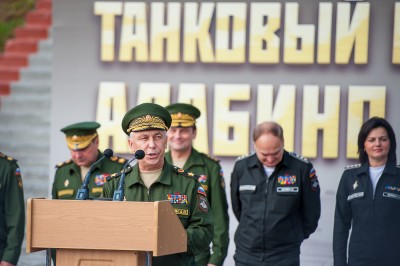
At the tank biathlon in Alabino, Tatyana Shevtsova and Anatoliy Antonov were caught wearing theirs at the right edge of this photo.

Antonov and Shevtsova in Uniform (photo: Rbc.ru)

Antonov and Shevtsova in Uniform (photo: Rbc.ru)

Like Tsalikov, Shevtsova (who somehow managed to hang on after Serdyukov’s demise) also wears four stars based on her civilian rank.

It looks a bit like either the USAF or the starship Enterprise has come to visit.

At any rate, Izvestia wrote about the new uniforms.  It notes the zippered jackets look like MChS, and are supposed to be more comfortable work-a-day attire for civilians and military men alike.  But one anonymous senior officer said the material feels like overalls, and he’s generally not won over at this point.