Promotion List

For Russia Day on 12 June, President Vladimir Putin promoted a number of  armed forces and other “power” ministry officers to higher ranks.

Click on this link to see those promoted in Putin’s decree along with as many positions as could be identified for them.  The link goes to an Excel file, click “View full-size workbook” and you’ll see the spreadsheet on Microsoft’s Skydrive site.

Promotions from February remain in the file as well.

World-Class Competitors

Defense News has posted its annual list of the world’s top 100 defense companies for 2012.

The same seven Russian firms appear on the list.  But against the backdrop of a declining international defense market, the performance of Russian companies last year is interesting.

They did fairly well, except for airplane makers.

Almaz-Antey’s reported defense revenue rebounded strongly in 2012 – by 62 percent — to make it 14 overall.  It moved up from 21 last year.

Helicopters of Russia’s revenue jumped 32 percent to put it at 24.  It was 44 last year.

Sukhoy’s revenue was down 8 percent.  But down less than others.  With the market declining,  it came in 43rd, up from 52nd last year.

United Engine-building’s revenue increased nearly 50 percent to make it number 49, up from 55.

Irkut’s revenue and position declined, more than 18 percent to make it 62 versus 53 a year ago.

RTI Sistemy reported a 12 percent gain to be 80th instead of 100th last year.

RSK MiG was down 17 percent and came in at 93rd.

Here are the posts on 2011 and 2010.

Iskander-M “Brigade Set” Delivery

Some significant news from late June and early July, largely (or entirely) overlooked by Western observers . . .

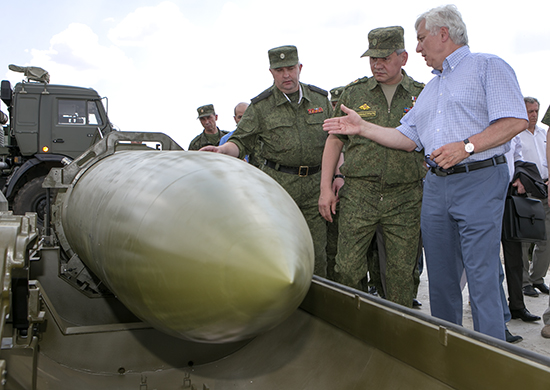
Designer Kashin Shows Shoygu the Iskander-M (photo: Mil.ru)

Designer Kashin Shows Shoygu the Iskander-M (photo: Mil.ru)

Defense Minister Sergey Shoygu presided over the first delivery of a “brigade set” of Iskander-M (SS-26 / Stone) short-range ballistic missile systems at Kapustin Yar on 28 June.

According to Mil.ru, uniformed and civilian Defense Ministry officials, industry representatives, and journalists were present for the test range ceremony.

The delivery followed the MOD’s announcement last month that Iskander-M system components will no longer be supplied separately to the army, only in “brigade sets.”  The military department also reported a “long-term” contract for deliveries of the missile system until 2017 was concluded with the producer.

A complete “brigade set” includes missiles, launchers, transport-loaders, command-staff, data processing, check-out, and maintenance vehicles, and training systems.

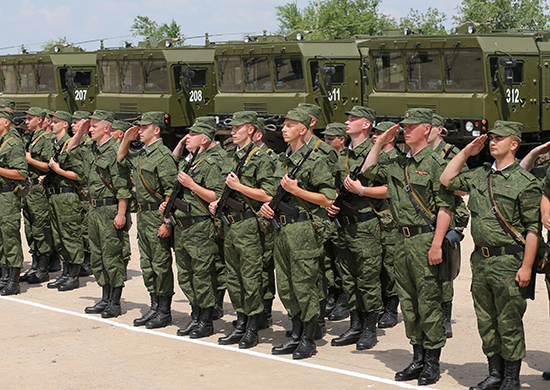
Missile Troops at Attention in Front of Iskander-M Launchers (photo: Mil.ru)

Missile Troops at Attention in Front of Iskander-M Launchers (photo: Mil.ru)

Shoygu reiterated that the MOD intends to reequip all ten Ground Forces missile brigades with Iskander-M before the end of 2017.  Ten brigades should deploy at least 120 missiles, not including reloads.  The Iskander-M is the only weapons system to be 100 percent procured before 2020, according to the MOD’s recently publicized Action Plan.

At Kapustin Yar, Iskander-M designer Valeriy Kashin of the Kolomna Machine-Building Design Bureau told reporters the military will receive another “brigade set” before year’s end, according to Nezavisimaya gazeta and Komsomolskaya pravda.

But completing the military’s order in less than five years could prove difficult for Russia’s defense industries.

NG reported Kashin said enterprises working on the Iskander-M have to “intensify” their activities several fold to meet the MOD deadline.  Seventeen specialized manufacturers are scheduled to upgrade and retool under a 40 billion ruble ($1.2 billion) investment effort.

However, actual reconstruction of production lines will not begin until 2014, according to online daily Vzglyad.

Shoygu told those in attendance at Kapustin Yar the most important step now is establishing the “essential infrastructure” for the deployment of new arms and equipment. He reemphasized this in a 1 July MOD videoconference by calling for special attention to synchronizing the delivery of weapons with the construction of bases and other support infrastructure where they will be deployed (and with the training of those who will operate them).

The defense minister stated that the MOD currently awaits completion of military construction projects worth 314 billion rubles ($9.7 billion). He said he wants the backlog eliminated before November.

An NVO correspondent present at Kapustin Yar reports that the just delivered Iskander-M brigade’s new facilities will be complete in September.

The newest Iskander-M brigade is likely intended for the Southern Military District, which presently only has one battalion of the new missiles. 

Shoygu is right to focus on arranging the appropriate infrastructure for Russia’s new armaments because it has traditionally neglected support and lifecycle investments in its military equipment.

Missile Away!

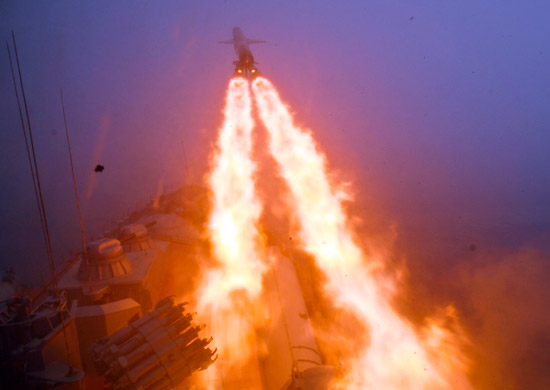
Missile Cruiser Moskva Fires SS-N-12 (photo: Mil. ru)

Missile Cruiser Moskva Fires SS-N-12 (photo: Mil.ru)

Definitely don’t be on deck for this.  Mil.ru covered Black Sea Fleet flagship Slava-class CG Moskva (121) firing one of its deck-mounted SS-N-12 ASCMs during inter-fleet training in the Atlantic this week.

TK Zvezda provided video of this firing and lots of others.

SS-N-12 Launch (photo: TK Zvezda)

SS-N-12 Launch (photo: TK Zvezda)

This might be one of the few times (possibly only the second!) in Moskva’s career that it’s fired its primary weapon system.  In 2008, New Times covered what it reported as the very first.

This seems somewhat improbable.  Moskva, née Slava, surely fired its reputed “carrier-killing” SS-N-12s at some time during the zenith / denouement of the Cold War in the mid- and late 1980s.  There also had to be acceptance-related firings by the lead unit of the guided missile cruiser class during the early 1980s.

However, very casual research leads one to conclude that most Russian Navy cruise missile firings come from subs or “small missile ships” and “missile boats.”

Nevertheless, Moskva heads Russian Navy ships currently training and bound for a number of Western hemisphere port calls.  No one can really deny that the Navy is getting more miles under the keel than five or ten years ago.

Draft Details (Addendum or Draft Board Storming)

One must report the apparently contradictory along with the confirmatory . . . Mil.ru has reported GOMU’s final results for the spring 2013 callup.

GOMU indicates that, as of 12 July, it summoned more than 700,000 draft-age males, with more than 692,000 appearing as requested.

The order to induct 153,200 men in President Putin’s decree was, of course, fully accomplished.

It must have been hard getting 118,000 men in front of draft commissions during the final ten days of the callup.

Это какой-то штурм . . . .

Another Readiness Ex

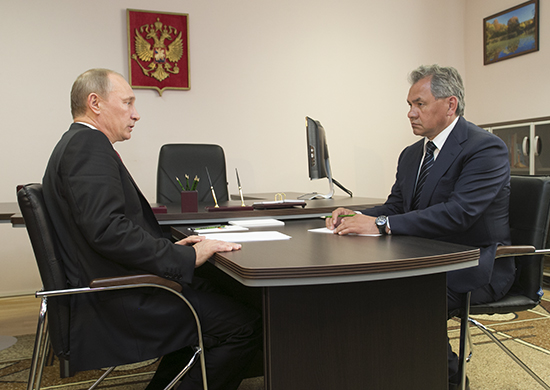
Putin and Shoygu (photo: mil.ru)

Putin and Shoygu (photo: mil.ru)

President and Glavk Vladimir Putin ordered Defense Minister Shoygu to conduct another readiness exercise yesterday.  This time in the Eastern MD, to include the Pacific Fleet.

Putin hinted he might show up in the Far East to watch.

The Supreme CINC directed that particular attention should be paid to transferring large masses of troops to assembly points, to transportation support, and to logistical and medical support.

Putin ordered Shoygu to:

“Also conduct all necessary measures relative to rescue at sea and the rescue of transportation means, including the submarine fleet.”

Apparently, the Glavk’s bitter (but important) memory of August 12, 2000 is jogged at this time of year.

He said he regards this year’s readiness checks as highly effective and extremely useful in eliminating problems.

Today Mil.ru indicated the exercise has started, and expanded a bit.  It includes not only the Eastern MD and Pacific Fleet, but the Central MD, LRA, and VTA.

The “formations and units of the Central MD’s Novosibirsk large formation” (i.e. the 41st CAA) will play a notional enemy role.

The ex aims to evaluate sub-units’ readiness to fulfill designated missions, the skill level of personnel, technical readiness, and proper outfitting with weapons and equipment.

As in others, the readiness ex will feature marches (convoys) to unfamiliar ranges far from permanent bases for two-sided tactical play with combat firings.

It will test the operational mobility of a formation (brigade) to a distance of more than 3,000 km.  Troops will move by rail, ship, and VTA.  More than 80,000 personnel, 1,000 tank and armored vehicles, 130 aircraft, and 70 ships will participate.  The drill concludes on 20 July.

Mil.ru also covered a high command videocon devoted to the ex.  Shoygu said up to 160,000 troops might be involved in one way or another.

Draft Details

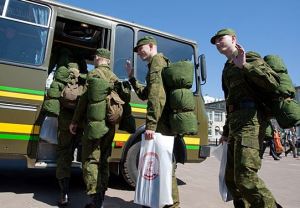
New Conscripts Depart for the Army (photo: Mil. ru)

New Conscripts Depart for the Army (photo: Mil.ru)

Another posting hiatus officially ends.

A recent Defense Ministry press-release on the conclusion of this spring’s draft campaign contained the following:

“According to the situation as of 2 July 2013, more than 582,800 men were summoned to proceedings connected with the call-up, to which more than 574,900 citizens came.”

President Putin’s March decree stipulated 153,200 men would be inducted into the armed forces in the first half of 2013.

We’ve not often seen figures on the number of young Russian men receiving a summons to appear at local draft commissions during conscription campaigns.

A check turned up only two more recent instances where the summons number was specified:

  • In fall 2012, 556,000 were summoned and 545,000 came against an induction target of 140,140.
  • In fall 2008, more than 800,000 were summoned against a target of 219,000.

The drop from 800,000+ to 500,000+ illustrates the abrupt break in the number of men liable to conscription which occurred between 2008 and 2013, i.e. the “demographic hole” caused by lower birthrates in the 1990s.

Still, it shows consistency — it appears the Defense Ministry (if it meets its induction target) conscripts 25 percent of the men it summons to draft commissions.

And the difference between summonses and appearances shows what looks like the number of draft evaders for that half year (i.e. 8,000 or 11,000).

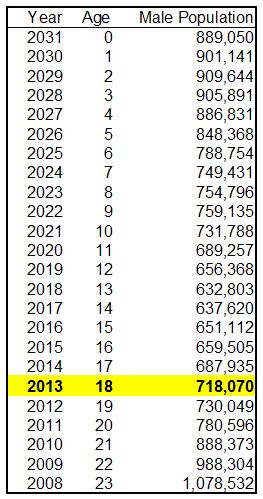
It’s interesting to compare the summons number to the number of available 18-year-old males.

The data below came from the U.S. Census Bureau, but the birth year in the left column was changed to indicate the year group will turn (or turned) 18.  The age column is the year group’s age in 2013.  According to this, you can see the nadir of the “hole” doesn’t come until 2018 and the climb out is long and slow.  The number of males born doesn’t even return to the level of 1990 (shown here as 2008) until some time after 2031.

Draft Age Males, 2008-2031

Draft Age Males, 2008-2031

So, this spring the Defense Ministry summoned 582,800 men against 718,070 available 18-year-olds.  Obviously, a significant number of those summoned are probably 19, 20, etc., and were summoned before, in 2012 or earlier.  And presumably, some who will be, but aren’t yet, 18 this year can’t be summoned until the fall 2013 draft.

The point being that the draft net has to be expanded considerably to bring in two groups of nearly 600,000 (even with many repeaters) to be considered for military service.  And it’s clear many brought in for the second or third time have solid legal deferments.  Some of them are, of course, drafted later.  Witness the Defense Ministry’s fondness for citing the percentage of draftees with complete higher education.

But it’s certainly harder for the military to draft an older man than it is one just turning 18 this year.  Economically speaking, the marginal cost of inducting a 22- or 24-year-old is much higher.  It requires greater effort on the commissariat’s part and the average return on the time invested is much lower.

It’s hard to guess the mechanics of the draft, but here’s a whack.

As stated above, the Defense Ministry puts 582,800 men in front of draft boards to find 153,200 it will accept.  Of those 718,070 18-year-olds in 2013, presumably only half have birthdays allowing them to be drafted in the spring.  So, in a perfect world, that’s 359,035 of the men needed at the draft commission.  And 223,765 are still needed.

The Defense Ministry looks first to this year’s 19-year-olds.  There are 730,049 of them.  But many served, or will have served, in 2012-2013.  The draft campaigns last year inducted 155,570 and 140,140 for a total of 295,710 men.

Here’s where real guesswork begins.  If 200,000 18-year-olds were drafted last year, there are only potentially 530,049 19-year-olds to send some of those other 223,765 summonses to this year.  And if deferred, their deferments probably still hold this year.  And the undrafted 19-year-olds will probably need to be summoned again in fall 2013 even though another 359,035 men will turn 18 in the second half of the year.  Those 19-year-olds might be considered for induction in place of some large number of 18-year-olds already picked for the military in the spring.

But you get the picture of how rapidly the military’s human resources diminish.

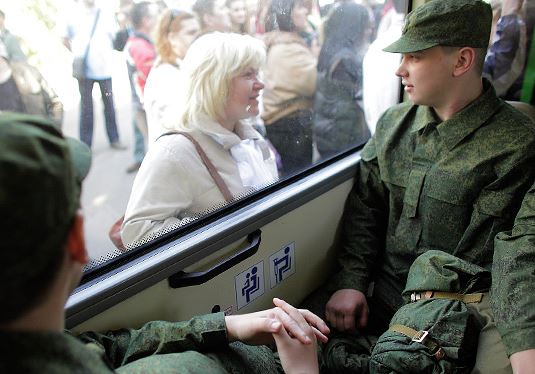
Bye Mom (photo: Mil.ru)

Bye Mom (photo: Mil.ru)

It’s far from a complete picture, but an interesting and essential part of the Russian military manpower dilemma.

Of course, the Defense Ministry has the long-term answer for its declining conscription resources:  professional contract service.  The trick there is to make it work.

Official Word on Contract Service

Deputy Defense Minister Nikolay Pankov

Deputy Defense Minister Nikolay Pankov

Yesterday NVO recapped the Defense Ministry position on efforts to enlist 50,000 contract servicemen in 2013.  

The Armed Forces have to recruit (and retain) 50,000 each year through 2017 when they’re supposed to have 425,000 contractees.  President Putin decreed the goal upon his inauguration for a third term.  

Defense Minister Sergey Shoygu addressed contract service in a Monday videoconference.  He said the army has to enlist 60,000 contractees to reach 240,000 by the end of 2013.  Shoygu factored in more to cover the  anticipated departure of 10,000 current enlisted.

Deputy Defense Minister, State Secretary Nikolay Pankov reported the armed services had 186,000 contractees on January 1.  He said the selection of candidates is running a little ahead of schedule:

“This year the first quarter target indicator was fulfilled at 107%.  10,699 men were picked and accepted for military service.  In the second quarter we are planning to accept not less than 18,500 men for military service on contract, including 4,500 men in April.”

Defense Minister Shoygu addressed reestablishing warrant officer ranks eliminated by his predecessor.  He ordered up a directive listing the technical posts to which warrants will be assigned:

“Not depots or bases — only to those places where we really need specialists in maintaining complex equipment and complex weapons systems.”

Though not noted by NVO, according to the Defense Ministry account, Shoygu said 14,000 servicemen are no longer on ordnance disposal duty since explosive methods were halted.  He wants to hand shipbuilding companies the repair and dismantlement duties now carried out by 5,000 sailors. 

He didn’t specify whether these servicemen are conscripts or contractees.  But he apparently agrees with his predecessor’s emphasis on getting uniformed personnel out of non-core functions.

But back to signing up 50,000 contractees for service this year.  Is it possible?

Defense Ministry recruiting centers opened in August, and Mil.ru’s reported their numbers.  Some from the fall, others from the first quarter of 2013.

  • The Western MD indicated it dispatched 2,500 new contractees by early January.  The Murmansk Oblast, by itself, has to recruit 3,000 this year.
  • The Central MD recruited 1,100 in late fall, and has to enlist 5,500 in 2013.
  • The Eastern MD reportedly recruited 1,000 by March, and its number for the year is 11,000.
  • No word on overall Southern MD numbers.

So the country’s most sparsely inhabited regions need to provide about one-third of the contractees for 2013.  More populated western and southern areas have to provide two-thirds.  They should have supplied roughly 3,000-3,500 recruits each to reach the first quarter total of 10,699.   

Based on the early results, it doesn’t seem possible.  Recruiting centers had a “running start” during the fall.  And it’s likely the most interested men signed up right off.  Finding candidates may be harder later in the year.  And it may be easier now than in 2014, 2015, etc.

What’s It Cost?

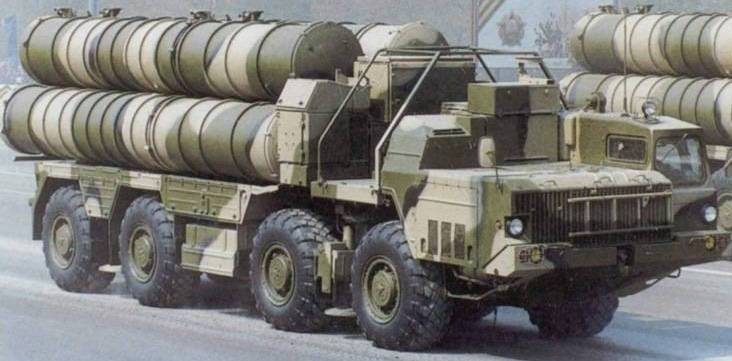
S-400

S-400

A reader recently asked:

What’s the cost of one division of the S-400 for Russia and for foreign customers?

Let’s call it a battalion (дивизион).  We’ll start with exports (for which there is actually data).  And we proceed from what was paid for the S-300.

Russia’s planned sale of the S-300PMU1 to Iran reportedly involved the transfer of five “battalion sets” for $800 million.  Some sources said as much as $1-1.2 billion.   

Let’s guess the “battalion set” has three firing batteries, with two launchers per, for a total of 30 TELs, 120+ missiles, and all associated radars, fire control systems, and vehicles.

If $800 million is accurate, the price for one battalion was $160 million.  The price for one S-400 system, four missiles on a TEL, was roughly $27 million.

This isn’t unlike what the Chinese paid for the S-300 in the 1990s and 2000s.  According to Sinodefence.com, they bought battalions for between $25 and $60 million at different times under different contracts.

That done, we make the leap from the S-300 price to the S-400 price.

A couple years ago, Vedomosti drew the scarcely precise conclusion that the price of the S-400 will double the S-300’s price (and the S-500 double the S-400’s). 

So perhaps a “battalion set” or a battalion of the S-400 will go for $320 million.  That would be one full-up launch vehicle for $40-50 million.

The only other shred of information is the widely-reported Financial Times story saying, if the Russians added the S-400 to a $2 billion arms deal with Saudi Arabia, the price of the sale would climb to $7 billion.  But lots of Russian reports say Moscow won’t be selling the S-400 abroad soon.  The military obviously hopes that’s true, so it can get first.

But not every customer is Iranian, not every one will have to pay a premium price, and not every customer is foreign.

Which brings the trickier question of what Russia’s Defense Ministry has to pay.  It’s simply impossible to guess.

Certainly a lot less than buyers abroad.  The military’s bought some S-400 systems so there is a going price.  OAO Concern PVO Almaz-Antey’s costs are a big question as is the level of profit the government is willing to tolerate.  

The government owns Almaz-Antey, so one part of government is selling to another.  It’s a prime example of angst over GOZ “price formation” in recent years.  There was a similar big-ticket dustup over submarine prices with Sevmash.  It’s something of a Mexican standoff.  The buyer doesn’t have other supplier alternatives.  And the seller may not be allowed to sell elsewhere. 

The Defense Ministry, the government don’t want to pay a lot and have the power to refuse and yet still receive goods.  The question is how many.  That’s ECON 101, friends.

If those buyers set their price below equilibrium, Almaz-Antey will provide a lower than desired quantity more slowly than the buyers want.   And Almaz might have other buyers as an option, an advantage Sevmash lacks.  So “price formation” for the S-400 is all about agreement on Almaz’s costs and an acceptable level of profit.  That agreement is apparently not smoothly worked out yet.

Clean Slate

It took a brave man to tell the State Duma what department chief Aleksandr Piskunov said in the Audit Chamber’s annual legislative report in February.  Voyenno-promyshlennyy kuryer published excerpts of his remarks.

Piskunov’s a government official.  Not a powerful voice, but an authoritative one in his specialty.

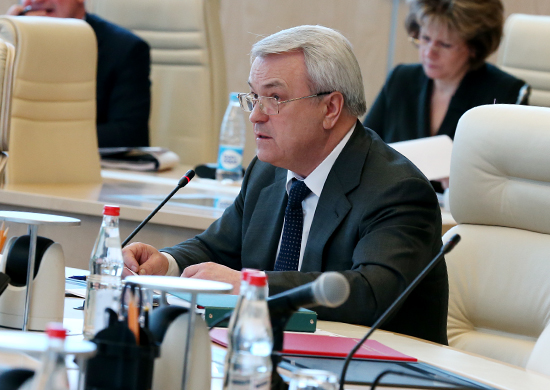
Auditor Aleksandr Piskunov

Auditor Aleksandr Piskunov

To say he’s well-equipped for his work is an understatement. 

Sixty-one or 62 years old, Piskunov graduated from the RVSN’s Dzherzhinskiy Military Academy with a radio engineering degree.  He served on active duty to the rank of general-major, spending many years at the Plesetsk cosmodrome.  He later trained in the RF Government’s Financial Academy and a business school in London.  He has a PhD in economics.

Piskunov served in both the RSFSR Supreme Soviet and State Duma in the early 1990s, and was deputy chairman of the Defense Committee for each body.  He also chaired the Defense Ministry’s Military-Technical Policy Committee.  In the mid-1990s, he moved to the staff (apparat) of the RF Government and was deputy chairman of its Committee on Military-Industrial Issues.

He returned to the Duma briefly in 1999, and became deputy chairman of its “Regions of Russia” faction.

He went to the Audit Chamber in 2001, and is currently in his third term of service.

Piskunov thinks Russia can’t produce new, better, or more weapons and military equipment without modernizing its badly neglected defense industrial base.  But he has pretty much nothing but scorn for the current management of the state defense order.  And he sees little but failure in the GPV over the last 20 years.  In particular, Piskunov calls for incorporating life cycle costs into the GPV.  Ultimately, however, he says auditors and accountants can’t fix the GOZ or GPV, but lawmakers could.

Enough preamble.  Here’s VPK’s excerpt of Piskunov’s remarks.

“STRICT CONTROL OF FULFILLING THE ARMAMENTS PROGRAM IS NEEDED”

“I represent a department that performs strategic audits in the Audit Chamber.  We’ve done a lot of work in evaluating the condition of practically all 1,350 enterprises of the defense-industrial complex, their financial stability and real contribution to equipping the Armed Forces.”

“We looked at how balanced the program of defense-industrial complex modernization and State Program of Armaments were.  A gap of 700 billion rubles was observed.  At the same time, 1 trillion 200 billion is built into the budget to guarantee compensation to enterprise directors who go to commercial banks for credits.”

“Similar credit practices are leading to the growth of OPK enterprises with an unstable financial situation.  More than 30 percent are like this.  Only 20 percent come close to world standards in technical equipping.  More than half are in a condition where their restoration is already senseless — it would be better to build from a clean slate.”

“In preparing the law on the state defense order we tried to correct this situation.”

“From my point of view, our system of administering the state defense order is uncompetitive.  The adopted law preserved the situation under which  management amounts to a lag in the state defense order.”

“The deputy prime minister, responsible for the defense-industrial complex, reported that the state defense order was fulfilled by 99 percent as in past years.  But almost one hundred percent fulfillment of state defense orders over the last 20 years has not prevented the failure of all arms programs or fulfilling them at 30, 40, 50 percent.”

“Dmitriy Rogozin himself noted that fulfillment happened because of the appearance of realization.  During the execution of the arms program 7,200 changes were introduced into it, that is the real result is being slanted to agree with this fact.”

“Meanwhile Rogozin recognized that the arms program has gotten old.  The task of preparing a new State Program of Armaments stands before him.  So the problem of forming a legislative basis and management of the State Program of Armaments is more acute than ever.”

“Our opponents in government, having considered it inexpedient to include the management of the acquisition program life cycle in the GOZ law, said it was necessary to include this management in the law on the State Program of Armaments.”

“To me it seems necessary in this instance to hold them to their word — to propose that the government prepare a draft law on the State Program of Armaments.  It’s possible this will allow us to compensate for not realizing it in the GOZ law, and meet the president’s demand to create essential management of the life cycle of weapons systems.  But today the state of affairs is seriously complicated by the fact that the life cycle is really torn into several parts in the Defense Ministry itself.”

“Those who’ve served understand:  you can’t modernize armaments without the experience of using them.  Who really tracks all this life cycle?  It would be logical if Rosoboronpostavka were occupied with this, but it is located at the junction of the functional orderer — a service of the Armed Forces and a contracting firm.  It would be more appropriate to subordinate this department to the government.  It’s perfectly clear that the main risks are connected not to corruption, but to the low qualifications of the orderer.  Someone needs to “hang” over the orderer from the point of view of its responsibility for how both the program and the contract as a unitary whole are being executed.  Juridical responsibility is not rebuilt only through the contract.”

“The level of project management in our ‘defense sector,’ unfortunately, is also very low, especially the quality management system.  We are all witness to what is happening now in space.”

“It’s frightening that it’s impossible to create new equipment without metrics.  We lost the project management culture and stopped training specialists in military academies and schools.  The very best on this plane is OOO ‘KB Sukhoy’ and it used the American experience-plan for metrics on developmental aircraft.  The Americans seized and simply closed the issue — this project is no longer being supported.  To rewrite project documentation now in some kind of domestic variant is complex, therefore the development of these systems is essential.”

“The participation of commercial banks in providing credit for the state defense order is an important question.  Now in the government they are discussing how these 23 trillion will go — through commercial banks, for free or for money?  It’s understood that banks simply don’t work that way.  There is a precedent — the government resolution on the Mariinka, the Bolshoy [theaters], the M-4 [highway].  If you calculate it, then 20 percent received from 23 trillion over these years, it’s necessary to take an additional amount from the taxpayers or cut the defense order by this sum.”

“Not less sensitive is the issue of intermediaries.  If the Defense Ministry and government don’t put transactions under the strictest control, then there are all the calculations on the defense order, life cycle and cooperation levels, we will mess up this program of armaments also.  This, undoubtedly, is one of the most dangerous questions for the Defense Ministry — too large lobbyist forces participating, too large sums going.”

“Questions of managing the life cycle and control of finances are the most fundamental.  The treasury is incapable of resolving this task.”