Serdyukov Speaks to Investigators

Former Defense Minister Serdyukov apparently decided to speak to investigators last week, shifting his previous stance of taking the 51st or providing written statements.  Media outlets said the appearance of “new materials” caused the change in his tactics.

Last Monday, Newsru.com recapped a Kommersant story saying that Serdyukov’s signature was on documents transferring the Bolshoy Utrish property to his brother-in-law Valeriy Puzikov.  But investigators haven’t talked to the ex-minister about that case yet, which they say amounts to large-scale fraud by a group of conspirators.

Recall the Defense Ministry obtained this Black Sea coastal property near Anapa in 2010 to build a radar station, but, with the help of Yekaterina Smetanova, it was excessed for two-thirds of the military’s purchase price to Puzikov. 

According to Newsru.com from Tuesday, Serdyukov was called to the GVSU SKR to meet with investigators about the Zhitnoye dacha.  ITAR-TASS said he provided 11 pages of evidence, and claimed the Defense Ministry participated in this civilian project out of military “necessity.”

On Wednesday, Politkom.ru commentator Tatyana Stanovaya reported that the ex-Defense Minister talked to investigators for five hours.

She believes Putin doesn’t want Serdyukov to sit in jail, and anonymous media sources say he told SKR chief Aleksandr Bastrykin as much early on.  She sees it like this:

“It’s important for Putin to sort out the corruption cases, to intimidate the elite, but generally not to get worn out with real purges.  He recognizes corruption as an evil, but an unbeatable evil which is part of Russia’s historical tradition.  In other words, for Putin thievery is an insufficient basis for ‘sitting’ given the political loyalty of the ‘figure.'”

Bastrykin notwithstanding, the siloviki think they long since had enough evidence for Serdyukov’s prosecution. 

Stanovaya cites Kommersant’s report that the former minister decided to cooperate, to talk, because investigators recently conducted searches and seized documents on the case from his relatives.  The commentator believes his more constructive position improves his chances of escaping the affair without criminal charges.

If the existing affair of the three dachas weren’t enough, Nezavisimaya gazeta unearthed another issue last week.

In the deal to import light armored vehicles from the Italian firm IVECO, Serdyukov’s Defense Ministry allegedly conspired to avoid paying customs duties amounting to $10 million.  All for vehicles of questionable suitability for Russian conditions.  NG concludes charges will be brought against the Oboronservis officials involved in the purchase.   

The paper wonders out loud if Serdyukov will play a part in the regime’s anti-corruption campaign (such as it is): 

“A critical mass of dissatisfaction is accumulating.  The country’s leadership is turning into a hostage of its own effort to reprove part of the confused elite in this way.  Citizens have learned too much about the life of high officialdom so it’s possible the ‘valve could turn’ at any moment.  It’s possible for this besides the usual cosmetic means of a party-political character a serious sacrificial victim is required — if the process of disclosures goes far enough.  It’s possible that now some backstage casting for the role of such a victim is going on.”

Izvestiya provided details on Serdyukov’s personal involvement in building Puzikov’s resort on Zhitnoye, where he claimed officers could stay (but not for free) after air defense exercises at Ashuluk.  The former Defense Minister traveled to the site 17 times between 2010 and 2012, while the road construction and landscaping was in progress, on Air Forces helicopters leased to Chkalov Avia.  That company’s majority owner is Anna Tretyakova, and her mother Yelena is general director of Zhitnoye.

Former General Staff Chief Makarov reportedly told investigators he ordered railroad troops (v/ch 42677) to build the 6.7-kilometer road and three bridges on Serdyukov’s personal order.  The construction materials came from that unit. 
 
A law enforcement source told the paper Puzikov and Serdyukov didn’t miss a trick: 
 
“First they built themselves a dacha at government expense, and then they wanted to rent out the very same — also at government expense.”

Moskovskiy komsomolets concludes Serdyukov’s assertion that Zhitnoye would serve the needs of servicemen would be funny if it weren’t so sad.  Then:

“So, as ‘MK’ has already written, Serdyukov must sit.  Otherwise Vladimir Putin can’t prove to 140 million Russian citizens that he is as before master of the situation.”

On balance, it seems prosecutors are closing on Serdyukov.  As written here in November, there’s too much blood in the water.  Putin will sacrifice him.  His effort to rebalance the political system he created depends on more than not letting the siloviki have Serdyukov.

And what of Serdyukov-instituted reforms which promised to change still largely Soviet Armed Forces into a more modern military?  The pain of reforms joined with the taint of high-level corruption to undermine them.  Their opponents could not possibly devise a more ingenious strategy to discredit them.  That too would be funny if it weren’t so sad.

If That Was Cosmic . . .

If 2011’s corruption figures for the armed forces were cosmic, what are 2012’s?

We usually get various prosecutors’ reports about this time.  This year’s no different.

Newsru.com picked up some of Main Military Prosecutor Sergey Fridinskiy’s comments on military corruption from the GVP’s web site.

The biggest issue, of course, is Oboronservis, 25 related criminal cases, and more than five billion rubles in damages to the state.  But those future facts and figures don’t play into Fridinskiy’s 2012 report.

In 2012, Fridinskiy said crimes by officers, as a share of the armed forces total, reached their highest level in 10 years — 30 percent.  The share of crimes by contract servicemen increased by 14 percent.

The overwhelming motive, said Fridinskiy, was greed, and losses to the state tripled to 11 billion rubles.

According to GVP data, every fifth crime involved corruption.  Losses from corruption exceeded seven billion rubles.  Bribery cases rose by a third.  Embezzlement and misappropriation by two times.  And fraud by almost 20 percent.

Three higher [general] officers and 210 senior officers, including 64 military unit commanders and chiefs of various facilities, were convicted of corruption-related offenses.

Promotion List

On February 20, President Putin, as is customary, issued a pre-Defender’s Day promotion list.  The link takes you to a page with an Excel file.  Click on the icon for “View full-size workbook” and you’ll access the entire spreadsheet on the Microsoft Skydrive site.

Putin promoted forty officers.  Most of their duty posts are identified on the spreadsheet.

You can see the original promotion list at Pravo.gov.ru or Krasnaya zvezda.


It’s All Relative (Part II)

Regret the delay in returning to the rest of this summary of the Oboronservis scandal from Newsru.com.

“The ‘Oboronservis’ Affair:  Figures and Episodes”

“Despite, more precisely, thanks to his unconstructive, in the SKR’s opinion, silence, Serdyukov continues to keep his witness status in the ‘Oboronservis’ affair.  At present the number of accused has reached eight.  And the charge of particularly large-scale fraud has been leveled at the former head of OAO ‘Oboronservis’ Vasilyeva (the restraint measure is house arrest), Smetanova (personal recognizance) and Zakutaylo (arrest).  Smetanova is also implicated in commercial bribery as a result of investigation of activity which the ‘Oboronservis’ affair initiated.”

“Another branch of the anticorruption investigation concerns OAO ‘Slavyanka’ and ZAO ‘Security and Communications.’  The three affairs, united into one case, arose over falsely signed statements of completed construction and cleaning work on Kolymazhnyy Lane, the Military Academy of the General Staff and a number of other facilities.  As of today in this affair the charge of particularly large-scale fraud has been leveled at five:  former general director of ‘Slavyanka’ and ‘Security’ founder Aleksandr Yelkin; Andrey Luganskiy, who has been general director of ‘Security’ since April 2011; ‘Security’ head bookkeeper Yuliya Rotanova.  And also Nikolay Ryabykh and Konstantin Lapshin — former acting chief of the Defense Ministry’s administrative directorate and chief of ‘Slavyanka’s’ repair department.  All of them are under arrest.”

“The largest part of criminal cases in ‘Oboronservis’ concerns the disposition of several pieces of property.  They are the complex of buildings ‘31st State Planning Institute of Special Construction’ and the ‘Main Directorate of Troop Installations,’ the hotel ‘Soyuz’ and the premises of OAO ‘Mosvoyentorg’ on the Arbat, buildings in the working-class village Bolshiye Vyazemy in Moscow Oblast, land plots in St. Petersburg.  Part of the matters arose over the facts of theft of money upon the conclusion of contracts with ‘Expert’ Smetanova, for example, in the sale of shares in Moscow-based ‘Central Experimental Production Combine’ and stakes in ООО ‘436th Non-Metallic Minerals Combine’ in Leningrad Oblast.”

“‘Thanks to timely intervention we succeeded in preventing the illegal, in our view, disposition of the building of the directorate of trade of the Moscow Military District on Bolshaya Serpukhovskaya Street in Moscow, and also the oil transshipping complex in the village of Roslyakovo-1 in Murmansk Oblast,’ – GVSU Chief Sorochkin boasted to ‘Rossiyskaya gazeta.’  He also recalled that today the general amount of losses, suffered by the state in the ‘Oboronservis’ affair, exceeded four billion rubles.”

“Serdyukov’s Brother-in-Law Could be Called for Questioning”

“So, investigators tactfully sidestep the question of whether the appearance of new figures and still more accused in the ‘Oboronservis’ affair is expected.  There are already a number of candidates to populate the list.  For example, there’s Marina Lopatina, ex-chief of OAO ‘Voyentorg’ and the ‘Red Star’ subholding.  But also head of ‘Oboronstroy’ Larisa Yegorina.  Both ladies are thought to be former classmates of Vasilyeva and at present are alleged to be on the run.”

“There are suspicions that Serdyukov’s brother-in-law is also on the run, still, it’s true, investigators are not confirming this information.  ‘I don’t have unambiguous information about this.  I confirm that we have questions for him, therefore he could be interrogated,’ – Sorochkin said.”

“Petersburg’s ‘Fontanka’ relays interesting facts from Puzikov’s life.  ‘No stranger to the family furniture business, Puzikov managed to achieve notable commercial successes also in the automobile business and in construction, and the amount of property he’s acquired is striking,’ – the article’s author notes.”

“According to the publication’s information, the Kuban native Puzikov built an expensive development where his neighbor found a space for Serdyukov’s OAO ‘Furniture-Market’ (the former ‘Lenmebeltorg’).  At the same address nine companies, fully or partly controlled by Puzikov, appeared, for example, OOO ‘Avtotsentr Soyuz 021.’  The auto business generally attracted Puzikov’s attention, ‘Fontanka’ notes.  So, he owns 15% of OOO ‘Aksel Group’ – a large dealer of BMW, Volkswagen and Toyota automobiles, one of the showrooms of which is located in the very same expensive development.  Incidentally, also located there is OOO ‘Avtoservis-MM,’ where Viktor Zubkov, father of Serdyukov’s wife Yuliya Zubkova bought a Toyota Land Cruiser, ‘Fontanka’ writes.”

“The publication also reports that Puzikov together with Aleksandr and Petr Usov and Artur Pozov was involved in construction, and also bought up property in Leningrad Oblast.  According to YEGRYUL [Unified State Register of Juridical Persons] data, today limited liability companies ‘Alyans’ (until 2012 – ‘Furniture-Market’), ‘Petersburg Agricultural Corporation,’ ‘Contemporary Food Technologies,’ ‘Investproyekt,’ ‘KRIOS’ fully belong to Puzikov, he has shares in OOO ‘Novyy Megapolis,’ ‘TrestStroyKomplekt’ and ‘InterVal.’  An OOO with the classic name ‘Vektor-SPb,’ in which Puzikov was the only participant, no longer belongs to him, but the firm remained in the larger family [?!] of the ex-defense minister — now its owner is Yevgeniya Vasilyeva, ‘Fontanka’ concludes.”

More on the Inspection

Inspection Report Delivered in Central Command Post

Inspection Report Delivered in Central Command Post

More reaction to the results of the inspection . . .

Nezavisimoye voyennoye obozreniye editor Viktor Litovkin expressed surprise at “the military’s absolute openness” in allowing journalists to attend General Staff Chief Valeriy Gerasimov’s report on the results of the exercise.

Litovkin noted the 98th Air-Assault Division’s 227th Parachute-Assault Regiment participated in the exercise.  Su-25 and Su-24 aircraft flew from 4th Air and Air Defense Command bases at Primorsko-Akhtarsk, Morozovsk, and Marinovka.

201st Military Base Commander, Colonel Sergey Ryumshin attributed his problems in communicating to the Russian military in Tajikistan using old local phone lines, which are often out of order.  Gerasimov ordered the chief of the Main (?!) Directorate of Communications to sort out the problems.

Litovkin added that part and system malfunctions kept five Mi-8 and Mi-24 helicopters from the 2nd Air and Air Defense Command’s 565th Aviation Base from joining the exercise.  Su-25 ground attack aircraft from the 4th Command’s 6972nd Aviation Base returned home without dropping ordnance. 

Two Msta-S artillery systems were out of order in the Central MD’s 28th Motorized Rifle Brigade.  Oleg Sidenko [sic] was there to answer for this.  He said there are defects in 900 Msta-S systems.  Siyenko, you’ll recall, is General Director of Uralvagonzavod, owner of Uraltransmash.  The latter has a contract to maintain the Msta-S, but needs to buy new components from sub-contractors.  Siyenko indicated he wants his enterprise to take over Oboronservis affiliate Spetsremont, currently responsible for Defense Ministry armored vehicles.  He said UVZ can’t constantly make repairs “on the fly.”

Litovkin reported 100 R-168-5un radios in the 58th Army are inoperable.  Specialists call these systems from the Yaroslavl Radio Factory unreliable.

However, an earlier NVO article, by Oleg Vladykin, points to the positive; 20 VTA transports were able to operate successfully. 

Vedomosti’s Aleksey Nikolskiy summed the inspection up this way:

“In Soviet times such evaluations were conducted so often that every officer fell into them at least once every two years, says retired Colonel Viktor Murakhovskiy.  Unsatisfactory results after so many years without normal combat training don’t surprise the expert, in his words, such an inspection is very useful and will give the Genshtab a picture of the true condition of combat readiness.  The reason such a large quantity of equipment is out of order is also fully clear — organizational chaos has ruled in the realm of equipment repair in the troops in recent years, the expert says.  Therefore Defense Minister Sergey Shoygu’s decision to return repair sub-units which were liquidated in the course of the transition to outsourcing should be implemented as quickly as possible.”

Yes, it’s not surprising, and the honesty is the first step toward improvement.  But we should remember the civilian side of the Serdyukov-led Defense Ministry really didn’t, and wasn’t supposed to, worry too much about what the troops could do in strictly military terms.  That was properly the responsibility of the General Staff.  Shouldn’t it be criticizing itself too?  Shouldn’t it have come forward about problems earlier?

And one has to wonder, in the relatively short period of time since Serdyukov announced the outsourcing of most army maintenance, how much outsourcing was actually done?  Certainly some, but certainly not all of it.  Nevertheless, Serdyukov’s scheme is certainly bearing the brunt of the blame.  A proper question might be how capable were those repair sub-units before Serdyukov supposedly swept them all away?  Probably not very.

Army General Gerasimov promised surprise inspections and exercises will occur regularly now.  It’ll be interesting to see just how routine they become.

Surprise Inspection

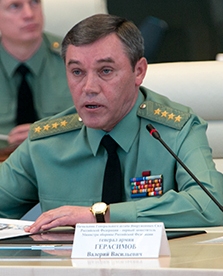
Army General Valeriy Gerasimov

Army General Valeriy Gerasimov

Complete coverage of General Staff Chief Valeriy Gerasimov’s remarks on the surprise inspection and readiness exercise can be found on Radio Voice of Russia or Mil.ru.

According to the newly-minted army general (four stars), the General Staff planned the inspection on the Defense Minister’s order.  It evaluated command and control organs, formations, and units of the Central and Southern MDs, VDV, VTA, and the 12th GUMO.  It was the largest of its kind in 20 years. 

The inspection began at 0400 on 18 February when operational and unit duty officers received packets with General Staff orders to go to higher states of combat readiness and carry out combat training missions.  This, Gerasimov said, required moving and transporting forces to exercise areas and “unfamiliar terrain” far from their permanent deployment locations.  The inspection included 7,000 soldiers, several hundred pieces of equipment, and 48 aircraft.

The General Staff Chief emphasized that the inspection was a complete surprise to command and control organs and troops to allow for objectively the combat readiness of formations and uncovering problems.

He praised the readiness and performance of sub-units of the VDV’s 98th Air-Assault Division (Ivanovo) and the 4th Air Forces and Air Defense Command (Southern MD / Rostov).  What was likely a battalion tactical group of the 98th loaded in twenty Il-76 transports and flew to Shagol outside Chelyabinsk, marched 100 km under difficult conditions (-20° C / -4° F, broken terrain, deep snow cover) to Chebarkul, and conducted its combat training.  For its part, the 4th VVS and PVO Command’s aircraft conducted bombing exercises with good or excellent results.

There were, however, “a number of systematic deficiencies in the state of combat readiness and lever of personnel training.” 

In practically all evaluated elements, duty officers showed weak skill in transmitting orders via automated combat command and control systems.  They weren’t certain how to receive the order to go to higher readiness.  In the VDV and the 201st Military Base, it took too long to send signals to subordinate troops.

In the Central MD’s 28th Motorized Rifle Brigade, training center graduates, drivers, and mechanic-drivers showed a low level of training.  Tank and BMP crews usually got only satisfactory in firing exercises.  Young officers just graduated from military schools exhibited poor knowledge of weapons and equipment.

Equipment generally performed reliably, given the weather conditions and its age.  Some of it required repair in the field, and, according to Gerasimov, this demonstrated the expedience of the Defense Minister’s decision to reestablish maintenance units.  But they need more training, spare parts, and improved organization.  Factory repair is more problematic:

“Sufficiently efficient work by repair factories and industrial enterprises is a serious problem for the troops.  Equipment coming from capital or medium repair, even under a service guarantee, often breaks down in the first months of its use in line units.  An analysis of deficiencies discovered is currently being conducted.”

Interesting, where does the fault lie?  The factory or troops and young officers who don’t know how to use or repair it?

Gerasimov admitted and lamented that nearly two-thirds of aircraft (in units being drilled?) is out of repair.  He called effective resolution of this problem the most important joint task of command and control organs and industry.

Gerasimov called the BMD-2 both obsolete and worn-out at 20 to 25 years old, or even more.  At 14.2 metric tons, he said the BMD-4M’s weight is at the limit for air transport, and an Il-76 can only carry three.  The General Staff Chief cited repair problems with Mi-8 and Mi-24 helicopters, Su-25, self-propelled Msta artillery, and R-168-5un radio.  He indicated the still experimental Volk armored vehicle doesn’t meet 12 of its TTZs and won’t undergo repeat state testing.

Gerasimov said the Defense Minister has decided inspections like this will now take place on a regular basis.

Happy Defender’s Day

It's Not a Search (photo: Polit.ru)

It’s Not a Search (photo: Polit.ru)

Nervous times for some in the Defense Ministry.

The mail delivery woman knocks on the Defense Ministry’s door and says, “Open up, don’t be afraid!  It’s not a search.  It’s a postcard for 23 February.”

It’s a Defender’s Day greeting with a tank and red star, reading “I congratulate you on 23 February . . . .”

Cartoonist Sergey Yelkin (Yolkin, Elkin, Ёлкин, Елкин) is a Russian national treasure however you spell his name.

To this English speaker’s fingers, reaching for and finding the Ё key is akin to a holy fool wandering from Moscow to Anadyr.

Yes, if one had a category for Cheap Posts, this would be filed there.

It’s All Relative (Part I)

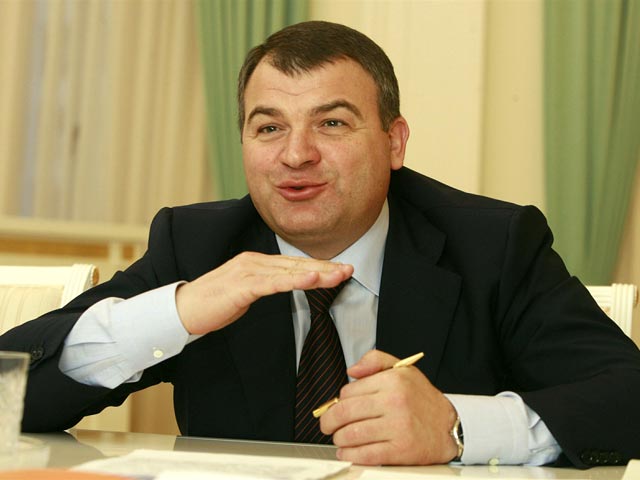
Serdyukov in More Ebullient Times (photo: Russianlook.com)

Serdyukov in More Ebullient Times (photo: Russianlook.com)

The SK tried again Tuesday to question former Defense Minister Serdyukov about the disposition of military property near the resort town of Anapa.  But, as Interfaks reported, Mr. Serdyukov once more invoked his 51st article right against incriminating himself or close relatives.  And RF Prosecutor General Yuriy Chayka told the Duma the entire Defense Ministry corruption affair now adds up to 25 criminal cases and more than 5 billion rubles in losses to the state.

Newsru.com nicely wraps the state of play in the Defense Ministry scandal.  It’s entitled “Relatives Saving Serdyukov:  Investigators Address the Affair’s Outlook, Journalists — His Family Business Ties.”

“The inquest has brought preliminary investigative results in the ‘Oboronservis’ corruption affair, whose episodes and figures have grown so strongly for several months it’s no wonder people are confused.  The results are as yet inauspicious — the figures are silent, shielding themselves with the Constitution, or they are fleeing the country.  But, investigators note, it’s premature to say the affair will begin to subside and the former defense minister will remain in his previous status [witness].  And journalists meanwhile are trying to unscramble the great tangle of family ties enmeshing the corruption affair.”

“‘Serdyukov is going through this affair as a (‘landscaping’) witness.  To make any supposition concerning his procedural status in the future is incorrect, at a minimum.  I can assure readers of only one thing — professionals who will sort out this affair perfectly and will precisely name everyone who is guilty in what has happened work in the SKR’s Main Military Investigative Directorate [GVSU],’ director of the SKR’s Main Military Investigative Directorate Aleksandr Sorochkin told ‘Rossiyskaya gazeta’.”

“The business about improving recreation facility ‘Zhitnoye’ which belongs to Anatoliy Serdyukov’s brother-in-law Valeriy Puzikov, as is known, is not the only one on which the inquest has concrete questions for the ex-minister. But they still haven’t managed to get his statements on this episode or on others.  As is known, on 19 February Serdyukov, together with his girlfriend and ex-chief of the Defense Ministry’s property department Yevgeniya Vasilyeva, was called for questioning on episodes involving land near Anapa and the activity of the St. Petersburg engineering-technical center, which the already earlier mentioned Puzikov directed.  But both refused to talk, citing the 51st article of the Constitution on the right not to bear witness against oneself and relatives.”

“If all three figures weren’t relatives [sic?], then investigators could make them criminally responsible according to art. 308 UK RF (‘Refusal of witness or victim to give statements’), levy a fine and even arrest them for a term up to three months, ‘Kommersant’ notes.  In this way, family ties have saved the ex-minister from potentially dangerous outcomes.”

“In a conversation with ‘RG’ the main military investigator presented the results by the number of episodes and figures well-known at present in the ‘Oboronservis’ affair.  As concerns Serdyukov, for him, the witness, there are immediate questions on the three ‘dacha’ episodes.”

“Serdyukov’s Three ‘Dachas'”

“The first is the ‘Zhitnoye’ recreation facility in Mouth of the Volga, owned by his brother-in-law, but managed by the mother of the CEO of OOO ‘Chkalov Avia’ Yelena Tretyakova, whom they earlier suspected of transporting facility guests and soldiers involved in its landscaping (‘ the aviation episode’) at Defense Ministry expense.”

“The second ‘recreational episode’ concerns a plot in Temryuk Rayon of Krasnodar Kray, where, it’s alleged, an elite vacation home was built on land illegally transferred from the Defense Ministry.  They’ve dubbed the facility with its grand buildings, pool, park, quay and helicopter pad served by locals ‘Serdyukov’s dacha’.  Considered instrumental in the acquisition of this former military land is the ex-chief of Moscow Air Forces District depot Maksim Zakutaylo — common law husband of Yekaterina Smetanova, ex-director of OOO ‘Expert’ Legal Support Center’ and accused in a number of other episodes.”

“And finally, there are questions for Serdyukov about the allegedly illegal disposition of military land in the village of Bolshoy Utrish near Anapa.  In 2009 the Defense Ministry wrung this territory out of itself for the construction of a radar station for Black Sea Fleet ships rebasing from Sevastopol, however built it up with cottages, ‘Kommersant’ writes.  According to some information, the personal signature of Serdyukov is on documents about the land’s transfer.  And the very same brother-in-law Puzikov worked on developing the property.”

Gerasimov Speaks

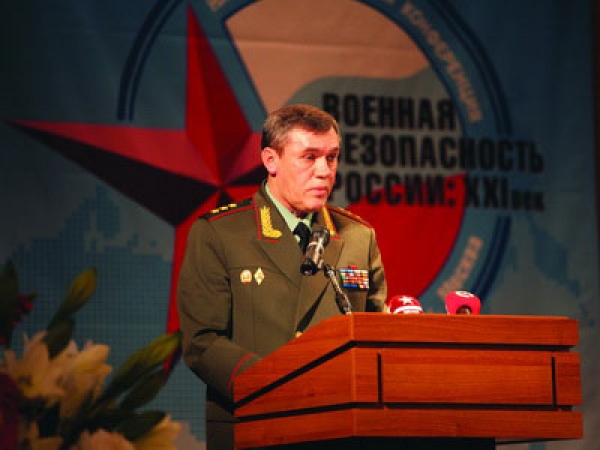
Gerasimov on RF Defense Priorities

Gerasimov on RF Defense Priorities

On Thursday, General Staff Chief and First Deputy Defense Minister, General-Colonel Valeriy Gerasimov spoke about RF defense priorities at a conference on Russia’s military security in the 21st century.  The meeting was organized by Duma and Federation Council defense committees.

Gerasimov largely repeated earlier official statements, but added a few comments that might be significant for what they left out.

Strategic nuclear forces are, of course, Russia’s priority.  He mentioned acquiring Topol-M, Yars, and SSBNs, modernizing Tu-160 and Tu-95MS bombers, and getting satellite systems for VVKO, according to Krasnaya zvezda’s recap of his remarks.

For conventional forces, among other things, Gerasimov said VTA will get 200 new transports, and the Ground Troops and VDV new heavy, medium, and light armor using the Armata, Kurganets, and Bumerang platforms, respectively.

The VKO system for protecting important state and industrial facilities will be formed in 2016-2020.  Mobile S-500 brigades will have this mission.  Troop air defense will be the responsibility of SAM brigades equipped with the S-300V and Buk-M3.

All Ground Troops missile brigades will have the Iskander.

The new NGSh declared that, since the 2008 decision to make “cardinal changes” in the Armed Forces, the share of new types of arms in the army has increased from six to 16 percent.

He apparently didn’t say anything about a new strategic bomber or surface combatants beyond frigates.

On the possibility of Russia being dragged into armed conflicts by 2030, Gerasimov said the level of existing and potential military danger will increase because of competition for energy resources and trade.  He nodded to net-centric and information warfare saying they are a new fourth dimension for conflict.

Gerasimov addressed non-military warfare:

“The role of non-military means of achieving political and strategic aims, which in a number of cases significantly surpass military means in effectiveness, has grown.”

“They expand clandestine military measures, and include informational confrontation measures, the actions of special operations forces, the use of the population’s protest potential.”

Also on Thursday, Gerasimov was asked about President Putin reducing the requirement for six months of military training to four before conscripts can be sent into combat.

According to RIA Novosti, the NGSh essentially said no one should worry about this because contractees would be used in combat.  Russia now has three brigades fully manned by contractees in the North Caucasus. 

He linked the reduction to the current one-year draft, and more intense training that prepares draftees for combat in four months.  He also claimed outsourcing has relieved them of “non-core” functions.  This despite the fact that outsourcing has fallen from favor along with former Defense Minister Serdyukov. 

What Gerasimov didn’t say is that there’s no legal bar to using a Russian soldier with four months of service in a combat operation.

RIA Novosti printed criticism of the conference, and of Gerasimov by implication, from former United Russia party and Duma Defense Committee member Mikhail Nenashev: 

“Everything we heard at this event had already been said a million times before in different auditoriums:  all participants shrugged their shoulders as if to say where do they get these reports?  There was no content, no line of thought, just some lecture.  Therefore it was a ‘check the box’ conference.”

“So, unfortunately, it wasn’t an event for the level of the 21st century.  These were conversations like in some garrison house of officers.”

GURLS

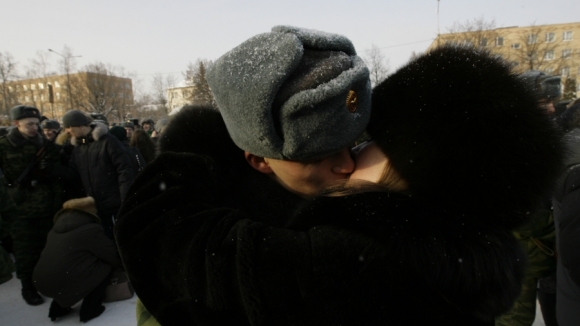
So, Do You Have a Girlfriend? (photo: Izvestiya / Gleb Shchelkunov)

So, Do You Have a Girlfriend? (photo: Izvestiya / Gleb Shchelkunov)

A strange and ironic title.  “Do Ask, Do Tell” might be appropriate too.

By chance, two recent articles focused on the Main Directorate for Personnel Work (GURLS or ГУРЛС).

Information at Nezavisimoye voyennoye obozreniye’s disposal indicates Defense Minister Shoygu will reorganize GURLS into a Cadre Policy Department (DKP or ДКП), like what he had at MChS.  The change would encompass everyone working with personnel issues, military education, and psychological evaluation and treatment.

Author Vladimir Mukhin concludes the Defense Ministry’s personnel structures haven’t been effective during the entire post-Soviet period.  But former Defense Minister Serdyukov, in particular, had little use for personnel work.  He dismissed the last chief of GURLS, and left the post vacant.  The chief before was convicted for bribery and sent to jail for seven years. 

Serdyukov cut personnel work officers by a factor of three, sold off cultural-educational institutions in large garrisons, and was prepared to privatize major facilities reportedly worth “several billion dollars” — the Central Academic Theater of the Russian Army, the Cultural Center and Museum of the Armed Forces.

The article in Izvestiya is much more interesting. 

Its headline says Russian officers are obligated to determine the sexual orientation of their soldiers (among other things).

This comes from “methodological recommendations” codified by GURLS at the end of last year.  They cover the spectrum of psychological work with young soldiers, from counteracting “barracks rackets” to national [ethnic] and religious issues.

As they put it, “disorderly sexual relations” qualify as a sign of nervous-psychological instability on par with alcohol addiction, running away from home, suicidal tendencies, and stealing.

Officer-educators (officer-indoctrinators) should get to know a soldier, ask about his sexual experience, if he has a girlfriend, and whether her fidelity is important to him.

A physical inspection of the soldier to look for tattoos is recommended:

“The reasons for having tattoos could attest to a low cultural and educational level.  If the influence of external motivations is established, for example persuasion, coercion, then this will attest to the compliance of the young man, his inclination to submit to another’s will.”

“. . . knowledge of tattoo symbols will help the officer best organize work with a specific individual.  Special attention should go to tattoos on areas of the face, the genitals, the buttocks.  They can attest not only to specific personal attitudes, but also to possible sexual deviations.”

A military psychologist from GURLS tells the paper the army remains a bastion of traditional views on sexuality:

“In closed military collectives, sexual minorities introduce unnecessary tension, negatively influence the moral atmosphere.  Soldiers begin thinking not about their service, but about extraneous things.”

An assistant battalion commander for personnel work says he can’t talk with every young soldier; this is up to company and platoon commanders.  But the perplexed officer asked rhetorically:

“Will they inspect genitals for tattoos?  And how do you ask about the first sexual experience?  ‘When did you try a woman for the first time, greenhorn?  Answer straight, don’t weasel.'”

He claimed he had one gay contractee who came to the army looking for more partners.

Other officers told Izvestiya they aren’t in a hurry to follow GURLS’ guidance. 

Before Serdyukov introduced the “new profile” reforms, companies had deputy commanders for indoctrination work, and battalions still had a staff psychologist.  Now there’s only the deputy battalion commander for personnel work, and companies have four officers — the company commander and three platoon commanders.