GPV 2016-2025

Dmitriy Rogozin

Dmitriy Rogozin

Last week Rossiyskaya gazeta’s Sergey Ptichkin reviewed Dmitriy Rogozin’s comments on the formation of the next state armaments program, GPV 2016-2025.  Rogozin is Deputy Prime Minister and Chairman of the Military-Industrial Commission (VPK) attached to the RF Government.

Rogozin indicated the next GPV will be very different from the current one, according to Ptichkin.

Rogozin said fulfillment of GPV 2016-2025 will be tracked with a new automated system GAS-GOZ, or the State Automated System of the State Defense Order (or perhaps State Automated Defense Order System?).  It’s supposed to allow for “quickly reacting to the smallest failures” in the GOZ.

The Future Research Fund (FPI or ФПИ, the emerging Russian DARPA) will effectively develop the most promising military and civilian technologies in 2016-2025.

Systems now in RDT&E are supposed to be in serial production.  There may be some weapons based on “new physical principles.”

The PAK DA, a new strategic bomber, should be developed and produced during this GPV.  The fifth generation fighter, PAK FA, will be in production.

There will be new missiles, from operational-tactical to strategic, hypersonic ones too.

It’s “not excluded” that aviation-carrying formations (aircraft carriers) will appear in the Navy.

Rogozin said the “active inclusion of the Military-Industrial Commission in developing the future GPV” is a first, and will allow for avoiding “many problems and collisions” along the way.

Rogozin criticized the “former Defense Ministry leadership” for refusing to accept the BTR-90, not ordering the BMD-4, not taking delivery of assembled BMP-3s, and not testing Obyekt 195 (a future tank) after GPV 2011-2020 was already finalized.  Instead, rushed orders for developing and producing the wheeled Bumerang, light tracked Kurganets-25, and heavy tracked Armata ensued. 

These armored vehicles are supposed to enter the force in a year or two, but this seems unlikely.  They will probably become part of GPV 2016-2025.

Rogozin promised the next GPV will be the most balanced, most well-calculated, most innovative, and, at the same time, most realistic.

It’s very early to talk about the next GPV.  Traditionally, this is a sign things aren’t going well in the GOZ or the current GPV.  The overlap in consecutive GPVs makes it difficult (perhaps impossible) for anyone — citizens, lawmakers, bureaucrats, military men, and, defense industrialists — to understand exactly what’s been procured (or not) under each GPV.  This state of confusion probably serves the interests of some of the same  groups.  Rogozin makes it sound as if defense industry, rather than the military, will drive the train this time around.

Big Consequences of Small Steps

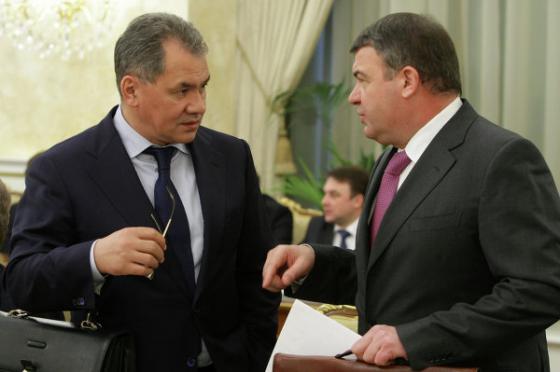
Defense Minister Shoygu

Defense Minister Shoygu

A couple weeks ago, Aleksandr Golts wrote in Ogonek about the situation in which Defense Minister Shoygu finds himself.  Golts has two main points.  First,  small policy changes can lead to big ones which unravel former Defense Minister Serdyukov’s positive reforms.  Second, Shoygu in uniform is a setback to real civilian political control of Russia’s Armed Forces.

Golts says that, although officers had their pay raised 2-3 times and tens of thousands received apartments thanks to former Defense Minister Serdyukov, the military still clamored immediately for Shoygu to change every decision made by his predecessor.  Chairman of the Duma Defense Committee, KPRF member, ex-admiral Vladimir Komoyedov called for lengthening the conscript service term.  Generals associated with retired Marshal Dmitriy Yazov demanded an expert review of the results of Serdyukov’s tenure.

However, Golts notes both President Putin and Prime Minister Medvedev gave Serdyukov’s painful reforms high marks (Smirnov in Gazeta made the same observation).  So, concludes Golts, it was a signal to Shoygu that no fundamental review of them is needed.  This left Shoygu in a complicated situation.

So Shoygu has taken some minor decisions to placate those seeking the pre-Serdyukov status quo.  But these small steps, writes Golts, can have big consequences.  Reestablishing the Main Directorate for Combat Training (GUBP or ГУБП), for example, will ultimately undercut the authority of the main commands of the services and branches as well as (and more importantly) of the four new MD / OSK commanders.

Reversing Serdyukov’s significant cuts in the Russian military educational establishment will put unneeded officers in the ranks to reanimate cadre units and the mass mobilization system.

Lastly, Golts is critical of the president for deciding to “return” the rank (and uniform) of Army General to the Defense Minister.  Observers commented this was done to give Shoygu “authority” within the military which his predecessor sorely lacked.  But Golts says the army has a way of ensnaring a Defense Minister, drawing him into the military “clan” or “corporation.”

The Defense Minister’s civilian status, Golts continues, was the very first step in establishing if not civilian, then at least political control over the military.  But establishment of civilian control takes more than one civilian minister.  It takes civilians who formulate decisions for military men to execute.  He points to Serdyukov’s attempt to separate civilian and military functions and competencies in the Defense Ministry.

But now Serdyukov’s “skirt battalion,” which so irritated military men, is gone.  Golts concludes:

“Now the generals will return to their places, and the minister himself will be doomed to make not political, but purely technical decisions and bear responsibility for them.  In essence, he is returning to be the hostage of the military who prepares these decisions…”

One has to agree that Shoygu’s three-month tenure consists of little more than examining and questioning every decision made by Serdyukov. 

Shoygu’s status as civilian or military is more interesting. 

He passed through the general’s ranks to four stars between the early 1990s and early 2000s.  More unclear is how or why he got the first star.  He had been a strictly civilian and party figure.  Many readers may not realize Shoygu’s MChS is a “military” (militarized or paramilitary) ministry where servicemen and officers with ranks serve like in the Armed Forces, MVD, or FSB.  So, at some level, it may not be fair to claim anyone “returned” his rank, or forced him to wear a uniform. 

The question is does an MChS rank carry any weight or “authority” in the Defense Ministry?  Recall Sergey Ivanov never wore his SVR or FSB General-Colonel’s uniform as Defense Minister. 

Shoygu remains an inherently civilian and political figure whom President Putin turned to in a pinch and trusts to keep the lid on at the Defense Ministry.  Russians joked in November that the old Minister of Emergency Situations was clearly the right guy for the job when the Oboronservis scandal broke and Serdyukov had to go.

One shouldn’t worry about Shoygu and civilian and political control of the military.  The slippery slope of undoing Serdyukov’s positive efforts, on the other hand, is concerning.

Shoygu’s Inherited Dilemmas

Shoygu and Serdyukov

Shoygu and Serdyukov

Before Russia’s holiday topor fully enshrouded military commentators, Gazeta’s Sergey Smirnov published an interesting piece on the situation in which Defense Minister Shoygu finds himself.  There isn’t a lot of great comment on Shoygu yet, but it might be cranking up.  Smirnov looks at how the popular Shoygu could mar his well-regarded career while tackling the same accumulated military structural problems that faced his predecessor.  He writes about possible bureaucratic and personal conflicts with Sergey Ivanov, Sergey Chemezov, and Dmitriy Rogozin.

Leftover Problem One:  Contract Service

According to Smirnov, Russia’s military added virtually no contractees in 2012, but still has to recruit 50,000 of them every year until 2017 to reach its assigned target of 425,000.  The obstacles are the same.  Eighty percent of them don’t sign a second contract because the army doesn’t offer living conditions more attractive than barracks.  Undermanning is a related problem.  Smirnov says the military’s manpower is certainly below 800,000.  And Shoygu may have to acknowledge this problem.

Leftover Problem Two:  Bureaucratic Competitors

Smirnov describes Serdyukov’s conflict with Rogozin over the OPK and its production for the military.  He claims the “Petersburg group” of Sergey Ivanov, Chemezov, and Viktor Ivanov wanted one of its guys to take Serdyukov’s place at the Defense Ministry.  But Putin didn’t want to strengthen them, so he took the neutral figure Shoygu.

According to Smirnov, Serdyukov wanted out, and wanted to head a new arms exporting corporation to replace Rosoboroneksport.  That, of course, conflicted directly with Chemezov and the interests of the “Petersburgers.”  And Smirnov makes the interesting comment:

“But that appointment [Serdyukov to head a new arms exporter] didn’t happen precisely because of the big criminal cases which arose not by accident.”

Was Serdyukov done in for overreaching rather than for corruption scandals in the Defense Ministry?

Shoygu, writes Smirnov, was not thrilled at the prospect of continuing the “not very popular” army reforms.  Smirnov is left at the same point as everyone else:  will it be a “serious revision” of Serdyukov’s reforms or a “course correction?”

There’s lots of talk to indicate the former rather than the latter.  The new VVS CINC has bloviated about returning to one regiment per airfield instead of large, consolidated air bases.  He claims the Krasnodar, Syzran, and Chelyabinsk Aviation Schools will be reestablished.  He babbles about going to a three-service structure and retaking VVKO.  Shoygu will allow Suvorov and Nakhimov cadets to march in the May 9 Victory Parade.  He stopped the Military-Medical Academy’s move out of the center of Piter.  Other commonly mentioned possible revisions are returning to six MDs and transferring the Main Navy Staff back to Moscow.

Leftover Problem Three:  Outsourcing

Serdyukov’s outsourcing policy led to scandals, and didn’t work for the Russian military’s remote bases.  Gazeta’s Defense Ministry sources say the structure and activity of Oboronservis will likely be greatly modified or, less likely, Oboronservis will be completely disbanded if some workable entity can take its place.

Leftover Problem Four:  Military Towns

The military wants municipal authorities to take over the vast majority (70-90 percent) of a huge number of old military towns (that once numbered 23,000) no longer needed by Armed Forces units.  The army only wants some 200 of them now.

The local government wants the military to provide compensation to restore and support these towns, but the latter doesn’t have the funds.  The army is laying out billions of rubles in the next three years, but only to outfit 100 military towns it wants to use.  There is also the problem of who gets, or has the power to give away, legal title to this military property.

Leftover Problem Five:  Officer Housing

Shoygu, says Smirnov, has to solve the unresolved problem of officer housing, especially for officers “left at disposition” of their commanders (i.e. not retired but lacking duty posts and apartments).  The Defense Ministry still doesn’t know how many need housing.  Smirnov writes:

“Despite the fact that the military department daily reports on the handover of apartments, the line of officers retired from the army who are awaiting receipt of living space is not becoming smaller.  At present from 80 to 150 [thousand] former officers are awaiting the presentation of housing.”

More than enough lingering headaches for one Defense Minister.

Still A Witness

Serdyukov on His Way to the SKR (photo: Kommersant / Dmitriy Dukhanin)

Serdyukov on His Way to the SKR (photo: Kommersant / Dmitriy Dukhanin)

For now.

On Friday, the Investigative Committee of Russia (SKR) subjected Anatoliy Serdyukov to a couple hours of questioning about the Oboronservis corruption scandal.  This session was scheduled when the former defense minister refused to answer questions on December 28 because his attorney was ill and not present.

Nothing much changed this time. 

Media accounts claim Serdyukov again effectively refused to answer SKR questions, taking the Russian version of the 5th (the 51st Article of the RF Constitution against self-incrimination).  He presented some written material to investigators describing the process of selling excess Defense Ministry property during his tenure.  But, according to Vedomosti, Serdyukov denied any wrongdoing, and placed blame for the sale of significantly undervalued and underpriced military real estate squarely and completely on his former subordinates (currently under indictment).

SKR patience with Serdyukov is wearing thin.  In fact, spokesman Vladimir Markin basically warned that he could become a suspect:

“In this situation, the former defense minister’s position might be regarded as an attempt to obstruct the investigation.  If the former defense minister believes he did not participate in those events which have become the subject of the investigation, then it would be fully logical to answer specific questions of interest to investigators.  But Mr. Serdyukov and his attorney believe it simpler to lay out a free form version of events in a light favorable to himself, and not to answer uncomfortable questions of substance for the investigators.  But in the investigation there is a large number of questions for Serdyukov about how decisions on the sale of Defense Ministry property were made, why deals were made at certain prices.”

“The position Mr. Serdyukov has taken does not guarantee that he will remain just a witness in the case.  It is fully probable his status could change.”

Kommersant and Interfax.ru reported Serdyukov claimed he signed off on paperwork for Defense Ministry property deals without looking into their “commercial aspects.”

A Kommersant source in the SKR admitted problems connecting Serdyukov to property sales or kickbacks.  However, he said investigators are looking at why Defense Ministry personnel and equipment built an 8-kilometer, 20-million-ruble road for a VIP resort in Astrakhan Oblast partly owned by the ex-defense minister’s brother-in-law, Valeriy Puzikov.  They’re also looking into high-priced Black Sea vacation homes built by Puzikov on Defense Ministry land.  

The SKR is apparently warming up charges against Serdyukov for exceeding and misusing his official authority. 

Investigators are clearly turning up the heat on Anatoliy Eduardovich.

Okryg.ru wrapped it succinctly:

“Serdyukov has a lot to be silent about.  Because if they’ve already decided to put him in jail, then helping the investigation is unrewarding.  Besides, it seems, the ex-minister still has a glimmer of hope that they will protect him.  Or, if you like, fight them off.”

“Judging by the reaction of official SK representative Vladimir Markin to the result of the second questioning, the Investigative Committee’s intention to put Serdyukov behind bars is practically unyielding.”

The blog calls Serdyukov a Putin creature who became “untouchable” but then got out of Putin’s control.  It concludes:

“The status of Anatoliy Serdyukov (witness or accused) depends not on what he said or was silent about, and not on how the investigator evaluated his answers or silence.  The fate of an official at such a level, at which Anatoliy Serdyukov dwelled, is decided exclusively in the Kremlin, that is, at the highest level.”

So will Putin see any reason to save Serdyukov, or will Putin leave him to the wolves?  Or can Putin control the wolves at this point?

Su-34 Growing Pains

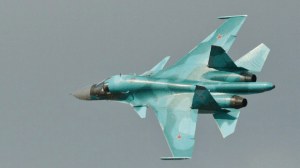
Su-34 (photo: Izvestiya / Dinar Shakirov)

Su-34 (photo: Izvestiya / Dinar Shakirov)

Early this month, Izvestiya’s Aleksey Mikhaylov and Dmitriy Balburov published on “growing pains” in Russia’s procurement of the Su-34 strike fighter.  The aircraft is “not combat capable” according to them.

A few English-language sites mentioned their story, but didn’t render it completely or accurately.

According Izvestiya, the Defense Minister may soon sign out a report on  defects in the Su-34 that interfere with its “full combat employment.”  Each of the 16 Su-34s received over six years reportedly has its own “individual problems.”

The authors say the Defense Ministry already won an 80-million-ruble suit against the Novosibirsk Aviation Plant named for Chkalov over undelivered aircraft.  They insinuate this Defense Ministry report could be the basis for more litigation against the airplane’s manufacturer.

A Su-34 pilot told Izvestiya radar and targeting-navigation system problems interfere with flight training in the aircraft.  Malfunctions, he says, are the result of both programming problems and technical flaws.  A maintenance officer said each aircraft has “its own characteristics,” for example, an auxiliary motor located in different places on different borts.

Two Su-34s delivered to Lipetsk in 2006 are allegedly non-operational, and sit at the airfield for show.  However, the best airframes are the last three borts sent to Baltimor / Voronezh last summer, a VVS Glavkomat officer told the authors.

OPK representatives expressed surprise at the military’s complaints, noting that the early production run of any aircraft entails problems.  Some blamed a low level of training among VVS pilots and technicians for difficulties with the Su-34.

The Izvestiya report seems at odds with the recent announcement that delivery of a second Su-34 squadron is beginning.  In fact, the media reports five more aircraft arrived at Voronezh from Novosibirsk just days ago.  Practically the same day, Defense Minister Shoygu visited the city, airfield, and other VVS institutions.  It may be that his predecessor Serdyukov was inclined to criticize the OPK and the Su-34’s quality.  So maybe Shoygu won’t approve the Su-34 report.  But that doesn’t necessarily mean there aren’t real problems with the aircraft.

Stories of the Year

RIA Novosti has its list of the main military events of 2012.

No surprise number 1 is the Oboronservis scandal, the fall of former Defense Minister Serdyukov, and appointment of successor Sergey Shoygu.

The rest:

  • 16 accidents in munition destruction leaving 12 dead and 23 injured.
  • Retirement of the CO of the Strizhi flight demonstration group who allegedly demanded money from subordinates for the freedom to show up for duty or not.  Remember Senior Lieutenant Sulim at Lipetsk?
  • Vityazi flight group doesn’t participate in Farnborough.
  • Ex-Gorshkov carrier still not delivered to India due to power plant problems.
  • Rearmament of RVSN with Yars and Topol-M ICBMs.  See Karakayev’s remarks the other day.
  • Acceptance of Dolgorukiy, Nevskiy, Bulava, and Severodvinsk all put off until 2013.
  • Delayed space vehicle launches, but fewer failures than in 2011.
  • The death of Ruslan Ayderkhanov.  A surprise pick.  Remember the army and medical examiners say he killed himself even though he was beaten and abused before he died.
  • The contract for five Borey SSBNs, and Prime Minister / President Putin’s role in getting the Defense Ministry and industry to agree on a price.
  • The collapse of Moscow’s $4.2 billion arms deal with Iraq amid talk of corruption.
  • Losing another Indian helicopter tender to the U.S.
  • Russia’s conference on EuroMD.

Russia 2030

Global Trends 2030:  Alternative Worlds

Global Trends 2030: Alternative Worlds

The NIC has released its latest Global Trends publication.  Hat tip to Newsru.com and Igor Korotchenko for taking note of it.  As usual, and rightly, the document focuses more on “megatrends,” and less on individual countries.  Nevertheless, here are excepts of its forecast for Russia.

Under the “Changing Calculations of Key Players,” the NIC says:

Russia’s strategic calculations will depend to a great extent on whether Russian leaders decide to increase Russia’s integration into the international system and mitigate the threat of future armed conflict or whether they choose to continue Russia’s relative isolation and mistrust of others, exacerbating interstate tensions. Russia has serious concerns regarding the threat posed by a rapidly expanding China, particularly Beijing’s growing appetite for natural resources which could eventually encroach upon the Russian Far East and Siberia. Russian leaders believe that they need to be wary of the potential for the US and NATO to intervene in a conflict involving Russia and one of the former Soviet republics.”

The section on military trends has the following:

Nuclear Disfavor vs. Nuclear Renaissance. Nuclear ambitions in the US and Russia over the last 20 years have evolved in opposite directions. Reducing the role of nuclear weapons in US security strategy is a US objective, while Russia is pursuing new concepts and capabilities for expanding the role of nuclear weapons in its security strategy.”

The following appears in a textbox entitled “Russia:  Potential Global Futures.”

“Russia’s role in the world during the next two decades will be shaped by the rising challenges it faces at home as well as in the global environment. Russia’s economy is its Achilles’ heel. Its budget is heavily dependent on energy revenue; efforts to modernize the economy have made little progress; and its aging of the workforce will be a drag on economic growth.”

“Russia’s population is projected to decline from almost 143 million in 2010 to about 130 million in 2030. Although Russia’s fertility rate is similar to that of many European countries and aging populations are also a drag of European economies, life expectancy is about 15 years lower for Russians than for Europeans: since 2007 the size of the Russian workforce has been declining and it will continue to do so for the next two decades.”

“However, Russia’s greatest demographic challenge could well be integrating its rapidly growing ethnic Muslim population in the face of a shrinking ethnic Russian population. There are now about 20 million Muslims in Russia, comprising about 14 percent of the population. By 2030, that share is projected to grow to about 19 percent. Russia’s changing ethnic mix already appears to be a source of growing social tensions.”

“To enhance its economic outlook, Russia will need to improve the environment for foreign investment and create opportunities for Russian exports of manufactured goods. Russia’s entry into World Trade Organization (WTO ) should provide a boost to these efforts and help Moscow to diversify the economy: by one estimate Russia’s membership in the WTO could provide a substantial boost to the economy, adding 3 percent to GDP in the short term and 11 percent over the longer term.”

“Russia’s relations with the West and China are also likely to be a critical factor in determining whether Russia moves toward becoming a more stable, constructive global player during the next two decades. We see three possibilities:”

1. Russia could become more of a partner with others, most probably, in a marriage of convenience, not of values. Russia’s centuries-long ambivalence about its relationship with the West and outside is still at the heart of the struggle over Russia’s strategic direction.”

2. Russia might continue in a more or less ambivalent relationship with the other powers, but over the next 20 years this path would likely be a more troublesome one for international cooperation if Russia rebuilds its military strength and must contend with an increasingly powerful China.”

3. Russia could become a very troublesome country, trying to use its military advantage over its neighbors to intimidate and dominate. This outcome would be most likely if a Russian leader were facing rising public discontent over sagging living standards and darkening economic prospects and is looking to rally nationalist sentiments by becoming much more assertive in the Near Abroad.”

There’s not a lot new here.  But it can’t go without comment.

Are the Russians really not integrated into the “international system?”  Or do they obstruct because they don’t like the outcomes of the “system’s” operation?  Moscow will probably never (at least not for a long, long time) agree with Western views on mitigating a future armed conflict, especially in a former Soviet republic.  Russia always evinces more worry about the U.S. and NATO despite the claim of its “serious concerns” about a threat from China.

One can’t be sure what’s meant by “pursuing new concepts and capabilities” for nuclear warfighting.  The Russians are active developing their strategic nuclear forces for two reasons.  First, conventional force problems.  Second, U.S. ballistic missile defense.  Both require ensuring their deterrent is viable, now and somewhat down the road.

Yes, it’s the economy stupid (and demographics too).  It’s hard for anyone to say what will happen with Russia’s economy, but the latter’s pretty much destiny at this point.  Russia will need more than a better foreign investment climate and WTO to improve its long-term economic prospects.  If years of windfall hydrocarbon revenues don’t do it, perhaps open politics, impartial rule-of-law, and serious anti-corruption efforts might be the path to a modernized, diversified, and stronger economy.

Are Russia’s external relations with the West and China critical in its  behavior as a “global player?”  Or does that behavior stem more from the country’s internal evolution or lack thereof?

The three possibilities look pretty familiar — pretty good Russia, not as good Russia, and bad Russia.  We’ve had the first and second mostly, and a taste of the third occasionally, over the last 20 years.  And elements of one and two, or two and three, can occur at the same time.

Overall, the Russian discussion in Global Trends 2030 is disappointing.

Combat Readiness Percentages

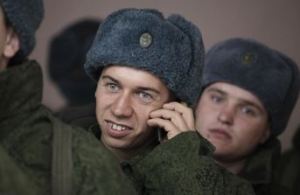
Conscript on His Mobilnik (photo: Reuters

Conscript on His Mobilnik (photo: Reuters)

Nezavisimaya gazeta’s editorial has the title above.  It’s sub-titled “An Unprejudiced Look at Military Reform.”

Here’s what it says.

“One of the most serious accusations against the former defense minister and former chief of the General Staff is the low combat readiness of armed forces units and sub-units caused by the military reform they conducted.  And the basic argument is the fact that only 15 of 35 combined arms brigades of permanent combat readiness are manned at 100%, the rest have personnel deficits from 20 to 30%.”

“There’s some truth in this.  If you figure the number of servicemen in the force structure — 220 thousand officers, 186 thousand contractees, 320 thousand conscripts and 50-60 thousand VUZ cadets — then the million required by the president’s decree has in no way been gathered.  But the main cause of this is by no means military reform, but the demographic situation in the country for which neither Serdyukov nor Makarov can answer.  And increasing conscript service, as proposed by some [Duma] deputies, can’t patch this hole.  And only those who contrary to Suvorovist science trained to fight the old way with numbers, and not skill, can talk about combat readiness relying just on arithmetical calculations.”

“Many concepts are part of combat readiness.  And not just manning.  Among its components, in particular, are the presence of modern combat equipment and combat support systems in the force, high operational-tactical qualifications of officers, their combat experience, skill and training of personnel…  The military reform of Serdyukov and Makarov, it seems, managed to deal with the last indicator.  We’ll cite just one fact — the average flying time of Russian Air Forces pilots reached 125 hours per pilot in 2012.  And squadron commanders flew 175 hours, and at Vyazma air base — more than 215 hours.  If you remember just several years ago our pilots had an average flying time of 30-40 hours, some of them generally 5-7 hours a year, and they got lost in the sky over the Baltic, then who would dare say that our military aviation is suffering from a lack of combat readiness.”

“The picture is approximately the same in the Ground Troops where soldiers and officers literally don’t leave the training grounds, conducting integrated tactical and operational-tactical exercises jointly with the Air Forces and Air Defense, with the Naval Infantry — if they’re on maritime axes.  They can’t complain about low combat readiness even in the Navy, whose ships, earlier tied to the piers, today ply the waters of the world’s oceans year-round, joining in the struggle against pirates in the Gulf of Aden.  They don’t complain of boredom in the VDV where over the past year more than 65 exercises of varying scale and intensity have been conducted, together with 1,150 combat training events, including more than 800 section- and 270 platoon-level combat firings, 73 company and 14 battalion tactical exercises.  Including with USA spetsnaz on American territory.  Additionally, the blue berets completed several tens of thousands of parachute jumps…  If these are not indicators of combat readiness, then what kind of percentages can you talk about?!”

“One more indicator of combat readiness is the evaluation of strategic nuclear deterrence forces which President Vladimir Putin recently carried out.  Launches of ground, naval and air-launched missiles were conducted then with high accuracy.  And the Supremo directed them from the Unified Central Command Post created in the framework of the reform this very year.”

“Yes, the reform according to the prescriptions of the ex-minister and the ex-NGSh has many deficiencies and mistakes.  ‘NG’ and ‘NVO’ wrote about them not once or twice.  We hope the new Defense Ministry leadership will rectify and correct them.  But not one more or less serious army dared test the combat readiness of our country’s armed forces after August 2008.  And no percentages can refute this fact.”

Yes, Serdyukov and Makarov are to blame for the mistakes of army reform.  Primarily for moving too fast across too broad a front without without adequately understanding the situation and consequences of their actions.  In some sense, this was their task — to break the logjam on military reform.  And that some people in Serdyukov’s team were venal didn’t help matters.

But NG’s right to argue they aren’t to blame for undermanning that leaves only 15 maneuver brigades at full personnel strength.  That’s a number not different from Putin’s first and second terms, the 1990s, or the late Soviet period.

NG’s also right to point to higher levels of training activity as an unalloyed good thing from Moscow’s perspective.  It’s a start.  It’s a function of having money and fuel, and a political leadership willing to allocate them.  But it’s only a necessary condition for building a modern army.  Sizeable Russian forces are probably ready to leave garrison when ordered.

The sufficient condition goes deeper.  Are those formations and units armed, equipped, supported, as well as trained to execute the missions their leadership envisions (and ones it doesn’t)?  It’s simply much harder to tell if they are ready for battle, if they will be capable in combat.  Much depends on the situation and scenario into which they’re thrown.  If, as NG alludes, Georgia should test the Russian Army’s readiness, it would perform better than in 2008.  It would probably do better in a new North Caucasus counterinsurgency.  But these cases are on the low intensity side of the warfare spectrum.  But perhaps they’re the most likely places where the Armed Forces would be employed.

But let there be no mistake, training activity doesn’t equal combat readiness, and combat readiness doesn’t equal combat capability.  It is significant and necessary, yes, but not sufficient.  One has to know a lot more about the condition of the forces and what goes on in those exercises.

Gerasimov Says No Sharp Course Change

General-Colonel Gerasimov (photo: RIA Novosti / Sergey Pyatikov)

General-Colonel Gerasimov (photo: RIA Novosti / Sergey Pyatikov)

Gazeta.ru pieced together RIA Novosti clips of General Staff Chief Valeriy Gerasimov’s session with foreign military attaches yesterday.

Gerasimov said army reforms begun by former Defense Minister Anatoliy Serdyukov will be “corrected,” not radically altered:

“Anticipating your questions on the possibility of a sharp course change in military organizational development, I would note there won’t be one.  In 2008, the Russian Federation President clearly indicated development tasks for our army, they will be fulfilled.  Naturally, some issues are being subjected to certain correction accounting for deficiencies revealed.”

“Organizational development” is primarily (but not entirely) TO&E and force structure.

Gazeta reports Gerasimov said mixed conscript and contract manning will be preserved, and the one-year conscript service term won’t be increased as some would like.

The new NGSh said the Defense Ministry is creating its own element to track fulfillment of the state defense order (GOZ):

“And by the minister’s decision, a structure will be created in the Defense Ministry which allows for controlling not only the completion of contracts, but work in all phases of the production cycle.”

Serdyukov’s Defense Ministry had various organs with this responsibility, including Rosoboronzakaz, Rosoboronpostavka, etc.  How will the new structure be better?

Gazeta closes with expert opinions on the fate of reforms introduced by Serdyukov.  Igor Korotchenko says:

“We didn’t have Anatoliy Serdyukov’s reform, but a reform the main parameters of which were set by the president.  That is the military reform course will continue fully with the exception of some cases of deficiencies revealed in the military education system, military medicine, and the reinforcement of control procedures over the activity of those structures involved in armed forces outsourcing.”

Ever-skeptical Aleksandr Khramchikhin doesn’t think there was a coherent course to be changed:

“In the army reform, there wasn’t a clear plan of action, one won’t appear under the new defense minister.”

“I don’t think Shoygu’s Defense Ministry will try to correct the course of reform or introduce some fixes.  There is nothing to correct.  Serdyukov’s reform had no kind of course, it went by the trial and error method.  There are grounds to believe that Shoygu will act according to the same principle.”

There’s a long list of policies commentators think will or might be changed, but little so far officially.  A new category to replace Serdyukov’s Reforms is needed.  Maybe Shoygu’s Nuanced Corrections?

Those Air Defense Missile Factories

S-300 Launch Canister? (photo: Izvestiya)

S-300 Launch Canister? (photo: Izvestiya)

OK, a lot gets under the radar . . . hadn’t noticed interesting reports since August by Izvestiya’s Aleksey Mikhaylov.

Sue me.

The latest is Mikhaylov’s informative update on two Almaz-Antey factories planned to crank out missiles for the S-400 Triumf and S-500 Prometey.

His OPK source says:

  • By 2014, large factories in Kirov and Nizhniy Novgorod are supposed to manufacture hypersonic 77N6-N and 77N6-N1 missiles for the S-400 and S-500.
  • The missiles will have inert, kinetic kill warheads, and supposedly be capable of intercepting ballistic targets at 7 km/s.
  • The Kirov factory will cost 41.6 billion rubles, the one in Nizhniy 39.5 (81.1  together).  Almaz will get a credit of 25 billion from VEB; the Defense Ministry will invest 35 billion.  One wonders where the balance comes from, and what the terms of this three-way partnership are.

Almaz greatly needs a new production base to field missiles for its SAM launchers.  It was planned in 2008, but the financial crisis prevented it.  The military doesn’t want to repeat the S-400 experience.  It remains armed with older, shorter-range 48N6 and 9M96 missiles.  Since 2007 only seven battalions (3 and 1/2 “regimental sets”) of the S-400 (out of 56 planned) have been fielded.

New missile production should coincide with serial production of the S-500 system (not later than 2014).  It remains under development.  However, Mikhaylov reports rumored sightings of  Prometey prototypes at this or that test range.

Over time, various officers and officials have claimed new, long-range missiles for the S-400 would be fielded in 2013, 2014, or 2015.

By way of conclusion, Mikhaylov turns to independent defense analyst Aleksandr Konovalov to comment:

“The country’s leadership looks at the defense sector like a Coke machine.  Put money in and get a bottle.  Nothing is that simple with the domestic OPK, and investing a lot of money doesn’t guarantee getting production precisely on time.  And discussion about the S-500 is questionable, it’s possible it doesn’t even exist in drawings.”