What Kind of Army?

Not again . . . but yes, Wednesday Trud asked what kind of army does Russia need in the future? 

It’s almost 20 years since the army ceased to be Soviet, and the paper asked five relatively independent experts the same question that’s been asked since 1991 –what is to be done about Russia’s Armed Forces?

Yes, it’s repetitive . . . it’s rare we hear something new, the problem is not ideas and initiatives, it’s implementing them.

At the same time, these commentaries are short and pithy.  They cover a lot of ground, and might be handy.

Korotchenko supports the Defense Ministry’s swerve back toward contractees, since there aren’t enough conscripts.  And he doubts conscripts are up to the task of handling modern weapons.  But he points to the need to end dedovshchina and other barracks violence to attract professional enlisted. 

Sharavin believes the big mobilization army is still needed, and conscription will continue alongside contract service for some time.  He wants more benefits for conscripts who’ve served, and he wants the sons of the bureaucratic elite to serve. 

Belozerov agrees recruiting 425,000 professional soldiers won’t be easy or fast.

Litovkin is harsher; he says there’s no reform, just back and forth on contract service.  He lampoons the current small-scale effort to train professional NCOs.  He ridicules thoughts of a serious mobilization reserve because of the lack of reserve training.

Makiyenko thinks a contract army is cost prohibitive, and the army numbers only about 800,000.  He likes the fighting spirit of soldiers from the Caucasus, opposes segregating them, but hopes Muslim clergymen in the ranks can restrain them. 

Igor Korotchenko:

“Of the million servicemen, ideally we should have 220 thousand officers, 425 thousand contractees and 355 thousand conscripts.   It’s true, not now, but in 10 years.  On the one hand, this is due to the physical impossibility of calling up more — there is simply no one to put under arms according to demographic indicators.  In the last call-up, the army took in 70 thousand fewer conscripts than in the preceding campaigns.  On the other hand, it’s simply scary to entrust those weapons systems, which should be purchased in the coming decade according to the state armaments program (and this is 20 trillion rubles by 2020), to people who were just driven out of the  sticks and into the army for a year.  Whether the Armed Forces want it or not, they are doomed to a certain intellectualization.  However, this is impossible if existing nonregulation relations between servicemen are preserved.  It seems that the Armed Forces leadership has started to understand this.  A program for the humanization of  service which also aims to remove the problem of dodging service (about 200 thousand men) has appeared.  Now in the Ryazan VDV School the first graduating class of professional sergeants is finishing the three-year course of study.  The eradication of nonregulation relations is connected directly with them.”

Aleksandr Sharavin:

“What kind of army to have is determined primarily by the country’s geographic situation.  If there is a potential threat to its territory from neighboring countries, we need a conscript army, through which a large mass of young men pass and allows for having a great mobilization reserve as a result.  If there is no threat, we can limit ourselves to professionals.  Russia has such threats — look closely at the map!”

“Is the transition to a professional army possible in Russia?  I suggest it’s possible, but not necessary. According to the Supreme CINC, we will transition to a new profile of the Armed Forces in 10-15 years.  For this or an even more extended period, conscription will remain.  Possibly in a much easier form — they will serve, not a year, or will call-up not 200 and some thousand, as now, but only 170 thousand men.  In the future, it would do to reduce even this number.  Moreover, reducing it will allow a certain selection and thereby improve the quality of the young men conscripted into the army.”

“In my view, a serving citizen [conscript] can’t receive the current 500 rubles [per month].  Hard military work should be well-paid, otherwise it is objectively devalued.  The rate — not lower than the country’s minimum wage!  We also need to think about other stimuli:  free higher education for those who’ve served, some kind of favorable mortgage credit, and, most importantly, we should only accept those young men who’ve fulfilled their duty to the Homeland into state service.  No references to health conditions can be taken into account.  If there’s strength to be a bureaucrat — get well and find the strength to serve in yourself!  If we need to amend the Constitution for this, we’ll amend it.  Our neighbors in Kazakhstan went this way and got a double benefit:  improved quality of the army contingent and bureaucrats who are not so divorced from the people, as in Russia.”

Vasiliy Belozerov:

“If the political decision is made, it’s possible even now, undoubtedly, to establish a fully volunteer army in Russia.  But do we need this?  I suggest it will be correct and justified if the share of professional sergeants and contractees in the army will be raised gradually.  Since it’s unclear from where a quantity of 425 thousand professionals can be gotten all at once.  They won’t fall from the sky.  We have to remind ourselves that the contingent of both current conscripts and potential professionals is one and the same:  young men 18-28.  This means we have to  create such conditions that it’s not the lumpen who go into the army, but normal men.  And worthy people need worthy conditions.  And there’s one more figure:  based on world experience it’s possible to say that in a professional army in the year for various reasons (health, age, contract termination, etc.) 5 percent of personnel are dismissed.  This means that in a 425,000-man professional corps in a year we have to recruit an additional 20 thousand men.  They also need to be gotten from somewhere.”

Viktor Litovkin:

“As is well-known, the army should know only two states:  either fighting, or preparing for war.  For us, it is either reforming or preparing to reform.  Meanwhile, there’s still no clear presentation of ​​what kind of army we want and what government resources we are prepared to give for this army.”

“In Russia, there is no coherent policy on establishing new Armed Forces.  The fact is the Chief of the Genshtab says we made a monstrous mistake and the Federal Targeted Program for Forming Professional Units failed, therefore we’ll get rid of contractees.  A half year goes by, the very same Genshtab Chief comes to the podium with the words that the country, it turns out, again needs 425 thousand professionals.  Make the basic calculations:  for this number of soldiers we need to have 65 thousand professional junior commanders [NCOs].  And now in Ryazan we have 250 men studying to be sergeants, they’ll graduate next year.  Meanwhile, there’s no data that they’ve selected the next course.  Has anyone thought about this?  And one more thing.  When we say that we need the call-up to create a trained reserve, this is self-deception.  The reserves are so unprepared!  Suppose we trained a soldiers for a year to drive a tank.  What next?  Once or twice a week after work this mechanic-driver has to work on the trainer at the voyenkomat, and every six months — drive a real tank on the range.  Otherwise, in case of war, we get not a trained reserve, but several million 40-year-old guys with beer guts who’ve forgotten which end the machine gun fires from.”

Konstantin Makiyenko:

“In my opinion, the transition to a professional army in Russia is desirable, but absolutely impossible.  A contract army is actually substantially more expensive than a conscript one.  Another thing, our announced one-million-man [army], in my view, likely doesn’t number 800 thousand men.  We have to talk about yet another problem — the coexistence of conscripts from the Caucasus and other regions in the army. Everyone remembers the wild incident, when these guys laid out the word ‘Kavkaz’ using conscripts of other nationalities.  But, on the other hand, conscripts from Dagestan, Chechnya or Kabardino-Balkaria, as a rule, stand-out for the best physical preparation and desire to learn about weapons.  Once the idea was floated to have Caucasians serve in some units, and Russians in others.  At the last session of the Defense Ministry’s Public Council, it was announced that this won’t be.  It was decided to refrain from creating monoethnic military formations of the ‘wild division’ type from the Tsarist Army.  Contradictions between conscripts called up from the Caucasus and other regions of the country will be removed by introducing the institution of military clergy of the Islamic persuasion.”
More Appointments, Etc.

Medvedev’s 29 March decree.

Appoint:

  • Rear-Admiral Vasiliy Fedorovich Lyashok, Chief, Development Planning Directorate, Deputy Chief, Main Staff, Navy, relieved as Chief, Organizational-Planning Directorate, Deputy Chief, Main Staff, Navy.
  • Colonel of Medical Service Aleksey Eduardovich Nikitin, Chief, 2nd Directorate, Deputy Chief, Main Military-Medical Directorate, Defense Ministry.
  • General-Lieutenant Igor Nikolayevich Turchenyuk, Deputy Commander, Southern MD, relieved as Commander, 35th Army.
  • General-Major Sergey Vitalyevich Solomatin, Commander, 35th Army, relieved as Chief of Staff, First Deputy Commander, 36th Army.
  • General-Major Valeriy Yevgenyevich Sharagov, Chief of Staff, First Deputy Commander, 36th Army, relieved as Deputy Commander, 2nd Army.

Relieve:

  • Rear-Admiral Viktor Nikolayevich Afanasyev, Chief of Armaments and Arms Servicing, Deputy Commander for Armaments and Arms Servicing, Black Sea Fleet.
  • General-Major Vladimir Grigoryevich Belyayev, Commander, 6991st Aviation Base (1st Rank).
  • Rear-Admiral Anatoliy Nikolayevich Minakov, Deputy Commander, Indoctrination Work, Northern Fleet.
  • Rear-Admiral Yuriy Stanislavovich Rebenok, Chief, Higher Special Officers’ Classes, Navy.

Relieved and Dismissed

President Medvedev’s 8 April Defense Ministry personnel decree.

Relieve:

  • Colonel Vitaliy Leonidovich Razgonov, Commander, 200th Independent Motorized Rifle Brigade, Western MD.
  • Captain First Rank Aleksandr Viktorovich Shemetov, Chief Navigator, Navy.

Relieve and dismiss from service:

  • General-Lieutenant Vadim Yuryevich Volkovitskiy, Chief of the Main Staff, First Deputy CINC, Air Forces.

Dismiss from service:

  • General-Major of Medical Service Sergey Anatolyevich Belyakin.
  • Rear-Admiral Aleksandr Anatolyevich Popov.
  • General-Lieutenant Yuriy Nikolayevich Tuchkov.

More Appointments, Etc.

The wave of appointments, dismissals, and reshuffling in the upper echelons of the military leadership continues . . . this one features the dismissal of Vice-Admiral Borisov, the shipbuilding chief, who reportedly went down over his role in the December round of Mistral talks with the French.  This one also has a lot of changes and shuffling of officers in RVSN armies.

Here’s what President Medvedev’s 19 April decree on Defense Ministry personnel does.

Relieve:

  • Colonel Aleksandr Vasilyevich Deryavko from the post of Commander, 60th Missile Division.

Relieve and dismiss from military service:

  • Vice-Admiral Nikolay Konstantinovich Borisov from the post of Chief, Shipbuilding, Armaments, and Arms Servicing, Deputy CINC for Armaments, Navy.

Appoint:

  • Colonel Aleksandr Vladimirovich Kasyanenko, Deputy Commander, 31st Missile Army, relieved of duty as Chief, Military Academy of the RVSN Branch (Rostov-na-Donu).
  • General-Major Aleksandr Dmitriyevich Sivachev, Deputy Chief, Military Academy of the RVSN, relieved of duty as Chief of Staff, First Deputy Commander, 33rd Missile Army.
  • General-Major Valeriy Yevgenyevich Tarazevich, Chief of Staff, First Deputy Commander, 33rd Missile Army, relieved of duty as Deputy Commander, 33rd Missile Army.
  • General-Major Ivan Nikolayevich Kuzichkin, Deputy Commander, 33rd Missile Army.
  • General-Major Viktor Vladimirovich Lizvinskiy, Chief, Organizational-Technical Directorate, Deputy Chief, Main Armor Directorate, Defense Ministry.
  • Colonel Andrey Gennadyevich Loginov, Commander, 60th Missile Division.
  • Colonel Andrey Nikolayevich Mordvichev, Commander, 4th Independent Tank Brigade.
  • Colonel Aleksandr Ivanovich Novkin, Commander, 138th Independent Motorized Rifle Brigade.

Appointments, Etc.

Way behind on these.

On April 25, President Medvedev issued his most recent decree on Defense Ministry personnel.  Here’s what it does.

Appoint:

  • Colonel Sergey Vladimirovich Bibik, Chief, Armor Service, Western MD.
  • Colonel Viktor Vladimirovich Voronov, Chief, Rear Services Support Directorate, Eastern MD, relieved of duty as Chief of Rear Services, Deputy Commander for Rear Services, Far East MD. 
  • Colonel Pavel Anatolyevich Shushpanov, Deputy Chief, 12th Main Directorate, Defense Ministry.

Kicking the Defense Ministry and OPK

President's Meeting on the OPK

President Medvedev is irritated as ever that the Defense Ministry and OPK aren’t moving out smartly to rearm and reequip the Armed Forces.  He’s trying to kick them into gear, but can he get results where his predecessors either didn’t care or simply failed?

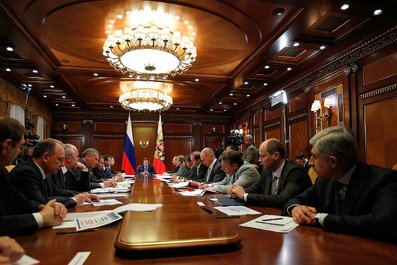
According to Kremlin.ru, Medvedev met this afternoon in Gorki with a host of government officials and industrial chiefs.  They included, inter alia, Sergey Ivanov, Anatoliy Serdyukov, Vladimir Popovkin, Nikolay Makarov, Denis Manturov, Yuriy Borisov, Sergey Chemezov, Sergey Nikulin, Mikhail Pogosyan, and Roman Trotsenko.

Medvedev’s opening monologue enumerated what’s been done for defense industry — providing a full state defense order and financial support, creating integrated development and production structures [OSK, OAK], etc..

Then the President says:

“However, despite all adopted measures, the state of defense production cannot be called good, all attending understand this.  There are objective reasons:  the deterioration of enterprises’ basic capital is nearly 70 percent (on average), in some enterprises it’s all much worse.  We still have not even managed to establish effective mechanisms to attract innovation and off-budget resources to the defense-industrial complex.”

Medvedev goes on to say that all relevant documents, including the GPV 2011-2020, have been signed, but the assembled group still needs to think about how to implement the GPV.  He reviews how he talked at the Defense Ministry Collegium in March about balancing producer and buyer interests, about justifiable and understandable prices.

But in many areas, says Medvedev, this has already become moot, and he intends to increase responsibility for the fulfillment of these obligations.

First, he wants a Federal Goal Program for OPK Development in 2011-2020.  Its focus is to be “real readiness” of the OPK to produce actual weapons and equipment.

Second, he wants the Defense Ministry to finish placing GOZ-2011 completely by the end of May, and advance payments issued to producers in accordance with the 2011 and 2012-2013 plans.

Work to date, he says, is going poorly and slowly.  He reminds the assembled that he told them about the failure of previous state armament programs:

“Today I want to hear from all present why this happened:  both from government leaders, and from industry leaders, who was punished for this and how.  Report proposals to me, if they still aren’t implemented, with positions, with the types of responsibility, completely concretely.  If such  proposals aren’t reported, it means [industrial] sector leaders and government leaders have to answer for it.”

It’s unacceptable, he says, that high-level decisions have been made, money allocated, but a product isn’t supplied.  He recalls his late 2009 Poslaniye in which he said 30 land- and sea-based ballistic missiles, 5 Iskander missile systems, nearly 300 armored vehicles, 30 helicopters, 28 combat aircraft, 3 nuclear submarines, one corvette, and 11 satellites would be delivered in 2010.  

Everyone here, says Medvedev, agreed with this, so why wasn’t it done.  He is, he says, waiting for an answer, and:

“. . . we have to answer for the duties we’ve taken on ourselves, we look simply in this sense absolutely unacceptable.”

Medvedev finishes by saying he knows military production is profitable, and it’s possible to attract strategic investors.  He says he wants to talk about how to stimulate investment.  The goal for the day is concrete reports on what’s been done on the level of those responsible for organizing work and correcting the situation in defense industry.

Where’s this leave things?

Not exactly throwing down the gauntlet, just another warning that he’s getting serious.  But it’s doubtful the government or defense industry will take Medvedev seriously until he fires a minister, other high-ranking official, or an important enterprise director.  And it’ll probably take more than a couple dismissals to get anyone’s attention.  Medvedev is running out of time on this account (as well as others).  Those he’d like to make responsible or punish will just take the tongue-lashings and wait him out.

Full Parade Coverage

Here’s Pervyy kanal’s complete coverage of today’s parade.  The second half starts as soon as you reach the end of the first.

Victory Day Parade

Here’s the link for Vesti.ru’s seven-minute report on today’s 63-minute Red Square parade.

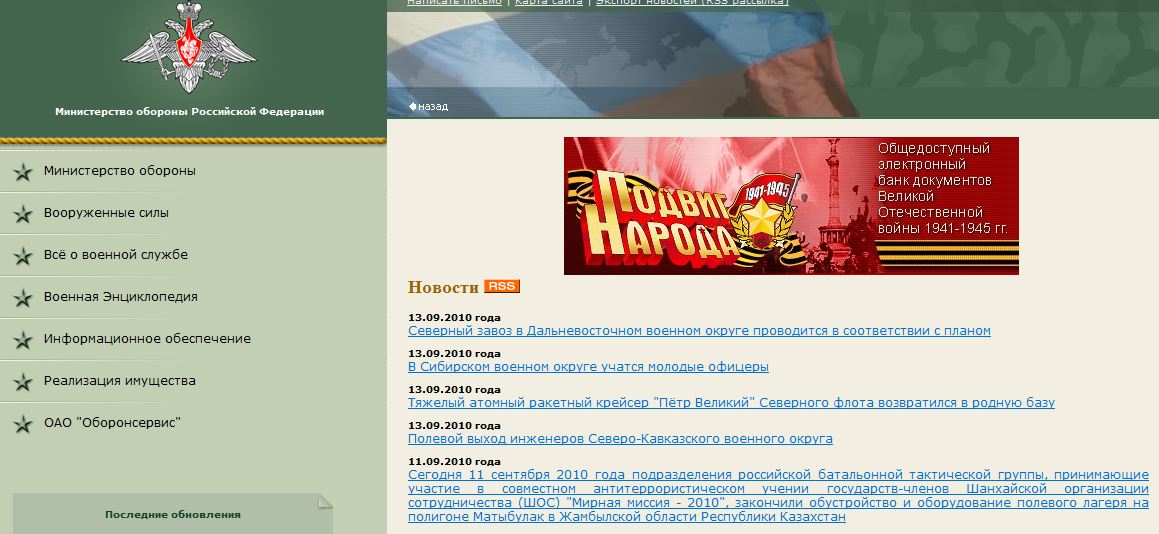
New Mil.ru

The New Mil.ru

A new look for the RF Defense Ministry website’s been unveiled (in testing mode, so far).

The first treat we’re supposed to get is video from tonight’s Red Square rehearsal of Monday’s Victory Day parade.  There’s a place to click for it, but it’s obviously not loaded yet.

So, say farewell to the old Mil.ru.

Farewell Old Mil.ru

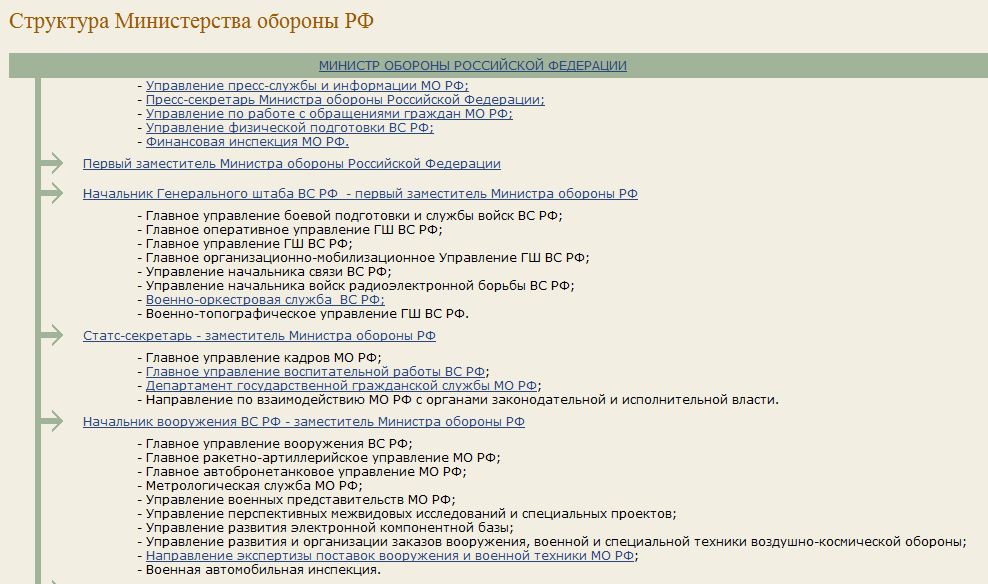
Old Mil.ru had a nice rundown of the Defense Ministry’s organizational structure that was once well maintained, but became an untended mess after Anatoliy Serdyukov arrived in 2007 and changed the Russian military bureaucracy in myriad ways.

RF Defense Ministry Structure on the Old Mil.ru

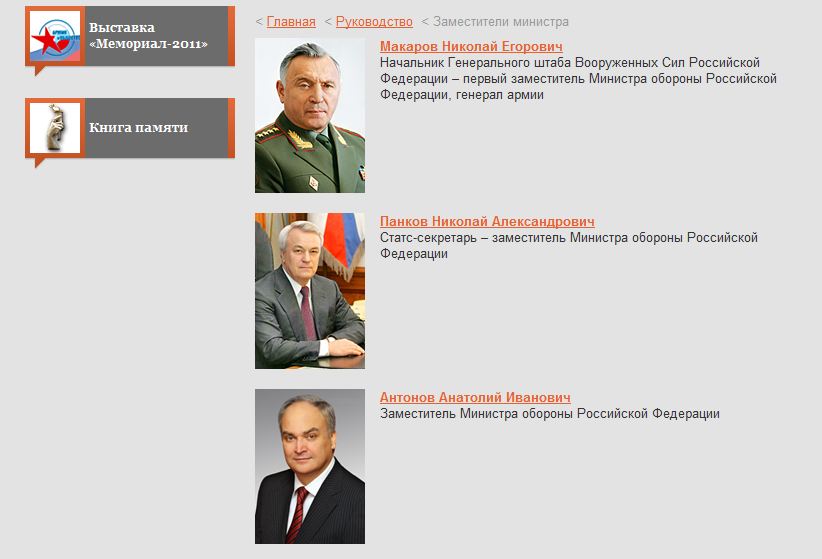
New Mil.ru is pared down, so far, in this respect, showing only a slicker (but up-to-date) rundown of Serdyukov’s deputies.

New Defense Ministry Leadership Page

Strategic Fireworks

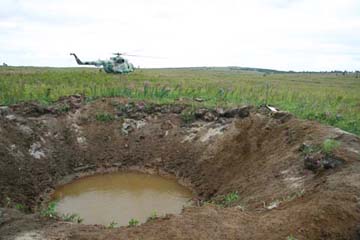
Warhead Impact Crater (photo: Novaya gazeta)

Being practically the eve of Victory Day, news is hard to come by.  

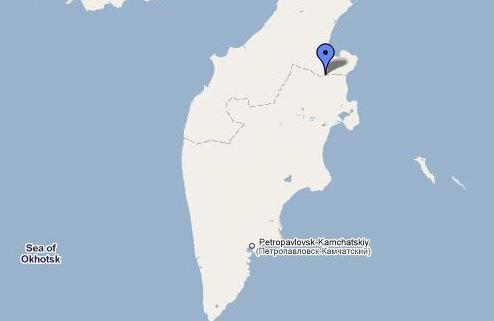
Novaya gazeta, however, was nice enough to print an interesting article about Russia’s strategic shooting gallery — Kamchatka’s Kura test range.

The author says, from the air, this 13,206 square kilometer patch of taiga looks like an unattractive golf course with a great quantity of holes.  In Kura’s 55-year history, more than 5,500 “items” have landed here.

Kura was called Kama at the time of its establishment in 1955, and two years later, the first missile, an R-7 (SS-6 / Sapwood) — the world’s first ICBM, landed here.

Why this site?  An old hand at the Independent Scientific-Testing Station of Space Forces explains:

“There are several reasons for this.  Firstly, this is one of the most remote regions, that is it’s possible to test missiles here not only for firing accuracy, but for range.  Secondly, the trajectory of all flights was conducted only over the USSR’s territory.  Thirdly, the range was laid out at a great distance from populated points and airline routes.”

So, the military’s calculations were correct.  No aircraft or people ever suffered from a stray missile, but not every “item” landed as intended.  They cut into mountains, or splashed in the ocean.  In the early 1980s, one caused casualties in a Koryak reindeer herd.

Kura Test Range

“Items” land here less frequently now, not more than 20 per year.  In the past, there were up to 250 per year.  The old hand continues:

“In the Soviet years, warheads poured from the sky like off a conveyor belt.  Not just military here, but scientific life was also cooking here.  Groups from scientific-research institutes who were creating the Soviet ‘star’ program as a counterweight to the American SDI constantly came here.  But after perestroyka, most scientific research was rolled up.”

He says the range’s helicopter pilots are marvelous fliers, but it’s often the bears who first find what’s fallen from the heavens.  All the oxidized metal is bad for the environment, of course.

The local garrison is just tens of kilometers from the Klyuchevskaya Sopka volcano, and its ash and sulfuric acid takes a toll on equipment.

The author says the locals say the warhead flights are spectacular.  At first, there’s a bright star in the night sky, rapidly approaching the ground.  Then a flash so powerful the street’s lit like daytime, but doomsday lasts not more than a second.  In an instant, the big star separates into several smaller ones.  Up to 10 warheads separate from the platform and fly at their own targets.  Cooler than any fireworks.

V / ch 25522 has 200 conscripts, about the same number of contractees, and 500 officers.  Life in the garrison town is generally good.  Soldiers preferred the old “Afghan” uniforms to the new ones from Yudashkin.  The barracks are warm, and there’s been no violence or hazing in recent years, but there’s not much free time (or much to do) either.  Soldiers can use their cell phones on days off.

For Space Troops officers, service here is considered prestigious, and the pay is almost three times that in units in Central Russia.  A year of service here counts double for hardship.  The stores are significantly better stocked here than on the “mainland,” but the prices are also 2-3 times higher.

Like everywhere, officers are being retired or put in civilian billets.  Engineer pay at the range, with supplements and coefficients, is 25-30 thousand rubles a month.  A lieutenant colonel gets 50-60 thousand.

Winter is seven months, and earthquakes a daily occurrence.  The volcanic ash isn’t good for people, but it isn’t deadly, they say.

Many officers have served at Kura since the early or mid-1990s, and they don’t complain.  The work is interesting, and the surroundings beautiful.  Things are better than 10 years ago when personnel didn’t get paid, and pilots had to buy their own spares for their helicopters.  Now equipment gets repaired, and the pay’s on time.