Shamanov Returns to Duty

VDV Commander, General-Lieutenant Vladimir Shamanov reported for duty today a little more than three months after his BMW was slammed by a truck on the highway between Tula and Moscow.

Shamanov was discharged from Burdenko Main Military Clinical Hospital in late December, and has been on rehabilitation leave in Sochi since then.

Also injured in the accident, then-acting commander of the Tula-based 106th Airborne Division, Colonel Aleksey Naumets remains in the hospital in satisfactory condition after more surgery.

The Tajik national who rammed into Shamanov’s service vehicle admitted his guilt in the accident.  He remains in custody while the investigation and court proceedings continue.

Hypersonic Cruise Missile for Navy?

Yesterday Lenta.ru relayed an Interfaks item in which NPO Mashinostroyeniye General Director Aleksandr Leonov said Russia is working on a naval hypersonic cruise missile.  But, he said:

“It’s difficult to say when all this will be turned into metal.  But technically today I don’t see obstacles to this direction being realized this decade.”

Leonov also claimed that development of this missile is included in GPV 2011-2020.  He didn’t talk about the characteristics of the missile, but said the general trend is to increase its speed to hypersonic, not to increase its range.  It’s designed for anti-ship and land attack missions, and will be fired from various launch platforms.  

Leonov noted that today up to 80 percent of Russian Navy cruise missiles were developed by NPO Mashinostroyeniye.  It produced both the Granit (SS-N-19) and Bazalt (SS-N-12) ASCMs.

He didn’t mention that the hypersonic missile development’s being done as part of Russia’s BrahMos joint venture with India.  Some sources claim the BrahMos II cruise missile has surpassed Mach 5 in stand testing.

Military Men Refuse Apartments

The military housing story is interesting, but, regrettably, also neglected of late.  And lots has happened on this front in recent weeks and months.  At every turn, the Kremlin, White House, and Defense Ministry have tried to convince Russians that they honored former President Putin’s pledge to provide permanent apartments not later than 2010 to all servicemen entitled to them. 

Putin and the government may say they delivered 50,000 apartments in 2010, but they didn’t necessarily reduce the line for military housing or satisfy the government’s obligation to retired, or retiring, servicemen.

Newsru.com provided a good story on this last Friday.  And it’s not the first time it’s been told.  

A Defense Ministry source told Interfaks more than 20,000 apartments acquired for servicemen are unoccupied.  They and their families have refused to move in because these apartments lack access to essential services and infrastructure.  He says:

“On 1 January 2011, according to preliminary data, 20 to 25 thousand apartments built for servicemen in various regions of Russia were unoccupied.  But officer families are refusing to receive such housing built, as it’s called, in an empty field, where there are no schools, no clinics, no stores.”

United Russia member, Deputy Chairman of the Duma Defense Committee, and frequent critic of the government’s military policy, Mikhail Babich told Interfaks the “process of building and receiving housing, organized by the Defense Ministry’s State Order Directorate, generally contradicted common sense and the interests of servicemen, who weren’t even asked where they want to settle after dismissal into the reserve.”  Babich continued:

“It goes without saying now the Defense Ministry has a large quantity of unoccupied apartments which officers have refused because of their lack of social infrastructure, opportunities to find daycare for their children, schools, and also even to find work for themselves.”

The Audit Chamber told lawmakers last year that the “absence of necessary coordination in the activity of the Defense Ministry’s State Order Directorate and FGU ‘Rosvoyenzhile’ in a number of  the country’s regions led to buying apartments in volumes significantly exceeding real demand for them.”

The Audit Chamber said in the Central MD alone more than 50 percent of apartments in the cities of Kinel, Balakov, Almetyevsk, Salavat, Kopeysk, and others are unwanted.  A check showed that local authorities permitted 9 apartment blocks in Serpukhov, Chekhov, and Khimki, which lacked essential infrastructure (heating mains, water supply, sewer), to be accepted for use, and this led to improper expenditures in the amount of 1.6 billion rubles.

Makarov Interview

Voyenno-promyshlennyy kuryer published an interview with the Chief of the General Staff, Army General Nikolay Makarov last Tuesday.  It’s not exactly a hard-ball interview.  But it’s fairly consistent with his other statements.  Among the priorities, preserving mobilization appears again.  Inter-service C2 in the new OSKs is a big theme.  He can’t explain why the Air Forces aren’t getting more new aircraft, and PVO sounds like it’s destined for joining VKO under the Space Troops. 

VPK asked about the possibility of changes in Russia’s military doctrine following the NATO-Russia summit and more talk of a strategic partnership.  Makarov said the approach of NATO infrastructure to Russia’s borders and the alliance’s continued “open door” policy vis-a-vis Ukraine and Georgia are still factors in Russia’s military doctrine.  Therefore, there’s no need to adjust it.

Makarov expounded on the concept of force and force structure development [строительство] to 2020 adopted by President Medvedev last April 19.  Its main measures include:

  • Establishment of the air-space (aerospace) defense (VKO) system;
  • Formation of the optimal composition of inter-service troop (force) groupings on strategic axes;
  • Supporting mobilization of military formations and troop groupings;
  • Establishing modern command and control systems;
  • Deploying military towns of a new troop basing system;
  • Reequipping formations and units with new and future types of armaments and military equipment;
  • Resolving social protection issues of servicemen.

Asked about military science and operational training, Makarov said the main task of the military-scientific complex is to “support the training and employment of the Armed Forces in their new profile, especially inter-service training of the military command and control organs” of the new MDs / OSKs. 

Makarov admitted that Russia lags behind developed countries in reconnaissance and command and control, and is still using communications systems developed in the 1990s.  He continued:

“Another problem is the fact that every service and troop branch of the Armed Forces developed its own means of automation and communications without looking at the others.  The command and control systems of the Ground Troops, Navy, and Air Forces didn’t interface with each other, that lowered the possibilities for controlling troop groupings on the operational-strategic and operational level.”

He says the General Staff has given the OPK requirements for high-tech digital reconnaissance and communications systems.  Industry is already developing a fundamentally new, sixth generation radio system with digital signal processing to implement a net organization in radio communications.  He says it’s being built as a unitary, integrated net at all levels, from the General Staff to the individual soldier on the battlefield.  Command and control systems will get 300 billion rubles under GPV-2020, according to Makarov.

Sounding very much the net-centric warfare disciple, Makarov says the main task is to form a unitary information space uniting reconnaissance, navigation, command and control, and new generation weapons.

Makarov doesn’t have a good answer when asked why the Air Forces don’t have a single fully reequipped unit despite increased defense expenditures.  He maintains they are getting new aircraft and their units are now all permanently combat ready and fully equipped and manned.

On aerospace defense, Makarov says PVO, PRO, SPRN, and KKP (space monitoring) will be concentrated in the hands of one commander, but:

“I’d like to note this won’t be a simple, mechanistic merger of different military entities under the leadership of a new strategic command.  Their deep integration and echelonment by mission, information exchange, and interception fire is envisaged.  We’ve already started fulfilling the initial measures on this issue.”

Obviously speaking much prior to last week’s news about reversing cuts in the officer ranks, Makarov addressed the moratorium on inducting new cadets.  He said 78.5 percent of 2010 VVUZ graduates became officers.  Others, he says, who wanted to stay in the service were temporarily placed in lower-ranking [i.e. sergeant] posts, but will participate in command training and form a cadre reserve for filling officer positions.

Lastly, Makarov talked about the new military pay system coming next year.  Military retirees have been especially concerned about its effect on pensions.  Makarov didn’t say much to assuage them.  He said there will be no difference in pensions depending on when servicemen retired, and a commission under Finance Ministry leadership is working on the issue.  That will probably reassure army pensioners.

Walking Back Serdyukov’s Personnel Policies (Part II)

Medvedev in Meeting on Military Pay (photo: Kremlin.ru)

So officers were cut too drastically, and their numbers are going to be increased.

One recalls Ilya Kramnik saying officer cuts were causing serious tension in the ranks.  As if to prove the point, on Wednesday, near Novosibirsk, a drunken major living outside the “shtat” threatened to blow up his room in the unit’s dormitory.  This summer Aleksey Nikolskiy said halving officers caused trouble for brigades in the Vostok-2010 exercise.

But it’s not just an officer shortage that’s led to this policy reversal.  Difficulties with conscription and sergeants have forced the Defense Ministry to plug holes with more officers. 

Aleksandr Sharavin talked to BFM.ru about the situation:

“I think this is connected with the fact that now the situation in the army is very tense.  They cut officers from 450 thousand [sic] to 150.  They cut warrant officers completely, and professional sergeants aren’t appearing, we didn’t train them, and still can’t do this.  What we’ve got is a lot of conscript soldiers, few contractees, generally no professional sergeants, and a triple load laid on the remaining officers.  Now we have to compensate by increasing the number of officers.”  

Increasing the officer ranks wasn’t the only personnel policy reversal announced on 2 February.  A preliminary decision to increase contractees in the Armed Forces was also discussed.  Serdyukov said:

“This issue isn’t finally decided, but we have a proposal for an increase.  The Security Council was ordered to review this issue, in the course of the month a concrete figure – how much the number of contractees will be increased from 2012 – will be determined.”     

Utro.ru entitled it’s coverage of this story “Army Reform Reversed,” and reminded readers that army contract service was curtailed last winter because the military couldn’t afford it.  And now apparently it can?

We don’t know how many contract sergeants might be added starting next year.  In fact, no one seems to know how many there are now.  Newsru.com claims the army currently has 180,000 contract soldiers, sergeants, and warrants.  If that’s true, the Armed Forces are about 900,000.  But if there are fewer contractees, and conscripts are less than 560,000, then the Armed Forces are that much below 900,000.

Can an about-face on the elimination of warrant officers be far behind?

As early as 27 January, Rossiyskaya gazeta reported Deputy Defense Minister Pankov said some cadets might be inducted into VVUZy in 2011.  It was just back in the fall that the Defense Ministry put a two-year moratorium on them.  As it is, VVUZy now have about 45,000 cadets in the classes of 2011, 2012, and 2013.

But the Defense Ministry is looking at having these would-be officers join 5,000 other former cadets as sergeants.  The Defense Ministry is talking about salaries as high as 40,000 rubles a month for professional NCOs.  But current NCO training efforts in VVUZy are going very slowly, and the army wants 250,000 of them, according to Nezavisimaya gazeta.

Let’s return for a bit to Medvedev’s Tuesday session on raising pay for servicemen and law enforcement.  We’re talking Defense Ministry, MVD, MChS, FSB, FSO, and SVR here.  Men with ranks, badges, and guns.  Medvedev called higher pay for them:

“. . . an issue of state importance.  In the last analysis, our efforts to reform the Armed Forces, create a new profile of the Armed Forces and, of course, reform the system of law enforcement organs, including reforming the Internal Affairs Ministry and creating police depend on it.”

The Defense Ministry is talking median pay of 50,000 rubles a month for lieutenants starting in 2012.  Just a sampling . . . a cadet would get 18,200, a contract soldier 24,800, a squad sergeant 34,600, and a brigade commander 93,800 rubles per month.

NG’s Vladimir Mukhin reports the Finance Ministry believes the new military pay plan will cost another 1 percent of Russia’s GDP, taking the defense budget from nearly 3 to nearly 4 percent of GDP.  All this while the government wonders whether outyear budgets will be in deficit or not.

The last couple days represent the first major defeat for Serdyukov.  His military personnel policies are a complete and utter shambles.  Political analyst Aleksey Mukhin commented to BFM.ru on Defense Minister Serdyukov’s prospects: 

“ It’s fully possible that soon they’ll call him enemy No. 1 for the reform which is being conducted.”

If they don’t already.  One guesses he’ll keep his post though.

So after flirting briefly with paying relatively few officers more money, the Defense Ministry’s going to pay more officers more money instead.  And this is more officers at the same time President Medvedev’s ordered a 20 percent cut in government bureaucracy.

The fact is military reform’s gone beyond the military now and become more of a factor in domestic politics.  Vlasti are just a bit nervous about social stability in the runup to elections this year and next, and are also a little worried about the guys with the guns.  For the regime, the extra money is worth keeping 70,000 potential ex-officer opponents out of the streets.  It may feel this provides some insurance that the guys with guns will do as they’re told.

As BFM.ru concludes, the Tunisian [or Egyptian] “virus” could spread.  And the terrorist threat is high.  So Russia’s leadership has to think about an effective and combat capable army.

Commentator Sergey Markov told BFM.ru that the regime wants to increase the number of officers who can fight, but it will continue cutting those in support functions and replacing them with civilians:

“But everyone understands perfectly that you can’t do without a real combat force.”

Walking Back Serdyukov’s Personnel Policies (Part I)

And so it’s begun. 

The first of Defense Minister Serdyukov’s major reform planks – cutting the officer corps from 355,000 to 150,000, or no more than 15 percent of the million-man army – has been reversed.

The Armed Forces’ officer manning level was apparently one topic in yesterday’s meeting between President Medvedev and his “power” ministers about plans to raise pay for servicemen in 2012.

Serdyukov told the media about the decision to increase officers in the Armed Forces by 70,000:

“A decision’s been taken to increase officer personnel by 70 thousand.  This is connected with the fact that we’re deploying additional military units, establishing military-space defense, that is, an entire service (of troops), and the increase is happening in connection with this.”

First, this raised some interesting questions about VKO.  Is it really going to become a service (vid or вид).  After all, the Space Troops are only a service branch (род войск) right now.  That’s quite a promotion.  And are we really supposed to believe the expansion of VKO or the Space Troops will require 70,000 additional officers? 

Of course not, it’s a convenient excuse to walk back a large part of the 50 percent cut in army officers Serdyukov announced when he launched his reforms in October 2008.

Most media outlets were pretty confused on what this means for officer numbers.  They assumed the Russian Army’s at 150,000 officers right now, just add 70,000 for a total of 220,000.  But it’s not so simple.

When Serdyukov started cutting officers, there were 305,000 occupied officer billets.  Krasnaya zvezda said the Armed Forces had 181,000 officers at the end of last year.  So a grand total of 124,000 officers were either discharged, placed outside the “org-shtat” at their commander’s “disposition,” or forced to accept an NCO billet between late 2008 and the end of 2010.  Returning 70,000 to the ranks might leave us wondering only about what happened to the other 54,000.  And 181,000 plus 70,000 takes the officer corps basically back to 250,000, or fully one-quarter of the million-man army.

The army officer corps has endured considerable sturm und drang in a little over two years all for the sake of shedding just 55,000 officers.

More on this tomorrow.

New Deputy Defense Minister

Antonov with Medvedev and Serdyukov (photo: Kremlin.ru)

Today President Medvedev made Anatoliy Ivanovich Antonov Deputy Defense Minister for International Military Cooperation.  He’ll bear responsibility for organizing and conducting the Ministry’s contacts with foreign military departments.  Kremlin.ru notes Antonov was one of the negotiators for the new Treaty on Strategic Offensive Arms.  Medvedev said Antonov’s experience in this successful negotiating process will enable him to fulfill his new duties effectively.

Anatoliy Antonov

PIR-Tsentr’s short biography of Ambassador Antonov says he’s been serving as Director of the Foreign Ministry’s Security and Disarmament Issues Department.  He was born in 1955.  In 1978, he graduated the USSR Foreign Ministry’s Moscow State Institute of International Relations (MGIMO or МГИМО).  In 1983, he completed graduate study at the same institution.  Antonov’s worked in the Foreign Ministry since 1978.  He’s headed government delegations in G8, NPT, Inhumane Weapons Convention, and multilateral export control negotiations.  He’s a member of the U.N. Secretary General’s Consultative Council on Disarmament.

In mid-2007, Antonov helped then-President Putin unveil his offer to use Russia’s Gabala and Armavir radars in NATO missile defense, according to Novosti KM.RU.

Antonov makes nine deputies to Serdyukov; a tenth deputy slot for finance-economic work has been vacant since Vera Chistova’s departure in the fall.

Antonov’s quite different from his predecessors in this job.

International military cooperation seemed to fall off the Defense Ministry’s radar for a while after Anatoliy Serdyukov took over.  You may recall, former Main Directorate for International Military Cooperation (GU MVS) Chief, General-Colonel Anatoliy Mazurkevich fled the Defense Ministry when Serdyukov arrived.  GU MVS essentially disappeared from the military department’s organizational chart.

GU MVS’ roots stretch back to the General Staff’s old 10th Main Directorate, which had a long history of involvement in arranging arms sales and providing military advisors and training to Soviet client states in the bad old days.

Blaming Yudashkin

Aleksandr Kanshin has reemerged . . . late of the Public Chamber, he’s now Deputy Chairman of the Defense Ministry’s Public Council, and he blames new army uniforms designed by fashion mogul Valentin Yudashkin for the recent outbreak of illnesses among conscripts in the Central Military District.

Vesti.ru and Newsru.com picked up what Kanshin told Interfaks:

“Judging by documents I’ve been made familiar with, one of the causes of illnesses among the young reinforcements in the troops, particularly in the Central Military District (TsVO), is manufacturing defects in the new winter field uniform supplied to conscripts at the assembly points of the military commissariats.  In other words, the new type uniform ‘from Yudashkin’ doesn’t defend soldiers against freezing in low temperatures.”

“At times, TsVO servicemen have to wear warm things under the new winter uniform.”

Kanshin also said he’s talked with TsVO Commander, General-Lieutenant Vladimir Chirkin who recognizes the new uniform needs improvement, but he also indicates 80 percent of his personnel are dressed in the old field uniform which is much warmer.

Vesti.ru reported the majority of the district’s servicemen are negative about the Yudashkin uniform because the air temperature is -20° (-4° F) and the wind blows through it outside.

Newsru.com pointed back to several scandals over the Yudashkin uniform, including last December when it said 250 soldiers became seriously ill in their unit in Yurga.  It was proposed at the time that they became sick because the new uniform didn’t protect them against the cold.

These new digital cammies were developed between May 2007 and 2010.  Besides fashion designer Yudashkin, specialists from the Central Scientific-Research Institute of the Garment Industry and the Defense Ministry’s Central Clothing Directorate participated in creating them.

Gzt.ru claims Yudashkin isn’t to blame.  The winter uniform was changed and sewn in defense industry factories with cheap materials.  Perhaps these are Kanshin’s “manufacturing defects.”  Sounds like corruption though, if someone substituted inferior materials.

Doctors told journalists that Yudashkin’s boots don’t keep out the cold either.

According to Gzt.ru, the military prosecutor is checking the situation in the TsVO.  Meanwhile, the military officially denies the uniforms are to blame, and maintains the emergency situation is just a seasonal outbreak of illness.

The Treatment of Private L.

Militaryparitet.com took time to highlight an article from Rusinfotoday.com on the deaths of Privates Lantsov and Tsybuk, as well as the case of the Samara conscripts in Astrakhan. 

21-year-old Kemerovo native Yevgeniy Lantsov last communicated with his wife on 5 January.  In her words, he coughed more than he talked, and he told her he couldn’t get out of bed.  

The military hospital refused to admit Lantsov because they didn’t think he was from one of their units.  It was only on 7 January that Lantsov was seen in a medical unit.  His command subsequently said that they had just moved, and their own medical unit was not set up.

On 10 January, now in serious condition, Lantsov was transferred to the military hospital that originally refused him, and it promptly sent him to the Chelyabinsk Oblast Hospital.

Meanwhile, Lantsov’s command didn’t inform his parents about his condition; they found out when they called the hospital using a telephone number they got from the Internet.  Learning their son wasn’t getting better, they immediately flew to Chelyabinsk.

Lantsov’s mother and father met with a deputy military prosecutor in Chelyabinsk.  According to them, the prosecutor said:

“If you hadn’t come to us, we wouldn’t have known anything about this.”

On 21 January, Lantsov’s parents gave the prosecutor a statement about the absence of prompt medical care for their son, and the next day he died.

The elder Lantsov said:

“No one is concerned about soldiers.  No one needs a soldier.  They’re called up and abandoned.  What need was there to move the unit right before the New Year, when there’s such a freeze?  Officers themselves were in confusion, they had just settled in a new place, and nobody worried about the soldiers.”

For two years, Lantsov had a deferment because of a heart problem.  But he was inducted a month and a half after his daughter’s birth.  His father says:

“We asked for a deferment until spring – his wife was in the hospital with complications for a month after delivery, but they told us – they are discharging your wife, and we’re taking you.  They just have to fulfill the plan.  The order came from above – shave [i.e. induct] them all in turn.”

So Yevgeniy went in the army with a diagnosis of tachycardia and “insignficant limitations” on his service.  Being ordinary miners without connections or money to buy his way out, his parents weren’t able to help him evade service.  So, the dead serviceman leaves a wife, infant child, and a 7-year-old adopted daughter.

Private Konstantin Tsybuk died from an aggressive form of meningitis, although he’d been diagnosed with pneumonia.  He left a wife and 10-month-old daughter in Cherbarkul.  The military commissar of Chelyabinsk Oblast Nikolay Zakharov comments:

“The ‘father-commanders’ didn’t worry about normal, ‘human’ conditions of life for their own soldiers, as a result of this, in the full swing of winter’s freeze, one of them died.  It’s very bad that a soldier perishes in peace time, and not in the fulfillment of a combat mission.  The investigation is on-going and will bring the guilty people to account.”

More than 60 soldiers from Tsybuk’s unit are in the hospital with pneumonia.  Over the New Year’s holiday, the unit’s boiler blew up and the boiler house burned down.  And conscripts had just arrived, and were settled in the frozen barracks.  Tsybuk’s relatives said he called home and said that he had to sleep in his overcoat.  

The Main Military Prosecutor is investigating the illnesses in Tsybuk’s unit, and has found that certain officers did not conscientiously fulfill their duties in protecting the lives and health of their soldiers.  Senior Lieutenant Igor Gurov is being charged with negligence in Tsybuk’s case.

Lastly, Samara conscripts who arrived sent to Astrakhan were living in tents, according to the mother of one soldier, on a dirt floor covered with mattresses, without hot water, while it was -20° C (-4° F).

Many of them got sick, and their commanders didn’t hurry to get them medical attention until their parents went to the human rights ombudsman for Samara Oblast.  After this, their situation improved.  The sick were hospitalized, and the others got wooden floors for their tents and hot food.

Rusinfotoday.com concludes such stories are a dime a dozen:

“There isn’t a person in Russia who doesn’t know that our army is slavery.”

The army doesn’t spend money on elementary but expensive things like real medicine, hospitals, and doctors because:

“Soldiers are an expendable resource which everyone wants to make a profit on.”

“Our country simply doesn’t and won’t have an army.  Just the lives of young men driven into slave work, sacrificed right and left for practically no reason.”

Nezavisimaya gazeta’s Vladimir Mukhin has an article today claiming sources tell him there’s an army pandemic, with more than 2,500 men in the hospital with URIs, including more than 500 with pneumonia.  And the military’s medics have been cut 5-7 times.

The Main Military-Medical Directorate, meanwhile, is under investigation by both the Audit Chamber and the Main Military Prosecutor for questionable use of its budget in some instances, according to Mukhin.

In other related news, this morning IA Rosbalt reported an Australian citizen has died of swine flu in Ufa.

Tvoy den says Lantsov’s unit is under a quarantine, and has 36 soldiers in its medical unit with URIs.

IA Regnum reported Friday that there are some quarantine measures in place in Chelyabinsk, where 95 people have allegedly contracted swine flu.

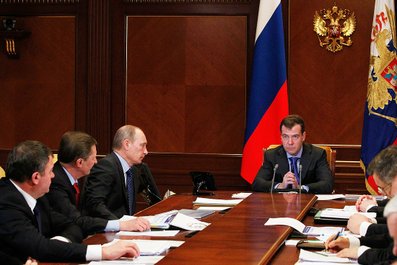
General Staff Chief Makarov’s Retirement Rumored

On Thursday, Argumenty nedeli said its source claims Defense Minister Serdyukov will soon send some well-known generals into retirement.  The Defense Ministry press service, of course, denies it.

AN’s source says the departure of these generals isn’t due to conflict between them and Serdyukov, but rather to the latter’s policy of “rejuvenating” Russia’s high command.  Among those who will allegedly be retired:

  • General Staff Chief, Army General Nikolay Makarov (61).
  • Deputy Defense Minister for Rear Services, General-Colonel Dmitriy Bulgakov (56).
  • Air Forces CINC, General-Colonel Aleksandr Zelin (57).
  • Navy CINC, Admiral Vladimir Vysotskiy (56).
  • Space Troops Commander, General-Lieutenant Oleg Ostapenko (53).

It’s interesting because none of them is really up against the legal age limit for leaving military service.  And Makarov apparently already has a service term extension from President Medvedev. 

One presumes, according to AN’s information, that the Ground Troops CINC, and RVSN and VDV Commanders are safe for now.

AN also expects some of the newly appointed MD commanders to be dismissed or moved to new posts.

There are other angles to AN’s story besides more rotation in cadres.

First, it repeats earlier press on trouble in finding a replacement for “key military department figure,” former Deputy Defense Minister for Finance-Economic Work Vera Chistova who left her post three months ago. 

An AN source in the Finance-Economic Service claims the lack of a replacement puts in doubt Prime Minister Putin’s promise to deliver a 6.5 percent increase in military pensions on 1 April.  Budget resources weren’t allocated for this.  And there’s still no candidate to replace Chistova.  And without one such issues simply won’t be resolved. 

AN doesn’t mention also that as active duty officer pay is reformed this year, the Defense Ministry will have to figure what to do about retiree pay.  If, as expected, they break the long-standing link between active pay and military pensions, the vets aren’t going to be very happy just before the 2011 and 2012 elections.  Putin just courted representatives of veterans’ organizations about a week ago.

According to AN, the Defense Minister has offered the military finance portfolio to more than one official at different levels in the Finance and Economic Development Ministries, but all of them declined.

The military department’s officers are also talking loudly about the coming appointment of a new Serdyukov deputy who will be called in to “correctly”  track the military’s political preferences ahead of the fast-approaching legislative and presidential elections.  

A high-ranking but unnamed military man tells AN

“He will be an important civilian and definitely a member of ‘United Russia.’  It goes without saying this is connected with the upcoming parliamentary and presidential elections.  The negative mood of officers is great, it is directed against the minister, his assistants and the party of power which is conducting the reforms without considering the human costs.”