FOM Defenders’ Day Poll

Time for the annual polls about the army.  And Defense Minister Serdyukov faces a sudden jump in the number of Russians who believe the situation in the army’s worsened during the past year.

The Public Opinion Foundation (FOM) conducted this poll on 12-13 February, with 1,500 respondents in 100 populated areas, in 43 of Russia’s regions.  The poll doesn’t list its margin of error.

Is the Day of the Defender of the Fatherland (23 February – Defenders’ Day) a special day? 

The yes and no answers – let’s call them two-thirds to one-third respectively – have changed little over eight years.  But those picking “difficult to answer” have increased from 5 to 14 percent over that time.

How do you evaluate the situation in the army? 

FOM shows data for the last six years, aggregated as “excellent-good,” “satisfactory,” and “poor-very poor.”  The number responding “excellent-good” has stayed low over that period, starting at 6 percent, going as low as 3 percent in 2006, as high as 11 percent in 2010, and resting at 8 percent this year.  All in all, pretty steady over the period.

“Poor-very poor” and “satisfactory” look like mirror images of each other over time.  The greatest gap between them was in 2006 when 71 percent said “poor-very poor” and 17 percent “satisfactory.”  “Satisfactory” has increased, reaching 42 percent last year, while “poor-very poor” was 33 percent.  In this year’s survey, “satisfactory” holds a slight lead at 40 percent to “poor-very poor’s” 35 percent.  This could be within or very close to the survey’s margin of error.

Is the situation in the army improving, worsening, or staying the same? 

In 2007, 31 percent thought “improving” to 11 percent “worsening.”  Four years later [exactly coinciding with Defense Minister Serdyukov’s tenure], the numbers are almost exactly reversed 35 percent say “worsening” and only 19 percent say “improving.”  And the 35 percent who say “worsening” is a real jump over previous years – 18 percent in 2006, 11 percent in 2007, and 16 percent in 2010.  In other words, the past year’s been difficult for Serdyukov’s Defense Ministry.

Respondents were also asked about some [possible] army reforms they would approve or not approve.  A few examples :

  • Extending the draft age to 30 . . . Approve – 18 percent, disapprove – 67 percent.
  • Removing deferments from students . . . Approve – 29 percent, disapprove – 57 percent.
  • Reducing the number of officers . . . Approve – 24 percent, disapprove – 52 percent.
  • Transferring the army to a contract basis, ending the draft . . . Approve – 51 percent, disapprove – 32 percent.

Serdyukov’s Anniversary

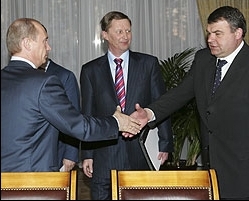
Putin Welcomes Serdyukov as Ivanov Looks On

The fourth anniversary of Anatoliy Serdyukov’s appointment came and went quietly enough on 15 February.  But WikiLeaks has come through as if to mark the occasion.  

On Friday, it posted an Amembassy Moscow assessment of Defense Minister Serdyukov a month and a half after he arrived in the “Arbat Military District.”  Mindful of hindsight bias, one can’t judge this cable too harshly.  But it’s an interesting retrospective on what was expected of the man going in, and what has happened since.

As stated all over the Russian media, Amembassy anticipated Serdyukov would impose discipline on the “Ministry’s notoriously loose financial control system,” and not otherwise initiate major changes.

Aleksandr Golts told Amembassy:

“Serdyukov’s inexperience on military issues would undermine his credibility with the General Staff and other senior officers, hindering his ability to push through needed reforms.”

A bit silly in retrospect.  Yes, he had no credibility with the Genshtab, nor it with him.  But he didn’t care and pushed right through the Genshtab, cutting the Genshtab (it suffered first in the reforms) and building his own bureaucratic machinery in the Defense Ministry.

Amembassy claimed that Serdyukov dismissed then-Chief of the Main Directorate of International Military Cooperation (GU MVS) General-Colonel Anatoliy Mazurkevich, and that Serdyukov’s auditors might be driving other corrupt officers into resignations or dismissals.

The cable describes the Defense Minister aptly as a “detail-oriented micromanager and ruthless policy administrator.” 

But what it doesn’t note (and what has become patently obvious over the last four years) is that the Defense Ministry, and the Russian military, is an unwieldy and untidy establishment not well-suited to micromanagement.  Talk about trying to turn an aircraft carrier on a dime . . . not gonna happen here. 

A couple stories come to mind . . . Serdyukov trying to put new uniforms on the troops, one of his first initiatives.  Now maybe only 20 percent of the troops have them, and the parents of those that do say the new uniforms aren’t as good against the cold as the old ones.

Also, Serdyukov talking about one new brigade commander who didn’t implement his directives.  It’s a big country and a big army.  What Moscow says isn’t always relevant in Chita, etc.

Next, Amembassy summarized the views of Ivan Safranchuk this way:

“He thought the Ministry establishment would try to ‘outlast’ any reforms that Serdyukov sought to impose, with the brass counting on Serdyukov to adjust to their way of thinking — or at least to stay out of their way.  Safranchuk told us that former DefMin Ivanov ultimately had not made a significant impact on how things functioned within the Ministry, despite his reform efforts, and predicted the same fate for Serdyukov.”

This one turned out to be pretty wrong, didn’t it?  There may still be some elements awaiting Serdyukov’s departure and a return to the way things used to be, but too much has changed.  The military establishment can’t ever be exactly what it used to be.  And the brass was definitely no match for Serdyukov, and he didn’t stay out of their way, but rather sent many of them down the highway.  And this Defense Minister has had a greater impact in four years than Sergey Ivanov in nearly six.  Ivanov’s fate was not to be Putin’s successor, and to muddle around in his next job, i.e. First Deputy PM.  As for Serdyukov’s fate, we’ll have to see.  As for his impact, at least some is likely to be lasting.  How long?  Only until the next determined reformer arrives.  None of this is to say Serdyukov’s impact is all positive, mind you.  Some changes may have messed things up worse than they were.  But he got reform off the dime in a way Ivanov never dreamed.

Here’s video of Putin’s meeting with Ivanov and Serdyukov on 15 February 2007.

The cable continues:

“Sergey Sumbayev, a former journalist with Krasnaya zvezda (Red Star), told us that management and accountability within the Ministry were dysfunctional and fostered inefficiency and corruption.  He referred both to financial accountability and responsibility for policy implementation.  Sumbayev thought the Ministry’s entrenched bureaucracy resisted, mostly successfully, institutional change, which generated considerable waste and delayed delivery of modern weapons systems to the armed forces.”

Sumbayev also told Amembassy:

“. . . management experience and tenacious work ethic make [Serdyukov] the ideal ‘technical’ manager that the Ministry needs.  While acknowledging Serdyukov’s political connections, Sumbayev did not think Serdyukov harbored any political ambitions.  He was chosen mainly for his managerial expertise, loyalty, and willingness to please his political bosses.  Serdyukov could probably make progress in streamlining the Ministry’s management structure, reducing waste, and exerting more control over its financial accounting systems.  One year, however, would not be sufficient to accomplish these tasks.”

“Sumbayev speculated that keeping the General Staff off-balance and focused on internal matters over the next year was one of Putin’s objectives in appointing Serdyukov. In this respect, he suggested that Serdyukov had a mandate to shake things up in the Ministry without sparking too much discontent.”

Amembassy concluded that:

“Serdyukov has his work cut out for him in bringing order to a Ministry badly in need of reform.”

Serdyukov’s made progress, but this final assessment probably remains true four years on.

Mi-28N Crash

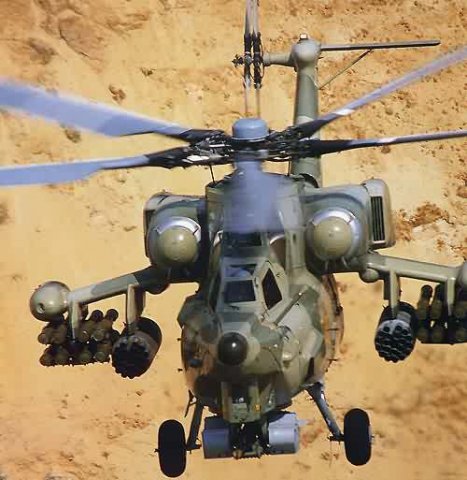
Mi-28N Night Hunter

Russia’s Mi-28N Night Hunter helicopters are grounded pending completion of the investigation into Tuesday’s crash in which the pilot died and his co-pilot was hurt.  The Mi-28N belonged to the Budennovsk-based 487th Helicopter Regiment in the Southern MD.

Unnamed sources tell RIA Novosti investigators attribute the crash to engine failure caused by metal shavings in the engines or gear box.  But one experienced test pilot told Vzglyad.ru that shavings usually don’t cause a sudden loss of control or engine failure.

Over the last year, problems with the Mi-28N’s gear box, flight controls, and tactical performance have been reported in the media. 

In January, Izvestiya’s Dmitriy Litovkin visited the flight training center in Torzhok to look at the Mi-28N.  He discussed the June 2009 crash of an Mi-28N at the Gorokhovets training range with the center’s chief, Colonel Andrey Popov.  Litovkin said people believe that crash occurred when powder gases from a rocket firing got in the helicopter’s engines.  Here’s a video.  Popov acknowledged the Mi-28N’s growing pains, and said the manufacturer is constantly modifying the aircraft.

This certainly sounds like production problems to these nonexpert ears.  There’s still a struggle between those who back the Mi-28N and others who favor the Ka-52 as Russia’s primary attack helicopter.  With stronger state support, the Night Hunter has been winning the battle, but this accident might hurt its case.  Meanwhile, a second Mi-28N squadron is supposed to be established at Budennovsk this year.

A Second Regimental Set of S-400s

Russian news outlets reported yesterday that two new S-400 SAM battalions (a “regimental set”) will soon go on duty in the 210th Air Defense Missile Regiment at Dmitrov north of Moscow. They will join the first two battalions fielded at Elektrostal east of Moscow in 2007 and 2008.

In early 2010, Air Forces CINC, General-Colonel Aleksandr Zelin talked about getting up to 5-6 battalions last year, but this didn’t happen. Zelin has also said 18 S-400 battalions will be in service by 2015.

The factory handover of the two new battalions began Wednesday at Kapustin Yar. The acceptance process included various test firings yesterday with OSK VKO Commander, General-Lieutenant Valeriy Ivanov and Air Defense Missile Troops Commander, General-Major Sergey Popov in attendance.

Lenta.ua quoted Ivanov saying 3-4 S-400 regiments will defend Moscow by 2020, with most going on duty in 2016-2020. He told Interfaks:

“If earlier we accepted it (the S-400 SAM) in separate units of equipment by battalion, by launcher, then today for the first time everything is being received fully – as a regiment.”

One supposes these regiments will only have two S-400 launch battalions then.

Lots has swirled around the inability to get S-400s in the field.

General Director Igor Ashurbeyli was dismissed from Almaz-Antey early this month. There’s been the talk of the government financing two new plants to speed the process of building the S-400.

Last May, Viktor Litovkin was reporting that the VVS would receive six S-400 battalions in 2011. He also said the Defense Ministry would not order more after that.

Ashurbeyli said last April the Defense Ministry was not signing contracts for S-400 production in 2012.

In Memory of Soldiers-Internationalists

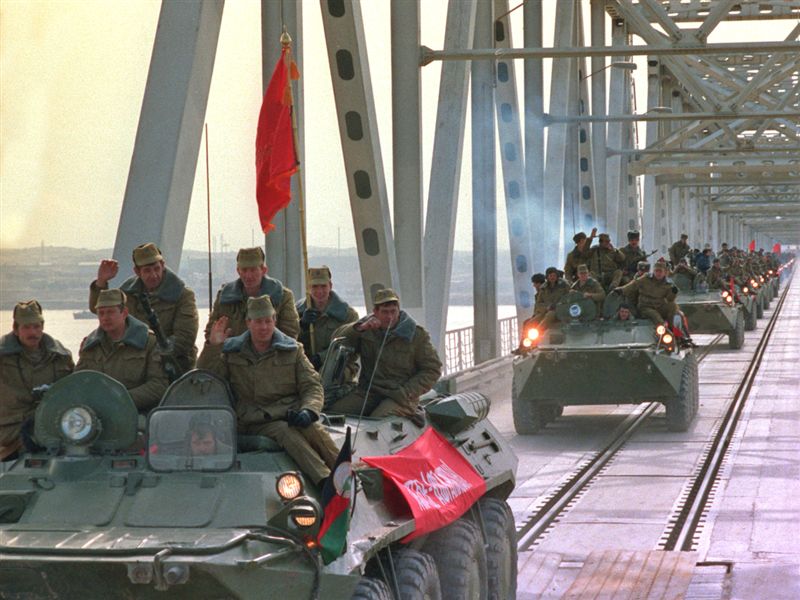
Departing Afghanistan

OK, “internationalist-soldiers” is less awkward.  “Internationalist” was the CPSU’s way of describing Soviet advisors and troops abroad assisting or fighting on behalf of various regimes during the Cold War.

Tuesday’s Moskovskaya pravda had a very interesting news-essay by Natalya Pokrovskaya on the 22nd anniversary of the Soviet withdrawal from Afghanistan.  It’s entitled “The Newest History.  The Soldier Doesn’t Pick the War.” 

The completion of the Afghan withdrawal on February 15, 1989 has the same resonance for Russians as April 30, 1975 for Americans:  it represents the collapse of a crusade conducted in the context of a global ideological and military confrontation called the Cold War.  And as Pokrovskaya implies, whether sent by Leonid Brezhnev or Lyndon Johnson, Soviet and American soldiers didn’t choose the conflicts they fought in.

Pokrovskaya reports that, though long celebrated, Tuesday marked the first time Russia officially celebrated the Day of Memory of Internationalist-Soldiers:

“For too long, the Fatherland didn’t want to recognize those who defended its interests in far-away countries, fulfilling their internationalist duty.”

She notes, in 2002, the federal law on veterans was changed and participants in local wars and conflicts received the status of combat veterans.  And then late last year the law on military memorial dates was amended, and 15 February is now the Day of Memory of Russian Citizens Who Fulfilled Their Service Duty Beyond the Boundaries of the Fatherland.

Pokrovskaya says Russians typically associate “internationalist-soldier” only with those who fought in Afghanistan, but, in fact, after 1945, Soviet officers and soldiers shed their blood in the interests of their Homeland in 18 wars in 14 countries.  She includes:

  • Algeria (1962-1964).
  • Egypt (October 1962-March 1963, June 1967, 1968, March 1969-July 1972, October 1973-February 1975).
  • Yemen (October 1962-March 1963, November 1967-December 1969).
  • Vietnam (1961-1974).
  • Syria (June 1967, March-July 1970, September-November 1972, October 1973).
  • Angola (November 1975-November 1979).
  • Mozambique (1967-1969, November 1975-November 1979, March 1984-April 1987).
  • Ethiopia (December 1977-November 1979).
  • Afghanistan (April 1978-February 1989).
  • Cambodia (April-December 1970).
  • Bangladesh (1972-1973).
  • Laos (January 1960-December 1963, August 1964-November 1968, November 1969-December 1970).
  • Syria and Lebanon (June 1982). 

Soviet participation in these wars was generally a closely guarded secret, but the Afghan war was too burdensome to keep secret.  More than half a million Soviet troops passed through Afghanistan, and more than 14,000 died in nine years of fighting.

Pokrovskaya describes the end – the withdrawal of the 40th Army over the Friendship Bridge from Hairaton to Termez, five Border Guard groups providing security for the departing column, the weary-faced General-Lieutenant Boris Gromov.

She recalls bloodletting after the Soviet withdrawal [again, not unlike Vietnam], a soldier’s memories of his first time in battle, and the life of Soviet Army convoy drivers.

But Pokrovskaya saves her best for the end:

“But back Home there was sketchy news of voyenkomaty and burials which, with a few exceptions, all regions of a huge country got – a little less, others – more.  But the information vacuum didn’t allow a chance for drawing a conclusion, for citizens of a big country to realize the essence of what was happening with their sons beyond the bounds of the Fatherland.  The total ban on the truth worked impeccably during practically all ‘foreign’ campaigns.”

She thinks people began to learn about the war about four years after it began, mainly via veterans, from “Afgantsy.”  About them today, she says:

“Each of them who, in peacetime, endured the hardships and privations of war for the sake of their native state’s interests, also lives every day with the memories and pain of his combat past.  They say that the war ends on the day when the last soldier who returned from it dies.”

Pokrovskaya says the Soviet internationalists, who are now generally between 40 and 50 with families and kids, understand how thin the border between war and peace, between senseless cruelty and a peacekeeping mission is.

One hero from the Afghan war tells Pokrovskaya a story about last Victory Day when he gathered with close buddies and sang some Afghan songs with them.  He said suddenly a bunch of skinheads jumped from the bushes.  They said, “Old men we respect you!  Let’s drink, you are heroes, you killed the ‘black ones’!”

The reader can substitute whatever racist term he or she chooses for чёрные –  n*****, wog, kaffir, etc.  Again not different from the unfortunate American experience in dehumanizing enemies as slopes or gooks.

Pokrovskaya’s war hero goes on to say he was knocked unconscious in battle in 1986:

“Guys, a Tajik and an Uzbek, dragged me more than ten kilometers to a chopper.  I owe them my life!  And these ones who’ve never seen a battle, but after hearing every idea about racial supremacy, try to cozy up to me?!  We weren’t restrained to put it mildly . . . .  We conked them on their heads and sent them home to mama and papa . . . to learn their lessons.  History, for example.  They don’t even know how many Heroes of the Soviet Union we have who aren’t Slavs.  Georgians, Chechens, Tatars, Uzbeks . . . .”

 Ms. Pokrovskaya sums it all up:

 “Can it be that the state was silent for nothing, didn’t remember for so long those who honorably fulfilled their duty to the Homeland for nothing?  And is today’s gift of memory which we are giving the present-day children of the internationalist-soldiers really to teach the most recent history of a country now split by the contradictions of inter-ethnic discord?”

Yes, a grunt’s a grunt.  And the grunts and their loved ones often ask what they’re fighting for.  Or did they die for nothing.

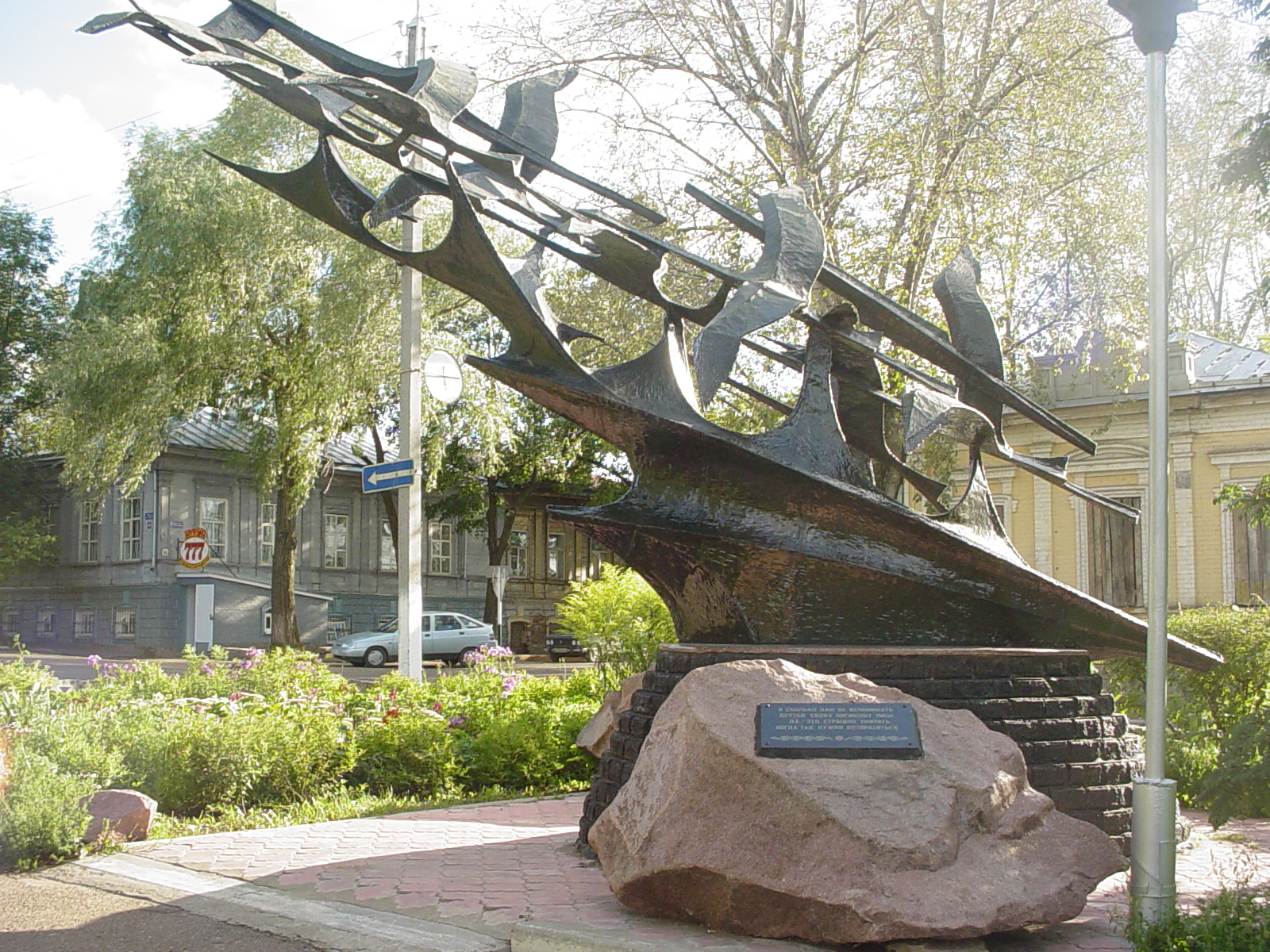
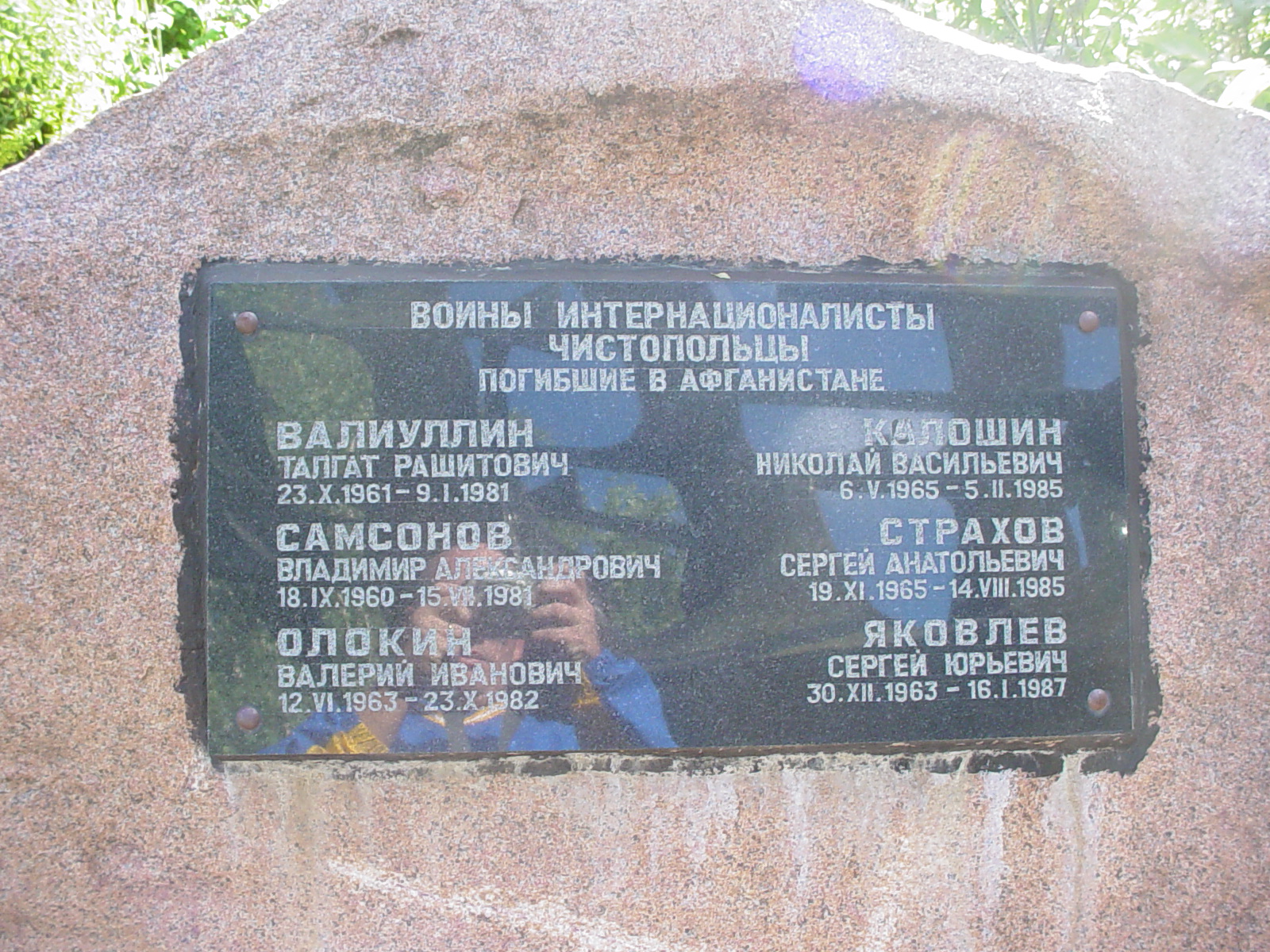
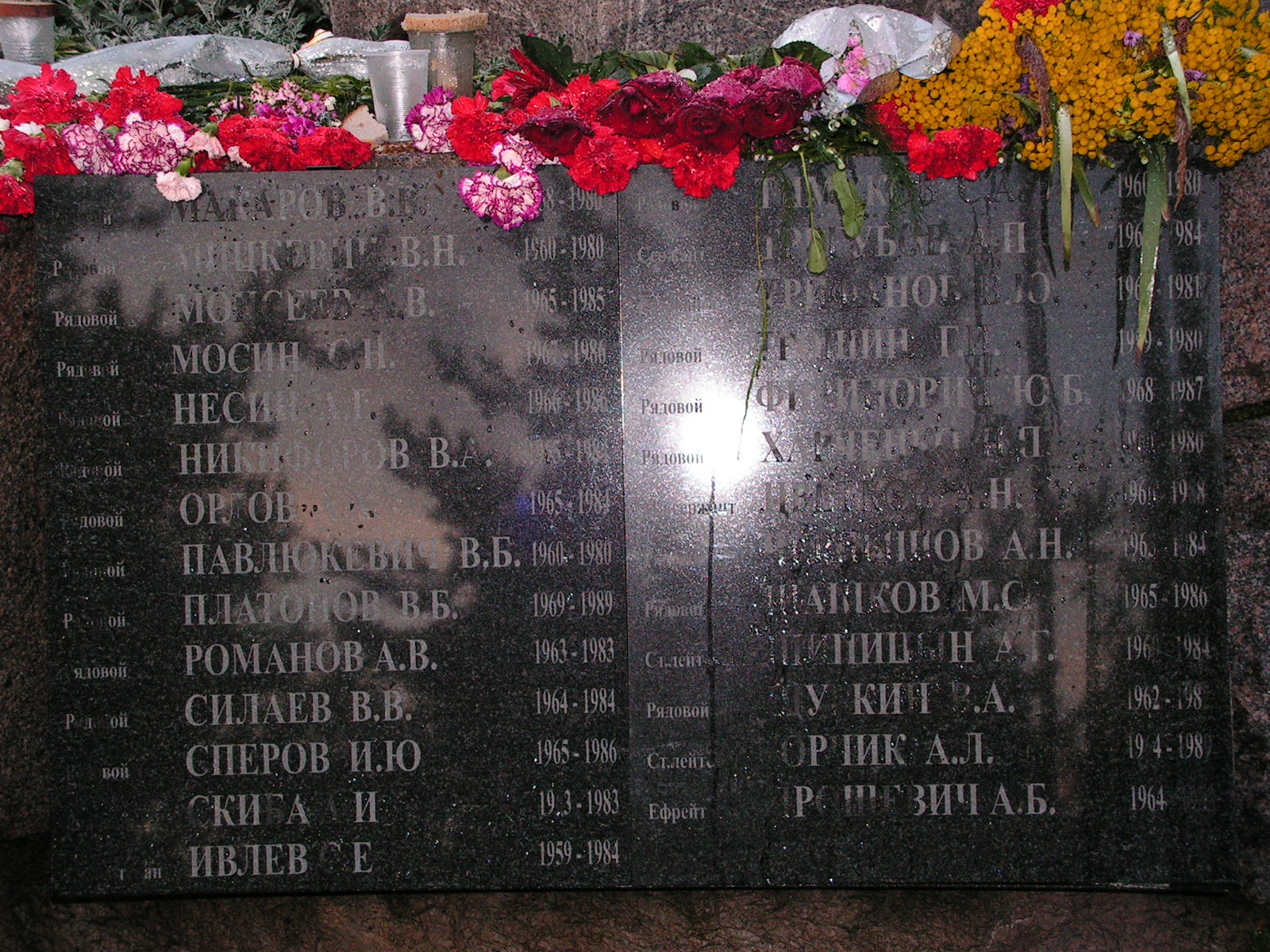
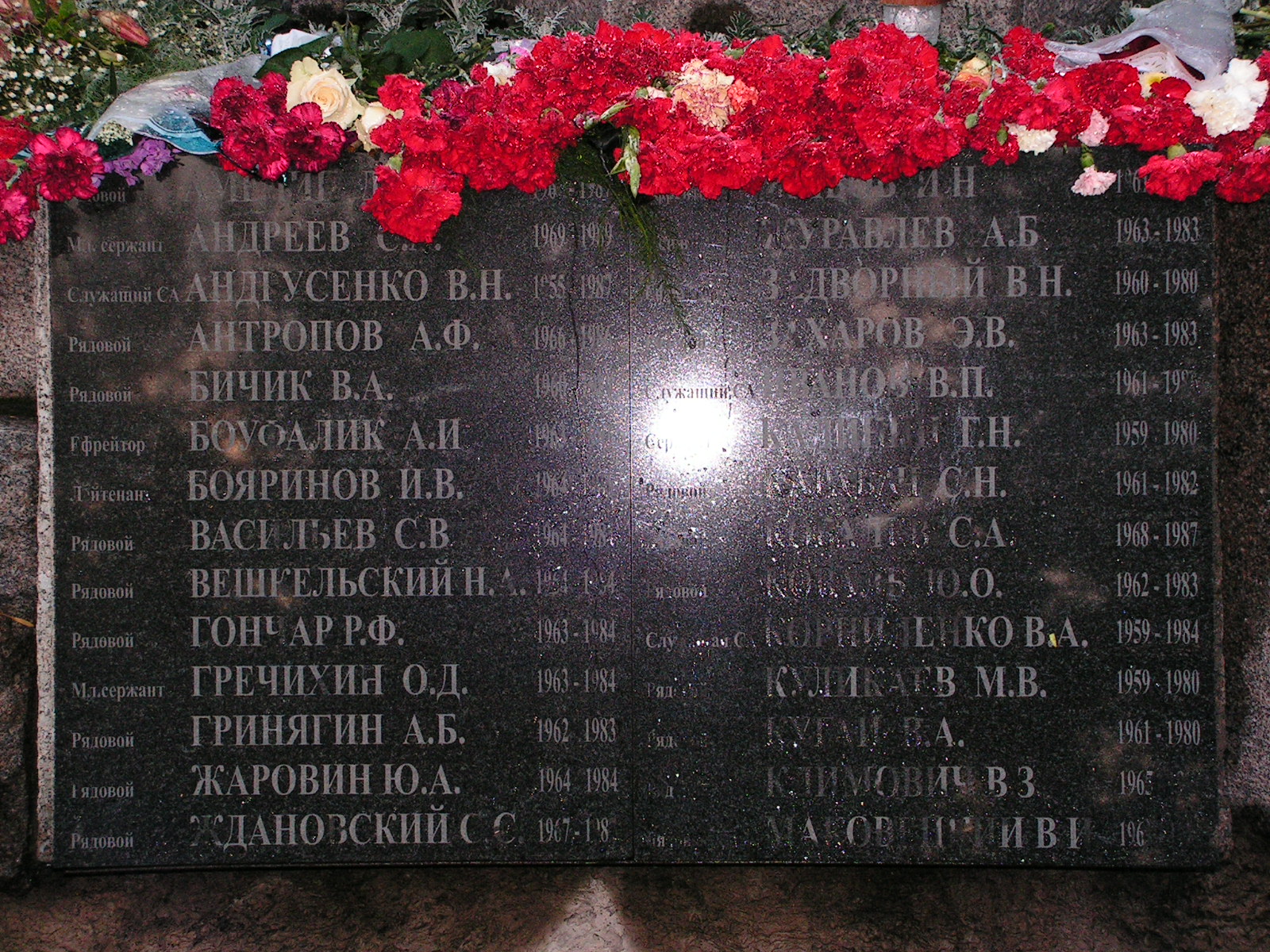
Afghan War Memorial in Chistopol

6 Boys from Chistopol

28 Guys from Petrozavodsk

27 More

How’s It Look for VDV?

On Monday, Voyennoye obozreniye took a look at the VDV and their rearmament needs.  It notes they’ve received virtually nothing new since the USSR collapsed, and what new equipment has arrived came in small amounts.

The composition of the VDV has shrunk from 65,000 personnel in seven divisions to about 35,000 in four divisions (Novorossiysk, Tula, Ivanovo, and Pskov) today.  Its airborne combat vehicles include BMD-1, BMD-2 Budka, BMD-3 Bakhcha, and BMD-4 Bakhcha-U, armored personnel carriers include BTR-RD Robot and BTR-3D Skrezhet.

Here’s a RenTV video about the Bakhcha and Bakhcha-U.

Artillery includes ASU-57, ASU-85, 2S9 Nona-S, 2S25 Sprut-SD, and howitzers 2A18 D-30 and 2A18M D-30A.

In January 2007, then VDV Commander, General-Colonel Aleksandr Kolmakov said the troops would soon be getting BMD-4, 2S25 Sprut, BTR-D3 Rakushka, KamAZ-43501, D-10 and Arbalet parachutes, and new infantry and special weapons.  In 2010, the Defense Ministry reportedly said it was buying Italian-made IVECO LMV combat vehicles for its “winged infantry.”

According to VO, the press says VDV has gotten more than 300 BMD-4 since they were accepted for service in 2004.  The BMD-4M, however, basically remains in testing, and only 10 of them are being used in the VDV.  Its future with the airborne troops might be in doubt.  Last December, VDV air defense sub-units got their first Strela-10M3 self-propelled anti-aircraft systems.  They will replace aged ZU-23-2 anti-aircraft guns.

VO concludes the VDV need to reestablish both their air and ground mobility.  VTA has degraded and can’t support airborne operations large enough to seize and hold strategic or tactical objectives in enemy rear areas, or to destroy enemy government and military command and control systems:

“As it was in the USSR, so it is in the RF, airborne troops are really used like the best trained motorized rifle units — for example in Chechnya, Ossetia.”

For off-road mobility, VO says VDV need Tigr, Vodnik, dune buggies, and ATVs.

It argues VDV divisions need their own fixed- and rotary-wing aviation, including multipurpose, transport, strike, and reconnaissance aircraft and UAVs.

The missions of the VDV need to be formulated like Spetsnaz, so they aren’t used like regular infantry.

Finally, VO says the VDV need to be fully professional, with career personnel, and pay twice the country’s median wage.  It can’t be done with today’s contractees who are mostly lazy and drunk, but this is the fault of the army’s reformers, according to VO.

Then, VO concludes, the VDV would be a real elite of the Russian Army.

The Foggy Goal of the GPV (Part II)

Sovershenno sekretno’s Vladimir Spasibo describes the early post-Cold War process of mergers and consolidations in the Western defense industries, and then asks:

“And how are our integration processes going?  By altogether different schemes.  Mainly by creating industrial ‘kolkhozy.’”

His example is the United Aircraft Corporation (UAC or OAK) which conglomerated most Russian aircraft designers and producers.

Spasibo says this consolidation should have eliminated problems with skilled personnel shortages, technology losses, obsolete production lines, low labor productivity, product quality, duplicative development, and excess capacity.  But it didn’t.

Spasibo examines the labor force in the OPK’s aircraft industry.  He claims with VVS purchases of 380 billion rubles per year, and productivity of 6 million rubles per worker (three times less than Boeing’s rate), there should be 66,000 workers in Russia’s industry, but its 6 lead plants have more than 100,000 workers, and the aviation industry overall has more than half a million.

He looks then at the labor force for the entire OPK.  With purchases totaling 19 trillion rubles, with modest productivity of 3 million rubles per worker over ten years, the OPK should have 630,000 workers, but Rostekhnologii General Director Sergey Chemezov says there are now 1.2 million.  And Spasibo concludes good specialists won’t work for what companies are able to pay as a result.

Chemezov has pointed out that only 36 percent of Russia’s “strategic enterprises” are financially stable; at the same time, 30 percent show all the signs of bankruptcy.  The situation is particularly bad in the munitions and special chemicals sector, where nearly 50 percent of companies look like potential bankruptcies.

Spasibo adds that only 15 percent of the OPK’s technologies meet world standards, 70 percent of basic production assets are outdated, and the equipment renewal rate is only 3-4 percent.  He says:

“To count on these companies being able to produce the weapons required is laughable.  But they will absorb the money they receive.  Naturally, without any particular result for the reforming Armed Forces.”

Spasibo concludes:

“The ‘estimated expenditures’ of the Defense Ministry obviously demonstrate that we’re again being dragged into a senseless and dangerous arms race which in no way increases our military security.  On the contrary, it increases the risk of creeping into military conflicts.”

“NATO and the U.S. absolutely don’t need a war with Russia.  China doesn’t either.  Even despite periodic rumors that it has territorial claims on us.”

“But it’s impossible to make these claims by military means.  Especially if Russia will have a modern high-tech army.  But once again no one is building it.  And doing this is impossible, scattering resources on strategic arms, VKO, an ocean-going fleet, whose role in the hypothetical case of war is completely incomprehensible.  The situation’s exacerbated by the lack of an entire series of experimental models fit for production and supply to the Armed Forces, an obsolete technological and organizational structure of OPK enterprises which, most likely, will turn the money into dead metal.”

“During perestroyka, we learned that the USSR lost the ‘Cold War’ to the U.S. and that the arms race killed the Soviet economy.  Scholars and commentators talked about this with figures and facts.  In those days, there were many suggestions about what to do with the Armed Forces and VPK.  But all this ended in empty talk.  In fact, they simply killed the VPK.  They practically didn’t invest money in the Armed Forces.  There was neither an army, nor a defense industry to arm the army.”

“And here a time has come when the Kremlin and the White House have decided to modernize the army and, using the financial possibilities that have appeared, to pour 20 trillion rubles into it before 2020.  But won’t we now be stepping on the very same rake as in the eighties, won’t the president and premier be repeating the mistakes of the Politburo, initiating a thoughtless and dangerous arms race?  The key word here is thoughtless.”

“Of course, the draft State Program of Armaments, 2011-2020 is a document under the top secret seal.  Does this mean the public shouldn’t discuss and understand what trillions will be spent for.  Or is it the prerogative of a narrow circle of interested officials — lobbyists for the VPK and the military?”

“The trouble is old and familiar.  Recently deceased  Academician Georgiy Arbatov wrote about it in 1990:  ‘An affair most important for the country and the people — defense, security, fantastically large military spending — was monopolized by a narrow group of generals and general designers from military industry.’  And further:  ‘I think the military shouldn’t be given a monopoly on assessing the threat of war.  Just the same it’s reasonable not to make this assessment without accounting for its opinion.’  It just shouldn’t dominate this.”

Thank you Mr. Spasibo.  A good article.  He has a clear point of view on the issue of the GPV and where the Russian military might or might not be headed.  But where does it leave us?

Just a little commentary . . . Spasibo says Russia aims to match NATO, the U.S., and maybe China too.  This raises the issue of whether it should aim for this and whether it can achieve this.  The answer to both is no.

That is, however, not the same thing as saying the Russian Armed Forces don’t need to modernize.  If they were smart, they’d aim for capabilities to offset the advantages of their stronger potential enemies.

That means difficult picking and choosing, something we haven’t seen much of in the GPV, where it looks like every service is at the table awaiting a full meal.

Russia is definitely not France, but this doesn’t mean Moscow has to defend everywhere.  Perhaps it should prioritize and worry more about Vladivostok and China than about Iturup and Japan.

Spasibo does a good job of pointing out that there are at least as many problems in the VPK, the OPK as in the military itself.  And yet there’s no real effort yet to remedy them.  All of this goes to whether Russia can reach whatever aim it sets for military modernization.  As Spasibo says, they might just be sending good money after bad.  They may be risking a repetition of past mistakes by overspending on arms, but, of course, they may not even get a chance to repeat these mistakes if money isn’t allocated.  Remember that previous GPVs died of financial starvation in their infancy.

One’s not sure about Spasibo’s argument on Moscow’s promotion of an arms race.  Right now, only the Russians need to ‘race’ — and the race is to catch up after years of falling behind.  And it doesn’t necessarily need to catch up to the extent that it duplicates U.S. capabilities.

And yes Spasibo’s right in saying these defense expenditures should be debated and decided more widely and publicly, but unfortunately Russian citizens have even more basic and important political and social issues that need that kind of scrutiny first before they get down the list to military procurement.

The Foggy Goal of the GPV (Part I)

In its February issue, Sovershenno sekretno’s Vladimir Spasibo examines the State Program of Armaments, 2011-2020, and tries to say if Russia can afford it.  Or more importantly, whether the new GPV makes sense given that Russia is unlikely to go to war with NATO, the U.S. or China.  Spasibo also casts a critical eye at whether the OPK is up to the task of fulfilling the GPV.  This author doesn’t vouch for Mr. Spasibo’s numbers and math; they are relayed as in the original.  But his arguments are interesting and useful.

Spasibo says, after 2013, the GPV’s 22 trillion rubles [19 trillion for the Armed Forces] will amount to almost 4 trillion annually for the military, or 8 percent of Russia’s GDP as compared with 5 percent in the U.S. and 2-3 percent in other NATO countries.  Buried a little down in the text, he cites Deputy Prime Minister Sergey Ivanov on the 1.2 trillion ruble State Defense Order for 2010, and Prime Minister Putin’s assertion that this amount will triple in 2013.

And the military actually wanted more — 36 trillion, which Spasibo claims would be 15 percent of GDP, an amount equal to the Soviet defense burden before the USSR’s collapse.  He asks if this isn’t too much for a country just emerged from an economic crisis.  And what threat is this colossal military budget directed against?

He turns to Defense Minister Serdyukov’s explanation to Der Spiegel:  terrorism, proliferation, and NATO expansion.

Spasibo suggests the thrifty French defense reform which, for less than Russia’s 22 trillion rubles, “Created a small, balanced grouping with modern equipment.  Capable of instant reaction and an adequate response to any threat to France’s interests.”  He continues:

“The approach of the current Russian military, more precisely civil-military, leadership toward reform of the Armed Forces is somewhat similar.  The preconditions, it’s true, are different, and the goals are foggier.”

Who, asks Spasibo, are Russia’s enemies, and against whom is it supposed to fight?  The Military Doctrine and other pronouncements make it sound like the answer is the U.S. and NATO, as well as nonstate irregular armed forces inside and outside Russian Federation borders . . . leaving Moscow to prepare both VKO against a high-tech enemy with highly accurate long-range weapons, and low-tech enemies conducting guerrilla warfare and sabotage-terrorist actions.

Spasibo then turns to thinking about which services and defense enterprises will get GPV money:

  • According to its commander, the RVSN will replace 80 percent of its ICBM inventory (roughly 300 missiles) by the end of 2016 for a price that Spasibo puts at 1.9 trillion rubles.
  • Spasibo thinks VKO and PRO might cost 3 trillion by 2020.
  • The Air Forces are looking to renew 70 percent of their aircraft, 1,500 aircraft in all including 350 new combat aircraft for 3.8 trillion.
  • Spasibo believes the Ground Troops will get 7.6 trillion to replace combat vehicles including 60 percent of their tanks and BMPs, and 40 percent of their BTRs, that are over 10 years old.
  • And the Navy, as reported elsewhere, will get 4.7 trillion.

That all adds to 21 trillion rubles.

Golts on the Sudden Increase in Officers

Yezhednevnyy zhurnal’s Aleksandr Golts says Defense Minister Anatoliy Serdyukov’s explanation that 70,000 more officers are needed because of VKO doesn’t hold water since it will be created on the basis of existing formations and units.

Golts concludes that Russian military reform has reached its next turning point.  He recalls that cutting officers to 150,000 and eliminating a large number of cadre formations and units represented the rejection of the old mass mobilization army concept.

But the reduction of so many officers could not but bring bitter opposition.  Nevertheless, Serdyukov stubbornly implemented the cuts, ignoring cries about the destruction of the country’s glorious officer corps (which Golts says hasn’t existed in a very long time).

Then suddenly the chief of the military department reversed himself.  Suddenly, it appears there are not too many officers, but a shortage.  The Armed Forces agonizingly cut 200,000 officer positions just to reintroduce 70,000!

Golts thinks there are several possible reasons.

The most obvious is the state’s inability to meet its obligations (primarily permanent apartments) to dismissed officers.  In mid-2010, there was information about 70,000 officers outside the shtat (штат or TO&E).  Later in the year, the number given was 40,000.  But says Golts:

“. . . to find out how many officers are really outside the shtat is impossible:  whatever figure Defense Ministry officials want to name, they name.  It’s possible to suppose that, having realized their inability to settle up with future retirees, the military department simply decided to put them back in the shtat.”

The second possible cause, according to Golts, is that the Defense Ministry failed to fill the officer posts it cut with well-trained sergeants and civilian personnel because the wages it offered were too low.  On the issue of more sergeants, Golts concludes:

“Sergeant training programs are failing.  Training centers simply can’t put out as many junior commanders as the Armed Forces need – they require not less than 100 thousand.  There’s no where to get them from.  And so they decided again to use officers to perform sergeant functions in combat sub-units, as rear service guys, service personnel.  If so, then this is a serious blow to reform.  Because the officer will cease being the elite of the Armed Forces, again turning into a low-level functionary.”

And Golts provides his third, worst case possibility:

“The generals convinced the president, but most of all, the premier [Putin] that it’s possible to achieve combat readiness by returning to the old mobilization model.  This is an ultimate end to reforms.  If so, then after presidential elections in 2012 the term of conscript service will inevitably be raised.  And everything will be back to normal.”

Golts concludes this concession by Serdyukov – heretofore supported by President Medvedev and Prime Minister Putin – will make those who hate him conclude he’s lost support, and they will triple their attacks on reforms.  In the worst case, this will be the first step toward overturning them.

More on the Military Personnel Zigzag

Wednesday’s Argumenty nedeli looked briefly at the reversal of Defense Minister Serdyukov’s cuts in the Russian officer corps, as well as plans to increase officer pay.

AN said Serdyukov said 70 thousand officers were needed to establish Air-Space (Aerospace) Defense (VKO), but noted he didn’t say where he would find so many officers for such a complex and specialized military field.

Those thrown out of the service in the course of implementing the “new profile” can’t be brought back, and training new officers will take 10-12 years following the reform of the military education system and the liquidation of the Mozhayskiy Military-Space Academy.

And, says AN, radically increasing pay won’t be so simple.  The budgets for 2011 and 2012 have been approved, so pay raises will have to wait until 2013 and 2014, after a new Duma and president have been elected.  And increasing the number of contractees [also with higher pay] will be another factor in army financing problems.

A General Staff source told AN:

“The approximate manning of VKO in all duty positions, including conscripts, contractees, and officers, will be 20-22 thousand.  This means the majority of duty positions will transfer there from Space Troops (KV), air defense troops and missile defense.  But after the mass cuts there aren’t enough commanders on the level of company, regiment and even brigade commanders.  And in all services and branches of the Armed Forces at that.  Therefore, it’s incorrect to think that all 70 thousand are going into VKO.”

According to him, the establishment of any new service [if it is a service rather than a branch], especially one as high-tech as VKO, requires “decades of work by all staffs.”

AN also cites Aleksandr Khramchikhin:

“It seems to me that constant casting about on the size of the officer corps just says that military reform issues haven’t been worked out in a strategic plan.”

A short item that says a lot . . . just a couple comments:

  • This piece is saying that VKO officers and specialists will be taken from the ranks of those currently serving in KV, PVO, and PRO.
  • The 70,000 additional officers will plug holes in command positions throughout the Armed Forces.
  • It would be difficult to bring back dismissed officers.  But there are lots of serving officers living in limbo outside the shtat (штат), outside the TO&E at the disposition (распоряжение) of their commanders, who could be called back to their units.
  • Military education’s been hammered, but it looks like Mozhayskiy’s still operating.
  • Delivering the promised new higher pay system in 2012 will be difficult under current and projected budgetary constraints.  So it’s another opportunity for the regime to fail.  But the Kremlin and White House don’t really need to worry about military votes anyway.
  • Kramchikhin’s right on.  Serdyukov’s idea to cut the officer corps in half – from more than 30 to 15 percent of Armed Forces personnel – was right.  But he failed to plan properly for it, and he tried to do it too fast.  Without accounting, or compensating, for the myriad historical, economic, and cultural reasons Russia had so many officers in the first place – reliance on conscripts and the lack of a strong NCO corps being first and foremost.  So another correct step is discredited by hubris, lack of foresight, and poor execution.  Serdyukov didn’t need to measure seven times before cutting, but twice would have been nice.
  • Taking “decades” to put VKO in place would certainly be the old-fashioned speed of Russian military reform.  But if it’s to be done quickly and successfully, it has to be done with more care than Serdyukov’s demonstrated over the last four years.