
Novyye izvestiya has 1TV’s video coverage and story on the flight.
Pilot.strizhi.info posted these photos, along with links to the high resolution originals from Sukhoy.org.

Second PAK FA Takes Off
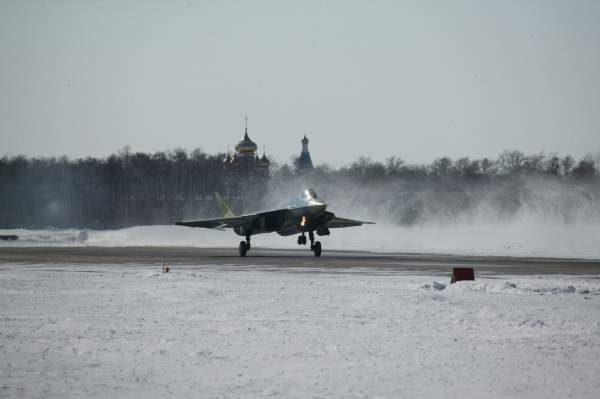
Landing

PAK FA Chutes Deployed
Novyye izvestiya has 1TV’s video coverage and story on the flight.
Pilot.strizhi.info posted these photos, along with links to the high resolution originals from Sukhoy.org.
Second PAK FA Takes Off
Landing
PAK FA Chutes Deployed
On Tuesday, Vedomosti’s Aleksey Nikolskiy wrote about breakdowns in last year’s State Defense Order (GOZ). He notes that concern about failures started with Roskosmos, but it isn’t limited to that part of the defense sector.
Nikolskiy recounts Deputy Prime Minister Sergey Ivanov’s session with the Roskosmos collegium. The space industry only produced five of 11 satellites specified in GOZ-2010, and 6 civilian launches were postponed. The three GLONASS satellites lost to a “childish mistake” [in filling the rocket’s tanks] cost 2.5 billion rubles. But we’ll return to Russia’s space woes another day.
A Defense Ministry source tells Nikolskiy GOZ failures are constant.
Bulava SLBM delays kept Yuriy Dolgorukiy from entering service [remember the new SSBN itself had to return to Sevmash for work while it awaits the next Bulava test]. Introduction of the new Severodvinsk SSN has been put off until much later because of construction defects. A United Shipbuilding Corporation (OSK) source tells Nikolskiy the Defense Ministry has stopped financing completion of a proyekt 677 diesel-electric sub, and work on two others laid down at Admiralty Wharves is in question.
Nikolskiy says the Air Forces’ assimilation of Yak-130 trainers is delayed by last March’s crash. And there’s a serious delay in the testing of the Su-35 fighter, according to a Defense Ministry officer [Sukhoy was reportedly testing two Su-35s last August]. One enterprise manager claims reforms in the Defense Ministry purchasing system are holding back contracting for aircraft deliveries this year.
CAST’s Konstantin Makiyenko says government and Defense Ministry criticism of industry for its GOZ failures could be followed by personnel changes. In Roskosmos’ case, the situation is almost “overripe.” But Makiyenko defends other Russian arms producers by noting that delivery delays are common even for U.S. and European manufacturers.
In today’s Nezavisimaya gazeta, Vladimir Mukhin concludes the OPK’s “systemic failure” has left the military without new weapons. His article also says a lot about the base upon which the Kremlin intends to build a modernized economy. But perhaps the OPK is in worse shape than other sectors . . .
Defense Minister Serdyukov apparently sent President Medvedev a report explaining why some very important armaments and military equipment were not delivered in 2010.
According to Boris Nakonechnyy, Deputy Chief of the Directorate of State Defense Order Formation in the Defense Ministry’s Armaments Department, Serdyukov proposes that the Supreme CINC use “measures of administrative effect against enterprise directors who have violated the timeframe for fulfilling the Gosoboronzakaz.” He doesn’t say if this means fines, arrest, etc. Specifically, Nakonechnyy said, in 2010, a proyekt 20380 corvette, two proyekt 955 submarines, one proyekt 885 submarine, 3 of 9 planned Yak-130 trainers, and 73 of 151 expected BMP-3s were not delivered.
Mukhin calls this an obvious failure, and estimates at least 30 percent of the 2010 GOZ wasn’t realized. He contrasts this with President Medvedev’s Poslaniye, in which he said he was sure defense expenditures in the 2011-2013 budgets would allow the Armed Forces to buy the new armaments they need.
Speaking to defense enterprise directors in Sverdlovsk Oblast, Nakonechnyy said the cause of failure in the Gosoboronzakaz is poorly organized work by enterprises and designers:
“Signing contracts . . . an enterprise director assumes quite serious obligations. And, signing such a state contract, he is correspondingly bound to meet these obligations.”
But, he says, in a number of OPK enterprises, this isn’t happening.
Mukhin turns to the directors’ side of the story.
Military plant directors in the Urals unanimously announced that “contracts are concluded in such a way that we will always be in extremis.” They say they’ve made proposals about contracts, but none of them are considered. They also point to the Defense Ministry’s significant indebtedness to enterprises for completed work. This supposedly amounts to 228 million rubles in the Urals. Most of all, managers worry about uncertainty in this year’s GOZ, and about the Defense Ministry’s intention to pay 2009 prices this year.
The head of the Sverdlovsk producers’ group says:
“To this point, there are no agreements, no money. All this pushes us toward emergency work in the future. The pricing policy is driving us into a corner.”
Another general director complains of low profitability in the OPK. Only 6-7 percent, according to him. The Defense Ministry is allowing growth in materials costs of not more than 1 percent this year, and this will erode profitability further.
Military analyst Vladimir Dvorkin says a third of defense enterprises are really bankrupt. Investment in R&D is ten times lower than in developed countries. Investment in basic capital and personnel training is five times lower. He continues:
“Fixed capital assets at OPK enterprises are two-three times, and labor productivity five-ten times lower than in developed countries. More than 70% of technologies supporting production demands are worn-out or obsolete. More than half the machine tool inventory is 100% worn-out. The average age of OPK workers is more than 50, in defense NII [scientific-research institutes] it approaches 60.”
Dvorkin thinks the Armed Forces can’t be brought to the level of the world’s leading armies without extraordinary efforts. Priorities need to be set for the armaments development system in order to concentrate efforts on a limited list of systems.
Mukhin thinks it might be too late since Medvedev’s already signed GPV 2011-2020. But whether its priorities will be met is another thing. So far in post-Soviet history, not one GPV has been fulfilled, Russia’s defense industry continues to decline, and global restructuring in military production still hasn’t been noticed in Russia.
This morning’s press included various accounts of statements from Igor Korotchenko or in the name of the Defense Ministry’s Public Council, on which Korotchenko serves, about mitigating the impact of corruption on the State Program of Armaments (GPV), 2011-2020.
RIA Novosti quoted Korotchenko to the effect that the rearmament program will only be successful with strict financial accounting and effective measures against corruption in the State Defense Order (GOZ or гособоронзаказ).
He said Defense Minister Serdyukov is taking steps to ensure that resources are used as intended, including the establishment of a Military Products Price Formation Department and the resubordination of the Federal Arms, Military, Special Equipment and Material Resources Supply Agency (Rosoboronpostavka) to the Defense Ministry. But the latter step was done over six months ago, and not much has been heard about it since.
Novyye izvestiya and Novyy region quoted the Public Council’s statement:
“But for the army to receive all this [equipment in the GPV], money is simply not enough – it’s necessary to make things so that Defense Ministry generals, who to this point were occupied simultaneously with orders and purchases of weapons, don’t get access to money, are occupied only with formulating lists of everything needed for the conduct of modern war, but the function of monitoring prices and purchases should be transferred to other departments. Otherwise, government resources allocated to the GPV will get ‘sawed off,’ placing this program in jeopardy.”
Those are, of course, the jobs of the new Price Formation Department and Rosoboronpostavka. Serdyukov’s tax service veterans are supposed to free the payments system from graft, and use their experience to uncover complex theft schemes. Military prosecutors are also expected to be more active here. Main Military Prosecutor (GVP) Sergey Fridinskiy told Novyy region about prosecutors’ work in uncovering the theft of 6.5 billion rubles’ worth of military budget. He claimed his prosecutors have stopped 240,000 violations, suspended 12,000 illegal actions, held 40,000 people to account, and returned 4 billion rubles to the treasury. But it’s not clear what time period he’s talking about.
RIA Novosti recounted Korotchenko’s comments about preventing corruption in military RDT&E:
“Special control needs to be provided on scientific-research work and justification of expenditures on it, but also on the development of new types of armaments, since it’s precisely here that opportunities for different types of financial machinations and abuse exist.”
Of course, reminds RIA Novosti, RDT&E only amounts to 10 percent of the GPV. Bigger chances for theft exist in procurement, which is supposed to be 78-80 percent of the rearmament plan.
According to Novyye izvestiya, on the procurement side, Korotchenko says, in past years, a minimum of 45-50 percent of money for arms simply ended up in someone’s pocket. For this reason:
“For the very same money, Russia buys 14 tanks a year, and India 100. This led the country’s leadership to the kind of thinking reflected in the Defense Minister’s authority to reorganize the entire purchasing scheme. This time [the new GPV] 19 trillion rubles are at stake. Can you imagine with what interest the ‘market players’ are waiting for them? But the state machinery is running: many OPK directors are already being removed, in the case of the director of one of the system-forming design bureaus, suspected of stealing money from a state order through offshore shell companies, an investigation is being conducted, and other criminal cases in orders-purchases from previous years are also possible.”
The nongovernmental National Anticorruption Committee says the average kickback in civilian contracting is 30 percent, but, in defense, it’s 60 to 70 percent. Because arms prices are secret [and hard to determine anyway], no one knows how much this is. But common sense says this makes everything cost nearly twice what it should.
In Vladivostok yesterday, Defense Minister Anatoliy Serdyukov made the surprising announcement that the first Borey-class SSBN, Yuriy Dolgorukiy, will deploy to Russia’s Pacific Fleet, once it becomes operational with its complement of Bulava SLBMs.
To be precise, Serdyukov said:
“The first Borey will enter the TOF [Pacific Ocean Fleet]. This is how it is in our plans. . . . new barracks are already built for crews of new submarines. Since 2007, we’ve been taking down old barracks and building new ones, renovating the social infrastructure 100 percent.”
Serdyukov made the comments while inspecting new construction in Vilyuchinsk for Pacific Fleet contractees.
Basing the first Borey away from where it was built, and away from Russia’s Northern Fleet, is a sharp break from the Soviet / Russian Navy tradition of keeping the first units of new classes — especially SSBNs — close to their point of origin at Sevmash. A Pacific Fleet deployment could complicate service and support not only for Yuriy Dolgorukiy, but for its new missile system as well, and make this more costly too.
The Defense Ministry seems to have decided it needs to retain a two-fleet naval strategic nuclear deterrent. And putting the first Borey there seems essential given that the Pacific Fleet has only a handful of 30-year-old Delta III-class SSBNs at this point. This decision may also reflect what’s been presented several times as an increased Russian military focus on the Asia-Pacific region.
Posted in Force Structure, Navy, Strategic Forces Modernization
Tagged Borey, Bulava, Delta III, ТОФ, Kamchatka, Pacific Fleet, SLBM, SSBN, TOF, Vilyuchinsk, Yuriy Dolgorukiy
According to Nezavisimaya gazeta’s Vladimir Mukhin, Defense Minister Serdyukov has lost the confidence of his bosses, as well as his carte blanche to reform the Armed Forces. NG’s Kremlin source claims Serdyukov’s initiatives will be vetted at higher levels (i.e. the Sovbez and President) in the future. But can there really be any initiatives left at this point? Isn’t it all either implementation or reversal at this point?
President Medvedev’s press-secretary quickly denied that responsibility for military reform is being transferred elsewhere, and insisted it remains with the Supreme Commander-in-Chief and his Defense Minister (but what about Putin?). She called Mukhin’s report a “lie,” and said only Medvedev and Serdyukov answer for Armed Forces reform, while others just “contribute to it.”
Mukhin covers Putin’s trip to Kaliningrad about military housing where he was told about discontent among military retirees and he promised a 50-70 percent increase in their pensions. General-Lieutenant Netkachev blames Putin for letting military pensions slip from three times to barely equal to a normal labor pension.
Mukhin’s final interlocutor cites Finance Minister Kudrin on the cost of these political promises to the military increasing Russia’s defense burden from 3 to 4.5 percent of its GDP.
It’s worth including all of Mukhin’s article:
“Election Candy for the Military Electorate. The Party of Power Struggles for the Votes of Veterans and Servicemen.”
“The fundamental steps connected with reforming the army will now be implemented not by the military department itself, but by the Security Council (SB), where the main director of this work will be the Deputy Secretary of the SB, ex-Chief of the General Staff Yuriy Baluyevskiy. A Kremlin source has told ‘NG’ such information. It notes that in its responsibilities, the Sovbez is charged with supervising the general work of the government and power structures in creating a positive image of the main activities of military organizational development, especially in the social sphere for officers and retirees and their family members.”
“So it is that the carte blanche given to Anatoliy Serdyukov several years ago by Vladimir Putin for a radical reorganization of the country’s Armed Forces is now canceled. Further reforms will be agreed at a higher level and, of course, with the participation of Dmitriy Medvedev’s team. As an SB source notes, Prime Minister and United Russia leader Vladimir Putin agreed to such steps for two reasons. First, the image of the country’s military-political leadership was recently severely shaken, and the protest mood among a large number of serving military personnel and retirees is growing. Taking into account the experience of the Arab revolutions, the tandem, apparently, decided to secure itself. Secondly, the electoral battle has pushed the party of power to correct steps in the army’s reform and especially in social issues.”“Vladimir Putin’s 23 February trip to Kaliningrad, where he, along with General Staff Chief Nikolay Makarov, Deputy Defense Minister Grigoriy Naginskiy, and other government officials met about the housing problems of servicemen and where he met with residents as UR leader, was evidently connected to these factors. These meetings happened at the same moment when on Poklonnaya Gora in the capital, the Union of Airborne of Russia (SDR) demanded the Defense Minister’s resignation, when on the Arbat [location of the Defense Ministry’s buildings] under the flags of [the political party] ‘Yabloko,’ military retirees demonstrated demanding doubled pensions, when on Pushkin Square in Moscow and Lenin Square in St. Petersburg communist-veterans demanded a solution to the housing problems of servicemen. Television didn’t show these and other protest actions, occurring in many regions, at all. On the other hand, all central television channels broadcast Putin’s visit to Kaliningrad.”
“Against this background, ‘Finans’ magazine published its latest list of [ruble] billionaires in Russia, where under number 163 current Deputy Defense Minister and United Russia activist Gregoriy Naginskiy was noted. On the list, he is noted as founder of the engineering firm ‘Titan-2’ which is involved in construction. His personal wealth is estimated at 20.7 billion rubles. We note that in the Defense Ministry Naginskiy is also in charge of construction issues.”
“At a meeting with Putin, one of the leaders of the Kaliningrad veterans movement, former chief of the 11th Army’s political department, General-Major Boris Kosenkov handed the Premier a ‘little extremist manifesto’ being disseminated among veterans in Kaliningrad. At the same time, talking about low pensions for retirees, the general stressed that ‘a very tense situation is being created in our veterans’ organization structures and political parties are even using this problem in the election campaign.’ As is well-known, there’s no such thing as a former political worker, and the veteran precisely seized the moment to enlighten the Premier about the mood among military pensioners. Vladimir Putin had no choice but to agree with the fact that ‘really the situation with pension support for servicemen doesn’t correspond to the principles on which it was formed in previous years. And according to recent data, for about 40% of military pensioners (or, maybe, even a little more), the pension is already either equal, or even a little less than a labor pension.’ Putin immediately promised that the ‘increase in military pensions will be substantial. It will be an increase of about 1.5 times, about in the range of 70%.’”
“‘Let them, of course, raise pensions. But now this looks like pure PR,’ believes General-Lieutenant Yuriy Netkachev, advisor to the Association of Social Defense for Veterans of ‘Rus’ Special Sub-Units. ‘In 2000, when Vladimir Putin became President, military pensions were on average three times more than civilian ones. Now they are much lower. Who stopped the current authorities from keeping our pensions at the previous level?'”
“Academy of Military Sciences Correspondent-Member Colonel Eduard Rodyukov draws attention to another fact. ‘In Kaliningrad, Putin promised to allocate another 150 billion rubles to solve all the housing problems of servicemen and military pensioners. President Dmitriy Medvedev has once again pledged that from 2012 the salaries of officers will increase several times. In Finance Minister Aleksey Kudrin’s opinion, all these transformations, as well as realization of rearmament programs, which the President and Prime Minister proudly proclaim, will require increased defense spending of at least 1.5% of the country’s gross domestic product. That is the total expenditures in the military budget next year will be 4.5% of GDP. For comparison: in the U.S. about 3.5% of GDP is spent on defense.’ Rodyukov draws attention to the fact that in Russia wars are not foreseen in the near future. But spending on defense will be very great. ‘This will lead to increased problems in the economy. Or is there a possibility that militarization simply won’t occur, and this means the military’s negative attitude in society will exacerbate further.’ Rodyukov supposes.”
Posted in Officer Corps, Serdyukov's Reforms
Tagged Defense Burden, Military Budget, Military Pay, Military Pensions, SB, Security Council, Sovbez, Yuriy Baluyevskiy
Yesterday First Deputy Defense Minister Vladimir Popovkin gave RIA Novosti more details on Russia’s procurement plans under the State Program of Armaments (GPV), 2011-2020. He said 78-80 percent of the 19-trillion-ruble Armed Forces portion of the GPV will go to procurement.
Popovkin said Russia plans to develop a new liquid-fueled heavy ICBM to carry up to ten warheads, and having a service life of up to 35 years. Former RVSN Commander General-Lieutenant Andrey Shvaychenko talked about a new liquid heavy as far back as late 2009, and the issue’s been debated in the Russian military press since.
Popovkin said the Defense Ministry plans to accept the Bulava SLBM and the first two Borey-class SSBNs this year. There will be 4-5 Bulava launches this year. Recall to date only 7 of 14 Bulava tests have been successful. Addressing the missile’s past failures, Popovkin said there were many deviations from the design documentation during production. He also said Russia plans to build eight SSBNs to carry Bulava by 2020. He was unclear if this includes the first two Borey-class boats.
Popovkin said work on a new strategic bomber is ongoing, and he claimed a technical design will be complete in 2015. He said this work isn’t being rushed.
Popovkin told RIA Novosti the Air Forces will receive more than 600 new aircraft and 1,000 new helicopters by 2020. In 2011, Su-27SM, Su-30M2, Su-35S, Yak-130, and Su-34 aircraft are to be procured. More than 100 helicopters, including Mi-26 transports and Mi-28N and Ka-52 combat helicopters will be acquired this year, according to Popovkin.
Popovkin said a contract for the first ten experimental PAK FA (T-50) aircraft will be signed in 2013, with serial production of 60 aircraft beginning in 2016.
The GPV includes the purchase of ten S-500 air defense systems. Popovkin said this system will begin testing in 2015, initially with missiles from the S-400. Fifty-six S-400 units will also be purchased by 2020. This sounds like seven 8-launcher battalions.
Popovkin said the GPV will buy 100 ships – including 20 submarines, 35 corvettes, and 15 frigates – for the Navy. He didn’t specify types for the other 30 ships, and it’s unclear if new SSBNs are included in these numbers. Popovkin reconfirmed Russia’s plan to buy two and build two Mistral amphibious ships. Recall also the Black Sea Fleet alone is supposed to get 18 new ships including proyekt 636 diesel-electric submarines, proyekt 11356 and 22350 frigates, and proyekt 11711 LSTs.
Popovkin also mentioned plans to buy a limited number of French FELIN soldier systems, with the intent of Russia producing its own version by 2020. He looks for it to equal the advertised capabilities of U.S. and German equivalents.
Posted in Force Modernization
Tagged Acquistion, Borey-class, Bulava, Corvettes, FELIN, Frigates, GPV, ICBM, Mistral, PAK FA, Procurement, Proyekt 11356, Proyekt 11711, Proyekt 22350, Proyekt 636, S-400, S-500, SLBM, Soldier Systems, SSBN, State Program of Armaments, T-50, Vladimir Popovkin
FOM against VTsIOM on the army’s current condition:
| Army’s condition | FOM | VTsIOM |
| “Very good, good” | 8 percent | 13 percent |
| “Average” | 40 percent | 44 percent |
| “Poor, very poor” | 35 percent | 29 percent |
And Levada against VTsIOM on the army’s capability to defend against an external threat:
| Capable of defending | Levada | VTsIOM |
| “Definitely yes, most likely yes” | 59 percent | 55 percent |
| “Most likely no, definitely no” | 28 percent | 30 percent |
Posted in Serdyukov's Reforms
Tagged FOM, Levada, Military Capabilities, Polling, Polls, VTsIOM
Some more polling results for the 23 February holiday.
VTsIOM polled 1,600 people in 138 inhabited areas of 46 regions, with a margin of error of 3.4 percent.
Some questions are similar to FOM’s and Levada’s.
How do you assess the Russian Army’s current condition?
VTsIOM doesn’t aggregate, so we will. “Very good, good” is 13 percent this year. “Average” is 44 percent. And “Poor, very poor” is 29 percent.
Do you think the army is capable of defending Russia against a real military threat from other countries?
“Definitely yes, most likely yes” is 55 percent this year. It’s interesting that the “definitely yes” answer is down to only 12 percent vs. 31 percent three years ago. “Most likely no, definitely no” is 30 percent this year.
VTsIOM also asked for opinions about Defense Minister Serdyukov’s reforms.
Are you aware of large-scale army reforms affecting various categories of servicemen and aspects of service?
Thirteen percent say they know a lot about this. Fifty-seven percent have heard about reforms, but don’t know what they’re about. And 25 percent hadn’t heard about them at all until this poll.
What kind of effect will the reforms have on the army’s capability?
Nineteen percent think “positive, capability will increase.” Thirteen percent said “negative, capability will decrease.” Twenty-three percent believe “no effect, capability won’t change.” And 46 percent found it “difficult to answer” one way or the other.
Posted in Serdyukov's Reforms
Tagged Military Capabilities, Military Threats, Polling, Polls, VTsIOM
The widely-respected Levada-Tsentr asked 1,600 Russians in 130 inhabited points in 45 regions its usual slate of Defenders’ Day questions reflecting attitudes toward the military and military service. Its margin of error is 3.4 percent.
Are there military threats to Russia from other countries?
This one ticked up a bit this year. “Definitely yes, most likely yes” rose from 47 percent last year to 53 percent this year. It’s a little higher, but not way off the norm since 2000.
Is the Russian Army capable of defending the country from a real military threat from other countries?
“Definitely yes, most likely yes” ticked down a little from 63 to 59 percent, and “most likely no, definitely no” rose from 22 to 28 percent this year.
To serve or not to serve . . . would you want your son, brother, husband, or other close relative to serve in the army?
Respondents answered 36 percent yes to service, and 54 percent no to service. This was only a slight change from last year’s 34 and 57 percent – within the error margin.
If no, why not?
Interestingly, “dedovshchina, nonregulation relations, and violence in the army” declined from 37 to 29 percent in a year when, by every official account, reported cases of barracks violence increased significantly.
Should a family member serve if called up or look for a way to evade service?
Basically unchanged from last year, 46 percent say serve, and 41 percent say look for a way to avoid it.
Lastly, a question not asked every year . . . .
How widespread is dedovshchina and abuse of young soldiers by officers and older servicemen?
“In the majority of military units” has fallen over time to 39 percent, “everywhere” has declined to 13 percent. These two answers together in 2006 were 82 percent. “In a small number of military units” and “isolated instances” have both increased over time and represent 27 and 11 percent respectively this year.
Posted in Conscription, Hazing, Law, Order, and Discipline, Manpower
Tagged Dedovshchina, Nonregulation Relations, Polling
 Russian Defense Policy