Bulava Test Delayed Two or Three Weeks

ITAR-TASS reported this morning that the expected Bulava SLBM test has been put off for two or three weeks.  The state commission looking at the December 2009 Bulava failure apparently made the decision today ahead of an anticipated launch between 11 and 14 August.  A defense industry source didn’t give a reason for the postponement.

Lieutenant Colonel Biront’s Defense

Sounding somewhat dazed, Lieutenant Colonel Viktor Biront told Life News his story about how and why the naval aviation depot near Kolomna burned.  According to Biront, higher authorities were completely informed about his situation days before the facility burned, but ignored repeated requests for assistance.

Biront says firefighters worked to save expensive dachas near his base, but weren’t as willing to help him.

According to Biront, the base he commanded for only three months before the fire had just lost 19 officers and 36 warrants as a result of Defense Minister Serdyukov’s cuts in both personnel categories.  He also lost his firefighting unit in February.

Biront describes how he managed to trade his car to get use of a fire engine.

Reports of the value of property lost have varied widely, but Biront indicates they saved most of what was worth saving.

Here’s the interview verbatim: 

“The lieutenant colonel dismissed because of the fire relates how he and his sailors saved the air base from fire for 10 days.”

“Relieved of duty as military base commander after the big fire, 43-year-old Lieutenant Colonel Viktor Biront tells in an exclusive interview with Life News how he and his subordinates saved the military unit from the fire.”

“The morning of 29 July the lieutenant colonel went to the perimeter and posted people on the edge of the burning forest.”

“’Everyone worked in the forest – both civilians and military,’ said Viktor Ivanovich.  ‘I was there also, only leaving periodically to call and request help.  The chiefs of Civil Defense and Emergency Situations came to evaluate the situation.  Then a strong wind started – the gusts were nearly 20 meters per second – and drove everything from the depth of the forest.  It was terrible to be in the fiery pockets.  Here, look – hands, feet all burned.  We stood on the perimeter, still 1.5 kilometers from the facility.  What a terrible picture – the fire was a wall in the forest.  I gave the order to evacuate.  I was last to leave there, because I was shouting to the last so the boys wouldn’t die there.’”

“According to Viktor Biront, the firemen arrived only two hours after the call.”

“’It’s as if we don’t exist for the city:  neither MChS, nor police . . . no one was with us,’ said the lieutenant colonel.  ‘They saved 1.5 million dollar dachas here.  There were both cordons and police there.  The first help came after several hours – no matter how much I called, how much I asked.  Only after a couple hours a firefighting helicopter flew in.  We can’t get through there – everything’s burning, everything’s blazing . . .  I quickly recounted the people.  Then equipment came from Moscow, and by night a deputy defense minister arrived.  It was impossible to go in.  Sailors were simply suffocating in gas masks – they were saturated with smoke.  I gave the command to take them off . . .’”

“The massive fire that destroyed property worth billions of rubles was preceded by 10 days of struggle with the fire.  And over these 10 days, the big bosses, despite all requests, didn’t take any clear decision about how to save the air base.  In fact, saving it depended only on 40 sailors and their commander.  115 hectares – almost three per man.”

“’I’ve been in the position for three months, they gave me this unit in May in a new composition, after reductions,’ Biront says.  ‘They cut 19 officers, 36 warrants.  In all 40 sailors remained, eleven sergeants and four officers – and this is all the people for such a large unit.  Plus civilian personnel whom I treated with great understanding.  I couldn’t send female clerks into the battle with the fire because the average age of my workers is 58-60.  The pay is low, 5-7 thousand, only female pensioners who’ve worked here a long time do this work.  They also helped as they could.  Men came into the forest with axes and shovels – tried to stop the flames.’”

“’The forest near the unit burned for 10 days,’ Viktor Ivanovich continues.  ‘I turned to them repeatedly, high officials came, had meetings here, made plans, a certain Mr. Shumeyev – deputy for security, an ecologist came here.  The sailors stood two days on the perimeter, not allowing the fire to spread.  I called Civil Defense and Emergency Situations.  Sometimes they gave help, but sometimes they refused.  I didn’t have my own firefighting team – they eliminated it in February of this year.  There was simply an ad hoc firefighting team, they dug themselves in and fought by all means.  When I saw this was all very difficult – I put my non-TO&E car to use, I had to give it to the firemen.  Generally, it’s use is forbidden, we used it because I had to pay money.  They brought a fire engine and handed it over there.  I secured a driver, whom we used to the fullest extent.  We hosed, knocked down flames, in general, battling though I didn’t have specialists.  We had to teach our officers who were extinguishing the fire.’”

“’In principle, we coped with the fire the first ten days,’ says the dismissed commander.  ‘I reported to Moscow by phone, by morning reports, by faxes.  I asked for help.  One time they gave equipment.  A KamAZ came from Shcherbinka from the airport, poured out two cisterns and went back.  Local civilians were all in action – villages burning, the government likewise, then they left 14 castoff portable fire extinguishers, literally the day before the conflagration.  They took them from the unit two kilometers into the forest.’”

“They didn’t manage to save the base.  Viktor Biront learned about his dismissal on the television news. At this moment he’s again writing a statement in the prosecutor’s office.  In this document he indicated that they managed to save property worth 40 million rubles.”

“’My people saved the new equipment.  The burned up property there had expired service lives and required repairs.  But then everything was finished, all closed, but they told us we were all morons generally.  Here it’s burning, and they are crawling through hell and saving equipment.  I’m not defending myself, I’ve told it like it is.  In theory in three months I should have cleared out everything that grew up in this forest over 60 years.  Because in 60 years no one ever did anything there.’”

President’s Tough Talk to Defense Minister Serdyukov

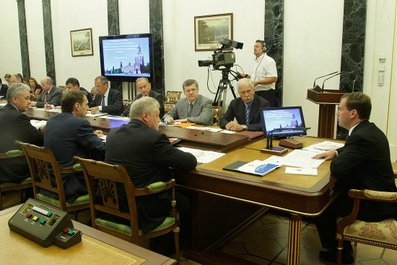
Medvedev at Security Council Meeting

Let’s look at President Dmitriy Medvedev’s criticism of the Navy and the Defense Ministry, his warnings and dismissals of some Navy officers.  It looks somewhat like a script torn from Vladimir Putin’s ‘tough guy’ handbook. 

Kommersant recounted the details of what sparked the President’s ire.  On 29 July, a fire burned the 2512th Central Aviation-Equipment Base of Naval Aviation and Air Defense near Kolomna, several dozen kilometers southeast of Moscow.  The Prosecutor’s Investigative Committee (SK) said the blaze destroyed the staff headquarters, finance unit, club, two bays of vehicle parking, 13 warehouses with various items of aviation equipment, and 17 open equipment storage stands with vehicles on them. 

Medvedev addressed yesterday’s Security Council meeting: 

“I instructed the Defense Ministry to take part in the firefighting effort and help to protect the civilian population, but sadly, in a number of cases, the ministry has proved unable to protect itself.  A fire took place in Moscow Oblast that has caused very serious damage.  The ministry has already carried out a preliminary internal investigation, and the investigation will continue of course.  The evidence so far indicates that this is quite simply a case of neglect of duty and criminal negligence, when personnel failed to bring under control a fire that was not spreading particularly fast, and no one even knew where the base’s commanders had gone.  I have therefore taken the following decision.”      

“Regarding the Navy’s senior command:  Navy CINC Admiral Vysotskiy has been warned about not fulfilling his duties; Chief of the Navy Main Staff and First Deputy CINC  Tatarinov has been warned about not fulfilling his duties; Deputy Chief of Navy Rear Services Sergeyev is dismissed; Chief of Naval Aviation Kuklev is dismissed; Deputy Chief of Naval Aviation Colonel Rasskazov is dismissed; Acting Deputy Chief of Naval Aviation Rear Services Monakov is dismissed; the chief of base 2512 is dismissed.”  

“I am also instructing the Defense Ministry to dismiss a number of other officers and personnel for disciplinary violations.  If anything similar happens in other places and other departments I will do exactly the same again, and without the slightest regret.” 

After discussing the fire situation with other ministers, Medvedev turned back to Defense Minister Serdyukov later in the meeting: 

“Now the Defense Ministry.  I already announced certain decisions.  The Minister needs to take everything under direct control.  Conduct a meeting today with the Ministry’s leadership and say that, if anything else like this burns, everyone will answer for it.” 

“Are there any concerns about the current situation?” 

Serdyukov responded saying plans have been made, operational groups established at all command levels.  Personnel and equipment have been put at the disposal of MChS and regional authorities.  And he noted that Deputy Defense Minister, General-Colonel Dmitriy Bulgakov is his point man for the fire emergency. 

Medvedev chided Serdyukov because the Vladimir Oblast governor had to go to the Defense Ministry for help instead of suitably empowered local commanders. 

Serdyukov said ‘corresponding’ orders have gone to all commanders and garrisons.  He continued with the Defense Ministry’s support of MChS — 11,000 servicemen, thousands of pieces of equipment, 33 kilometers of water pipelines laid in four rayons.  After Bulgakov’s visit to the Federal Nuclear Research Center in Sarov yesterday, another two battalions and special equipment were allocated to efforts there.  Serdyukov said another 28,000 troops can be brought into firefighting in the Central Federal District within 3-12 days. 

Serdyukov concluded: 

“We are taking all steps in full measure, we reinforced all facilities (there are 164 of them, but in immediate areas where there are fires there are 22) behind every responsible commander.  We are conducting all measures there:  increased volumes of water reserves for extinguishing fires, equipment has been brought in, extra personnel, everything literally transferred into a barracks condition, therefore all necessary steps for this, in fact, have been accomplished.  Therefore I submit that this sad incident that happened at base 2512 will not be repeated.” 

Kommersant helped out with a full run-down on the ranks and names of the lesser known Navy officers:  Rear-Admiral Sergey Sergeyev, General-Major Nikolay Kuklev, Colonel Sergey Rasskazov, Colonel Sergey Monakov, and Base Chief Colonel Viktor Biront. 

RIA Novosti covered Serdyukov’s firing of other officers at the base.  They included:  Deputy Base Chief Major R. Gidayatov; Deputy Chief Main Engineer Lieutenant Colonel V. Marchenko; Support and Security Company Commander Major A. Yermolov; Chief of the Material-Technical Support Department V. Karandak; and Chief of the 7th Storage Department V. Melsisidenkov. 

Today the SK said a criminal negligence case has been initiated.  Gazeta ru said, per usual Russian practice, top officials have blamed lower-ranking ones, in this case Navy officers, allowing the ‘untouchables’ to demonstrate their toughness and avoid responsibility.  Kommersant noted that the warnings for Vysotskiy and Tatarinov are just a step from dismissal.  But history shows other general and flag officers have gotten such warnings and still moved forward in their careers. 

Gzt.ru broached the subject of whether this could provide Medvedev an occasion to purge the Defense Ministry and fill it with his ‘own people.’ Konstantin Sivkov and Aleksandr Konovalov agree that he could use this opportunity.  But one has to ask, does this make sense in the scheme of tandem politics?  Medvedev has changed few in the cast inherited from Putin, and he’s very unlikely to start with a stolid Team Putin guy like Serdyukov.  Especially when he appears to be the first man to make some real headway in fixing the post-Soviet military.

Disappearing Deputy Defense Minister Portfolios

Or who will answer for what?

On Tuesday, Kommersant and Rossiyskaya gazeta described, even if they can’t explain, Deputy Defense Minister portfolio changes.  The shuffling began in early July, when Grigoriy Naginskiy was ‘freed’ from his responsibilities as Chief of Housing and Construction but remained a Deputy Defense Minister.

According to a decree known, but not published, Medvedev removed General-Colonel Dmitriy Bulgakov from his post as Chief of Rear Services, while retaining him as a Deputy Defense Minister without specific duties.  It’s widely believed, of course, Bulgakov has taken charge of a new Material-Technical Support (MTO) empire that will encompass not only logistics but also arms and equipment supplies.

For his part, Defense Ministry Apparatus Chief Mikhail Mokretsov formally became a Deputy Defense Minister (no longer holding just informal ‘Deputy Minister status’).

Kommersant points out there are still eight Deputy Ministers (six are civilians).  A Defense Ministry source told the paper, however, that Bulgakov might be civilianized.  And his MTO organization will be part of the Defense Ministry’s ‘civilian component’ as opposed to its ‘military component.’  Kommersant says the ‘military component’ (planning and operational troop command and control) will just be the General Staff when the current Defense Ministry reorganization is complete.

Bulgakov has apparently indicated that MTO will have a planning and coordination department, a resource and transportation support department, Main Automotive-Armor Directorate (GABTU), and also repair-refurbishment and metrological directorates.  As announced elsewhere, ten new MTO brigades are to be established in the four new OSKs.  Recall that, in the same presidential decree on Naginskiy, Bulgakov’s rear services chief of staff Sergey Zhirov became Chief of the Planning and Coordination Department (read staff).

One should really look at Mil.ru’s ‘Leadership Structure’ page here.  In it, you’ll see Vera Chistova retains her clear responsibility for finance-economic work.  Bulgakov’s biography notes he became simply Deputy Defense Minister in July.  Naginskiy’s contains no similar notation though it could.  Then comes the oft-forgotten Dmitriy Chushkin who followed Defense Minister Serdyukov from the Federal Tax Service in late 2008.  He has no portfolio spelled out in his title, but his bio reads:

“Responsible for forming and conducting the Defense Ministry’s united military-technical policy in the information and telecommunications technology area which aims to increase the effectiveness of the command and control system, as well as supporting and developing its foundations.”

Mokretsov’s bio has a note that he added Deputy Defense Minister to his title in July.

The ultimate plan behind these moves isn’t clear yet.  But it does seem to go back to late June’s replacement of Kolmakov with Popovkin in one of the Defense Ministry’s two First Deputy slots.  More support functions were and are being consolidated under civilians, while purely military training, planning, and operations may now be more solidly under General Staff Chief, First Deputy Defense Minister Nikolay Makarov.

VDV Day Recap

VDV Day (photo: Dmitriy Lebedev / Kommersant)

Just closing the loop . . . there were “no large incidents or violations of public order” during VDV Day celebrations yesterday, according to an MVD spokeswoman who talked to RIA Novosti.  She said 106,000 Russians joined in 525 commemorative activities in 347 cities. 

However, RIA Novosti reported a fight on Manege Square next to the Kremlin late Monday evening.  The incident involved young men from Dagestan and former VDV men.  Two of the latter were hospitalized with head injuries, while a third suffered a gunshot wound.  RIA Novosti reported 20 ‘Dagestanis’ held by police while they investigated to determine identity of the shooter.  No former VDV men were arrested.  

Vesti.ru reported a similar version, adding that OMON troops intervened to stop the fight.  Obshchaya gazeta cited an Interfaks law enforcement source who said quick police action kept things from escalating. 

Other media outlets had different details.  Regions.ru said seven were injured, including three hospitalized–one man with a serious knife wound, and two others with broken ribs and bones.  It said 15 ‘Dagestanis’ were detained.  It also provided two versions of how the fight began.  In one, the ‘Dagestanis’ attacked the VDV veterans; in the other, the VDV men started it by stealing watermelons from a vendor near Samarkandskiy bulvar. 

Novyye izvestiya reported that VDV men burned a black BMW near Krymskiy Val while one of them videotaped the scene.  It concluded that the revelry was down because of the holiday falling on Monday and the heat. 

RIA Novosti called the day peaceful on the whole, with 24 VDV men arrested for minor violations.  Fifteen were treated for injuries, including 9 who were intoxicated.  From the bizarro file, police stopped a drunken man dressed like VDV (but supposedly lacking any relationship to the Airborne Troops) as he tried to drive a tractor across Red Square. 

Newsru.com reported on an incident in Yekaterinburg.  It said a group of three VDV guys got into a scuffle at a ‘non-Russian’ cafe.  In the end, 40-50 VDV brawled with 15-20 men of ‘non-Slavic appearance.’  There were no serious injuries, but the VDV reportedly damaged the premises heavily.

Reporting from Krasnodar, RIA Novosti said local police noted no serious violations of public order, but still had to deal with several obstreperous groups of VDV veterans.  They detained 50 men, and sent 15 others to sobering-up stations.

No One, Except Us!

VDV Day Revelry

No service (or branch), except the VDV, generates this kind of media attention for its anniversary.

On 2 August, the VDV will celebrate its 80th birthday, and to mark this nice round number, the holiday will actually be a three-day fiesta running from 31 July.

Also marking the occasion, a new documentary film entitled ‘Landmarks of History, 80 Years of the VDV’ has been released, but, surprisingly, it wasn’t picked up by theaters or television. 

According to Rossiyskaya gazeta, the Moscow city government paid for its production.

VDV Commander, General-Lieutenant Vladimir Shamanov stars in the documentary, providing lots of the commentary, noting that the VDV are already ‘new profile’ since they are permanently ready, mobile, and physically fit.  Including its generals.  Shamanov told press conference he just recently made two jumps.

A VDV press-service representative told Nezavisimaya gazeta:

“Unfortunately, the VDV anniversary film will hardly be shown to a broad central TV audience at present.  For some reason, the central television channels have no particular desire to reflect this day comprehensively, but of course they will show people in striped tee shirts swimming in fountains.”

Ah, yes, the fountains . . . General-Lieutenant Shamanov told the press mobile groups of VDV and Moscow OMON troops would work together to keep airborne guys from bathing in the capital’s fountains on the branch’s birthday.  Interestingly, he had to admit to ITAR-TASS that he was perplexed by an announcement that the police have permitted dips in fountains for several years, having found that trying to prevent them only led to conflicts.  Police also said they would be on-hand to make sure nothing happens to bathers, according to Nakanune.ru.

While sounding reasonable and accommodating, the Moscow OMON Commander also noted that OMON, the GUVD’s 2nd Operational Regiment, and VV troops were ready to “respond to events.”  He expects 5,000 VDV revelers.  About 1,700 police, including 350 OMON (of whom 109 are former VDV themselves), will be on duty, according to Svpressa.ru.  It claimed former and current VDV officers would also help in keeping order.  The OMON Commander told Vesti.ru, “In recent years we’ve come to mutual understanding largely thanks to VDV veterans who now serve in the Moscow police.”

Of course, it doesn’t do for the regime to have two elite silovik forces square off in the capital.

Beyond announcing that the VDV is already fully subscribed when it comes to the ‘new profile,’ Shamanov also made his obligatory statement / promise that the VDV preserves its independence and  role as the reserve of the VGK to reinforce strategic directions.

He commented to ITAR-TASS on the VDV’s capacity for air drops:

“In realizing the measures in the State Program of Armaments – 2020, the VDV will be capable of landing by parachute an airborne or air assault division.  Now the question hinges on the degree of readiness of the existing fleet of Il-76 military-transport aircraft, but also on how these possibilities will be after the realization of the State Program of Armaments, calculated out to 2020.  A month ago we agreed on the draft GPV.  The modernization of the existing fleet of Il-76 aircraft and an increase in their number is in there.  It also provides for the purchase of Russian-Ukrainian An-70 aircraft, refurbishment of existing An-124 aircraft and the construction of 20 new aircraft of this type.”

He continued:

“. . . we also need to use the American experience in using civil aviation aircraft in the interests of the military.  All this would allow us by 2017 to establish the possibility of landing a full airborne or air assault division.”

“. . . it’s possible to solve it even more quickly by a combination, when the first echelon is approximately 30 percent airborne – landing by parachute, the rest by runway.  We could accomplish this task in three months after receiving the order.”

Answering a question about helicopters and air mobility for the VDV, Shamanov said:

“With the General Staff, we’ve defined a concept for establishing an army aviation brigade in the VDV in the future.”

And on army aviation’s transfer to the Air Forces in 2002:

“It would be the right decision to return army aviation to the Ground Troops, as it’s done throughout the world.”

Shamanov also told RIA Novosti 120 men from 104th Parachute Regiment of the 76th Airborne Division will stay in Kyrgyzstan until parliamentary elections are held.

Will the Genshtab and OSKs Replace the Glavkomaty?

Writing in Vremya novostey yesterday, Nikolay Khorunzhiy claims the recently-concluded, largest post-Soviet exercise – Vostok-2010 – was intended to test the establishment of four operational-strategic commands (OSK or ОСК) in place of Russia’s six military districts, as well as the establishment of structural sub-units of the General Staff in place of the Main Commands (Glavkomaty or Главкоматы) of the Ground Troops, Air Forces, and Navy.

Khorunzhiy continues:

“It’s proposed that the army’s new structure will allow a sharp cut in the steps in passing commands from 16 levels to three, and increase their precision and reliability.  On 6 July, President Dmitriy Medvedev signed a decree establishing OSKs.  Part of the authority of central command and control organs, but also that earlier entrusted to the Glavkomaty, are going to the OSKs.”

The 6 July decree still hasn’t appeared publicly. 

Khorunzhiy notes that then-General Staff Chief Yuriy Baluyevskiy tested the transition to regional commands during Baykal-2006:

“Then he didn’t manage to break the resistance of district commanders who didn’t want to share their authority with OSK commanders.”

Khorunzhiy digresses to the precursors of OSKs, without calling them High Commands of Forces.  Former General Staff Chief Nikolay Ogarkov set out to reform the army’s command and control:

“The instrument of such a reform he considered main commands on strategic directions (theaters of military operations, in modern terminology) which would improve coordination between services and troop branches and would strengthen the unity of command in combat units (permanent readiness units).”

Ogarkov viewed the Soviet North-Western, Western, and South-Western main commands of troops from World War II as prototypes, but these Glavkomaty were only intermediate links between the Headquarters,  Supreme High Command [Stavka VGK] and the fronts, but received no authority, troops, or communications.  Khorunzhiy contrasts this to Vasilevskiy being sent to fight the Japanese in 1945; he had authority and troops.

Then, in 1978, Army General Vasiliy Petrov was sent out to establish the Main Command of Troops of the Far East, and he had authority up to appoint regiment commanders and arrange cooperation with neighboring states.  The situation of troops in the Far East sharply improved.

Ogarkov set off then to establish main commands on strategic directions, and improve command and control and readiness in yearly exercises (West, East, Autumn).  But in 1984, Ogarkov himself was sent off to be CINC of the Western direction in Legnica.  He failed to get enough authority for these commanders from the CPSU or Defense Ministry, and these main commands were eliminated in 1991.

But Khorunzhiy goes on to describe today’s OSK as an ultimate victory for Ogarkov over the ‘parochial interests of the army elite.’  He doesn’t seem to wonder whether it might be too soon to declare victory.

He finishes by looking at the KPRF’s call for a parliamentary investigation and special Duma session on how Serdyukov’s reforms are ‘disarming Russia.’  In particular, Khorunzhiy quotes the KPRF press-service:

“The system of military districts which has existed for centuries has just been eliminated.  In place of them incomprehensible strategic commands have been established according to an American template.  It’s obvious that this endless modernization of military structures is leading unavoidably to the loss of troop controllability.”

What’s it all mean . . . ?

The possible elimination of the Main Commands — the service headquarters — would be a big deal (no one mentioned what might happen to VDV, Space Troops, or RVSN branch commands).   

This would obviously greatly strengthen General Staff Chief Makarov, and really make him lord and master of the uniformed military.  It would strengthen the General Staff (except Serdyukov’s been cutting its personnel, like the rest of the Central Apparatus).

Would it give Makarov too much power?  Maybe, or maybe not if Serdyukov thinks he can fire him and get another general whenever necessary.

The possibility of eliminating service headquarters makes Navy CINC Vysotskiy’s reticence to talk about moving to St. Petersburg in the midst of a command and control reorganization make more sense.  Maybe he was telling us there’s a much bigger issue at work than just OSKs.

Perhaps in the most objective sense, getting rid of the Glavkomaty would reduce personnel and some resistance to new ideas.  But wouldn’t it also throw away yet another place where the regime should seek good alternative ideas, counterarguments, and feedback on its plans?

Vysotskiy’s Navy Day Interview

Press coverage of Navy Day (25 July) was replete with interesting stories of plans to revivify Russia’s Kirov-class CGNs and even the Orlan-class wing-in-ground effect vehicle.  There was more talk about moving the Neustrashimyy and Yaroslav Mudryy to the BSF.  Navy CINC Admiral Vladimir Vysotskiy’s interview with Ekho Moskvy, however, didn’t get a lot of attention beyond a couple RIA Novosti and ITAR-TASS sound bytes.

Discussing development of Russia’s fleet of the future, Vysotskiy emphasized the long lead time required to get it:

“Today it takes 10-12 years to get some kind of definite design.  We understand that we have to go according to some operational-tactical requirements, perhaps even operational-strategic ones in this design, of course.  So, it means the development or construction of a series is approximately another 5-7 years, up to 10 years.  Perhaps more, the service life of the design is 20 to 25 years.  In other words, if today we make a decision on constructing some full-scale fleet, then we have to understand we’ll receive this fleet in about 50 years.  Well, at a minimum, beginning from the main component in 35 years.”

Vysotskiy’s comments on Bulava were also captured by the wire services:

“Well, the question which we, military men bearing certain responsibility for this, of course, well, honestly speaking, we are already tired of answering because there is one cause — a deep, I underscore, failure of primary production technology for such expensive missile systems.”  

“We all very simply understand well:  when we began to arrange the process of our work incorrectly from the beginning, and here everything was not done as it needed to be.  Here, of course, we’ll get big problems in the process of the work itself.  This means, in my view, in the last 2 years, a serious move in the direction of us receiving this system has been made nonetheless.  But we need to understand that getting this system in its current form is not the final step of the work.  But we have a fair chance all the same to complete this work successfully, well, so we’ll say, in the course of the coming year.”

“When a systemic mistake is found, it’s simpler,  In this instance, an entire systemic mistake was found precisely in the lack of a system.  That is, to put it properly, forgive such a tautology or, on the other hand, a paradox.  But, what we’ve got is what we’ve got.”

And Vysotskiy said lots of other interesting things that went unnoticed.

He naturally supported Vice-Admiral Sidenko as Far East OSK Commander, saying it made sense and reflected the country’s maritime interests in the Pacific and Indian Oceans. 

He connected the acquisition of the Mistral to drawing down mobilization resources in favor of permanent readiness.  He said PR units could be put on Mistral and the ship could be a mobile command point for an OSK’s inter-service grouping.  He defended turning abroad by saying it would take Russian yards 1.5 to 3 years to even prepare to make such a ship if they started today.

Vysotskiy wants the BSF to pick up the antipiracy load so the distant fleets don’t have to send their ships.

He discussed Russia’s long-term search and rescue support program, and he emphasized rapid information transfer and international cooperation and combined training, like NATO’s Bold Monarch exercise, as essential ingredients for success.

On the loss of the Kursk ten years ago, Vysotskiy said the accident started with a technical cause — errors in handling a peroxide-fueled torpedo — but there was an accumulation of mistakes, including organizational and command ones, that led to the tragedy.

Russia is working on its organizational and technical problems in SAR, both buying equipment and learning to use it abroad.  Vysotskiy cited an ‘absolute understanding’ on cooperation with foreign partners.

He was evasive on moving the Navy’s headquarters to St. Petersburg, saying a remote command and control point is there, and other steps in this direction are being taken.  But the overall military C2 reform has to be completed this year before he can really answer questions.

Lastly, on foreign bases for the Navy.  He’d like to have them, and there’s movement in this direction, at least compared with the recent past.  The Navy is working with a number of states to arrange for simplified port access for its ships in some strategic places, and it’s almost like having a base.

High-Level Corruption Up, Crime Down in Military

A little more news on the military crime and corruption front.  Corruption is up at least 26 percent year-on-year for the first half of 2010.  General military crime, however, is down more than 10 percent.  Officer crime is down 11 percent.  And draft evasion declined by a factor of two.  Without reciting his recent figures on a 50 percent increase in dedovshchina, GVP Sergey Fridinskiy noted that prosecutors need to ‘activate their work’ against ‘nonregulation events,’ now that there’s a much larger number of conscripts in the ranks.

How do these numbers track with the past?  Just a few days ago, the GVP said general crime was down by 12 percent in all military units and by 15 percent in the Armed Forces.  The decline in general crime follows a reported decline in 2009 as well.  Corruption has accelerated in 2010 apparently.  In January and February, it was only up by 10 percent.  The number of officers convicted in corruption cases looks to be about the same this year as last, but the GVP may be on a pace to convict more generals in 2010.

“More Than 250 Officers Convicted for Corruption Offenses Since Beginning of Year — GVP”

“MOSCOW, 27 July – RIA Novosti. More than 250 officers, including seven higher ranks [general or flag officers], have been convicted for crimes of a corruption nature in the first half of 2010, the RF Main Military Prosecutor Sergey Fridinskiy announced Tuesday at an expanded session of the department’s collegium.”

“‘The quantity of offenses in the given (corruption) area for the first six months of 2010 increased by almost 26 percent.  The quantity of misappropriations, embezzlement, and exceeding duty authority grew.  270 officers, including seven higher ranks [general or flag officers], were convicted for such crimes in the indicated period,’ – the press-service announcement quoted Fridinskiy.”

“According to him, military prosecutors uncovered more than 128 thousand legal violations, nearly 17 thousand officials were brought to account, more than 4.6 thousand people were convicted for various crimes, and the rights of more than 270 thousand servicemen were restored.  And 3.3 billion rubles were returned to the state as a result of prosecutorial investigations.”

“At the same time, the prosecutor noted a tendency toward a reduced number of crimes in the RF Armed Forces.”

“For the first half year in the RF Armed Forces, other troops, military formations and organs 10.5% fewer crimes were committed than in the same period of 2009.  The quantity of grave and particularly grave crimes, including those causing grave bodily harm, declined.  The quantity of  military service evaders declined almost two times.  In the current half year a decline – almost by 11% – was registered in the number of crimes committed by officers,” – Fridinskiy was quoted in the statement.”

“Taking note of the increased number of conscripts, the Main Military Prosecutor directed his subordinates to activate their work to uncover nonregulation events in military collectives, the announcement said.  Fridinskiy noted that ‘in connection with the continued growth of these legal violations we must, together with commands, come up with steps to more effectively implement systematic measures to prevent and interdict them.'”

Fridinskiy enumerated some predictable priorities for the GVP’s work during the balance of 2010 — struggle against corruption and misuse of budget resources, oversight of military reform, fulfilling legislation on the State Defense Order (GOZ), and ensuring housing and other social benefits for servicemen.

Interim OSK Commanders Named

Late Thursday Interfaks learned that Defense Minister Anatoliy Serdyukov signed an order naming acting commanders of Russia’s four new military districts, or operational-strategic commands (OSKs).

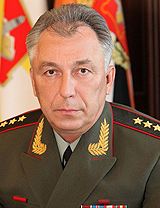
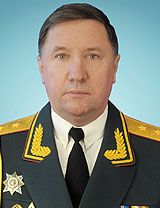
Volga-Ural MD Commander, General-Colonel Arkadiy Bakhin will be the interim commander of the new Western MD.  Siberian MD Commander, General-Lieutenant Vladimir Chirkin will temporarily head the new Central MD.  Pacific Fleet Commander, Admiral Konstantin Sidenko will command the new Far East MD for now.  And North Caucasus MD Commander, General-Lieutenant Aleksandr Galkin will head the the new Southern MD. 

General-Colonel Bakhin

General-Lieutenant Chirkin

Admiral Sidenko

General-Lieutenant Galkin

Serdyukov wants the new command and control scheme operating from the start of the new training year on 1 December.

Kommersant noted general surprise that a naval officer was picked to head the Far East MD.  Ground Troops generals have always commanded the army-dominated MDs.  But a Navy Main Staff source said Sidenko is not new to commanding army units; he once commanded the combined Navy-Ground Troops force on Kamchatka.

Kommersant also said extramural Defense Ministry collegiums will evaluate the effectiveness of these reorganizations before the end of the year.

Makarov’s Guys Take Key Posts

Bakhin, Chirkin, and Galkin prospered under General Staff Chief Nikolay Makarov when he was Siberian MD Commander from 2002-2007.  Each of them served as an army commander, deputy MD commander, and chief of staff, first deputy MD commander under Makarov in Siberia (or immediately after his departure for Moscow).  Chirkin served as Bakhin’s chief of staff, first deputy commander of the Volga-Ural MD, before becoming Siberian MD Commander this year.

Sidenko is a submariner, and most of his career has been in the Pacific Fleet.  His experience as ‘Commander of Troops and Forces in the North-East’ is, interestingly enough, a little similar to Makarov’s late 1990s time as ‘Commander of Ground and Coastal Troops, Deputy Commander of the Baltic Fleet for Ground and Coastal Troops.’