Supreme CINC Meets Troops at Alabino

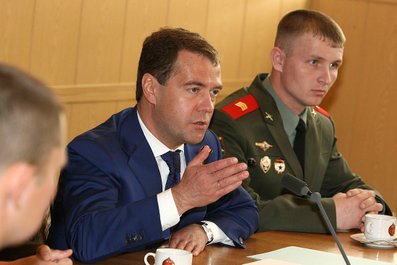
President Medvedev at Alabino

On 5 May, President Medvedev visited Alabino’s 5th Guards Taman Independent Motorized Rifle Brigade (formerly division), a traditional showcase and test bed formation for new equipment and concepts.  

Medvedev and Defense Minister Serdyukov followed up the latter’s late April meeting with the Committee of Soldiers’ Mothers and other public representatives about ‘humanizing’ the armed forces.  At that time, Serdyukov presented ideas for driving the ‘spirit of the prison camp from the army.’  They included freeing soldiers from additional duties to focus completely on training, allowing them more free time, pushing reveille and lights-out back an hour, mandating a rest hour after lunch, instituting a 5-day conscript working week, allowing the possibility of draftees serving close to home, and obtaining weekend passes to leave the garrison. 

Alabino is a place where things like these are typically tried out. 

As Rossiyskaya gazeta put it, Medvedev went to Alabino to see how conscripts live in ‘new profile’ conditions.  He inspected the training grounds, classrooms, and barracks, and answered questions from the new soldiers themselves.  

Medvedev and Serdyukov addressed physical training, one-year conscription, contract service, weekend passes, mobile phones, and hiring civilians to perform nonmilitary support services. 

Taman Brigade Commander Andrey Ivanayev told the Supreme CINC about the experiment with intensive physical training (PT) in his formation.  Ivanayev indicated the troops formerly had 53 hours of PT  per year, but now get 4-5 hours per day, or about 25 per week.  He and Medvedev discussed how soldiers are separated into groups by the physical load they can handle. 

In the Kremlin.ru transcript, Ivanayev said in April testing there were only 88 negative PT evaluations.  According to RIA Novosti’s reporting, Ivanayev thinks the formation’s fitness level has already increased 50 percent.   

Medvedev remarked on the Taman brigade’s outfitting with special PT gear.  He asked Defense Minister Serdyukov about introducing new athletic uniforms in other units.  Serdyukov said:  

“Yes, we are literally this spring buying 50,000 sets and toward fall, apparently, on the order of 100,000 more, the fact is in the course of two years we’re trying to outfit the entire army fully with sports gear for training in summer as well as winter.” 

Most important to the vast majority of Russians, Medvedev told Taman brigade soldiers he doesn’t intend to raise the current 1-year conscription term:  

“That decision on the transition to one-year service which was made, it was painful for us, it isn’t easy, but we won’t change it.  Service in other countries comparable to our country in combat potential is organized in exactly such as way.  And this year still allows us to train a quality specialist, soldier, sergeant.  And despite the fact that there are now certain problems with manning—it’s true, we don’t intend to change the service term.” 

When one soldier asked about enlisted contract service, Medvedev turned to Serdyukov to explain what’s new on this front.  Serdyukov answered: 

“We are now preparing a concept precisely on contract service for soldier and sergeant personnel.  There will be an entire complex of proposals, including on pay, service conduct.  We will equate the entire social package (sergeant like officer) on support, pay and all parameters . . . .” 

“I think in the course of this summer we will prepare and then send you concrete proposals about how this will look, what quantity of contractees we intend to accept, in which specialties particularly and with what kind of pay.” 

Medvedev responded that current pay is not very high, but those who are serving well on it should be retained: 

“However, at the same time, it’s completely obvious according to the well-known principle, better less, but better.  Let there be higher pay and those remaining will really want to serve, instead of us spreading this [pay] among a large quantity of contractees, who won’t have the stimulus, particular desire, or any kind of motive to continue serving and to serve well.” 

When Medvedev pressed him for what he thinks about contractee pay, Moscow MD Commander Valeriy Gerasimov finally said he thinks contractees should get 50-60 percent of lieutenant pay.  Serdyukov said it would be more on the order of 80-85 percent, depending on the duty position.  The more technically complex, the closer to officer pay.  He continues: 

“We are proceeding from the fact that, on the whole, in all the armed forces—a lieutenant from 55, and a sergeant from 35 [thousand rubles per month] . . . .” 

But a little math says that is closer to Gerasimov’s figure, or 64 percent of officer pay . . . 

Medvedev asked his Defense Minister about devising a policy to give conscripts weekend passes to visit home if they live nearby.  Serdyukov said: 

“We are planning over two-three months to proceed on this regime.  Well, naturally, after taking the oath, after he becomes a soldier, after this we’ll introduce it.  We have this really experimental brigade, we are just beginning to work all these approaches out.” 

Medvedev added: 

“Here again we have to proceed from modern approaches.  If a guy serves close by and manning goes according to the territorial principle, then why not let him go home?  Another thing, of course, everyone has to understand what responsibility the soldier carries for any type of infraction in this case, but this is just a question of self-discipline.  You want to go home for the weekend, this means, simply do everything as it’s supposed to be done.” 

Serdyukov chimed in: 

“In the course of five days [of the working week] you need to show the highest indicators, then this will be a particular stimulus for one who wants to pay a visit home on Saturday and Sunday.” 

This policy is especially interesting . . . the possibility of the weekend pass is predicated on several things not really discussed during the Alabino visit.  Working backward, the pass depends on successfully implementing a five-day working week for conscripts.  Then on having conscripts serving relatively close to home in the first place.  At least one voyenkom has already said conscripts from his republic don’t have this chance because they all serve outside their home borders.  A prized weekend pass could also become one more thing to be bought and sold to the highest bidder, or briber.  If implemented, this policy will be difficult to maintain in the face of soldiers who don’t return to the garrison or get into serious trouble while away from it. 

A new conscript asked Medvedev if mobile phones are permitted in the army.  The President asked him if he had one in his pocket, and the soldier replied yes.  Medvedev responded, “Then why did you ask?”  He continued: 

“In fact these rules, as I understand, essentially are established at the unit level, at the level of the corresponding troop formation, but there are no bans on this issue.” 

Gerasimov added that in the Moscow MD anyone may have a cell phone, but they may not be used during training or duty time. 

Discussing training and physical conditioning, Serdyukov turned to one of his earliest initiatives at the Defense Ministry—relieving soldiers from essential nonmilitary duties like kitchen patrol, cleaning, groundskeeping, and utilities maintenance. 

He mentioned the goal of moving to civilian service and support within 12-18 months in all Defense Ministry units, but “everything will depend on our financial condition.  According to preliminary calculations, we have to make do in the bounds of our existing budget.” 

Medvedev said: 

“I think here it’s obvious to everyone that soldiers and officers need to serve the Motherland, be occupied with troop training, improve their physical conditioning, but questions of maintaining the sub-unit, generally, this is an issue which civilian organizations could do successfully for money, as this is done, incidentally, around the world.  Then there won’t be problems with tiresome details and it’ll be possible to concentrate on fundamental service.” 

Civilians already take care of the Taman brigade’s food service, and soon they will maintain its engineering networks, and provide cleaning services.  Serdyukov indicated the FSB is working on licensing firms to work in closed facilities, and Oboronservis will work in remote garrisons where contractors can’t be found.
Navy CINC on Bulava Findings and Typhoon SSBNs

Speaking Friday in Novorossiysk while accompanying Prime Minister Putin, Navy CINC Admiral Vladimir Vysotskiy said the Bulava SLBM commission will report 20 May on its findings regarding the last unsuccessful test launch.  He also promised:

“We are working continuously and checking the entire process of the missile’s development.”

“Continuous work of voyenpredy [military factory representatives] is being implemented.  Right down to a screw, with the submission of corresponding certificates.”

“. . . all enterprises active in Bulava production are working under control of military acceptance.  We are checking the entire process from beginning to end.”

RIA Novosti reminded readers that, despite a string of unsuccessful tests (only 5 of 12 have been considered successful), the Defense Ministry still considers it ‘unrealistic’ to put another type of ballistic missile in new proyekt 955 SSBNs.

In February, Defense Minister Serdyukov expressed his certainty that Bulava problems would not affect the laydown of the next proyekt 955 submarine, the fourth in the series.  Officially, Moscow says Bulava will be carried through until the necessary result is obtained, and the missile will be the basis of sea-based strategic nuclear forces until 2040-2045.

One has to wonder, what happens if, after all the emphasis on eliminating production defects, Bulava still doesn’t fly?  Where does Moscow turn next for answers.

Vysotskiy also told journalists two proyekt 941 Akula (Typhoon-class SSBNs Arkhangelsk TK-17 and Severstal TK-20) will remain in the Russian Navy’s order-of-battle until 2019.  He said:

“They will be in a combat condition until 2019.  They have very great modernization possibilities.” 

This isn’t the first time he’s said this, but he hasn’t said how the 1980s-era SSBNs might be used or altered:

“There are several options, but the decision has yet to be made.” 

Of course, TK-208 Dmitriy Donskoy was modified to be the Bulava test platform.

Some of Today’s Victory Day Parade

More coverage from Rossiya 1 can be found at http://www.vesti.ru/videos?vid=271461.

More on OSKs, and ASU TZ

On Monday, Olga Bozhyeva reminded readers the proposed OSKs were former Genshtab Chief Baluyevskiy’s idea, and she called them part of a command reorganization along an American model.  She contends Baluyevskiy lost his job for pushing the change from military districts (MDs) to operational-strategic commands (OSKs).  And now the OSK will apparently win out, even though Baluyevskiy’s long gone. 

Bozhyeva says Baluyevskiy and the shift to OSKs were defeated in the past by MD commanders [and their powerful patrons] who stood to lose out in the process.  She claims Baluyevskiy’s opposition to the  Navy Main Staff transfer from Moscow to St. Petersburg was a pretext for his dismissal when the OSK was the real issue.  And his OSK experiment in the Far East was quietly dismantled after his departure. 

Actually, it’s more likely Baluyevskiy went down for opposing–rightly or wrongly–the whole range of ideas pushed by Defense Minister Anatoliy Serdyukov.  By contrast, Baluyevskiy’s replacement has been a veritable extension of Serdyukov on policy issues.

With Baluyevskiy gone, according to Bozhyeva, the MD commanders bent the OSK idea to their way of thinking, proposing to make every MD an OSK, without cutting or consolidating MDs, and duplicating efforts in the process.  She says this reflected the MDs as ‘sacred cows’ upon which no one would encroach, and this tracked with new Genshtab Chief Makarov’s background as an MD commander.  Recall that Baluyevskiy was a career Genshtabist.

Bozhyeva continues, saying this year Makarov has begun to think about how to command the ‘new profile’ army.  And wars of the future will hardly accommodate a command structure like the MD.  But Bozhyeva reports a rumor that the name Military District could be retained to appease opponents of merging MDs in favor of modern OSKs.  She concludes, if the OSKs are realized, it’ll be possible to talk of a really ‘new profile’ army.

Dmitriy Litovkin also had his say on the OSK story last Friday.  He describes the possible move to OSKs in terms of more responsive command and control, reducing the transmission of orders from 16 to 3 steps.  But, he cautions, the OSKs are still just a proposal at this point.

Litovkin says the military hasn’t tried to hide the fact that the OSK is borrowed from the U.S. concept.  The main thing achieved in such an approach, he continues, is responsiveness in issuing and receiving combat orders.  The Defense Ministry says this new OSK structure will be tightly tied to the new automated battlefield command and control system ASU TZ (АСУ ТЗ).

Litovkin mentions how Prime Minister Putin saw ASU TZ at Voronezh, and how the system is supposed to centralize command and control down to the ‘electronic soldier’ on the battlefield.  This fall brigade exercises are supposed to employ ASU TZ with the aim of controlling several hundred ‘objects’ in battle simultaneously.  This summer the OSK model will be tried as part of the Vostok-2010 exercise in the Far East.

Litovkin’s source says:

“Developing ASU TZ without trying it in the new armed forces structure is impossible.  We need to understand in practice not just how this works, but also, possibly, that we are developing something unnecessary or, conversely, we aren’t making anything.”

Not a big vote of confidence for the new system.

Litovkin concludes by saying the possibility of unit and even garrison relocations might be a limitation on the OSK scheme.  Forces would need to be better balanced among the four strategic directions.  For example, the Western OSK would have too many motorized rifle units and the Eastern too few.

Defense Industry’s Last Warning

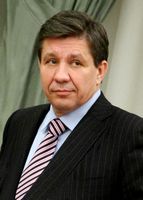
Popovkin in a Suit

Last Friday’s NVO printed an interesting editorial that discussed arms exporter irritation with Deputy Defense Minister, Armaments Chief [former Commander of Space Troops and ex-General-Colonel] Vladimir Popovkin for publicly admitting the Defense Ministry’s dissatisfaction with many of the OPK’s products.  The exporters are obviously upset that Popovkin’s comments have, and will, cost them sales abroad.  But NVO concludes a greater danger would be trying to silence anyone–high-ranking defense official or independent defense analyst–who dares point out the OPK’s problems in the hope of remedying them.

NVO’s sub-title for the article is “The OPK’s systemic crisis threatens a breakdown in the supply of combat equipment to the Russian Army and a lack of export contracts.”

The Greeks have apparently called off a purchase of 420 BMP-3s for $1.5 billion (let’s call it $3.6 million per vehicle).  The deal had been 2 years in the making, and it wasn’t the state of the Greek economy that caused the halt.  According to NVO, the money was already in the defense budget.  Rather it was Popovkin’s specific criticism of the BMP-3 that folded the deal.

Popovkin is quoted:

“We very much need to protect our soldiers.  Today everyone rides on top of the BMP because no one wants to ride in this ‘coffin.’  We need to make a different vehicle.”

Greek journalists published his remarks, and opposition politicians turned them into a scandal:  how can you buy unsuitable equipment that even the country that makes it won’t buy?

Popovkin also complained about the T-90 that the Indians are buying, the tank support combat vehicle (BMPT) that Rosoboroneksport recently demonstrated at an arms show in Kuala Lumpur, and other equipment which the army won’t buy for one reason or another, but which is put forth for export and actively advertised there.

According to NVO, the arms exporters are terribly offended because the [ex-] general cost them several lucrative contracts.  But, in NVO’s estimation, his speech is very necessary.  It says:

“. . . the truth about the condition of the Russian defense-industrial complex, about those processes occurring there, about the systemic crisis in it and the inability of its various directors, including even the government’s Military-Industrial Commission [VPK], to correct the existing situation, is not a secret at all.  It’s been talked about more than once.  On the most varied levels.  Including even presidential.”

NVO says this truth is very important; it could help the powers-that-be uncover the problem areas, fix them, and produce the modern equipment needed for the defense of the country’s interests.  Without an honest discussion, the deficiencies can’t be fixed.  But the Kremlin, government, the legislature, executive organs, or the regions won’t undertake any serious measures against negligent managers.  Despite constant talk of state arms programs, federal programs of technical reequipping of defense enterprises, in reality, with the exception of aviation and air defense firms, nothing is really happening.  It’s moving at a snail’s pace.  Or is it?

Foreign buyers send in 33 warranty claims for every 100 Russian weapons systems exported.  And the scandal with the Algerian MiGs didn’t teach the OPK anything.

It would be possible to silence critics and protect military-technical cooperation with foreign countries and keep the profits coming to the budget and the manufacturers.  But won’t the low quality of these systems, their inability to meet the demands of modern war, really be a negative advertisement?  Does someone really think if they quiet the generals, together with the Moscow media, military analysts and experts then they can sell some kind of half-finished military goods to a serious buyer?  Naive views worked out for illiterate dilettantes.

NVO figures there are two ways out:  either give up, lose export orders, and accept the situation or sharply improve the quality and effectiveness of Russian weapons, reduce prices and defects, and strive to be on the leading edge of technology.  In other words, saving defense industry is in the hands of defense industry itself.  And no one else.  

When it comes to combat vehicles, sniper rifles, UAVs, assault ships, night sights, and armor, the international division of labor in defense industry isn’t such a bad thing after all.  It brings Russia closer to the ‘probable enemies’ of the recent past.  But when it comes to nuclear-powered submarines and strategic missiles we still don’t know how to do them ourselves and no one’s going to sell us those.  And [unless Russia remembers how and gets its OPK in order] it will remember national security the same way it remembers the long forgotten past. 

This is NVO’s way of telling the Putin-Medvedev regime it would be foolish to shut down this feedback channel that tells it what needs fixing in the OPK.

Phantom Apartments

Yesterday NTV aired an expose which helps explain how the Defense Ministry claims it  built 45,600 apartments for officers in a single year.

It’s a bit surprising that a national channel aired this piece.  It depicts quite a mess in military housing, although it doesn’t venture to say how widespread this problem might be.  Recall that the military prosecutor was investigating a case of 8 unfinished buildings in Chekhov back in January. 

It’s unclear how such messes could be cleaned up–how unfinished apartments could be completed, who would do it, and, most importantly, who would pay.  Previous reports made clear the turmoil in the Defense Ministry’s Housing and Construction Service when civilian Grigoriy Naginskiy replaced General-Colonel Filippov at the beginning of 2010.

NTV also hints at pervasive corruption in the military housing program, but doesn’t address this directly. 

Brewing military housing scandals could lead not just to questions about poor management in Serdyukov’s Defense Ministry, but also about Prime Minister Putin’s (and President Medvedev’s) ability to delivery on oft-repeated promises to servicemen.

The video shows poor quality work on an apartment building in a way text alone could never describe it.  The looks and expressions of the jilted officers would similarly be difficult to capture in words.

NTV says officers of the Ufa garrison are thinking not about the upcoming 9 May Victory Day holiday, but about resolution of their everyday problems.  Because of bureaucrats, they and their families could end up out in the street.  They were allocated apartments in a new building where they can’t live.  The multi-story building is incomplete, and several parts of it haven’t even been started.

But according to the documents everything is in order.  There are even acts of acceptance for the nonexistent apartments.  The chief of every organization involved in the project hurried to put check marks on reports about the completion of this state construction order.  For this reason, it will be hard to determine exactly who’s to blame.

The camera turns to one Lieutenant Colonel Valeyev, effectively out of the service for 7 years, but unable to retire (he hasn’t received permanent housing).  He had to surrender his service apartment, and lives in the kitchen of an officer’s dormitory while his daughter lives in his room.  Valeyev concludes simply, “It’s shameful to live in such a situation.”

The construction contract for 350 apartments on the outskirts of Ufa was signed a year ago, and the work was to be finished in just three months, understood to be unrealistic and impossible from the very beginning.  The builders didn’t finish for understandable reasons, but the acts of delivery-acceptance were signed on time.  It turns out this housing existed on paper, but not in reality.

They managed to build only one-third of the apartments promised, and even those remain incomplete after six months.  Nevertheless, the chief of the Ufa KECh (housing management unit or КЭЧ), who distributes housing to servicemen, signed for ceramic tile, linoleum, and wallpaper back in October (so where did these materials end up?).

Asked why the acceptance was signed if the apartments weren’t ready, the KECh chief says only, “It was signed, so to speak, in advance.”

Meanwhile, the other two apartment buildings are just holes in the ground, as shown in the video.  These unbuilt apartments have been distributed already, so 100 military families have housing on paper.

Ufa garrison officers can’t go back to their old service apartments that have been given to others already.  It’s also possible their assigned permanent apartments, when and if completed, could be sold to civilian buyers now that the original contract’s been voided.  The officers will claim they have documents for the apartments, but the builder will tell them to take it up with those that gave them the papers (i.e. the KECh and the Defense Ministry).

The contractor complains that the Defense Ministry contract was lower than market price by one-fourth (well, why did they agree?).  And he claims he went ahead with his own money and now the apartments are more expensive (he seems to be preparing to justify selling them on the private market).

The officers don’t even have anyone with whom they can argue.  The previous KECh chief is under investigation on bribery charges.  And dismissed officers from distant Ural garrisons are being sent back to their units to ask their old commanders for some living space.

VDV Rotation at Kant

Last Friday ITAR-TASS indicated that two companies from the VDV’s 45th Independent Reconnaissance Regiment of Special Designation (Spetsnaz), based at Kubinka near Moscow, were the units sent to reinforce Russian military facilities in Kyrgyzstan on 8 April.

Two companies from the VDV’s Ulyanovsk-based 31st Independent Air-Assault Brigade rotated in on Friday to relieve those from the 45th.  The VDV’s spokesman has said the contingent numbers 160 contract personnel.

Moscow has been low-key on the deployment of extra troops, denying plans to evacuate dependents, and downplaying threats posed by the political unrest there.

But the Russians must have taken the situation seriously, sending the ‘elite of the elite’ to Kant in the first days of unrest in Kyrgyzstan.

Another One for the ‘Northern Capital’

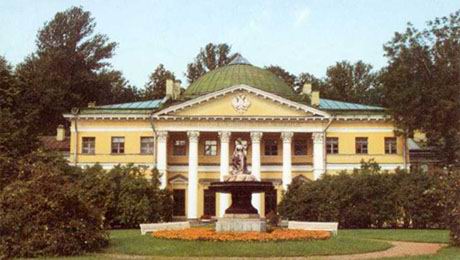
Argumenty.ru on Friday reported a Main Military-Medical Directorate (ГВМУ or GVMU) source says Russia’s military-medical headquarters will relocate from Moscow to St. Petersburg.  Although no timetable is specified, it has been decided that GVMU will end up sharing the complex of the Military-Medical Academy (ВМА or VMA) in Piter.

Military-Medical Academy

The GVMU source said:

“This issue was raised and decided  positively from the moment when General-Major of the Medical Service Aleksandr Belevitin transferred from the post of VMA chief to the post of GVMU chief.”

General-Major Aleksandr Belevitin

A VMA source says:

“The issue is being actively discussed in the academy, although the exact timing is unknown.  But part of the buildings, in particular, the physical training faculty building have already been set aside.”

Argumenty.ru reminds that the final decision on moving the Navy Main Staff to St. Petersburg was made not long ago, and ‘military experts’ put the cost of that move at 20-25 billion rubles.

This is kind of interesting.  That’s a lot of influence to attribute to the new guy in the job, particularly a job several ‘comrade doctor generals’ have not been able to hold onto for long in recent history.  Moreover, there are a lot of military hospitals and clinics in Moscow to serve the real capital’s large military and ex-military population.  If GVMU moves, they will be somewhat illogically separated from their headquarters element.

Idea of OSKs Waxes Again

In Russian defense policymaking, ideas never die; they wax and wane, and wax again.  Andrey Nikolskiy in Thursday’s Vedomosti reported a source in the Defense Ministry’s central apparatus claims the idea of establishing four regional Operational-Strategic Commands (OSKs) in place of Russia’s current military districts and fleets is waxing again.  This is hardly a new story.

The West reportedly would combine the Moscow Military District (MD) and Leningrad MD, and the Baltic Fleet, under a headquarters located in St. Petersburg.  The East would combine the Far East MD with part of the Siberian MD, and the Pacific Fleet, with its headquarters in Khabarovsk.  The North would combine the remainder of the Siberian MD with part of the Volga-Ural MD, and the Northern Fleet, with Yekaterinburg as the headquarters.  Finally, the South would put the North Caucasus MD with the remainder of the Volga-Ural MD, and the Black Sea Fleet and Caspian Flotilla, with Rostov-on-Don as the headquarters.

Vedomosti  is circumspect on the four OSKs.  It maintains that no decision has been taken yet, and the possibility of creating them is being studied.  Interfaks was quick to claim they’ll be established before the end of the year.  Putting the West headquarters in Piter would track with the apparently continuing effort to relocate the Navy Main Staff to the country’s ‘northern capital.’

So, a little about what would happen if this idea were implemented . . . clear losers are the LenVO, SibVO, and PUrVO, which all disappear.  The VMF won’t like the idea and the VVS is perhaps more ambivalent since its air forces and air defense armies (AVVSPVOs) pretty much exist within the current MD structure anyway.  The East would have 14 active maneuver brigades instead of the DVO’s 10.  The West would have 9 instead of 6.  And the North might be created with 6 brigades.  Of course, the OSKs would also have greater territory to cover than the MDs.

In retrospect, new Ground Troops CINC General-Colonel Aleksandr Postnikov foreshadowed renewed talk of OSKs replacing MDs when he arrived in March mentioning the possibility of an MVO-LenVO merger.

Former Genshtab Chief Yuriy Baluyevskiy’s one-year experiment with an Eastern Regional Command at Ulan Ude headed by General-Lieutenant Nikolay Tkachev was euthanized by his successor, Nikolay Makarov, in October 2008.  Theoretically, it might have been one regional command alongside analogous western and southern structures.  Baluyevskiy’s initiative probably dated back to 2005 discussions about a new command structure in the RF Security Council.  But it’s not clear what kind of regional commands were considered.  Were they to overlay the MDs and fleets like the High Commands of Forces of late Soviet days or replace them in a more radical restructuring?

This winter, then Ground Troops CINC, Army General Boldyrev said that each MD would become an OSK, and the MD-OSK commander would have operational control over all military units on its territory–Navy, Air Forces, MVD Internal Troops (VV), etc.  Boldyrev said:

“The operational-strategic command is a military district.  Such is its function and standing.  The legal status of the OSK has been drafted, its approval is planned in the very near future, this will possibly happen before the end of this year.  The district commander has been declared the commander of the operational-strategic command.”

Nezavisimoye voyennoye obozreniye has been predicting the MD’s replacement for some time, writing in September last year: 

“. . . the leadership of the country and of the Armed Forces are returning to the idea that was proposed several years ago by former RF Armed Forces General Staff Chief, Army General Yuriy Baluyevskiy, who attempted to create Operational-Strategic Commands in theaters of operations, but not on the basis of individual districts, but rather by unifying several districts and fleets under the command of the OSK.” 

The MD is still more part of the administrative, training, and mobilization system for the paradigmatic ‘large-scale war’ of Soviet planning.  The OSK would have to become a combatant command for fighting regional or local wars here and now.  Consolidating three MDs and possibly downgrading fleet commands somewhat might save a few hundred senior officer positions.

As Vedomosti describes it, if the four OSKs actually stand up, they will include armed forces units, not other militarized forces like the VV or FSB Border Guards.  This isn’t surprising since these OSKs would be permanent, not just wartime, command structures. 

The control of strategic nuclear forces is always an issue in debating structures like the OSK.  Would OSK commanders really control and operate the RVSN, SSBNs, and long-range bombers on their territory?  If not, how would the OSK’s general purpose forces support strategic operations?  

Abolishing 6 MDs and especially 4 fleets and their long histories would be a politically daunting task, sure to raise lots of opposition in the ranks and among the publicly vocal ex-military.

Finally, it might be argued that the military has experienced near ‘permanent revolution’ over the last 18 months, and doesn’t need another major organizational innovation while the situation settles out from previous changes.

In any event, the replacement of MDs with OSKs still remains a rumor at this point.

Can Imports and Money Solve OPK Problems?

Ilya Kramnik (photo: RIA Novosti)

On 22 April, RIA Novosti military commentator Ilya Kramnik provided an essay on the army, the VPK [OPK], and post-Soviet realities.   He gives a convincing negative answer to the question posed above.  Like more money and budget, foreign imports won’t be enough by themselves to fix the Russian OPK’s structural problems which have to be addressed more directly at their roots.   

He has praise for Defense Minister Serdyukov for being willing to admit that the ‘emperor had no clothes’ to some degree.  Serdyukov’s management has recognized that the world has changed and changed the army’s missions accordingly. 

A recognition of one’s problems, however, is not the same thing as fixing them.  Serdyukov, the army, and the OPK face the same kind of modernization dilemmas that face Russian politicians, business, and society.  But thanks to Serdyukov, the armed forces are operating under a more realistic vision of what they are, or should be, building toward.

Kramnik believes imports are fine, but the OPK needs the capability to build the entire line of military equipment needed, if it has to.  To do that, it will have to remedy its capital problems, including human capital.  He concludes there’s still a way to go to get to a mobile, well-armed, and trained army, appropriate for the real threats facing the country.

Kramnik writes:

“In the past few days Defense Minister Anatoliy Serdyukov and his deputy Vladimir Popovkin again raised questions about the quality of the work of the country’s VPK [military-industrial complex].  These questions are not being mouthed for the first time, and are taking on a particular acuteness against the backdrop of announcements of planned purchases of military products abroad–both separate components and complete systems.”

“It’s difficult to say when the theme of the Russian VPK and armed forces’ dependence on foreign supplies first began to resound.  In a large sense, it was always acute–even the USSR didn’t have full independence from foreign supplies, in its heyday, trainer aircraft from Czechoslovakia, light helicopters (Soviet-designed) from Poland, large assault ships from the very same Poland, various types of boats and ships from the GDR, etc., were bought.”

“After the USSR’s collapse this dependence deepened because of the foreign status of many producers which had been an integral part of the Soviet VPK–from Dnepropetrovsk’s Yuzhmash to the Tashkent Aviation Production Conglomerate.  But the problem of the VPK’s growing dependence on producers in the ‘far abroad’ is the most acute and painful today.” 

“The list of purchases of military equipment abroad being realized by the Russian military and producers is already now quite broad:  different types of infantry weapons, communications systems, unmanned aerial vehicles, thermal sights, digital electronic equipment…” 

“Now being added to this list are multipurpose assault ships, and armor for vehicles and light armored equipment.” 

“Meanwhile from the Defense Ministry resound still louder complaints about the domestic VPK over the quality of the equipment it is producing.  Of the number of the largest scandals of this type the recently resonating complaints about domestically developed unmanned aerial vehicles, armored personnel carriers and infantry fighting vehicles must be noted.  Problems are also arising where there are no alternatives to domestic manufacturers, and can’t be in principle–in the development and production of ballistic missiles (“Bulava”).”

“What is happening with the country’s VPK, and what kind of ways out of the situation which has taken shape are there?” 

“The main cause of today’s situation is obvious:  from the beginning of the 1990s through the mid-2000s a large part of VPK enterprises together with the entire country was occupied with everything except strengthening defense capability and modernizing production.  The collapse of the USSR, with the consequent destruction of Soviet industrial infrastructure, disruption of production ties and scientific schools didn’t leave any chance for a better result.” 

“It follows to note that the disruption was systemic, and besides experts in the State Property Committee and other government organs of the 1990s, the authors of this process could, with complete justification, be considered the ‘captains of industry,’ many of whom in this period openly used enterprises entrusted to them for the purpose of ‘making money here and now,’ even through the ruin of production sold off for scrap.”    

“Against this background in the armed forces and those close to the military, but also in industrial circles, groups of ‘patriotic’ experts and analysts, rose like mushrooms after the rain, thoroughly glorifying the country’s army and VPK with chants of one and the same incantation:  ‘it has no analog in the world.’  The incantations rang out with respect to various military and technical wonders, and meanwhile not the slightest attempt was made to comprehend the changing world map, missions of industry and the armed forces.”       

“From the other side the ‘alarmists’ were entrenched and grievously moaned about the death and destruction of the army and military industry, keeping such an inadequate perception of the world as a whole.  Both sides supposed that Russia and its army would in the future conduct a precisely ‘Soviet’ type war against the entire capitalist world, or, at a minimum, against a Chinese invasion.”       

“Very few production associations, which were flagships of the domestic VPK, were able to preserve themselves as single entities in the Bacchanalia of destruction.  There is, first of all, the ‘Sukhoy’ firm, which knew how to turn the crown of Soviet scientific-design thinking–the family of aircraft on the T-10 (Su-27) platform–into the most commercially successful product on the combat aircraft market of the last 20 years.  There is ‘Almaz-Antey,’ whose air defense systems received not less recognition.  There is Nizhnyy Tagil’s UVZ which was saved thanks to the T-90.  There are some shipbuilders and several other companies that managed to ‘get’ the situation and survive.  But such successful ones turned out to be far from all.”        

“The renewal of defense development and the increase in the State Defense Order in the middle of the 2000s could not be and didn’t become a panacea.”       

“Firstly, a simple increase in monetary investment will not save a disrupted industry:  dead people don’t need money, neither do the seriously ill generally.”       

“Secondly, this money by itself could not resolve the row of problems of even successful enterprises–for example, the problem of a lack of personnel, caused not only by the outflow of workers ‘in the hungry 1990s,’ but also by a sharp decline in the young population, together with the fall in the quality of engineering-technical education, and the practically complete collapse of the system of specialized secondary education.”       

“But the biggest problem became the management of the armed forces and military industry in principle.  The armed forces command right up to recent times didn’t have any kind of clearly expressed views on the future profile of the Russian Army.  All the years of reforms right up to the arrival of Anatoliy Serdyukov in the post of Russia’s Defense Minister preserved in essence the truncated and frayed Soviet Army, whose model was becoming ever less and less adequate for the missions facing the country in the prevailing economic and political conditions.”

“Military industry against this background survived reorganization after reorganization, the overwhelming majority of which led to nightmarish overgrowth in bureaucratic components and an increase in the already huge gap in pay between specialists on the line and in the laboratory and the management.  This state of production efficiency contributed to the growth of military expenditures and the amount of ‘kickbacks’–most of all.  Responsibility for results was conveniently forgotten:  ‘captains of industry’ together with the armed forces leadership now, as a rule, won’t risk even dismissal, much less their freedom.”       

“A similar uncertainty led to uncertainty with the military order.  Plans and ideas floated and sank, development began and stopped, the vision of the army and its complex of armaments as some kind of organic system aimed at resolving such-and-such concrete missions was totally absent.  The sole exception on this score was the strategic nuclear forces, where a clear understanding of missions and ways of conducting them was preserved, and work was conducted–on supporting old RVSN missiles, on testing and adopting new ones, on repair and modernization of the Navy’s strategic missile submarines and Air Forces heavy bombers.” 

“Anatoliy Serdyukov’s reform, being the first systemic reform of the armed forces in the last decade, not directed at supporting a dead Soviet structure, but at arranging a new one, under concretely certain missions of fighting local and regional conflicts while preserving nuclear deterrence potential, did not create new problems.  It simply revealed old ones, aggravating them with the absolute ‘nonconcurrence’  of the new Defense Ministry leadership in the old system of relations of the army and VPK.”       

“This ‘nonconcurrence’ became a thorn in the side of very many, those problems earlier kept quiet behind the reckoning ‘well, you understand,’ suddenly stopped being kept quiet, and floated in all their ugliness before the eyes of an astonished public.”      

“For the public the foregoing was a big shock, since it all these years kept the point of view on the army and VPK as some ‘island of stability,’ preserving, in the face of all problems, the Soviet system of connections and ties, and, in general, Soviet possibilities.  Many understood the fact that this wasn’t so, but an open recognition of the changed situation by the leadership of the armed forces and the country, nonetheless, was unexpected.”       

“However such a recognition was necessary as a recognition of the fact that the world has changed.  The Russian Army is more incapable of realizing the West’s half-century nightmare–a three-day dash to the English Channel (we set aside the question of whether the Soviet Army was capable), however does Russia need this capability for defending its people, its sovereignty, its interests?”      

“It occurs that our country needs something different.  It needs a clearly expressed understanding of threats, developed with the participation of the military, politicians, and the public, which stand before the country and the capability to counter these threats.  It needs a compact, ‘quick reaction,’ innovative, directed military industry with minimal bureaucratic overhead, and an education system regularly supplying engineering and labor personnel who will receive pay greater than the managers of shops selling mobile phones and taxi drivers.  At a minimum.”      

“This industry needs to produce the entire line of types of equipment and hardware essential to the armed forces, even if using some quantity of imported components–in the end, even the USA doesn’t disdain the use of military imports, and it imports foreign military hardware worth $15-16 billion annually.”      

“It needs an army–mobile, trained, armed, conscious of its status, prestige, and many centuries of history.  It needs strategic forces which protect the country against wars with superior enemies, the calculation of which on our planet doesn’t even require three fingers.”      

“All this could become a reality only in the event that it’s made into a goal at the very highest level.  Still the reactions of the country’s leadership, and of the armed forces, at a minimum, demonstrate understanding of the problem.”