Three Identical Missiles

The Defense Ministry’s inter-departmental commission didn’t make any announcement about its work or the causes of Bulava SLBM test failures as had been anticipated on 20 May.  If this commission has clues about the missile’s problems, it didn’t reveal them.  But Kommersant concludes that the Defense Ministry hasn’t reliably determined the causes of previous failed launches.

However, on 21 May, Defense Minister Serdyukov announced a new approach to Bulava testing.  The Russians will make three identical missiles and launch them in hopes of pinpointing the same problem in each.  It’s a gamble, but it could work.

RIA Novosti quoted Serdyukov:

“The problem of the unsuccessful ‘Bulava’ missile launches lies in the assembly process.  We do not see any other violations there.  The whole matter is missile assembly quality.  Each unsuccessful launch has its own causes.  They are all different.”

“Now we are working on making three absolutely identical missiles.  We believe that this will allow us to precisely locate the mistake, if there is one, since it must be repeated in all three missiles.  Now we are working on how to control the assembly process in order to know that all the missiles are identical.  Toward November, I think, we can begin launching the missiles.  After this we will be able to identify the cause precisely.”

Earlier reports had said the next Bulava test would occur in June, but Serdyukov now says November at the earliest.  Over six years, only 5 of 12 Bulava launches have been successful or ‘partially successful.’  The missile launched on 9 December 2009 self-destructed after a third stage engine problem.  Grani.ru recalled that other recent problems included steering system and stage separation malfunctions.  Moscow had intended to put the Bulava on its new Borey, or Proyekt 955, SSBNs starting in 2007.

Gzt.ru describes the new three missile approach as an expensive “hit or miss” method.  The Defense Ministry hopes launching identical missiles will point to the same problem in each, if there is one.  But if they still manifest different problems, Moscow will be no closer to pinning them down.  The risk is another year without getting any closer to a new SLBM.

Gzt.ru concludes:

“Serdyukov didn’t specify what will happen if in the November series of launches of ‘Bulava’ each time a different component of the missile fails.  Apparently, this possibility isn’t being considered.”

Also in Gzt.ru, Defense Ministry critic Konstantin Sivkov describes the three missile plan as absurd and expensive.  With each missile costing 300 million rubles, it’s a 1 billion ruble effort and there’s no guarantee the bug, or bugs, will be identified.  He believes the designers will have to conduct stand tests where all components can be checked under controlled conditions.  He blames defective parts allowed into the system due to inadequate production controls.

Gazeta.ru cited one Andrey Ionin, a missile designer, who agrees the problem lies in the absence of technological discipline in the enterprises of the Russian OPK.  He says:

“Cooperation by several hundred enterprises, working under different forms of ownership, in different parts of the country, without observing all rules of technological discipline is pointless.” 

Nevertheless, simultaneous assembly of three missiles could be a way of searching for mistakes in Bulava.

MIT missile designer Yuriy Solomonov has said repeatedly it’s defective materials, production process breakdowns, and the lack of quality control, but neither he nor military men are saying which materials or processes they suspect.  He’s also said Russia lacks 50 materials needed for solid-fuel missile production.

In Kommersant, former RVSN general Viktor Yesin claims the Defense Ministry’s inter-departmental commission investigating Bulava has determined that enterprises didn’t cooperate and provided poor quality parts for the missile.  Still he sees no alternative to Bulava and believes its design is workable.
Poor Health of Potential Conscripts

The Defense Ministry press service today revealed some scarcely concealed official irritation with the poor health of its pool of potential conscripts.

ITAR-TASS reported that almost half the men called to draft commissions have been sent for medical observation.  The press service source told ITAR-TASS:

“As of 21 May draft commissions have made decisions on 155,300 of those called up, more than 70,800 men have been sent to places of service.  Since the beginning of the call-up, military commissariats have sent nearly 67,000 young men for medical observation.”

The draft campaign which began 1 April will call 270,000 men into the armed forces and other militarized structures.  The largest numbers of conscripts thus far have come from the Volga-Ural region and Siberia.  In last year’s competition for citizens best prepared for military service, Tatarstan was first, Stavropol second, and Arkhangelsk third.

ITAR-TASS concludes, in the Defense Ministry, they remained worried as before by the weak health of Russian conscripts.  In the 2009 call-up [not clear if this means spring, fall, or both draft campaigns taken together], 68 percent of those appearing at draft commissions were found fit for military service without limitations or with insignificant limitations, but of the number actually inducted into the service, more than half had various limitations because of their health.  This prevented sending them to military units with high demands on servicemen–the VDV, VMF, MVD VV, and others.

ITAR-TASS reports doctors were forced [spring, fall, all of 2009?] to send nearly 86,400 of those called-up to ambulatory or in-patient observation in medical facilities because of unsatisfactory health indicators.  And their fitness for service can only be determined once they complete medical observation.  The item notes that, over time, 1-3 percent of young guys go ‘AWOL’ from observation and don’t complete it.  The fact that young men manifest health problems for the first time when they’re in front of the draft commission shows the weaknesses of the health care system.  The Defense Ministry also believes this shows that medical prophylactic measures for young people are poorly organized in the regions.

Serdyukov Looks at IVECO Light Armored Vehicles

Defense Minister Serdyukov indicated today that, although Russia is interested in foreign light armored vehicles, it won’t buy any, and wants to produce its own.

During last week’s visit to Italy, IVECO put on a demonstration for Serdyukov at Moscow’s request.

According to RIA Novosti, Serdyukov said:

“The Defense Ministry is actively studying modern tendencies in arms employment.  Particularly in transporting personnel, medical personnel, and also reconnaissance in light armored vehicles.  The experience of Afghanistan and Iraq and our experience (in the regions), where explosions often occur, shows it’s essential to transport Defense Ministry sub-units in armored vehicles.”

Maybe Serdyukov should have said we already transport troops in armored vehicles, but we need to transport them in good, modern ones.

Serdyukov also noted that Germany is actively studying armor protection for troops, and Russia’s Defense Ministry is interested in similar production of its own.  He called Germany the leader in armor, and noted that German armor is mounted on Italian vehicles.  Serdyukov continued:

“We’re not talking about purchases of these vehicles in Italy or another country.  The main thing is to organize production of such equipment in Russia.”

Serdyukov on Mistral

Defense Minister Serdyukov today said Moscow still plans on acquiring four Mistral amphibious assault ships.  He said Russia is talking not just with France, but also Spain and the Netherlands, about Mistral

According to RIA Novosti, Serdyukov said:

“At present, we’re in pre-contract negotiations on this type of ship with three governments.  They are Spain, the Netherlands, and France.  We plan to sign a contract for four of these ships.”

He also said one ship would be completely foreign-made, but Russian shipbuilders would participate in building the other three.  And the fourth ship will be built, to the maximum extent, in Russia.  

Serdyukov reiterated that the Defense Ministry is working on this acquisition according to President Medvedev’s decision.  And the Defense Minister added: 

“We are now occupied with the issue very seriously.” 

He concluded that the issue of buying the ships will be resolved positively “if there aren’t any revisions, including in the financing question.”  And finally Serdyukov noted:

“We understand now that the Northern and Pacific Fleets need these ships.”

Meanwhile, Baltic Shipbuilding Plant ‘Yantar’ is trying to tout its proyekt 11711 large amphibious ship Ivan Gren as an alternative to buying or building foreign ships.  VPK.name published a version of this story based on an earlier Interfaks report.

More on ‘Virtual’ Apartments

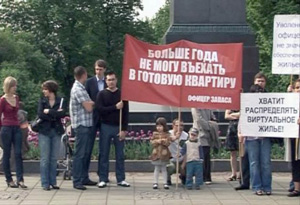
On Friday, TV Tsentr broadcast a story on former military men waiting over a year for new apartments due to the lack of proper transfer and ownership documents.  Two of the men and a military wife were interviewed.  The footage showed a quiet demonstration on Gogolevskiy Bulvar, several blocks from the Defense Ministry.

One officer showed the camera crew his family’s room in an officer’s dormitory.  Another walks through a finished apartment building, saying he is into his second year of waiting.  The ‘virtual’ apartments exist, but the documents for them don’t.  A military wife says their lives and obtaining services are difficult without a permanent place of residence. 

The chief of the regional capital construction directorate talked to the demonstrators about ‘complex relations with the contractor,’ but assured them their apartment problems will be resolved in the next month.

Fifth Generation Helicopter

Andrey Shibitov

In a 13 May news conference, OAO Helicopters of Russia Executive Director Andrey Shibitov described the company’s work on a concept for a fifth generation helicopter.  His comments to the press came in advance of HeliRussia-2010 beginning today in Moscow. 

Shibitov said:

“We are actively working on the concept of a fifth generation combat helicopter.  Wind tunnel testing of two aerodynamic designs coaxial [Kamov] and traditional [Mil] has begun.  Initial results have been received.  Which of the two designs we’ll pick will become clear in the first quarter of 2011.”

According to Gzt.ru, Shibitov claimed OAO Helicopters is willing to invest $1 billion in its development, and is looking for state investment beyond that amount.

Neither OAO Helicopters nor the Defense Ministry is talking specifics about the new helicopter, but former VVS CINC Aleksandr Kornukov stated the obvious when he told Gzt.ru a fifth generation helicopter needs to be quiet and stealthy.  According to Newsru.com, Kornukov also stated a preference for two pilots in a side-by-side configuration.

In Gzt.ru, former army aviation commander, retired General-Colonel Vitaliy Pavlov said noise isn’t so significant since Mil’s X-shaped tail rotor already reduced noise on the Mi-28 by 15 percent (in comparison with its Mi-24 predecessor), but he added that reworking the engine could further reduce noise.  Pavlov doesn’t see great importance in increasing flight speed.  He sees the coaxial Kamov design as more reliable, but Mil’s traditional rotor system as more stable.  He also likes the maneuverability of Kamov’s helicopters, but he still thinks it’ll be a difficult choice between the two producers.

Also in Gzt.ru, Defense Ministry critic, retired General-Colonel Leonid Ivashov said the fifth generation helicopter could be stillborn:

“If there isn’t a state order for this aircraft, it will wither.  We’re grasping at all fifth generation aircraft, fifth generation helicopters, but for some reason none of this is coming to the troops, today we have helicopters from the 1970s in the army.  So the country’s leadership shouldn’t just rejoice at new equipment in various air shows, but also buy it for the troops.”

Then Ivashov’s deputy at the Academy of Geopolitical Problems, Konstantin Sivkov, takes over, citing his definition of a fifth generation helicopter—increased range, ‘fire and forget’ weapons, capability to engage fixed-wing aircraft, low radar detectability, and speed up to 500-600 km/h.  Sivkov sees noise reduction as secondary since radar can detect helicopters at a 150-200 km range.

Sivkov thinks, under favorable conditions—steady financing, cooperative work by the design bureaus and factories—a new helicopter could be developed in 5 years, but, absent those conditions, development could take 20 or 30 years.

Dmitriy Litovkin in Izvestiya covers a lot of the same information on the pre-design research and wind tunnel blowdown of the prototypes.  He says the so-called Ka-90’s ‘dual-contour’ jet engine could develop speeds over 800 km/h, and he cites a system development timeframe of 5-8 years.  According to him, work is focusing on canted blades with thrust vectoring as well as a new blade design.

He believes one of the designs will win out, but there could be a third hybrid design.  But he thinks there’s little time to waste since the U.S. is already testing new designs, albeit unsuccessfully thus far. 

Writing in Nezavisimoye voyennoye obozreniye, Viktor Litovkin notes three named prototypes–Mi-X1, Ka-90, and Ka-92. 

Shibitov also talked to the press about OAO Helicopters’ record state defense order from army aviation in 2010.  He said:

“A year ago I said it was a shame the Defense Minister wasn’t buying new helicopters.  Beginning this year, I can’t say this.  Finally conscious, sensible purchases of military equipment have begun.”

“We got a record order from the Defense Ministry for purchases of combat, strike, and reconnaissance helicopters in the basic and supplementary order.  Unfortunately, we can’t fulfill the supplementary order because other commercial projects are being completed.”

“From this year, we’re delivering volume for the Defense Ministry comparable with all export deliveries of combat and strike helicopters.  In the course of the coming five years this tempo will continue, and in the period to 2017-2020 the Russian Air Forces will renew its complement of combat, strike, and reconnaissance helicopters by 85-90 percent.”

Aviaport.ru indicated the armed forces will also receive their first Mi-35D, Mi-24D, and Ka-226T helicopters, previously produced only for foreign customers.  OAO Helicopters is reportedly looking at modernizing Ka-29 or Ka-32 helicopters for Mistral, but Ka-52 is another candidate for shipboard helicopter.

CAST’s Konstantin Makiyenko puts the armed forces helicopter inventory at 850, of which 90 percent is obsolete.  He estimates it’ll cost $8 billion to renew this force.

There is evidence of life in Russian military helicopter procurement.  Talking about the GOZ, President Medvedev said 30 would be bought this year, and Defense Minister Serdyukov claimed the army got 41 during 2009.  In late 2008, VVS CINC Zelin said the plan was to obtain 100 new helicopters over 4 years, so these numbers would be in that range.

‘Virtual’ Apartments and the Army’s Protest Mood

Ex-Military Men Protesting 'Virtual' Apartments (photo: RIA Novosti)

In Monday’s Nezavisimaya gazeta, Vladimir Mukhin described a 15 May demonstration outside the Defense Ministry by former officers who were allocated ‘virtual’ apartments in Balashikha six months ago, but have been unable to occupy them due to slow paperwork.  Their demands are simple:  these retirees want bureaucratic obstacles removed.  

The protest was not covered by the media, or received only scant coverage.  However, the Defense Ministry’s promise to fix the problems for former servicemen from Balashikha was reported widely in the press. 

Mukhin’s subtitle for the article reads, “Unfulfilled Presidential housing program for the military leading to protest actions.”  He concludes that military demonstrations have been so rare in post-Soviet history that, if they occur, they have to be symptomatic of something.  He says similar protests have happened in other regions with large military garrisons. 

Everyone remembers Defense Minister Serdyukov’s reports about fulfilling the military housing program in 2009.  However, it’s becoming clear that this didn’t happen.  New military housing and construction chief Grigoriy Naginskiy not long ago announced that of 45,000 permanent apartments handed out in 2009, less than half have been occupied.  So the plan wasn’t achieved.  This has provoked a protest mood in the army, and the authorities, it seems, prefer not to notice it.  

Mukhin cites similar situations and actions in Bashkiriya, and elsewhere in  Moscow’s far suburbs.  The All-Russian Professional Union of Servicemen (OPSV or ОПСВ) tells Mukhin it’s pretty simple.  A garrison is drawn down, and officers who don’t want to relocate are put out of their apartments (sometimes into the street).  The garrison is then sold by Defense Ministry officials with a direct interest in this.  Mukhin concludes, that’s the ‘new profile’ army for you. 

OPSV Chairman Oleg Shvedkov told Mukhin several thousand retired officers and servicemen participated in May 1 protests around the country.  They protested not just housing, but also pension and pay problems.  But, of course, active-duty servicemen are prohibited from participating in political actions under the law. 

Viktor Baranets also addressed the plight of former officers in Balashikha in a 12 May article. 

According to ITAR-TASS and RIA Novosti, a Defense Ministry housing official promised on 15 May that the problem of 80 retired servicemen and the apartments allocated to them in Balashikha would be resolved before the end of June.  He said the process of preparing all the necessary documents would be complete by that time. 

A Defense Ministry spokesman said a meeting with an ‘initiative group’ [i.e. the protesters] was held in the ministry.  He also indicated the Defense Ministry is trying to speed up and smooth out the process of preparing and registering survey and property ownership documents.

Is Alarm About Aerospace Defense Warranted?

In today’s Nezavisimaya gazeta, Viktor Litovkin tries to reconcile Kornukov’s and Sitnov’s extremely pessimistic views on the state and future of Russian aerospace defense with the optimistic ones of Colonel Sigalov, whom Ekho Moskvy interviewed on Saturday.  He’s commander of the 5th VKO Brigade based in Moscow Oblast, responsible for defending the capital.

Litovkin notes the retired generals’ roles as defense industry lobbyists, their defense of business interests, and efforts to acquire new orders.  And for his part, the colonel could never imagine or admit a chance that his troops won’t be able to carry out their missions.  What kind of commander would he be?

But the situation in the realm of air defense, and even more in anti-missile defense, is very complicated.  Yes, the troops of Sigalov’s brigade are ready to open fire on air-breathing enemy forces with 10 minutes warning.  But repulsing strikes from space is much more complex.  The troops simply lack the weapons systems to do it.  And this threat doesn’t exist yet.

So is there a contradiction or not?  Litovkin reminds that military men judge not just the current potential of probable enemies, but their ‘technical-technological possibilities’ as well.  And these are alarming.  According to Litovkin, many leading countries are working on ‘the problems of space weapons’ (although he mentions just China’s ASAT capability and the U.S. X-37B orbiter). 

And Russia has no response yet beyond the much talked about S-500 system, which, says Litovkin, lives now on paper only, and two (and maybe six more by some time in 2011) S-400 battalions around Moscow.  Litovkin claims the Defense Ministry will not order more S-400s after that.  Recall Almaz-Antey chief Ashurbeyli complaining on 30 April that the Defense Ministry has not signed contracts for S-400 production in 2012.

Litovkin says this might have caused genuine alarm in the two retired generals.  He speculates there could be more delays in producing missiles for the S-400 as well as for the S-500, which will need to operate against targets in near space.  Finally, he notes that, although the military doctrine contains an understanding of VKO, there’s still no Defense Ministry organization responsible for it.

On balance, it sounds like Litovkin believes Kornukov’s and Sitnov’s concerns are genuine, rather than commercially motivated.

Yuriy Gavrilov, writing in Rossiyskaya gazeta, concludes that recent talk about VKO means that Russia has to take immediate measures, or allow the distance between itself and the U.S. to increase each year.  He gives a little useful history.  Yeltsin’s 1993 decree said to create VKO, but the establishment of OSK VKO and VKO brigades amounted to little beyond changing the names of existing units, without changing their command, control, subordination, or weapons systems. 

Kornukov mentioned VKO relies on S-300s, MiG-29s, and Su-27s, and the few deployed S-400s, which still need work and rely on a single suitable missile.  All of which means, while waiting for the S-500, Russia has no real system for intercepting medium- and short-range ballistic missiles at an altitude up to 200 kilometers, or hypersonic cruise missiles.

Gavrilov quotes Sitnov:

“To develop modern systems that cover air and space, to develop new satellites for reconnaissance, and comms relay, missile attack warning, a super-modern component base, new materials, powders, new developments in the area of command and control are required.”

But that’s not all.  Gavrilov says VKO also needs one master, but aviation and PVO belong to the Air Forces, while anti-missile defense, missile attack warning systems, and control of Russia’s orbital grouping belong to the Space Troops.  Kornukov and Sitnov argue for giving it all to the VVS.

And Gavrilov says time is short.  By 2030, hypersonic and air-space vehicles, sixth generation UAVs, as well as weapons ‘based on new physical principles’ will already be in foreign inventories.

Aerospace Defense in Disarray

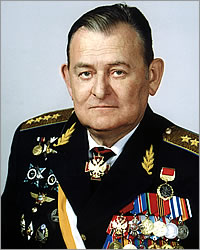
Retired Army General Kornukov

While Russian air and aerospace defenders were meeting in Tver last week, former Air Forces (VVS) CINC, Army General Anatoliy Kornukov gave Interfaks his opinions in a Moscow news conference.  

Kornukov is a member of a group calling themselves the ‘Extradepartmental Expert Council on the Problems of RF Aerospace Defense.’  He also advises the General Director of Almaz-Antey. 

He called aerospace threats the greatest danger for Russia’s security.  He said: 

“An attack from space decides everything now, strikes from space can be delivered to any point on Earth.” 

Kornukov thinks Russia’s aerospace defense (VKO or ВКО) concept’s been thought over long enough, and: 

“Unfortunately, there are still few practical decisions and concrete results.  New air defense systems are being developed very slowly.” 

“We, unfortunately, created a time lag of 20-30 years behind our possible enemy.” 

The ex-CINC says, although the VKO concept was approved in 2006, little has changed: 

“Years pass, but everything stays the same.  And to say that we’re ready for something now would be an exaggeration.  We can now resist an air attack from the standpoint of remaining S-300 systems.  As well as with those residual Su-27 and MiG-29 aircraft, the majority of which lack engines and spare parts.  The picture is simply terrible.” 

He also noted that new systems are progressing slowly, and are entering the armed forces’ inventory even more slowly.  He believes the Operational-Strategic Command of Aerospace Defense (OSK VKO or ОСК ВКО–the old Moscow Air and Air Defense District) can only destroy 1 in 5 targets: 

“If the reliability earlier was 96 or 98 percent, then now the effectiveness [of systems in the inventory] is in the range of 15-20 percent.  What’s meant is how many aircraft of 100 could get through without being countered.  Now about 80.” 

Kornukov recommends establishing VKO under the VVS, and under PVO specifically.  For example, he’d like the Moscow-based OSK VKO to control its own missile-space defense (RKO or РКО) formations and units.  He says: 

“Once all missile-space defense was in one set of hands–the PVO CINC.  He answered for PVO and for RKO.  Now the thinking is inexplicable:  each is dying by itself.  There’s not a person defined as responsible even for air defense.” 

“I think the correct decision would be for everything  to be located in one set of hands, and one person answering for the condition, training, employment [of PVO means]. 

He reminded the audience that, once the province of PVO, control of anti-missile defense went first to the RVSN, and now resides with the Space Troops.  Olga Bozhyeva reported that Kornukov wants RKO, specifically the 3rd Missile Attack Warning System Army to come to the Air Forces, and the latter should change its name to reflect its aerospace orientation.  He doesn’t like the idea of creating a new armed service called aerospace troops that would control PVO.  

Asked about Russia’s ability to defend against potential missile attacks from North Korea or Iran, Kornukov called the country’s capability to counter these threats ‘limited.’  He said, although the S-400 can cope with air-breathing threats, Moscow has no means for countering ‘operational’ (i.e. intermediate-range) missiles. 

Other members of the ‘Extradepartmental Expert Council’ had their say as well.  Former chief of PVO’s equipment ordering directorate General-Major Kolganov said: 

“. . . the VKO concept developed several years ago is not supported today organizationally or financially.  There is no targeted program for its realization.” 

Former Armaments Chief General-Colonel Anatoliy Sitnov says: 

“. . . in Russia they remembered about VKO only after the U.S. began to test the X-37 orbital glider.   . . . everyone’s occupied with a general assimilation of budget resources, and not at all with the development of new strategic technologies for modern space systems, reconnaissance, [and] missile attack warning satellites . . . .  This can’t come from a private businessman.  He comes to grab some budget money and sell what’s been made for scrap.” 

“We lost 300 super-technologies, primarily in aviation and air defense.  In particular, in the production of supergraphite, which is used in nose cones for missiles . . . .” 

Sitnov also criticizes poor organization for VKO: 

“There is no one to be in command, no one to command and control forces and means, no one to commission new air defense systems.” 

“It is time to move from words to deeds, to take purposeful directions and targeted programs for developing new aerospace defense systems.” 

“But we are waiting for someone to come and help us.  No one will.” 

Kornukov is an old PVO guy–albeit an Air Defense Aviation pilot; he was the first CINC of the VVS after it subsumed PVO.  Maybe he, and the others, are just shilling for Almaz-Antey to get even more from the State Defense Order.  Or perhaps their assessments are sincere.

Medvedev Can Wait for His BSF Basing Report

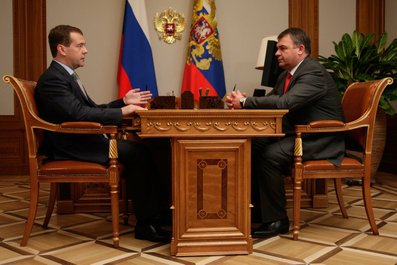
Medvedev and Serdyukov Meeting on 1 May

Whatever the complaints of some Ukrainians, the 21 April deal extending Russia’s basing privileges in Sevastopol is a good deal for Kyiv.  It’s now using the relatively meaningless Russian Black Sea Fleet (BSF) presence to secure a valuable 30 percent discount on Russian natural gas supplies.  

Moreover, in one suited for the ‘be careful what you wish for’ file, Moscow is also left holding the bag when it comes to the economy and infrastructure of Sevastopol, and much of Crimea as well, instead of Kyiv having to worry about assuming responsibility in a few short years. 

On 1 May, President Medvedev ordered Defense Minister Serdyukov to prepare a plan for developing the BSF’s naval base in Sevastopol, and to conclude an agreement with Ukraine on its social infrastructure.  According to Kremlin.ru, Medvedev said: 

“. . . today I want to touch on an issue with you which has taken on particular acuteness for our country in recent times.” 

“We need to think about the social arrangements for this base, that is very important to us, so that our sailors live in modern, full-fledged human conditions, have the chance for recreation and other opportunities a base is supposed to provide.” 

“So we’re agreed that our base will conclude a corresponding agreement with the Ukrainian side, with Sevastopol.  In accordance with this agreement, special support, social-economic support will be rendered to a series of Sevastopol city programs.” 

“This city is really not foreign to us and we need to think in what way to participate in these programs both along Defense Ministry lines and along the lines of other executive organs and business structures.  That’s the task.” 

Medvedev said Serdyukov should present his plan for approval in a month, and the latter responded that he would. 

Curiously, on 7 May, General Staff Chief Nikolay Makarov told RIA Novosti

“A working group’s been created which will evaluate the real condition of the basing point in Sevastopol and make its proposals.  I think this will take not less than two months.” 

“Practically nothing’s been invested there in recent years.” 

One wonders, would Makarov have unilaterally announced that Putin, when he was president, would have to wait an extra month or longer for the plan he ordered? 

Makarov said the Genshtab has no plans to freeze development of other basing points:   

“The fleet has to be.  The more basing points, the better.  And Novorossiysk is one of the key basing points.  And we intend to develop it.” 

Without elaboration, he said the Defense Ministry has modernization plans for the fleet’s ships, submarines, and aircraft to 2020.  Makarov was with Prime Minister Putin visiting the construction work at Novorossiysk.  

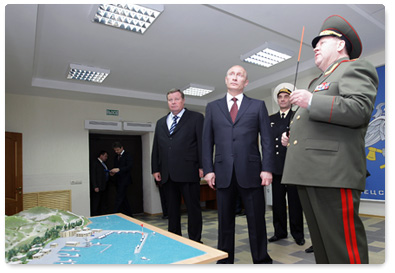
Putin Briefed on Novorossiysk

On 24 April, Anatoliy Tsyganok told RIA Novosti conditions at Novorossiysk are not particularly well suited for major base.  He noted it’s only 25 percent complete, and its price tag is continuously rising. 

Nevertheless, Putin reaffirmed Moscow’s commitment to Novorossiysk.  He acknowledged only 13 billions rubles have been spent, and he’s looking at an ultimate cost of 92 billion.  The base is slated for completion by 2020. 

But Moscow, Medvedev, and Putin may need to worry more about new ships and submarines than about infrastructure when it comes to the BSF. 

On 2 May, Anatoliy Baranov in Forum.msk pointed out that there’s practically no fleet there; a minimum of 2 more first rank ships and a submarine are needed for an adequate order-of-battle.  He says the social infrastructure’s not so bad, but 40- and 50-year-old civilian engineers and technicians have to go out with fleet units to conduct training.  What will the Navy do when they retire?  

Rosbalt.ru described a wave of new officer and civilian dismissals in the BSF, which occurred simultaneously with the new agreement with Kyiv.  The fleet, it says, is nothing more than a mixed force division’s worth of units and personnel.   Viktor Yadukha concludes: 

“NATO’s gracious reaction to the BSF lease extension didn’t surprise politicians more.  But if Western special services knew about real plans for its reinforcement, the reaction would have been very severe.” 

Lastly, in today’s Nezavisimaya gazeta, Aleksandr Khramchikhin says: 

“. . . renting empty piers for a great amount of money is not a mistake, but thoughtless, considering how many ships and how well-outfitted a base in Novorossiysk this money could build.” 

He calls today’s BSF a unique collection of floating antiques.  Even if the oldest units were dropped, most BSF ships would still be 20- to 25-years-old.  It will be impossible to avoid sending ships from the 1960s and 1970s off for scrap soon, as has been officially acknowledged.  Khramchikhin recommends placing what’s left at Novorossiysk as a ‘water area security’ (OVR or ОВР) brigade.