More Drugs, Extremism in the Army

According to ITAR-TASS, Main Military Prosecutor Sergey Fridinskiy today warned colleagues at an inter-governmental meeting on military-patriotic indoctrination that anti-drug measures among minors are not having the intended effect, and: 

“Based on last year’s results, the growth of crime connected with illegal trade in narcotic and dangerous substances in the troops (of all power structures) exceeded 70 percent.” 

For his part, Deputy Defense Minister, State Secretary Nikolay Pankov agreed that drug-addicted youth pose a threat not just to the army, but the whole country.  He added: 

“The ‘drug addiction’ diagnosis is becoming customary for draft commissions.” 

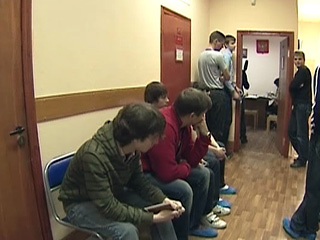
At the Draft Board (photo: Newsru.com)

And as if on cue, today from a Ural region draftee assembly point in Yegorshino came the story of 100 young men who arrived recently high on marijuana in hopes of being deferred from conscript service for dependence on narcotics. 

The voyenkomat reported nothing like 100 guys showing up before the draft board in a state of ‘narcotic intoxication’ has previously happened. 

A voyenkomat representative said: 

“There’s never been such a thing, we are sure this is a particular feature of the current draft.  The young guys intentionally used narcotics in order not to end up in the army.” 

According to Newsru.com, a State Narcotics Control officer for Sverdlovsk Oblast is investigating the ‘stoners’ who came from Nizhniy Tagil, Yekaterinburg, and Pervouralsk.  The voyenkomat said these men would be returned to their towns for additional medical observation and rehabilitation. 

ITAR-TASS reported more of Pankov’s comments on a different subject.  He said: 

“In Russia, nearly 150 extremist youth groups are active, the participants in them live mainly in big cities.” 

Pankov didn’t rule out that young extremists could spread from large cities to small towns and lightly populated areas, saying: 

“This is highly probable.  All this comes into military collectives and leads to the growth of nonregulation relations, so-called ‘dedovshchina.'”  

This is just one reason the army’s always preferred country boys from the ‘sticks’ rather than city guys.

The topics of drugs and nationalism in the army, if not taboo outright, have been little discussed.  Some honest talk about these problems might be the first step in solving them.

More VDV to Kyrgyzstan

Escalating violence in southern Kyzgyzstan has prompted Moscow to dispatch more VDV to protect Russian servicemen and their dependents, according to Kremlin and Defense Ministry representatives.

ITAR-TASS reports President Medvedev’s press secretary indicated Medvedev decided to send extra sub-units to reinforce the contingent already located there.  The Defense Ministry said a reduced strength battalion of the VDV’s Ulyanovsk-based 31st Independent Airborne-Assault Brigade arrived in Kyrgyzstan today. 

It will reinforce the security and defense of Russian military facilities there.  Its arrival is also connected with the rotation of other 31st Brigade sub-units out of the country.

ITAR-TASS sources in Russia’s power structures say two reinforced companies numbering more than 300 men have been sent into Kyrgyzstan.  The current contingent of Russians numbered about 160.

The introduction of additional Russian troops comes on the heels of weekend violence in Jalal-Abad, where crowds broke into military units and stole weapons.

There Will Be Professionals, But Later

In Thursday’s Vedomosti, Aleksey Nikolskiy wrote about Defense Minister Serdyukov’s remarks on contract service to the Federation Council.  Serdyukov and General Staff Chief Makarov have cited different figures on the current number of contractees (150,000 vs. 190,000), but agree they’ll be cut.  Professionals will come not only later, but in a smaller numbers.  And contractees will occupy only certain duties.

Nikolskiy cites a figure of only 50,000 contractees signed on during Russia’s failed 2003-2007 attempt to set up a professional enlisted force.

A future smaller number of contract NCOs could receive pay equivalent to that of junior officers.  Except that junior officer pay is supposed to increase dramatically toward 2012 under the new pay system.

According to Nikolskiy’s interlocutors, a new table of organization will soon spell out exactly where contractees will serve, i.e. there will reportedly be few driver-mechanic contractees, while the number of senior NCO billets will increase.

While contract soldiers decrease, how will Moscow manage its commitment to keep conscripts out of ‘hot spots’ (i.e. potential combat zones)?  As recently as April, the Defense Ministry had to reassure the public it had no intention of stationing draftees in Chechnya.

Here’s Nikolskiy verbatim:

“In the long run, contractees in the army will increase from 150,000 to 250,000, but first they will cut them to pick the best and pay them more.”

“Defense Minister Anatoliy Serdyukov told reporters in the Federation Council yesterday there are no plans to abandon contractee servicemen and their number in the future will increase to 200,000-250,000. The day before in the defense committee of the upper chamber, the Genshtab chief Nikolay Makarov said the number of contractees will be significantly reduced compared with the current 190,000.  According to him, contractees will occupy only duties in the Navy, Air Forces and Air Defense requiring good professional training, and also in permanent readiness units.  Only conscript soldiers will serve in the remaining posts.”

“An officer from the Defense Ministry central apparatus explains that Serdyukov’s and Makarov’s statements don’t contradict one another.  In the long run, depending on developing financial conditions, the number of contractees will grow, but first they will reduce them to get rid of ballast which got into these posts during the first attempt at professionalization of the army.”

“In 2003 the FTsP “Transition to Manning with Soldiers Conducting Military Service on Contract in Some Formations and Military Units” was adopted at a cost of more than 20 billion rubles.  According to it, by 2007, the number of contractees in soldier and sergeant duties in permanent readiness units should have gotten to 150,000.  However, they began to fulfill this program from the wrong end, said an officer, having simply mechanically increased the number of contractees in posts not worrying about their training or paying a normal wage.  As a result, they took less than 50,000 and the program collapsed, as the Defense Ministry’s leaders confirmed this year.  Now, after their reduction, the number of contractees will be increased carefully, take well trained people into posts and pay them wages equivalent to salaries of junior officers, said Vedomosti’s source.  At President Dmitriy Medvedev’s meeting on Monday [7 June], increasing wages was discussed and a figure was named—from 25,000 rubles [monthly].”
 
“In the words of an officer from one of the Ground Troops’ motorized rifle brigades, the latest order about contractees came to the unit at the beginning of the year and it indicated there should be no more than 5 percent of them among the number of soldiers and sergeants in driver duties, though more posts for contract sergeants as company and battery sergeant-majors were introduced.”
 
“According to him, you can’t judge where exactly contractees will serve until the introduction of new tables of organization which they’ve promised to do in coming months.”

Serdyukov on Contract Service

Wednesday Defense Minister Anatoliy Serdyukov appeared before a closed session of the Federation Council’s ‘government hour,’ and answered 30 prepared questions. 

ITAR-TASS reported the upper legislative chamber’s Speaker Sergey Mironov summarized Serdyukov’s presentation as follows:

“Objectively speaking, we received exhaustive explanations on several positions, some answers explained the situation which had called forth serious questions from the senators.”

Mironov added that Serdyukov’s answers:

“. . . did not completely satisfy FC members.  Personally I and many of my colleagues remained with our own opinions about what is happening in the armed forces.”

Defense and Security Committee Chairman Viktor Ozerov delivered the gist of Serdyukov’s answers to the Russian media, although Serdyukov answered some direct press questions after his session with the legislators.

According to RIA Novosti, Serdyukov said:

“We talked about the transition to the new profile, the numerical composition of the armed forces, the new structure, military units which are being created, draft legislation on pay and proposals concerning the provision of housing to servicemen.”

The major news out of Serdyukov’s parliamentary appearance was the report that he denied Russia is abandoning professional contract service or returning to Soviet-style, all-conscript armed forces.  This contrasted with the recent Newsru.com report saying contractees will soon be drastically cut everywhere except in permanent readiness units, as well as with General Staff Chief Makarov’s February admission that contract service has failed. 

Several media sources reported that Serdyukov indicated contractees would increase 50 percent from a current level of 150,000 to between 200,000 and 250,000.  ITAR-TASS reported his words as:

“In the future it [the number of contractees] will grow, there is potential for this.  In the future the number of contractees will grow to 200-250 thousand, such conditions will be created for them so that they can fulfill their duties as real professionals.”

However, BFM.ru and Regions.ru heard it quite differently.  They reported:

“The Russian Army has not abandoned contract service.  Now in the Armed Forces of Russia there are 150 thousand contractees.  At minimum, this number will be preserved.  If the financial potential of the government allows, we will broaden this component.  Ideally, according to our calculations, the quantity of contractees should be about 200-250 thousand.  They should occupy duties demanding good training and knowledge, service experience.”

According to Ozerov and press sources, Serdyukov addressed other miscellany.

The Defense Minister said the LDPR’s recent draft law proposing to allow young men to buy their way out of the draft for 1 million rubles “raises a whole series of issues.”  He claimed this would interfere with the country’s mobilization potential.  He apparently didn’t say how many guys he thought could afford that much, but he must think a lot can, if it could affect Russia’s human mobilization resources.

Despite recent press indicating a strong presumption that Serdyukov is ready to euthanize premilitary Suvorov and Nakhimov schools (much as VVUZy have been paired back), he told the Federation Council that Suvorov schools will be preserved and strengthened.

Serdyukov demurred from the possibility of more Russian bases abroad, calling them an “expensive pleasure.”

He said the military’s 8,000 plus military towns will be reduced and consolidated into only 184, and those cut would be turned over to the oblasts and republics in which they are located.  The Defense Ministry will discuss with RF subjects and local governments the transfer of housing and other social infrastructure in military towns to their jurisdiction. 

This harks back to the late April announcement about constructing new, large ‘core military towns.’  The smaller number of garrisons sounds more appropriate for a million-man army than 8,000, but taking care of those left stranded without utilities and other services in former garrisons is much more troublesome than simply transferring them to the control of oblasts or local governments.

Serdyukov said the Defense Ministry will acquire 51,000, rather than 45,000 permament apartments for servicemen this year.  He doesn’t see any problem with providing service apartments to every military man by the end of 2012.

He regrets that the Defense Ministry’s request for indexing military pay and pensions has not been approved, but he said this issue is not decided yet.

On the Black Sea Fleet, Ozerov said Serdyukov said the fleet’s personnel will be less than the 24,000 stationed there earlier.  He said Serdyukov said he expects the new Ukrainian government to be much more amenable to discussing deliveries of new weapons and equipment of the Russian fleet.

OSK Commanders Will Directly Control Navy and Air Forces

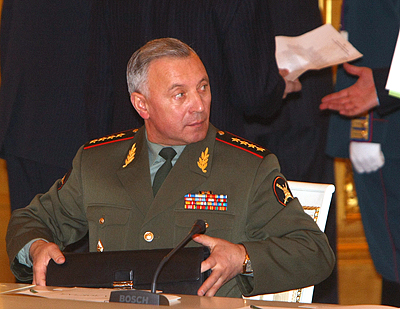
Army General Makarov

Russian General Staff Chief, Army General Nikolay Makarov briefed the Federation Council’s Defense and Security Committee today, and, according to Interfaks, he has made the decision to replace Russia’s six military districts with four that will function as operational-strategic commands (OSK).  He said:

“We will propose on the base of six military districts to establish four military districts, to the commander of which all forces and means deployed on their territory, including Navy, Air Forces and Air Defense, will be subordinate.  And subordinate not operationally, but directly.”

“Ground-, sea- and air-based nuclear deterrence forces will remain under the General Staff.”

“Our proposal on establishing four operational-strategic commands is now with the country’s president and I think that this issue will be favorably resolved soon.”

Infox.ru cited Makarov on the creation of three additional combined arms armies for several strategic axes: 

“We conducted a careful analysis of current threats and challenges and came to the conclusion that it’s necessary to create additional combined arms armies on several strategic axes.  There will be three in all.”

Makarov added that one army would be based in Chita, and six additional motorized rifle brigades will be formed to flesh out the newly created armies.

And Makarov wasn’t done . . .

According again to Interfaks, Makarov told these members of Russia’s upper house of parliament that ten combined air (8) and naval air (2) bases will be established in Russia.  Until recently, the military had been talking about new “first- and second-rank air bases” that were basically Air Forces’ equivalents of Ground Troops’ brigades.  This approach may have been abandoned in favor of a smaller number of larger air bases.  The choice of the word ‘combined’ [объединённые] makes these things sound like they’re now equivalent to armies.

Makarov explained that Russia has 245 airfields:

“The approximate cost of using one airfield is 1 billion rubles per year.  This amount is prohibitive, therefore we took a decision on enlarging air bases.”

After this change, Russia will only have 27 airfields, according to the General Staff Chief, and the combined air and naval air bases will be spread out over Russia in cities like Voronezh, Chelyabinsk, Domna (near Chita), and Komsomolsk-na-Amure.

Makarov said the goal was not only excellent conditions for fulfilling flight missions, but also for the everyday lives of servicemen and their families:

“We’re doing everything so that our pilots and their families can live in human conditions.”

Makarov told the assembled lawmakers that Russia will complete contract to buy Mistral from the French:

“Concerning Mistral, the contractual obligations are practically ready.  I think we’ll buy this ship.”

“We need such a ship.  In the Far East, it’s simply essential.”

He went to say, it’s needed around the Kurils which “generally have nothing to defend them.”  And he elaborated:

“Earlier there was an army there.  There’s no one there to cover them, we need mobile means so at the necessary time we can deliver a landing force quickly.”

He repeated his past comments to the effect that Mistral is 4-5 times bigger than Russia’s largest amphibious ship, the Ivan Rogov class.

Tomorrow it’s Serdyukov’s turn to speak to the Federation Council, so prepare for some more news.

More on the Military Manpower Dilemma

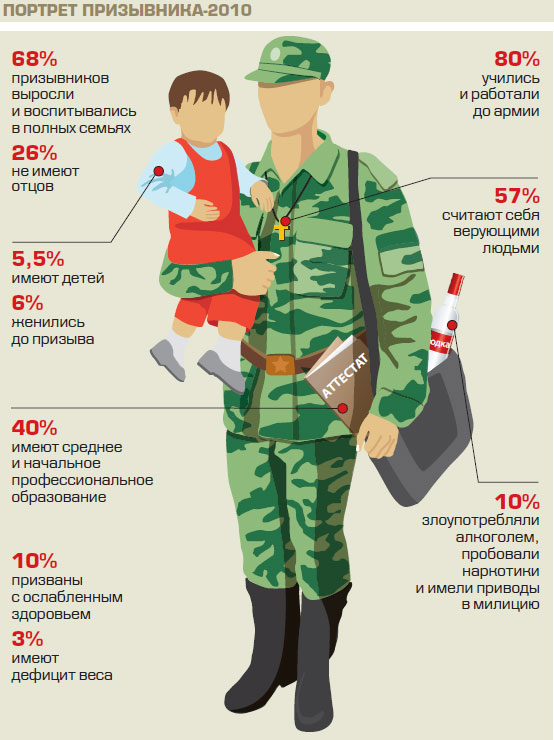
Social Portrait of SibVO Conscripts (Photo: Trud)

Mikhail Lukanin wrote in Trud this week about the Defense Ministry’s unending manpower woes. 

He concluded that the first two months of this spring’s draft campaign showed there’ll be almost no way to avoid conscription.  Experts he talked to believe the Defense Ministry’s conscription plan is unrealistically high, and the armed forces will turn to inducting every student. 

The callup is supposed to run 1 April to 15 July, and take in 270,000 new soldiers.  Voyenkomaty have already sent 100,000 men—mostly from the Volga-Ural region and Siberia—to their units.  One-third of callup-aged men were screened out due to health problems, most of which were diagnosed initially when the men appeared before the military-medical commission. 

Experts consider the early part of the draft campaign the easy part.  Voyenkomaty have been dealing with young men not in school who go pretty willingly to the army, according to human rights advocate Sergey Krivenko.  

But he says in the last weeks of the draft the voyenkomaty have to meet their quotas mainly with VUZ graduates who don’t have any desire to serve.  Valentina Melnikova of the Soldiers’ Mothers’ Committee says: 

“Mass roundups in student dormitories have already begun.  They traditionally conduct them mostly in Moscow and St. Petersburg.” 

In the fall, 43,000 university and institute graduates found themselves in the army—that’s 15 percent of all conscripts. 

Demographers indicate that the number of 18-year-old men will fall, and not exceed 600,000 for the next two years.  That number equals the number of places available in higher education institutions.  Independent military-economic analyst Vitaliy Tsymbal concludes: 

“The Defense Ministry can fully meet its draft plan only by means of total conscription of students.” 

And it has done little to hide its appetite for students, according to Lukanin. 

GOMU Chief Vasiliy Smirnov already talked to the Federation Council about drafting students after one or two years in a VUZ, and the Education Ministry reportedly didn’t object.  The extension of the current draft until 31 August means that those finishing school at 18 can now fall directly into the army, rather than taking their VUZ entrance exams.  Similarly, the ‘nonstop draft’ means VUZ graduates hoping to start their graduate studies will now fall subject to the draft. 

Of course, Smirnov has also raised cutting sharply the number of VUZy that can provide students a draft deferment.  He talks about a 50 percent cut, expanded later to a 70 percent cut in qualified VUZy.  Trud has been told all nongovernmental institutions will lose the right to provide deferments. 

Sergey Krivenko believes in every draft about 130,000-150,000 conscripts are ready to serve [his number may be high since it wasn’t so long ago that 133,000 were drafted every six months, and surely not every one of them was happy to go].  If, according to Krivenko, the Defense Ministry stuck with this number, it wouldn’t have any problem with conscription [it would certainly have fewer problems].  He continues: 

“However, the whole point is that beginning with spring 2009 the plan jumped to almost 300,000 in one callup.  Troop commanders themselves say that half of this number is simply ballast for the army.  Mainly these are guys in poor health, with a low level of education, and also inveterate hooligans.” 

Lukanin had a second article reviewing data from a survey of 7,800 conscripts in the SibVO.  Every third conscript considers serving a burden.  Only 40 percent had a secondary school (high school) or initial professional (post-secondary technical training) education; 4.5 percent had a complete higher education.  A third of the men grew up without fathers.  One in ten admitted either misusing alcohol, trying narcotics, or having a run-in with the police before coming to the army. 

More than 30 percent said they came to the army just to avoid trouble with the authorities.  Two percent said they have a negative attitude toward the army [this represents the small number of young men willing to tell the army’s pollsters what they really think to their faces]. 

Experts tell Lukanin the poll results will change as conscripts from Moscow, St. Petersburg, and other large cities begin to arrive.  A figure of 15 percent with negative attitudes toward the army is about the norm. 

Ten percent of the conscripts have health problems.  Three percent are underweight. 

The medical condition of conscripts may be worsening.  Official data say half of conscripts have health-related restrictions on their service.  And army commanders confirm that it’s hard to find draftees without some kind of defect.  ‘Ideal’ soldiers (from a physical and social standpoint) are found only in honor guards.  The deputy commander of the Moscow honor guard battalion said last fall he traveled all over Kostroma Oblast and, of 1,000 candidates presented by local voyenkomaty, he accepted only 30. 

Finally, one last story of draft-related problems . . . Nezavisimaya gazeta ran an editorial this week describing how some conscripts finishing their year of service in the DVO, Pacific Fleet, and SibVO are not being demobbed on time.  According to this report, they are being held because the DVO doesn’t have trained soldiers to take their places and participate in the operational-strategic Vostok-2010 exercise starting at the end of June.  The editorial concludes that the spring conscripts don’t even know how to handle their weapons yet, much less find a target on radar.  NG calls it a symptom of the fact that the Russian Army never has, and never has had, enough specialists.  The editors could hark back to the need for a professional army, but instead they recommend a better system of reserve mobilization.

Defense Ministry Claims More Money Needed for Armaments

General-Lieutenant Frolov

Speaking before the Duma yesterday, acting Armaments Chief, General-Lieutenant Oleg Frolov indicated the proposed 13-trillion-ruble State Armaments Program (GPV or ГПВ) for 2011-2020 is not enough to accomplish the Kremlin’s rearmament goals.  RIA Novosti reported the draft GPV will go the government’s Military-Industrial Commission (VPK or ВПК) by the end of this month. 

From the Space Troops like his boss Vladimir Popovkin, Frolov is the Defense Ministry’s Deputy Armaments Chief, and Chief of the Main Armaments Directorate. 

Frolov said 13 trillion rubles will guarantee development of strategic nuclear forces, air defense, and aviation, but the Ground Troops’ requirements for modern weapons will be underfinanced. 

He added that 28 trillion rubles would allow the Defense Ministry to cover the Ground Troops’ needs, and 36 trillion—almost three times the planned amount of the GPV—would fully finance programs for the Navy and Space Troops. 

First Deputy VPK Chairman, ex-general Vladislav Putilin responded that his commission hasn’t heard answers as to why the proposed 13-trillion-ruble allocation is insufficient for the military’s needs: 

“In the Defense Ministry’s opinion, the armed forces will degrade under an allocation of 13 trillion rubles out to 2020.  But we haven’t gotten explanations even though we’re asking:  show us these horror stories.” 

Putilin noted that the GPV is still a ‘working’ document at this point. 

At the same time, the Audit Chamber (a GAO-type organization) told the Duma the Defense Ministry is not succeeding in using its allocated funding.  Lenta.ru reported that, by varying measures, the Defense Ministry executed only 42-65 percent of the State Defense Order (GOZ, Gosoboronzakaz, ГОЗ, Гособоронзаказ) for last year.  Also of interest from yesterday, SIPRI released its estimate of Russian defense spending for 2009–$53 billion (about 1.6 trillion rubles), good enough for fifth place worldwide.  See also Grani.ru for coverage of the Defense Ministry’s difficulty spending the GOZ. 

Newsru.com captured this story appropriately as a Defense Ministry demand for more funding.  Prime Minister Putin and President  Medvedev have vowed repeatedly to increase new armaments, from the current level of 10 percent, to 30 and 70 percent of the inventory in 2015 and 2020 respectively.  What’s unknown is why at least one uniformed military man has decided to challenge the feasibility of his political masters’ long-term rearmament goals.

Sharp Cut in Contract Soldiers Coming

In the wake of General Staff Chief Makarov’s February admission that professional contract service had failed, a Defense Ministry source told Interfaks last week that contractees in noncombat positions will be sharply cut.  According to Newsru.com:

“It’s planned that by 1 July of this year only those specialists affecting combat readiness of military sub-units will remain in contract positions.”

He said this means combat vehicle commanders, driver-mechanics, gunner-operators, and other specialists, and civilians or conscripts will fill other contractee posts.  Lenta.ua noted the source didn’t specify how many contractees would be released or how many would remain.

Some of data cited referred back to a Vedomosti editorial about two weeks ago.  It said, under the 2003 Federal Targeted Program “Transition to Manning by Servicemen Conducting Military Service on Contract in Some Formations and Military Units” for 2004-2007, professional contract soldiers in permanent readiness units were to increase from 22,000 to 147,000 by 2008, and from 80,000 to 400,000 in the armed forces overall.  But in reality, there were only 100,000 in permanent readiness units by 2008, and only 200,000 in the Defense Ministry overall.  Meanwhile, the effort cost 84 billion rubles.  Vedomosti concluded:

“It seems the generals could not fulfill (or sabotaged) the directives of the country’s highest political leadership in peacetime.  Who will guarantee that the generals’ disobedience won’t be repeated in an emergency situation?”

“The Defense Ministry could not organize or make professional service in the army attractive and it sees as a way out stuffing the developing hole with a growing number of conscripts.  It’s understandable that the quality of these one-year draftee soldiers will be lower than that of contractees.”

“The abandonment of the move to a professional army promises many dismal consequences for Russia’s future.  Drafting 27-29-year-old higher educational institution graduates, who are in professional demand, could deliver significant damage to the economy and scratch the country’s modernization.”

So what is to be done?

This spring the Defense Ministry floated several trial balloons to answer its manpower problems.  As Parlamentskaya gazeta reported, the chief of the Genshtab’s GOMU, Vasiliy Smirnov told the Federation Council last month that he wants to increase his conscription base by reducing student deferments, raising the upper limit of the call-up age from 27 to 30, lengthening the semiannual callup until it becomes almost perpetual, and requiring young men to report to voyenkomaty without a summons.  Reportedly, the Kremlin has approved some or all of these proposals.

The Genshtab has proposed cutting the number of VUZy with the right to provide students deferments.  Even though deferments were trimmed in the recent past, Russians still have 21 legal ways to postpone their military service.  Smirnov claimed over 2 million draftees, more than 60 percent of the overall number, legally ‘dodge’ the army with deferments, the vast majority of which are educational deferments.  He continued:

“The number of higher educational institutions in which study is a basis for the right to a draft deferment from military service has to be reduced in stages.  Already this year it would be advisable to cut the number of VUZy having the right to a deferment in half or even by 70 percent, keeping that right only for educational institutions having a state order.  An alternative option could be having students perform conscripted service after the first or second year of studies.  The Education Ministry made this study and sees no negative consequences.”

Noting that voyenkomaty have been unable to notify 200,000 men to report, Smirnov concluded:

“Thus, the existing system of holding citizens liable who for some reason are not fulfilling military service obligation is ineffective today.  We have to change the system of notifying citizens.  In case a person does not receive the notice from the military commissariat, it is proposed that he go to the induction center on his own on the date indicated in the certificate of a citizen subject to call-up for military service.  This procedure functions in many states.”

Summing up, Smirnov said:

“A General Staff analysis of capabilities for manning the state’s military organization with conscripted servicemen showed that the needs of the state’s military organization for a draft contingent will not be supported as early as the end of 2010.”

In other words, the ‘demographic hole’ created by the sharp reduction in male births during the early 1990s is beginning to have its inevitable effect.

Deputy Defense Minister, State Secretary Nikolay Pankov and Main Directorate for Socialization Work Chief Yuriy Dashkin appeared at a Duma roundtable on 31 May to discuss conscription and conscript life.  According to RIA Novosti, Dashkin told Duma members, “Today the armed forces, dealing with a large number of tasks, are forced by the state’s economic condition, by resource provision, to rely still on a conscript army.”  Pankov said he could not give percentage figures on the future mix of conscripts and contractees in the Russian Army.  Soldiers’ Mothers Committee chair Svetlana Kuznetsova expressed doubt that the army will be able to induct 270,000 men as planned this spring.

Trud recently published a number of open letters to President Dmitriy Medvedev, one of which came from Soldiers’ Mothers’ founder Valentina Melnikova.  She asked Medvedev to end conscription, writing:

“Dear Dmitriy Anatolyevich, explain, please, why the Defense Ministry buried the idea of creating a professional army in Russia.   Back in 2003 the government adopted a special Federal Targeted Program on the full manning of all permanent readiness units with contractees.  All together, it was proposed by 2008 to bring into the forces 147,000 professional sergeants, for this 79 billion rubles was allocated.  The Defense Ministry reported that it was managing the task, and promised to increase the number of contractees in the army, and reduce the share of conscripts.  But in the end everything turned out exactly opposite.  At the beginning of this year the military officially stated that the task of building a professional army is being put off for indefinite long term.  As regards conscription into army units, the Defense Ministry intends to take it to 700,000 per year.  It’s simply impossible in Russia to find so many boys fit for military service according to the state of their health.  Almost a third of all conscripts that end up in the army have serious illnesses.  They’ll make just as many young citizens serve who have parents who can’t work.  End conscription and force the generals to create an army not of boys, but of professionals.  And don’t believe the generals when they say Russia doesn’t have the money for a professional army.  Independent experts believe that the state, if all expenditures are considered (pay for voyenkomat doctors, medical evaluation in hospitals, transporting conscripts to their service locations, assistance to soldiers’ wives, etc.), spends 150 billion rubles every year on conscription.  It seems to me that for this money it would be fully possible to maintain a fully contract army in a worthy condition.”

Step Closer to Four OSKs Instead of 6 MDs

ITAR-TASS reports today that the reform of the operational-strategic level of command and control has entered its final phase.  According to the Genshtab’s plan, on 1 December 2010 military districts (MDs) will shrink from 6 to 4.  A Genshtab source told ITAR-TASS that 4 MDs and operational-strategic commands (OSK or ОСК) will be formed–Western, Southern, Central, and Eastern, with their commanders having operational control over all (or most) of the troops (forces) of the armed forces and other militarized structures located on their territory.  

The Genshtab representative says the Western MD/OSK, based in Piter, will include the Moscow and Leningrad MDs, with Baltic and Northern Fleets, VVS, VDV, and other militarized structures operationally subordinate to it.  The Southern MD/OSK in Rostov-na-Donu will have the North Caucasus MD, with the Black Sea Fleet and Caspian Flotilla operationally subordinate.  The Central MD/OSK in Yekaterinburg will have the Volga-Ural MD and the western part of the Siberian MD.  The Eastern MD/OSK in Khabarovsk will have the eastern part of the Siberian MD and the Far East MD, with the Pacific Fleet operationally subordinate to it.

The question of subordinating units and formations of the RVSN, naval strategic nuclear forces, LRA, and the Space Troops hasn’t been decided.  According to the source:

“This issue is now under long-term study, Genshtab Chief Army General Nikolay Makarov is personally occupied with it.”

The Genshtab source said the new MD/OSKs will be tested out during the Vostok-2010 operational-strategic exercise at the end of June.

ITAR-TASS said this major command change will not involve officer cuts, but there will be a redistribution of the officer corps to new service locations.

So there’s more smoke from a fire somewhere, presumably.  If this pans out, it will be the culmination of a command and control change long talked about, and even tried out piecemeal at times.  After many waves of reform since late 2008, one has to wonder whether this is the time for more disruption.  Maybe it is since things are already disrupted.  Which generals will be the winners or losers?

It will be hard to judge the value of this effort just from the name changes or the movement of a major combined formation from one order-of-battle column to another.  A lot will depend on what the exact terms of ‘operational subordination’ are when it comes to the fleets and other major militarized formations outside the Defense Ministry’s administrative control.  The four MD/OSK commanders will certainly have more responsibility, and they must be hoping and working to get the real authority they need to go along with it.

Shamanov’s Press Conference

General-Lieutenant Shamanov

Ever-loquacious VDV Commander, General-Lieutenant Vladimir Shamanov held a wide-ranging press conference on Wednesday.  The Defense Ministry web site covered it hereITAR-TASS also published a number of short items on it. 

Shamanov detailed the work of five immediate deployment VDV battalions, lobbied again for a helicopter regiment, and discussed training issues and his procurement desires.  He joined the dogpile on top of the Russian OPK although he once seemed to defend it, and he credited Putin alone for the initiative to modernize the military’s arms and equipment.

He described his forces as combat ready, and manned and equipped at 100 percent.

Relative to combat readiness, Shamanov announced that the VDV has dedicated five battalions for immediate deployment which, if necessary, will be its first units sent into combat.  He said:

“By agreement with the General Staff, in the VDV we’ve dedicated five battalions for immediate deployment.  The uniqueness of service in these battalions is such that personnel from each of the battalions goes on leave for 45 days as a complete unit.  Therefore, at a minimum four battalions are always ready for combat deployment.  Today one of the sub-units of such a battalion from the 31st Airborne-Assault Brigade (Ulyanovsk) is fulfilling missions in Kyrgyzia [sic].”

Shamanov also gave voice to his desire, more modestly expressed than in April, for some aviation assets for VDV.  Speaking about the VDV’s future development, he said his troops must become airmobile.  To this end, he’s “given the Genshtab’s Main Operations Directorate [GOU] a request on the issue of forming a helicopter regiment in one of the three airborne-assault divisions [DShD or ДШД].”

Shamanov discussed VDV training at great length.  He started, of course, by speaking about jump training.  The parachute jump training plan was 70 percent fulfilled during the winter training period.  He blamed poor weather, saying troops often jumped in minus 30 degrees Celsius—the lowest acceptable temperature.  The plan for jumps from An-2 aircraft was fulfilled, but only 70 percent fulfilled from Il-76 aircraft.  He noted the VDV conducted its first-ever drop of a BMD-2 with its crew on-board, and said this hasn’t been done in 7 years, and then it was a BMD-1.  Use of the BMD-2 was significant, he said, because the BMD-2 represents 80 percent of VDV’s combat vehicle inventory.

Shamanov talked about large Spetsnaz assault group jump training in guided parachutes.  He said the use of guided parachutes allows reconnaissance troops to complete a horizontal flight of 20 kilometers, and:

“Our goal is to get so that such movements reach 40 kilometers, as they do in the Israeli Army.”

The VDV Commander noted that the multi-component Polet-K command and control system was tested for the first time in winter training.  He said: 

“It still isn’t the full suite envisioned in the future.  We are one-third through its introduction into the forces.  This process won’t happen in a year.”

Also for the first time, an artillery sub-unit of the 98th Airborne-Assault Division used Russian-made ‘Eleron’ UAVs for target designation on the Luga training grounds.  Shamanov said five ‘Eleron’ UAVs were employed in the training, and they conducted supplemental reconnaissance to a range of 10 kilometers in advance of fire missions.  This summer, 12 VDV crews will train on Israeli-made UAVs in Moscow Oblast.  Shamanov said:

“Unfortunately, our representatives did not go to Israel where they produce the ‘Hermes’ UAV which has been bought by Russia.”

Shamanov noted more attention to air defense training in the VDV this winter.  There were 40 firings of manportable ‘Strela-10’ and ‘Igla’ SAMs.

For the summer training period, Shamanov noted the VDV has 9,300 conscripts to get through three jumps in the course of 1.5 months.  The VDV will participate in ‘Vostok-2010’ and the CSTO’s ‘Cooperation-2010.’  There will be a VDV-level CSX (КШУ), as well as a CSX involving the 98th VDD (or ВДД).

Following the lessons of the Georgian war, the VDV is periodically training on the Navy’s large assault ships (BDK or БДК).  Shamanov says:

“In the winter training period we transported the 108th Regiment on large assault ships three times.  The exercises ended with a naval assault landing by a reinforced assault-landing battalion (ДШБ).

Last but not least, Shamanov commented on VDV procurement, and transport aircraft in particular:

“Work on the State Armaments Program for 2011-2020 is being completed.  According to our requests, in it there is the modernization of Il-76 aircraft, renewal of production and modernization of An-124 aircraft, the purchase of 30-40 An-70 aircraft.”

An-70

But the VDV Commander stressed these were his requests, and the final say isn’t his.  Utro.ru quoted him:

“In the development of the state [armaments] program, we gave our proposals, whether they’ll be realized in the confirmed version of the state program, I can’t say yet.”

Gzt.ru and Lenta.ru covered the An-70 and An-124 story in detail.

Shamanov said troop testing of the ‘Shakhin’ thermal sight for infantry weapons is complete.  He said:

“There has to be one approach for weapons—they have to be all-weather.  Not long ago the thermal sight ‘Shakhin’ went through troop testing.  After the testing we returned it to the designers for reworking.  We’ve given the task that our weapons work according to the aviation principle—turn your head and firing systems turn after it.”

He commented on air-dropping the BMD-4M, and added that, “The BMD-4M has every chance in the future, owing to its qualities, to be the forces’ main infantry combat vehicle.”

Although he seemed more like a supporter of Russian-made weapons six months ago, Shamanov now applauds Prime Minister Putin [not President Medvedev?] for searching for good weapons and equipment abroad.  Shamanov said the prospect of foreign competitors has forced “the domestic OPK to move,” as reported by Utro.ru.  He continued:

“Last year when industry was told that we’d look for alternatives abroad, they began to move.  In particular, the atmosphere around Mistral is creating a significant context for the domestic OPK.  When people declare that they’re ready to produce 21st century weapons but their equipment is from the 30s and 40s [of the 20th century], how can you talk about the 21st century?  Therefore, every official supports Vladimir Vladimirovich Putin’s initiative on the requirement to renew our armaments.  As long as this doesn’t happen, we’ll being shifting in place, and this won’t be just a lament of Yaroslav’s daughter [reference to the Prince Igor’s wife in the Lay of the Host of Igor after his defeat by the Turkic Polovtsy in 1185].”

At the same time, Shamanov concluded that GAZ and Izhevsk vehicles perform better for the VDV in the snow that equivalent Italian and Canadian ones.

Shamanov also said it’s essential to decide what to buy without any kind of lobbying, and for his part, he bases his decisions on saving soldiers’ lives and fulfilling missions.