Tag Archives: Anatoliy Serdyukov

Walking Back Contract Service (Part I)

Anatoliy Serdyukov’s 18 March pronouncement on relaunching contract service was another painful Defense Ministry policy reversal.  He said:

“One of the important directions of Armed Forces reform is improving the manning system.  The Russian Federation President approved the Defense Ministry’s proposal to have 220 thousand officer positions and 425 thousand servicemen serving on contract in the Armed Forces.  The given changes in  numerical strength are viewed as long-range and connected with keeping a missile army and four missile divisions in the Armed Forces order of battle, increasing the number of formations in the Ground Troops, and establishing the Air-Space Defense Troops.  It is planned to increase the share of contract-servicemen by creating attractive military service conditions.  In the near future, soldier and sergeant duties will be manned on a mixed [i.e. conscript and contract] basis.”

Serdyukov’s words in 2011 sound very much like former Defense Minister Ivanov’s when he launched contract service nine years ago.  We’ve come full circle.  Russia tried professional enlisted service, declared it a failure, and returns to it as something essential and unavoidable.  The inevitability of contract service springs from the insoluble problem of the draft.  Moscow can’t man its Armed Forces with the right number and kind of conscript soldiers.

Early last year, Serdyukov was careful in his criticism of contract service.  He consistently pointed to inadequate funding as the reason for failure.  He didn’t indict the concept.  The Defense Minister said contractees would be cut, and eventually brought back up to the level of 200 or 250 thousand.  The current target of 425 thousand indicates something’s changed significantly over the past year. 

For his part, General Staff Chief Nikolay Makarov categorically condemned contract service.  In early 2010, he said:

“We are not switching to a contract basis.  Many mistakes were allowed, and that task which was given—construction of a professional army—was not completed.  Therefore a decision was made that conscript service needed to remain in the army.  Moreover, we are increasing the draft , and decreasing the contract part.”

One can hear sand crunch under Makarov’s boot as he about faced in his Academy of Military Sciences speech last week:

“You know about the recent decisions of the Supreme CINC to have 425 thousand contractees and 220 thousand officers.  We will be implementing this literally starting today.”

“We understand that these Armed Forces are created for servicemen-contractees.  Only with their training can we have a well-prepared and professional army.”

So we understand that do we?  It’s not how Makarov understood things a year ago.

Let’s summarize where we are . . . a year ago, contract service was cast off and the Defense Ministry said henceforth it would rely on conscript manpower with far less training and experience than contractees that apparently didn’t meet its needs.  Serdyukov and Makarov declared the central military personnel policy of the 2000s — Putin’s years as Supreme CINC — to be a complete and utter disaster. 

Now barely 13 months later, these men have recognized the basic reality that there simply aren’t enough conscripts and they aren’t the kind of manpower that can operate a modernized Russian Army.  So the turn back to contractees.

But still questions remain.  How will Russia create these professionals?  How will it craft a contract service policy that works?  How will it differ from what was tried previously? 

So far the answers sound familiar.  Good pay, service conditions, housing . . .  will they be more successful getting these things for contractees this time around?  Can they afford them more?  What is different this time?

Serdyukov’s Anniversary

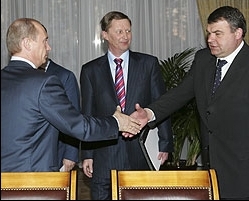
Putin Welcomes Serdyukov as Ivanov Looks On

The fourth anniversary of Anatoliy Serdyukov’s appointment came and went quietly enough on 15 February.  But WikiLeaks has come through as if to mark the occasion.  

On Friday, it posted an Amembassy Moscow assessment of Defense Minister Serdyukov a month and a half after he arrived in the “Arbat Military District.”  Mindful of hindsight bias, one can’t judge this cable too harshly.  But it’s an interesting retrospective on what was expected of the man going in, and what has happened since.

As stated all over the Russian media, Amembassy anticipated Serdyukov would impose discipline on the “Ministry’s notoriously loose financial control system,” and not otherwise initiate major changes.

Aleksandr Golts told Amembassy:

“Serdyukov’s inexperience on military issues would undermine his credibility with the General Staff and other senior officers, hindering his ability to push through needed reforms.”

A bit silly in retrospect.  Yes, he had no credibility with the Genshtab, nor it with him.  But he didn’t care and pushed right through the Genshtab, cutting the Genshtab (it suffered first in the reforms) and building his own bureaucratic machinery in the Defense Ministry.

Amembassy claimed that Serdyukov dismissed then-Chief of the Main Directorate of International Military Cooperation (GU MVS) General-Colonel Anatoliy Mazurkevich, and that Serdyukov’s auditors might be driving other corrupt officers into resignations or dismissals.

The cable describes the Defense Minister aptly as a “detail-oriented micromanager and ruthless policy administrator.” 

But what it doesn’t note (and what has become patently obvious over the last four years) is that the Defense Ministry, and the Russian military, is an unwieldy and untidy establishment not well-suited to micromanagement.  Talk about trying to turn an aircraft carrier on a dime . . . not gonna happen here. 

A couple stories come to mind . . . Serdyukov trying to put new uniforms on the troops, one of his first initiatives.  Now maybe only 20 percent of the troops have them, and the parents of those that do say the new uniforms aren’t as good against the cold as the old ones.

Also, Serdyukov talking about one new brigade commander who didn’t implement his directives.  It’s a big country and a big army.  What Moscow says isn’t always relevant in Chita, etc.

Next, Amembassy summarized the views of Ivan Safranchuk this way:

“He thought the Ministry establishment would try to ‘outlast’ any reforms that Serdyukov sought to impose, with the brass counting on Serdyukov to adjust to their way of thinking — or at least to stay out of their way.  Safranchuk told us that former DefMin Ivanov ultimately had not made a significant impact on how things functioned within the Ministry, despite his reform efforts, and predicted the same fate for Serdyukov.”

This one turned out to be pretty wrong, didn’t it?  There may still be some elements awaiting Serdyukov’s departure and a return to the way things used to be, but too much has changed.  The military establishment can’t ever be exactly what it used to be.  And the brass was definitely no match for Serdyukov, and he didn’t stay out of their way, but rather sent many of them down the highway.  And this Defense Minister has had a greater impact in four years than Sergey Ivanov in nearly six.  Ivanov’s fate was not to be Putin’s successor, and to muddle around in his next job, i.e. First Deputy PM.  As for Serdyukov’s fate, we’ll have to see.  As for his impact, at least some is likely to be lasting.  How long?  Only until the next determined reformer arrives.  None of this is to say Serdyukov’s impact is all positive, mind you.  Some changes may have messed things up worse than they were.  But he got reform off the dime in a way Ivanov never dreamed.

Here’s video of Putin’s meeting with Ivanov and Serdyukov on 15 February 2007.

The cable continues:

“Sergey Sumbayev, a former journalist with Krasnaya zvezda (Red Star), told us that management and accountability within the Ministry were dysfunctional and fostered inefficiency and corruption.  He referred both to financial accountability and responsibility for policy implementation.  Sumbayev thought the Ministry’s entrenched bureaucracy resisted, mostly successfully, institutional change, which generated considerable waste and delayed delivery of modern weapons systems to the armed forces.”

Sumbayev also told Amembassy:

“. . . management experience and tenacious work ethic make [Serdyukov] the ideal ‘technical’ manager that the Ministry needs.  While acknowledging Serdyukov’s political connections, Sumbayev did not think Serdyukov harbored any political ambitions.  He was chosen mainly for his managerial expertise, loyalty, and willingness to please his political bosses.  Serdyukov could probably make progress in streamlining the Ministry’s management structure, reducing waste, and exerting more control over its financial accounting systems.  One year, however, would not be sufficient to accomplish these tasks.”

“Sumbayev speculated that keeping the General Staff off-balance and focused on internal matters over the next year was one of Putin’s objectives in appointing Serdyukov. In this respect, he suggested that Serdyukov had a mandate to shake things up in the Ministry without sparking too much discontent.”

Amembassy concluded that:

“Serdyukov has his work cut out for him in bringing order to a Ministry badly in need of reform.”

Serdyukov’s made progress, but this final assessment probably remains true four years on.

Walking Back Serdyukov’s Personnel Policies (Part I)

And so it’s begun. 

The first of Defense Minister Serdyukov’s major reform planks – cutting the officer corps from 355,000 to 150,000, or no more than 15 percent of the million-man army – has been reversed.

The Armed Forces’ officer manning level was apparently one topic in yesterday’s meeting between President Medvedev and his “power” ministers about plans to raise pay for servicemen in 2012.

Serdyukov told the media about the decision to increase officers in the Armed Forces by 70,000:

“A decision’s been taken to increase officer personnel by 70 thousand.  This is connected with the fact that we’re deploying additional military units, establishing military-space defense, that is, an entire service (of troops), and the increase is happening in connection with this.”

First, this raised some interesting questions about VKO.  Is it really going to become a service (vid or вид).  After all, the Space Troops are only a service branch (род войск) right now.  That’s quite a promotion.  And are we really supposed to believe the expansion of VKO or the Space Troops will require 70,000 additional officers? 

Of course not, it’s a convenient excuse to walk back a large part of the 50 percent cut in army officers Serdyukov announced when he launched his reforms in October 2008.

Most media outlets were pretty confused on what this means for officer numbers.  They assumed the Russian Army’s at 150,000 officers right now, just add 70,000 for a total of 220,000.  But it’s not so simple.

When Serdyukov started cutting officers, there were 305,000 occupied officer billets.  Krasnaya zvezda said the Armed Forces had 181,000 officers at the end of last year.  So a grand total of 124,000 officers were either discharged, placed outside the “org-shtat” at their commander’s “disposition,” or forced to accept an NCO billet between late 2008 and the end of 2010.  Returning 70,000 to the ranks might leave us wondering only about what happened to the other 54,000.  And 181,000 plus 70,000 takes the officer corps basically back to 250,000, or fully one-quarter of the million-man army.

The army officer corps has endured considerable sturm und drang in a little over two years all for the sake of shedding just 55,000 officers.

More on this tomorrow.

General Staff Chief Makarov’s Retirement Rumored

On Thursday, Argumenty nedeli said its source claims Defense Minister Serdyukov will soon send some well-known generals into retirement.  The Defense Ministry press service, of course, denies it.

AN’s source says the departure of these generals isn’t due to conflict between them and Serdyukov, but rather to the latter’s policy of “rejuvenating” Russia’s high command.  Among those who will allegedly be retired:

  • General Staff Chief, Army General Nikolay Makarov (61).
  • Deputy Defense Minister for Rear Services, General-Colonel Dmitriy Bulgakov (56).
  • Air Forces CINC, General-Colonel Aleksandr Zelin (57).
  • Navy CINC, Admiral Vladimir Vysotskiy (56).
  • Space Troops Commander, General-Lieutenant Oleg Ostapenko (53).

It’s interesting because none of them is really up against the legal age limit for leaving military service.  And Makarov apparently already has a service term extension from President Medvedev. 

One presumes, according to AN’s information, that the Ground Troops CINC, and RVSN and VDV Commanders are safe for now.

AN also expects some of the newly appointed MD commanders to be dismissed or moved to new posts.

There are other angles to AN’s story besides more rotation in cadres.

First, it repeats earlier press on trouble in finding a replacement for “key military department figure,” former Deputy Defense Minister for Finance-Economic Work Vera Chistova who left her post three months ago. 

An AN source in the Finance-Economic Service claims the lack of a replacement puts in doubt Prime Minister Putin’s promise to deliver a 6.5 percent increase in military pensions on 1 April.  Budget resources weren’t allocated for this.  And there’s still no candidate to replace Chistova.  And without one such issues simply won’t be resolved. 

AN doesn’t mention also that as active duty officer pay is reformed this year, the Defense Ministry will have to figure what to do about retiree pay.  If, as expected, they break the long-standing link between active pay and military pensions, the vets aren’t going to be very happy just before the 2011 and 2012 elections.  Putin just courted representatives of veterans’ organizations about a week ago.

According to AN, the Defense Minister has offered the military finance portfolio to more than one official at different levels in the Finance and Economic Development Ministries, but all of them declined.

The military department’s officers are also talking loudly about the coming appointment of a new Serdyukov deputy who will be called in to “correctly”  track the military’s political preferences ahead of the fast-approaching legislative and presidential elections.  

A high-ranking but unnamed military man tells AN

“He will be an important civilian and definitely a member of ‘United Russia.’  It goes without saying this is connected with the upcoming parliamentary and presidential elections.  The negative mood of officers is great, it is directed against the minister, his assistants and the party of power which is conducting the reforms without considering the human costs.”

The Results of Reform

Trud’s Mikhail Lukanin offered an interesting one last Wednesday . . . with help from other frequent commentators, he takes a swag at describing the results of Anatoliy Serdyukov’s nearly 4-year tenure as Defense Minister.

It’s interesting because it’s unclear if Lukanin’s article is intended to damn by faint praise, to be sarcastic, or was ordered by someone.  Maybe he intends to say these are just results, the good and the bad.

It’s easy to see some good in Lukanin’s first five, but his final three are pretty much unleavened.

The Army’s Become More Mobile

Lukanin quotes Vitaliy Shlykov:

“Until 2008, our army looked like fragments of the old, Soviet one, weighed down with heavy weapons, oriented toward global nuclear war with practically the entire world.”

He says even in the August war against Georgia the army was still “Soviet” — slow to stand up, with an archaic command and control structure.  But now the situation’s changed with mobile brigades that can answer an alert in 1 hour instead of days.

The Army’s Rid Itself of the Spirit of the Barracks

Valentina Melnikova tells Lukanin that the soldier’s life has changed cardinally under Serdyukov.  She says, until recently, one-third of soldiers were typically involved in nonmilitary work every day.  Now soldiers are gradually being freed from such duties as commercial firms take them on.

New Equipment Has Come to the Troops

Lukanin writes that finally a start’s been given to the largest rearmament of the army in post-Soviet times.  One that will take new weapons and equipment from about 10 percent of today’s inventory to 90-100 percent [official sources only claim 70 percent] by 2020.

Lukanin quotes Ruslan Pukhov:

“The Navy alone will receive 40 submarines and 36 new ships, and the Air Forces 1,500 aircraft in the next decade.”

Officer Pay Has Grown

Lukanin says lieutenants and majors made 14 and 20 thousand rubles per month respectively before Serdyukov’s reform,  but now 50 and 70 thousand if they receive premium pay for outstanding combat training results.  And from 2012, premium payments will be included in their permanent duty pay, and 50 thousand rubles will be the minimum base pay for officers.

Lukanin quotes Aleksandr Khramchikhin: 

“The officers of our army are actually comparable with the armies of developed countries in pay levels. “

They Didn’t Talk Reform to Death

Lukanin says experts think it’s good Serdyukov’s reform was pursued energetically, without lengthy discussion and debate.  Pukhov gives the cut from 6 to 4 military districts as an example:

“At one time, it would have taken years to transfer a huge quantity of officers and generals from place to place, but the Defense Ministry did this in just 4-5 months.”

They Stopped Training Officers

Lukanin refers to Serdyukov’s halt to inducting new cadets into officer commissioning schools until at least 2012.  He says 2010 graduates were either released or accepted sergeant positions.  This led to the departure of experienced instructors, and their replacement with younger officers lacking the necessary experience.

Sergeants Almost Ceased to Exist

Contract sergeants were dispersed in 2009-2010.  The Defense Ministry considers them poorly trained, and in no way superior to ordinary [conscript] soldiers.  Now it’s counting completely on conscripts with an even lower level of training.

There’s Nothing to Defend Against China

Here Lukanin notes that some results of reform have put people on guard.  Anatoliy Tsyganok tells him tank units have been practically eliminated: 

“Now only 2,000 tanks, old models at that, remain in the army.”

In Tsyganok’s opinion, tanks are still very relevant for the defense of Russia’s border with China.

What do we make of all this?

  • It’s good that the Russian Army was restructured into smaller, more combat ready formations, i.e. brigades, and sub-units. 
  • We really have no clear picture of the extent and success of outsourcing nonmilitary tasks in the army.  Meanwhile, the “spirit of the barracks” is alive and well when it comes to dedovshchina and violence in the ranks. 
  • The promise of another rearmament program shimmers on the horizon, but it’s not delivering much yet, and there are plenty of serious obstacles to completing it. 
  • The officer pay picture has improved, but the Defense Ministry has real work to do this year to implement a fully new pay system next year.  Meanwhile, several years of premium pay have caused divisions and disaffection in the officer corps. 
  • Moving out smartly on reform was a change over endless talk, but there are areas where more circumspection might have served Serdyukov well. 
  • The Defense Ministry definitely had to stop feeding more officers into an army with a 1:1 officer-conscript ratio.  We’ll have to see what kind of officers the remaining VVUZy produce when the induction of cadets restarts. 
  • Aborting contract service cut the army’s losses on the failed centerpiece military personnel policy of the 2000s.  But something will have to take its place eventually to produce more professional NCOs and soldiers. 
  • Russia is probably right to deemphasize its heavy armor.  It doesn’t appear to have much of a place in the coming rearmament plan.  And tanks really aren’t the answer to Moscow’s largely unstated security concerns vis-a-vis China anyway.

So what’s Serdyukov’s scorecard?  A mixed bag.  Probably more good than bad, but we’ll have to wait to see which results stand and prove positive over the long term.  Definitely superior to his predecessor’s tenure.  Expect more Serdyukov anniversary articles as 15 February approaches.

Serdyukov’s Year-Ender

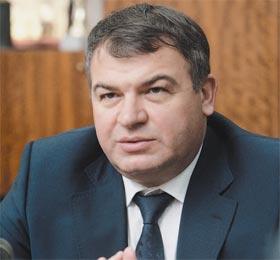
Anatoliy Serdyukov (photo: Izvestiya / Vladimir Suvorov)

ДОРОГИЕ ЧИТАТЕЛИ ! ! !

С НОВЫМ ГОДОМ ! ! !

Thanks for reading and commenting this year.

This one could have been entitled, The Army’s Great Scourge or Reform Isn’t Utopia or We Straightened Them Out.  Great quotes, but you’ll have to read to the bottom.

Defense Minister Anatoliy Serdyukov’s year-ending interview in Monday’s Izvestiya is a good read.  The paper asked some harder-hitting questions than Serdyukov normally gets.  And, though they aren’t necessarily new, his answers are pretty direct and revealing.  There are problems with a lot of them though.

Let’s look first at what Serdyukov said, then we’ll look at the deeper meaning of his answers.

Asked about this year’s command and control changes, the Defense Minister says:

“The most important thing is that we already changed the entire troop command and control system.  From one side, we tried to minimize the command and control levels; from the other side, to equip them technically.  Now the next task is before us – to tie it all into a single system so that every district commander answers not just for the ground, but also for the air, and air defense, and naval component.  The next step is we are trying to conduct exercises in such coordination between districts.  I think 2011 is key for us on this plane.”

On the decision to move to four unified strategic commands (OSKs) and cutting levels of command, Serdyukov said:

“This is the General Staff’s idea.  Before going to the president with such a proposal, we discussed this initiative since the end of 2007.  At the same time, we had conferences at various levels, consulted with experts, important military leaders, and studied international experience again – both American and NATO.  We tried to analyze the situation from every angle and arrived at the fact that this is really useful for various reasons.” 

“First and foremost, the transition to the OSK should be reflected in the controllability of the army.  A simple example:  at the beginning of the transformations, an order from me to a battalion commander had to go through 17 levels.  So you understand this influenced the speed of their transmission, and the content of the information itself.  Now we have three levels in all. If one wanted, it would be possible to calculate how much was saved both on communications nodes, and on communications systems themselves, and in speed.  And as a result – the army’s combat capability rose 50 percent.”

Asked about what will happen in combat situations now that more civilians occupy military support jobs, the Defense Minister says:

“Several factors converge into one point here, therefore, we came to the conclusion that we could and should divide directions of responsibilities – operational and support.  It’s not an accident that the Defense Minister has a first deputy – the Chief of the General Staff and a first deputy – a civilian who handles the direction connected with supporting the operational component.  Everything’s been thought out, and there won’t be any kind of failures.  Neither peacetime, nor wartime frightens us.”

On General Staff Chief Makarov’s assessment that the commander’s slovenliness caused 150 conscripts to get ill in Kemerovo, Serdyukov takes the opportunity to describe the pains he’s taken in establishing systems to monitor the implementation of military reform:

“Unfortunately, we are getting started.  Actually, when we launch any process, we try to organize the monitoring system and incentive system in the final result.  But this doesn’t always work.  We’ve established a series of structures for monitoring.  They are, for example, the financial inspectorate, which checks the use of budget resources.  Then the personnel inspectorate – occupied with the activity of every officer and civilian specialist.  There is the military inspectorate, which checks those measures which should go on in this or any military institution.  There is an organizational-inspector directorate occupied with checking fulfillment of all directives, orders, decrees, laws, etc.  This is that system of monitoring which gives the capability to influence internal army processes, and to move them.  Naturally, an entire system of regulations exists where the duties of every colleague, every sub-unit are strictly prescribed as is the corresponding period for fulfilling the orders.”

Asked about indicators of the fulfillment rate for Defense Ministry orders:

“All orders are being fulfilled.  The question is different:  are they on schedule?  And for the last half year, the picture generally doesn’t look bad.  The schedules we are establishing are holding on the whole.  Inside the ministry, we changed our entire workflow, accordingly this entailed a cut in signatories on this or that issue or project.  We are introducing electronic workflow which allows us at any stage to check how this or that directive or order is being fulfilled.”

“But there are also breakdowns.  Recently we had a collegium in Khabarovsk.  We listened to the report of an army commander who should have implemented 87 different measures, but implemented all of two.  What kind of combat readiness and discipline can you speak of if an officer doesn’t fulfill his own duties?”

“When we embarked on reform, both I personally, and many of my colleagues strove to understand:  what kind of problems really could be blocking the army’s development – housing, lack of money, lack of equipment, of soldiers?  Now there’s everything.  If you serve, then according to order 400 the money is very respectable.  We are providing housing.  There’s one hundred percent in equipment.  Almost one hundred percent – give or take one-two percent – in servicemen.  There you have it:  if you chose this profession, then serve.  But here we are stumbling over weak managerial discipline – the army’s great scourge.  And even here we’re trying, from one side, to stimulate work, and from the other – to severely demand fulfillment of service duties.”

Is Russia buying weapons abroad because the systems are really needed or is it being done out of political considerations:

“There is a certain requirement for foreign military equipment, because in a series of types of armaments, we, unfortunately, will fall behind.  Our models don’t meet the demands presented by the times.  It’s important also to understand how to formulate the tactical-technical tasks and characteristics of this or that essential production.  Therefore, we’re also trying to familiarize ourselves with those modern models of equipment and armaments which our partners have.  For this, in fact, we are buying equipment in small amounts – as in the case of UAVs.”

“However, besides equipment, it’s also necessary to have trained personnel, and a command and control system.  We don’t have many models of armaments, but to work on their development, spend time and money on their adoption is simply irrational, it’s simpler to buy, to study, and later begin to develop our own production.  Those Israeli drones gave a serious impetus to developing domestic industry.  Not long ago, the president was at the test range and there we showed him Russian models that are sufficiently reliable.  They are fully suited to us.”

“We don’t have ships like the Mistral.  We never built them.  But to try to catch up now is senseless.  We plan to buy the license and technical documentation for their production.  Moreover, there’s an agreement that, starting with the third ship, we’ll build the helicopter carriers in Russia.”

Doesn’t such an approach hurt Russia’s defense industry?  Wouldn’t it be better to finance and support our own enterprises:

“In the new state program of armaments, for four years, we laid out 600 billion rubles which will be allocated according to a new credit system for enterprises under a government guarantee.  Now  discussion is going quite actively on the subject of how this should happen, with what credit requirements and conditions.  This is one of the forms of financing which has a relationship not so much to support of enterprises as to the system of paying the state defense order itself.  It allows for transferring the load from the second half of the GPV to the first and vice versa.  Or to take off the peak load, meanwhile working out forms of active participation in financing by the Ministry of Finance and the banking system.  Incidentally, the reaction is fully positive, we already have trials with the largest banks – with Sberbank and VTB.”

On inter-ethnic conflicts in units and the possibility of creating nationality-based units:

“This isn’t today’s or yesterday’s problem.  If the commander fulfills his duties completely, then time and energy for conflicts simply won’t remain.  If they’re occupied with physical training for a minimum of four hours a day in every unit , and the remaining time is combat training, as it’s stipulated, then no kind of misunderstandings will arise.  It’s not important where you’re from, which nationality, and religion, if you just fall in your rack after exercises.  The problem again is in the commanders.  Some of them are simply estranged from working with personnel – they see that there are many physically strong, willful guys in the unit, and give over control of the barracks to them.  But those ones become abusers.”

What happens with commanders like these:

“We’ll dismiss them, get others.  An officer must be physically and morally very well prepared and engender only respect.”

Has the army rid itself of dedovshchina with the move to one-year service:

“We now are trying to get away from this term.  There is no longer such a phenomenon.  There is simply hooliganism, crude violation of the law.  If a man served three months, what kind of ‘ded’ is he?  The roots of dedovshchina are much deeper than commonly believed.  In Soviet times, when people served three-five years, then it was the rule:  a man just called up, and a man looking at demob in six months, have different training.  Here then is this phenomenon, really, and its origin.  Now this is pure hooliganism, legally punishable crime which we have fought and will fight without compromise.  Here it’s important that the commander in the sub-unit should fulfill his duties completely.  Then there can’t be any kind of conflicts by definition.”

Asked about accidents with munitions dismantlement over the last year, and how is the problem being resolved now, Serdyukov says:

“The problem is very serious.  For long years, munitions were stockpiled to excess, calculated for a multimillion-man army.  Besides, in the last twenty years, virtually no attention was given to combat training and firings, but the norms of munitions stockpiling remained as before.  As a result, so much ended up in excess that we have work for several years.  To dismantle them by industrial methods is quite complex – there aren’t enough enterprises.  Besides, this is very expensive and not safer than destruction.”

“Therefore, we’re now preparing special teams, certifying equipment, and selecting officers.  They mainly need to be combat engineers.  We’re picking ranges.  We’ve figured where, in what volume, and what we need to blow up, and worked out safe techniques.  We need at a minimum two, maybe three years of such work.  Yes, this will create some temporary discomfort and difficulties.  But it’s impossible to not do this.  If the entire arsenal at Ulyanovsk had blown up, the trouble would have been much more serious.”

Asked about demographic problems, a potential shortage of conscripts, and possibly cutting more deferments, the Defense Minister answered:

“We won’t revoke anything.  As far as demographic problems go, it goes without saying that they exist and we will take them into account.  How do we solve this problem?  I think if the country’s financial situation allows, then we will still try to return the issue of a contract army.  No one has revoked this program, we didn’t realize it because of a lack of resources.  We haven’t  rejected the idea itself.”

Serdyukov tells his interviewers flat out, there’s no longer opposition to his reforms in the army.  What happened to his opponents:

“We straightened them out.  Of course, this was difficult, especially at first.  Now a team of like-minded people has been laid down which itself is generating reform ideas.  Something’s already started to come from it.  People see this and understand:  reform is not utopia, but completely concrete matters.”

After four difficult years in the Defense Ministry, where does Serdyukov see himself:

“I still haven’t finished my service, so I can’t begin to talk about what’s been achieved and what hasn’t.  We’re now in a transitional phase.  There’s not a single direction of the ministry’s activity that modernization, the transition to a new profile wouldn’t affect.  We are working everywhere – in all spheres:  armaments, scientific-research activity, education, organization of daily service, military-technical cooperation.  I can’t say now what we’ll succeed in, and in which direction we’ll lag.  It seems to me that everything’s going pretty well.  We’re on schedule, there’s no deviating.”

Let’s deconstruct some of this shall we? 

Serdyukov and company seem to be obsessed with eliminating layers.  You know sometimes redundancy is good, and prevents making mistakes.  In a net-centric army, every layer sees the picture, but doesn’t necessarily have it for action.  It’s very hard to believe Serdyukov’s claim that just cutting command levels increased combat capability 50 percent when you look at everything that’s factored into the Russian definition of combat capability. 

Yes, we know operational and support stovepipes have been created.  But Serdyukov completely dodges the question of what happens when the combat tooth depends on a civilian tail.  There are obviously answers to this, but the Russians aren’t accustomed to this.  He brushes it off saying there just simply won’t be any failures.  That’s reassuring.

 On the soldiers in Kemerovo and slovenliness, Serdyukov goes a bit non-sequitur.  It’s great hearing about his monitoring system and the implementation of orders, etc.  One wonders, however, if electronic workflow in the Defense Ministry was as important as many things that needed to happen in the troops this year.  But then it gets really interesting.  We start to hear in Serdyukov’s words some of the animus he has for officers.  Why did he ever have such an army commander as the one he vilifies?  He really lays into officers, saying he’s given them everything they need now, they just need to do their jobs.

Serdyukov really avoids the question on buying arms abroad and hurting domestic producers.  He monologues about some convoluted credit provision scheme for paying out the GOZ.  This issue of real money for producers to make weapons and equipment is significant.  Even with the GOZ and a new GPV in place, all anyone can talk about is extending credit to the OPK in 2011.  Hmmm, interesting.

He blames commanders again for inter-ethnic conflicts in the army.  If they were doing their jobs, it couldn’t happen.  If they just wore the boys out properly, it wouldn’t occur.  There is some truth in this, yes, but it’s more complex than just that.  But saying any more might have taken the Defense Minister into a social and political minefield.

On dedovshchina, again Serdyukov blames officers for not taking care of the problem.  Serdyukov’s insistence on just talking about hooliganism makes some sense, yes, but there is still dedovshchina going on.  And, by the way, dedovshchina was never just purely hazing, making the juniors do the crappy jobs; it always had more violence, abuse, and crime in it than Serdyukov is willing to allow.

Serdyukov doesn’t say how he’s addressing the real civil-military relations problem he’s got in Chelyabinsk with regard to the explosions at Chebarkul.  But at least it’s a little like the problems his counterparts face in normal countries, and one has to credit him for taking on a lingering military problem all his predecessors simply ignored.

Wow, is Serdyukov cocky on vanquishing his opponents in the military!  He ought to watch it, it could come back on him.  But as we’ve seen, large-scale, public political demonstrations are going to come from other sources (i.e. the soccer fan bunt or pogrom).  The purely military ones (i.e. the Russian Airborne Union, etc.) tend to be more farcical.  But veterans and even serving officers could provide critical mass in a bigger social protest.  And there’s always the chance that some disaffected Kvachkov could fire a grenade at the Defense Minister’s limo.  Yes, yes, I can hear you — this is just by way of playing out one scenario on what could happen in the future.

One has to respect Serdyukov’s reticence to judge his legacy right now.  It may be possible he’ll leave the big marble building on the Arbat one day thinking how much he’s changed everything, thinking he’s a 21st century Dmitriy Milyutin.  And he may be, at least in comparison with any other choice.  He is making essential changes, and some progress.  More than this analyst thought he would back in early 2007.  But, on close inspection of the military, we may discover that less will actually have changed and improved than we think right now.

How much longer will Serdyukov continue in this burn-out job?  He’s pretty stoic, but he’s definitely more frayed than 4 years ago.  The issue probably comes down to the larger context of the Putin-Medvedev tandem and team — changes in high-level personnel could be more difficult now with every passing day.  Perhaps Serdyukov will remain through a fifth year, and the seating of the next Russian president.

It’s a great interview.  We got some real insight into the Defense Minister’s thinking.  Never could have gotten this 20 or 30 years ago.

Serdyukov’s Duma Session

ITAR-TASS reported a few tidbits from Defense Minister Serdyukov’s closed session before the Duma yesterday.  Not surprisingly, Serdyukov told Duma deputies:

“We fulfilled those tasks which the President gave to conduct the Armed Forces to a new profile in 2010.  The Armed Forces’ combat readiness increased 1.5 times.  We believe that the combat readiness of the army and navy will grow 3-3.5 times toward 2020.”

RIA Novosti reported that Serdyukov said combat capability, not combat readiness.  Combat capability seems to make more sense.

ITAR-TASS says Serdyukov familiarized deputies with the basic tasks of transitioning to the new profile, and the completion of reforms planned for 2010.  Attention was given mainly to implementing the State Program of Armaments and social issues for servicemen.  He said:

“I familiarized deputies with the transformation of the military districts, changes in army corps and brigades, and military command and control at all levels.”

Corps?  Did he really say that?

Answering a question about housing for servicemen, Serdyukov said the Defense Ministry has fulfilled the government’s order about this:

“In 2009, we obtained 45,500, and in 2010 55,000 apartments from all sources.  This attests to the fact that the government’s order has been fulfilled and is being fulfilled.”

As usual, the official news sources turned to Duma Defense Committee Chairman Viktor Zavarzin for comment, and he said:

“I give high marks to today’s meeting of the chief of the defense department and deputies.  We have established tight coordination with the Defense Ministry on legislative support of military reform, and bringing the Armed Forces to a new profile. “

“We are certain we will decide all issues concerning the rearmament of the army and navy, and social support of servicemen with the Defense Ministry leadership.  I say that we need to preserve this pace which exists in the Defense Ministry and with us next year to take the work to the intended results.”

Regarding rearmament, Zavarzin said:

“Besides, in ten years, the share of modern weapons in the army should be not less than 70 percent, for which unprecedented sums have been allocated.  For this, not only a principled position of the Defense Ministry, but also readiness by OPK enterprises for serial deliveries of modern types of armaments is required.”   

Zavarzin said Serdyukov didn’t have much to say on the Mistral purchase, but Zavarzin said:

“In our view, we don’t need to acquire a hunk of metal, but we need the documentation and understanding of those ideas and developments abroad which will enable us to realize the possibilities of our industry.”

Is Russian shipbuilding really going to learn that much from Mistral?

Zavarzin expressed the opinion of the deputies who think:

“We need to give the Defense Minister great credit because he is deeply involved in these issues and, as the one ordering, aiming to supply the army and navy modern armaments and military equipment. Our convictions are that we should create a competitive environment and competitive structures which would push Russia’s defense-industrial complex to the development and creation of the newest weapons systems, including for the Navy.”

At the same time, Zavarzin credited the Defense Ministry for understanding that military social issues deserve special attention too:

“We are talking about creating attractive conditions for those who are serving, but also providing all stipulated benefits to those who are dismissed from military service.  And this is the guarantee of permanent and service housing for servicemen and their family members, but also increasing pay to servicemen and military pensioners.  By 2012, the new pay system for servicemen should be functioning.”

“It’s understood that the level of pay and military pensions today is far from what’s really needed.  Here it’s necessary to change the situation in a cardinal way.”

ITAR-TASS also talked to members of the three other factions in the Duma. 

The KPRF’s Gennadiy Zyuganov negatively evaluated the army’s combat capability saying:

“The state of preconscription training is zero, and mobilization reserves have disappeared.  The general condition is such that today the army is not in a state to defend the country reliably in the event of a small conflict.”

Zyuganov claimed that defense is spending every third RF ruble, and “spending it absolutely ineffectively.”

He complained that outsourcing support functions to civilian companies has doubled the cost of maintaining each soldier.  Zyuganov also said that, “Switching to expensive cars is a luxury in hard times.”

The Just Russia spokesman supported Serdyukov’s formation of a single queue for military apartments, saying:

“We all know that earlier this was a very corrupt sphere where there was a great deal of injustice and complaints.”

Just Russia supported publishing the apartment queue on the Internet, as well as Serdyukov’s ‘humanization’ of conscript service (an extra day off, ability to communicate with family, service near home, and weekend passes), though nothing was said about the extent to which any of these have been implemented in units.

But the Just Russia faction leader also said:

“Today we raised the issue of material support for civilian workers serving the RF Armed Forces.  Today their wages are so low that a whole row of military commanders complains that they can’t fill vacant positions:  simply no one comes for such pay.”

According to RIA Novosti, Just Russia also supports giving military retirees the option of civilianizing their pensions, a move also advocated by the Defense Ministry, but opposed by the Finance Ministry.  The move would spare the Defense Ministry from choosing between paying more in pensions as active pay rises, or breaking the sacred link between active pay and pensions.  For its part, the Finance Ministry doesn’t want pay out for more expensive civilian pensions.

The LDPR was skeptical of Serdyukov.  Its spokesman said:

“We didn’t hear any news that would surprise us.  And the points of this endless reforming, they are all mainly well-known.  It feels like the man [Serdyukov] is in the flow of what’s happening, but our faction doesn’t always share those methods with which this is happening, particularly cuts, civilianization.”

Sounds like he’s tired of sound bytes too.

Igor Barinov, Deputy Chairman of the Defense Committee from United Russia, expressed concern that Serdyukov’s VVUZ reductions have cut military education to the bone:

“Of course, optimization on this level was essential.  But I think it was clearly a mistaken decision to stop induction [of new cadets] into military VUZy altogether this year and next.”

Mikhail Grishankov, also from United Russia, said there have been failures in the program of providing housing to servicemen.

Refusenik Accountants

This morning Argumenty.ru reports that Defense Minister Anatoliy Serdyukov can’t find a new deputy minister for finance-economic work to replace Vera Chistova who left to head the Moscow city finance department on 8 November.  

A Defense Ministry source tells Argumenty.ru, “about 10 offers have been made, but all candidates declined.”

A highly-placed source in the Defense Ministry’s financial directorate says the absence of a deputy minister to answer for financial issues is already creating a number of problems in the ministry’s work:

“A number of contracts for construction of housing for dismissed officers have been broken, draft orders for next year for financial incentives for serving officers have been frozen.  And there’s simply no one to sign the certification of budget execution for this year for the country’s highest leadership.  I simply can’t recall such disorder in my 30 years of service.”

The source says Defense Minister Serdyukov’s report to the President on the fulfillment of orders to provide apartments to servicemen has also been postponed for an undetermined period.

Leaving to work for the new Moscow mayor seemed like a good opportunity for Chistova.  Or did she figure this was an opportune time to escape some blame for problems in the military’s budget? 

Chistova’s predecessor Lyubov Kudelina served for a long time, but left in early 2009 because, according to Viktor Litovkin’s source, she objected to the Defense Ministry pressing some officers to resign short of receiving their severance benefits, and because Serdyukov refused to ask for extra money to pay for military reform.

It seems odd that someone as well-connected in government finance as Serdyukov can’t find a deputy for this.  It would seem he has cronies already brought into the Defense Ministry that he could just order to take the post.  Maybe the refusenik accountants know it’s a bad place to be right now.

We should also recall that Serdyukov was brought to the Defense Ministry in early 2007 reportedly for the express purpose of bringing financial order to the armed forces.

GUBP Retirees Against Reform

 A belated post-script to the Colonel Krasov, Seltsy, SDR flare-up against Defense Minister Anatoliy Serdyukov and his reforms . . . .

On the first of this month, Life.ru reported that officers of the now-disbanded Main Directorate of Combat Training and Troop Service (ГУБП or GUBP for short) established a public organization to oppose military reform.

The organizing assembly occurred right after the directorate furled its standard (marking the unit’s dissolution) on 26 November.  Life.ru says 60 men attended.  This new, as yet unnamed organization is apparently seeking official registration.  It expects support from the LDPR faction in the Duma, and from large veterans organizations that have come out against reform.

Its executive secretary, Andrey Serdyuk, said:

“Ill-conceived reform has left the Russian Army without a central combat training methodology – that is, now no one knows what and how we teach soldiers and officers on the battlefield.  Nevertheless, we intend to conduct meetings and demonstrations like our colleagues from the Union of Airborne Troops.  We plan to achieve our goals in three ways – media appearances, organizing public monitoring over the course of reform, and cooperation with public veterans’ organizations.”

Retirees will be the backbone of this organization.  It won’t accept serving military men out of concern for their welfare.

A former chief of the main directorate, General-Colonel Aleksandr Skorodumov will head the group.  He retired in late 2004 after complaining publicly about personnel decisions and reorganizations that look minor compared with Serdyukov’s tenure.  He created a mini-scandal by saying the army had collapsed at that time.

Viktor Ozerov – Chairman of Federation Council’s Defense Committee and an uncritical functionary – admitted:

“There was and undoubtedly will be resistance to reform.  Remember when the General Staff apparatus was cut, how many dissatisfied people there were:  people occupied specific duties, had pay, and then they’re deprived of all this.  But in any instance, there are people standing behind every such decision and their legal rights should be guaranteed upon dismissal.”

Ozerov also said responsibility for combat training will go to the individual services and branches, and inter-service training will be supervised by the military districts / unified strategic commands (OSKs).

Serdyukov himself told the Defense Ministry’s official Public Council on Friday that combat training will be the purview of services, armies, and brigades, and operational training will be under the Genshtab, MDs, and brigades (but apparently not armies?).

The GUBP’s fate was decided in June and sealed in September.  See Moskovskiy komsomolets, Argumenty.ru, and Gazeta.ru for more.  They claim former Moscow MD Commander, General-Colonel Valeriy Gerasimov – newly retooled as a deputy chief of the General Staff – will oversee inter-service training for the Genshtab.  And, by 1 February, a new Directorate of Troop Service and Military Service Security will stand up.  This will actually be a new / old directorate.  It existed several years ago and supervised safety issues, and grappled with crime and dedovshchina among the troops. 

MK presented two opposing opinions on GUBP’s fate. 

Leonid Ivashov said:

“The most experienced officers and generals serve in the GUBP, they develop and monitor combat training.  The Genshtab has several other functions – strategic ones.  No one there will take evaluation trips to far-off garrisons.  Especially since the Genstab’s combat training directorate will be a very truncated version.  Its elimination means our troops won’t be prepared for combat actions.

A Genshtab source gave this view:

“This is simply the latest course of reform which we have going on.  The information about the GUBP’s elimination appeared long ago.  The directorate has a highly inflated number of personnel, and its work has been evaluated as, to put it mildly, ineffective.  No new methods, no training ground equipment, no simulators in recent decades.

No Carrier in GPV

Despite the Navy CINC’s optimism last winter, Defense Minister Serdyukov stated flatly late yesterday Russia has no plans to build carriers in the near future. 

MOSCOW, 10 Dec — RIA Novosti.  The RF Defense Ministry has no plans for aircraft carrier construction in the near future, the chief of the military department Anatoliy Serdyukov stated Friday.

“No, there are no plans,” said Serdyukov, answering such a question from journalists. 

Earlier an RF Defense Ministry representative told RIA Novosti that Russia would begin construction of a class of aircraft carriers consisting of four units before 2020.  According to him, these ships are needed for the full-fledged functioning of the Navy, and the Defense Ministry will not abandon the idea and intention of building them.

Some desires die hard, but that seems like a categorical no.