Tag Archives: Bulava

Golts Looks Under the Hood of PAK FA

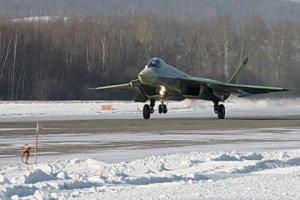
PAK FA in First Test Flight (photo: RIA Novosti)
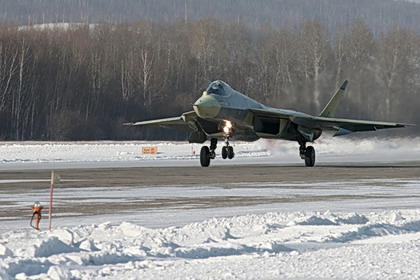
In today’s Yezhednevnyy zhurnal, Aleksandr Golts turns his skeptical eye toward the PAK FA, Russia’s 5th generation fighter aircraft which just took its first test flight.

Golts says, looking a little like the F-22 and even more than the Su-27, PAK FA called forth a storm, a waterfall of success reports.  He notes that Prime Minister Putin cited it as proof of the wisdom of creating the United Aircraft-building Corporation [UAC or OAK] four years ago. 

Those in charge of the project are breathing easier.  After the Bulava SLBM failures, getting the new fighter off the ground was a matter of principle, especially since the leadership promised that it would fly every year since 2005.  Golts believes the Bulava failures combined with the 5th gen fighter delays caused people to discuss whether Russia could modernize, and whether it could develop high-tech products.  One thing Bulava and PAK FA have in common is that both are truly Russian projects, ones that are being implemented without dependence on significant leftover Soviet-era resources.  Their results could enable observers to question whether the OPK is being managed correctly, whether it was smart for Putin, [Sergey] Ivanov, and Chemezov to herd hundreds of enterprises into several gigantic OPK kolkhozy. 

Golts says some aviation industry leaders worried that OAK was created, not to concentrate resources to build PAK FA, but for Moscow bureaucrats to get their hands on profits from foreign aircraft orders [doesn’t ROE do this already?].  And Golts reminds that around 2000 then-Minister of Industry Ilya Klebanov said PAK FA development would cost $1.5 billion, but as we’ve learned the pricetag was closer to $10 billion over ten years. 

And it had to fly no matter what, and so it did.  But what actually flew, Golts asks.  One thing for sure, the first new airframe in 25 years.  And that’s it.  Everything else–speed, max and min ceilings, radars, weapons systems–all remain to be seen. 

As for the engines, Golts says we just don’t know.  Years ago the engine producers fought it out to be the designer and builder.  NPO ‘Saturn’ won out.  And, according to Golts, its director started to lie.  Putin and Ivanov both recognize that the engine problems will take some time to work out.  But on the day of PAK FA’s first test, the managing director of ‘Saturn,’ who directs the PAK FA program for the United Engine-building Corporation [ODK], claimed the new fighter has the newest engine, not an improved version of the Su-35’s engine, as the press and specialists have written. 

So what Putin and Ivanov worried about was secretly resolved by NPO ‘Saturn’ and the new engine is ready.  This is great news for Air Forces CINC Zelin.  Just four months ago he said that the PAK FA engine couldn’t be foreseen in the near future.  He said it would fly with a ‘Saturn’ engine, the 117S, a ‘deeply modernized’ version of the AL-31F. 

So, according to Golts, either ‘Saturn’ decided to pawn off on the Motherland an engine it demonstrated four years ago or, worse, having pocketed the contract, it simply decided to put old engines in a new aircraft. 

Golts concludes honestly that he can’t say whether PAK FA will be a true 5th generation aircraft, but it has taken off in a thick fog of lies.  And here’s the distinction between it and Bulava; there’s no way to hide Bulava’s failures since the U.S. gets the telemetry and people in other countries can see evidence of an unsuccessful test launch.  There aren’t the same limits on lying about PAK FA. 

So PAK FA is a “cat in a sack.”  You can’t say much for sure about the cat, but don’t worry, it’s a 5th generation sack.
Thrust Control Problem on Bulava

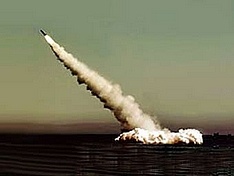
Bulava Test (photo: IA Rosbalt)

 Aleksey Nikolskiy in Vedomosti reports that Bulava testing will resume this summer.  He says the problem in December may have been a defect in the third stage engine, not a design flaw. 

Tests may resume this summer from the modified Dmitriy Donskoy SSBN.  Yesterday ITAR-TASS reported a minimum of two tests would be conducted from Donskoy.  If successful, testing would move to the missile’s intended platform, the new Proyekt 955 Yuriy Dolgorukiy, this fall.  

A Navy Main Staff representative told Vedomosti that Dolgorukiy would need to fire several missiles in a salvo launch.  An industry source said, if all these tests were successful, a “preliminary document on completion of the first phase of testing” could be signed and serial production of the missile could start. 

The Defense Ministry and OPK commission investigating the December failure has provided optimism for those involved, according to a source close to the commission.  In his words, a third-stage thrust control mechanism produced by the Perm-based NPO Iskra failed in the December test.  So some conclude the missile’s overall design is sound and it makes sense to continue work on it. 

Mikhail Barabanov says “shock work” on Bulava might be risky, since MIT already promised that it could produce the missile quickly and cheaply.  Konstantin Makiyenko reiterates the lack of an alternative missile to keep a naval component in Russia’s strategic nuclear forces. 

Denis Telmanov in Gzt.ru adds that a Defense Ministry source has not excluded the possibility that another design bureau, possibly Kolomna Machinebuilding, has gotten orders to work on a missile.  The Makeyev GRTs is another possibility, but its deputy general designer responded that quick development of a missile was physically impossible.  He said, even from an existing system, it would take 5-6 years.  And he said no one in the country’s leadership has taken a decision to start work on a new missile. 

All stories repeated the expressions of support for Bulava from the Defense Minister and Navy CINC.

What Others Say About Bulava and Borey

New Borey-class SSBN Yuriy Dolgorukiy on Sea Trials

According to Navy Commander-in-Chief Vladimir Vysotskiy, the slight delay in the laydown of the 4th Borey SSBN unit came from “technological causes” unconnected with the problems of the developmental Bulava SLBM.  Vysotskiy also denied that there were any financing problems behind the postponement.  He said, “All preparatory work for the laydown was complete.”  The laydown was moved from 22 December to sometime in the first quarter of 2010.  Sevmash shipyard officials in Severodvinsk report that they weren’t told any more than that.  However, Vladimir Yevseyev of IMEMO told Gazeta.ru the delay in the next Borey is connected with the unsuccessful test launches of Bulava.  Yevseyev said, “There really is a connection with the postponement of the laydown.  The perspectives are unclear, two boats out, one building, but no missiles.  It’s only possible to put Bulava on boats of this class, therefore after the last unsuccessful launch they decided to wait it out, it’d be strange to spend so much money and lay down a boat without missiles.”

Serdyukov Not Abandoning Bulava SLBM

Reporting on a Rossiyskaya gazeta interview to be published Thursday, ITAR-TASS quoted Defense Minister Anatoliy Serdyukov saying he is not giving up on the Bulava, despite a string of unsuccessful test launches.  Asked if the Bulava’s problems influenced the delay in the laydown of the fourth Borey SSBN, Serdyukov stated, “The laydown will happen, and we certainly aren’t abandoning the Bulava.  What’s the cause of unsuccessful launches?  I think there are really many causes, among them, the unpreparedness of the production base to make everything precisely.  Here the question of production discipline still has an impact.  Someone tries to replace materials with others, this also drags a mass of consequences.  In general, there is an entire tangle of problems and, unfortunately, they are not being resolved as quickly as we would like.  Nevertheless, I think that the missile will fly.”

Bulava SLBM Test Failure

The failed Bulava test launch yesterday is today’s big story.  See Myasnikov in Nezavisimaya gazeta or D. Litovkin in Izvestiya for coverage. 

Myasnikov recounts delays this fall in conducting the missile’s 12th test firing.  He recalls the story of how the project was given to MIT under the apparently ill-conceived thought of unifying naval and land-based strategic missiles.  Meanwhile, the SS-N-20  follow-on missile Bark, and the TYPHOON SSBNs to carry it, basically went away.  The Defense Ministry refuses to return to stand tests for Bulava.  Myasnikov says test missiles alone may have already run $3 billion.  The rest of the Navy is starved for resources, but Bulava has a strong lobby to keep it going.

D. Litovkin wonders whether it is Bulava’s control systems or poor manufacturing.  He wants to believe the system will work, but notes that time is running out for the current DELTA IV SSBN force, even with overhaul and modernization.

ITAR-TASS says the Defense Ministry blames a defect in the third-stage engine.