Tag Archives: State Defense Order

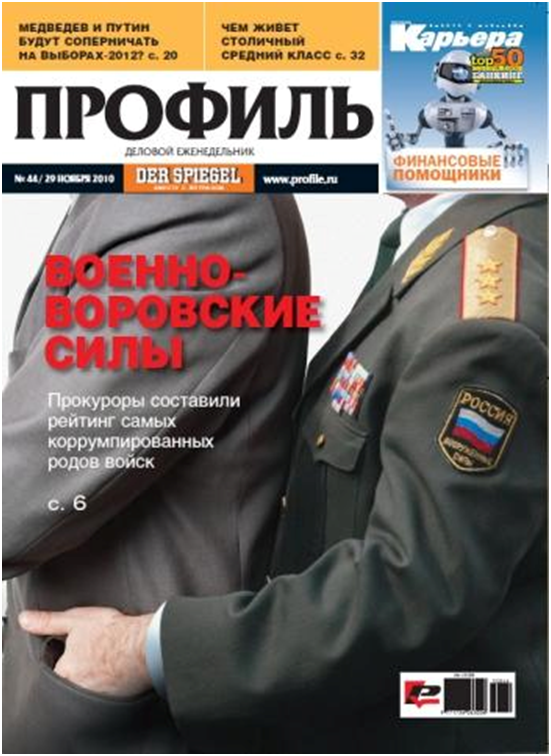
Military-Theft Forces

Prosecutors Rate the Most Corrupt Service Branches

40-50 Percent of State Defense Order Simply Stolen in Recent Years . . . no wonder large-scale procurement hasn’t happened.  Serdyukov supporter Korotchenko tries to paint opponents of military reforms as people trying to protect their corrupt schemes.  This surely goes on, but there also have to be people opposing them for reasons other than greed.  Finally, it’s at least conceivable that, if Serdyukov doesn’t make progress against corruption, it could cost him his job (if he stays that long, he is approaching the four-year mark).  Thus endeth the precis for this post . . .

This week Profil investigates military corruption.  The magazine notes the number and scale of Defense Ministry corruption cases is growing by leaps and bounds, reaching losses of 2.2 billion rubles for the first ten months of 2010.  It concludes, despite a significant cut in the officer corps and Defense Minister Anatoliy Serdyukov’s battle against “thieves in broad stripes [generals],” the number of corruption crimes is not only not declining, but has substantially increased.  Profil obtained an analytical report compiled by the Main Military Prosecutor (GVP) showing who has stolen how much this year.

The GVP presented its report to a closed session of the Duma Defense Committee.  It says its analysis shows “efforts to counteract corruption in the troops are insufficiently effective.”

Profil’s first graphic . . .

Growth of Corruption Crimes in the Army (First 10 Months of 2010)

Troops/Military District/Fleet                     2009       2010       Growth (%)

North Caucasus MD                                             184          311                 69

Moscow MD                                                              94           152                61.7

Air-Assault Troops (VDV)                                 34            119                250

Siberian MD                                                             76            117                 54

Strategic Missile Troops (RVSN)                  59              93                 57.6       

Northern Fleet                                                      50              59                 18

Space Troops                                                        27              44                 63

Caspian Flotilla                                                      5                  7                 40

Black Sea Fleet                                                      2                  6                 200

Profil suggests the recent wave of military retirements signed off by President Dmitriy Medvedev could have been sparked by corruption charges.  While possible, there’s no evidence to support this thesis. 

A Profil source in the Defense Ministry says, not surprisingly, officials responsible for the State Defense Order (GOZ or ГОЗ), capital construction, and the disposition of military property (first and foremost real estate) inflict the greatest losses on the budget.  The article quotes Igor Korotchenko:

“In the course of recent years, 40-50% of resources allocated for the State Defense Order were simply stolen.  This happened, for example, when money was directed at the fulfillment of some concrete work, but there were no real results.  Write-offs appeared in the end or a weapons system was developed that simply didn’t meet its technical requirements.”

Profil suggests that many officers are rushing to get one last bite of military money before Serdyukov’s reforms completely derail their schemes.  It cites Ruslan Pukhov offering two different explanations for rising military corruption:

“Feeling an impending dismissal, officials are probably trying to take the maximum from their positions.  However, it can’t be ruled out that the prosecutor has really reinforced his work in different areas.  Corruption is an acute issue for the prosecutor.”

Pukhov thinks that, although the percentage increase in corruption looks really bad for the VDV, “corruption in the armed forces is spread equally and the growth in corruption crimes in separate branches or districts is connected only with where they are being investigated.”

A very good point, Mr. Pukhov.  Yes, the results of this little anticorruption experiment are very much influenced by where and how it is being conducted.  One should also pay much more attention to the absolute numbers of corruption cases than the percentage changes, and nothing has been said about the relative size of the various parts of the armed forces . . . no per capita figures are provided.  Are 44 crimes in the relatively small Space Troops more significant than 152 in the larger Moscow MD?

Korotchenko, a fairly strong Serdyukov proponent, says the Defense Minister and his tax service colleagues are beginning to break existing corrupt ties, institute financial transparency, and deprive the generals of the right to conclude any contracts.  Dividing the Ministry into military and civilian halves will keep military men out of financial expenditures, and this “process of shifting generals out of the feeding trough” will continue until 2012.  The generals will provide requirements, and civilians will allocate the financing.

A second graphic with some absolute figures on losses due to corruption . . .

Growth of Corruption Crimes in the Army (First 10 Months of 2010)

Troops                                                                  Loss Amount                      Annual Growth

                                                                           (millions of rubles)                        (times)

Strategic Missile Troops (RVSN)                      59.8                                            15          

Air-Assault Troops (VDV)                                   57.5                                            12.2

Space Troops                                                            47.6                                              2.2

Korotchenko claims:

“The campaign against Serdyukov is mainly heated up by those people who’ve been deprived of the feeding trough.  So, the director of a large defense enterprise has for many years sawed off rubles by the billion every year in the transfer of money that comes to fulfill the Gosoboronzakaz.  When Serdyukov deprived this director of such a trough, he began to finance any actions directed at discrediting and, possibly, even removing the Defense Minister.”

So, Korotchenko asserts most conflicts over army reform are banal conflicts of interest for those who can’t steal like they used to.  But didn’t the GVP just say they’re doing a better job of stealing than ever before?

Korotchenko continues:

“Of course, Serdyukov is not an angel, and many of his actions on the military reform plane call forth questions, but it’s another thing that before he arrived, corruption in the Defense Ministry had achieved such a level that he was forced to cut to the bone.  Many scandals proceed only because their financial-economic interests were affected:  the meetings of the airborne guys is just one in this series.”

Then Profil turns to Vitaliy Shlykov, who says:

“Broad publicity for corruption scandals in the Defense Ministry cannot but affect the minister.”

But he believes the Kremlin knows no one can fight corruption like Serdyukov, therefore the GVP report isn’t a real blow to him.

Profil concludes, so far, Serdyukov hasn’t squandered the trust placed in him, but the struggle against corruption only strengthens him as long as it’s a success.  If corruption keeps growing, it’s possible the Defense Minister himself could wind up on the “shot list.”

BMD-4M Update

BMD-4M

An item on pending troop testing of the BMD-4M for VDV . . . .  No, they aren’t in the force yet.  Despite the optimism expressed below, it remains to be seen if the Defense Ministry will actually order the system upon completion of troop testing.  It sounds like the designers and builders have footed the bill — 200 million rubles — for the system’s development thus far.

From this week’s Voyenno-promyshlennyy kuryer:

“Troop testing of the modernized airborne combat vehicle BMD-4M is being conducted in the course of the 98th Airborne-Assault Division’s command-staff exercise (KShU), which will take place from 23 to 28 August near Ivanovo.”

“During the airdrop of military equipment, seven BMD crews will be inside the combat compartment of these vehicles.  Immediately on landing, the crews will move out to fulfill combat missions on unfamiliar terrain in the notional enemy’s rear area.”

“An airdrop of parachute troops and military equipment from aircraft of Military-Transport Aviation will occur in the course of the divisional KShU, which will be directed by VDV Commander General-Lieutenant Vladimir Shamanov.  In all, it’s planned to airdrop 15 pallets with military equipment, including the BMD-4M.”

“After the completion of troop testing of the modernized combat vehicle, development of which Kurganmashzavod, the Volgograd Tractor Plant and other enterprises of the ‘Tractor Plants’ Concern are engaged in, it will be accepted into the arms inventory of the ‘winged infantry’ and included in the state defense order.”

“Development and production of the BMD-4M is being conducted with the agreement of the Defense Ministry at the concern’s expense.  Expenditures on the first test models amounted to nearly 200 million rubles.”

Deputy Defense Minister Shevtsova

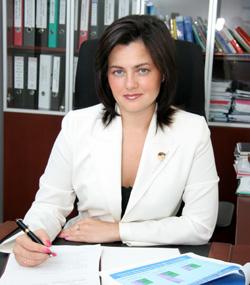
Tatyana Shevtsova at the FNS

Last Friday, Tatyana Shevtsova became the newest deputy defense minister – the ninth overall, seventh civilian, second female.  By all accounts, Shevtsova will oversee and audit Defense Ministry spending and other activities.  Kommersant calls her an ‘oversight and monitoring specialist.’  The Defense Ministry’s spokesman has said as much, according to Vedomosti (read it in Moscow Times as well).  Shevtsova’s another member of Defense Minister Serdyukov’s former team at the Federal Tax Service (FNS or ФНС).  Kommersant describes her as a ‘trusted individual’ who will help Serdyukov supervise all but the Defense Ministry’s purely military functions.  In particular, several commentators believe Shevtsova will track outsourced service and support activities paid for in the state defense order (GOZ).

The 41-year-old Shevtsova was born in Kozelsk, Kaluga Oblast, and graduated from the Leningrad Financial-Economic Institute in 1991.  She’s a candidate of economic sciences (Ph.D.). 

She started in the tax service in 1991 as an inspector in the central rayon of St. Petersburg, eventually heading the tax service’s St. Petersburg directorate.  Kommersant reminds that Serdyukov was a deputy director in the St. Petersburg directorate during Shevtsova’s time there in the early 2000s. 

Shevtsova went to Moscow to head the tax service’s large taxpayer department in early 2004.  In mid-2004, Serdyukov became Director of the FNS, and Shevtsova became one of his deputies. 

Shevtsova stayed at the tax service under Mikhail Mokretsov after Serdyukov left for the Defense Ministry in early 2007.  She was in charge of the oversight directorate and all nine inter-regional inspectorates for large taxpayers.

When Mokretsov and others members of Serdyukov’s FNS team departed for the Defense Ministry in mid-2010, Shevtsova did likewise, becoming an advisor.  According to one official who spoke to Kommersant, she spent the last few months ‘studying the situation’ in the Defense Ministry.

A former Defense Ministry official told Vedomosti Shevtsova is “a talented economist as well as an exacting official, whose subordinates at the Federal Tax Service were very afraid of her.”  She reportedly will turn ten Defense Ministry oversight bodies into a system.

Kommersant said Shevtsova will direct oversight organs for administrative, organizational, and financial activities as well as military housing.  The paper’s source says this could translate into oversight over everything except military command and control and operations.  The ninth deputy minister will reportedly gain some responsibilities once discharged by the chiefs of the ministry’s apparatus, Rear Services, and Housing and Construction Service.

Radio Svoboda was kind enough to interview Aleksandr Golts who concluded:

“It’s more or less obvious Anatoliy Eduardovich Serdyukov rapidly gathers his team in those areas important to him.  As we know, at present a so-called second civilian branch of the Defense Ministry is being formed.  Operational troop command and control, combat training remain with the Genshtab.  At the same time, a very strong area which will withdraw from the ministry a great number of functions connected with service and support of all Defense Ministry units and formations is being formed.  This is very complex work in the realm of the state defense order and the like.  Evidently, Ms. Shevtsova will work in this area.”

 Asked about her first steps, Golts commented:

 “If there will be first steps, we haven’t found out anything about them.  The Defense Ministry very precisely hides the most important directions of its activity from any public scrutiny.  Everything happens very quietly.”

Radio Svoboda also asked Viktor Baranets about ‘civilianization’ and the appointment of a reported 50 women to high posts under Serdyukov:

“They are already sarcastically joking  in the army about the ‘feminization’ of the Defense Ministry leadership.  A large number of women who’ve appeared in key Defense Ministry posts, at various times crossed paths with Serdyukov, and with Putin, and with Medvedev.  Of course, they’re Petersburg natives . . . .  There are unofficial reports that [Shevtsova] actively assisted Serdyukov in destroying Khodorkovskiy’s empire.”

Baranets’ sources in the Defense Ministry also say Shevtsova will be responsible for large sums of service and support funding being directed to contractors.  His general and colonel friends joke:

“We only have one vacant post left – deputy defense minister for corruption.  Because all the other jobs are filled.”

 Or anti-corruption one supposes . . . .

Igor Korotchenko told Vedomosti the Defense Ministry’s growing civilian component is designed to supervise the generals’ spending and accounting, especially in the GOZ.  Ruslan Pukhov calls the ‘invasion’ of former tax officials perfectly normal since Western defense ministries are full of civilian auditors who scrutinize massive military budgets.

Rearmament Tempo Less Than 2 Percent Per Year

Vasiliy Burenok

Vasiliy Burenok told a round table at the ‘Army and Society’ exhibition in Moscow Friday that the current pace of Russian force modernization, not more than 2 percent, won’t support the transition to a ‘new profile’ military.

Burenok is Director of the Defense Ministry’s 46th Scientific-Research Institute (46 NII).  The 46 NII is a lead organization involved in formulating the State Armaments Program (GPV) and State Defense Order (GOZ).  It works on military-technical policy documents and program planning methodologies.  Burenok is a member of the Scientific-Technical Council of the RF Government’s Military-Industrial Commission (VPK).

Reviewing history a bit, Burenok told his audience, at the beginning of the 1990s, the rearmament rate was 5-7 percent annually.  But, between 1991 and 2000, financing for new arms and equipment declined more than 50 times, leaving only enough money to maintain existing weapons.

Burenok concludes to get the army to the ‘new profile’ it’s essential to introduce 9 percent new equipment every year, and for some services and combat arms, up to 11 percent.

This 9 to 11 percent is, of course, the difficult target President Medvedev set at the Defense Ministry Collegium.  Burenok indicated just how difficult–going from less than 2 to an 11 percent annual renewal rate.

Armaments Chief and Deputy Defense Minister Vladimir Popovkin also addressed the ‘Army and Society’ round table.  He said GPV 2011-2020 will go to the president for approval in June.  The new GPV will be accompanied by yet another new Federal Targeted Program for OPK Development.

Popovkin said a number of systems won’t be produced under the new GPV.  They include short-range tube artillery, and BTR-80, BMP-2, and BMP-3 combat vehicles that soldiers are afraid to ride in.

Update on Military Corruption, State Losses, and Crime

Main Military Prosecutor (GVP) Sergey Fridinskiy observed last week that it will only be possible to deal with corruption when not just the law enforcement organs, but also responsible officials in the military command hierarchy become involved in fighting it.

At last week’s coordinating conference on fighting corruption in the armed forces and other armed formations, Fridinskiy reported that, in January and February, military corruption cases increased by 10 percent over year ago figures, and material losses to the state in those first months of 2010 were 5 times greater than in 2009.  Inflation and an increased volume of arms purchases were cited as contributing to the spike. 

In 2009, corruption cases increased 5 percent in military units.  Fraud and forgery cases increased 50 percent, but misappropriation, embezzlement, bribery, misuse, and abuse of authority also grew. 

Fridinskiy said:

“For such crimes, 543 officers, including some higher officials, were convicted last year.  Last year military prosecutors uncovered nearly 7,500 violations of the law in this area, more than 2,000 responsible individuals were held to varying degrees of accountability in connection with 540 warnings delivered about unacceptable legal violations.”

Fridinskiy maintains that corruption doesn’t just have a negative economic impact, it also has an extremely demoralizing effect on military units.  He noted that the State Defense Order (GOZ) and the provision of social benefits to servicemen are trouble areas for military corruption.  He said:

“Placing a barrier against incidents of illegal and mismanaged expenditure of budget resources allocated for reequipping troops with new arms and military equipment, but also providing housing to servicemen, people discharged from military service, and family members is one of the complex, but principle tasks.”

Fridinskiy said a systemic fight against corruption was particularly important at a time of rising expenditures on the defense budget and rearmament.  He cited improved legislation, departmental regulations, reduced opportunities for misappropriation, guaranteed transparency and competition in tenders and state contracting as possible measures.  He continued:

“It’s also important to strengthen the role of control-auditing organs at all levels, to raise the level of inter-departmental  coordination, to conduct active propaganda work necessary to create an atmosphere where corruption is unacceptable.”

Fridinskiy reportedly proposed changing the existing GOZ system:

“We’re now working in the first place on putting systematic changes into the purchasing system so that prices will be down to earth, and not astronomical, so that it will be possible to organize this work in the bounds of current demand for purchases, and in order that not only the purchaser, but also those performing the work will bear responsibility for what they are doing.”

Representing the Defense Ministry, State Secretary and Deputy Defense Minister Nikolay Pankov reported that his department has created a special financial inspectorate sub-unit to exercise control on the use of its resources:

“Finance specialists, economists, mostly not from the armed forces, have been asked to join the financial inspectorate, and my presentation today concerned the effectiveness of the work of the financial inspectorate.  All the results that the financial inspectorate turn up are given to the organs of the military prosecutor.”

Recall, of course, that the Defense Ministry claimed it had a major anticorruption drive in progress this winter.  Maybe these are some of the results.

Attendees at GVP conference included representatives of the Federation Council, Duma, Military Collegium of the RF Supreme Court, Military-Investigative Directorate of the RF Prosecutor’s Investigative Committee, Ministry of Defense, MVD’s Main Command of Internal Troops, Ministry of Emergency Situations, and the FSB’s Border Service and Department [once Directorate?] of Military Counterintelligence.

Chief of the GVP’s Oversight Directorate Aleksandr Nikitin  repeated an earlier publicized statistic on a 16 percent reduction in military crime last year.  Nikitin credited widespread GVP preventative measures for the decline in crime.  He also noted the induction of more conscripts with higher education and supplementary performance pay for commanders as positive factors.  According to him, with the extra money, young commanders have started to pay more attention to ensuring order in their units.  Nikitin also says the overwhelming majority of the country’s military units generally function without crime or other incidents.