Monthly Archives: February 2010

The Russian Military Housing Shuffle

Who knows what the military housing shuffle would sound like, but it would have to be a catchy tune.  Watching the official dancing on Russian military housing is really great sport.

Today it was the turn of Regional Development Minister Viktor Basargin and Prime Minister Vladimir Putin himself.  At an RF Government Presidium session, the duo announced that they were plunking down an additional 35.2 billion rubles to finance 18,500 GZhS for military men, about half of whom are retiring this year and would presumably otherwise add to the military housing queue.

Basargin said, “Our target is to provide housing for retired military by January 1, 2012, and we’ll meet it 80 percent this year.”  Wait a minute Viktor…Vladimir Vladimirovich (and Dmitriy Medvedev) have said repeatedly that retired military men are to receive permanent apartments in 2010, not by 2012.  2012 is the goal for service apartments.

Basargin also made a point of saying this is the first time in six years that such an amount has been laid out in February, with the idea that the work might actually be completed in the same calendar year.

At any rate, Putin chimes in, calling it a timely emission of budget money, not an early one.  And he said, “We’re allocating large additional resources, the [Defense] Ministry will conduct a corresponding tender, and a large scale one at that.”

These GZhS would be worth 1.9 million rubles each for 35.2 billion rubles total.  For an average, smallish permanent military apartment of 39 square meters, that’s a little less than 50,000 rubles per square meter.  A little pricy by the Defense Ministry’s standards but not Moscow or Petersburg prices.

Back on December 30, Putin said 44.4 billion rubles would be spent in 2010 to obtain 45,000 military apartments.  This is more like 988,000 rubles per apartment (vice 1.9 million) and the price per square meter of average, smallish military apartment is more like 25,000 rubles–about what the military wants to pay and a good average for Russia as a whole.  Just as an aside, this day Putin said, “In 2010, we must resolve this [military housing] problem.  People are tired of waiting years for the resolution of this problem.”

Here’s where it gets really interesting [if it ever actually does].  If you take those, let’s call it a round 18,000 apartments Basargin and Putin are talking about and you put them together with the roughly 27,000 [not 45,614] apartments that most knowledgeable and semi-independent observers say the Defense Ministry actually received in 2009, it’s enough to get the military up to the level of housing acquisition it claimed last year (18,000 + 27,000 = 45,000).  So one could suppose that this extra is just catch-up for what wasn’t actually accomplished last year and one could also guess this year’s 45,000 won’t be met, and will have to be finished in 2011, or whatever.

Just as a reminder, who said 27,000?  Well, Vadim Solovyev said it in Nezavisimoye voyennoye obozreniye on 29 January.  On 25 December, NVO had an editorial saying the Defense Ministry came up 17,000 short.  On New Year’s Eve, Izvestiya said only 28,000 were obtained in 2009.  Gazeta reported on December 23 that the Audit Chamber [Счётная палата] had found only 21,000 apartments had been acquired as of 2 October 2009.  And even Krasnaya zvezda on 10 December said that only 25,000 of the planned 45,000 were procured by the end of November.
Rastopshin on OPK’s Problems

In yesterday’s Vremya novostey, Mikhail Rastopshin recalled how President Medvedev reproached the OPK last year for lagging in the production of new types of weapons to rearm Russia’s military. Medvedev said, if Moscow’s enemies possess superior weapons, no strategy or tactics will help Russia.

Rastopshin asks why the rearmament tasks laid down in documents like the National Security Concept and Military Doctrine remain unfulfilled? These documents seem like they did nothing to slow the degradation of the OPK and the army.

Among other basic state documents, Rastopshin mentions the Federal Goal Program (FTsP or ФЦП) Reform and Development of the Defense-Industrial Complex (2002-2006), but it didn’t bring the desired results. The first Russian State Armaments Program for 1996-2005 (GPV-2005) was in ruins a year after it was adopted. The second, the GPV for 2001-2010 (GPV-2010), and the current GPV for 2007-2015 (GVP-2015) are coming to naught.

According to Rastopshin, this attests to an inability to forecast arms and equipment development tens year out. There’s not only a lag of technological generations in traditional armaments, but an absence of entire classes of new weapons based on different physical principles.

After the Georgian war, Medvedev apparently ordered Serdyukov to prepared proposals on outfitting the army with modern combat support equipment. This amounted to ‘reloading’ the GVP. One can suppose that serious proposals didn’t ensue since Medvedev had to return to this problem in late 2009.

Weapons from yesterday are not infrequently put forth as our modern armaments. But there’s no other place to get them since military science and design bureaus are in a steep decline. The insolvency of the domestic defense system can be followed in the munitions sector, which hasn’t produced artillery shells since 2005. Russia lacks war reserves of ammunition, and an army without munitions is no longer an army. The sector has been producing poor quality powder, making it likely that fragmentation shells won’t reach their targets and armor-piercing ones will lose their penetration capability.

Taken as a whole, the existing armaments development system can’t provide a high tempo of rearmament, nor quality which continues to drop in both domestic and export orders. Complaints from foreign buyers are increasing, but domestic complaints are concealed. The fall in quality places doubt over future weapons. And there’s a huge divergence between the army’s demand for new weapons and the OPK’s ability to provide them, according to Rastopshin.

The quality problem won’t be resolved because OPK management is so complicated. The OPK has been reformed 8 times in the past 15 years. The lack of quality restructuring at the top exacerbated problems at the bottom. Management could not bring order to NIIs, KBs, or factories, failure above gave birth to technical breakdowns below. Rastopshin says in today’s RF Government, the Department for OPK Industries has the same status as the Communal Services Department, a situation tantamount to simply ignoring the country’s defense capability.

The creation of industrial holdings was chosen as the path to improved OPK management. Uniting in these holdings enterprises that use old production equipment, lack sufficiently qualified personnel, have eliminated quality control, testing, standardization, and military acceptance offices cannot bring the desired results.  It results only in old weapons unsuited for combat in today’s conflicts.  Rastopshin recommends returning to a Ministry of Defense Industry [sounds a little like one more reform at the top that doesn’t influence the situation below].

Rastopshin sees a gulf between the army’s ‘new profile’ structure and supplying it with new arms.  For this reason, he says, the combat readiness of the new TO&E brigade with old armaments remains extremely low.

He points to NATO’s superiority in conventional arms to say that Russia couldn’t hold out two weeks.  Russia would have to resort not only to strategic, but also tactical nuclear weapons.  So Rastopshin concludes Russia needs to revisit the issue of producing nuclear-armed intermediate and shorter range missiles, and leaving the INF Treaty.  He sees Moscow as having little choice since it’s left choosing between conventional defeat or strategic nuclear conflict.

Rastopshin sums up, it’s time to stop giving the army old, ‘modernized’ weapons, the life cycle of which was long ago used up.  Medvedev himself has said this more than once.

Sadly, Rastopshin offers more criticism than solid answers (except for seeing an INF withdrawal as one path for Russia).  Science and applied science need to be improved as does personnel training for the OPK.  New requirements need to be put on the OPK.  He’d also like to see some of those who have reorganized the OPK punished for irresponsible actions that have damaged the country’s defense capability.

Golts Looks Under the Hood of PAK FA

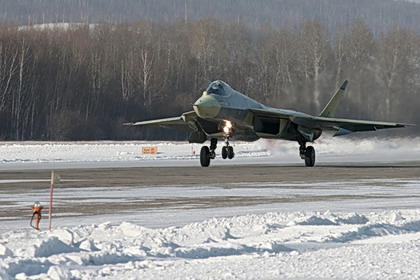
PAK FA in First Test Flight (photo: RIA Novosti)

In today’s Yezhednevnyy zhurnal, Aleksandr Golts turns his skeptical eye toward the PAK FA, Russia’s 5th generation fighter aircraft which just took its first test flight.

Golts says, looking a little like the F-22 and even more than the Su-27, PAK FA called forth a storm, a waterfall of success reports.  He notes that Prime Minister Putin cited it as proof of the wisdom of creating the United Aircraft-building Corporation [UAC or OAK] four years ago. 

Those in charge of the project are breathing easier.  After the Bulava SLBM failures, getting the new fighter off the ground was a matter of principle, especially since the leadership promised that it would fly every year since 2005.  Golts believes the Bulava failures combined with the 5th gen fighter delays caused people to discuss whether Russia could modernize, and whether it could develop high-tech products.  One thing Bulava and PAK FA have in common is that both are truly Russian projects, ones that are being implemented without dependence on significant leftover Soviet-era resources.  Their results could enable observers to question whether the OPK is being managed correctly, whether it was smart for Putin, [Sergey] Ivanov, and Chemezov to herd hundreds of enterprises into several gigantic OPK kolkhozy. 

Golts says some aviation industry leaders worried that OAK was created, not to concentrate resources to build PAK FA, but for Moscow bureaucrats to get their hands on profits from foreign aircraft orders [doesn’t ROE do this already?].  And Golts reminds that around 2000 then-Minister of Industry Ilya Klebanov said PAK FA development would cost $1.5 billion, but as we’ve learned the pricetag was closer to $10 billion over ten years. 

And it had to fly no matter what, and so it did.  But what actually flew, Golts asks.  One thing for sure, the first new airframe in 25 years.  And that’s it.  Everything else–speed, max and min ceilings, radars, weapons systems–all remain to be seen. 

As for the engines, Golts says we just don’t know.  Years ago the engine producers fought it out to be the designer and builder.  NPO ‘Saturn’ won out.  And, according to Golts, its director started to lie.  Putin and Ivanov both recognize that the engine problems will take some time to work out.  But on the day of PAK FA’s first test, the managing director of ‘Saturn,’ who directs the PAK FA program for the United Engine-building Corporation [ODK], claimed the new fighter has the newest engine, not an improved version of the Su-35’s engine, as the press and specialists have written. 

So what Putin and Ivanov worried about was secretly resolved by NPO ‘Saturn’ and the new engine is ready.  This is great news for Air Forces CINC Zelin.  Just four months ago he said that the PAK FA engine couldn’t be foreseen in the near future.  He said it would fly with a ‘Saturn’ engine, the 117S, a ‘deeply modernized’ version of the AL-31F. 

So, according to Golts, either ‘Saturn’ decided to pawn off on the Motherland an engine it demonstrated four years ago or, worse, having pocketed the contract, it simply decided to put old engines in a new aircraft. 

Golts concludes honestly that he can’t say whether PAK FA will be a true 5th generation aircraft, but it has taken off in a thick fog of lies.  And here’s the distinction between it and Bulava; there’s no way to hide Bulava’s failures since the U.S. gets the telemetry and people in other countries can see evidence of an unsuccessful test launch.  There aren’t the same limits on lying about PAK FA. 

So PAK FA is a “cat in a sack.”  You can’t say much for sure about the cat, but don’t worry, it’s a 5th generation sack.